How to document a vine removal and replant for phylloxera management

TL;DR
- Documenting a phylloxera-driven removal and replant means recording the date and GPS block ID of every pulled vine, the confirmed pest or rootstock failure, the new rootstock variety with its source nursery certification, and every pesticide application before and after planting.
- Federal law asks for two years of pesticide records.
- California requires five.
- Keep everything else at least five.
Why does documentation matter for a phylloxera removal?
Phylloxera is more than a vineyard problem. It is a legal and financial one. The moment you confirm Daktulosphaira vitifoliae in a block and decide to pull vines, you start a paper trail that touches pesticide compliance, nursery certification law, crop insurance claims, and in some regions, state pest reporting rules. [1]
Get it wrong and you lose the insurance payout. Get it really wrong and you move cuttings or equipment to a neighbor's property without documenting the movement, and you could face a county agricultural commissioner inquiry.
Here is the good news. The paperwork is not hard. What kills most growers is doing it after the fact from memory, which is exactly how gaps and errors creep in. The fix is a plain field log that runs alongside the physical work, started before the first vine comes out of the ground.
What records do you legally need to keep for a vine removal?
Requirements vary by state, but there is a core set every U.S. vineyard should keep no matter where it sits. Pesticide records are the non-negotiable part.
Pesticide application records are federally required under the Worker Protection Standard (WPS) and, for restricted-use pesticides (RUPs), under EPA rules at 40 CFR Part 171. [2] For any fumigant or soil drench applied before replanting, the record has to include the date and time, product name and EPA registration number, application rate and total amount used, treated area in acres, applicator name and license number, and the target pest. California's Department of Pesticide Regulation requires RUP use reported to the county agricultural commissioner within 24 hours to seven days depending on the material and setting. [3]
Beyond pesticides, you need:
- Block identification (block name or number, GPS coordinates or a referenced map)
- Number of vines removed and row and vine spacing
- Date of removal
- Reason for removal (phylloxera confirmed, rootstock failure, variety conversion)
- Rootstock on the pulled vines (AxR#1, St. George, 5BB) and the approximate age
- Soil fumigation records if you fumigate before replanting
- Any equipment sanitation steps taken before moving machinery to other blocks
For a claim, your crop insurance adjuster wants timestamped photographs, more than written entries. Turn on your phone camera's location tagging in the field, or use an app that pins GPS and time automatically. [4]
California and Oregon are the two states with the most detailed phylloxera-related documentation expectations. Oregon's Department of Agriculture treats a confirmed infestation as reportable, and that notification becomes a record in its own right. [5] In Washington or Idaho, call your county extension office. Guidance there is less codified, but inspectors still expect complete pesticide records.
How do you confirm and document a phylloxera infestation before pulling vines?
You cannot document what you have not verified. Assuming it is phylloxera because the vines look bad will not hold up for an insurance claim or a pest report. You need roots.
Root excavation is the standard confirmation method taught through University of California extension and its statewide Integrated Pest Management program. [6] Dig at the root zone of symptomatic vines, roughly 10 to 18 inches deep, and look for the yellowed, hook-shaped rootlets with feeding galls (nodosities) on young roots or tuberosities on older woody roots. On susceptible rootstocks like AxR#1, the root system is often mostly gone, which makes gall hunting harder because there is little left to find them on.
Document the diagnosis like this:
- Date of inspection and the name of the inspector
- Number of vines showing above-ground symptoms (stunting, early senescence, uneven ripening)
- Number of vines where you excavated roots
- What you found (galls present, level of root destruction)
- Whether you sent a sample to a diagnostic lab, and if so the lab name, sample ID, and result date
In Washington, WSU Extension points growers to the WSU Puyallup Plant and Insect Diagnostic Laboratory for formal identification, which matters most when the result could trigger an insurance or reporting action. [7] A lab report gives you a layer of defensibility a field photo cannot.
Pull three to five root samples from different vines in the affected zone. Photograph each excavation hole with the roots visible before you collect. Label samples by vine location (row and vine number from your vine map).
What information should go in a vine removal log?
A vine removal log does not need to be fancy. It needs to be complete and time-stamped. Here is what every entry should carry.
| Field | What to record | Example |
|---|---|---|
| Date | Calendar date of the removal work | 2024-03-15 |
| Block ID | Your internal block name or number | Block 7-East |
| GPS / Map ref | Coordinates or hand-marked vineyard map | 38.5412N, 122.3190W |
| Rows affected | Row numbers from your vine map | Rows 12-19 |
| Vine count removed | Actual count, not an estimate | 214 vines |
| Rootstock removed | Name of the pulled rootstock | AxR#1 |
| Age of vines | Approximate plant year | Planted 1998 |
| Reason | Phylloxera confirmed, with diagnosis method | Root galls, lab ID |
| Crew supervisor | Name and contact | J. Hernandez |
| Equipment used | Any machinery that touched the soil | Excavator #2 |
| Equipment sanitation | Steps taken, products used | Pressure wash + bleach rinse |
| Photographs taken | File names or device folder reference | IMG_20240315_001-047 |
Keep this log in the same binder or digital folder as your pesticide records. When a state inspector or insurance adjuster asks, everything lives in one place.
For bigger jobs across several blocks and several weeks, number each log entry and tie it to a site map. Do not reconstruct this at the end of the season. Growers who see claims denied almost always waited too long to write things down.
Do you need to notify the state or county before removing phylloxera-infected vines?
It depends on where you farm, and the answer changes by county. Call first. That call costs five minutes and protects you.
In California, grape phylloxera is not on the A-rated or B-rated pest lists that force mandatory notification before removal, but some counties layer on local rules the state does not. [1] Phone your county agricultural commissioner before you pull.
Oregon treats Daktulosphaira vitifoliae as a reportable pest under its plant pest rules at OAR Chapter 603. [5] Washington does not require notification for phylloxera specifically, though it does for certain other vine pests, and rules shift. Check your state department of agriculture at least once a season if you farm in a grape region.
If you signed up for a federal or state cost-share program through USDA's Environmental Quality Incentives Program (EQIP) or a state equivalent, those contracts often carry their own pre-removal notification and documentation terms. Skip a required pre-work notification and you can void the payment.
For any fumigation before replanting, EPA's soil fumigant labels and rules at 40 CFR Part 180 require notifying people near a buffer zone and posting fumigant-specific signs. [2] That posting is itself a record you file.
How do you document the soil fumigation between removal and replanting?
This is where more growers fall short than at any other step in a replant. Fumigation is the most heavily regulated single action in the whole process, and the recordkeeping matches.
Metam sodium, chloropicrin, and 1,3-dichloropropene (Telone) are the fumigants used most often before replanting in phylloxera ground. All three are restricted-use pesticides. All three need a licensed applicator (or a licensed-supervised application). All three carry specific record rules under federal and state law. [3]
Your fumigation record has to include:
- Fumigant product name, EPA registration number, and formulation
- Application date, start time, and end time
- Soil temperature at application (required on most labels)
- Application rate in gallons per acre and total gallons used
- Treated acreage (block level, not whole ranch)
- Equipment calibration record, or the applicator's certification that equipment was calibrated
- Buffer zone distances actually maintained
- Weather noted (wind speed and direction, if the label requires it)
In California, this goes to the county agricultural commissioner as a pesticide use report on the required timeline for the material. [3] Keep a copy in your own files. Do not lean on the deadline. File the same day if you can, because harvest or a busy planting schedule will eat the week before you notice.
One more entry on equipment. Fumigation applicators who also treat other vineyards have their own sanitation obligations, but note in your own log that the applicator confirmed the rig was cleaned before entering your property. That single line protects you if a future infestation ever gets traced back to equipment from another site.
What rootstock documentation do you need for the replant?
Picking the wrong rootstock is the most expensive mistake you can make in a replant, and rootstock paperwork is where growers most often have holes. Fix both at planting, not five years later.
Every phylloxera-resistant rootstock you buy from a California nursery comes with a plant material label under the California Grapevine Registration and Certification program (CGRC), run by CDFA. [8] That label certifies freedom from specific virus diseases and that the material is true to variety. Keep every label. File them by nursery order number and planting date.
Your replant records should include:
- Rootstock variety (110R, 1103P, 3309C, 101-14 Mgt)
- Source nursery name and state
- Nursery registration or certification number
- Number of vines received, by rootstock lot
- Date received and date planted
- Scion variety grafted (for bench grafts) and budwood source
- Any phytosanitary certificates for material crossing state lines [9]
Bringing material in from another state means USDA's Animal and Plant Health Inspection Service (APHIS) phytosanitary rules apply to the grapevine stock. [9] Violating interstate movement rules for uncertified plant material is a federal matter, more than a state one.
For rootstock selection tied to phylloxera resistance, University of California IPM and extension resources compare resistance ratings, soil fit, and vigor. [6] WSU Extension has equivalents for Pacific Northwest ground. [7] Cornell's grape program covers New York and the Northeast. [10]
One practical habit: write the rootstock variety directly on your vineyard map the day you plant. Block maps get revised, digital files get overwritten, and the ink on the soil log ends up the only reliable record five years out when you are chasing vigor differences.
How do you track the spray program during establishment after replant?
Young vines are more exposed to foliar disease and secondary pests than mature ones, so your spray records during the establishment window (usually years one through three) need to be every bit as complete as they were in the old block. Same rules, higher stakes.
Every pesticide record for a commercial vineyard has to meet EPA WPS standards at a minimum. [2] The WPS requires application records be kept for two years. California requires five years for all agricultural pesticide use records. [3] If you farm elsewhere, check your state department of agriculture, but defaulting to five years everywhere is the safe move.
For a replanted block, your spray log should also note:
- Vine age at application (year one, year two)
- Whether the spray hit replanted vines only or included adjacent mature rows
- Any pre-emergence herbicide and its proximity to young vine stems (this matters a lot on new plantings)
- Growth regulator or rooting aid applications, if used
Keep establishment sprays in a clearly marked section of your spray log, tagged to the block ID and plant year. That makes it easy to pull records for one crop year if an auditor or adjuster asks.
Tools like VitiScribe let you tag records to both a block ID and a vine cohort, so that separation happens automatically instead of at year-end on paper. That is the real value of a purpose-built vineyard record system across a multi-year replant.
How long do you need to keep phylloxera replant records?
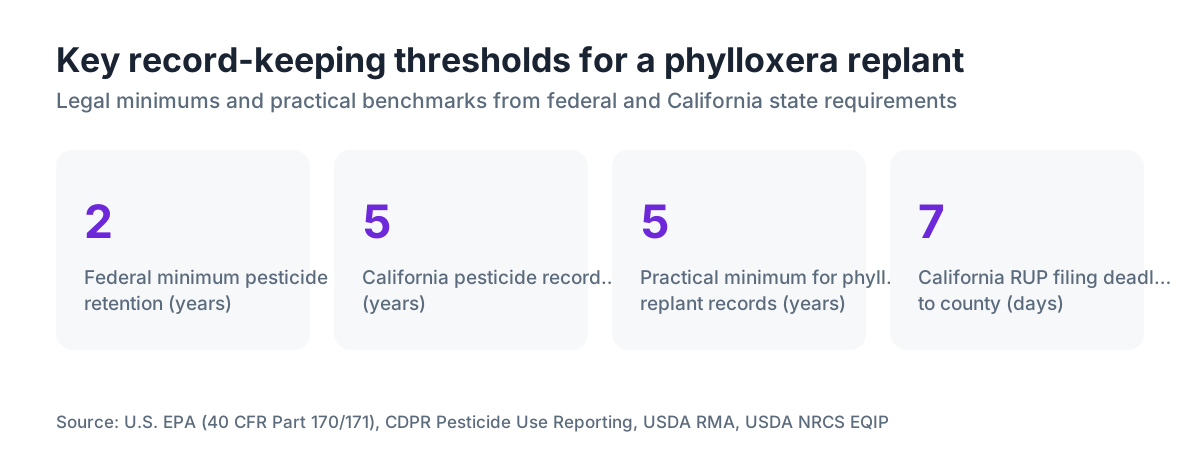
Two years is the federal floor. Five is California's number. Everything else is judgment, and the judgment says keep more.
The minimum federal retention for pesticide application records under FIFRA is two years from the date of application. [11] California requires five years for agricultural pesticide use reports filed with the county commissioner. [3]
For insurance, keep records for the life of the claim plus two years after it resolves. If you took cost-share funds (EQIP or a state equivalent), USDA program contracts generally require records for a set period after the final payment; confirm the exact term in your contract. [12]
Phylloxera replant records earn their keep long past the legal minimums. A block replanted on resistant rootstock in 2024 may show vigor or mortality problems by 2030 that trace to the rootstock lot, the fumigation protocol, or the planting depth. The old records make that diagnosis possible. Growers on their second replant in the same block almost always wish they had kept better notes from the first.
The floor: keep all phylloxera records, including removal logs, fumigation records, nursery certificates, and planting records, for at least five years. Ten is better.
What does a complete replant documentation package look like?
Think of the whole package as four folders, physical or digital. Build them as you go, not at the end.
Folder 1: Pre-removal. Vineyard maps of the affected block, pest diagnosis records (field notes and lab reports), any county notification correspondence, and pre-work photographs.
Folder 2: Removal and fumigation. The vine removal log (see the table above), equipment sanitation records, all RUP use reports filed with the county, and fumigant posting photos.
Folder 3: Planting materials. Nursery certification labels, phytosanitary certificates, rootstock selection notes, delivery receipts with vine counts, and planting records tied to the block map.
Folder 4: Establishment records. Spray logs tagged to vine age and block ID, any replant disorder treatments, training system notes, and annual photos of establishment progress.
This structure lines up with how Cornell Cooperative Extension frames vineyard record systems, and it maps to what a crop insurance adjuster or a USDA cost-share auditor will ask for if you ever file. [10]
For growers running multiple blocks over multiple years, a digital system makes version control real. Update a block map and the old version stays, instead of getting overwritten. That holds whether you use a spreadsheet, a binder, or a dedicated field platform. VitiScribe offers a free trial built for vineyards managing replant and compliance records.
See the vineyard section for more on block mapping and field operations documentation.
Are there cost-share or subsidy programs that require additional documentation?
Yes. USDA's EQIP program includes conservation practices that can cost-share parts of a vineyard renovation and pest management, and the applicable practice codes vary by state NRCS office. [12] Do not guess at the codes. Ask your local NRCS service center which practices apply to your renovation and how they want the work documented.
For any EQIP-funded work, documentation typically includes a pre-approval site assessment, practice completion certification, and retention of payment records for a set period after the final payment. If you cannot show the work met the practice standard, NRCS can require repayment.
Some states run their own programs. California's CDFA administers specialty crop grant programs that have funded vineyard pest management work. Oregon's Department of Agriculture has similar grant mechanisms. These change year to year with funding, so check current offerings straight with your state department of agriculture.
Crop insurance documentation under USDA Risk Management Agency rules asks for records of production and practices. A phylloxera removal is a qualifying cause of loss under most Multi-Peril Crop Insurance (MPCI) policies when it is properly documented. [4] Without the removal log and pest confirmation records, that claim is very hard to support.
Frequently asked questions
Do I need to report phylloxera to the state before I pull vines?
It depends on the state. Oregon treats confirmed grape phylloxera as a reportable pest under its plant pest rules at OAR Chapter 603, so notification goes to the state department of agriculture. California has no statewide mandatory pre-removal notification for phylloxera, but some counties do. Always call your county agricultural commissioner before pulling. Washington and Idaho have no mandatory phylloxera notification, but check annually because pest rules change.
What is the best rootstock to use when replanting after phylloxera?
There is no single best choice. It depends on your soil pH, drainage, vigor needs, and scion variety. University of California IPM and extension rootstock guides compare 110R, 1103P, 3309C, and 101-14 Mgt for California conditions. 110R and 1103P get used widely for drought tolerance and phylloxera resistance. Never plant AxR#1 or St. George own-rooted on known phylloxera ground. Get a soil analysis and talk to your local farm advisor before you order.
How long should I wait before replanting after phylloxera removal?
Most extension programs recommend at least one full fallow growing season, ideally two, especially if you fumigate. Timing matters: metam sodium and Telone work best when soil sits roughly between 50 and 85 degrees Fahrenheit and is properly moist. University of California guidance points toward fumigating in fall after soil temperatures drop, then replanting the following spring. The wait is frustrating, but planting into poorly treated ground risks immediate reinfestation.
Do pesticide records for a vineyard fumigation need to be filed with the county?
In California, yes. Restricted-use pesticide applications must be reported to the county agricultural commissioner on the required timeline (as short as 24 hours for some uses, up to seven days for others), and the commissioner sends them to the state. The report includes product name, EPA registration number, date, rate, acreage treated, and the licensed applicator's name and number. FIFRA requires records kept two years minimum. California requires five.
What does a nursery certification label tell you and why do you need to keep it?
California's CGRC nursery certification label confirms the vine material was inspected, found free from specific regulated virus diseases, and is true to variety. Keeping it proves the rootstock variety and virus status of your planting stock. That matters for insurance claims, future replant planning, and any disease problem that shows up in the block years later. File labels by nursery order number alongside your planting records.
Can I move equipment from a phylloxera-infested block to a clean block without documentation?
You can move equipment, but you should document the sanitation steps you took first, even where no law requires it. Phylloxera spreads on equipment, soil, and footwear. Recording that you pressure-washed and disinfected before moving to a clean block protects you if that clean block turns up infested later. Some EQIP practice standards require sanitation protocols be documented as part of the funded practice.
How many vines per acre typically need to be removed in a phylloxera block before replanting the whole block?
Nobody has clean universal data on this threshold. Practical guidance from University of California extension is that once vine mortality or severe decline runs past 20 to 30 percent in a block, and the affected vines are not confined to one corner, whole-block removal beats spot replacement on cost. Spot-replacing into infested ground on susceptible rootstock is generally a waste of money and time. Weigh the block's remaining productive life and fumigation economics.
Does the EPA Worker Protection Standard apply to vineyard fumigation work?
Yes. The EPA Worker Protection Standard at 40 CFR Part 170 covers agricultural pesticide applications, including soil fumigants in vineyards. It requires that workers and handlers get pesticide safety training, have access to application information, and stay protected from early re-entry into treated areas. Fumigants carry some of the strictest re-entry intervals of any agricultural pesticide class. Training and application records must be kept for two years.
What photographs should I take during a phylloxera vine removal?
Shoot each stage: above-ground vine symptoms before removal, root excavations showing galls or root loss (with a ruler or hand for scale), the block mid-removal showing the scope of work, any equipment sanitation steps, and the bare block after removal before fumigation. Make sure your phone or camera records GPS and timestamp in the metadata. Name or number each file to match your removal log entries so they are easy to find later.
What USDA programs can help fund a phylloxera replant, and what records do they require?
USDA's EQIP program is the main federal cost-share option for vineyard renovation work, with practice codes that vary by state NRCS office. EQIP requires a pre-approval site assessment, documentation that the practice met the standard, and record retention for a set period after final payment. Crop insurance through USDA RMA covers phylloxera-related loss when documented. State programs like California's CDFA specialty crop grants may also apply; check with your state department of agriculture annually.
Do I need phytosanitary certificates to bring in rootstock from another state?
Yes, for most interstate movement of grapevine material. USDA APHIS oversees federal phytosanitary certificate requirements for plant material crossing state lines, and grapevines are regulated in most states because of phylloxera and virus disease concerns. Your nursery should send the certificates with the shipment. Keep them with your planting records. Moving uncertified grapevine material across state lines can trigger Plant Protection Act penalties.
How do I document equipment sanitation between a phylloxera block and clean blocks?
Write a short log entry each time equipment moves. Record the date, the equipment identifier (serial number or your internal number), which block it came from, the sanitation steps taken (pressure wash, bleach concentration, contact time), who did the work, and where the equipment went next. This takes two minutes per move. Photograph the cleaned equipment before it enters a clean block, one photo per move event.
How do I record a partial block removal where only some rows are affected?
Use your vine map to mark exactly which rows and vine numbers came out. The removal log should list specific row numbers, not an acreage estimate. Note whether the removed rows are contiguous or scattered, because scattered removal often means the infestation is wider than the symptomatic vines suggest. Document the boundary of the removal relative to the block perimeter using GPS points or a hand-drawn overlay. Adjusters want row-level detail, not block-level estimates.
Sources
- California Department of Food and Agriculture, Plant Health and Pest Prevention Services: Phylloxera status under California pest rating system and county agricultural commissioner notification practices
- U.S. EPA, Agricultural Worker Protection Standard (40 CFR Part 170) and soil fumigant requirements: Federal WPS requirements for pesticide application records, two-year retention minimum, and soil fumigant posting and buffer zone requirements under 40 CFR Part 180
- California Department of Pesticide Regulation, Pesticide Use Reporting: California requires restricted-use pesticide applications reported to the county agricultural commissioner on the required timeline; five-year record retention required
- USDA Risk Management Agency, Crop Insurance: Phylloxera as a qualifying cause of loss under MPCI policies when properly documented; documentation requirements for crop insurance claims
- Oregon Department of Agriculture, Plant Health (OAR Chapter 603): Oregon plant pest rules treat grape phylloxera as reportable, with notification to the state department of agriculture
- University of California Statewide Integrated Pest Management Program (UC IPM): UC IPM root excavation sampling protocol for phylloxera confirmation and rootstock selection guidance including phylloxera resistance ratings for 110R, 1103P, and 3309C
- Washington State University Extension, Viticulture and Enology: WSU Extension recommends sending root samples to the WSU Puyallup Plant and Insect Diagnostic Laboratory for formal identification when phylloxera is suspected; rootstock guidance for Pacific Northwest conditions
- California Department of Food and Agriculture, Grapevine Registration and Certification Program (CGRC): CGRC nursery certification labels required for grapevine plant material sold in California, certifying freedom from regulated viruses and varietal trueness
- Cornell Cooperative Extension: Cornell Cooperative Extension recommendations for vineyard record system structure including pre-plant, planting materials, and spray log organization
- U.S. EPA, Pesticide Registration and FIFRA recordkeeping (40 CFR Part 171): FIFRA requires pesticide application records for restricted-use pesticides kept for a minimum of two years from the date of application
Last updated 2026-07-10