How to document a vineyard equipment accident for insurance and OSHA

TL;DR
- After a vineyard equipment accident you have two hard deadlines.
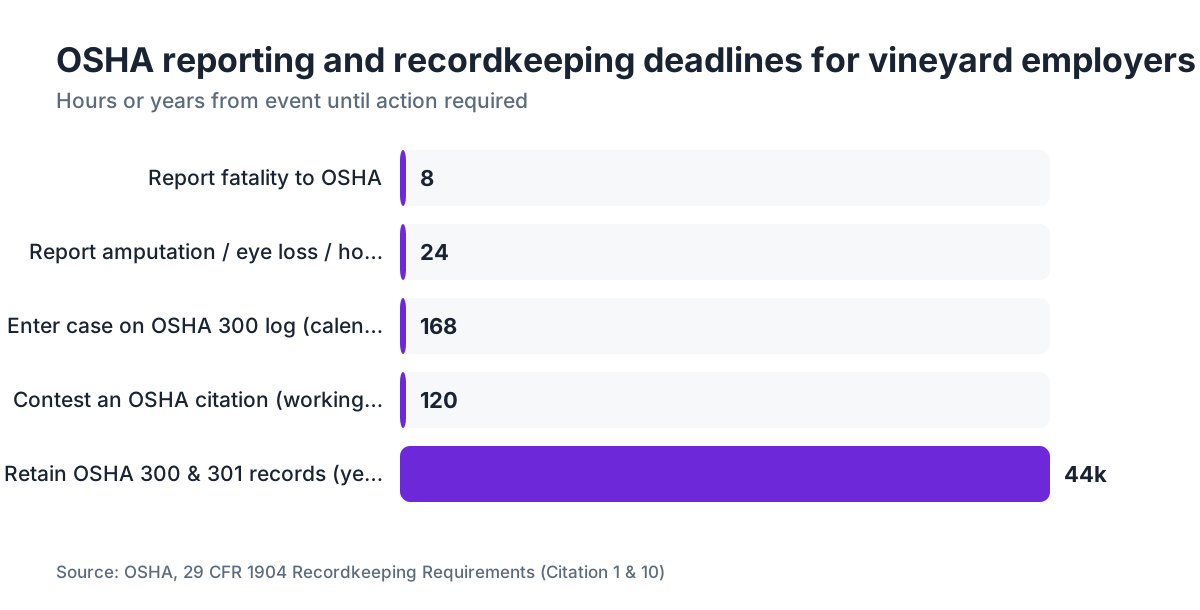
- Report a fatality to OSHA within 8 hours, and an amputation, eye loss, or in-patient hospitalization within 24 hours.
- Document the scene before you move any equipment.
- Then enter the case on your OSHA 300 log within 7 days, file a workers' comp claim, and keep every record for 5 years.
What do I do in the first 30 minutes after a vineyard equipment accident?
Stop the work. Get the injured person medical care, and leave the equipment where it sits unless moving it is the only way to reach someone. Everything after that is documentation, and the clock is already running.
Call 911 if the injury is serious. Once help is on the way, start preserving the site. Rope off the area if you can. If a tractor rolled, a PTO shaft caught a sleeve, or a forklift struck someone, the exact resting position of that equipment is evidence your insurance adjuster and any OSHA compliance officer will want to see. Photograph it before anyone repositions a thing.
Assign one person, you or a supervisor you trust, to be the single point of contact for documentation. When five people take notes and make phone calls, you get five conflicting versions of events. Write down the time, the exact spot in the vineyard, and the names of everyone present. Paper is fine. You can move it into a formal incident report within the hour.
Don't coach your witnesses. Give each of them space to write their own account, alone, before anyone compares notes. Statements written separately carry far more weight with insurers and OSHA investigators than a tidy group narrative that everyone happens to agree on.
When do I have to report to OSHA, and what are the exact deadlines?
OSHA's reporting rule under 29 CFR 1904.39 sets two firm deadlines for employers covered by federal OSHA or a state plan [1]. A work-related fatality goes to OSHA within 8 hours of the moment you learn of it. An in-patient hospitalization, an amputation, or the loss of an eye goes within 24 hours.
You report by calling 1-800-321-OSHA (6742), walking into your nearest OSHA area office, or using the online reporting portal at osha.gov. Have six things ready before you dial: your employer identification number, the employee's name, the location, the time of the incident, a short description of what happened, and a contact person with a phone number.
The rule reads, "Each employer covered by this part must report to OSHA" those events, per 29 CFR 1904.39 [10]. There's no discretion baked in. You don't get to decide the hospital stay wasn't serious enough. If the hospital admitted your worker, you report it.
Small farms get a partial break, but not on reporting. OSHA's agricultural exemption at 29 CFR 1928.1 has long exempted farms with ten or fewer employees and no temporary labor camp from the recordkeeping rules [2]. The fatality and severe-injury reporting requirements apply anyway, at any size. Run a twenty-acre block with four full-time workers and you still report a death within 8 hours. Don't assume the small-farm exemption has you covered here.
State-plan states run their own OSHA programs with rules at least as strict as the federal version. California, Washington, and Oregon all qualify. Cal/OSHA holds you to the same reporting clock under Title 8 CCR 342 [3]. Farm in a state-plan state and you call your state agency, not federal OSHA.
What evidence should I photograph and preserve at the scene?
Photograph wide, then close. Start with shots that fix where you are: the row number, the distance to the barn or access road, the equipment sitting against the vines. Then move in on the mechanism of injury. Missing or damaged PTO shield? Photograph it. Tractor on its side? Photograph the slope, the soil condition, and the rollover protection structure (ROPS) or the empty space where one should be.
Get date and time stamps into your photos. Most phones bury this in the EXIF data automatically, but drop a handwritten note with the date into the frame of at least one shot per sequence too. Adjusters and courts have challenged photo authenticity for decades. A visible timestamp in-frame kills that argument before it starts.
Preserve the physical evidence. Don't clean or repair anything until your insurer has inspected it, and if OSHA opens an inspection, until the agency releases the scene or gives you written authorization. The regulation at 29 CFR 1904.39(b)(7) says an employer must preserve the scene to the extent possible [10]. Moving or fixing equipment without that clearance can be treated as spoliation of evidence in litigation, and that's a hole you can't climb back out of.
Write down the conditions. Weather, light, soil moisture, and anything that might have played into it: a steep grade, wet grass, that berm you'd been meaning to regrade since March. This gives your insurer context and protects you when the incident gets contested.
Pull the maintenance records for the equipment involved. When did you last service those tractor brakes? When was the last ROPS inspection? Those records either back you up or reveal a gap you need to close before the next machine goes out.
How do I fill out the OSHA 300 log and the 301 incident report form?
The OSHA 300 log is a running record of every work-related injury and illness for the calendar year. You enter a case within 7 calendar days of learning that a recordable injury or illness happened [2]. Recordable means it caused days away from work, restricted work or a job transfer, medical treatment beyond first aid, loss of consciousness, or a diagnosis of a significant injury by a healthcare professional.
Each entry captures the employee's name, job title, date of injury, where it happened, a short description of how, the injury type (fracture, laceration, amputation, and so on), and one outcome category. The categories are days away from work, job transfer or restriction, or other recordable cases. You check one box.
The OSHA 301 Incident Report is the companion form. It holds the full narrative behind each 300-log entry, and you fill out one 301 per recordable case. It asks for the sequence of events, what the worker was doing, the object or substance that caused the harm, and the body part affected. Most state workers' comp first-report-of-injury forms cover the same ground, so you can use your state's equivalent in place of the 301 as long as it captures every data field [2].
Keep these records for 5 years past the end of the calendar year they cover [2]. Store them where you can put your hand on them during an inspection. A locked file cabinet works. So does a secured digital system. If you run multiple parcels or have crews split across properties, a platform like VitiScribe keeps these forms tied to specific blocks and workers, so you're not tearing through folders while a Cal/OSHA officer waits at your desk.
Post the OSHA 300A summary (the annual roll-up of all cases) somewhere visible from February 1 through April 30 every year, even if you had zero recordable incidents. The posting rule applies to covered employers no matter the count [2].
What does the workers' compensation insurance claim process look like?
Workers' comp is state-mandated for most employers in the U.S., and the claim starts on your side, not the insurer's. The worker reports the injury to you, you complete a first report of injury (the form name varies by state) and file it with your carrier, and the insurer takes over the medical and indemnity side from there.
Timelines bite here too. California requires employers to hand the injured worker a DWC-1 claim form within one working day of learning of the injury, then file it with the insurer within one business day of getting it back [3]. Other states set their own windows, most in the 24-to-72-hour range. Read your state's workers' comp statute directly rather than trusting a summary.
Document the conversation. Note the date and time the worker reported the injury to you. That single note protects you if the claim later gets disputed as a late report or if someone alleges a coverage gap.
Your carrier will probably send an adjuster to inspect a serious scene. Let them in. Cooperate. Answer factual questions about what happened, but don't speculate about fault in casual conversation, because casual conversation ends up in the file. If the adjuster is characterizing the incident in a way you disagree with, say so in writing.
Keep a claim file separate from your general paperwork. Into it goes the first report of injury, every medical report, all correspondence with the insurer, your OSHA forms, your incident report, the witness statements, and every photograph. A comp claim for a bad tractor accident can run for years. You'll be glad it's all in one place.
What should a written incident report actually say?
A good incident report reads like a neutral account, not a defense brief. Skip the adjectives that assign blame or shrink the harm. Write what happened, in order, in plain words.
The report covers the date, time, and specific location; the names and job titles of the injured worker and every witness; a factual sequence from the start of the task to the injury; the equipment involved (make, model, year, serial number if you have it); any personal protective equipment the worker was or wasn't wearing; the immediate actions taken (first aid, the 911 call); and the name of whoever completed the report.
Don't write "the worker wasn't paying attention" or "operator error." Those are conclusions, and conclusions belong to an investigation, not a first report. Stick to what you saw with your own eyes. If you didn't witness the accident, say so and name who did.
WSU Extension's agricultural safety materials suggest documenting the "4 Ws": who, what, where, and why, with root cause analysis saved for a separate document later [4]. That split keeps your immediate report factual and your analysis apart from it, which matters a great deal if the case ends up in litigation.
Sign and date the report. Keep the original. Give a copy to your insurer. When OSHA opens an inspection and asks for records, the incident report is near the top of the list.
Does the EPA Worker Protection Standard apply to equipment accidents in vineyards?
No, not on its own. The EPA's Agricultural Worker Protection Standard (WPS) at 40 CFR Part 170 covers pesticide-related injury and illness, not mechanical equipment accidents [5]. A tractor rollover in a vineyard doesn't trigger WPS recordkeeping.
Pesticides change that. If the accident involves exposure, say a sprayer malfunction that douses a worker with a restricted-use product, or an employee found collapsed in a field after an application, then WPS requirements stack on top of your OSHA and workers' comp obligations. The WPS requires employers to provide decontamination supplies, transport to emergency medical care, and to give the treating physician the pesticide application information, including the product name and EPA registration number [5].
For pesticide incidents, check your state's separate reporting rules too. California's Department of Pesticide Regulation requires reporting any illness or injury reasonably attributable to pesticide exposure to the county agricultural commissioner within 24 hours [9]. That's a distinct obligation from OSHA and from your comp carrier, and missing it is its own violation.
The practical read: treat the WPS as additive, never as a substitute, whenever pesticides touch the incident.
What are the most common vineyard equipment injuries, and do they affect how I document?
Tractors lead the list, rollovers most of all, followed by PTO entanglement and struck-by incidents. NIOSH data and UC Davis agricultural safety research point to those three as the leading causes of serious farm injury [6]. In vineyards you can add mechanical harvesters, forklifts around the cellar and loading dock, and ATV or UTV rollovers on hillside blocks.
The mechanism changes what evidence matters. A tractor rollover means you document whether the ROPS was present and whether the seatbelt was worn. A PTO entanglement means you document whether the shield was in place and serviceable. A mechanical harvester incident means guard states and lockout/tagout records.
OSHA's agricultural regulations at 29 CFR Part 1928 include specific rollover protection requirements for tractors [2]. If the tractor involved had no ROPS when one was available or required, your documentation says that plainly, because it surfaces in the investigation no matter what you write. Trying to bury it turns a bad day into a worse one.
For struck-by incidents, document sightlines, noise levels (was the worker wearing hearing protection that might have kept them from hearing the machine?), and whether a spotter protocol was in place. Those details shape both the OSHA investigation and any third-party liability claim.
| Injury Type | Key Evidence to Document | Relevant OSHA Standard |
|---|---|---|
| Tractor rollover | ROPS presence/condition, seatbelt use, slope grade | 29 CFR 1928.51 |
| PTO entanglement | Shield condition, proximity to rotating shaft | 29 CFR 1928.57 |
| Mechanical harvester | Guard states, lockout/tagout records | 29 CFR 1910.147 |
| Forklift struck-by | Sightlines, pedestrian controls, spotter use | 29 CFR 1910.178 |
| Pesticide exposure | Product name, EPA reg. no., PPE used | 40 CFR Part 170 |
How long do I have to keep accident records, and who can request them?
Five years. OSHA 300 logs and 301 incident reports must be kept for 5 years past the end of the calendar year they relate to [2]. Occupational exposure medical records are a different category, mostly relevant to pesticide or chemical exposure, and those run 30 years under 29 CFR 1910.1020.
Your workers' comp carrier has a right to any records relevant to the claim. OSHA compliance officers can request your 300 logs during an inspection and can subpoena more. Current and former employees, plus their representatives, have the right to see the 300 log for the establishment where they work or worked [8]. You have to provide access within 4 business hours of a request during a regularly scheduled workday.
State retention rules sometimes run longer than the federal floor. California requires employers to keep payroll and personnel records for 3 years under Labor Code 1174, but OSHA records still follow the federal 5-year standard in the Cal/OSHA context [3].
Store records so they protect employee medical privacy. The 300 log leaves out medical diagnoses by design, but the 301 form doesn't. Keep 301 forms and medical records apart from general personnel files and limit access to people who need it for a real safety or legal reason.
For digital storage, VitiScribe's compliance tools attach photos, OSHA forms, and insurance correspondence right to the incident record with access controls, so you're not emailing a worker's medical details around in an open spreadsheet.
What happens if OSHA opens a formal inspection after the accident?
OSHA opens inspections after fatalities and severe injuries automatically. A compliance safety and health officer (CSHO) shows up, often with little warning. They present credentials, explain why they're there, and ask to walk the site.
Your rights are narrow. You can require a warrant if you refuse entry, but in practice refusing almost always escalates the inspection and reads as bad faith. Cooperate, keep it factual, and answer only from what you know firsthand.
The CSHO reviews your 300 log, your incident report, the maintenance records for the equipment involved, and your safety training records. Cornell's agricultural safety program flags training documentation, specifically records showing workers got hazard communication and equipment safety training in a language they understood, as one of the most commonly cited gaps in agricultural OSHA inspections [7].
Penalties sting. OSHA violations for serious agricultural equipment failures can reach $16,131 per violation as of 2024, and willful or repeated violations climb to $161,323 each [1]. Those figures adjust for inflation every year. If you get cited, you have 15 working days from receiving the citation to contest it [8]. Don't let that window close if you think the citation is wrong.
After the walk-through, the CSHO issues one of three outcomes: no citation, a citation with a proposed penalty, or a referral for a more serious investigation. Whichever it is, document the inspection itself: when the officer arrived, what they reviewed, what they photographed, what they asked. That record protects you if you end up contesting.
What training records should I have ready before an accident ever happens?
This is the section most vineyard managers skip until it's too late. Good training records on file before an accident are often the difference between a citation and a finding of no violation.
OSHA requires that workers using hazardous equipment get training in a language they can understand [1]. For a lot of California, Washington, and Oregon vineyards, that means documented Spanish-language training. The record shows the date, the trainer's name, the topic, and the names of the workers who attended, with signatures if you can get them.
For tractor operation, document ROPS and seatbelt training specifically. For powered industrial trucks (forklifts), OSHA requires operator evaluation at least every three years under 29 CFR 1910.178(l) [2]. For pesticide handling, the WPS requires annual training with documentation [5].
UC Davis's Western Center for Agricultural Health and Safety publishes free training materials and sign-in sheet templates for growers [6]. WSU Extension offers the same kind of thing for Washington and the Pacific Northwest [4]. Use their documented curricula and keep the sign-in sheets, and you've got a defensible training record that meets the standard.
A missing or thin training record after a serious injury looks like negligence even when it wasn't. Maybe the worker got excellent hands-on training that nobody wrote down. Fix that before next season, not the morning after an accident.
Frequently asked questions
Does the 8-hour OSHA reporting deadline apply to agricultural employers?
Yes. The fatality reporting requirement under 29 CFR 1904.39 applies to agricultural employers, even those with fewer than 11 employees who are otherwise exempt from OSHA recordkeeping. The small-farm exemption removes the obligation to keep a 300 log, but it does not remove the obligation to report fatalities within 8 hours and severe injuries within 24 hours. Call 1-800-321-OSHA to report.
Can I use a phone or tablet to document the accident scene, or do I need a dedicated camera?
A smartphone is fine. Modern phone cameras embed GPS coordinates and timestamps in the EXIF data of each photo, which helps establish location and sequence. Back the photos up to a cloud service or email them to yourself right away, so they carry a timestamp on a server outside your control. That chain of custody matters if anyone questions the images later.
What if the injured worker is undocumented? Do I still report to OSHA?
Yes. OSHA's protections apply to all workers regardless of immigration status. You report to OSHA within the required timeframes and file a workers' comp claim. Failing to report because of a worker's status is a separate violation that compounds your legal exposure. Most state workers' comp statutes explicitly cover undocumented workers.
My insurance adjuster told me not to talk to OSHA. Is that legal advice I should follow?
Your carrier's adjuster protects the carrier's interest, not yours, and their advice is not legal counsel. You have a legal obligation to give OSHA access during an inspection and to submit required reports. Refusing to cooperate on your insurer's say-so does not shield you from OSHA enforcement and can worsen your position. Talk to an employment or agricultural law attorney if you're unsure.
What is the difference between a recordable injury and a reportable injury under OSHA?
Recordable injuries go on your OSHA 300 log: any work-related injury needing medical treatment beyond first aid, days away, restricted duty, or loss of consciousness. Reportable injuries trigger the active call to OSHA: fatalities (8 hours) and in-patient hospitalizations, amputations, or eye losses (24 hours). An injury can be recordable without being reportable, and reportable without being recordable, say an overnight precautionary hospitalization where the worker returns to full duty the next day.
How do I document an accident involving a seasonal or H-2A worker?
The same way you document any worker's accident. H-2A workers are covered by OSHA standards and workers' compensation in most states. H-2A program regulations at 20 CFR 655 require employers to provide workers' comp coverage for H-2A employees and to report injuries to the Department of Labor if they result in death or serious injury. Your H-2A job order names the comp carrier.
Should I get a lawyer before talking to OSHA after a serious accident?
Consulting an attorney before an OSHA inspection is your right and often makes sense after a fatality or severe injury. An attorney familiar with agricultural OSHA can help you sort out what you must provide versus what is privileged, and can be present during the inspection. Retaining counsel does not suspend your reporting deadlines. Report to OSHA within the required timeframes whether or not you've reached a lawyer.
What if the accident involved a piece of equipment owned by a labor contractor, not by me?
Multiple-employer worksite rules apply in many agricultural settings. Under OSHA, both the controlling employer (often the vineyard owner) and the equipment-owning employer can be cited for hazardous conditions they knew or should have known about. Document clearly which party owned and maintained the equipment, who trained the operator, and who had supervisory authority at the time. Both your insurer and OSHA will want that.
Does a minor injury that only required first aid need to be documented at all?
You don't have to record it on the OSHA 300 log, but document it internally anyway. Patterns of minor injuries often signal a systemic hazard. If that same worker, or a different one, later suffers a serious injury from the same cause, your records either show you spotted and fixed the hazard or that you had notice and did nothing. Keep an internal near-miss and minor-injury log even for non-recordable events.
How do I handle the OSHA 300A annual summary posting requirement?
The 300A is a one-page summary of all cases from your 300 log for the prior year, and a company executive must certify it. Post it where workers can see it from February 1 through April 30. If you had zero recordable cases, you still complete and post the form with zeros. Failure to post is a separate recordkeeping violation from the underlying entries. Store the signed 300A for 5 years.
What role does the equipment's maintenance log play in an insurance or OSHA investigation?
A current, complete maintenance log is one of the strongest pieces of evidence you can have. It shows the equipment was inspected, that known defects were repaired, and that you took your safety obligations seriously. An absent or falsified log can turn an accident into a willful-violation finding with OSHA or a bad-faith defense for your insurer. Keep maintenance records on every piece of powered equipment and write down any safety-related repair.
Can a witness statement be handwritten, or does it need to be a formal notarized document?
Handwritten is fine for your initial documentation. What matters is that each witness writes their own account independently, signs and dates it, and does so as close to the time of the incident as possible. Notarization is not required by OSHA or by most insurers. If the matter reaches litigation, attorneys may take formal depositions later. Your handwritten statements preserve the immediate recollection, which is exactly what investigators need.
Is there a specific incident report form required by OSHA, or can I use my own?
OSHA provides the 301 Incident Report form, but you can substitute your state workers' comp first-report-of-injury form as long as it captures all the same data fields. Many employers use the state comp form because it does double duty. Whatever form you use, complete it within 7 calendar days of learning of the recordable case and keep it for 5 years.
What is a near-miss, and should I document those the same way?
A near-miss is an event that could have caused injury but didn't. OSHA does not require you to record near-misses on the 300 log. But documenting them internally is one of the best things you can do for safety, because near-miss reports reveal hazards before someone gets hurt. Cornell's agricultural safety materials recommend a simple form: date, location, what happened, and the corrective action taken. Keep them in the same file as your incident reports.
Sources
- OSHA, Injury and Illness Recordkeeping and Reporting Requirements (29 CFR 1904): Fatalities must be reported to OSHA within 8 hours; in-patient hospitalizations, amputations, and eye losses within 24 hours under 29 CFR 1904.39. Willful or repeated violations up to $161,323 per violation as of 2024.
- OSHA, Agricultural Safety and Health (29 CFR Part 1928): OSHA 300 log entries must be made within 7 calendar days; records kept 5 years; ROPS requirements for tractors under 29 CFR 1928.51; forklift operator evaluation every 3 years under 29 CFR 1910.178(l); small-farm exemption does not remove fatality reporting obligations.
- Washington State University Extension, Agricultural Safety and Health: WSU Extension recommends documenting the 4 Ws (who, what, where, why) as the framework for an immediate incident report, keeping root cause analysis in a separate document.
- EPA, Agricultural Worker Protection Standard (40 CFR Part 170): WPS requires employers to provide decontamination supplies, transport to emergency medical care, and pesticide product information (name and EPA registration number) to treating physician for pesticide-related injuries. Annual training with documentation required.
- UC Davis Western Center for Agricultural Health and Safety: UC Davis agricultural safety research and NIOSH data identify tractor rollovers, PTO entanglement, and struck-by equipment incidents as leading causes of serious farm injuries. Free training resources and sign-in sheet templates available to growers.
- Cornell University, Agricultural Workforce Development and Safety: Cornell's agricultural safety program identifies missing or incomplete training documentation, especially records showing training was conducted in a language workers understood, as one of the most commonly cited gaps in agricultural OSHA inspections.
- OSHA, Employer Rights and Responsibilities Following an OSHA Inspection: Employers have 15 working days from receipt of an OSHA citation to contest it. Access to OSHA 300 logs must be provided to current and former employees and their representatives within 4 business hours.
- California Department of Pesticide Regulation, Pesticide Illness and Injury Reporting: California requires reporting of any illness or injury reasonably attributable to pesticide exposure to the county agricultural commissioner within 24 hours.
- OSHA, Employer Responsibilities Under the OSH Act (29 CFR 1904.39): "Each employer covered by this part must report to OSHA" fatalities within 8 hours and in-patient hospitalizations, amputations, or eye losses within 24 hours. Employer must preserve the scene to the extent possible per 29 CFR 1904.39(b)(7).
Last updated 2026-07-10