How to document PPE issuance to vineyard workers

TL;DR
- EPA's Worker Protection Standard (40 CFR Part 170) requires agricultural employers to provide and document PPE issuance to pesticide handlers and early-entry workers.
- Your records must show what equipment went out, to whom, on what date, for which pesticide, and that the gear was clean and working.
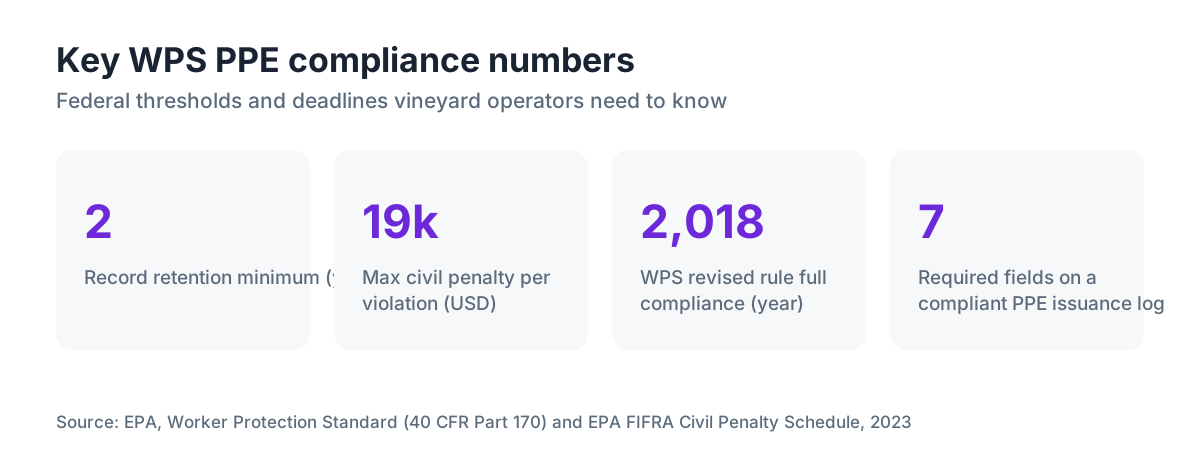
- Keep those records at least two years.
- Some states require three.
What does the EPA Worker Protection Standard actually require for PPE records?
You need written proof that each pesticide handler or early-entry worker got the correct PPE before entering a treated area or touching a pesticide. That's the whole requirement in one sentence. The EPA's Worker Protection Standard (WPS), codified at 40 CFR Part 170, was revised in 2015 and took full effect in January 2018. [1] That revision spelled out requirements for PPE provision, cleaning, maintenance, and storage that a lot of small vineyards had never bothered to track.
The rule says employers must provide handlers with PPE that is "clean, in operating condition, and in the correct size." [1] Read that phrase carefully. An inspector wants more than proof you handed out gloves. They want proof you checked that the gloves were intact and fit the person. A torn nitrile glove handed to a tractor driver does not meet the standard, and you should be writing down that you inspected the gear before it left your hand.
WPS does not force you onto a specific form. Paper logs, a spreadsheet, field-operations software: all fine. What it does dictate is content. The chemical applied. The PPE the label requires. The worker's name. The date. A record that the gear was clean and functional. Drop any one of those fields and you have a compliance gap. [1]
Here's the part growers trip on. The PPE requirement comes from the pesticide label, not your gut. The label is a federal legal document under FIFRA. If it says chemical-resistant gloves plus a respirator, that combination is what you document, full stop. Deciding the respirator feels like overkill and skipping it is a FIFRA violation, and those carry civil penalties up to $19,456 per violation under the 2023 penalty schedule. [2]
Who counts as a handler or early-entry worker under WPS?
Different people trigger different paperwork, so this line matters. A handler generates the detailed PPE log. A regular field worker mostly does not. Get the category wrong and you either keep records you don't need or skip records you do.
A pesticide handler is anyone who mixes, loads, transfers, or applies a pesticide, handles open containers, cleans application equipment, or enters a treated greenhouse during application. In a vineyard, that's your spray operator, whoever does the tank mix in the shop, and whoever washes out the sprayer afterward. [1]
An early-entry worker enters a treated field during the Restricted Entry Interval (REI) on the label but is not a handler. Scouting crews, irrigation workers, and canopy crews all become early-entry workers depending on timing. Their PPE comes from the label, and you document their gear the same way you document a handler's.
Workers who enter after the REI expires, with no other label restriction, are agricultural workers under WPS, not handlers. They still have training and posting rights. But the detailed PPE issuance log you keep for handlers is not required for them. Knowing that boundary keeps your paperwork sized to the actual risk instead of piling up records nobody will ever need.
WPS exempts some immediate family of the agricultural employer from certain provisions, but the exemption is narrow and several state programs close it entirely. California's Department of Pesticide Regulation does not honor the family exemption for handlers. Check your state before you rely on it. [3]
What specific information belongs on a PPE issuance log?
A compliant record needs seven data points at minimum. Here they are in plain terms.
- Worker's full name
- Date of issuance
- Pesticide product name and EPA registration number
- Application site or block ("Block 7, Cabernet Sauvignon, north tractor row" beats "vineyard")
- Specific PPE items issued, listed one by one (gloves, apron, respirator, goggles, coveralls, chemical-resistant footwear)
- Condition check notation (you or a designee confirmed each item was clean and functional before handing it over)
- Worker signature or initials acknowledging receipt
The signature isn't spelled out word for word in 40 CFR Part 170, but it's the best protection you have if a worker later claims they never got the gear. Extension guidance from UC Davis's Division of Agriculture and Natural Resources recommends a signature line for exactly this reason. [4]
Respirators add a whole second layer. OSHA's respiratory protection standard at 29 CFR 1910.134 requires medical evaluation, fit testing, and training before a worker uses a tight-fitting respirator, and those records live separately from your WPS PPE log. [5] People mix these up constantly. Your WPS log shows you handed out the respirator. Your OSHA file shows the worker was medically cleared and fit-tested to use it. Two documents, two purposes.
When the same crew uses the same PPE kit across several applications in one week, many operations run one log sheet per crew per week and add a line per application event. That works, as long as each line carries all seven fields. A blank column is an open door for an inspector.
What PPE do different pesticide categories require in vineyards?
The label sets the PPE, so no table is universal. Still, common vineyard chemistry groups into broad tiers that tell you roughly what your logs will look like. The table below reflects typical label requirements for each category. Always confirm against the actual label for the product in your tank.
| Pesticide category | Typical handler PPE (from label) | Respirator usually required? |
|---|---|---|
| Copper-based fungicides (copper hydroxide, copper sulfate) | Long-sleeved shirt, long pants, chemical-resistant gloves, protective eyewear | No (NIOSH-approved particulate respirator sometimes) |
| Organophosphates (e.g., malathion, dimethoate) | Coveralls or chemical-resistant suit, chemical-resistant gloves and footwear, goggles or face shield | Yes, often OV/P100 |
| Sulfur (dust or liquid) | Long-sleeved shirt, long pants, gloves, goggles | Particulate sometimes |
| Synthetic pyrethroids | Chemical-resistant gloves, protective eyewear, long-sleeved shirt and pants | No for most labels |
| Systemic fungicides (DMIs, SDHIs) | Protective eyewear, chemical-resistant gloves, long-sleeved shirt | Rarely |
| Glyphosate | Protective eyewear, long-sleeved shirt, chemical-resistant gloves | No for most labels |
This is a rough guide. Some products inside each category run stricter. A label that says "chemical-resistant suit" means a suit, not a pair of coveralls. Document what the label requires, not your approximation of it. [1]
WSU Extension's Pesticide Safety Education Program has label-reading guidance written for agricultural handlers. [6] If your crew supervisor can't confidently read a label PPE table, that's the resource to hit before the season opens, not after the first spray.
How should you store and organize PPE issuance records?
Keep them two years minimum, at the site or retrievable fast, and back them up. WPS sets a two-year retention period for pesticide application records, and your PPE logs ride the same timeline because they're tied to application events. [1] Access matters too. Records must be reachable by inspectors and, in some states, by workers on request within a set window. California's DPR requires pesticide records be provided to the County Agricultural Commissioner on request within 72 hours. [3]
A three-ring binder organized by month works for a small operation. Label it by year, keep it in the farm office or shop, and don't let it turn into the drawer where everything gets shoved. When an inspector shows up unannounced, and they do, you want the log for a specific application date in your hand in under two minutes. That's the real test of whether your system works.
Run multiple blocks, multiple crews, and back-to-back spray days and paper gets ugly fast. This is where field operations software earns its keep. Tools like VitiScribe let you record PPE issuance at the crew level, attach it to a spray record, and generate a PDF with all seven required fields. The record is timestamped and searchable, which makes a state record request far less of a fire drill.
Whatever the format, keep a backup. Paper burns and floods. If you're paper-only, photograph each completed sheet at the end of the week and drop the image in a dated folder on a shared drive. Costs nothing. It has saved more than a few growers during an audit.
What does a compliant PPE log actually look like? A sample template
Below is a field-ready template you can adapt. It's not the only format that works, but it captures every required and recommended field.
PPE ISSUANCE AND INSPECTION LOG
Farm/Vineyard name: ___________
Applicator license number (if handler is a licensed applicator): ___________
| Field | Entry |
|---|---|
| Application date | |
| Block/Site | |
| Pesticide product name | |
| EPA Reg. No. | |
| REI (hours) | |
| Handler or early-entry worker name | |
| PPE item 1 issued | |
| PPE item 2 issued | |
| PPE item 3 issued | |
| (add rows as needed) | |
| Equipment condition check (clean/functional Y or N) | |
| Condition checked by | |
| Worker acknowledgment signature | |
| Date of signature |
One log line per worker per application event. Six handlers in the field for a fungicide spray means six lines, even if five of them wore the identical PPE kit.
Cornell's Agricultural Pesticide Safety Cooperative Extension program recommends supervisors review log completeness at the end of each spray day, not the end of the week, because by Friday nobody remembers which gloves went to which person. [7] Good advice. Build the habit of closing the log before the sprayer goes back in the barn.
What are the most common PPE documentation violations found during WPS inspections?
The same handful of gaps show up over and over. EPA and state ag commissioners publish enforcement summaries, and the patterns barely change year to year. The most common WPS violations across agricultural operations include failure to provide required PPE, missing pesticide safety information, and thin training documentation. On the PPE record side, five problems dominate.
Missing worker identification is number one. A log that says "spray crew" without naming each person does not meet the standard. Every individual who handled the pesticide or worked during the REI has to be on the log by name.
No condition inspection notation runs a close second. Employers hand out gear but never write down that they checked it. That notation can be one column labeled "Condition OK" with a checkmark and the supervisor's initials. Thirty seconds of work.
Mismatched PPE carries the highest penalty exposure because it doubles as a FIFRA label violation. If the label requires a chemical-resistant apron and your log shows only coveralls, you have two violations stacked on one line.
Too-short retention hits operations that do spring cleaning. Someone purges paper files at 12 months, figuring that's plenty. It isn't. Two years, minimum, and some state programs (California, Washington) require three years for certain records. [3][8]
Records kept somewhere unreachable finish the list. A log locked in the owner's truck is not available to a worker requesting information or to an inspector standing in your shop. Keep records on site or retrievable inside your state's required response window.
How do state programs extend or change federal WPS PPE requirements?
Federal WPS is the floor, not the ceiling. States pile requirements on top, and several major wine-growing states run materially stricter than the federal baseline. Build your system to the federal rule alone and your state inspector may still flag you.
California's DPR runs the most detailed state pesticide program in the country. California requires additional pesticide application records, including worker safety data, be filed with the County Agricultural Commissioner monthly, on top of what you retain on-farm. [3] California also runs a Designated Representative system, where a worker can name someone to receive pesticide application and safety information on their behalf. That's another documentation touchpoint to account for.
Washington State's Department of Agriculture runs its own WPS inspection program and has issued interpretive guidance that effectively requires PPE records be available for worker access within one business day of a request. [8] WSU Extension produces Spanish-language handler safety materials adapted for Washington's WPS rules, which matters because WPS requires training in a language the worker understands. [6]
Oregon's Department of Agriculture runs similar oversight and adds pesticide safety training recordkeeping that overlaps with PPE issuance: if a worker got PPE training as part of handler training, document the two together. [9]
New York's Department of Environmental Conservation oversees WPS for the Finger Lakes and Hudson Valley wine regions. Cornell Extension guidance for New York recommends a single spray record binder that combines application, PPE, and training records to speed both internal audits and state inspections. [7]
The move here is simple. Pull your state's specific pesticide safety regulations before you design your recordkeeping, because the federal minimum may leave you short of what your inspector expects.
How do you handle PPE records for contract labor and farm labor contractors?
Split the work, but keep copies. This is where a lot of vineyards get confused, and the confusion gets expensive.
Under WPS, when a farm labor contractor (FLC) brings workers onto your property to do handler or early-entry tasks, you as the agricultural employer (the operator of the treated establishment) and the FLC as the employing entity share WPS responsibility. EPA's 2015 rule made clear the operator of the establishment is responsible for ensuring handlers and early-entry workers get required protections, whether those workers are direct hires or contracted. [1]
So you cannot hand PPE documentation to the FLC and walk away. What most operations do is divide it. The FLC provides and documents PPE issuance for their own workers, and you keep a copy of that documentation in your records. Your contract with the FLC should require them to hand you completed PPE issuance logs within 24 hours of each application event. Put it in writing before anyone starts work.
If the FLC documents sloppily and your vineyard gets inspected, you are the one exposed. EPA's position is that you, the operator, had an obligation to make sure the requirements were met. A verbal understanding won't save you.
For H-2A guestworker programs, extra recordkeeping under the Department of Labor's H-2A regulations may apply, especially around housing and safety disclosures. The PPE documentation itself is the same as for domestic workers under WPS, but the full compliance picture for H-2A employers is wider. [10]
What's the right process for cleaning and storing PPE, and does that need to be documented too?
Yes, and this is the piece that catches growers off guard. WPS requires employers to provide a place for handlers to wash and remove PPE, and to store PPE separate from personal clothing and other areas. The rule bars handlers from taking pesticide-contaminated PPE home in their personal vehicles without proper containment, because contaminated coveralls worn home expose family members, including kids, to residue. [1]
Cleaning documentation isn't as structured as the issuance log, but inspection guidance from EPA and state programs points to a practical standard: a short written cleaning protocol posted where PPE is stored, plus a cleaning log noting who cleaned which items on which date. If your PPE is reusable and shared across workers, that cleaning log carries more weight, because you have to show gear was decontaminated between users.
Disposable PPE (single-use coveralls, say) needs no cleaning log, but you do need to document how you disposed of it. Many pesticide labels classify PPE worn during application as pesticide-contaminated waste, which in California and Washington triggers specific disposal requirements. [3][8]
Respirators bring their own paperwork. OSHA's 29 CFR 1910.134 requires a written respirator program covering maintenance, inspection, and cleaning. That program is a separate required document from your WPS PPE log. [5] If your operation uses tight-fitting respirators, both documents need to be on file.
How do electronic records and vineyard management software change PPE documentation?
They don't change what you document. They change how fast you can produce it and how hard it is to lose. That's the whole pitch, and it's a good one.
EPA does not require paper. Electronic records that capture all required fields and can be printed or exported on demand are compliant. Several state programs, including California's DPR, have built electronic reporting interfaces for pesticide use reports that accept digitally maintained records. [3]
The practical wins are real. Build a template that forces every required field before the record saves and the blank-column problem disappears. Search by worker name, date, or product across a whole season in seconds. Sync to the cloud and losing your laptop no longer loses two years of compliance history.
VitiScribe's spray and compliance record system, for one, folds PPE issuance into the spray record workflow, so the handler list, PPE checklist, and application data land in one record instead of two loose sheets that get separated. For an operation running 50 or more application events a season across multiple blocks, that integration pays for the subscription in audit-week time alone.
One warning. Whatever system you pick, make sure you can export records in a readable format (PDF, CSV) without the software still running. If your subscription lapses, you still need to produce records for an inspector asking about an application from 18 months back.
For growers on vineyard properties building systems from scratch, a digital workflow from year one is almost always cheaper than retrofitting one after your first compliance incident.
What training do workers need before they receive and use PPE, and how does that connect to issuance records?
Handler training under WPS has to happen before the worker does any handler task, including putting on PPE for an application. The training must cover pesticide safety, how to use, clean, and care for PPE, and emergency procedures. [1] The training record and the PPE issuance record are separate documents, but they're joined at the hip. Produce a PPE issuance log but no handler training record for the same worker and your compliance picture has a hole in it.
WPS requires handler training be delivered by a certified applicator or by someone using EPA-approved materials. EPA lists approved handler training materials on its WPS page. [1] UC Davis's Agricultural Labor Management program produces Spanish and English training materials built for vineyard handler crews. [4]
Respirators demand more. OSHA requires workers get respirator training on the respirator's limitations, how to don it and check the seal, and how to spot signs of overexposure, all before use. [5] That's on top of WPS handler training. If your spray operators wear OV/P100 half-face respirators for organophosphate applications, both sets of training need to be documented.
Here's an approach that works for a lot of operations. At the start of the season, run one combined handler safety and PPE training session, document attendance with signatures, and keep those sign-in sheets in the same binder as your spray records. When you issue PPE for the first application, the training record sits right beside the issuance log, and your full compliance picture is one page-flip away.
Frequently asked questions
How long do I need to keep PPE issuance records for vineyard workers?
Federal WPS requires pesticide application records be retained two years. Your PPE issuance logs are tied to those application records and should follow the same two-year minimum. California and Washington state programs require three years for some categories of pesticide records. When in doubt, keep them three years. That adds no cost and closes any state-specific gap.
Do I need a separate PPE log for each worker, or can one sheet cover a whole crew?
One sheet can cover a crew, but it needs a separate line per worker with their name, the specific PPE they received, and their signature or initials. A single entry reading 'spray crew, six people, issued gloves and goggles' is not compliant. Every person must be named. A crew log with one row per worker is both efficient and legally sufficient.
What happens if a worker refuses to sign the PPE issuance log?
Document the refusal. Write the worker's name, date, the PPE offered, and a note that the worker declined to sign, then have a supervisor sign as witness. Refusing to sign is not refusing PPE. If the worker also refuses to wear required PPE, they cannot legally be assigned a handler task for that application. Keep the refusal notation in your records; it protects you.
Are farm labor contractor workers covered by the same WPS PPE rules as my direct employees?
Yes. Under WPS, the operator of the agricultural establishment is responsible for ensuring all handlers and early-entry workers on that property get required PPE and protections, no matter who employs them. Your FLC should provide PPE issuance documentation for their workers, and you should keep copies. Your contract with the FLC should require this explicitly, in writing.
Does WPS require PPE records for workers who enter the field after the REI has expired?
No. Agricultural workers entering after the REI with no other label restriction are not required to have handler-level PPE issuance records. They have other WPS rights, including training and access to pesticide safety information, but the detailed PPE log requirement applies to handlers and early-entry workers who enter during the REI, not to post-REI general workers.
Can I use a digital signature on a PPE issuance log instead of a handwritten one?
Yes. EPA does not require handwritten signatures for WPS records. Electronic signatures are acceptable as long as the record is legible, attributable to a specific person, and can be printed or exported on demand. Some state programs have their own electronic records rules, so check your state's guidance. California's DPR, for example, has provisions for electronic pesticide records.
What PPE records do I need specifically for early-entry workers during the REI?
The same seven fields required for handlers: worker name, date, pesticide and EPA registration number, site, PPE items issued (as the label requires for early entry), condition check, and worker acknowledgment. The label specifies early-entry PPE separately from handler PPE in many cases, so read that section carefully. Early-entry PPE is often slightly less stringent than handler PPE but still mandatory.
Do I have to document PPE for pesticide applications that don't have an REI on the label?
If there's no REI, handler PPE during application still applies whenever the label lists any PPE requirement. The REI governs post-application entry; the handler PPE section governs the application itself. Most labels carry at least a basic handler PPE requirement even when the REI is very short or listed as zero. Read both sections of the label and document accordingly.
How do I document PPE for custom applicators hired to spray my vineyard?
Custom applicators are responsible for their own handler safety and PPE under WPS, since they act as the handler's employer. But as the operator of the establishment, you still owe them certain WPS protections, including hazard information about the application site. Get a copy of the applicator's PPE and application records after each job and file them with your spray records.
What's the fine for failing to maintain PPE records under WPS?
WPS violations are enforced under FIFRA, which carries civil penalties up to $19,456 per violation under the 2023 EPA civil penalty schedule. Penalties are assessed per violation, not per inspection. An audit finding missing PPE records across 10 application events is 10 potential violations. EPA guidance allows reduced penalties for small businesses and first offenses, but the exposure is real and cumulative.
Do I need PPE records for sulfur dust applications, since sulfur is a minimum-risk pesticide in some contexts?
Sulfur formulated as a registered pesticide product (with an EPA registration number on the label) is subject to WPS and label PPE requirements, even though sulfur has non-pesticide uses. Most commercial vineyard sulfur products are registered pesticides. The label PPE section controls. Elemental sulfur used as a fertilizer amendment without a pesticide label is a different situation, but that's rarely how sulfur goes on in a disease program.
What language do PPE records need to be in if my workers primarily speak Spanish?
WPS requires training and safety information be provided in a language workers understand, but the rule does not specify the language of internal records. Most state programs accept English-language records. The practical catch: if workers sign a document they cannot read, that signature has limited value as proof of informed receipt. A bilingual log form is a reasonable practice even where it isn't strictly required.
Do I need to document PPE for residential winery properties where workers might contact pesticide residues?
WPS applies to agricultural establishments producing agricultural plants for sale, including commercial vineyards. If a property grows grapes commercially, WPS applies whether or not it also has residential or hospitality functions. Decorative or hobby vineyards not engaged in commercial production fall outside WPS, but the line between hobby and commercial is drawn by your state's ag commissioner, not by your own label.
Sources
- EPA, Worker Protection Standard for Agricultural Pesticides (40 CFR Part 170): WPS requires handlers be provided clean, in operating condition, correctly sized PPE; two-year record retention; operator responsibility for all workers on the establishment
- EPA, FIFRA Civil Penalty Policy and Penalty Schedule: FIFRA civil penalties up to $19,456 per violation as of 2023 EPA penalty schedule
- California Department of Pesticide Regulation, Pesticide Use Reporting: California requires monthly pesticide use reports to County Agricultural Commissioner, records accessible within 72 hours, and does not honor WPS family exemption for handlers
- UC Davis, Division of Agriculture and Natural Resources, Pesticide Safety Program: UC Davis DANR recommends worker signature on PPE issuance logs as standard practice for documentation protection
- OSHA, Respiratory Protection Standard (29 CFR 1910.134): OSHA requires medical evaluation, fit testing, and training before any worker uses a tight-fitting respirator, documented separately from WPS PPE issuance logs
- Washington State University Extension, Pesticide Safety Education Program: WSU Extension provides Spanish-language handler safety materials adapted for Washington WPS requirements including label-reading guidance for agricultural handlers
- Cornell Cooperative Extension, Agricultural Pesticide Safety Program: Cornell Extension recommends supervisors review log completeness at end of each spray day and suggests unified spray record binders combining application, PPE, and training records
- Washington State Department of Agriculture, Pesticide Management Division: Washington state interpretive guidance requires PPE records be available for worker access within one business day of request; three-year retention recommended for certain records
- Oregon Department of Agriculture, Pesticide Division, Worker Protection Standard: Oregon requires pesticide safety training recordkeeping to overlap with PPE issuance records when PPE training is delivered as part of handler training
- U.S. Department of Labor, H-2A Temporary Agricultural Worker Program: H-2A program adds DOL recordkeeping requirements for H-2A employers beyond WPS, particularly around housing and safety disclosures, while PPE documentation requirements remain those of WPS
- EPA, WPS Revised Rule Summary, 2015: 2015 WPS revision added explicit requirements for PPE provision, cleaning, maintenance, and storage, with full compliance required by January 2018
Last updated 2026-07-10