How to document beneficial insect habitat plantings in sustainability reports
TL;DR
- Document beneficial insect habitat plantings by recording species planted, planting date, GPS location, square footage, and management activities in a dated field log.
- Cross-reference those records against your chosen standard (SIP, Lodi Rules, CCOF, or a state program) to confirm which credits apply.
- Photos with EXIF timestamps and GIS maps are the evidence auditors trust most.
Why does this documentation actually matter for your sustainability report?
Habitat work earns you nothing on your word alone. Every major vineyard sustainability program scores habitat on points or credits, and none of them hand out those points without dated evidence. The Sustainability in Practice (SIP) Certified standard, the Lodi Rules program, and California's Healthy Soils Program all require documentation before they credit beneficial insect habitat. A note that reads "planted wildflowers along the west block" does almost nothing for your score.
The stakes reach past the certification checkbox. If your operation ever faces a pesticide incident or a neighbor complaint about spray drift, regulators look at whether you kept non-crop refuges. A clean habitat log is evidence of good-faith stewardship. It can also matter under the EPA Worker Protection Standard, which requires employers to keep records of pesticide applications near treated areas, and documented buffer plantings help define those zones [1].
Then there's grant money. USDA EQIP's Pollinator Habitat practice (Code 420) pays per acre of established habitat, but payment requires documented species composition and establishment success under Natural Resources Conservation Service standards. Nobody pays out on sloppy records [2].
The system doesn't have to be complicated. You need four things: a planting record, a location record, periodic monitoring notes, and photos. Get those four in order and every major standard has something to work with.
Which sustainability programs give credit for beneficial insect habitat?
Seven programs cover most of what vineyard managers actually run into. Here's what each one asks for.
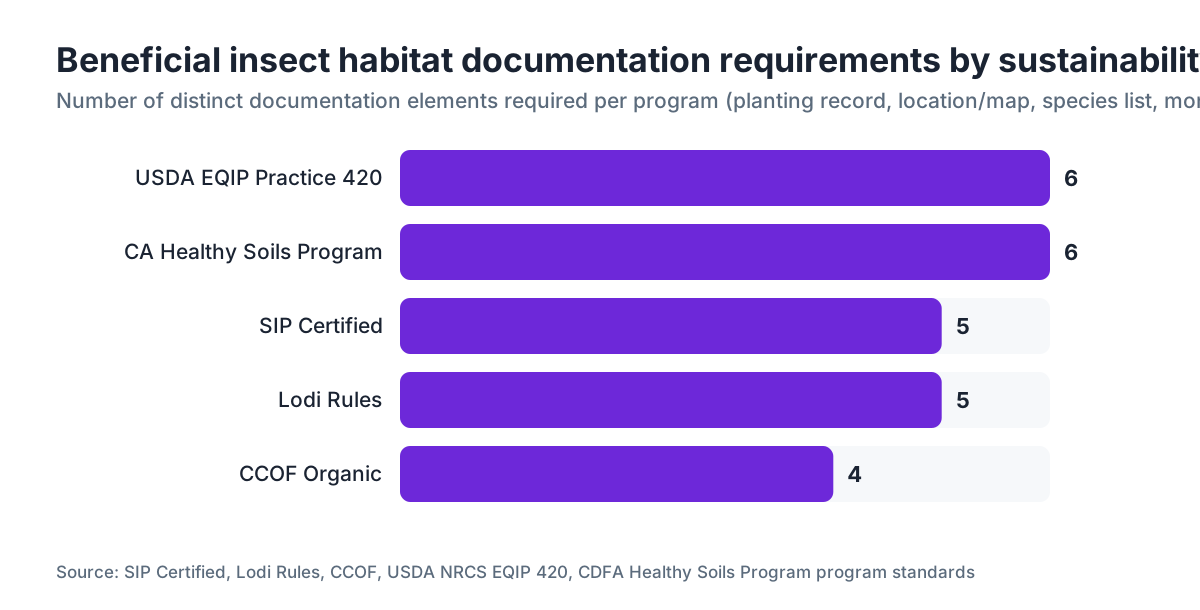
| Program | Credit Type | Key Evidence Required | Third-Party Audit? |
|---|---|---|---|
| SIP Certified | Scored metric in Biodiversity section | Species list, planting map, annual monitoring | Yes, every 3 years |
| Lodi Rules | Chapter 3 Ecosystem Health points | Planting records, photos, beneficial species observed | Yes, annual peer review |
| CCOF Organic | Not a direct credit, but biodiversity practices documented in OSP | Organic System Plan narrative + records | Yes, annual |
| USDA EQIP Practice 420 | Payment per acre | NRCS-approved seeding mix, establishment report | Yes, NRCS site visit |
| California Healthy Soils Program | Per-acre incentive payments | Baseline soil data, practice records, GIS shapefiles | Yes, CDFA review |
| Certified Sustainable Wine of BC | Biodiversity section score | Habitat map, species documentation | Yes, annual |
| New York Sustainable Winegrowing | Best Practice credits | Field records, photos | Peer review |
SIP Certified's biodiversity section asks whether you have "a documented plan for managing vineyard habitat for beneficial insects" and whether you track outcomes [3]. Lodi Rules goes further and asks for evidence of actual beneficial insect populations observed, more than what you planted [4]. That difference decides how much monitoring you build into your annual routine.
CCOF works differently. Organic certification grants no explicit points for habitat, but the Organic System Plan (OSP) has to describe your pest management approach, and documented habitat for beneficials supports the case that you're managing pests ecologically rather than reaching for prohibited inputs [5].
Operating in a state with its own program? Check whether your Department of Agriculture has tied pollinator protection requirements to pesticide licensing or right-to-farm protections. Several states now condition certain spray exemptions on documented habitat maintenance.
What records do you need to keep for each habitat planting?
Treat a habitat planting record exactly like a pesticide application record. It has to answer who, what, where, when, and how much.
For each planting event, capture:
- Date of planting (or seeding)
- Location (field block name, GPS coordinates, or GIS shapefile)
- Species planted and seed source (supplier name and lot number if it's a purchased mix)
- Seeding rate or plant spacing
- Square footage or acreage
- Site preparation method (tillage, herbicide, hand-clearing)
- Any amendments applied (compost, mulch, irrigation installed)
- Who did the work (employee name or contractor)
- At least two geotagged photos: one wide shot for context, one close-up of the seed mix or plant material
GPS coordinates are the piece most people skip, and they're the piece auditors ask for most. A hand-drawn map on a field notepad won't survive a SIP auditor who wants to verify acreage. A pin drop in Google Maps exported as a KML file, or a shapefile from your vineyard mapping software, is plenty.
For species selection, UC Cooperative Extension and UC Davis publish recommended cover crop and hedgerow mixes for California wine grape regions, and Cornell's New York State IPM program keeps equivalent lists for the Northeast [6] [7]. Pulling species from those lists gives you defensible documentation that your choice rested on agronomic science rather than whatever was on sale at the nursery.
WSU Extension's publications on vineyard floor management in Washington include species recommendations and establishment protocols for the Pacific Northwest [8]. Citing those in your planting record ("seeding mix based on WSU cover crop recommendations") adds credibility auditors notice.
How do you map and measure beneficial insect habitat for a report?
You need two numbers: total acres under management and total acres of dedicated beneficial insect habitat. The ratio is what programs read. A tiny herb border on a 200-acre ranch scores nothing like a connected hedgerow system covering 8% of the farm. SIP and Lodi Rules both weigh habitat as a proportion of farmed area.
Mapping gives you three practical options.
Option 1 is a GIS shapefile. If you already run vineyard management software, you can probably draw polygons directly. Export the shapefile and attach it. This is the approach auditors like best.
Option 2 is a georeferenced PDF. Take a satellite image from Google Earth or your county assessor's parcel map, draw the habitat areas on it by hand or in a free tool like QGIS, and export a PDF with a scale bar. Not as clean as a shapefile, but most programs accept it.
Option 3 is a field measurement with a GPS unit or phone app. Walk the perimeter of each habitat patch and record the track. Avenza Maps or the free USDA Cropland Data Layer viewer both work. Export the track, calculate the area, attach the file.
For acreage tied to EQIP payments, the NRCS Field Office Technical Guide sets the measurement standards [2]. For other programs, any reasonable measurement with a documented method usually passes.
Write the method into your record. "Area measured by GPS perimeter walk on [date] using [device/app], calculated area 0.8 acres" is all you need. An auditor can repeat the walk and confirm your number.
How should you document habitat monitoring and beneficial insect observations?
Planting records prove you put seeds in the ground. Monitoring records prove the habitat is doing something.
Lodi Rules explicitly requires "evidence of beneficial insect populations" in the Ecosystem Health chapter [4]. SIP asks about habitat outcomes. Neither program tells you exactly how to monitor, which is both flexible and a little annoying. Here's what actually works for a small-to-mid-size operation.
Run a timed visual count twice a season: once in spring before bloom, once during veraison. Walk the habitat area for 15 minutes and note every distinct beneficial insect type you see. Species-level ID isn't needed for most programs. "Lacewings, hoverflies, parasitic wasps (small, multiple species)" is a fine entry. Record the date, time of day, temperature, and weather, because all of those shift what you'll find.
Want more rigor without hiring an entomologist? UC ANR Publication 3485 (Grape Pest Management) includes monitoring guidance for beneficial arthropods and beat-net sampling protocols any trained farm employee can run [6]. Cite the protocol in your log and the credibility of your data jumps.
Photos count too. A timestamped shot of a lacewing on a buckwheat bloom in your hedgerow, filed in your seasonal record, is hard to argue with. Store photos in folders by date and block rather than dumping them into a camera roll.
At minimum, log monitoring once a month through the growing season. Keep it short. "May 14: 15-min visual walk, hedgerow west block. Moderate hoverfly activity on phacelia. No aphid pressure in adjacent vines. Temp 68F, sunny." Two sentences. Do it every month and by year-end you have a real record.
What photo and digital evidence do auditors actually want?
The most common documentation failure in a sustainability audit isn't a missing record. It's a record that can't be verified. A spreadsheet of planting dates is easy to backfill. Photos with EXIF timestamp and GPS coordinates baked into the file metadata are not.
Turn on location services for your phone camera before you shoot any habitat photos. The JPEG files then carry latitude, longitude, and timestamp in the EXIF metadata. Check it yourself by right-clicking a photo and opening Properties on Windows or Get Info on Mac. Any auditor with a little sophistication runs that exact check.
For each planting season, aim for:
- A wide-angle establishment photo taken within one week of planting, showing the habitat area against surrounding vineyard rows
- A close-up of the seed mix or plant material with the seed bag or nursery tag visible (this documents species and source)
- Monthly in-season photos showing plant development
- At least one photo per season showing beneficial insect activity
Video walkthroughs with narration are catching on, and they're genuinely useful for complex hedgerow systems. A two-minute phone video walking the hedgerow perimeter and describing what's planted where, uploaded to a dated cloud folder, makes audit-ready evidence for almost no extra effort.
Organize digital files in one consistent structure: Year / Block Name / Habitat Type / Photos. Keep a simple index at the top level listing what's in each folder. When your auditor asks for the west block hedgerow records from 2023, you should pull them in under two minutes. If you can't, it isn't documentation. It's just files.
How do you write the narrative section of a sustainability report for habitat work?
Most reports ask for records and a narrative. The records prove what you did. The narrative explains why and what happened. Auditors read the narrative to gauge whether you actually understand your own operation, so a specific, honest account beats polished boilerplate every time.
A good habitat narrative runs 150 to 300 words and covers four things: what you planted and where, why you chose those species, what you observed during the season, and what you plan to change or expand next year.
Here's an example structure (not a template to copy word for word):
"In March [year], we established a 0.6-acre hedgerow along the eastern property boundary adjacent to Block 7 Cabernet. Species selection followed UC Cooperative Extension recommendations for Central Coast beneficial insect habitat, primarily buckwheat (Eriogonum fasciculatum), yarrow (Achillea millefolium), and blue elderberry (Sambucus nigra). We chose these because the elderberry provides early-season bloom before the vineyard flowers, and the buckwheat carries into late summer when most other sources are done. During our May and July monitoring walks we recorded consistent hoverfly and parasitic wasp activity. We saw no significant mealybug pressure in Block 7 this season compared to moderate pressure in prior years. We can't attribute that causally to the hedgerow alone, but the correlation is encouraging. Next year we'll extend the hedgerow 200 feet north to connect with the riparian corridor."
That paragraph is specific, honest about what you can't claim, and shows you're thinking in systems. It beats "we planted a hedgerow to support biodiversity and ecosystem services" by a mile.
If you manage records across multiple blocks and seasons, keeping these narratives current year over year without losing older data is where a structured tool earns its keep. VitiScribe is built around this kind of timestamped field documentation, with photo attachment and export into report-ready formats.
How do beneficial insect habitat records connect to pesticide application records?
This connection is one of the most underappreciated parts of habitat documentation.
The EPA Worker Protection Standard (WPS) requires that pesticide applications near treated areas be recorded in enough detail that a worker or handler can identify restricted entry intervals and treated zones [1]. If you keep documented buffer plantings, those records back up your pesticide-free zone designations and help show you're actively cutting chemical inputs near refuge areas.
More practically, many programs ask you to cross-reference your pesticide records with your habitat records to prove you're not spraying broad-spectrum insecticides in or right next to beneficial insect habitat during bloom. SIP's biodiversity scorecard asks whether you have "reduced or eliminated use of broad-spectrum insecticides" and whether your spray timing protects pollinators [3].
So your habitat record has to live alongside your spray log, not in a separate binder you dig out once a year. When an auditor asks "what did you spray in Block 6 on June 3rd, and how far is that from your hedgerow?" you want the answer in one minute, not thirty.
A practical fix: note the nearest habitat planting (block reference and rough distance) in your pesticide records, and note any spray events within 300 feet in your habitat monitoring log. That cross-reference makes it plain you were thinking about both systems together.
California's pesticide use reporting system requires growers to report all applications by site, and those records are public. Your narrative should name any broad-spectrum applications, not bury them, and explain how they were timed or placed to spare documented habitat [9].
What are the most common documentation mistakes that fail sustainability audits?
Across SIP, Lodi Rules, and organic audits, a handful of patterns fail the same way over and over.
The first and most common mistake is planting without recording. Growers establish hedgerows or cover crops, they look great, beneficials are all over them, and there's no dated record of what went in or when. The auditor can see the hedgerow. They still can't credit it without documentation.
The second is species lists without sources. "Mixed wildflowers" is not a species list. Listing species by common name with no scientific name or seed source leaves it unclear whether the mix was actually right for beneficial insects or slipped in an invasive species. Check your mix against your state's invasive list before planting and keep that check [10].
The third is monitoring that's too thin. One observation a year won't satisfy Lodi Rules or SIP. Monthly growing-season entries, even brief ones, beat a single detailed report in September.
The fourth is photos with no timestamp or location data. EXIF metadata is your friend. If you've shot years of photos without location data, it isn't fatal, but you'll need corroborating records (dated field logs, plant-material receipts) to make up the gap.
The fifth is treating habitat as an island. Auditors want to see your habitat work tied to your pest management decisions, your spray records, and your farm plan. A hedgerow that exists on paper but connects to no other management choice reads like greenwashing, even when it isn't. Let your annual narrative spell out the relationship.
How do you calculate and report beneficial insect habitat as a percentage of farmed area?
Several programs, including the USDA Conservation Reserve Program and EQIP practice standards, set habitat targets as a percentage of managed cropland. The rough NRCS target for on-farm pollinator habitat is 3-5% of managed cropland in dedicated habitat, though it shifts by practice and region [2].
To calculate your percentage:
- Total vineyard acres under management (all blocks, even ones not currently producing)
- Total acres of dedicated beneficial insect habitat (hedgerows, wildflower strips, insectary plantings, cover crops kept specifically for habitat, riparian buffers managed for biodiversity)
- Divide habitat acres by total vineyard acres, multiply by 100
A 50-acre vineyard with 2 acres of hedgerow and wildflower strips has 4% habitat coverage. That's a number worth putting in a report.
Be honest about what counts. A ryegrass cover crop mowed short before bloom doesn't. A diverse cover crop mix with clovers, vetches, and phacelia that you let bloom before mowing, documented with bloom-period photos, can count if your program accepts it.
In the narrative, present the number alongside the year-over-year trend. "We've grown from 1.2% to 4.0% habitat coverage over three years" is a story of real progress, and programs reward documented trajectory as much as hitting a target in a single year.
Operations in Paso Robles or similar warm-climate regions can go further. Paso Robles wineries working through the Vineyard Team's SIP program will often find their regional auditors keep specific acreage worksheets you can request.
How do you keep these records organized year after year?
The system that fails most often runs entirely on goodwill and memory. You plant a hedgerow in year one, keep good records, and by year three somebody asks for the original seed mix documentation and nobody can find the folder.
A long-term system that holds up has three parts.
First, a master planting log. One document (a spreadsheet is fine) with one row per planting event going back as far as your records reach. Columns: planting date, block or location name, GPS coordinates, species planted, seed source, acreage, notes. This document never gets deleted, only added to. New rows drop at the bottom.
Second, a seasonal monitoring log. A new section each growing season. Within each season, dated entries carry block, observation type (visual walk, beat net, photo), what you observed, and notes on adjacent pest pressure or spray events. At season's end, write a 100-200 word summary pulling out the highlights.
Third, a photo archive. Organized as above: Year / Block / Habitat Type, with an index at the top level. Cloud backup so it doesn't vanish when a laptop dies.
Operations that want this stitched to spray records, variety data, and block maps instead of scattered across spreadsheets and folders can hold all of it in one place. VitiScribe is built for that, with export functions shaped for sustainability report formats.
For vineyard operations of any size, the five-minute habit that matters most is logging immediately. Don't wait for the end of the week. Enter the planting date and GPS coordinates the day you plant. Take the photos that day. That habit is the whole difference between an audit-ready record and a stressful reconstruction project.
Are there federal or state incentives that require this kind of documentation?
Yes, and the payments can be big enough to justify the record-keeping even if you're not chasing certification.
USDA EQIP Practice 420 (Pollinator Habitat) pays roughly $400 to $1,200 per acre (depending on region and practice requirements) for establishing and maintaining qualified pollinator habitat [2]. Payment requires an approved Conservation Activity Plan, an NRCS-approved seeding mix, establishment documentation, and a follow-up site visit confirming establishment. The requirements are rigorous but not heavy if you're already keeping the records this article describes.
California's Healthy Soils Program, run by CDFA, lists pollinator habitat as an eligible practice and has paid per-acre incentives in prior rounds, though availability moves with the funding cycle [11]. Its documentation includes GIS shapefiles of practice areas and baseline data.
The USDA Conservation Reserve Program (CRP) has a practice called CP-42 (Pollinator Habitat on Cropland) that pays annual rental rates for enrolled acres. CRP aims mostly at row crops rather than perennials like vineyards, but it can apply to field borders and buffer areas.
At the state level, several western states have folded pollinator protection into pesticide applicator license renewals. Oregon, Washington, and California all carry provisions that can touch vineyard operators. Documented habitat maintenance can matter for compliance, though the specifics vary by state pesticide law [12].
The pattern runs the same across all of them: the documentation these programs demand overlaps heavily with what a solid sustainability report already needs. Build the habit once and it covers most of the bases.
Frequently asked questions
What is the minimum documentation needed to get credit for a hedgerow in a SIP audit?
SIP wants at minimum a dated planting record with a species list, a location map or GPS coordinates placing the hedgerow relative to vineyard blocks, and evidence of seasonal monitoring. Photos with timestamp metadata strengthen it. SIP audits happen every three years, so you need records spanning the full audit cycle, more than the current season.
Do I need a professional entomologist to document beneficial insect populations?
No. Lodi Rules and SIP both accept field staff observations using standardized timed visual counts or beat-net sampling. UC Davis and Cornell publish protocols any trained farm employee can follow. Programs want consistency and a documented method, not academic rigor. Note the protocol you used and cite the extension publication you based it on.
Can I count a flowering cover crop as beneficial insect habitat in my report?
It depends on the program and how you manage the crop. A diverse mix with clovers, phacelia, vetch, and buckwheat that you let bloom before mowing can qualify under Lodi Rules and EQIP 420 if documented with a species list, bloom timing, and management records. A monoculture grass cover crop mowed before bloom generally does not qualify.
How far back do my habitat planting records need to go for a first-time sustainability audit?
Most programs ask for the current season plus the prior two to three. SIP audits cover a three-year cycle. Lodi Rules runs annual peer reviews. For EQIP 420 payments, the practice period is typically one to three years. Start documenting now and reconstruct older records as best you can using dated photos, receipts, and spray log cross-references.
What should I do if I planted a habitat area but didn't keep any records at the time?
Reconstruct what you can. Seed receipts, nursery invoices, and pesticide records showing spray-free zones all corroborate a planting date. Dated photos in your phone's camera roll (check the actual file EXIF date) can confirm establishment timing. Document what you know now in a narrative note that honestly describes the gaps. Auditors prefer an honest partial record over nothing.
How do GPS coordinates for habitat areas affect my pesticide application records?
If your documented habitat carries GPS coordinates, you can calculate exact distances from spray applications, which supports pollinator protection requirements and the EPA Worker Protection Standard. Several state pesticide programs and EPA guidance recommend maintaining documented buffer distances. Habitat GPS data makes that calculation verifiable rather than estimated.
What species documentation does USDA NRCS require for EQIP Practice 420 payments?
NRCS requires a seeding mix approved by the local Field Office, documentation of the seed source and lot, seeding rate by species, planting date, and an establishment report confirmed by an NRCS site visit. The mix has to meet the local Field Office Technical Guide specifications for Practice Code 420. A pre-approved commercial mix simplifies approval a lot [2].
Do California vineyard operators need to report beneficial insect habitat to CDFA?
There's no mandatory reporting requirement for habitat plantings under California's pesticide use reporting system. But if you're enrolled in California's Healthy Soils Program, you do submit practice records and GIS shapefiles to CDFA as part of that incentive. Voluntary certifications (SIP, Lodi Rules) run their own reporting processes outside of CDFA.
How do I document that my habitat species aren't invasive?
Cross-reference your species list against your state's invasive species database before planting and save a copy of that check with your planting record. California uses the CalIPC invasive plant inventory. Washington uses the state Noxious Weed Control Board list. Cornell's New York State IPM program publishes recommended non-invasive native alternatives for the Northeast. Documenting the check protects you if a neighbor or auditor questions a species choice.
How should I handle a year when my habitat planting failed or had poor establishment?
Document it honestly. A monitoring record that shows poor establishment, names the likely cause (drought, weed competition, late planting), and outlines your corrective action beats a gap in the record. Most programs score trajectory and good-faith effort. A documented failure with a documented response is not a disqualifier. Hiding it and hoping nobody notices is.
What's the difference between a hedgerow and an insectary planting for reporting purposes?
For most programs the distinction is practical, not definitional. A hedgerow is usually a linear woody planting along a border. An insectary planting is usually an annual or perennial herbaceous bed within or beside the vineyard. Both qualify as beneficial insect habitat. Document each one separately with its own location, species list, and acreage so auditors can credit each type.
Can I use aerial or drone imagery to document habitat area instead of GPS ground measurements?
Yes, and it's getting common. Drone imagery with embedded GPS metadata and a measurable scale is accepted by SIP, Lodi Rules, and NRCS for area verification. The image has to be dated and the area calculation method documented. Many vineyard platforms import drone imagery and calculate polygon areas directly. Keep the original image files, not screenshots.
How do I show that my habitat plantings connect to pest management decisions rather than serving as decoration?
In your narrative, link habitat monitoring observations to pest management decisions from that season. For example: noting parasitic wasp activity in hedgerow monitoring, then documenting the choice not to spray an adjacent block with low-level aphid pressure. That cause-and-effect account is what separates genuine integrated pest management from a planting that exists only on paper.
Sources
- EPA, Worker Protection Standard: EPA Worker Protection Standard requires employers to keep records of pesticide applications and define treated areas and restricted entry intervals
- Vineyard Team, SIP Certified Standard Documentation: SIP Certified biodiversity section asks whether operators have a documented plan for managing vineyard habitat for beneficial insects and whether they track outcomes
- Lodi Winegrape Commission, Lodi Rules for Sustainable Winegrowing: Lodi Rules Chapter 3 Ecosystem Health requires evidence of actual beneficial insect populations observed, more than records of what was planted
- CCOF, Organic System Plan Requirements: CCOF Organic System Plan must describe pest management approach and documented beneficial insect habitat supports the case for ecological pest management
- UC Division of Agriculture and Natural Resources, Grape Pest Management (ANR Publication 3485): UC ANR Publication 3485 includes monitoring guidance for beneficial arthropods and beat-net sampling protocols for vineyard beneficials
- Cornell Cooperative Extension, New York State IPM Program Vineyard Resources: Cornell's New York State IPM program publishes species recommendations and establishment protocols for beneficial insect habitat in Northeast vineyards
- Washington State University Extension, Vineyard Floor Management: WSU Extension publications include species recommendations and establishment protocols for cover crops and beneficial insect habitat in Pacific Northwest vineyards
- California Department of Pesticide Regulation, Pesticide Use Reporting: California's pesticide use reporting system requires growers to report all pesticide applications by site and those records are public
- California Invasive Plant Council, CalIPC Invasive Plant Inventory: CalIPC publishes the California invasive plant inventory used to verify that habitat plantings do not include invasive species
- California Department of Food and Agriculture, Healthy Soils Program: California's Healthy Soils Program includes pollinator habitat as an eligible practice with per-acre incentives and requires GIS shapefiles as documentation
- EPA, Pollinator Protection: EPA pollinator protection guidance and state programs in Oregon, Washington, and California include pollinator protection provisions that can affect vineyard operators
Last updated 2026-07-11