How to document soil carbon sequestration practices for sustainability reports
TL;DR
- Documenting soil carbon sequestration means one thing: a baseline soil organic carbon measurement, a record of every practice that moves carbon (cover crops, compost, less tillage), repeat sampling on a fixed schedule, and numbers that match a recognized framework like the GHG Protocol or USDA COMET-Farm.
- Sampling depth, lab method, and GPS coordinates have to stay identical year to year, or the data is worthless.
Why does soil carbon documentation even matter for a vineyard sustainability report?
Buyers, certifiers, and regulators want proof now, not good intentions. A report that says 'we practice regenerative viticulture' with no numbers behind it gets ignored, or flagged as greenwashing. Documented soil carbon is one of the few vineyard practices that turns into a quantified climate benefit you can put on paper with a unit attached: tons of CO2-equivalent per hectare per year.
The California Air Resources Board, several state right-to-farm programs, and the USDA Natural Resources Conservation Service all run programs that require or reward documented soil carbon data [1][2]. The Sustainable Winegrowing Alliance and LIVE Certification both build soil health into their scorecards. Want points in those programs, or a shot at low-carbon labeling markets? You need a paper trail that survives an audit.
There's money in it too. USDA's Environmental Quality Incentives Program (EQIP) pays cost-share on conservation practices that build soil organic matter, and documentation of what you actually did is required to collect [2]. Get your records right from the first cover crop and you're positioned for payment programs that may not even exist yet.
Nobody has clean data on how much a documented carbon claim adds to bulk grape prices. The closest published work is from the Wine Institute's sustainability survey, which found certified wineries reported access to more retail channels, but the carbon-specific price signal is still thin. That could change fast as Scope 3 emissions reporting tightens for large wine buyers in the EU and California.
What is soil organic carbon (SOC) and how is it measured for reports?
Soil organic carbon is the carbon fraction of organic matter in your soil. It's what you build when you add compost, grow cover crops, or stop tilling. For reporting, SOC is almost always a percentage of total soil mass (g C per 100 g soil), then converted to a stock in metric tons of carbon per hectare using bulk density and sampling depth [3].
The standard lab method is dry combustion (the Dumas method), which burns the sample and measures the CO2 released. UC Davis Extension recommends dry combustion over the older Walkley-Black wet chemistry method, because wet chemistry can underestimate SOC in soils with high inorganic carbon, which is common across California wine country [3]. Switch methods between sampling years and your trend data is compromised. Nail the method down in writing before you start.
Sampling depth matters enormously, and getting it wrong is one of the most common failures in vineyard carbon documentation. The USDA COMET-Farm tool, the agency's preferred method for quantifying agricultural carbon, needs samples from 0-10 cm and 10-30 cm depth increments at minimum [4]. Some protocols go to 100 cm for perennial crops. Report to 30 cm this time and 20 cm next time and you get a meaningless comparison.
Bulk density gets measured alongside SOC concentration, every time. A soil that compacts over the years has a higher bulk density. Track SOC percentage alone and you can convince yourself carbon is accumulating when the soil is just denser. Collect bulk density cores at every sampling event with a known-volume ring sampler.
| Measurement | Unit | Why it's required |
|---|---|---|
| SOC concentration | % or g/kg | Base measurement from lab |
| Bulk density | g/cm³ | Converts concentration to stock |
| SOC stock | t C/ha | Comparable across sites and years |
| CO2-equivalent | t CO2e/ha/yr | Required for GHG Protocol reports |
| Sampling depth | cm | Must be fixed across all years |
How do you establish a valid soil carbon baseline?
A baseline is your starting point. Without it you can't claim sequestration, because there's no reference to show change from. The baseline has to be collected before or right at the start of the practices you're documenting, which is why dragging your feet on this step costs you years of credible data.
For a vineyard, the baseline record should include GPS coordinates for each sample location (recorded to at least 5 decimal degrees), the date and time, the equipment used, the lab name and method, and the depth increments. Cornell's Soil Health Lab recommends 15-20 cores composited per management zone to get a representative sample in perennial fruit crops, because vineyard rows and inter-rows carry dramatically different carbon levels [5]. Sample only the row middles, then compare to a reference that includes under-vine areas, and you'll overstate your sequestration.
Management zones matter. A block with permanent mid-row cover crops, deep clay soils, and a north-facing aspect behaves nothing like a block on sandy loam facing south. Lump them together and your data is noise. Draw your zones on soil texture, slope, and existing management before you pull a single core.
Resampling frequency gets argued about. The honest answer is that soil carbon changes slowly enough that annual sampling buys more lab cost than information. Most extension guidance, including Washington State University's viticulture and enology program, suggests resampling every 3-5 years for trend detection in perennial systems [6]. Some carbon markets require annual sampling, which is their call, but the signal-to-noise ratio on annual vineyard SOC data is poor unless you have a very large number of sample points.
Which vineyard management practices actually generate documentable carbon credits?
Not every green practice adds SOC. Drip irrigation is great for water but doesn't sequester carbon. Cutting pesticide use helps biodiversity but doesn't build soil carbon stocks. The practices with published evidence behind them, accepted by USDA COMET-Farm for carbon accounting, are a shorter list than most vineyard managers assume [4].
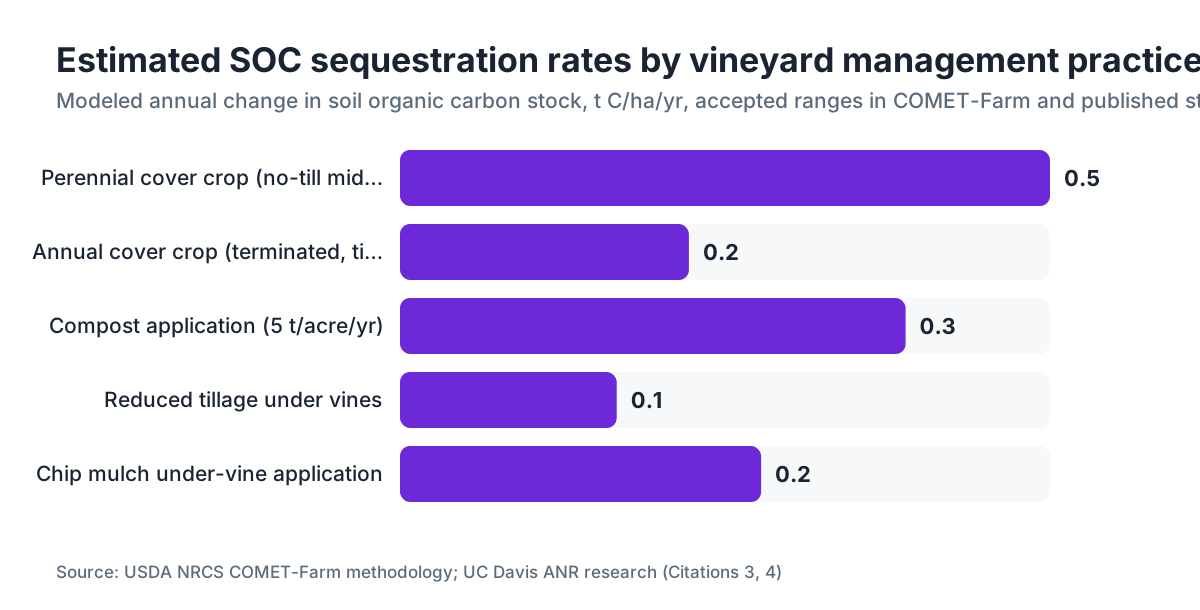
Cover cropping is the big one. Perennial or annual inter-row cover crops add root biomass and surface residue that feed the microbes that build stable organic matter. The rate swings widely by species mix, soil type, and climate. A UC Davis study in Central Valley vineyards found cover-cropped blocks accumulated roughly 0.2-0.5 tons of carbon per hectare per year over cultivated controls, though the range across studies is wide [3].
Compost application has strong evidence. COMET-Farm treats compost as a direct carbon input and calculates a credit from application rate and compost carbon content. You need compost records with date, rate (tons per acre), and a quality analysis showing carbon-to-nitrogen ratio and total carbon percentage. Save every delivery ticket.
Reduced tillage or no-till under the vines prevents the physical breakup of soil aggregates that releases stored carbon. Document it by logging tillage passes per year, the implement, and the depth of disturbance. Going from four shallow diskings a year to zero is a practice change you can enter straight into COMET-Farm.
Woody material incorporation (pruning returns, chip mulch under vines) is getting more recognition, but the accounting is less settled. COMET-Farm has a residue management module, and recording whether you chip-and-spread or haul off prunings is worth doing even if it earns no credit in every framework today.
A record of what you didn't do counts as much as what you did. If you used to burn prunings and stopped, that's a documented emission reduction. Keep a log.
What records do you actually need to keep, and in what format?
Here's the practical list. For each practice you need the date it happened, the block or GPS-defined area, the rate or intensity (tons/acre of compost, species mix and seeding rate for cover crops, tillage depth and implement), and who did the work. That covers the practice side. The soil sampling side needs GPS coordinates, sampling depth, composite or discrete designation, lab name, lab method, and the result with units.
Format is more flexible than people expect. A spreadsheet is fine if it's consistent and backed up. A paper field log works if it's dated and signed. What fails is a mental note or a summary written after the fact. Auditors and certifiers look for contemporaneous records, meaning the entry was made at or near the time of the event. If you keep spray records to the EPA Worker Protection Standard, you already know what contemporaneous documentation looks like [7].
A few fields people skip and then regret: the specific block identifier (block name or APN), the weather at time of sampling (wet or dry changes bulk density), and the name of the person who pulled the cores. In an audit two years later, you'll want to answer all three.
Managing several vineyards, or pulling practice records together for a third-party report, gets painful fast on paper. A dedicated field operations platform makes the aggregation easier. VitiScribe, for one, logs blocks, management events, and soil data in one place so you can export a clean practice history by block. A well-kept spreadsheet with consistent column headers passes an audit too. The tool matters less than the discipline.
Retention: USDA recommends keeping agricultural records at least 3 years for cost-share compliance. Carbon market agreements typically require 5-10 years, and some voluntary registries want records for the full project duration plus 5 years after [2].
Which reporting frameworks and tools should you use to quantify sequestration?
The two most widely accepted tools for U.S. vineyard-scale carbon accounting are USDA COMET-Farm and the GHG Protocol for Agriculture, Forestry and Other Land Use (AFOLU) [4][8]. COMET-Farm is free, web-based, and built for U.S. agricultural soils on IPCC-compatible modeling. You enter your county, soil type, and management history, and it outputs estimated SOC change in CO2-equivalent. The output is a modeled estimate, not a direct measurement, but many voluntary carbon markets and USDA programs accept it.
The GHG Protocol AFOLU guidance is more rigorous and more demanding. It requires either empirical soil sampling or approved modeling, plus uncertainty quantification, and it's the standard most large corporate supply chain reports run on [8]. If a wine buyer's sustainability team asks you to feed data into a Scope 3 inventory, they're probably expecting GHG Protocol-aligned numbers.
Verra's Verified Carbon Standard (VCS) and the American Carbon Registry (ACR) have specific agricultural soil carbon methodologies. Those are for projects that want to generate tradeable credits, not internal reporting. The documentation load is heavy: a project design document, third-party verification, and ongoing monitoring reports. Most small vineyards find the overhead isn't worth it unless they're part of an aggregated project.
The USDA's COMET-Planner tool can help you estimate sequestration rates before you commit to full COMET-Farm modeling [4]. Run COMET-Planner first to see if your practice changes pencil out at all before you spend money on lab work.
WSU Extension's viticulture program has published guides on folding soil health metrics into vineyard sustainability plans that line up with LIVE Certification and other Pacific Northwest programs [6]. If you're in Washington or Oregon, read those before you design your sampling protocol.
How do you match your vineyard records to a formal sustainability report structure?
Most reports that include soil carbon follow one of three structures: a narrative section with a supporting data appendix, a scored scorecard (like the California Code of Sustainable Winegrowing workbook), or a standardized disclosure aligned to GRI (Global Reporting Initiative) or SASB (Sustainability Accounting Standards Board).
For the California Code of Sustainable Winegrowing workbook, Chapter 6 covers soil and water management and asks specific questions about cover crop management, compost use, and soil testing frequency. Your records need to answer those questions with documented evidence, more than 'yes.' If the workbook asks whether you test soil organic matter, you need a lab report behind it [9].
GRI Standard 13 (Agriculture, Aquaculture, and Fishing Sectors, published 2022) includes disclosures on soil health and carbon. Disclosure 13.5.2 asks organizations to report the practices they implemented to address soil health and the area covered. You need the hectares under each practice, more than confirmation the practice exists [10].
The cleanest way to structure the data section of a soil carbon disclosure: (1) total vineyard area under each documented carbon-building practice and when it started, (2) the baseline SOC measurement with date and protocol, (3) any later measurements with the same protocol, (4) the modeled or measured change in SOC stock in t CO2e/ha/yr, and (5) the tool or framework used to calculate it. That answers every question a sustainability auditor will ask.
One honest note. If your records only go back two years and you haven't done repeat sampling, say so. A report that presents a baseline with the line 'repeat sampling scheduled for 2026' is credible. One that implies a trend from a single data point is not.
What are the common mistakes that invalidate vineyard soil carbon data?
Inconsistent sampling depth is the most common. Switch from 0-30 cm in year one to 0-20 cm in year three and the data is incomparable. Fix the depth, write it into your protocol, and don't deviate.
Sampling at the wrong time of year is a close second. Soil carbon moves seasonally, especially under cover crops that are actively growing or breaking down. USDA COMET-Farm recommends sampling in the same season each time, typically late fall after cover crop termination or early spring before growth, and noting soil moisture [4]. Sample in a drought year versus a wet year without noting it and you'll see sequestration or loss that isn't real.
Mixing sample locations. Pull cores in the vine row in year one, then in the mid-row in year three because the mid-row was easier to reach, and the comparison is invalid. GPS your points and return to them. A steel pin marking each sample point is a small cost that saves years of data.
Using the wrong carbon conversion factor. Soil carbon is carbon, not CO2. To convert SOC stocks to CO2-equivalent, multiply by 3.67 (the molecular weight ratio of CO2 to C, 44/12). Simple, but it gets inverted or dropped in spreadsheets all the time. Check every calculation.
Ignoring permanence. Plant a cover crop for two years, then disk it under because of disease pressure, and you've likely released some of the carbon you stored. Reports need to address permanence honestly, and carbon market methodologies always deduct a buffer pool for this risk. In your own reporting, log practice continuity: how many years has each practice been in place?
How do soil carbon records connect to USDA programs and cost-share payments?
USDA's Natural Resources Conservation Service runs EQIP and the Conservation Stewardship Program (CSP), both paying cost-share for practices that build soil organic matter in vineyards. EQIP payment rates for cover cropping in California run roughly $150-400 per acre depending on the practice standard, and compost application assistance is available too [2]. These payments require you to document that the practice happened, at what rate, and in which fields, which is exactly the documentation you're building for your report. One records system does both jobs.
The USDA's Regional Conservation Partnership Program (RCPP) has funded several vineyard-specific carbon projects in California and the Pacific Northwest. Joining an RCPP project often comes with required data sharing on soil health metrics, which means your sampling protocol may be prescribed for you. Call your local NRCS field office before you design your own protocol if you might apply to RCPP. Aligning from the start saves you from resampling later.
The Inflation Reduction Act of 2022 increased USDA conservation program funding sharply, with a set-aside for climate-smart agriculture practices. NRCS has published updated payment schedules for climate-smart practices that name reduced tillage, cover cropping, and compost application in perennial crops [2]. Accurate records of these practices, with block area documented, decide how much you can claim.
For any USDA program payment, records need to be kept at the farm level with the associated Farm Service Agency (FSA) tract and field numbers [12]. If your vineyard records don't include FSA field numbers, get them from your local FSA office. They map to satellite imagery and make cross-referencing with NRCS payment records straightforward.
What do third-party auditors actually look for in a soil carbon documentation review?
Third-party auditors, whether for a carbon registry, a certification, or a buyer's supply chain assessment, look for three things: contemporaneous records, consistency, and chain of custody on lab data.
Contemporaneous means the record was made at the time of the event. A cover crop seeding date logged the day of seeding beats a date reconstructed from a seed invoice three months later. Both can pass. The field log is harder to challenge.
Consistency means the same sampling depth, the same lab, the same GPS points, and the same calculation method across every measurement period. Auditors will ask to see your written sampling protocol. Don't have one? Draft a one-page document right now that describes exactly how you sample, which lab you use, and what method they run. That document becomes your protocol and your proof of consistency.
Chain of custody means the lab report itself, with sample ID, collection date, and the lab's accreditation. The lab should be certified under a recognized quality system. In California, the Department of Food and Agriculture's soil and plant laboratory registry is one reference for accredited labs [11]. Keep the original PDF lab reports, more than the numbers you typed into a spreadsheet.
Carbon registry auditors also check additionality, meaning the practices you're claiming credit for wouldn't have happened without the carbon project or program. For a sustainability report, as opposed to a credit-generating project, additionality isn't usually a formal requirement, but you may be asked when you started each practice and why. Honest answers here beat perfect ones.
VitiScribe's block-level logs are built with exactly this audit trail in mind, worth knowing if you're scaling to multiple parcels where paper logs get unwieldy.
How do you handle uncertainty and data gaps in your soil carbon report?
Every soil carbon estimate carries uncertainty, and the frameworks know it. COMET-Farm outputs a confidence range, not a single point estimate. GHG Protocol AFOLU guidance requires uncertainty reporting [8]. Hide the uncertainty and your report reads as naive to anyone who knows the field.
The honest way to handle it: report your central estimate and the range, state where the uncertainty comes from (sampling error, model uncertainty, or both), and describe what you're doing to shrink it over time. 'Our baseline SOC stock is estimated at 42 ± 8 t C/ha based on 18 composite cores analyzed by dry combustion at UC Davis Analytical Lab in March 2024' is a sentence that survives scrutiny.
Data gaps happen. Maybe you have good practice records but no soil sampling yet. Maybe one baseline sample and no follow-up. Report what you have, note the gap plainly, and give a timeline to fill it. A section that says 'We do not yet have repeat sampling data to confirm sequestration trends; the next sampling event is planned for fall 2026' is honest and defensible. One that implies a trend from incomplete data is not.
Modeled estimates from COMET-Farm are acceptable when empirical data isn't available, but label them as modeled. The USDA's COMET-Farm documentation describes the tool as providing estimates based on IPCC Tier 2 methodology and regional soil survey data, not direct measurement [4]. Carry that distinction into your report language.
For small vineyards where full sampling programs cost too much (soil lab work runs roughly $50-150 per sample for basic SOC and bulk density in the U.S., and a proper baseline across multiple zones can need 40-80 samples), COMET-Farm modeling is a reasonable start. Plan to add empirical verification as resources allow.
Frequently asked questions
What is the minimum soil sampling needed for a vineyard sustainability report?
At minimum, one baseline measurement per distinct management zone, sampled to at least 30 cm depth in two increments (0-10 cm and 10-30 cm), with bulk density measured alongside SOC concentration. Cornell's Soil Health Lab recommends 15-20 cores composited per zone for perennial crops. Without a baseline you can't document a trend, so this is the non-negotiable starting point before any other record-keeping matters.
Can I use USDA COMET-Farm instead of lab testing for my sustainability report?
Yes, for most voluntary reports and many USDA program applications, COMET-Farm modeled estimates are accepted. The tool uses IPCC Tier 2 methodology and is free from USDA NRCS. Label the output clearly as a modeled estimate, include your management inputs, and note the county and soil series you entered. Some carbon registries and corporate supply chain audits require empirical sampling, so check the specific framework you're reporting to.
How often do I need to resample soil carbon to show a trend?
Most extension guidance suggests every 3-5 years for perennial crops, including vineyards. Annual sampling adds cost without proportionally improving data quality, because SOC changes slowly and seasonal variation can swamp a one-year signal. Washington State University's viticulture extension recommends a 3-5 year resampling interval for trend detection. If a carbon market program requires annual sampling, that's their requirement, but it's not the scientific optimum.
Do I need to measure carbon under the vines and in the row middles separately?
Yes, if you run different management in those zones (herbicide-maintained under-vine strip versus permanent mid-row cover crop), they're different management zones and should be sampled separately. Lumping them produces an average that describes neither zone accurately. Cornell's Soil Health Lab specifically flags vine row versus inter-row differences as a major source of sampling error in perennial crop carbon accounting.
What lab method should I specify for soil organic carbon analysis?
Specify dry combustion (Dumas method), and ask the lab to confirm they're measuring total organic carbon after acid pre-treatment to remove inorganic carbon if your soils are calcareous (pH above 7.5, or any carbonates present). UC Davis Extension recommends dry combustion over the older Walkley-Black wet chemistry method, which can underestimate SOC in high-carbonate California soils. Confirm the method in writing before your first sample and use the same lab for every round.
Which sustainability certification programs recognize soil carbon records for vineyards?
The California Code of Sustainable Winegrowing (Chapter 6), LIVE Certification, and Certified California Sustainable Winegrowing all include soil health metrics that align with carbon documentation. Demeter Biodynamic and the Regenerative Organic Certified (ROC) standard include soil organic matter requirements with documented testing. GRI Standard 13 for agriculture sectors, published in 2022, gives the most formalized disclosure structure for external reports.
How do I convert soil organic carbon percentage to CO2-equivalent for a sustainability report?
First convert SOC percentage to a stock: multiply SOC% by bulk density (g/cm³) by sampling depth (cm) by 100 to get t C/ha. Then multiply t C/ha by 3.67 to get t CO2e/ha (the molecular weight ratio of CO2 to C is 44/12 = 3.67). For an annual sequestration rate, divide the stock change by the number of years between sampling events. Put your calculation in an appendix so auditors can follow it.
Can cover crop records double as documentation for USDA EQIP payments and a sustainability report?
Yes, and you should design your record-keeping to serve both at once. EQIP requires practice records with date, location (FSA tract and field number), and rate (species, seeding rate, area). A sustainability report needs the same plus soil sampling data. One set of field logs that includes FSA field numbers, GPS coordinates, and practice details covers both. EQIP payment rates for cover cropping in California run roughly $150-400 per acre depending on practice standard.
What is 'additionality' and do I need to address it in a vineyard sustainability report?
Additionality means the carbon-building practice wouldn't have happened without the reporting program or incentive. It's a formal requirement for tradeable carbon credit projects (Verra VCS, American Carbon Registry) but isn't usually required for internal reports or most certification programs. For supply chain disclosures, you may be asked when each practice started and why. Being honest about practice history matters more than claiming additionality you can't support.
How long do I need to keep soil carbon and practice records?
USDA NRCS requires at least 3 years for cost-share program compliance. Most voluntary carbon market agreements require 5-10 years. Some registries require records for the full project duration plus 5 years after. For reports with no program attached, a 5-year retention policy is a reasonable minimum. Store original lab reports as PDFs with consistent file naming (block, date, method) and keep backups off-site.
What is the difference between soil carbon sequestration and a carbon offset credit?
Sequestration is the physical process of increasing soil organic carbon; documenting it in a report is a disclosure of what's happening on your farm. A carbon offset credit is a tradeable instrument, issued by a registry like Verra or ACR, that represents one metric ton of CO2-equivalent removed or avoided, after third-party verification. Generating credits requires a project design document, an approved methodology, and ongoing verification. Most vineyard operators report sequestration without ever generating tradeable credits.
Do I need GPS coordinates for every soil sample point?
Yes. GPS coordinates (recorded to at least 5 decimal degrees) let you return to the exact sample location in future years, which is required for a valid trend comparison. Permanent markers, like a steel pin or rebar flush with the soil, add physical confirmation. Without consistent locations, each sampling event is effectively a new baseline, not a measurement of change. Most smartphone GPS apps are accurate enough for this in open vineyard blocks.
What does bulk density have to do with soil carbon reporting?
Bulk density (g/cm³) converts SOC concentration (a percentage) into SOC stock (tons per hectare), which is the number you actually report. A soil that compacts over time has higher bulk density, so SOC concentration can stay flat while total stock per hectare climbs. Reporting concentration alone without bulk density is incomplete. Measure bulk density with a known-volume ring sampler at every sampling event, in the same locations and depth increments as your SOC cores.
Sources
- California Air Resources Board, Compliance Offset Program: CARB administers compliance offset protocols relevant to agricultural soil carbon projects under AB 32 cap-and-trade
- UC Agriculture and Natural Resources (UC Davis), Soil Science and Viticulture Research: UC Davis Extension recommends dry combustion over Walkley-Black for SOC analysis in calcareous California soils; cover-cropped vineyards in Central Valley studies accumulated roughly 0.2-0.5 t C/ha/yr
- USDA COMET-Farm and COMET-Planner (Colorado State University / USDA NRCS): COMET-Farm requires soil samples from 0-10 cm and 10-30 cm depth increments at minimum; uses IPCC Tier 2 methodology and regional soil survey data; recommends consistent-season sampling; provides modeled estimates, not direct measurement
- Cornell Soil Health Laboratory, Comprehensive Assessment of Soil Health: Cornell Soil Health Lab recommends 15-20 cores composited per management zone for perennial fruit crops; flags vine row versus inter-row differences as a major source of sampling error
- Washington State University Viticulture and Enology Program: WSU viticulture extension recommends resampling every 3-5 years for trend detection in perennial cropping systems and publishes soil health integration guides aligned with LIVE Certification
- U.S. EPA, Agricultural Worker Protection Standard: The EPA Worker Protection Standard sets contemporaneous record-keeping requirements for pesticide applications that model good field documentation practice
- GHG Protocol, Agriculture, Forestry and Other Land Use (AFOLU) Guidance: GHG Protocol AFOLU guidance requires empirical sampling or approved modeling plus uncertainty quantification for soil carbon disclosures; is the standard for corporate Scope 3 supply chain reporting
- Wine Institute, California Code of Sustainable Winegrowing: California Code of Sustainable Winegrowing Chapter 6 covers soil and water management and requires documented evidence for soil organic matter testing and cover crop management claims
- Global Reporting Initiative, GRI Standard 13: Agriculture, Aquaculture and Fishing Sectors (2022): GRI Standard 13 Disclosure 13.5.2 requires organizations to report practices implemented to address soil health and the area (hectares) covered by those practices
- California Department of Food and Agriculture: CDFA maintains a registry of accredited plant and soil analysis laboratories in California; accreditation is relevant for chain-of-custody requirements in carbon audits
- USDA Farm Service Agency: FSA assigns tract and field numbers to agricultural parcels that must be included in USDA program payment records for EQIP and CSP cost-share documentation
Last updated 2026-07-11