How to document water use efficiency for sustainability certification
TL;DR
- Sustainability programs like CSWA, SIP, Lodi Rules, and LIVE all require written water use records: irrigation logs, soil moisture data, applied gallons per acre, and evidence of efficiency practices.
- Most audits want at least three years of data.
- Start with metered totals and a written irrigation plan, then layer in soil monitoring records and equipment maintenance logs as your program demands.
What do sustainability certifiers actually want to see for water use?
The short answer: metered applied water totals, a written irrigation management plan, evidence of soil or plant water status monitoring, and records showing you acted on that monitoring. Every major program phrases it differently, but those four elements show up everywhere.
CSWA (California Sustainable Winegrowing Alliance) scores water stewardship on a 1-to-5 scale in its Code of Sustainable Winegrowing Workbook. Achieving the highest scores requires quantitative records, more than a description of intent. You need applied water totals in acre-inches per year, a map showing your irrigation system layout, calibration records for flow meters, and documentation that you use at least one method to monitor plant or soil water status. [1]
SIP Certified (Sustainability in Practice) takes a similar approach but adds an explicit requirement for an annual water budget: projected need versus actual applied, compared at the end of the season. Auditors want to see that comparison sitting in your records, not reconstructed from memory. [2]
Lodi Rules for Sustainable Winegrowing Chapter 6 (Water Management) requires members to maintain irrigation records including application date, block, duration, flow rate, and calculated volume. The program's third-party verification process samples those records directly. [3]
LIVE (Low Input Viticulture and Enology), which operates mainly in the Pacific Northwest, requires documented irrigation efficiency and a written irrigation management plan as part of its annual self-assessment. [4]
If you grow in a state with mandatory water reporting, those state reports can double as certification evidence if they contain the right fields. Oregon Water Resources Department and California State Water Resources Control Board both accept electronic reporting that can be exported and submitted to auditors. [5]
Which irrigation records are required versus nice to have?
Required everywhere, across every program: applied water totals by block or management zone, in acre-inches or gallons per acre, by season. That one number is the foundation. Without it, you cannot demonstrate efficiency because you have no baseline to improve against.
Also required by most programs: irrigation event logs (date, start and stop time or duration, valve zone, and calculated volume); equipment inspection or calibration records; and a written description of your irrigation decision process, even if that description is just a paragraph in your farm plan.
Nice to have, but not universally required: evapotranspiration (ET) replacement percentage logged per event (many growers target 50-70% ET replacement during deficit irrigation [6]); pressure readings at representative emitters to flag uniformity problems; tissue or petiole nitrate data that can help distinguish water stress from nutrient stress; and photographs of soil probe readings or plant water potential measurements.
Really nice to have, and increasingly what separates a four from a five on most scorecards: continuous soil moisture data from sensors logging at least every hour, showing you can see soil water content change in real time and that you responded to it. This also helps if you ever face a water rights dispute or a nuisance complaint from a neighbor, because it shows you were running a managed system, more than flooding and hoping.
One practical point: if you're using a pressure bomb for stem water potential readings, write down the reading and the date in the same place every time. A pocket notebook works. A spreadsheet works better. The audit goes badly when you have scattered Post-it notes and an auditor asking for the pattern over three years.
How do you calculate and record water use efficiency metrics?
The most common metric auditors accept is applied water per acre per season, expressed in acre-inches. One acre-inch is 27,154 gallons. If you applied 400,000 gallons across 10 acres last season, that's 400,000 / 27,154 / 10 = about 1.47 acre-inches per acre. Write that down. Compare it to the prior year and to your local reference ET from CIMIS (California Irrigation Management Information System) or AgriMet in the Pacific Northwest. [7]
A second metric that matters for most programs is distribution uniformity (DU). Low-quarter DU is the standard: the average output of the lowest-performing 25% of emitters divided by the overall average, expressed as a percent. A DU below 80% means you're over-watering part of the vineyard to adequately irrigate the worst-performing zones. UC Cooperative Extension recommends targeting DU of 85% or higher for drip systems. [8]
You don't have to run a full system audit every year. Most programs accept a rolling schedule, one check per zone every three years. But document every check: the date, which zone, how many emitters you sampled, the calculated DU, and what you did if DU was low (replaced clogged emitters, adjusted pressure, rearranged zones).
Here is a simple table for the core metrics and what to record:
| Metric | Unit | Minimum frequency | Where it goes |
|---|---|---|---|
| Applied water total | Acre-inches/acre/season | Annually | Season summary log |
| Irrigation event log | Gallons or hours + flow rate | Per event | Event-by-event log |
| Distribution uniformity | % (low-quarter DU) | Per zone, every 1-3 years | Equipment records |
| Soil or plant water status | MPa, %, or FT bars | Weekly during irrigation season | Monitoring log |
| ET replacement percentage | % | Per event or weekly | Event log or separate column |
The calculation chain that trips people up most often is flow rate to volume. If you don't have a flow meter (and many small operations don't), use the manufacturer's rated emitter output times the number of emitters per zone times the run time. That estimate is acceptable to most auditors if you note that it's calculated, not metered, and if you have a meter somewhere in the system to cross-check occasionally.
What does a written irrigation management plan need to include?
Most sustainability programs require a written irrigation management plan (IMP), but very few specify an exact format. Here's what consistently satisfies auditors across CSWA, Lodi Rules, and SIP.
Start with a one-page description of your irrigation system: type (drip, micro-sprinkler, overhead), water source (well, surface diversion, recycled, municipal), storage capacity if any, and the total irrigable acres. Include a basic map or aerial with irrigation zones labeled.
Add a section on your decision criteria: what triggers an irrigation event (plant water potential threshold, soil moisture percentage, ET accumulation, visual observation, or a combination). Cornell's viticulture program recommends that irrigation decisions integrate at least two data sources, because single-sensor approaches miss too much variability across a block. [9]
Then describe your target: what applied volume or ET replacement percentage you're aiming for, and what crop coefficient (Kc) you're using. UC Davis viticulture extension has published Kc values for wine grapes by growth stage that are accepted by California programs without question. [10]
Finally, include a section on your off-season practices: how you manage frost irrigation if applicable, whether you apply any post-harvest irrigation, and how you handle dormant-season system maintenance. Some programs score this separately from in-season efficiency.
A one-to-three page plan is plenty. The auditor is looking for evidence that decisions are deliberate, not evidence that you wrote a novel.
How should you organize water records so an auditor can actually verify them?
Organization matters more than format. An auditor given a folder with 200 loose receipts and two years of handwritten notebooks will have a bad time, and so will you.
The cleanest approach is a single water use binder or folder per season, with tabbed sections matching the certification program's checklist. For CSWA, that means one tab per Code chapter subsection that touches water. For Lodi Rules, one tab per Chapter 6 requirement. You print their checklist, fill it in, and the corresponding evidence sits right behind it.
If you prefer digital, any spreadsheet or farm management platform works as long as you can export a timestamped PDF. Auditors increasingly accept digital records, but some still want a paper trail for the final summary. Keep backups. One operation I know of lost two years of irrigation logs in a hard drive failure three weeks before their SIP audit. They rebuilt from flow meter reads and water bills, which was painful but possible.
VitiScribe was built around this kind of compliance workflow, letting you log irrigation events in the field from your phone and export a formatted season summary directly. Worth considering if manual log transfer is where your system breaks down.
Date, block, and volume: if every record has those three fields, you can reconstruct almost anything. If any one is missing, reconstruction is guesswork.
What do soil moisture and plant water status monitoring records look like?
Sustainability auditors want to see that you measured something, made a decision based on it, and recorded both. That's the loop.
For soil moisture, common tools are tensiometers, gypsum blocks (electrical resistance), capacitance sensors (like Decagon/METER Group probes), and neutron probes. Each has different output units: tensiometers give centibars, capacitance sensors give volumetric water content as a percentage, neutron probes give counts that convert to VWC. Whatever unit you use, record the value, the date, the depth, and the location within the block. A sketch showing sensor placement takes five minutes to make and saves a lot of auditor questions.
For plant water status, the pressure bomb (Scholander pressure chamber) measuring stem water potential in MPa or bars is the gold standard. WSU Extension's irrigation scheduling research shows that midday stem water potential between -1.0 and -1.4 MPa is a commonly used mild-to-moderate stress target for wine grapes during veraison and ripening, depending on variety and style goals. [4] Record the reading, the time of day, the number of leaves measured, and the variety. Stem water potential varies a lot with time of day, so predawn and midday are not interchangeable in your records.
Leaf area index measurements, pressure bomb readings with photos, and even Crop Water Stress Index calculations from thermal imaging are starting to show up in high-scoring audits, but none of those are required by any mainstream certification today. They're a future-proofing choice, not a current mandate.
How far back do your water records need to go?
Three years is the de facto standard. CSWA's workbook assessment is designed as a continuous improvement system, and auditors look for trend data over time, more than one good season. SIP Certified similarly asks for year-over-year comparisons in its annual verification. [2]
If you're applying for certification for the first time and don't have three years of formal records, don't panic. Most programs accept a first-year self-assessment with available records plus a commitment to build out your documentation going forward. Lodi Rules explicitly allows new members to be scored against a baseline year before improvement trends are expected. [3]
Water utility bills, pump logs, and water district delivery records can backfill gaps if you haven't been keeping event-by-event logs. They won't give you block-level resolution, but they prove a farm-level total, which is better than nothing.
For operations in California, water rights diversion records (required for surface water users reporting to the State Water Board) work as primary documentation because they're already date-stamped and volume-specific. [5]
What are the most common documentation mistakes that fail certification audits?
The first and most common: total applied water recorded at the farm level but not broken out by block or management zone. If you have one meter for your whole operation, most auditors will accept a farm-level total, but they'll ding you on scoring because you can't demonstrate targeted management.
Second most common: monitoring data exists (you were out there with a pressure bomb every week) but it was never written down in a consistent format. Photos on your phone don't count. A reading on a napkin that you threw away definitely doesn't count.
Third: equipment records that are aspirational rather than actual. Writing "drip system inspected annually" in your IMP when you can't produce a date, a zone list, and a DU calculation for the most recent inspection is an immediate audit flag.
Fourth: irrigation decisions that can't be traced to the monitoring data. If your soil sensor showed field capacity on June 15 and your event log shows you ran the drip system for six hours on June 16 anyway, an auditor will ask why. Have an answer, or better, don't create that pattern.
Fifth, and underrated: recycled water or reclaimed municipal water users who don't document the water quality test results. Most programs require annual or more frequent water quality testing for alternative sources, and that documentation lives in a separate tab that's easy to forget.
For operations in California, the EPA Worker Protection Standard intersects with irrigation in one specific way: if you apply any chemigation (pesticides or nutrients through the irrigation system), your WPS records for restricted entry intervals and application records need to cross-reference your irrigation logs. A separate chemigation log is the cleanest approach. [11]
How does water documentation connect to other sustainability certification requirements?
Water records don't live in isolation. They connect to at least three other certification domains in ways that catch people off guard.
Soil health documentation is one. If you're claiming reduced tillage or cover crop benefits for soil water retention, your water use records can show whether those practices actually changed your irrigation need. A farm with five years of cover cropping and the same applied water total as a conventionally managed neighbor won't score as high on integrated soil-water management.
Energy use is another. Pumping is usually the largest energy draw on a vineyard. Some programs (CSWA in particular) tie energy and water efficiency together, asking whether you've done a pump efficiency test. A pump test result is a one-page document from a certified pump tester that gives you your pump's wire-to-water efficiency as a percentage. California's Department of Water Resources offers subsidized pump testing in some regions. [12]
Nutrient management is a third connection. Fertigation records need to be consistent with your irrigation event logs, because applying nutrients through an inefficient system wastes both inputs and creates runoff risk that some programs score separately.
Some programs (Lodi Rules, for example) also ask about irrigation water source and any off-farm impacts, including whether your well draws from an overdrafted basin or whether your surface diversion timing conflicts with fish passage windows. That kind of documentation goes beyond meter reads into something closer to a water stewardship narrative. Have one ready, even if it's just two paragraphs.
Small vineyard operations in places like Paso Robles wineries and South Coast Winery often find that water stewardship narrative is what sets them apart in marketing as much as it does in certification scoring.
What software or tools help vineyard managers maintain water documentation?
You don't need software to pass a water documentation audit. A three-ring binder and consistent handwriting have worked for decades. But software helps if the bottleneck is getting field data into a format auditors can read without help.
Spreadsheets (Google Sheets or Excel) work well for most operations up to about 100 acres. Build one sheet per season, one row per irrigation event, and set up a summary tab that auto-calculates totals per block and per acre. Export to PDF at season end and you're done.
Farm management platforms like VitiScribe, AgWorld, and Conservis offer mobile entry, which matters because the failure point is almost always the gap between what happens in the field and what ends up in the computer. If you're logging irrigation runs from the truck, that gap narrows a lot.
For soil moisture data, most datalogger systems (Campbell Scientific, METER Group) can export time-stamped CSV files that you attach directly to your binder or upload to a folder per season. That's cleaner than transcribing manually and the timestamp is more credible to an auditor than a handwritten notebook.
ET reference data from CIMIS (California) and AgriMet (Pacific Northwest) is free, exportable by station and date range, and accepted by every program in those regions as the reference ET source. [7] Download your local station's seasonal summary at the end of each growing season and file it with your irrigation records. It takes five minutes and makes your ET replacement calculations auditor-ready without additional work.
For operations spread across multiple vineyard sites, a shared cloud folder with consistent file naming (YYYY_BlockName_WaterLog.pdf) is honestly all you need to keep things findable across three years.
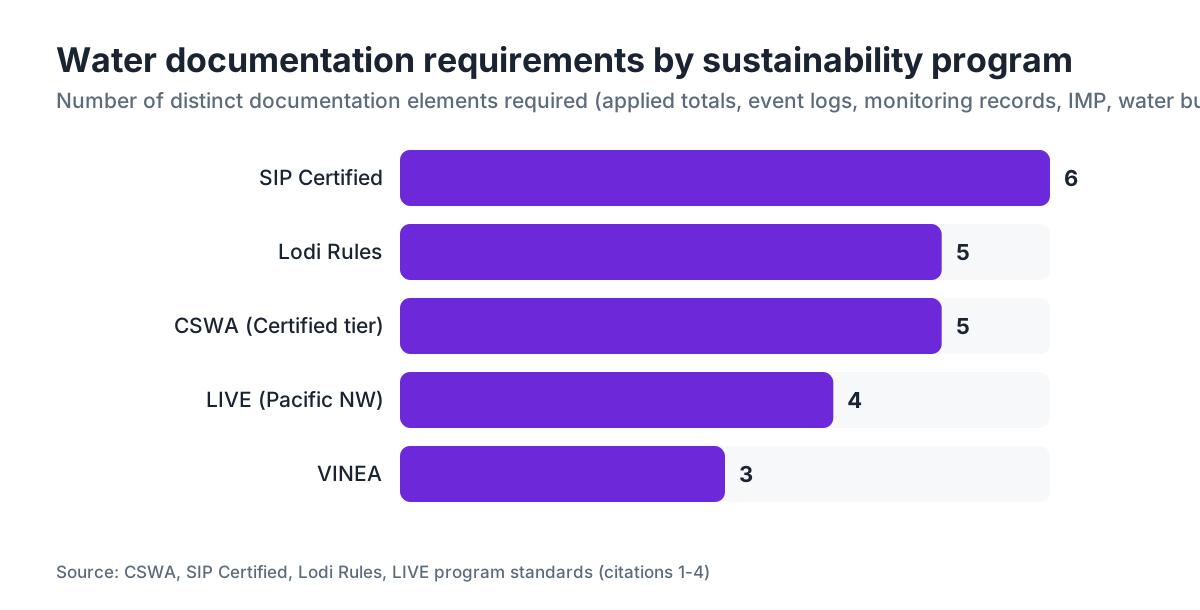
How do different sustainability programs compare on water documentation requirements?
The programs differ most on specificity and on how much third-party verification they require. Here's an honest comparison.
| Program | Geographic focus | Water docs required | Third-party audit | Soil/plant monitoring required |
|---|---|---|---|---|
| CSWA / Certified California Sustainable Winegrowing | California | Applied totals, event logs, monitoring records | Third-party for certified tier | Yes, at least one method |
| SIP Certified | California | Applied totals, annual water budget, event logs | Yes, annual | Yes |
| Lodi Rules | Central Valley CA | Event logs per Chapter 6, annual totals | Yes, third-party | Yes |
| LIVE (Low Input Viticulture and Enology) | Pacific NW | Written IMP, efficiency documentation | Yes, annual | Yes |
| VINEA (Sustainability Program) | Central Coast CA | Self-assessment workbook | Self-assessment only | Recommended, not always required |
| USDA Organic (NOP) | National | Soil/water conservation plan for certified farms | Yes, USDA-accredited certifier | Not water-specific, but soil plan required |
For growers pursuing multiple certifications at once, build your documentation to the highest common denominator. That means SIP or Lodi Rules standards for water if you're in California, LIVE standards if you're in Oregon or Washington. One set of good records usually satisfies all programs simultaneously, even if the exact checklist format differs.
USDA's NRCS (Natural Resources Conservation Service) pays cost-share for irrigation efficiency improvements through the Environmental Quality Incentives Program (EQIP). If you install a soil moisture monitoring system or upgrade to sub-surface drip with EQIP funding, the EQIP application paperwork itself documents your efficiency investment. [13] That's a two-for-one worth knowing about.
What's the minimum viable water documentation system for a small vineyard?
Minimum viable means: you can pass a first-year certification audit, you're building toward three years of trend data, and the time cost is realistic for a working vineyard manager.
Here's what that looks like in practice. One irrigation event log, either a notebook or a simple spreadsheet with columns for date, block, hours run, flow rate, and calculated gallons. Fill it in the same day you irrigate. Do not try to reconstruct it from memory at the end of the month. That's where small operations consistently fail audits.
One soil moisture reading per week during the irrigation season, from a fixed location in each management zone. Write the reading and the date. A tensiometer at two soil depths costs under $200 per station and gives you the data you need. [8]
A one-page IMP describing your system, your water source, and your decision criteria. Update it if anything changes. Date it.
A season-end summary: total applied water per block in acre-inches, total farm water in acre-feet, and a one-paragraph note on anything unusual (drought, frost event, disease pressure that required additional irrigation).
That's it. Four components, all of which you can build in a weekend if you're starting from scratch, then maintain with fifteen minutes per irrigation event. The auditor isn't expecting perfection. They're expecting a system that shows you're managing water deliberately, more than running the pump until things look green.
Frequently asked questions
What is the difference between CSWA and SIP Certified for water documentation purposes?
Both require applied water totals, event logs, and soil or plant monitoring records, but SIP Certified adds an explicit annual water budget comparing projected versus actual applied water. CSWA uses a scored workbook where you self-assess and a third-party auditor verifies records at the certified tier. For most operations, SIP's annual budget requirement is the more specific commitment and takes slightly more time to maintain.
Can I use my water district delivery records instead of a flow meter?
Yes, for farm-level totals. Water district delivery records are date-stamped and volume-specific, so most auditors accept them as primary documentation for total applied water. The limitation is that they give you a whole-farm number, not a block-level breakdown. If you want to demonstrate targeted management or score highest on water efficiency, you still need either sub-metering by zone or a method to allocate the total across blocks by run time and flow rate.
How often do I need to test distribution uniformity on my drip system?
Most certification programs don't specify a mandatory interval, but UC Cooperative Extension recommends checking each drip zone at least every two to three years, and after any major system repair or modification. Record the date, the zone, sample size, individual emitter outputs collected, and the calculated low-quarter DU. A DU below 80% generally warrants corrective action before your next irrigation season.
Does organic certification count toward water sustainability documentation?
USDA National Organic Program certification doesn't directly satisfy the water efficiency documentation requirements of California or Pacific Northwest sustainability programs. Organic certification requires a soil and water conservation plan, which overlaps conceptually, but the applied water totals, event logs, and monitoring records required by SIP, CSWA, or Lodi Rules are separate obligations. Holding organic certification alongside a water-specific program is common and the records mostly don't conflict.
What plant water potential threshold should I target and document for wine grapes?
That depends on your style goals and variety, so document your target explicitly and explain why. Many California programs see midday stem water potential targets between -1.0 and -1.5 MPa as evidence of intentional regulated deficit irrigation. WSU Extension research uses -1.0 to -1.4 MPa as a commonly cited range for moderate stress during ripening. Document your target, your readings, and any adjustments you made, so the trend makes sense to an auditor reading it cold.
Is rainfall documentation required as part of water use records?
Most programs ask you to record or reference seasonal rainfall totals so auditors can interpret your applied water volume in context. A dry year with 4 inches of winter rainfall is different from a wet year with 18 inches, even if your applied irrigation was the same. The closest weather station's precipitation record, downloaded from NOAA or CIMIS, is the cleanest way to document this without installing your own rain gauge.
Can chemigation records and irrigation records be combined in one log?
You can combine them in one log as long as it's clear which events involved only water and which involved fertigation or pesticides. Under the EPA Worker Protection Standard, pesticide application records (including chemigation) must include specific fields like the product name, EPA registration number, application rate, and restricted entry interval. Mixing those into a plain irrigation log is possible but risks the log becoming hard to read. A separate chemigation column or separate tab is cleaner.
How do I document efficiency improvements if I switched irrigation systems mid-certification period?
Document the old system's last season totals, the date of the changeover, the capital investment, and the new system's first season totals. Most programs treat a system upgrade as a documented efficiency practice and give credit for it even before multi-year trend data accumulates. Keep your contractor invoices, any EQIP cost-share approval letters, and the new system's design specs as supporting documentation.
Are there free templates for vineyard irrigation management plans?
UC Cooperative Extension and WSU Extension both publish irrigation scheduling guides that include sample record formats. UC Cooperative Extension's Drought Toolbox and WSU's viticulture irrigation pages have downloadable worksheets. Lodi Rules publishes its Chapter 6 workbook publicly, and many growers use its record-keeping tables as templates even if they're not pursuing Lodi certification specifically. None of these are locked behind a paywall.
What NRCS or USDA programs pay for water efficiency upgrades, and does applying count as documentation?
USDA NRCS's Environmental Quality Incentives Program (EQIP) pays cost-share for practices including irrigation system conversion, soil moisture monitoring installation, and irrigation water management planning. The EQIP application, practice approval, and payment documentation all work as evidence of your efficiency investment for sustainability certification purposes. Contact your local NRCS field office to find out current payment rates and practice eligibility, as they vary by state and funding year.
Do records need to be in English, or can I keep them in another language?
No program explicitly requires records in English, but auditors working through a U.S.-based certification body will almost always request English-language documentation or a certified translation for review. Practically speaking, keeping water logs in English avoids a translation step at audit time and makes it easier to share records with consultants. The regulatory content of your records (volumes, dates, block IDs) is the same in any language.
How long do I need to keep water use records after certification?
Certification programs vary, but three years is the working standard for most. Some programs require you to retain records for the length of your certification period plus one additional year. California water rights law separately requires that certain surface water diversion records be retained for five years. When in doubt, keep water records for five years. Storage is cheap and gaps in a historical record are much harder to explain than extra documentation.
What's the fastest way to get audit-ready if I've been growing for years but not keeping formal records?
Start with what you have: water bills, pump logs, water district statements, and any handwritten notes. Use those to reconstruct farm-level applied totals for prior seasons. Write your IMP now, dated today, describing your current practices. Start a formal event log immediately and note in it the date your formal record-keeping began. Most programs accept a first-year baseline audit rather than penalizing you for imperfect prior records, as long as you demonstrate a functioning system going forward.
Sources
- California Sustainable Winegrowing Alliance, Code of Sustainable Winegrowing Workbook: CSWA scores water stewardship on a 1-to-5 scale and requires applied water totals, irrigation system maps, flow meter calibration records, and evidence of soil or plant water status monitoring for highest scores.
- SIP Certified, Sustainability in Practice Program Standards: SIP Certified requires an annual water budget comparing projected versus actual applied water, with year-over-year comparison retained in records.
- Lodi Winegrape Commission, Lodi Rules for Sustainable Winegrowing: Lodi Rules Chapter 6 (Water Management) requires irrigation records including date, block, duration, flow rate, and calculated volume, subject to third-party verification.
- Washington State University Extension, Vineyard Irrigation Scheduling: WSU Extension irrigation research cites midday stem water potential between -1.0 and -1.4 MPa as a commonly used moderate-stress target for wine grapes during veraison and ripening.
- California State Water Resources Control Board, Water Rights Online Reporting: California surface water users are required to report diversions electronically, and those records can be exported and submitted to sustainability program auditors as primary water use documentation.
- UC Davis Department of Viticulture and Enology, Grape Irrigation and Water Use: Many California wine grape growers target 50-70% ET replacement during regulated deficit irrigation, depending on variety and style goals; UC Davis extension has published crop coefficient (Kc) values for wine grapes by growth stage.
- California Department of Water Resources, CIMIS (California Irrigation Management Information System): CIMIS provides free, station-level daily reference evapotranspiration (ETo) data exportable by date range, accepted by California sustainability programs as the reference ET source.
- UC Cooperative Extension, Drip Irrigation Management for Wine Grapes: UC Cooperative Extension recommends targeting a distribution uniformity (DU) of 85% or higher for drip irrigation systems in vineyards, with low-quarter DU as the standard metric.
- Cornell University Viticulture and Enology Program, Irrigation Decision-Making for Vineyards: Cornell's viticulture program recommends that irrigation decisions integrate at least two data sources to reduce variability risk across a block.
- UC Davis Cooperative Extension, Wine Grape Crop Coefficients (Kc) by Growth Stage: UC Davis viticulture extension has published Kc values for wine grapes by growth stage that are accepted by California sustainability programs without question.
- U.S. Environmental Protection Agency, Worker Protection Standard for Agricultural Pesticides: EPA Worker Protection Standard requires that pesticide application records including chemigation contain the product name, EPA registration number, application rate, and restricted entry interval.
- California Department of Water Resources, Agricultural Pump Efficiency Program: California's Department of Water Resources offers subsidized pump testing in some regions; a certified pump test produces a wire-to-water efficiency percentage used for sustainability scoring and energy benchmarking.
Last updated 2026-07-10