How to document bilingual training sessions for pesticide safety compliance
TL;DR
- Under the EPA Worker Protection Standard (40 CFR Part 170), you must train agricultural workers and handlers before they enter pesticide-treated areas, and keep those training records for two years.
- The record has to reflect the language the training was delivered in.
- Here's a system that does it right, whether your crew speaks Spanish, Mixtec, or something else.
What does the EPA Worker Protection Standard actually require for training records?
The short answer: document who was trained, when, who delivered it, and what materials you used. Keep the records two years after the training date and hand them to inspectors on request. [1]
The relevant rule is 40 CFR Part 170, specifically sections 170.309 and 170.311. Section 170.311(a) says agricultural employers must "maintain records of all training provided to workers and handlers," and those records must include the name and address of the establishment, the name of the trained individual, the date of training, and the means by which training was provided (video, in-person, written materials). [1]
Notice what the regulation doesn't do. It doesn't give you a specific form. EPA sets the data elements you must capture; your state lead agency or department of agriculture can add requirements on top. California, Washington, and New York all have their own supplemental rules. Check with your state ag department before you finalize your record format.
One thing the WPS does spell out is that training has to happen in a language the worker understands. 40 CFR 170.309(c) requires training "presented in a manner the worker or handler can understand, including in a language other than English when necessary." [1] If you never document what language you used, you can't prove you met that requirement during an inspection.
Why does language documentation matter so much for bilingual or multilingual crews?
Inspectors want evidence that workers actually understood the training, more than proof they sat through it. If 80 percent of your crew speaks Spanish and your training log says "in-person, English," you've got a gap on paper an inspector can and will flag. [2]
The stakes are real. EPA civil penalties for WPS violations can reach $9,275 per violation per day for repeat or serious cases under current penalty schedules. [3] That's not a common outcome for a single missing language notation. It's the reason a thin paper trail weakens your position.
There's also the practical side. If a worker gets hurt after a pesticide exposure and litigation follows, your training records are exhibit A. A log that shows training happened in a language the worker speaks protects you. A log with only a date and a signature says almost nothing.
For vineyards with crews that include indigenous language speakers from Oaxaca (Mixtec, Zapotec, Triqui), documented delivery gets harder. Spanish isn't a native language for those workers either. UC Davis and the California Department of Pesticide Regulation have both flagged this as a real gap in wine country training programs. [4]
What information should every bilingual training record include?
Think of your record as answering six questions an inspector would ask if they walked in tomorrow.
- Who was trained? Full legal name of each worker or handler, ideally matched to their employment record.
- When? Date and start/end time of the session.
- Where? Farm or ranch name, address, and the specific field or facility.
- Who trained them? Name and credentials of the trainer. WPS doesn't require trainers to hold a pesticide applicator license, but the trainer must have either completed an EPA-approved train-the-trainer program or be a certified pesticide applicator. [1]
- What was covered? The WPS specifies the content topics (hazards, PPE, restricted-entry intervals, emergency procedures, rights). Your record should note which materials you used: the EPA-approved video, EPA safety posters, a state-approved curriculum.
- In what language? This is where most records fall short. Note both the primary delivery language and any interpretation or supplemental materials. If you showed the EPA Spanish-language video and your lead farmworker interpreted questions into Mixtec afterward, write exactly that.
A signature or mark from each trainee isn't technically required by federal WPS for the training record itself. Some state rules require it, and it's a good idea everywhere. It creates a contemporaneous confirmation that the individual got the training. Keep a separate signature sheet keyed to the training date and session if your main log is digital.
| Required data element | Federal WPS (40 CFR 170.311) | CA DPR addition | WA WSDA addition |
|---|---|---|---|
| Trainee full name | Yes | Yes | Yes |
| Training date | Yes | Yes | Yes |
| Trainer name and qualification | Yes | Yes | Yes |
| Materials/curriculum used | Yes | Yes | Yes |
| Language of delivery | Implied by 170.309(c) | Explicit requirement | Explicit requirement |
| Trainee signature | No (federal) | Yes | Yes |
| Establishment name and address | Yes | Yes | Yes |
How should you structure a bilingual training log to survive a real inspection?
Keep the log simple enough that anyone in your operation can fill it out correctly on a busy spray day. A one-page paper form works. So does a spreadsheet or dedicated field software. The format doesn't matter. Completeness does.
For each session, create one header row or block covering the date, location, trainer, language(s), and materials. Below that, list every attendee with their name and, if your state requires it, their signature. This keeps the redundant header data off every row while still linking each person to the session details.
For vineyards running VitiScribe for field operations, the spray record and training log can live in the same dated entry, so inspectors see the training and the application history together. That context is hard to reconstruct after the fact if you're working from separate paper piles.
Be specific about language. "Spanish" beats "bilingual." "Spanish (Oaxacan Spanish dialect, with Mixtec interpretation by crew lead [name])" is better still. If you used a translated video, name it and the language version: "EPA WPS training video, Spanish edition, EPA-approved, revised 2016." [5]
Store records somewhere you can find them under pressure. Paper in a binder in the office is fine if it's organized by year and accessible to inspectors within the required timeframe. Your state may set how fast you have to produce records; California requires production within 24 hours in many cases. [6]
What EPA-approved training materials are available in Spanish and other languages?
EPA has approved several curricula and videos for WPS training, and a meaningful subset exist in Spanish. The most widely used is the "How to Comply with the 2015 Revised Worker Protection Standard for Agricultural Pesticides" video, available in English and Spanish from EPA. [5] Many state extension programs have translated supporting materials further.
UC Davis and the UC Agriculture and Natural Resources (ANR) system have produced Spanish-language pesticide safety curricula built for California farm workers, including materials adapted for low-literacy audiences. [4] These are real resources, more than translated text, and you can download or request them from UC ANR farm advisors.
Cornell's Pesticide Management Education Program (PMEP) keeps a library of WPS training resources and some bilingual materials for the Northeast. [7] Washington State University Extension has done similar work for the tree fruit and wine grape regions of Eastern Washington. [8]
For indigenous language speakers, the options get thin fast. The Mixtec Health Project and some California DPR-funded programs have produced audio training in Mixtec dialects, but coverage is inconsistent and not all dialects are covered. The honest answer: for those workers you need a qualified human interpreter, and you need to document the interpreter's name and the specific language or dialect they used.
When you use translated materials, keep a copy of the materials themselves (or a log of the exact publication title, version, and language) with your training record. If EPA published the Spanish video in 2016 and you're still running a DVD from 2012, an inspector may want to verify it still covers the 2015 WPS content requirements.
Do you need separate training records for workers who speak different languages?
No. You don't need physically separate files by language. But each training session record has to accurately reflect what happened in that session.
The practical implication: if you ran one session in English for your licensed applicators and a second session in Spanish for your field crew, those are two separate training records, not one. Same date, same trainer, same curriculum maybe, but the language of delivery differed, and each record should say so.
If you ran a single mixed session where an interpreter translated simultaneously, that's one session and one record, but the record has to show delivery was English with Spanish interpretation, plus the interpreter's name. Some compliance consultants recommend also noting the interpreter's relationship to the employer (for example, "crew supervisor, employed by [farm name]") so there's no ambiguity about who was in the room.
For audit purposes, some vineyard managers keep a secondary language-breakdown summary mapping which languages showed up in each calendar year's training. That's not required, but it makes answering an inspector's first questions fast and clean.
How long do you need to keep pesticide training records and where should you store them?
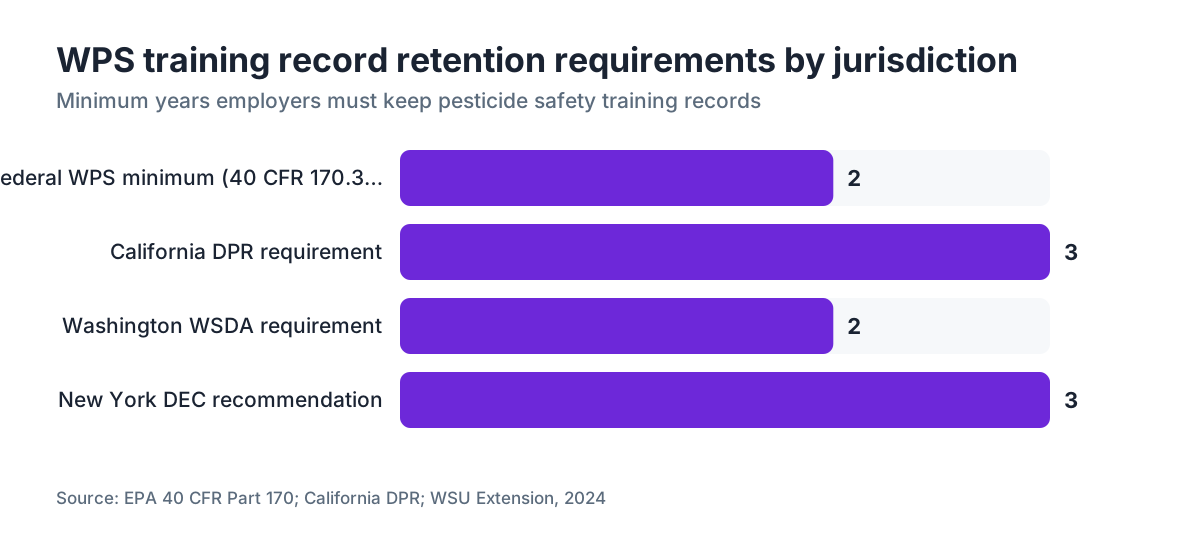
Federal WPS requires a two-year retention period for training records. [1] Some states require longer. California's Department of Pesticide Regulation requires pesticide use and safety records to be kept three years, and training records fall under that umbrella in most interpretations. [6] When state law is stricter than federal, follow the state.
Storage location is your call as long as records stay accessible. The WPS requires that records be available "for inspection and copying by representatives of EPA, OSHA, or the State lead agency" during normal business hours. [1] A locked file cabinet is fine. A cloud backup is fine. A shoebox under the manager's desk is technically fine and practically terrible.
The one thing to avoid: keeping records only on a personal phone or personal laptop that leaves the property with the manager. If that person is out during an inspection, you have a problem. At minimum, keep a paper backup or a synced shared drive.
If you're digitizing older paper records, scan them at enough resolution to read the handwriting clearly. A blurry scan of a signature page is barely better than no signature page when an inspector is squinting at it.
What happens during a WPS inspection and how do bilingual training records get reviewed?
WPS inspections come through EPA directly, through state lead agencies (often the state department of agriculture or department of pesticide regulation), or through OSHA in states where OSHA has agricultural jurisdiction. In California, that's Cal/OSHA plus the DPR. In Washington, it's the Washington State Department of Agriculture. [9]
An inspector usually asks to see training records covering the current and prior growing season. They check whether training dates precede any restricted-entry intervals on your spray records (you can't train after the fact and claim compliance), whether the content matches WPS requirements, and, increasingly, whether the language documentation is present and plausible.
"Plausible" is the word that matters. If your records say you trained 15 workers in English and an inspector notices your entire crew speaks Spanish, they'll ask follow-up questions. You don't want to explain an inconsistency on the spot.
WSU Extension's worker protection training notes that many inspectors use a targeted interview approach, asking a few workers (in their own language if possible) whether they remember receiving training and whether it was in a language they understood. [8] Your documentation and worker recall should line up. If workers keep saying "I don't remember any training" and your records say otherwise, that's a credibility problem paperwork can't fix alone.
For vineyard operations running large seasonal crews, the practical move is to build training into your pre-season crew orientation and document it the same day, not catch up later.
What are the most common documentation mistakes vineyards make with bilingual training?
The single most common gap is not recording the delivery language at all. The trainer assumed it was obvious, the log template had no field for it, and now the record is ambiguous.
Second most common: one training record covering a full season instead of a record per session. WPS requires records of training provided, which means every distinct session. Retrain after a new pesticide comes in, and that's a new record.
Third: trainer credentials not documented. WPS requires the trainer to be a certified applicator or to have completed an EPA-approved train-the-trainer program. If your bilingual session was run by a crew lead who is neither, you have a gap even if the content was perfect. [1]
Fourth: no record of which specific EPA-approved materials you used. "We showed the video" isn't enough. Which video, which language version, which revision year?
Fifth, and this one hits multilingual operations: recording the session language as "bilingual" without naming the languages. That's not a meaningful entry. Write out the languages.
How should you train and document for crews that include indigenous language speakers?
This is the hardest part of the problem, and the place where most extension guidance is honest about the limits. There's no perfect answer. There's a better practice.
First, find out whether you have indigenous language speakers on your crew before the season starts. A simple intake question during hiring, handled respectfully, tells you what you're working with. Growers in Sonoma, Napa, and the Central Valley have found that asking workers to self-identify their primary language during onboarding works well when it's framed around wanting to train them in a language they understand.
Second, find a qualified interpreter if at all possible. "Qualified" means someone who actually speaks the specific dialect (Mixtec has many mutually unintelligible dialects; "Mixtec" on a training record may mean almost nothing), more than someone who speaks some Spanish and some Mixtec. The California Rural Legal Assistance Foundation and some farmworker advocacy organizations keep lists of community interpreters. [10]
Third, document the interpreter fully: name, the specific language or dialect they interpreted into, and their relationship to the employer. If you used a phone interpretation service, log the call confirmation number and the language you requested.
Fourth, use visual and demonstration-based training wherever you can. EPA's WPS safety posters use pictograms precisely because literacy and language can both be barriers. Demonstrating PPE donning and doffing, showing workers how to read a label's signal word section, walking the team through an emergency eyewash station, these reinforce spoken instruction regardless of language.
UC Davis research on pesticide safety training with indigenous farmworkers has consistently found that demonstration-based and participatory methods work better than video or lecture formats alone. [4] That's not a documentation requirement, but it's worth building into your session design.
Is there a simple record form template you can start using today?
There's no official federal form, but the core fields fit on a single page. Here's what a functional header block looks like in plain text:
Training session date: ______
Farm / establishment name and address: ______
Trainer name: ______
Trainer qualification (circle): Certified Pesticide Applicator / EPA-approved train-the-trainer program graduate
Training materials used (title, language edition, revision year): ______
Primary delivery language: ______
Interpreter name and languages (if used): ______
Session duration: ______
Below that, a table with columns for: Trainee full name, Date of hire, Signature or mark, and (if your state requires it) last four digits of SSN or employee ID.
That's it. Print 50 copies, keep them in the vehicle with your spray records, and fill one out after every session before anyone leaves the field. The session is fresh, the signatures are genuine, and you haven't built yourself a reconstruction headache for October.
For operations managing records across multiple properties or seasons, a digital system where each training record is timestamped on creation and links to the associated spray application events is cleaner. Tools like VitiScribe let you attach training records directly to chemical use entries, so your compliance file is one coherent package instead of separate piles of paper.
What do state extension programs recommend beyond the federal minimum?
UC ANR farm advisors consistently recommend that California growers document training in enough detail to tell the story of the session, more than check a box. Their guidance suggests including a short note on trainee comprehension, such as whether workers asked questions and what came up, because it shows the training was interactive rather than a formality. [4]
WSU Extension's pesticide safety program for Washington vineyards and orchards recommends keeping a training calendar that shows planned sessions alongside completed ones, so there's evidence of intent and advance preparation instead of records that look like they were created after the fact. [8]
Cornell's PMEP recommends that New York growers keep copies of all materials handed out during training (or a log of materials shown) as part of the training file, especially when using third-party materials rather than EPA's own. [7]
All three extension programs agree on one thing: the records that hold up best in inspections and in litigation are the ones that were obviously created in real time, not assembled later. Handwriting that changes partway through a list, dates all in the same pen ink, training records with no notes or corrections, these details matter to experienced inspectors.
For vineyard managers who want to go beyond the minimum, running a brief post-training quiz (even oral, even informal) and noting in the record that comprehension was checked is a strong extra step. It's not required, but it answers the question an inspector might otherwise ask.
Frequently asked questions
Can one person serve as both trainer and record-keeper for a bilingual pesticide safety session?
Yes. The WPS has no rule separating those roles. The trainer can fill out the training log right after the session. The important thing is that the record is completed the same day, reflects what actually happened, and includes the trainer's own name and qualification. Don't date a record with a future date or reconstruct it days later if you can avoid it.
Does EPA provide a standardized bilingual training record form in Spanish?
No standardized federal form exists for WPS training records. EPA specifies the required data elements in 40 CFR 170.311 but leaves the format to the employer. Several state agencies and extension programs have published sample forms in English and Spanish, including UC ANR and the California DPR, which are freely available. Your state lead agency may have its own preferred template.
How do I document training if a worker is illiterate and cannot sign their name?
A mark (an X or thumbprint) next to the worker's printed name, witnessed by the trainer or a supervisor, is generally accepted. Write a brief note on the record that the worker is not able to sign by name and that the mark was made in your presence. Some states accept a photo of the worker at the training as supplemental documentation. Check with your state lead agency for specific guidance.
What if a new worker joins the crew mid-season after the main training session?
You must train them before they enter any pesticide-treated area or handle pesticides. That means a separate session and a separate record for that individual, even if the content is identical to what the rest of the crew got. Date the record accurately. It's common in seasonal operations, and inspectors expect to see mid-season training records for workers hired after the initial session.
Does the WPS require annual retraining, or is once enough?
The WPS requires training once every 12 months. If a worker was trained in the prior calendar year and it's still within 12 months of that date, they don't need retraining before entering treated areas. Keep the prior year's records accessible so you can show the 12-month window is still open. After 12 months, retraining and a new record are required.
Are pesticide handlers held to a different training documentation standard than field workers?
Yes, with some differences. Under 40 CFR Part 170, handlers (people who mix, load, apply, or work with pesticides) must receive handler training, which covers more content than worker training. The documentation elements are the same, but you should note in the record whether the session was worker training, handler training, or both, because the content checklists differ.
What counts as an EPA-approved training curriculum for WPS purposes?
EPA maintains a list of approved WPS training programs. Under the 2015 revised WPS, curricula must cover all required content areas listed in 40 CFR 170.309(a). The EPA-produced training video (available in English and Spanish) is approved. State lead agency curricula vetted against the 2015 standards are also approved. Using an older pre-2015 video without supplemental material on the revised content is a gap.
Do small vineyards with fewer than 11 workers get any exemptions from WPS training documentation?
No. The WPS training and documentation requirements apply to agricultural employers regardless of size if workers are employed or supervised on an establishment where pesticides are used, or if workers enter areas treated under a REI. There is no small-employer exemption in 40 CFR Part 170. Some other OSHA agricultural rules have size thresholds, but WPS does not.
Can video-only training count as bilingual training if the video is in Spanish?
Yes, if you show an EPA-approved Spanish-language video and the worker's primary language is Spanish, that satisfies the language requirement. Document the exact video title, language edition, and revision year. If you have workers who don't understand Spanish, though, you can't rely on a Spanish video for them. A video in a language the worker doesn't understand is not compliant training regardless of the language.
How do state programs like California DPR differ from the federal WPS on training records?
California's Department of Pesticide Regulation adds requirements beyond federal WPS, including explicit documentation of the training language, a three-year record retention period (versus two years federally), and trainee signatures on file. California also requires training before workers enter a field subject to a reentry interval, which in practice matches federal WPS but is enforced by a different agency with its own inspection program.
What should I do if I discover our training records from last season are incomplete or missing the language field?
Don't alter existing records. If they're genuinely incomplete, you can create a supplemental memo noting what you can reconstruct and why the original lacked the field, but never backdate or modify the original. Going forward, update your template to include the language field and brief all trainers on completing it. Proactive correction before an inspection beats getting caught mid-audit with obviously amended records.
Is an oral training session without printed materials acceptable under the WPS?
The WPS doesn't require printed materials; the key requirement is that training cover all specified content areas and be delivered in a language the worker understands. That said, some content, such as specific label information and safety data sheet information, is almost impossible to convey accurately without showing the actual document. Oral-only training with no visual aids is technically defensible but creates a harder documentation burden and a higher risk of content gaps.
Who is responsible for training records if we use a labor contractor or farm labor organization?
Both the agricultural employer and the farm labor contractor may have obligations, depending on who directs the work. Under WPS, the agricultural employer on whose establishment work occurs is responsible for ensuring workers are trained. If a labor contractor runs the training, get a copy of their training records for your files. Don't assume they're keeping compliant records without verifying.
Sources
- EPA, Worker Protection Standard 40 CFR Part 170: WPS training records must include trainee name, training date, trainer name, materials used, and establishment address; records kept two years; training must be in a language the worker understands (170.309(c), 170.311)
- EPA, Worker Protection Standard for Agricultural Pesticides: How to Comply: EPA inspectors review training records for evidence that workers genuinely understood training, including language appropriateness
- EPA, Civil Monetary Penalty Inflation Adjustments: EPA civil penalties for WPS violations can reach $9,275 per violation per day for serious or repeat cases under current penalty schedules
- UC Agriculture and Natural Resources, Pesticide Safety for Farmworkers: UC ANR has produced Spanish-language and low-literacy pesticide safety curricula; UC Davis research shows demonstration-based training more effective than video alone for indigenous-language farmworkers
- EPA, WPS Training Videos (English and Spanish editions): EPA has approved WPS training videos in English and Spanish; Spanish edition is an approved training method under 40 CFR Part 170
- California Department of Pesticide Regulation, Worker Safety: California DPR requires pesticide safety training records to be kept three years, training language explicitly documented, and trainee signatures on file; records must be produced within 24 hours of inspection request
- Cornell University Pesticide Management Education Program (PMEP): Cornell PMEP recommends maintaining copies of all training materials distributed or shown, and provides bilingual WPS training resources for Northeast growers
- Washington State University Extension, Pesticide Safety Education Program: WSU Extension recommends maintaining a training calendar showing planned and completed sessions; inspectors in WA use targeted worker interviews to check training recall
- Washington State Department of Agriculture, WPS Enforcement: In Washington, WPS inspections are conducted by the Washington State Department of Agriculture as the state lead agency
- California Rural Legal Assistance Foundation, Farmworker Resources: CRLA and associated organizations maintain community interpreter resources for indigenous-language farmworkers including Mixtec and Zapotec dialect speakers in California
Last updated 2026-07-11