How to document brix, pH, and TA at harvest for vineyard block records
TL;DR
- For each vineyard block at harvest, collect a minimum 100-berry composite sample, measure brix with a refractometer or hydrometer, pH with a calibrated meter, and TA by titration.
- Record the date, block ID, variety, row count sampled, and who took the measurement.
- Keep records for at least three years to meet most state pesticide and food-safety audit requirements.
Why do harvest maturity records matter for vineyard blocks?
Harvest maturity records are the paper trail that connects your fruit to the wine in the bottle. Without them, you can't prove when a block was picked, what the fruit quality looked like at that moment, or whether your winemaking decisions were grounded in actual data.
From a compliance standpoint, state departments of agriculture and the TTB don't specifically mandate brix/pH/TA logs, but your state's pesticide recordkeeping rules almost certainly require you to maintain crop and harvest records tied to the blocks where you applied restricted-use pesticides. California's Food and Agriculture Code, for instance, requires pesticide application records to be kept for three years and tied to specific fields or blocks [1]. If an inspector asks what was growing in Block 7 and when it was harvested, your maturity records answer that question cleanly.
Beyond compliance, the data is genuinely useful. Year-over-year brix and TA records let you see whether a block is consistently early or late relative to your other varieties, which informs irrigation cutoff timing, canopy management decisions the following season, and harvest crew scheduling. One season of data is a snapshot. Five seasons is a pattern you can actually use.
What's the right way to sample a block for brix, pH, and TA?
Sampling protocol is where most small vineyard operations cut corners, and it's the step that most determines whether your numbers mean anything. The goal is a sample that represents the whole block, more than the rows you walked past on the way to the refractometer.
UC Davis recommends a minimum 100-berry composite sample for a block up to about 5 acres, with berries collected from both sides of the vine and from multiple positions in the cluster (shoulder, mid, tip) to account for within-cluster variation [2]. For blocks larger than 5 acres or with high variability, bump that to 200 berries. Cornell's viticulture extension similarly stresses random-walk sampling: move through the block in a zigzag or grid pattern and pull 1-2 berries from each stopping point rather than stripping clusters off a few convenient vines near the road [3].
A few practical details that matter:
Sample at the same time of day, every time. Brix rises through the afternoon as water transpires from the berries. If you sampled at 7 a.m. last week and you sample at 2 p.m. today, you're not comparing the same thing. Early morning, before the sun has been on the canopy for more than an hour, is the standard.
Keep the sample cold if you can't analyze it immediately. Fermentation starts fast on ripe fruit, and a warm bag of crushed berries sitting in a truck for two hours will show elevated brix and lower TA than the same sample measured fresh.
Record the sampling location within the block if it matters, especially if you're tracking a known variability zone. GPS coordinates of the start and end of your sampling transect take 30 seconds to note and pay off if you ever want to correlate your maturity data with yield monitor data or NDVI imagery.
How do you measure brix accurately in the field?
You have two practical tools: a handheld refractometer and a hydrometer. A digital refractometer is a third option and the most accurate, but the analog handheld is fine for field screening.
For a handheld refractometer, squeeze a few berries onto the prism, close the cover, and read the scale in natural light. Calibrate to zero with distilled water before each sampling session, more than once at the start of the season. Temperature compensation matters: most modern refractometers have ATC (automatic temperature compensation) built in, but if yours doesn't, apply the standard correction of roughly 0.06 brix per degree Celsius above or below 20°C [4]. Write down the instrument ID and the calibration check result in the same record as your brix reading. If the instrument drifts and you later need to defend your harvest date or fruit quality, you want evidence that the tool was working.
Hydrometer readings require a juice sample, a graduated cylinder, and a conversion table. They're less convenient in the field but acceptable for the winery receiving record. Washington State University's extension program publishes a straightforward brix-to-potential-alcohol conversion table that's useful for winery documentation [5].
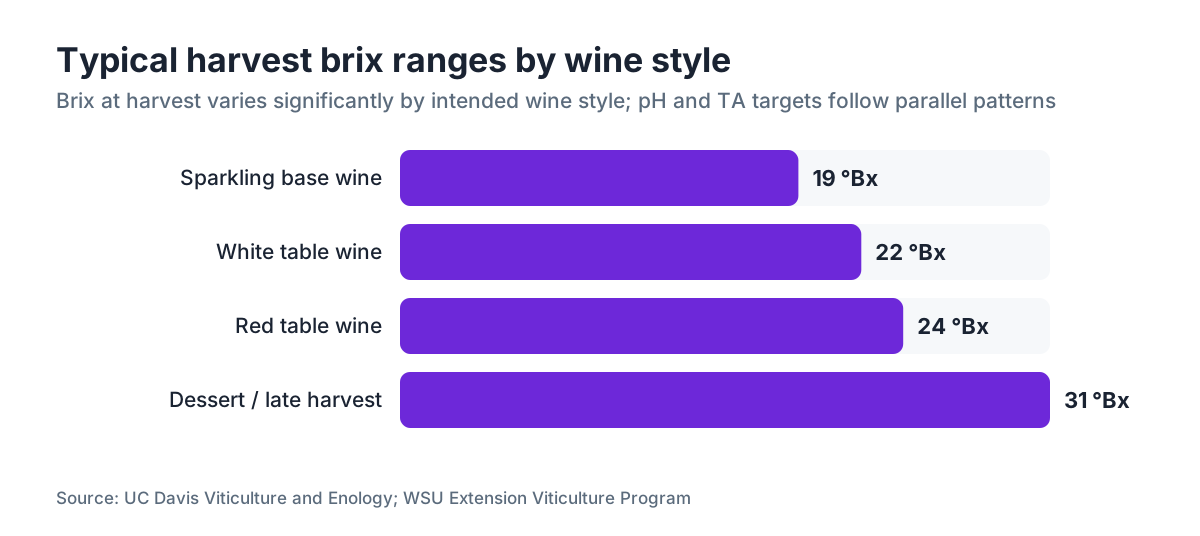
Typical harvest brix ranges by style, just so the numbers have context:
| Wine style | Typical harvest brix |
|---|---|
| Sparkling base wine | 18-20 °Bx |
| White table wine | 20-24 °Bx |
| Red table wine | 22-26 °Bx |
| Dessert/late harvest | 28-35+ °Bx |
These aren't absolute targets. They're reference points. Your own block history and winemaker's spec sheet define what's actually right for your fruit. [2][5]
How do you measure and record pH at harvest?
pH is the one measurement where a cheap tool really does hurt you. Litmus strips are not acceptable for harvest records. A calibrated bench or portable pH meter with a glass electrode is the standard, and it needs to be calibrated with fresh two-point buffer solutions (pH 4.0 and pH 7.0 are typical) before every use [2].
Buffer solutions expire and degrade once opened, especially the pH 4.0 buffer. Keep them refrigerated and note the lot number and expiration date in your calibration log. If the meter won't hold a stable reading within 0.02 pH units of the buffer value, the electrode needs cleaning or replacement before you trust any harvest data.
For the measurement itself: crush enough berries to fill the measurement vessel (usually 10-15 mL of juice is sufficient), let the electrode stabilize, and record the reading to two decimal places. Record the buffer values and calibration timestamp alongside the sample result. If you're measuring multiple blocks in the same session, rinse the electrode with distilled water and blot (don't rub) between samples.
Harvest pH targets vary meaningfully by variety and wine style. White wines destined for crisp styles are often picked between pH 3.1 and 3.3; reds are typically harvested between pH 3.3 and 3.6. Above pH 3.6, you're looking at significantly higher microbial risk in the winery and you'll likely need more sulfite additions to hit the same free SO2 target [2]. None of that shows up in your brix number, which is one reason pH is not optional in the record.
What's the correct way to measure and record titratable acidity (TA)?
TA is the one measurement most often skipped in field operations, usually because it requires a titration setup that doesn't fit in a vest pocket. That's understandable. But TA and pH together tell you something that neither one tells you alone: they reflect the acid composition of the juice, which affects perceived tartness, wine stability, and malolactic fermentation decisions.
The standard field-adaptable method is a simple NaOH titration to endpoint pH 8.2, which is the conventional endpoint for wine TA analysis [2][6]. You need:
- 5 mL or 10 mL of clarified juice (centrifuge or filter if possible; pulp interferes with the endpoint)
- 0.1 N sodium hydroxide solution, freshly standardized
- A burette or a calibrated digital titrator
- A pH meter to detect the endpoint (color indicators are less precise)
The calculation: TA (g/L as tartaric acid) = (mL NaOH used × normality × 75 × 1000) / mL juice. If you use 0.1 N NaOH and a 5 mL juice sample, the math simplifies to: mL NaOH × 1.5 = g/L TA. Record the NaOH normality, the juice volume, the mL of NaOH used, and the calculated result.
Typical harvest TA ranges:
| Wine style | Typical harvest TA (g/L as tartaric) |
|---|---|
| Sparkling base | 8-10 g/L |
| White table wine | 6-9 g/L |
| Red table wine | 5-8 g/L |
| Dessert wine | 5-9 g/L |
Acid levels drop as brix rises through the season, and they drop faster on hot days. A block sitting at pH 3.55 with TA at 4.5 g/L at 24 brix is a different decision than the same brix with TA at 7.0 g/L. [6]
What exactly should a harvest block record include?
The record format matters almost as much as the data. A scribbled brix on a napkin dated two weeks after harvest isn't going to help you in an audit or in a conversation with your winemaker next September.
At minimum, each block harvest entry should include:
- Block ID and/or name (exact match to whatever ID system you use in pesticide records and yield logs)
- Variety and clone, if tracked
- Date and time of sampling
- Who collected the sample
- Sample size (number of berries, or weight of composite sample)
- Sampling method notes (e.g., "random walk, 10 vines, 10 berries each from alternate sides")
- Instrument used for each measurement (include serial number or instrument ID)
- Calibration check result for that session
- Brix, pH, and TA values with units
- Harvest date (if different from sample date, which it often is)
- Estimated or weighed tonnage at harvest
- Any notes on fruit condition (botrytis percentage, bird damage, rain event in prior 48 hours)
If you're a small operation running everything on paper, a one-page block form per variety per year works fine. WSU Extension has published a vineyard record-keeping guide that includes sample block data sheets [5]. Cornell's viticulture team has similar templates designed for New York producers but adaptable anywhere [3].
For operations managing more than a handful of blocks, a spreadsheet or dedicated field records tool starts to pay off, especially when you want to sort by harvest date, compare across vintages, or pull data for a USDA FSMA audit. This is exactly the kind of workflow a platform like VitiScribe is built for: structured block records that stay linked to spray logs and yield data in the same place, searchable by block or by season.
One thing worth noting: if you sell to a winery under a grape purchase contract, the buyer often specifies minimum brix, maximum pH, and sometimes minimum TA in the contract language. Your records need to match what was invoiced. Keep the maturity data that matches the delivery date, more than the earlier scouting reads.
How often should you be sampling each block before harvest?
Once you're within three to four weeks of expected harvest, weekly sampling is standard practice. When brix starts climbing fast (more than 1 degree per week), move to twice-weekly. In the final 10 days before your target harvest date, some operations sample every two to three days because a heat spike can push brix 2-3 degrees in 48 hours while TA crashes.
Record every pre-harvest sample, more than the final one. That progression data is valuable. It shows you the trajectory, and it helps you understand how your block behaves climatically. A block that consistently hits 24 brix in 10 days after you see 22 brix is a block you can harvest with more precision and less fruit loss from over-ripening.
The records also protect you if a buyer disputes fruit quality. If you have documented readings showing the fruit was at 24.5 brix and pH 3.45 on the day of delivery, and the winery's receiving test comes back at 24.8 and pH 3.47, that's measurement noise. If there's a 2-brix gap and no explanation, you need your progression data to show what happened.
Do state or federal agencies require vineyard harvest maturity records?
No federal regulation specifically mandates that you record brix, pH, or TA. That's the honest answer. But several overlapping requirements create a practical obligation.
FSMA's Produce Safety Rule (21 CFR Part 112) covers produce operations, and while wine grapes used exclusively for winemaking are generally exempt under the "rarely consumed raw" provision, growers who also sell table grapes or conduct any direct-to-consumer sales of fresh fruit need harvest records that tie fruit identity to fields and dates [7]. The exemption is in 21 CFR 112.2(a).
On the pesticide side, EPA's Worker Protection Standard (WPS) and state pesticide use reporting requirements create indirect pressure to maintain field-level records that can be cross-referenced against harvest. California's DPR, Oregon Department of Agriculture, and Washington State WSDA all require pesticide application records that include commodity, location, and acreage. When audited, field harvest records are the logical complement [1][8].
For wines sold with an appellation of origin or a vintage date, TTB regulations require that a minimum of 85% of the volume come from the stated vintage year (27 CFR 4.27). Your harvest records are the documentation that supports that claim if TTB ever inquires [9].
Practically speaking, most winery buyers and grape brokers now ask for harvest maturity records as a condition of the contract. Even if no agency requires them, your customer does.
How long do you need to keep harvest block records?
Three years is the floor for most growers, and it matches California's pesticide recordkeeping requirement [1]. The USDA's FSMA Produce Safety Rule requires records to be kept for two years for covered produce [7]. TTB regulations for wine labeling records are generally two to three years depending on the record type [9].
If you participate in any federal or state cost-share programs (EQIP through NRCS, for example), those agreements often have their own record retention requirements that can run five to seven years [10].
My honest recommendation: keep harvest maturity records for five years, minimum. They're not large files. A decade of block records for a 20-block vineyard fits in a folder or a small spreadsheet. The upside of having them in year four of a contract dispute or a buyer acquisition due-diligence process is enormous compared to the cost of storing them.
What instruments should you have on hand for harvest sampling?
Here's a practical equipment list with honest notes on where to spend money and where not to.
Refractometer: a temperature-compensated handheld refractometer is all you need for field brix. $30-80 from viticulture supply companies gets you a perfectly serviceable tool. The $200+ digital refractometers are more accurate and easier to read in bright sunlight, but the extra precision isn't usually decision-relevant at the harvest threshold stage. Calibrate with distilled water. Carry a small bottle of distilled water in your pocket.
pH meter: this is where you should spend real money. A good portable pH meter with a gel-filled electrode runs $150-400 and will last years with proper care. The $20 meters fail to hold calibration and give you false confidence. Hanna Instruments, Mettler Toledo, and Apera all make reliable field-grade meters. Carry fresh buffers every time.
Digital titrator or titration kit: Hach and LaMotte make field-adaptable titration kits for TA that cost $100-250 and are accurate enough for field decisions [6]. A full burette setup is more precise but less portable. If you're doing titrations at a winery lab rather than in the field, a standard burette and ring stand is fine.
Sample bags and labels: reusable zip bags or small wine sample bottles. Label immediately with block ID and sample time. Don't trust your memory.
Field notebook or tablet: paper works. A waterproof field notebook works better in wet harvest conditions. A tablet with a vineyard records app works best if the data needs to be searchable later and linked to other block records.
Every piece of equipment should have a serial number or asset ID recorded in your calibration log. If a reading is ever questioned, you need to be able to show that the tool was checked and working on that date.
How do you handle multiple blocks with different varieties at peak harvest?
Harvest crunch is when record quality falls apart. You're sampling four blocks before 7 a.m., relaying info to the winery, dispatching the picking crew, and trying to keep the refrigerated trailer on schedule. This is exactly when someone writes "Block 4, 24.2" on a Post-it note and loses it by noon.
A few things that actually help:
Design your record form so it requires the same fields every single time, in the same order. When you're in a rush, a form with blank boxes is faster and more reliable than a blank notebook page, because you can't accidentally skip the field ID or the time.
Assign sampling responsibilities ahead of harvest. One person should own each block's sampling routine. That person is accountable for the record and knows which rows to walk.
If you're sampling five or more blocks in a session, write the records in the field, not from memory hours later. Human memory degrades fast under high cognitive load, especially for numbers. You don't need a study citation to believe this, but the effect is real and it will cost you a data point every harvest if you rely on recall.
For operations managing ten or more blocks across a multi-week harvest window, a digital system that timestamps entries on upload and links them to a block map starts to earn its keep. VitiScribe is one option built specifically for vineyard operations, where harvest maturity entries live in the same record as spray logs and tonnage invoices for each block, making year-end reporting straightforward.
For growers curious about how harvest practices fit into the broader story of California wine regions, operations at Paso Robles wineries and South Coast Winery both offer insight into how larger-scale harvest logistics are managed across diverse block portfolios.
What are common mistakes that make harvest records useless or non-compliant?
The records exist and you did the sampling. But a few specific errors make them fail in practice.
No instrument ID. If your brix number can't be tied to a specific calibrated tool, it's not auditable. Write down the instrument.
Time not recorded. Brix varies by time of day. A record that says "Sept 12" but not "6:45 a.m." leaves the data ambiguous and makes vintage progression comparisons unreliable.
Block IDs that don't match. If your spray records say "Block 7A" and your harvest records say "Pinot block south road," you have two record systems that can't be reconciled. Pick one ID system and use it everywhere from day one of the season.
TA missing. Recording brix and pH but skipping TA is common and understandable, but it means your records are incomplete as a quality document. Do all three or note explicitly why TA wasn't recorded (equipment failure, time constraint).
Backfilling records. Writing records after the fact from memory is both a data quality problem and a potential compliance problem. If records look backfilled (uniform handwriting, no corrections, suspiciously round numbers), an auditor will notice. Record in the field, in real time, with real messiness.
No calibration log. Your pH meter result is only as trustworthy as the calibration that preceded it. A calibration log showing date, time, buffers used, and instrument response is what separates a number from a documented measurement.
Frequently asked questions
What's the minimum sample size for a reliable brix reading?
UC Davis recommends at least 100 berries from a random-walk sampling pattern for blocks up to 5 acres. Pull berries from multiple vine positions and multiple cluster locations (shoulder, mid, tip). For larger or more variable blocks, 200 berries gives a more representative result. Fewer than 50 berries from a handful of vines is not statistically meaningful and shouldn't be recorded as a block sample.
Can I use a Brix strip or test tape instead of a refractometer?
No. Brix strips are designed for beverages with simple sugar content and are not calibrated for grape juice, which has a complex mix of sugars, acids, and solids. Readings from strips can be off by 2-3 degrees brix or more. Use a calibrated handheld refractometer or hydrometer. The tools cost $30-80 and are the only field methods that produce defensible data.
How do I calculate TA from a titration if I use a 10 mL juice sample and 0.1 N NaOH?
The formula is: TA (g/L as tartaric acid) = (mL NaOH × 0.1 × 75 × 1000) / mL juice. With a 10 mL sample and 0.1 N NaOH, it simplifies to: mL NaOH × 0.75 = g/L TA. Titrate to pH 8.2 endpoint using a calibrated pH meter rather than a color indicator, which is less precise near the endpoint. Record the NaOH lot number and normality in the same entry as the result.
Is there a federal requirement to keep harvest maturity records?
No federal rule specifically requires brix, pH, or TA records for wine grape growers. However, TTB vintage date regulations (27 CFR 4.27) and FSMA Produce Safety Rule requirements (21 CFR Part 112) create related documentation needs. State pesticide recordkeeping rules also require field-level records that complement harvest data. In practice, most buyers contractually require maturity records.
How far in advance of harvest should I start sampling?
Start weekly sampling three to four weeks before your expected harvest window. Switch to twice-weekly when brix is climbing more than 1 degree per week. In the final 10 days, sample every two to three days, especially if a heat event is forecast. Log every sampling date, more than the final pre-harvest reading. The progression data is as useful as the endpoint number.
What time of day should I collect harvest maturity samples?
Early morning, before the sun has been on the canopy for an hour, is standard. Brix rises through the afternoon as water transpires from berries; an afternoon sample can read 0.5-1 degree higher than the same block sampled at 7 a.m. Record the exact time on every entry and sample at the same time each session so that your progression readings are comparable.
Do I need a separate record for each vineyard block or can I combine blocks?
Separate records per block. Blocks differ in variety, clone, rootstock, canopy management, and microclimate, which means their maturity curves differ. Combining blocks into one average record hides that variation and makes the data useless for future planning. It also creates compliance problems if your block-level pesticide records are ever cross-referenced against harvest records.
How do I document fruit condition issues like botrytis or rain dilution in the harvest record?
Add a condition notes field to your block record form and fill it in at sampling time. Note estimated botrytis percentage, any visible rain-split, and whether a rain event occurred in the 48-72 hours before sampling. Rain events dilute brix and raise TA; botrytis increases pH and alters sugar composition. A brix reading without a note about a 2-inch rain two days prior is misleading.
What's the best way to store harvest records so they're easy to retrieve in an audit?
Organized by vintage year and block ID, in a format you can search. Paper records in labeled binders, scanned to PDF, work fine. A spreadsheet keyed to block ID and date is better. A vineyard records system that links maturity data to spray logs and delivery invoices is best. Keep records for a minimum of three years; five is safer given NRCS and buyer contract timelines.
My winery buyer tests fruit at the receiving dock and gets a different brix than I measured. How do I handle that?
Small differences (less than 0.5 brix) are normal measurement noise from different instruments and sample timing. Document your field reading, the instrument used, and the calibration check from that session. If the gap is larger than 1 degree, request a joint re-test or ask the buyer to share their calibration records. Your field documentation is your evidence that you measured correctly at the time of sampling.
How do temperature and sunlight affect pH meter readings in the field?
Most modern portable pH meters have automatic temperature compensation (ATC) that adjusts for sample temperature. However, very cold juice (below 10°C) or very warm juice (above 30°C) can affect electrode response time. Let the juice equilibrate toward room temperature before measuring if possible, and verify the meter shows a stable reading before recording. Always rinse and blot the electrode between samples.
What brix-to-potential-alcohol conversion should I use on records?
The standard approximation is: potential alcohol (%) = brix × 0.55. So 24 brix gives roughly 13.2% potential alcohol. This is an approximation; actual conversion depends on yeast strain, fermentation conditions, and residual sugar. WSU Extension publishes a detailed conversion table. For record-keeping purposes, log the actual brix and note the conversion factor used if you're calculating potential alcohol.
Can I use the same record form for organic and conventional blocks?
Yes, but your organic blocks need a field in the record that flags them as certified or transitional, and those records need to link cleanly to your organic system plan and crop activity log. NOP regulations require organic producers to maintain records sufficient to demonstrate compliance, and harvest maturity records form part of that audit trail alongside application records and yield data.
Sources
- California Department of Pesticide Regulation, Pesticide Use Reporting: California requires pesticide application records to be kept for three years and tied to specific fields or blocks under the Food and Agriculture Code.
- UC Davis Viticulture and Enology, Sampling and Analysis for Harvest: UC Davis recommends a minimum 100-berry composite sample for blocks up to 5 acres, calibrated pH meters with two-point buffers, and pH 8.2 as the TA titration endpoint.
- Cornell Cooperative Extension, Viticulture Program, Vineyard Record Keeping: Cornell's viticulture extension stresses random-walk sampling protocols and provides block data sheet templates for New York producers.
- American Society for Enology and Viticulture, Brix Measurement Methods: Standard temperature correction for refractometer readings is approximately 0.06 brix per degree Celsius above or below 20°C.
- Washington State University Extension, Vineyard Record Keeping Guide: WSU Extension publishes a brix-to-potential-alcohol conversion table and vineyard record-keeping guide including sample block data sheets.
- Hach Company, Titratable Acidity Analysis for Wine and Juice: Standard TA analysis uses 0.1 N NaOH titrated to pH 8.2 endpoint; field-adaptable digital titration kits from Hach cost $100-250.
- FDA, FSMA Produce Safety Rule, 21 CFR Part 112: Wine grapes used exclusively for winemaking are generally exempt from the Produce Safety Rule under 21 CFR 112.2(a) as a commodity rarely consumed raw; covered produce records must be kept two years.
- EPA, Worker Protection Standard for Agricultural Pesticides: EPA's Worker Protection Standard and state pesticide use reporting requirements create field-level records that are cross-referenced with harvest documentation.
- TTB, 27 CFR 4.27, Vintage Date Labeling Requirements: TTB regulations require that a minimum of 85% of wine volume come from the stated vintage year; harvest records document that claim.
Last updated 2026-07-11