How to document certified planting material sourcing for disease compliance
TL;DR
- To pass a disease-compliance audit, you need the nursery invoice showing certification program and lot number, the state-issued phytosanitary certificate, the variety and rootstock identification tag, and dated field planting records tying each lot to a specific block.
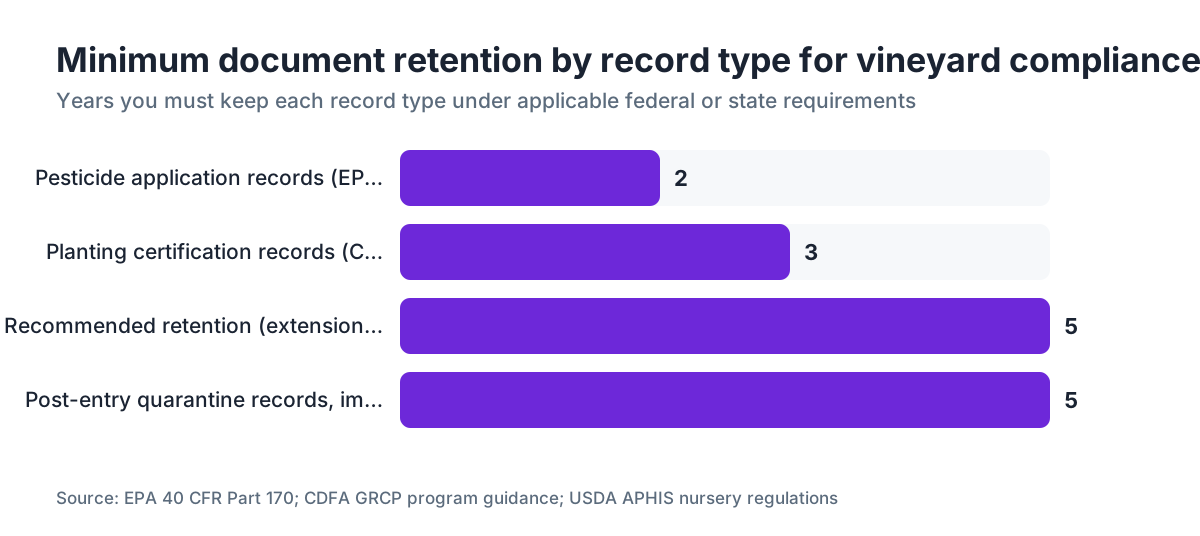
- Keep everything at least three years.
- Five is safer in states with active Pierce's disease or leafroll programs.
Why does certified planting material documentation matter for disease compliance?
Plant vines you can't trace, and you're exposed. That's the short version.
Grapevine diseases travel on plant material. Grapevine leafroll-associated viruses, Grapevine red blotch virus, Xylella fastidiosa (the bacterium behind Pierce's disease), fanleaf degeneration, and a long list of others move from infected nursery stock into the ground, where they stay for the life of the planting. The rules that grew up around this risk require growers to source from certified programs and, more to the point, to document that they did.
Documentation matters for three distinct reasons. If you need to make a disease-management claim to your crop insurer or to a state compensation program, you have to show the planting was clean at establishment. If a county agricultural commissioner or state inspector shows up after a disease detection in your area, traceability is what separates a warning from a quarantine notice. And if you sell fruit or wine grapes under a contract that specifies virus-tested or certified vines, the buyer can ask for records at any time.
The paperwork itself is simple. The hard part is building a system that captures it the moment the truck arrives, not six months later when you're reconstructing a nursery order from memory.
What are the main certified planting material programs in the US?
Program structure changes by state, but a consistent federal and state layer sits underneath all of them.
At the federal level, USDA APHIS regulates importation of grapevine material under the Plant Protection Act and issues Federal Phytosanitary Certificates for interstate movement of nursery stock [1]. Any vine crossing a state line commercially should come with one.
California runs the most developed state system through the California Department of Food and Agriculture (CDFA). The Grapevine Registration and Certification Program (GRCP) sorts planting material into Foundation, Registered, and Certified tiers based on testing history and generation distance from the nuclear stock [2]. A vine labeled "Certified" under GRCP has been propagated from tested Foundation material and passed an additional field inspection cycle.
Washington State operates through the WSU-affiliated Clean Plant Center Northwest (CPCNW), which maintains nuclear stock for the Pacific Northwest and provides foundation material to registered nurseries [3]. Oregon's program coordinates with CPCNW and the Oregon Department of Agriculture.
New York's program runs through Cornell's viticulture extension and the NYS Department of Agriculture and Markets. The National Clean Plant Network (NCPN), funded through USDA NIFA, connects state programs and maintains minimum testing protocols for what can carry the "clean plant" designation [4].
If you're in a state with no formal certification tier, the NCPN-Grapes guidance is the closest thing to a national baseline. A vine from an NCPN-participating nursery has been propagated from material tested for the core virus panel, which currently covers grapevine leafroll viruses 1, 2, and 3, grapevine red blotch virus, and fanleaf nepovirus at minimum [4].
| Program | State/Region | Tiers | Key agency |
|---|---|---|---|
| GRCP | California | Foundation, Registered, Certified | CDFA |
| CPCNW | WA, OR, ID | Nuclear, Foundation | WSU / state DOAs |
| NCPN-Grapes | National | Clean Plant designation | USDA NIFA |
| Cornell/NYS | New York | Foundation, Certified | Cornell / NYS Ag & Markets |
| Other state programs | Varies | Varies | State DOA |
What documents do you actually need to collect at time of delivery?
This is where most growers fall short. The documents exist somewhere. Nobody grabbed them at the right moment.
Here's the minimum set you want in hand before the delivery truck leaves your property.
First, the nursery invoice or sales order. It has to show the nursery license number, the variety and clone designation, the rootstock (if budded), the certification tier and program name ("CDFA Certified," for example), and the lot or block number at the nursery. If the invoice is missing any of this, call the nursery before the driver leaves and get a supplemental document in writing.
Second, the phytosanitary certificate. For intrastate deliveries in California, this comes from CDFA inspection of the nursery. For interstate shipments, it's the USDA APHIS Federal Phytosanitary Certificate or the origin state's equivalent [1]. The certificate carries an inspection date, the inspector's badge number or ID, and the specific lot description. File the original.
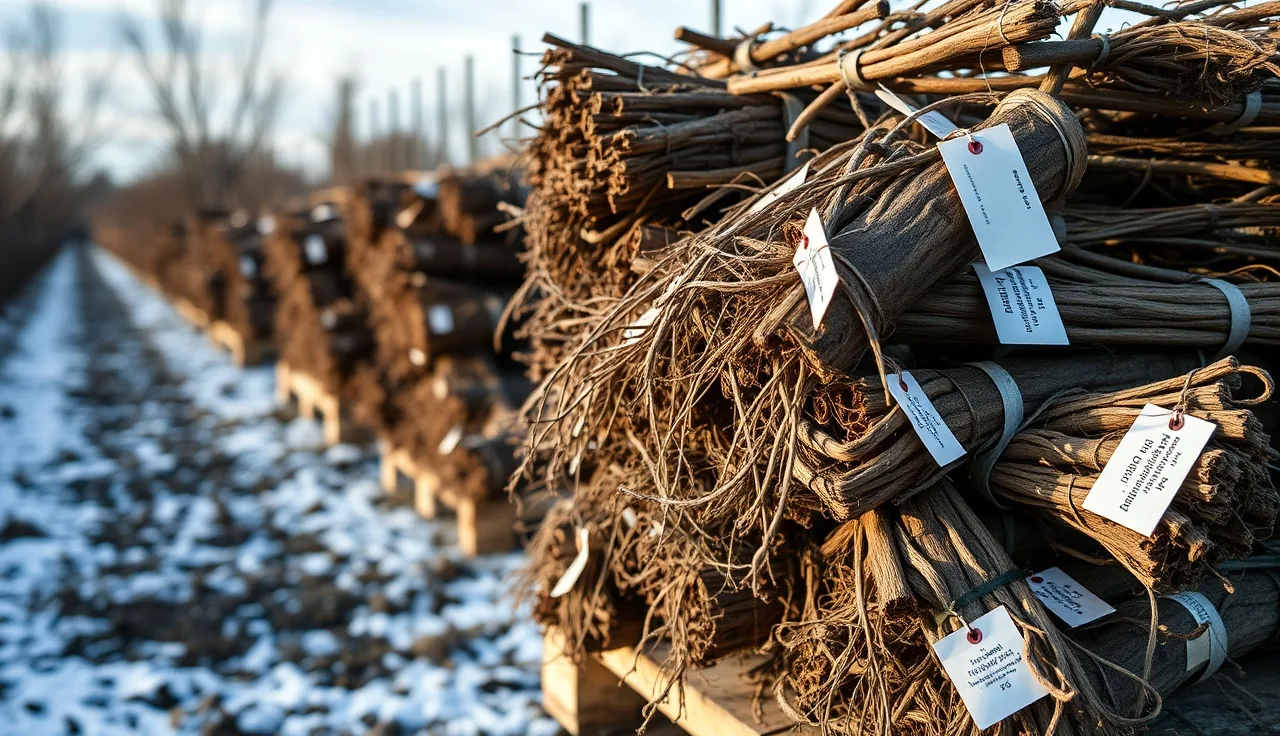
Third, the variety and rootstock tags. These plastic tags wired to the bundles are legally part of the labeling in most states. Don't throw them away. Photograph them with your phone the moment bundles are opened, then file the physical tags in a labeled envelope by delivery date and block.
Fourth, the nursery's own test records or test summary, if available. NCPN-participating nurseries and most GRCP-registered nurseries will hand you a test certificate or a reference number you can look up. This shows which virus panel the foundation material was screened against and roughly when.
Fifth, your own receiving log. Date of delivery, driver name or truck number, quantity by variety and rootstock, internal block assignment, and the names of the certifying documents you received. This is your chain-of-custody record, and it's what makes everything else traceable.
How do you create a field planting record that satisfies an audit?
The nursery paperwork proves what you bought. The field planting record proves what went into the ground, and where.
An auditor from CDFA, the county ag commissioner, or a crop insurance adjuster wants to walk your vineyard, point at a block, and trace that block back to a specific nursery lot. Your planting record makes that possible.
The record needs to capture the date planted, the block identifier (GPS coordinates or a clear block map reference), the variety and clone code, the rootstock, the row and vine count, the nursery lot number from the delivery, and the name of the person who supervised the crew. If you replanted dead vines within a year or two of the original planting, those replacement vines need their own entry, because they may have come from a different nursery lot.
Block maps are worth the time. A simple hand-drawn map with labeled blocks, tied to your planting record by block ID, satisfies most audits. If you use a GPS-enabled record platform like VitiScribe that links field blocks to input records, the audit trail is built in and you're not digging through folders.
Keep the planting record and the supporting nursery documents together, either in a labeled binder or a digital folder structure that mirrors your block layout. CDFA's GRCP guidance recommends growers retain certification records for a minimum of three years from planting [2]. Washington State's CPCNW materials suggest similar retention. In practice, five years is the better target, because disease investigations sometimes follow infection events that stay hidden for years after establishment.
What does a state audit or inspection actually look for?
State inspectors checking planting material compliance are looking at three things: that you used a licensed nursery, that the material carried the right certification, and that your records prove both.
In California, a CDFA nursery compliance inspection can include verifying that growers receiving GRCP-certified material hold the matching documentation [2]. The GRCP requires nurseries to keep propagation records. The grower receiving the material is responsible for keeping receiving records.
Inspectors rarely show up to check planting records for no reason. It usually takes a disease detection in the area, a nursery losing its license, or a filed complaint. When they do come, here's what they want to see:
- The nursery's license number and the certification tier on the invoice.
- The phytosanitary certificate for the specific lot.
- A field planting record or block map showing where the material went.
- Evidence you can trace any replant material back to its own documentation.
What they're not usually checking, at least at routine grower inspections, is whether you personally verified the nursery's propagation chain. That's the nursery's burden. Your burden is receiving documentation and knowing where you planted the material.
One real risk: if a nursery later has its certification revoked retroactively, which happens when testing failures surface after shipment, CDFA may notify buyers and ask them to remove and destroy the affected material. If you have no records showing which block the material went into, you can't target the removal, and the whole vineyard becomes suspect.
How do EPA Worker Protection Standard requirements interact with planting records?
This is a separate compliance layer that overlaps with planting material records more than growers expect.
The EPA Worker Protection Standard (WPS) governs pesticide exposure for agricultural workers and handlers [5]. WPS is mostly about pesticide application records, but it touches planting material documentation in one specific way: if you're applying any registered pesticide to newly planted certified vines, you need an active pesticide use record for that site, and that record points to the same block that should appear in your planting records.
More directly, if you're treating nursery stock or dormant vines at delivery with any restricted-use or general-use pesticide (a fungicide dip, a nematicide drench, a dormant spray), WPS requires records of the pesticide applied, the application date and rate, the site, and the applicator's license number where applicable [5]. Those records belong in the same block folder as your planting certification documents. An inspector who finds a pesticide application record for Block 7 but no planting certification record for Block 7 is going to ask questions.
WPS also requires that workers in treated areas within the restricted-entry interval (REI) receive training. That applies in the establishment year too, so if your planting crew is working a block that got a dormant spray, your WPS records need to reflect their training status. It isn't a planting-material documentation issue on its face, but it surfaces during the same audits.
For WPS record retention (two years for application records under 40 CFR Part 170), the EPA's agricultural WPS page is the primary reference [5].
What records do you need for imported or out-of-state vines?
Out-of-state shipments add a layer that catches people off guard.
Any grapevine material moved interstate for commercial planting requires a Federal Phytosanitary Certificate issued by USDA APHIS or the originating state's department of agriculture acting under APHIS authority [1]. The certificate has to travel with the shipment, not arrive separately.
Beyond the federal certificate, the receiving state may have its own import permit requirements. California requires an import permit for nursery stock from out of state, and shipments get inspected at border stations [6]. Arizona, Texas, and Florida have their own requirements tied to Pierce's disease and other regulated pests. If you're ordering from a nursery in another state, confirm the permit situation before the order ships, not after.
For material imported from outside the US, the requirements get heavier. USDA APHIS regulates importation of Vitis propagative material under 7 CFR Part 319 [1]. Importation generally requires post-entry quarantine and indexing, and the material must come through an approved port of entry with prior APHIS authorization. This process typically takes two to three years before the material clears for field planting. Keep every APHIS authorization letter, quarantine inspection record, and post-entry test result. Those are your entire chain of custody.
Most small and mid-size vineyards buy domestically. But if you're chasing a rare clone or importing specialty material from Europe or South America, read 7 CFR 319 and call APHIS Plant Protection and Quarantine (PPQ) early.
How should you physically organize and store planting material records?
A document system that works at 3 AM before an 8 AM audit is one you actually built and used, not one you meant to build.
The simplest physical setup is a three-ring binder per planting year, tab dividers by block. Under each block tab: the nursery invoice, the phytosanitary certificate, photocopies or photos of the variety tags, the nursery's test summary, and your receiving log entry. The block map goes at the front.
For digital storage, a folder structure like /Planting Records/2024/Block-7/ holding scanned PDFs of all the above works cleanly. The point is that every document is searchable by block ID and nursery lot number. If you have to flip through 80 pages of mixed documents to find one certificate, the system already failed you under audit pressure.
Some growers photograph all nursery documents at delivery and dump them into a cloud folder labeled with the date. Better than nothing, but it turns into a mess when you need records for a specific block two years later. Spend the extra few minutes on a consistent file name: YYYY-MM-DD_Block7_Nursery_Invoice.pdf.
Mid-size operations handling multiple deliveries across multiple varieties in one season benefit from a spreadsheet master log listing every delivery, its nursery, lot number, certification tier, block assignment, and document filenames. That master log is the first thing you hand an inspector, because it tells them where everything lives.
Platforms built for vineyard record-keeping, like VitiScribe, can link block records to uploaded documents directly, which takes the naming-and-filing step off your crew. Software or binder, the discipline of capturing documents at delivery matters more than where you store them.
What can go wrong, and how do you fix it retroactively?
You planted vines three years ago, the tags are long gone, and the nursery invoice has vanished. Now what?
Start with the nursery. Licensed nurseries in states with formal certification programs have to keep their own propagation and sales records. Call them and request a duplicate invoice or written confirmation of the lot number and certification tier for your order. Get it in writing and date it clearly as a retroactive confirmation. It isn't as clean as the original, but it beats nothing.
Next, check your bank records, email, and purchase orders from that year. A wire transfer to a nursery is circumstantial evidence of a commercial purchase. An email thread discussing variety and clone choices is useful context.
For the phytosanitary certificate, contact the CDFA Nursery Program (in California) or the originating state's department of agriculture. Inspection records are public documents in most states and can be pulled by shipment date and nursery license number [6].
If you truly can't reconstruct the documentation and you're facing an audit, tell the inspector what you have and what you're missing. Building plausible-looking records after the fact is a different kind of legal problem. Most inspectors dealing with a cooperative grower who can show good-faith sourcing from a licensed nursery, even with gaps, treat it very differently from a grower with no documentation at all or one who appears to have planted non-certified material.
Going forward, the fix is a delivery protocol. Every delivery, every time: invoice, certificate, tags, receiving log, photos. Takes 15 minutes and saves a lot of pain.
What additional resources and extension guidance are available?
Three university extension programs are worth bookmarking on this topic: UC Davis, Cornell, and WSU.
UC Davis Foundation Plant Services (FPS) manages the foundation plant repository for California and publishes detailed guidance on GRCP certification tiers, what testing each tier requires, and how to read nursery labeling [7]. Their site includes a searchable database of registered clones and rootstocks, useful for confirming that the clone designation on your invoice actually exists in the program.
Cornell Cooperative Extension covers eastern US disease challenges, especially grapevine leafroll, which is widespread in New York's Finger Lakes and Hudson Valley. Their viticulture extension page covers record-keeping recommendations and links to the NYS Agriculture and Markets nursery inspection program [8].
WSU's Clean Plant Center Northwest publishes protocols for how foundation material is maintained and propagated, and offers grower-facing guidance on reading the certification documentation that comes with CPCNW-sourced material [3].
The National Clean Plant Network's website (ncpn.info, run under USDA NIFA funding) maintains the minimum testing protocols every NCPN-affiliated program follows. Their published protocols spell out exactly which viruses and viroids each lot must be tested for before it can carry the clean plant designation [4]. Read it once so you know what the certification on your invoice actually represents.
UC ANR also publishes practical viticulture notes on disease management in new plantings that read more like field guidance than regulatory text. Worth keeping in the same binder as your compliance records.
How do you handle replants and gap-filling within an existing block?
Replants are the documentation gap that surprises growers most often.
When you fill in dead or missing vines in an established block, those replacement vines are a new planting event. They need their own documentation: their own nursery invoice, their own phytosanitary certificate, and a specific entry in your block record noting the row and position numbers filled, the date, and the nursery lot.
This matters because a disease inspector tracing an infection in a block may need to know whether the infected vine came from the original 2019 planting or a 2022 replant. Different nursery lots, potentially different certification histories, and pointing at the right lot is how the investigation moves.
If you're replanting with own-rooted vines from your own nursery block, the requirements shift. You're no longer buying certified material from a licensed nursery, so the chain of custody has to come from the records of the original certified material you propagated from. Most state programs prohibit or heavily regulate self-propagation from non-foundation material, so unless you're working with an approved foundation stock source, this path gets complicated fast.
The cleanest approach for replants: use the same nursery you used originally when you can, request material from the same variety-clone-rootstock combination, and file the new invoice with a clear note in your block record showing it covers replant positions, not a new planting.
Frequently asked questions
How long do I need to keep certified planting material records?
CDFA guidance recommends a minimum of three years from planting for GRCP certification records. EPA WPS records for pesticide applications made in the same period require two years retention under 40 CFR Part 170. Most extension advisors and compliance consultants recommend five years, because disease investigations can follow infection events detected years after establishment. Keep the records for the life of the planting if storage allows.
What is the difference between Foundation, Registered, and Certified vine material?
Under California's GRCP, Foundation material is maintained directly from nuclear stock at a state-registered facility like UC Davis Foundation Plant Services and tested regularly for a full virus panel. Registered material is propagated one generation from Foundation and inspected in the field. Certified material is propagated from Registered stock and has passed a field inspection cycle. Each tier down adds one propagation generation and more exposure time, but all three start from tested nuclear stock.
Does certified planting material documentation differ for grafted vines versus own-rooted?
Yes. Grafted vines need documentation for both the scion variety and the rootstock, each with its own certification status. Your nursery invoice should list both the variety clone code and the rootstock code with the certification tier for each. Own-rooted vines need documentation for the scion variety only, but the certification requirements are the same. Some rootstocks have their own certified clonal selections within state programs, so confirm both components are covered on your paperwork.
What happens if my nursery's certification is revoked after I planted the vines?
If a nursery loses certification for a lot you've already planted, the state program will typically notify buyers. You'll be asked to provide planting records showing which block received that material, then potentially to submit tissue samples for testing. If testing confirms infection, removal and destruction orders can follow. Your documentation showing the specific block is what limits the scope of any response. Without records, regulators may treat your whole vineyard as exposed.
Can I source vines from a nursery in another state without a phytosanitary certificate?
No. Interstate commercial movement of grapevine nursery stock requires a Federal Phytosanitary Certificate under the Plant Protection Act, issued by USDA APHIS or the originating state's department of agriculture under APHIS authority. The certificate must travel with the shipment. Many receiving states also require an import permit applied for before the shipment leaves. Receiving vines without these documents puts you in violation of federal plant protection regulations and undermines your compliance records.
What is the NCPN and does it replace state certification programs?
The National Clean Plant Network (NCPN) is a USDA NIFA-funded network of clean plant centers that sets minimum testing protocols and maintains foundation material for several crops including grapes. It doesn't replace state programs. It sets the baseline they build on. A vine from an NCPN-affiliated nursery has been propagated from material tested for the core virus panel. State programs like CDFA's GRCP add their own inspection and generation-tracking requirements on top of the NCPN baseline.
Do I need special documentation if I'm planting a rare or heritage clone?
If the clone is in a state or NCPN-recognized foundation program, the documentation requirements match any certified material. If you're planting material that isn't registered in any certification program, you're working outside certified channels with no compliance documentation to collect. Some states allow provisional or experimental planting of unregistered clones under permit, with extra testing requirements. Check with your state department of agriculture before planting anything not already in a recognized program.
What role do variety and rootstock tags play in a compliance audit?
Tags are legally part of the nursery labeling in most states and serve as physical evidence of variety identity and certification at delivery. An auditor may ask to see them as corroboration of your invoice records. Photograph them immediately at delivery and store the physical tags in a labeled envelope by block and delivery date. Tags fade and deteriorate, so the photos are your backup. Never throw tags away until the planting has been audited or the statutory retention period has passed.
How does grapevine red blotch virus factor into certification documentation?
Grapevine red blotch virus (GRBV), first formally described around 2012, was added to the testing panels of most NCPN-affiliated programs by the mid-2010s. Material certified before GRBV was included in testing panels may not have been screened for it. If you're reviewing older certification records, check the test date and the virus panel listed. NCPN's current minimum protocol requires GRBV testing for new foundation designations. UC Davis Foundation Plant Services updated their testing protocols after GRBV was characterized.
Can I use the same documentation system for spray records and planting records?
You can, and it makes sense to link them. Your spray records reference the same block IDs as your planting records, so a unified block file keeps everything an auditor might want in one place. Physical binder per block or digital system, having planting certification, pesticide application records, and any disease scouting logs all tied to the same block identifier means you're ready for a WPS records check or a disease-compliance inspection out of the same folder.
What if I bought vines at an auction, estate sale, or from another grower, not a nursery?
This is a serious documentation problem. Vines acquired outside licensed nursery channels have no certification chain of custody by definition. Some states explicitly prohibit moving grapevine material commercially without a nursery license and phytosanitary clearance. If you plant these vines, you have no compliance documentation. Your options are to not plant them, or contact your state department of agriculture to find out if a testing and provisional registration process could establish a clean designation.
What's the best way to train staff to capture documentation at delivery?
Write a one-page delivery checklist and tape it to the receiving area wall. List: invoice with nursery license and lot number, phytosanitary certificate, variety tags photographed, receiving log entry filled out, documents filed in block folder. Walk through it once with everyone who might sign for a nursery delivery. The failure mode is almost never that people don't know what to do. It's that nobody built the moment of documentation into the physical workflow of receiving.
Sources
- California Department of Food and Agriculture, Grapevine Registration and Certification Program: CDFA's GRCP classifies planting material into Foundation, Registered, and Certified tiers; growers receiving certified material are responsible for retaining receiving documentation for a minimum of three years
- Washington State University, Clean Plant Center Northwest: WSU's Clean Plant Center Northwest maintains nuclear stock for the Pacific Northwest and provides foundation material to registered nurseries in Washington, Oregon, and Idaho
- USDA NIFA, National Clean Plant Network - Grapes: NCPN-Grapes establishes minimum testing protocols including grapevine leafroll viruses 1, 2, and 3, grapevine red blotch virus, and fanleaf nepovirus for the clean plant designation
- US EPA, Agricultural Worker Protection Standard (WPS) - 40 CFR Part 170: EPA WPS requires pesticide application records to be retained for two years and governs exposure protections for workers in treated areas including newly planted blocks
- California Department of Food and Agriculture, Nursery Program - Import Requirements: California requires an import permit for nursery stock from out of state, and shipments are subject to inspection at border stations
- UC Davis Foundation Plant Services, Grapevine Certification Program: UC Davis Foundation Plant Services manages foundation plant repositories for California's GRCP and publishes guidance on certification tiers and testing protocols for registered clones and rootstocks
- Cornell Cooperative Extension, Viticulture and Enology Program: Cornell Cooperative Extension covers eastern US grapevine disease challenges including leafroll virus management and links growers to NYS Agriculture and Markets nursery inspection resources
- UC ANR Statewide Integrated Pest Management Program, Grapevine Red Blotch: Grapevine red blotch virus was first formally characterized around 2012 and subsequently added to NCPN and CDFA testing panels for foundation material designation
Last updated 2026-07-10