How to document custom applicator work in vineyard spray records

TL;DR
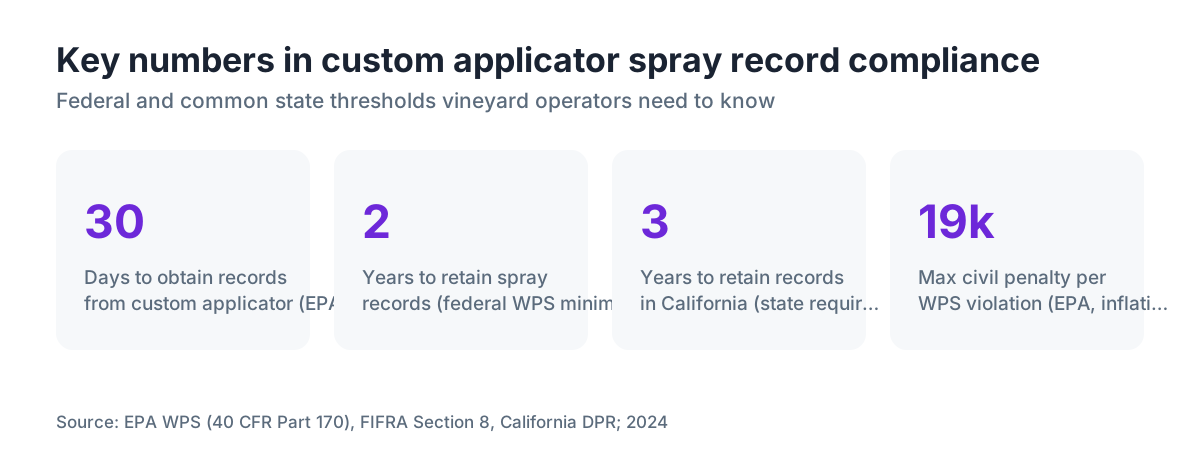
- When a custom applicator sprays your vineyard, the EPA Worker Protection Standard (40 CFR Part 170) requires you to obtain and keep records of every application for at least two years.
- The applicator must give you a copy within 30 days.
- You still log site, product, rate, REI, and the certified applicator's license number.
- Both parties carry liability for missing records.
What does the law actually require when a custom applicator sprays your vineyard?
The law is clearer here than most growers assume. Under the EPA Worker Protection Standard (40 CFR Part 170), and backed by FIFRA Section 8 recordkeeping rules, any pesticide application to an agricultural establishment has to be documented, and the agricultural employer (that's you, the vineyard operator) has to keep those records available to workers and inspectors for at least two years after the application date. [1]
The custom applicator is not off the hook. Under 40 CFR Part 171 and most state licensing laws, licensed commercial applicators have their own duty to keep records of every application they perform. But their file sitting in their office does nothing for you. You need your own copy, or at minimum a signed copy they hand you. [2]
The WPS timeline is explicit. Read the rule and the message is plain: the agricultural employer has to obtain the pesticide application and hazard information within 30 days of the application. [1] Thirty days is the outer wall, not the goal. If an REI is running and your crew needs to get back in the rows, you need that information the same day, not next month.
State rules stack on top of the federal floor. California, Washington, and New York each want detail beyond the EPA minimum, and California's County Agricultural Commissioner system adds a whole separate reporting layer. Call your state department of agriculture before you assume federal compliance covers you.
What specific information must the spray record include for a custom applicator application?
A record missing even one required field can fail an inspection. The WPS and most state statutes converge on a core set of data elements. Here is what belongs on every record.
| Field | Notes |
|---|---|
| Applicator name and license number | The certified applicator who made the decision, more than whoever drove the rig |
| Business name and address of the custom applicator | Required by most state commercial applicator rules |
| Date and time of application | Time drives the REI clock |
| Location of application (field block or GPS coordinates) | Enough detail to identify the treated area |
| Pesticide product name and EPA registration number | Both. One is not enough |
| Active ingredient(s) and amount applied per acre | Rate in the same units as the label |
| Total amount of pesticide applied | Gallons or pounds of product, more than concentrate |
| Restricted Entry Interval (REI) | From the label, and it must be posted |
| Crop and crop group | For WPS applicability |
| Target pest | Needed by many state records |
| Application method and equipment type | Airblast, mist, ground rig, aerial |
| Wind speed and direction at time of application | Required in many states, smart everywhere |
| Water source and water volume per acre | Often required, and useful if you ever have to reconstruct a drift event |
WSU Extension's pesticide recordkeeping guidance points to a habit that trips growers up: they get the product name right and leave off the EPA registration number, which is one of the deficiencies auditors flag most. [3] That number is on every label and container, formatted as two hyphenated numbers (for example, 62719-488).
Organic and Certified Naturally Grown vineyards face the same core fields plus the certifier's demands. Expect to log OMRI listing status and the lot number of the input on top of the EPA minimums.
Who is responsible for keeping the record, you or the custom applicator?
Both of you. This trips people up constantly.
The custom applicator has an independent duty under their commercial license to keep records of every application they perform. Most states set a two-year minimum retention period for applicators, matching the federal WPS floor. Fail to keep them and something goes wrong, and their license is on the line.
You, as the agricultural employer and the operator of the vineyard, have a separate duty to have those records on hand for your workers, for inspectors, and for your own protection. The WPS puts this on the "agricultural employer," which almost always means the entity that controls the establishment, not whoever held the spray gun. [1]
In a dispute, say a drift complaint or a worker illness, investigators ask for both sets of records. If yours are missing, "the applicator has them" is not a defense. State ag departments and courts treat the vineyard operator's recordkeeping failure as the vineyard operator's problem.
So get a signed application record from the custom applicator before they leave the property when you can, or within a day at most. Do not wait out the 30-day window. Build the handoff into the contract.
How should you structure the contract or work order with a custom applicator to protect your records?
A handshake deal with a spray contractor is a gap waiting to become a fine. Your contract or work order should spell out the recordkeeping handoff in writing.
At a minimum, the agreement should require the applicator to supply a completed application record within 24 hours of finishing the job, in a format that carries every field from the table above. Pin down the format: a paper form signed by the certified applicator, a PDF from their recordkeeping software, or a data export you can pull into your own system. Leave format vague and you will fight about it later.
Spell out who posts the REI notice at the field entry, and when. Under the WPS, the agricultural employer owns the posting, but the information (REI, product, application date) has to come from the applicator. If the contractor sprays and drives off without giving you the REI before your crew could re-enter, that is your problem now. Plenty of vineyard managers solve this by requiring the applicator to post the field sign themselves as a condition of the job.
UC Davis's plant sciences and pesticide safety resources treat a written work agreement between grower and custom applicator as the first line of defense in an audit. [4] The WPS language, the REI posting duty, and the record-return timeline all belong in writing before a drop of pesticide hits the air.
Keep the signed contract and the application record in the same file. An auditor showing up two years later should find both documents together.
What does an REI posting requirement mean for your crew after a custom applicator sprays?
The Restricted Entry Interval is more than a number on the label. It is an enforceable work ban.
After any application, no worker enters the treated area until the REI expires, unless they wear the early-entry personal protective equipment the label specifies. The clock starts when the application finishes and the treated area has dried or the dust has settled, depending on the formulation.
In vineyards, common REIs run from 4 hours (many daytime fungicides) to 48 hours or longer for some insecticides. Abamectin products commonly carry a 12-hour REI. Chlorpyrifos, before EPA's food-use cancellation actions, carried a 24-hour REI. Always read the specific label, because a generic REI does not exist.
Your spray record has to capture the REI so your crew supervisors know when re-entry opens. If the custom applicator sprays and never tells you the REI before your morning crew walks in, that is a WPS violation whether or not the applicator was licensed. The agricultural employer owns the field. [1]
EPA's revised WPS, published in 2015 and effective in 2017, added anti-retaliation protections and required that application information reach a worker's designated representative on request. [5] That means your spray records, custom applicator work included, have to be producible to a worker or their representative.
How do you handle electronic records for custom applicator applications?
Paper is legally fine. Electronic records are also fine in most jurisdictions, as long as you can print or export them in a readable format within a reasonable time.
The real headache with electronic records and custom applicators is format. Your contractor uses their own software, which spits out a PDF or CSV that does not line up with your fields. That does not disqualify it as a record. But you have to file it with everything else in a way you can search, not bury it in an email thread.
A setup that holds up: one folder structure, physical or digital, organized by year and block. Every completed job drops into that folder with a file name that carries the date and product. If you run recordkeeping software, either key in the data or attach the PDF as a supporting document to the application event.
VitiScribe, for one, takes third-party records directly. You attach the custom applicator's PDF to a spray event inside the block-level record so it stays tied to the right location and date, and you skip re-keying everything. That pays off at audit time, when an inspector wants to see every application to one block across a two-year window.
One warning. Electronic records need a backup. A dead hard drive that takes two years of spray records with it is not a legal defense. Cloud sync, or a scheduled export to a second location, should be standard.
What are the most common errors vineyard operators make when documenting custom applicator work?
Auditors and extension agents watch the same mistakes repeat across the industry. Here is where records fall apart.
Most common: the record arrives weeks later and vanishes before it gets filed. The applicator emails a PDF, it sits in an inbox, and by the time anyone files it the email is three hundred messages deep. Set a rule. No invoice gets paid until the application record is on file.
Second: incomplete records from the applicator. Some hand over a record with the product name but no EPA registration number, or a rate per acre but no total amount applied. Do not assume the record is complete because it came on a printed form. Check it against the required fields before you file it.
Third: vague block identification. "North block" on the applicator's form means nothing when your compliance map uses a different naming scheme. Make the block identifier on the applicator's record match exactly what you use in your own records. If it does not, add a note connecting them.
Fourth: missing license numbers. The certified applicator's license number has to be on the record. A company name is not enough. If the record you get leaves it off, call and ask. Applicators provide it all the time and have no reason to hold it back.
Fifth: nobody tracks re-entry. You have the record. Good. But does your crew supervisor know the REI? Does the field sign go up right away? The record is only half the job. The WPS requires that the information actually reach the workers who need it. Cornell's pesticide safety education program points out that the gap between finished paperwork and field-level communication is where most WPS violations start. [6]
Does the same documentation apply if the custom applicator is also a certified crop adviser or consultant?
Yes, with one distinction worth knowing.
A certified crop adviser (CCA) or private consultant may prescribe the application (product, rate, timing) without ever making it. The person or company that actually applies the pesticide is the applicator of record. If the CCA hires out to a licensed pest control operator or spray contractor, that contractor's license number goes on the record, and that contractor carries the legal duty to supply the application record.
If the CCA also holds a commercial applicator license and does the spraying, they wear both hats and their recordkeeping duty matches any other custom applicator.
Do not confuse a recommendation with an application record. Your spray record documents what actually went on the vines, when, at what rate, and by whom. A written CCA recommendation is a useful supporting document, especially in California, where a Pest Control Adviser (PCA) recommendation is required for certain restricted materials. [7] But the recommendation never replaces the application record.
How long do you have to keep custom applicator spray records, and who can ask to see them?
Two years minimum under federal WPS for most pesticides. Several states go longer.
California requires growers to keep pesticide use records for three years and to file monthly pesticide use reports with the County Agricultural Commissioner. [8] Oregon and Washington both set a two-year floor under state law. Operate across state lines and you either default to the longest applicable retention period for your whole file, or you keep state-specific files.
Organic certification usually runs longer still. Your certifier likely wants five years or more of input records to keep your certification current. So your custom applicator records, even for allowed inputs, need to live well past the two-year federal floor if you are certified organic.
Who can ask to see them? Plenty of people. State agricultural inspectors can request them, with or without notice in most jurisdictions. EPA can request them during a federal inspection. Under the WPS, workers and their designated representatives can access application information for the current season and the two seasons before it. [1] And in a drift incident, civil suit, or crop insurance claim, your records get subpoenaed.
Store them somewhere you can reach but nobody else can wander into. A locked cabinet for paper, or a password-protected account with backup for digital.
What is a real-world system for collecting records from custom applicators without chasing them down every time?
Most of the pain here comes from never setting expectations up front. A system that actually works looks like this.
Before the season starts, send every custom applicator you use a one-page document listing your required record fields, your preferred format (PDF, paper, data file), and your required timeline (24 hours after the job is a good standard). Have them sign it. This is not aggressive. Most professional applicators have seen it before and respect it.
Create one shared folder or email alias just for incoming records. Do not let them land in your general inbox. When a record arrives, someone files it that day. It does not sit and wait.
Tie payment to record receipt. When your office runs the invoice, part of the checklist is confirming the application record is on file. If it is not, the invoice goes on hold. Custom applicators answer that fast.
For a larger operation with several contractors and hundreds of applications a season, a platform like VitiScribe can carry some of this by letting you build a pre-filled spray event when you schedule the applicator, which they finish and submit digitally when the job wraps. The data lands in the right block record and the filing step disappears.
Cornell's Integrated Pest Management resources offer downloadable record forms built to work as both the field record and the compliance document, a solid starting point if you want a paper template. [6]
Are there additional record-keeping rules if the custom applicator uses restricted-use pesticides?
Yes. Restricted-use pesticides (RUPs) carry an extra layer.
Under FIFRA Section 8, any purchase or application of an RUP by a certified applicator has to be recorded, and those records are open to EPA and state inspection. [9] The applicator keeps RUP records for two years. Keep your copy the same length.
Many states require applicators to buy RUPs through a licensed dealer who logs the sale, which builds a chain of custody. Some states require the grower to hold a written recommendation from a licensed PCA or CCA before a certified applicator can put an RUP on your property. California's list of materials requiring a PCA recommendation is long and changes, so check with your County Agricultural Commissioner each season.
For RUPs, capture the applicator's certification type and license number with extra care. If an inspector pulls the record and the license on it does not match the category that authorizes that specific RUP, you both have a problem.
Aerial applications of any pesticide carry extra notification and recordkeeping duties under most state laws, and some require advance notice to neighbors or adjacent landowners. If you hire an aerial applicator for your vineyard, read your state's aerial application regulations separately from your standard spray record rules. [10]
What should you do if you discover a gap in your custom applicator records during or after a season?
Do not alter existing records or back-date anything. That turns a compliance gap into record falsification, which carries far steeper penalties.
Here is what you can do. First, contact the custom applicator right away and ask for a copy of their record for the missing application. They have their own copies and are generally obligated to hand them over. Get the original with their signature and the date it was created, not a rebuilt version.
Second, write a contemporaneous note explaining the gap: when you found it, what you did to retrieve the record, and what the retrieved document shows. Keep the note with the record. If an auditor finds the gap, that note showing your corrective action demonstrates good faith.
Third, if you truly cannot rebuild the record because the applicator lost theirs too or went out of business, document that. Write down what you know from receipts, invoices, or field notes. A partial record with an honest explanation beats no record.
Fourth, treat the gap as a trigger to tighten your intake. One missing record in a season is a process failure. Several missing records is a systemic problem, and an auditor will not read that charitably.
WSU Extension's compliance guidance recommends self-auditing your spray records before harvest rather than waiting for an external inspection, which catches most gaps while there is still time to fix them. [3]
Frequently asked questions
Does the custom applicator's own records satisfy my legal obligation as the grower?
No. Under the EPA Worker Protection Standard (40 CFR Part 170), you as the agricultural employer are independently required to keep application records at your establishment for at least two years. The applicator's own records sit separately and do not fulfill your duty. You have to obtain a copy from them and keep it. Both parties carry recordkeeping responsibility.
What happens if a custom applicator refuses to give me an application record?
First, check your written contract. If it requires record delivery and they refuse, that is a breach. Beyond that, a licensed applicator who refuses to provide application records may be violating their licensing obligations. You can report this to your state department of agriculture's pesticide regulation division. Document your attempts to obtain the record in writing before you escalate.
How soon after a spray do I need to post the REI notice at the field entry?
The EPA WPS requires application-specific information, including the REI, product name, and application date and time, to be posted at the field entry before the application begins or as soon as it finishes, and to stay posted until the REI expires. Posting after the crew has already re-entered is not compliant. Coordinate with the applicator so you have the information before they start.
Can I use a simple spreadsheet to track custom applicator records, or do I need special software?
A spreadsheet is legally acceptable. There is no federal requirement for dedicated software. What matters is that all required fields are captured, the record is legible, and you can produce it for an inspector within a reasonable time. The risk with spreadsheets is data-entry error and version control. Dedicated vineyard recordkeeping software reduces those risks but is not required by law.
What if the custom applicator applies a pesticide that is not registered for grapes?
This is a serious problem. Applying a product to a crop not listed on the label is a FIFRA violation. The applicator faces enforcement action on their license. You, as the agricultural establishment, may also face liability, especially if there is a residue violation at harvest. Your spray record should capture the product and registration number. If you discover a misapplication after the fact, consult your state department of agriculture and possibly legal counsel.
Do I need to track the custom applicator's records separately from my own employees' applications?
You can keep them in the same system as long as the records clearly identify who made each application and in what capacity. For audits and liability, many operators file custom applicator records in a separate subsection so the license number and applicator identity are immediately clear. The EPA WPS does not require separate filing, only that the information is accessible and complete.
How do I document a custom applicator application in an organic vineyard?
All the standard EPA WPS and state records still apply. On top of that, your organic certifier will want proof the product was on the approved materials list, the OMRI listing status, and often the lot or batch number of the input. Request this from the custom applicator along with their standard application record. Keep both together in your organic system plan documentation.
What records do I need if a custom applicator makes an emergency application after a disease event?
The same records as any other application. Emergency conditions do not suspend recordkeeping. If anything, document more: the reason for the emergency, who made the pest diagnosis, and what alternatives you considered. If a restricted-use pesticide was involved and you are in a state requiring a PCA recommendation, that recommendation still has to exist even in an emergency, though some states allow a verbal emergency authorization followed by written documentation within 24 hours.
Does a certified crop adviser need their own license number on the spray record?
Only if the CCA is also the person who physically made the application. If the CCA recommended it and a separate licensed commercial applicator performed it, the applicator's license number goes on the record. The CCA's recommendation may be a required supporting document in states like California, where a PCA recommendation is needed for certain restricted materials, but the CCA is not the applicator of record unless they also held the spray equipment.
What if the custom applicator operates across multiple counties or states? Who enforces the records?
Each state, and in California each county, enforces independently within its jurisdiction. The application that happened in your county is subject to that county's rules and your state's rules. The applicator's licensing state enforces against their license. You are responsible for the records at your agricultural establishment under federal WPS regardless of where the applicator is licensed. Keep records organized by the physical location of application.
How do I know if a pesticide is restricted-use and requires extra documentation?
The EPA registration decision and label say 'Restricted Use Pesticide' in a box at the top of the label. Your state may also have state-restricted materials beyond the federal RUP list. The National Pesticide Information Center maintains resources for searching registered pesticide products. In California, the Department of Pesticide Regulation publishes the list of materials requiring a licensed PCA recommendation, updated annually.
Can a custom applicator application record serve double duty as a pesticide use report for California's county system?
Not automatically. California growers must file monthly pesticide use reports with their County Agricultural Commissioner on the state's standard DPR forms or an approved equivalent. The custom applicator's record supplies the data you need to complete that report, but the report itself is a separate filing. Some software can auto-generate California-compliant pesticide use reports from application records, which saves real time in a county with active enforcement.
What is the penalty for missing or incomplete spray records from a custom applicator?
Penalties vary by state and violation type. Federal WPS violations can draw civil penalties up to $19,017 per violation under the current EPA penalty schedule, adjusted for inflation under the Federal Civil Penalties Inflation Adjustment Act. State penalties stack on top. California County Agricultural Commissioners can issue stop-work orders and refer cases to the state DPR for license revocation. First-time minor documentation gaps usually draw warning letters, but repeat or willful violations escalate fast.
Sources
- EPA, Worker Protection Standard for Agricultural Pesticides (40 CFR Part 170): Agricultural employers must obtain pesticide application and hazard information within 30 days of the application and maintain records for two years; the WPS rule was revised in 2015 effective 2017.
- EPA, Pesticide Worker Safety and Applicator Certification (40 CFR Part 171): Commercial pesticide applicators are independently required to maintain records of each restricted-use pesticide application they perform.
- WSU Extension, Pesticide Recordkeeping for Agricultural Producers: Omitting the EPA registration number from spray records is a common deficiency flagged by auditors; WSU recommends proactive self-auditing of records before harvest.
- UC Davis Department of Plant Sciences, Pesticide Safety and Worker Protection Resources: Written work agreements between growers and custom applicators are the first line of defense in audit or compliance review situations.
- EPA, Revised Worker Protection Standard Final Rule (80 FR 67496, 2015): The 2015 WPS final rule expanded protections to include anti-retaliation provisions and required that application information be provided to a designated representative of workers upon request.
- Cornell Cooperative Extension, Pesticide Safety Education Program: The disconnect between paperwork completion and field-level communication is where most WPS violations originate; Cornell provides downloadable record forms designed as both field records and compliance documents.
- California Department of Pesticide Regulation, Pest Control Adviser Licensing: California requires a licensed Pest Control Adviser (PCA) recommendation before certain restricted materials can be applied; the list of such materials is updated annually by CDPR.
- California Department of Pesticide Regulation, Pesticide Use Reporting: California requires growers to keep pesticide use records for three years and file monthly pesticide use reports with the County Agricultural Commissioner.
- EPA, Restricted Use Products and FIFRA Pesticide Registration: Under FIFRA Section 8, any application of a restricted-use pesticide by a certified applicator must be recorded and those records are subject to EPA and state agency inspection.
- EPA, Reducing Pesticide Drift: Aerial pesticide applications carry additional notification and record-keeping requirements under most state laws, and some states require advance notice to neighboring landowners.
- EPA, Enforcement and Civil Penalties: Federal WPS violations can result in civil penalties up to $19,017 per violation under the current EPA penalty schedule adjusted for inflation.
- National Pesticide Information Center, Pesticide Product Information: NPIC maintains resources for identifying whether a pesticide is classified as restricted use and searching registered pesticide product information.
Last updated 2026-07-11