How to document deer exclusion fence maintenance in vineyard records
TL;DR
- Log every deer fence entry with eight things: inspection date, inspector name, fence section (post number or GPS), defect found, repair made, materials, labor hours, and cost.
- Walk the full perimeter at least monthly through the growing season, plus after any storm and any confirmed deer pressure.
- Keep records three years to satisfy most state ag programs and GAP audits.
Why do vineyard records need to include fence maintenance at all?
Fence maintenance is paperwork before it's ever a repair problem. An auditor shows up for a Good Agricultural Practices (GAP) certification or a cost-share review, and the question lands: can you prove you maintained the fence? If you can't, the reimbursement disappears or the certification lapses.
The practical reasons stack up fast. Many USDA Natural Resources Conservation Service (NRCS) practice standards, including Practice Standard 382 for fence construction used in deer exclusion, require the practice to be maintained through the payment period and require records that show the maintenance happened [1]. Several state vineyard development grants, like California CDFA Specialty Crop Block Grant projects, ask for maintenance logs in the compliance file. And if you carry crop insurance and a deer event damages vines, the adjuster asks whether the fence was kept in good repair. A gap in the log is an easy reason to cut a claim.
There's a second payoff that has nothing to do with audits. A good log tells you what your fence actually costs to run. Labor, hardware, and wire add up quietly. Growers who track repairs by section usually find one or two chronic problem spots, often at drainage crossings or where deer trails press hardest, and they fix those structurally instead of patching them three times a season.
What specific information should each fence maintenance entry include?
Every entry answers six questions: who, when, where, what was wrong, what was done, and what it cost. Here is the minimum field set that satisfies both a GAP audit and an NRCS cost-share review.
| Field | What to record | Example |
|---|---|---|
| Date | Full date of inspection or repair | 2025-05-14 |
| Inspector / Technician | Name (and role if you use contractors) | J. Sandoval, vineyard manager |
| Fence section ID | Post numbers, block name, or GPS start/end | Posts 47-62, East Block N boundary |
| Condition found | Describe defect precisely | 8-ft section of top wire down; 1 post leaning 30 degrees |
| Repair action | What was done | Reset post, re-tensioned wire, added tie at post 54 |
| Materials used | Quantity and item | 3 wire ties, 1 compression sleeve |
| Labor hours | Decimal hours per worker | 1.5 hrs, 1 person |
| Cost | Materials + labor at actual or standard rate | $18 materials, $37.50 labor @ $25/hr |
| Follow-up needed? | Flag outstanding issues | Yes: replace post 61 before fall |
| Photos attached | File name or log number | 2025-05-14_east_block_post54.jpg |
The location ID matters more than most growers think. Without a consistent one, your records can't tell you whether repairs cluster in a single spot, and an auditor can't trace an entry back to the field. Number your posts permanently with stamped tags or paint. Map them once in a sketch or a simple spreadsheet, and every future entry references that map.
Photos are optional in most programs. They are your best friend in an insurance dispute. A time-stamped shot of a downed section before and after repair takes two minutes and can settle a multi-thousand-dollar argument.
How often should you inspect a deer exclusion fence and log the results?
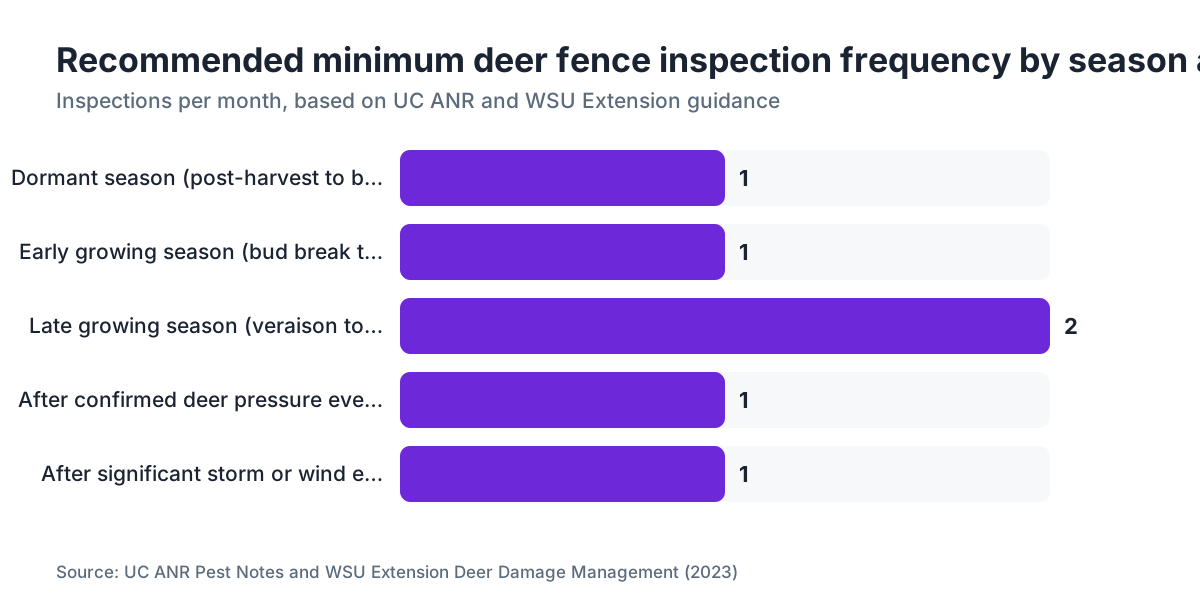
The standard recommendation from UC Cooperative Extension and most NRCS district offices is a full-perimeter walk at least once a month during the growing season (roughly bud break through harvest), plus a pre-season inspection in late winter before new growth starts [2]. That gives you six to eight logged inspections a year on a typical California North Coast or Pacific Northwest season.
That baseline falls apart in the real world without event-triggered inspections. Every heavy rain, windstorm, or confirmed deer intrusion (tracks, browse, scat inside the fence) earns a same-day or next-morning walk and a log entry, even when you find nothing. An entry that reads "full perimeter walked, no defects found" after a storm is documentation that you're watching the fence.
Deer pressure spikes at predictable times: late summer when browse outside the vineyard dries up, and again in late fall through winter when bucks push through vegetation. Deer-heavy pockets in Napa, Sonoma, and the Willamette Valley see the most fence damage from September through November [3]. Plan for twice-monthly inspections in those windows.
WSU Extension recommends checking post depth and anchor integrity at least annually, ideally in spring before new growth makes a full perimeter walk harder to finish [4]. Log those structural checks separately from routine visual inspections. Different actions, different risks.
What format works best for keeping these records: paper, spreadsheet, or software?
Any format you'll actually use beats a perfect system you abandon in week three of harvest.
Paper field logs work fine for one or two people doing the inspections. A printed form in a waterproof binder in the truck, filled out in the field and scanned at week's end, is a legitimate record. The catch is that paper is hard to search, hard to share with an auditor remotely, and easy to lose.
Spreadsheets (Google Sheets or Excel) with one row per inspection event are a real step up. You can filter by date, section ID, or repair type, and attach photos by linking to a shared drive folder. Under 50 acres of fenced vineyard, a well-organized spreadsheet is usually all you need.
Run multiple blocks, multiple fence types, or contractor crews, and a dedicated field-records platform closes the gap. VitiScribe, for example, logs fence inspections alongside spray records and equipment maintenance in one timestamped system, which shrinks the audit file. The value isn't the software. It's the consistency the software forces: same fields, every entry, no skipped dates.
Whatever you use, the records need to be legible and reachable for at least three years. USDA Farm Service Agency programs generally require three-year retention for practice records [10]. Some state programs require five. When in doubt, keep everything.
How do you map fence sections so records are traceable in the field?
A fence that runs 2,400 feet around a 12-acre block has about 200 posts at 12-foot spacing. Without a numbering system, "east side near the oak" is useless two years from now.
The simplest system: start at your main gate post, call it Post 1, number sequentially around the perimeter. Mark every 10th post permanently with a tag, paint, or carving. A hand-drawn sketch to rough scale, scanned and kept with the records, ties post numbers to the geography. For larger or multi-block operations, GPS coordinates logged once per post in a spreadsheet solve the mapping problem for good and let you overlay deer pressure data on satellite imagery if you want to get analytical.
Some growers use named sections instead, like "North Slope," "Creek Crossing," "Road Frontage East." That works, as long as each section is pinned to fixed start and end posts in a master document. Never change the standard mid-season. Changing it breaks the repair history and confuses anyone reading the log later.
Drainage crossings and gates deserve their own section IDs and their own inspection frequency. They fail more often than open-span sections because deer learn where the soft spots are, and moving water undermines posts and bottom wire faster than static soil does. Log them separately.
Does deer fence maintenance count toward EPA Worker Protection Standard recordkeeping?
No. Deer exclusion fence maintenance is not an EPA Worker Protection Standard (WPS) activity [5]. WPS covers agricultural pesticide handling and application, and its recordkeeping requirements cover applications, handler training, decontamination site availability, and emergency medical information. Fence maintenance sits outside that scope entirely.
Fence crews still overlap with spray crews, especially on small operations where one or two people do everything. If a crew member stops fence work to spray herbicide along the fence line (a common vegetation-management job under the fence), that herbicide application does fall under WPS and gets logged in the pesticide records separately [5]. Don't mix the two in one entry. Keep fence maintenance logs and pesticide records in separate files even when the same person writes both.
WPS, updated in 2015 with certain provisions phased in through 2018, requires that pesticide application records be kept for two years and be accessible to workers on request. The regulation directs handlers to record "the product name, EPA registration number, active ingredient(s), location and description of the treated area, date of application, and restricted-entry interval" [5]. None of that belongs in a fence log.
How should you document fence costs for USDA cost-share programs or tax purposes?
NRCS cost-share under EQIP (Environmental Quality Incentives Program) typically reimburses deer exclusion fencing on a set payment schedule tied to Practice Standard 382 or a related state standard [1]. To get full reimbursement and pass the certification inspection, you generally show that the fence was built to standard and maintained through the payment period.
For cost-share, your maintenance log doubles as a cost-accounting document. Record actual material costs with receipts or invoice references. Record labor hours at actual wage or a verifiable custom rate. NRCS district offices often publish county average rates for custom work that owner-operators can use when they don't carry a separate labor wage record. Ask your local NRCS office exactly what labor documentation it wants before you build the system. It varies by state and sometimes by county.
For taxes, fence maintenance costs are generally deductible as ordinary business expenses in the year you incur them, separate from the original installation, which may need to be depreciated over its useful life. The IRS assigns agricultural fencing a 7-year MACRS (modified accelerated cost recovery system) class life [6]. Repairs that don't extend the fence's life or add real value are typically expensed right away. Keep those receipts with the maintenance log so your tax preparer works with real numbers.
Track costs by section over several seasons and you'll see which sections carry an all-in repair cost that creeps toward replacement cost. That's a management decision, not an accounting one.
What should a completed fence maintenance log entry look like?
Here is a realistic entry in plain text, ready to adapt to any format:
Date: 2025-06-03
Inspector: Maria Keough, vineyard manager
Section: Posts 88-104, South Block, Creek Crossing to Gate 3
Condition found: Bottom wire slack in 15-ft span between posts 91 and 93; soil erosion has exposed base of post 92 by approximately 6 inches; one T-post clip missing at post 97.
Repair action: Re-tensioned bottom wire using come-along, added ground anchor at post 92 with 18-inch rebar stake, replaced missing clip at post 97.
Materials: 1 rebar stake ($2.40), 2 wire clips ($0.30)
Labor: 2.0 hours, 1 person
Cost: $2.70 materials, $50.00 labor (@ $25/hr)
Photos: 2025-06-03_creek_crossing_before.jpg, 2025-06-03_creek_crossing_after.jpg
Follow-up: Post 92 needs evaluation for replacement if erosion continues. Check after next rain event.
Next inspection: 2025-06-17 (biweekly during pressure season)
That entry is specific enough to trace, complete enough for an auditor, and clear enough that someone else could pick up the log and know exactly what was done and what's still open. That last part matters. You won't always be the person running the next inspection.
How do vineyard GAP audits evaluate fence maintenance records?
GAP audits, whether through USDA AMS or a third-party certifier like PRIMUS GFS, check two things: does the operation have a written pest exclusion program, and do the field records prove the program was followed [7]? Deer fencing sits under general pest exclusion in most GAP frameworks.
In a typical audit, the auditor asks to see your inspection schedule (written policy), your inspection logs (field records), and evidence of corrective action when defects turned up. The corrective action piece is where most operations fall short. Noting "wire down" in the log isn't enough. The record has to show what was done about it and when.
USDA AMS's GAP guidance states that "records must be available during the audit and must cover the current production season at minimum" [7]. Most auditors also want the prior season for context. Two full seasons of inspection logs in a searchable format, with repair entries tied to specific section IDs, passes without a finding.
One thing auditors flag over and over: gaps in inspection frequency during high-pressure periods. If your log shows weekly checks in April but nothing between late August and harvest, expect a question. The answer can't be "we were busy." The answer should already be in the log.
Are there different documentation requirements for electric deer fences versus physical exclusion fences?
Yes, and the difference is big enough to justify separate log types.
Physical fences (woven wire, high-tensile, game fence mesh) need the structural inspection log described above: posts, wire tension, gates, bottom clearance, drainage crossings. The failure mode is mechanical and visible.
Electric fences add several inspection points: energizer output (measured in joules or kilovolts, depending on the unit), ground rod condition, vegetation contact causing shorts, and insulator integrity [4]. WSU Extension's deer fencing guidance recommends checking voltage at the far end of each run with a digital fence tester and logging the reading at least weekly during the growing season, not only after problems appear [4]. A fence reading 2,000 volts at the energizer but 400 volts at the far end has a fault somewhere, even if you can't see it.
For electric fences, add these to the log:
- Energizer output reading (joules or kV, per energizer specs)
- Far-end voltage reading with date, time, and weather (wet vegetation shifts the reading)
- Fault location if found
- Ground rod resistance check (annually is standard)
Run a combination electric and physical fence, common in high-pressure Napa and Sonoma deer country, and log the physical and electrical inspections together in one entry per section but in clearly labeled sub-sections. Don't blur them.
Solar energizers need battery voltage logged too, especially heading into cloudy fall periods when charging turns unreliable [11]. A dead battery in October during the rut isn't a fence story. It's a crop loss story.
How do you use maintenance records to make smarter fence management decisions?
A log that only satisfies auditors is a cost. A log that drives decisions is an asset.
After two or three seasons, your records should answer four questions. Which sections get repaired most often? What's the total annual maintenance cost per linear foot? Do repairs cluster after specific weather events? Do deer pressure incidents cluster at specific sections?
Say Posts 88-104 at the creek crossing shows up in six of your twelve monthly entries needing a repair. That section costs you time out of proportion to its length. Now the decision is clean: upgrade the infrastructure there (deeper posts, better drainage, concrete base on the gate post) at a known cost, or keep patching at an accumulating one. You can't run that math without the records.
Cornell Cooperative Extension's IPM resources note that keeping damage and exclusion effectiveness records across multiple seasons is the baseline for any IPM decision involving deer exclusion [8]. You can't manage what you're not measuring.
Run records across several blocks and a platform like VitiScribe pulls a section-level repair history without digging through paper, which matters when you're making a capital expenditure case to an owner or a lender. The decision lives in data you've been collecting all along.
See related operational considerations for vineyard management at vineyard.
What records do you need if a deer incident results in crop damage?
Browse damage inside a fenced vineyard triggers two parallel documentation jobs: the damage assessment, and proof the fence was being maintained.
For the assessment, walk the affected rows immediately and log: date discovered, block and row numbers, type of damage (shoot browse, trunk rub, wire rub), estimated percentage of shoots affected per row, and photos. If you carry crop insurance through the USDA Risk Management Agency (RMA) or a private carrier, notify them before any cleanup, because the adjuster needs to see the damage in place [9].
For the fence side, pull your most recent inspection log for the section nearest the intrusion and confirm it's complete. A gap in the record in the weeks before the incident is the first thing an adjuster questions. A complete log showing regular inspections and prompt repairs is your best evidence that the damage wasn't neglect.
Document the entry point if you can find it. Deer usually come in through the same kind of weakness: a gate left ajar, a stream crossing where bottom wire has lifted, a section where snow or a fallen branch pressed the fence down. Photograph it, log its location by section ID and post numbers, and log the repair. That entry becomes part of your incident record.
For RMA-insured crops, the regulations under 7 CFR Part 457 require the insured to take "all reasonable steps to protect the crop" [9]. A maintenance log showing regular inspections is direct evidence you met that standard.
Frequently asked questions
How long do I need to keep deer fence maintenance records for my vineyard?
Most USDA Farm Service Agency and NRCS cost-share programs require three-year retention for practice maintenance documentation. Some state grant programs require five years. For crop insurance under RMA policies, keep records through the policy period and for at least two years after any claim. If you're unsure what your program requires, ask your local NRCS office in writing and save the answer.
Do I need to log fence inspections where I found nothing wrong?
Yes, absolutely. An entry reading 'full perimeter walked, no defects found' on a specific date is as important as a repair entry. It shows active monitoring and establishes a regular schedule. In a GAP audit or an insurance claim review, gaps in your log, including missing no-defect entries during a known pressure period, prompt questions that are hard to answer credibly.
Can a vineyard employee who isn't a supervisor sign off on fence inspection records?
In most programs, yes. NRCS practice records need to show who performed the inspection but don't require a supervisory signature for routine maintenance logs. GAP audits typically require the inspector to be trained or supervised. What matters is that the name is legible, consistent, and traceable to an actual employee. If you use contractors, include the company name and the individual's name.
What's the difference between a fence inspection log and a fence maintenance log?
In practice, most operations combine them. An inspection log records what was observed during a perimeter walk, even when no action was taken. A maintenance log records repairs, materials, and costs. The most useful system is one record that captures both in the same dated entry: the findings and any resulting action. Keeping them separate creates reconciliation headaches when auditors want to match findings to repairs.
Does deer fence maintenance need to be recorded in my pesticide application records?
No. Fence maintenance is not a pesticide application and doesn't belong in pesticide records. The EPA Worker Protection Standard applies to pesticide handling and application, not structural exclusion maintenance. If you apply herbicide along the fence line for vegetation management, that application gets logged separately in your pesticide records with the required WPS fields, but the fence inspection itself stays in a separate fence log.
What level of detail do photos need to include for vineyard fence maintenance records?
Photos should show the defect clearly enough that someone who wasn't there understands what was wrong, plus a post-repair photo showing the fix. Timestamp them through camera settings or a written date marker visible in the frame. File names should reference the date and section ID. You don't need professional quality; a smartphone shot with a clear view of the damage and the post number tag in frame is plenty.
How do I document deer fence maintenance for a leased vineyard where the owner holds the NRCS agreement?
Check your lease first; it should specify who maintains the fence and who holds the documentation obligation under any NRCS or state program agreement. If the owner holds the EQIP or cost-share agreement, they typically need copies of your maintenance logs. Build that into the lease terms explicitly and keep duplicates. Ownership of the records and responsibility for the fence should be in writing before any incident occurs.
Should deer fence maintenance costs be tracked separately from general vineyard equipment maintenance?
Yes, for a practical reason. Most NRCS cost-share programs require you to show the practice was maintained at the funded standard; they need fence-specific costs. For taxes, fence maintenance may be categorized differently from equipment maintenance. Keeping fence maintenance in its own cost center also lets you calculate per-linear-foot maintenance cost over time, the key input for any fence upgrade or replacement decision.
How do I handle fence maintenance records when I hire a contractor to do the inspection and repair?
Get a written work order or invoice that includes date of service, sections inspected, findings, repairs made, materials used, and the employee's name. Keep that document as your primary record for that inspection period. You can transcribe the key fields into your own log format for consistency, but keep the contractor's original paperwork too. If the contractor uses a standard service form, scan it and attach it to your digital records.
What's the minimum fence inspection frequency required for USDA EQIP program compliance?
NRCS Practice Standard 382 requires that fences built under the practice be maintained for the practice life stated in the EQIP contract, typically 10 years. The standard itself doesn't set a minimum inspection frequency, but it requires the fence to stay functional and in good repair through the contract period. Your local NRCS office may add guidance; inspections logged at least monthly during the growing season and after significant weather events generally show active maintenance.
Can vineyard fence maintenance logs be kept digitally instead of on paper?
Yes. USDA programs and GAP certification bodies accept digital records as long as they are legible, dated, include the required fields, and can be printed or shared with an auditor. Cloud storage with version control beats local spreadsheets because it protects against data loss and provides an independent timestamp. Make sure your system backs up automatically and can export in a standard format (PDF or CSV) on demand.
Are there extension service templates I can use for deer fence maintenance logs?
UC Cooperative Extension and WSU Extension both publish pest exclusion and deer management resources with guidance on what to track, though fillable log templates built specifically for deer fencing are rare. UC ANR's deer management publications and WSU Extension's wildlife damage resources are good starting points. Cornell IPM resources cover exclusion recordkeeping concepts too. You may need to build your own form from the field list in those guides, which forces you to commit to a format before you need it.
How do I document a deer fence that was partly destroyed and needed full-section replacement?
Treat it as both a maintenance event and a capital event. Log the damage in your maintenance record with the same fields (date, section, condition found, photos). Then create a separate project record for the replacement that captures total material cost, contractor or labor cost, and the date the section returned to service. Flag the section as 'replaced' with the date, so future cost-per-foot calculations start fresh rather than getting skewed by the replacement cost.
Sources
- UC Agriculture and Natural Resources, Cooperative Extension: UC Cooperative Extension guidance recommends a full-perimeter deer fence inspection at least monthly during the growing season plus a pre-season inspection in late winter
- UC ANR Integrated Pest Management Program, Wildlife Damage Management: Deer pressure on vineyard fences peaks in late summer through fall when outside browse dries up and during the rut in November
- Washington State University Extension, Deer and Elk Damage Management in Orchards and Vineyards: WSU Extension recommends checking electric fence voltage at the far end of each run weekly during the growing season and inspecting post depth and anchor integrity annually in spring
- EPA, Agricultural Worker Protection Standard (40 CFR Part 170): WPS requires pesticide application records to include product name, EPA registration number, active ingredient, location, date, and restricted-entry interval; fence maintenance is outside WPS scope
- IRS Publication 225, Farmer's Tax Guide: Agricultural fencing has a 7-year MACRS class life for depreciation purposes; routine maintenance that does not extend useful life is generally expensed in the year incurred
- USDA Agricultural Marketing Service, Good Agricultural Practices and Good Handling Practices Audit Verification Program: GAP audits require a written pest exclusion program and field records demonstrating that inspections and corrective actions occurred; records must cover at minimum the current production season
- Cornell Cooperative Extension, Integrated Pest Management Program: Cornell IPM resources note that keeping multi-season records of damage and exclusion effectiveness is the baseline for any deer exclusion management decision
- USDA Risk Management Agency, Common Crop Insurance Policy (7 CFR Part 457): RMA regulations under 7 CFR Part 457 require that insured producers take all reasonable steps to protect the insured crop; maintenance logs support this standard in damage claims
- USDA Farm Service Agency: FSA program records including practice maintenance documentation must generally be retained for three years following the year they were created
- WSU Extension, Protecting Vineyards from Deer and Elk Damage: WSU Extension recommends logging solar energizer battery voltage for electric fences heading into cloudy fall periods to prevent power failures during peak deer pressure
Last updated 2026-07-11