How to document organic input compliance for CCOF certified vineyards

TL;DR
- CCOF-certified vineyards must keep purchase invoices, product labels, Safety Data Sheets, and field application logs for every input applied to certified acres.
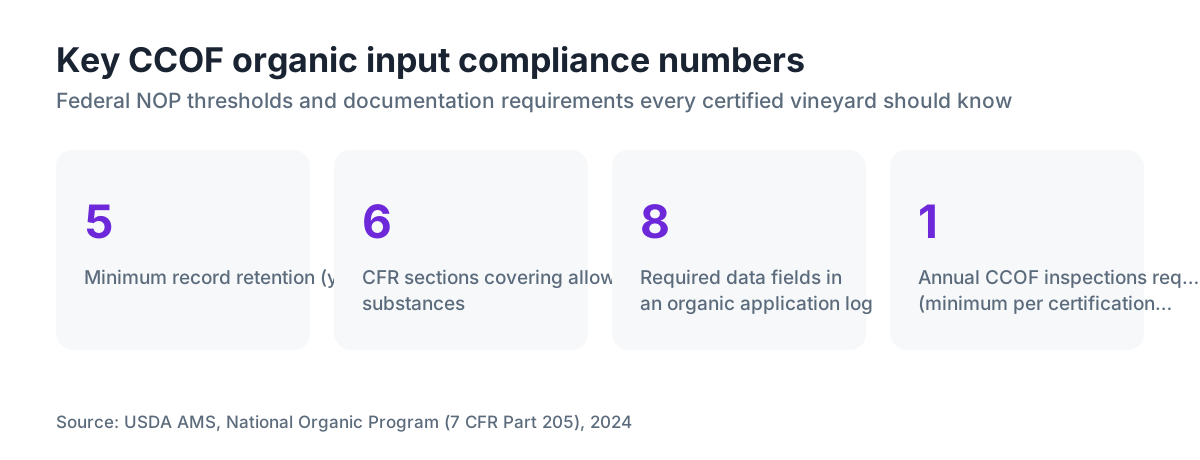
- The NOP requires 5 years of retention under 7 CFR 205.103, and records must be handed to your certifier on request.
- One missing input audit trail can trigger a Notice of Noncompliance.
What records does CCOF actually require for organic inputs?
CCOF certifies under the USDA National Organic Program, so the legal backbone is 7 CFR Part 205, the federal organic rules. Section 205.103 requires certified operations to keep records that "fully disclose all activities and transactions of the certified operation in sufficient detail as to be readily understood and audited." That's the core obligation. Everything else follows from it.
For a vineyard, "every input" means anything that touches soil, plant tissue, or water on your certified acres. Fungicides. Insecticides. Fertilizers, soil amendments, plant growth regulators, dormant sprays, row-cover materials, weed control adjuvants, and the water source itself if you're injecting anything through it. If it goes on or in the ground, you need a paper trail. [1]
CCOF asks for four categories of documents for each material, at a minimum:
- Purchase invoice or receipt showing the product name, quantity bought, and date of purchase.
- Product label (the current one, not a photocopy from five years ago).
- OMRI listing or other approved-materials verification, if applicable.
- Application log showing date, field or block, rate, method, applicator name, and crop growth stage.
Your Organic System Plan (OSP) has to list every material you intend to use before you use it. Apply something not in your OSP, even a material that is fully NOP-compliant, and you have a recordkeeping violation on your hands. The habit that saves you: update the OSP every January, and again any time you add a product mid-season. [2]
How long do you have to keep organic input records?
Five years. That's the NOP floor under 7 CFR 205.103, and CCOF mirrors it in its member handbook [1][2]. Some compliance attorneys tell growers to hold records for the certification period plus five years beyond any open dispute, but the regulatory minimum is five years from the date each record was created.
Five years sounds manageable until you're in year four and an inspector asks for the 2021 application logs on Block 7. Paper systems fail here constantly. Binders mold in farm offices, PDFs get buried in old email, and the guy who kept the spray log in his truck quit two seasons ago. Whatever system you run, the records need to come back by block and by date inside a few minutes.
One detail growers miss: the clock runs from the date the record was created, not from your last renewal. A 2021 invoice you used in a 2022 audit still has to survive until 2026 at the earliest.
What is an Organic System Plan and how does it connect to input documentation?
Your OSP is a written declaration of how you plan to run the organic operation for the coming year, and CCOF reviews and approves it before the season starts. It has to list every substance you plan to apply, with brand name, active ingredient, and intended use. It also covers soil management, pest management, equipment cleaning, and how you keep contamination out from any adjacent non-organic ground. [2]
The tie to input documentation is tight. An application log entry for a product not listed in your OSP is a paperwork violation even when the material sits on the National List. An invoice for a product that never shows up in any application log makes the inspector wonder whether it got used somewhere off the books. Your OSP, your purchase records, and your field logs have to tell one coherent story, where quantities bought line up roughly with quantities applied across your documented acreage.
Update the OSP whenever you switch suppliers, change formulations, or add a pest management tactic. CCOF runs an online portal for OSP amendments. Filing proactively reads a lot better than explaining after the fact why you sprayed something that wasn't on file.
Which materials are allowed and how do you verify a product before you buy it?
The National List (7 CFR 205.601 through 205.606) governs what's allowed in organic crop production [3]. It permits certain synthetic substances (copper-based fungicides, elemental sulfur, a short list of insecticides) and restricts or prohibits others. The list carries annotations, which means an allowed material may only be permitted at a set rate, for a set purpose, or under set conditions. Copper is the classic case: it's allowed, but the rule requires that documentation verify "that use of the materials does not contribute to contamination of crops, soil, or water." Blow past the annotation and you've got a violation even though the base substance is permitted. [3]
For pre-purchase checks, the fastest tool is the OMRI products list at omri.org. OMRI-listed materials get an independent review against NOP standards [9]. WSDA and CDFA keep state-level approved-materials lists too. Here's the part growers get wrong: OMRI listing is not legally required by the NOP. A material can be compliant with no OMRI listing at all if you can show it meets National List criteria. Either way, CCOF wants your verification documented.
Unsure about a product? Use CCOF's material review process. Submit the label and SDS before you apply. You get a written response, and that response becomes a compliance record worth keeping as long as you use the product.
UC Cooperative Extension farm advisors publish annual pest management guides for winegrapes that flag organic-compliant options by pest and growth stage [4]. WSU Extension puts out similar resources for Pacific Northwest vineyards [5]. Both are good cross-references when you're vetting something new.
How should a vineyard structure its field application logs for organic compliance?
Your application log gets scrutinized harder than anything else in an inspection. At a minimum it needs: date of application, block or field ID, acres treated, product name (with brand and EPA registration number where applicable), formulation, rate per acre, total amount applied, method (airblast, handgun, backpack), applicator name, and weather at the time. Some fields are required by the NOP, others by the EPA Worker Protection Standard [6] or California's county agricultural commissioner system. That overlap works in your favor: one complete entry satisfies several agencies at once.
For organic specifically, add two fields most conventional spray logs skip: the lot number of the container you opened, and the NOP compliance basis for the material (OMRI listing number, National List section, or your CCOF material review confirmation number). Thirty seconds per entry, and they close the two most common audit gaps.
Block identification matters more than growers think. Use a naming convention tied to your OSP and your vineyard map. If the OSP says "Block 12A, 3.2 acres, Cabernet Sauvignon, southwest slope," then the log says Block 12A, not "the Cab block by the barn." That consistency is what lets an inspector trace a purchased quantity to a specific location to a specific acreage and watch the math close.
Run a mix of certified organic and conventional blocks? The logs have to be dead clear about which blocks got which treatments. Drift from a conventional block into a certified one needs to be documented if it happened, along with your corrective action. Hiding it is far worse than disclosing it. [2]
Tools like VitiScribe structure these logs so the required fields are always there and records stay searchable by block, date, or product. That saves real hours during the annual CCOF inspection.
What happens during a CCOF inspection and what documents will the inspector want to see?
CCOF runs at least one announced inspection per certification year, plus unannounced inspections when there's a complaint or elevated risk. The inspector isn't trying to fail you. They're verifying that your operation matches your OSP. Expect walk-throughs of all certified blocks. They'll look at your equipment, check for residues or signs of prohibited material, and confirm your field boundaries match your certified map.
On the paperwork side, expect requests for:
- OSP for the current and prior year.
- All input purchase invoices for the period under review.
- Application logs for every certified block.
- Product labels and OMRI listings for each material in the logs.
- Equipment cleaning logs if you share equipment between organic and conventional work.
- Harvest records showing volumes from certified blocks.
- Sales records showing the certified product sold as organic.
The inspector reconciles quantities. Buy 50 gallons of a copper fungicide, log applications that would use roughly 35 across your certified acreage, and they'll ask about the other 15. "I used it on the conventional block too" works fine if you have logs for that. "I'm not sure" does not. [2]
After the visit, CCOF issues an inspection report. Deficiencies come back as a Notice of Noncompliance (NOC) with a deadline to correct and document the fix. Minor NOCs usually clear in a few weeks. A pattern of noncompliance can lead to suspension or revocation.
How do you document buffer zones and contamination prevention?
If your certified vineyard borders a conventional operation, you need documented procedures to prevent prohibited-substance drift. The NOP doesn't set a fixed buffer width. It requires the operation to prevent "contact of organic production and handling operations and products with prohibited substances." Your OSP has to describe those measures, and your inspection records have to show you followed them. [1]
In practice that means mapping your buffer areas, documenting what grows (or doesn't grow) there, logging any spray events you observe on neighboring property (date, approximate drift direction, your response), and keeping the results of any residue tests on border rows. If you've had a contamination incident, the file needs the incident report, the lab results, and your corrective action plan with dates.
CCOF advises keeping a spray-event log for neighbors even when you can't control what they do. A dated note reading "Neighbor sprayed conventional fungicide, wind from the north around 12 mph, our border row vegetation was wet, no evident drift into Block 1" is real evidence of diligence. No note leaves you with nothing to say when a residue test comes back positive later.
What does NOP say about prohibited substance residue testing?
Under 7 CFR 205.670, USDA's Agricultural Marketing Service can conduct residue testing on products sold as organic. CCOF may also require testing as part of your certification, especially where contamination risk is elevated. A positive test for a prohibited substance does not decertify you automatically, but it triggers an investigation. The question AMS and CCOF ask: did the contamination come from your own actions or from an uncontrollable external source? Your documentation is your defense. [7]
Testing your own grapes or must proactively? Use an accredited lab, keep chain-of-custody paperwork, and store results with your certification file. Testing isn't required for every certified operation, but it's cheap peace of mind if you have real buffer concerns. Multi-residue panels for organophosphates, carbamates, and synthetic pyrethroids typically run $150 to $300 per sample at commercial agricultural labs (pricing varies by lab and panel, so confirm before you send anything in).
How should equipment cleaning and contamination prevention be documented?
If your sprayer, tractor, or other equipment runs on both organic and conventional blocks, you need a written cleaning protocol in your OSP and a log proving you followed it at every transition. The log records the date, which equipment was cleaned, the method (triple rinse, steam clean, and so on), who did it, and confirmation that rinse water was disposed of correctly under local rules. [2]
This draws citations more than growers expect. Someone borrows the airblast for the conventional Merlot block on Tuesday, forgets to log the cleaning, then runs it on the organic Chardonnay block on Thursday. The organic application log won't flag it. Only the equipment cleaning log would. Keep that log as a physical sheet in the cab, not a spreadsheet you fill in from memory later.
Equipment dedicated only to organic blocks? Say so in the OSP. Dedicated equipment is cleaner in audit terms because there's no transition documentation to manage at all.
How do you organize all these records so an audit doesn't turn into a crisis?
The growers who breeze through CCOF inspections are almost never the ones with the most perfect operations. They're the ones who can find any document in three minutes. Organization is the real compliance skill.
A workable physical system uses one binder per certification year, tabbed by section: OSP and amendments, product approvals and labels, purchase invoices by date, application logs by block, equipment cleaning logs, NOC correspondence. Keep a master input list at the front that shows each product used, its NOP basis for approval, and a cross-reference to the page where its invoice and application records live. An inspector who opens that binder and hits a master index relaxes on the spot.
A digital system does the same job in cloud folders with consistent names. A PDF named "2024-06-15_CopperOctanoate_Wilbur-Ellis_Invoice.pdf" is findable. A file named "scan001.pdf" is not. Whatever you pick, run a mock audit on yourself every February before the annual inspection. Pull the records for three random application events from the prior year and confirm every required element is present and traceable. Find gaps in February and you have time to fix them. Find gaps in May with the inspector standing in your barn and you don't.
For operations tracking several certified vineyards or a mix of organic and conventional blocks, record-management software built for vineyard compliance cuts the audit-prep load hard. VitiScribe, for one, captures the NOP-specific fields and generates the cross-referenced block-level logs CCOF inspectors ask for, which is worth a trial if binder management is eating hours you can't spare.
What are the most common documentation mistakes that lead to CCOF violations?
Nobody loses certification because their grapes had a bad year. Certifications get suspended over paperwork. The violations that show up in CCOF inspection reports and NOP enforcement records are consistent patterns, not one-off slips.
Applying a material not listed in the OSP is the single most cited issue. A supplier runs out, the grower switches products mid-season, the new material is NOP-compliant, but the OSP never got updated. File the amendment before you spray the substitute, not after.
Missing lot numbers on application logs is second. CCOF and the NOP want traceability from container to field. A lot number links your invoice (proof you bought a genuine product) to your application record (proof you used that product on that block). Without it, the chain breaks.
Incomplete purchase records come third. Buying inputs from a new vendor at a farm show, paying cash, keeping no receipt: a recurring problem. Every purchase needs a paper trail. If all you get is a handwritten note, ask for an invoice on letterhead with the product's EPA number.
Quantity mismatches are fourth. Records show 20 gallons bought but logs account for only 8 gallons applied, and now the inspector has to ask where the other 12 went. A simple monthly reconciliation keeps those gaps from piling up.
Failing to document neighbor spray events or contamination incidents rounds out the list. Growers assume that if they didn't cause the contamination, they don't have to log it. Wrong. The record of an external incident plus your mitigation steps is exactly what protects the certification.
What resources and extension programs can help you build a better compliance system?
UC Cooperative Extension has vineyard-specific organic production guides covering both the agronomy and the compliance side of organic winegrapes. Its farm advisors in Napa, Sonoma, and San Luis Obispo counties field CCOF certification questions directly. The UC Davis Agricultural Sustainability Institute publishes organic transition guidance that walks through the record systems most certifiers expect. [4]
WSU Extension's viticulture program at Prosser covers Pacific Northwest pest management for organic growers and publishes spray guides that cross-reference NOP compliance [5]. In the eastern states, Cornell Cooperative Extension has organic production resources that apply to NOP-certified operations anywhere in the country. [8]
USDA's Agricultural Marketing Service keeps the full text of the NOP rules and a searchable National List at ams.usda.gov. Its National Organic Standards Board (NOSB) meeting records are public too and give advance notice of any pending changes to the allowed and prohibited lists. [7]
For worker protection and pesticide application records that overlap with organic compliance, the EPA's Worker Protection Standard resources live at epa.gov and cover the application-record rules for both restricted-use and general-use pesticides in organic systems where they're permitted. [6]
CCOF itself publishes a free certification handbook and a members' materials database. Read the handbook for the current certification year, not the one from three years back. The program revises its documentation requirements periodically, and what passed in 2021 may carry a different expectation in 2025. [2]
Frequently asked questions
How many years of records does CCOF require you to keep for organic inputs?
The NOP requires a minimum of 5 years of records under 7 CFR 205.103, and CCOF follows it. The 5-year period runs from the date each record was created, not from your most recent certification renewal. Hold records beyond 5 years if any dispute or noncompliance investigation is still open.
Does every input need an OMRI listing to be allowed on certified organic acres?
No. OMRI listing is a useful shortcut for verification but it is not a legal requirement under the NOP. A material is permitted if it meets the criteria in the National List at 7 CFR 205.601-606, whether or not OMRI has reviewed it. You still have to document the NOP compliance basis for any non-OMRI-listed material, and CCOF's material review process can provide that in writing.
What is an Organic System Plan and how often do you update it?
An OSP is a written management plan submitted to and approved by your certifier each year. It lists every input you intend to use, your soil management, pest management strategy, and contamination prevention measures. Update it at least annually before the season, and file an amendment any time you add a material, change suppliers, or alter your management approach mid-season.
Can you use copper fungicide on certified organic vineyard blocks?
Yes. Copper-based fungicides are on the NOP National List for organic crop production under 7 CFR 205.601, with an annotation requiring documentation that use does not contaminate crops, soil, or water. Your application logs must record rates and cumulative loading per block. Ignoring the annotation, or failing to document minimization, can trigger a finding.
What fields must be in an organic vineyard application log to satisfy NOP requirements?
At a minimum: date, field or block ID, acres treated, product name and brand, EPA registration number, formulation, application rate, total quantity applied, application method, applicator name, and weather conditions. For organic compliance, also add the product lot number and the NOP compliance basis (OMRI listing number or National List section). Those two additions close the most common audit gaps.
What triggers a CCOF Notice of Noncompliance for input records?
Common triggers: applying a material not listed in your approved OSP, missing lot numbers on application entries, quantity mismatches between purchases and logged applications, using a product whose label changed to include a prohibited ingredient, and failing to document contamination from neighboring conventional operations. A single NOC with a timely corrective response is manageable. A pattern of NOCs risks suspension.
Do you need to document spray events by neighboring conventional farms on your organic block records?
CCOF strongly recommends it, and in practice it functions as required documentation if you later face a residue finding. Log the date, observed spray activity, approximate wind direction and speed, whether visible drift reached your certified blocks, and your corrective response. This log is your evidence of diligence if an external contamination event is ever investigated.
How do you handle equipment shared between organic and conventional blocks in your compliance records?
Your OSP must describe the cleaning protocol for shared equipment. You also need a separate cleaning log, filled out each time the equipment transitions from conventional to organic use. Record the date, equipment identifier, cleaning method, person responsible, and how rinse water was handled. Keep this log in the equipment itself, not reconstructed later from memory.
What happens to your CCOF certification if a residue test comes back positive for a prohibited substance?
A positive residue test triggers an investigation under 7 CFR 205.670 but does not automatically decertify you. The key question is whether you applied the prohibited substance or whether it came from an external source. Your application logs, equipment records, neighbor spray logs, and OSP documentation are the evidence that decides the outcome. Thorough records are your primary defense.
Is there a required format for organic input records or can you use your own system?
The NOP specifies required data elements but not a specific form or software format. Paper binders, spreadsheets, or field management software all work, as long as every required element is captured and records are retrievable and legible. CCOF inspectors have reviewed everything from handwritten field notebooks to cloud-based ag software. Organization and completeness matter more than format.
How do you add a new input mid-season without violating your Organic System Plan?
Submit an OSP amendment to CCOF before you apply the new material. CCOF runs an online portal for amendments. Include the product name, active ingredient, intended use, and NOP compliance basis. Wait for written approval, then file that approval with the product's label and your first application record. Applying first and amending later is a protocol violation even if the material is compliant.
Do the EPA Worker Protection Standard requirements overlap with NOP application record requirements for organic vineyards?
Yes, heavily. The EPA WPS requires application records including product name, EPA registration number, location, date, time, and applicator information for any pesticide applied where workers may be present. Many of those fields match NOP application log requirements exactly. One complete log that satisfies both programs beats maintaining separate WPS and organic records.
What resources does UC Davis offer for organic vineyard compliance documentation?
UC Cooperative Extension farm advisors in major wine regions provide organic production guidance specific to winegrapes, including NOP-compliant pest management options and documentation expectations for CCOF audits. The UC Davis Agricultural Sustainability Institute also publishes organic transition guides covering record-keeping systems. These resources are free and updated regularly to reflect current NOP requirements.
Sources
- USDA Electronic Code of Federal Regulations, 7 CFR Part 205 National Organic Program: NOP requires certified operations to keep records that fully disclose all activities and transactions; minimum 5-year record retention under 205.103
- CCOF Certification Services, CCOF Organic Certification Handbook: CCOF requires an approved Organic System Plan listing all intended inputs, annual inspections, and documentation of contamination prevention measures
- USDA AMS, National Organic Program National List of Allowed and Prohibited Substances (7 CFR 205.601-606): Copper-based materials are permitted in organic crop production but with an annotation requiring documentation that use does not contaminate crops, soil, or water
- UC Agriculture and Natural Resources, Organic Winegrape Production Resources: UC Cooperative Extension publishes pest management guides for organic winegrape production that cross-reference NOP-compliant materials by pest and growth stage
- Washington State University Extension, Viticulture and Enology Program: WSU Extension publishes Pacific Northwest pest management and spray guides that cross-reference NOP compliance for organic vineyards
- US EPA, Agricultural Worker Protection Standard: The EPA Worker Protection Standard requires pesticide application records including product name, EPA registration number, location, date, time, and applicator information
- USDA Agricultural Marketing Service, NOP Compliance and Enforcement (7 CFR 205.670): AMS may conduct residue testing on products sold as organic; a positive test triggers investigation but does not automatically decertify the operation
- Cornell Cooperative Extension, Organic Crop Production Resources: Cornell Cooperative Extension publishes organic production resources applicable to NOP-certified operations nationwide
- OMRI (Organic Materials Review Institute), OMRI Products List: OMRI-listed materials have been independently reviewed against NOP standards; listing is useful for pre-purchase verification but not legally required by the NOP
- USDA AMS, National Organic Program Handbook: USDA NOP program handbook provides certifier and operator instructions for record maintenance including field operation logs and input documentation requirements
Last updated 2026-07-11