How to document re-entry worker training in vineyard WPS records

TL;DR
- Under the EPA Worker Protection Standard (40 CFR Part 170), vineyard operators must train all agricultural workers before they enter a treated area and keep those training records for at least two years.
- Records must capture the worker's name, training date, trainer's name and credentials, and the method used.
- Missing or incomplete records are among the top WPS violations found in state inspections.
What does the WPS actually require for re-entry worker training documentation?
The short answer: 40 CFR Part 170 requires that you document re-entry worker training before workers enter areas where pesticides have been applied or where a restricted-entry interval (REI) is in effect. The regulation does not mandate one specific form, but it does specify what information must be captured. [1]
According to the EPA's 2015 revised Worker Protection Standard, which took effect January 2, 2017, training records must include the worker's name, the date of training, the name and title of the person who provided the training, and the method or materials used. [1] That last item catches growers off guard. If you handed someone an EPA-approved video, write down the video title and its EPA approval number. If a bilingual crew supervisor conducted live training, note their name and that it was in-person oral delivery.
The records must be kept for two years from the date of training. [1] Not two years from the end of the season. From the actual training date. An inspector arriving in year two of a worker's employment will look back to the original hire-date training record.
One more thing the regulation does require: trained workers must receive the EPA's WPS Safety Data Sheet (formerly called the pesticide safety information) and have access to it at a central location on-site. Documenting that you provided it is not explicitly required by the text, but state enforcement agencies in California, Washington, and Oregon have cited growers who couldn't show they'd given it out. Write it down anyway.
Who counts as a "re-entry worker" under WPS and who needs to be trained?
Any agricultural worker who enters a treated outdoor or enclosed space production area on a farm where pesticides are used is covered. [1] That includes your full-time vineyard crew, seasonal harvest pickers, trellis repair contractors, irrigation workers, and even workers doing canopy management if pesticides have been applied to that block.
Handler employees (those who mix, load, or apply pesticides) have separate training requirements under WPS and are not counted as re-entry workers for documentation purposes. Don't mix the two records together. Keep handler training and worker training in separate files.
Family members are not exempt if they qualify as agricultural workers under the definition. A vineyard owner's adult child who regularly works in treated rows needs a training record the same as any hired employee. The exemption for immediate family applies only to the agricultural employer themselves, not to covered workers who happen to be relatives. [1]
Temporary or H-2A workers need the same documentation. This is an area where many small vineyards slip up, assuming that training provided by a labor contractor is someone else's problem. The WPS makes the agricultural employer (you, the grower or vineyard manager) responsible for ensuring training happens and records exist, regardless of whether you hired direct or through a crew company. Get copies of training records from any labor contractor before the crew touches your blocks.
What specific information must each training record contain?
The EPA lists the following required record elements in the revised WPS final rule [1]:
| Required field | Notes |
|---|---|
| Worker's full name | Legal name preferred; matches payroll records |
| Date training was completed | Day/month/year, more than the season |
| Name of person who trained them | Supervisor, certified applicator, or video source |
| Title or credentials of trainer | "Certified Crop Adviser," "licensed pesticide applicator," or equivalent |
| Training method or materials | Video title + EPA ID, or describe live instruction |
That table is the floor, not the ceiling. California's Department of Pesticide Regulation (CDPR) and Washington State Department of Agriculture (WSDA) both recommend including the language in which training was delivered. If your crew speaks primarily Spanish and training was in English, that gap in understanding is exactly what an inspector will flag. [2][3]
WSU's pesticide safety education program recommends also noting where the central posting location is (the building or location where the pesticide safety information sheet is displayed) because inspectors ask for it and workers are supposed to be told during training. [4] You don't have to put it on the training form, but having it there saves time during an inspection.
Sign-in sheets work for in-person group training as long as they include all the required fields above. A blank sign-in sheet with only worker names and a date is not compliant. Pre-print your required fields at the top of any sign-in sheet you use.
What are the accepted training methods under WPS, and does it change what you record?
WPS allows several training methods, and what you record varies slightly by which one you use. [1]
EPA-approved training materials include video programs with EPA approval numbers, written materials, and computer-based programs. If you're using an approved video (the National Pesticide Safety Education Center maintains a list of approved materials), your record should name the video, note its EPA approval number, and specify that the video was used. Workers must have the opportunity to ask questions after viewing it, and your record should note that the Q&A opportunity was provided. [8]
Live, in-person training by a certified applicator or another qualified trainer is also accepted. Here your record should describe the content covered, more than "WPS training completed." A phrase like "reviewed all 23 required WPS training topics per 40 CFR 170.130" is defensible. The EPA lists those 23 topics explicitly in the regulation, and your training should actually cover them. [1]
State-issued pesticide safety programs that have received WPS approval in your state can also serve. Check with your state lead agency (CDPR in California, WSDA in Washington, NYSDAM in New York) about whether their programs satisfy federal WPS requirements and what documentation they expect.
Computer-based or online programs are gaining traction. If you use one, save a screenshot or the system-generated certificate as part of the worker's record. The system's completion record is your trainer documentation in that case.
Cornell's Agricultural Workforce Development program produces WPS training materials and notes that in-person training with hands-on demonstration tends to produce better comprehension than video alone, which matters if you ever face a serious worker incident and a plaintiff's attorney is reviewing your training records. [5]
How long do you have to keep WPS training records and where do you store them?
Two years. [1] The two-year clock starts on the training date, not on the end of employment or the end of the season.
WPS does not specify the physical storage format. Paper binders, electronic files, and third-party software systems all work. What matters is that records are "maintained at the agricultural establishment" and retrievable when an inspector asks, which in practice means within a reasonable time during an on-site inspection (not three days later after you've driven to a storage unit).
For multi-block or multi-ranch operations, decide in advance whether each location maintains its own records or whether a central office holds everything. If a state inspector shows up at a remote block and your records are at headquarters two hours away, that's a problem even if the records exist and are complete.
California DPR recommends keeping records accessible during normal working hours at the site where workers are employed. [2] Practically, that means a binder in the farm office, a locked cabinet in the equipment shed, or a cloud-based system that a supervisor can pull up on a phone. All three work. None of them work if nobody on-site can actually access them.
One practical note: train in batches and file immediately after each session. Growers who let training records accumulate in a pile to "file later" are the ones who can't find a specific record two years later when an injury claim surfaces.
What does a compliant vineyard WPS training record actually look like in practice?
Here's what a complete, inspection-ready training record entry includes, written out in plain language:
Worker name: Maria Reyes
Date of training: April 14, 2025
Trainer name and title: James Holloway, California Licensed Pest Control Adviser (PCA License #12345)
Training method: In-person, oral instruction in Spanish; all 23 WPS required topics covered per 40 CFR 170.130
Safety information sheet provided: Yes, posted at equipment shed, Vineyard Block 3
Worker signature (acknowledgment): [signature]
That record is bulletproof. An inspector can match the trainer's license number, verify the topics covered match the regulatory list, confirm the language of delivery, and see the worker acknowledged the training. Each of those elements answers a different inspection question.
Not every operation needs to be this detailed, but adding trainer license numbers and noting the posting location costs you thirty seconds and closes two common inspection gaps. If you're running a small family vineyard and conducting training yourself, you can note your own name and whatever qualification you hold (certified pesticide applicator license, completion of an approved WPS trainer course, etc.).
Digital tools can generate this kind of record automatically if you build the required fields into your template. Software like VitiScribe can structure worker training logs so that all required WPS fields are built into the form and records are timestamped and stored for the full two-year retention window, reducing the chance that a field gets skipped during a busy pre-harvest training session.
What are the most common WPS training record violations found during vineyard inspections?
State enforcement data points to a consistent set of documentation failures. CDPR inspection reports identify the following as the most frequent WPS deficiencies: missing training records entirely, records that lack the trainer's credentials, no indication of the training method used, and records kept in a language workers can't read. [2]
Missing records entirely is the single biggest problem. Growers assume that because they remember training someone, there's a record. There isn't. The burden of proof is on you, not the inspector.
Records that don't match employment dates are the second most common issue. If someone was hired April 1 and your first training record shows April 20, you have a three-week gap where they may have entered treated areas without documented training. Either train before first field entry and document it that day, or push back first field entry until after training is complete.
WSDA's WPS inspection work has flagged "training not provided in a language workers understand" as a recurring finding in Washington vineyards. [3] This doesn't mean every worker needs a separate language-specific record form, but the training itself and any supporting handouts need to be genuinely comprehensible. If you're using an English-only video for a crew that primarily speaks Mixtec, that's a problem regardless of what your form says.
Not posting pesticide safety information at the central location, or posting it but not telling workers where it is during training, is also common. Both the posting and the notification during training are required. Your record should reflect that you did both.
Does WPS training need to be repeated every year for returning workers?
No. Under the 2015 revised WPS, a worker who received compliant WPS training does not need to be retrained annually. [1] Training is required before a worker enters a treated area, and it remains valid unless the worker experiences a gap in agricultural employment that makes retraining necessary under your state's rules.
However, some states impose stricter requirements than the federal standard. California, for instance, requires annual pesticide safety training for agricultural workers under its own labor code and DPR regulations, separate from the federal WPS requirement. [2] Check your state rules before assuming federal minimums are sufficient.
In practice, many vineyard managers retrain returning seasonal workers every spring. Even if it's not required in your state, the liability protection of a fresh annual record and an actual knowledge refresh for workers who haven't handled pesticides in six months has real value. It also makes your recordkeeping simpler: you retrain the whole crew in April and your records are all current.
For any returning worker where you cannot locate their original training record (which you should be able to, for two full years), retrain them and document it. Don't assume the old record exists somewhere. If you can't produce it, it doesn't exist for inspection purposes.
How do you handle training records for Spanish-speaking or multilingual crews?
The training itself must be in a language the workers understand. [1] The record documenting that training can be in English, as long as your record accurately reflects what actually happened.
In practical terms, this means your record should note the language of instruction. "Training conducted in Spanish" is a three-word addition that closes a common inspection gap. If you used a bilingual trainer or an EPA-approved Spanish-language video, note that specifically.
For multilingual crews where some workers speak Spanish and others speak, say, Mixtec or Triqui, this gets more complicated. EPA's guidance acknowledges that for languages where no approved training materials exist, oral instruction by someone fluent in that language can satisfy the requirement. Document who provided that instruction and in what language. [1]
The National Pesticide Safety Education Center maintains EPA-approved Spanish-language WPS training materials that vineyard operators can use. [8] Using a recognized resource and citing it in your training record is better than a home-translated handout with no provenance.
Worker acknowledgment signatures on training records create a potential issue when workers are not literate in any written language. The EPA does not require worker signatures on training records; they're your documentation, not a contract. Getting a signature is good practice, but if a worker cannot sign, note that you provided oral training and received verbal acknowledgment. Don't skip the record because you couldn't get a signature.
What happens if you get an inspection and records are incomplete or missing?
WPS is enforced by state lead agencies under federal EPA oversight. The penalties are civil, not criminal, in most cases, but they can stack up fast. [7]
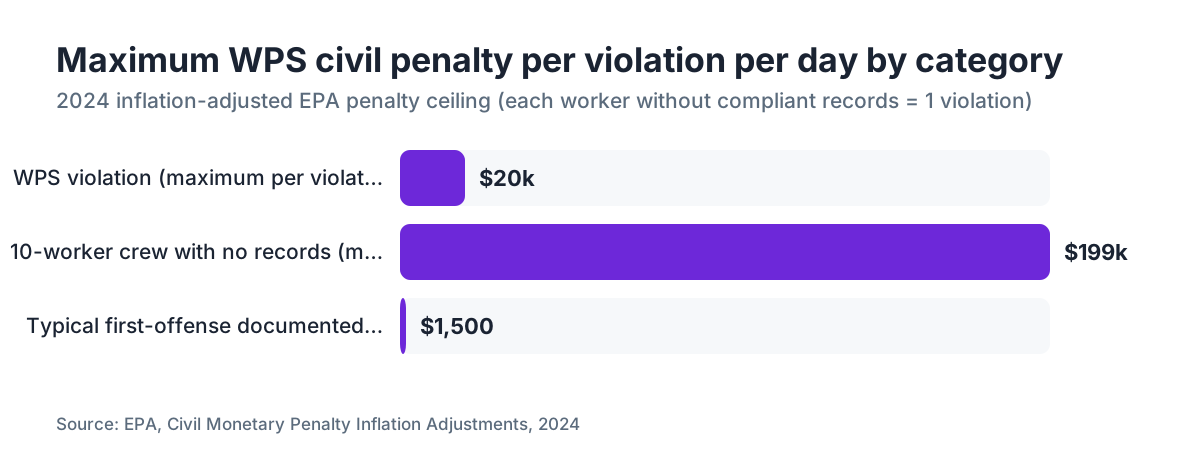
Under EPA's penalty structure, WPS violations are assessed up to $19,866 per violation per day (as of the 2024 Civil Monetary Penalty inflation adjustment). [7] Each worker without a compliant training record is a separate violation. A ten-person crew with no documentation is ten violations. That's a ceiling, not an automatic assessment, and first-offense penalties in practice are usually far lower, but the exposure is real.
State agencies handle first inspections differently. California DPR typically issues a notice of violation for documentation deficiencies on a first inspection, with a compliance deadline. Repeat violations or cases involving actual worker exposure move to penalty territory. Washington and Oregon operate similarly. New York tends to focus on outreach before enforcement for small operations.
The practical consequence most growers actually face is not a massive fine. It's the burden of proof in a worker injury or exposure claim. If a worker claims pesticide exposure and your training records don't exist or are incomplete, you lose that argument before it starts. Complete records don't prevent injuries, but they demonstrate you met your duty of care.
If you discover your records are incomplete, document what you can reconstruct with honest notes ("record reconstructed from payroll and field log; original not located") and implement a better system going forward. Do not backdate records. That converts a civil compliance problem into potential fraud.
How do you build a system that keeps training records current without it becoming a burden?
The operations that stay compliant without chaos treat training documentation like payroll: it happens on a fixed schedule, with a fixed form, and someone specific is accountable for it.
Start with a template. Print or create a digital form with every required WPS field pre-populated as a label. Workers fill in their name, trainer fills in the rest, date goes on top. No blank forms, no improvising. UC Cooperative Extension and WSU's pesticide safety education program both publish model WPS record forms aligned with their states' requirements. [2][4] Use one of these rather than building your own from scratch.
Assign one person per operation as the WPS records custodian. This doesn't need to be the vineyard manager. It can be an office admin or a senior crew lead. What matters is that one person knows where all training records are and is responsible for filing them within 24 hours of a training session.
Build training into your new-hire onboarding flow. Before any new worker touches a field, training and documentation happen. Not after orientation. Not at the end of week one. Before first field entry.
For operations managing multiple blocks or ranches, centralized digital record-keeping pays off quickly. A system that timestamps entries, requires all mandatory fields before saving, and generates a two-year archive makes an inspector's audit a five-minute exercise instead of a four-hour scramble. VitiScribe's compliance records module was built specifically for this kind of vineyard recordkeeping, with WPS training log templates that mirror the regulatory field requirements and retention-date tracking built in.
Are there WPS training record requirements specific to California, Washington, or New York vineyards?
All three states have requirements that meet or exceed the federal WPS standard. Know which state you're in and which agency inspects you.
California: CDPR administers WPS in California. California's own Agricultural Code and Title 3 CCR regulations require annual pesticide safety training for agricultural workers, which is stricter than the federal standard. [2] Records must be kept for three years in California (one year longer than the federal floor). CDPR inspection reports are public record and provide a useful picture of what violations actually get cited.
Washington: WSDA enforces WPS. Washington's requirements match the federal 2015 revised WPS standard closely. WSDA runs an outreach program and publishes compliance information, and its recent enforcement work has emphasized language-appropriate training. [3] WSU's pesticide safety education program supports Washington growers with training resources. [4]
New York: NYSDAM (New York State Department of Agriculture and Markets) is the state lead agency. New York generally follows federal WPS minimums. Cornell's Agricultural Workforce Development program produces New York-specific WPS training materials that are EPA-approved and available in multiple languages. [5]
Oregon: ODA (Oregon Department of Agriculture) enforces WPS. Oregon's requirements mirror the federal standard. ODA's pesticides program has a compliance assistance function and will conduct pre-inspection consultations for operations that request them. [10]
Regardless of state, the safest approach is to meet the most stringent applicable standard (usually California's three-year retention and annual training requirement) if you operate in multiple states or aren't certain which rules apply to a specific parcel.
Frequently asked questions
How long must vineyard operators keep WPS training records?
Federal WPS requires a minimum two-year retention period from the date of training. California imposes three years under CDPR regulations. If you operate in multiple states, keep records for three years to stay safe in all jurisdictions. The clock starts on the training date itself, not the end of the season or the worker's last day of employment.
Does every agricultural worker in a vineyard need WPS training, or just applicators?
Every agricultural worker who enters a treated area or any area under a restricted-entry interval needs WPS worker training. Pesticide handlers (mixers, loaders, applicators) have separate handler training requirements. The two categories are distinct and records should be kept separately. Contractors, H-2A workers, and family members who qualify as agricultural workers all need training documentation.
Can I use a sign-in sheet as a WPS training record?
Yes, a sign-in sheet works for group training sessions, but only if it captures all required fields: each worker's name, the training date, the trainer's name and credentials, and the training method or materials used. A bare sign-in list with names and a date is not compliant. Pre-print required fields at the top of any sign-in sheet you use so nothing gets missed in the moment.
What training topics are required under WPS, and do I have to document that I covered them?
The 2015 revised WPS lists 23 specific topics that worker training must cover, found in 40 CFR 170.130. These include pesticide hazards, REI meaning, decontamination procedures, rights to information, and emergency assistance. You don't have to check off all 23 on your record form, but noting that training covered all topics per 40 CFR 170.130 is a defensible shorthand that satisfies most inspectors.
Does WPS training need to be in the worker's language, and how do I document that?
Training must be in a language the worker understands, which is a regulatory requirement under 40 CFR Part 170. On your training record, note the language in which instruction was delivered (for example, "in-person training conducted in Spanish"). If you used an EPA-approved Spanish-language video, note its title and EPA approval number. Language gaps in training are among the most commonly cited WPS deficiencies in state inspections.
Do returning seasonal workers need to be retrained every year under WPS?
Under the federal WPS, no, retraining is not required annually as long as compliant prior training is documented and the record is retained. However, California requires annual pesticide safety training under state law, stricter than the federal floor. Always check your state's specific rules. Many vineyard managers retrain annually anyway for practical liability and safety reasons, and it simplifies recordkeeping.
What are the penalties for WPS training record violations in a vineyard?
Civil penalties under EPA's WPS enforcement authority reach up to $19,866 per violation per day as of 2024 inflation adjustments. Each worker without compliant documentation is a separate violation. In practice, state agencies typically issue notices of violation with compliance deadlines for first-offense documentation deficiencies. Repeat violations or actual worker exposure incidents move to formal penalty proceedings. Incomplete records also weaken your position in any worker injury claim.
Who is responsible for WPS training records when a labor contractor provides the crew?
The agricultural employer (the vineyard owner or operator) is responsible under WPS, regardless of whether workers were hired directly or through a labor contractor. You should request copies of training records from any labor contractor before workers enter your fields. If you cannot produce compliant records during an inspection, "the contractor was supposed to handle it" is not a defense that satisfies federal or state WPS enforcement.
What does EPA-approved WPS training material mean and where do I find a list?
EPA-approved training materials are programs that have been reviewed and accepted by the EPA as covering all required WPS training topics in the correct format. The National Pesticide Safety Education Center (NPSEC) maintains the official list of approved materials, including Spanish-language programs and video courses. Using an approved material and noting its name and EPA approval number on your training record is the most straightforward way to document the training method.
Can I train workers myself, or does WPS training have to be done by a licensed applicator?
WPS allows training to be conducted by the agricultural employer, a designated supervisor, or anyone who has completed an EPA-approved trainer course. A licensed pesticide applicator can train workers but is not the only qualified person. If you train your own workers, document your own name and qualification (such as completion of an approved WPS trainer program) on the record. The key is that the trainer is identified and their qualification is clear.
Where should WPS training records be physically stored at a vineyard?
WPS requires records be maintained at the agricultural establishment and accessible during normal working hours. For multi-block operations, this typically means at a central farm office. Records accessible only off-site create problems during inspections. Digital systems stored in the cloud and accessible via phone or tablet at the field office satisfy the requirement as long as someone on-site can actually retrieve them when an inspector arrives.
What is the WPS central posting requirement and how does it connect to training records?
WPS requires that specific pesticide safety information, including the EPA's WPS Safety Data Sheet and application-specific information, be posted at a central location accessible to all workers. Workers must be told during their training where this posting location is. Your training record should note that workers were informed of the central posting location, even though WPS does not explicitly require that field on the record. State inspectors frequently ask about it.
Are there free WPS training record templates I can use for my vineyard?
Yes. WSU's pesticide safety education program and UC Cooperative Extension both publish free WPS-compliant training record templates adapted to their respective states' requirements. Cornell's Agricultural Workforce Development program has EPA-approved materials including record forms for New York operations. These are better starting points than creating your own form from scratch because they're built with current regulatory language and are recognized by state enforcement agencies.
If a worker cannot read or sign, how do I handle the training acknowledgment on the record?
EPA does not require worker signatures on WPS training records. Signatures are your documentation, not a worker's contract. If a worker cannot sign, note on the record that oral training was provided and verbal acknowledgment was received. Do not skip the training record because you couldn't obtain a signature. The record documents what you did, not what the worker agreed to.
Sources
- EPA, Worker Protection Standard for Agricultural Pesticides (40 CFR Part 170, 2015 revised rule): WPS requires training before entry into treated areas, records kept two years, and specifies 23 required training topics and required record fields including worker name, training date, trainer name and credentials, and method used.
- California Department of Pesticide Regulation, Worker Health and Safety: California requires annual pesticide safety training for agricultural workers and three-year record retention, stricter than the federal WPS standard; CDPR inspection findings identify missing training records and records lacking trainer credentials as top violations.
- Washington State Department of Agriculture, Pesticide Management: WSDA enforcement guidance and inspection work identify language-inappropriate training and missing trainer credential documentation as recurring WPS deficiencies in Washington wine grape operations.
- Washington State University, Urban Integrated Pest Management and Pesticide Safety Education Program: WSU's pesticide safety education program recommends WPS training records include the central posting location and provides model record templates aligned with Washington's WPS requirements.
- Cornell University, Agricultural Workforce Development Program: Cornell's program produces EPA-approved WPS training materials in multiple languages for New York operations and notes that in-person training with hands-on demonstration produces better worker comprehension outcomes than video-only methods.
- UC Agriculture and Natural Resources, Statewide Integrated Pest Management Program: UC ANR develops pesticide safety and WPS training resources, including Spanish-language materials, that California vineyard operators can use and cite in training records as a recognized training source.
- EPA, Civil Monetary Penalty Inflation Adjustment, 40 CFR Part 19 (2024): As of the 2024 civil monetary penalty inflation adjustment, WPS violations carry maximum penalties of $19,866 per violation per day; each worker without compliant training documentation constitutes a separate violation.
- National Pesticide Safety Education Center, EPA-approved WPS training materials: NPSEC maintains the official list of EPA-approved WPS training materials, including Spanish-language programs; using an approved material with its EPA approval number on training records is the standard documentation practice.
- EPA, WPS Revised Rule Preamble and Summary (80 FR 67496, November 2, 2015): The 2015 revised WPS final rule, effective January 2, 2017, established the current training, record-keeping, and two-year retention requirements for all agricultural establishments.
- Oregon Department of Agriculture, Pesticides Program: Oregon's WPS requirements mirror the federal standard; ODA's pesticides program offers compliance assistance and pre-inspection consultations for agricultural operations.
Last updated 2026-07-11