How to file a grower information report for a regional water board coalition

TL;DR
- Growers enrolled in a Regional Water Quality Control Board coalition in California file an annual Grower Information Report covering irrigated acreage, crops, water sources, and nitrogen or pesticide practices.
- Reports go through your coalition's online portal, with most deadlines between January 15 and March 1.
- Miss one and the board can push you into individual monitoring that runs several thousand dollars a year.
What is a Grower Information Report and who has to file one?
A Grower Information Report (GIR) is an annual self-reporting document that irrigated farms in California submit through a third-party coalition to satisfy the Irrigated Lands Regulatory Program (ILRP), run by the State Water Resources Control Board and its nine Regional Water Quality Control Boards. If your vineyard discharges, or could discharge, irrigation or storm runoff to surface water or groundwater, the ILRP applies to you.
Most California growers comply through a coalition instead of enrolling on their own. A coalition is a group of agricultural operators who monitor water quality together and report on behalf of members [1]. Individual enrollment dumps the entire monitoring and reporting load on you alone. That's why nearly every vineyard in a regulated watershed joins a coalition.
The GIR is not a pesticide use report. That goes to your county ag commissioner separately. The GIR is a land-use, management-practice, and water-source inventory. Regulators use it to map nutrient and sediment risk across a watershed, flag operations that need outreach, and aim their water sampling. Think of it as the snapshot that tells the regional board what you're doing on the ground.
If you farm in more than one region, you may file with more than one coalition. The San Joaquin Valley, Central Coast, North Coast, and Sacramento River regions all run active coalition programs, and the forms and portals differ by region [1].
Which regional water board coalition covers my vineyard?
California has nine Regional Water Quality Control Boards. Where your parcels sit decides which one regulates you, and that board's approved coalitions handle GIR filing. Look up your board first, then the coalition inside it.
Here's a simplified breakdown of major wine-grape regions and the coalitions that usually serve them:
| Wine Region | Regional Water Board | Primary Coalition(s) |
|---|---|---|
| North Coast (Napa, Sonoma, Mendocino) | Region 1 (North Coast) | North Coast Resource Partnership |
| Central Coast (Paso Robles, Santa Barbara, Monterey) | Region 3 (Central Coast) | Central Coast agricultural water quality coalitions |
| Sacramento Valley / Delta | Region 5 (Central Valley) | Multiple CV coalitions by sub-watershed |
| San Joaquin Valley | Region 5 (Central Valley) | East San Joaquin, Westlands, others |
| Lodi / Clarksburg | Region 5 (Central Valley) | Central Valley coalitions by sub-watershed |
Some regions have more than one coalition working the same geography. In Region 5 you have to look up your specific sub-watershed, because there are more than a dozen coalitions and they don't overlap cleanly.
If you've never enrolled, or you're not sure which coalition covers your parcels, the State Water Board's ILRP program page has the enrollment lookup and current coalition contact lists [1]. Your county farm advisor or a local farm bureau office can also point you to the right coalition contact in a single phone call.
What information do you need to gather before filing?
The exact fields shift by coalition and by the region's current order, but every GIR asks for roughly the same core data. Pull it together before you open the portal. It saves real time and keeps you from guessing at the deadline.
You'll need your Assessor's Parcel Numbers (APNs) for every field you're reporting. The coalition maps your operation by parcel, so missing or wrong APNs cause the worst headaches during review. Get these from your property tax statement or the county assessor's website.
Beyond parcel data, expect to report:
- Total irrigated acres by crop type (wine grapes, table grapes, other)
- Irrigation system type (drip, micro-sprinkler, flood) and whether you use recycled water
- Water source (surface water by named ditch or canal, groundwater by well permit number, municipal)
- Fertilizer applications: product name, method, timing, and total pounds of nitrogen per acre if you have it from your PCA records
- Pesticide use summary, which you can often pull straight from your county pesticide use reports (PURs)
- Soil and water management practices you've put in place, such as cover cropping, filter strips, or tailwater ponds
- Any water quality monitoring data you hold, though coalitions usually run the ambient monitoring themselves
If you work with a Pest Control Adviser (PCA), ask for a summary of your PUR data before the portal opens. PCAs in California file pesticide use reports with the county by the 10th of the following month under Food and Agricultural Code section 12981 [3], so you shouldn't need to rebuild that data from scratch.
For nitrogen, a Nutrient Management Plan or fertilization records from your viticulture consultant translate directly into the GIR fields. UC Agriculture and Natural Resources publishes guidance on calculating pounds of nitrogen per acre from common fertilizer products, which helps if your records have gaps [4].
What are the GIR filing deadlines and what happens if you miss them?
Deadlines are set by each coalition and approved by the regional board, so they vary. Most coalitions covering wine grape regions set the annual GIR deadline between January 15 and March 1 for the prior calendar year's practices. Some have moved to a rolling 12-month window tied to when you enrolled.
Central Coast coalitions have historically clustered their annual member update deadlines around mid-February [1]. North Coast deadline dates go out in the member newsletter each fall. Central Valley growers should check their coalition's website in October, because that's when the next year's date usually posts.
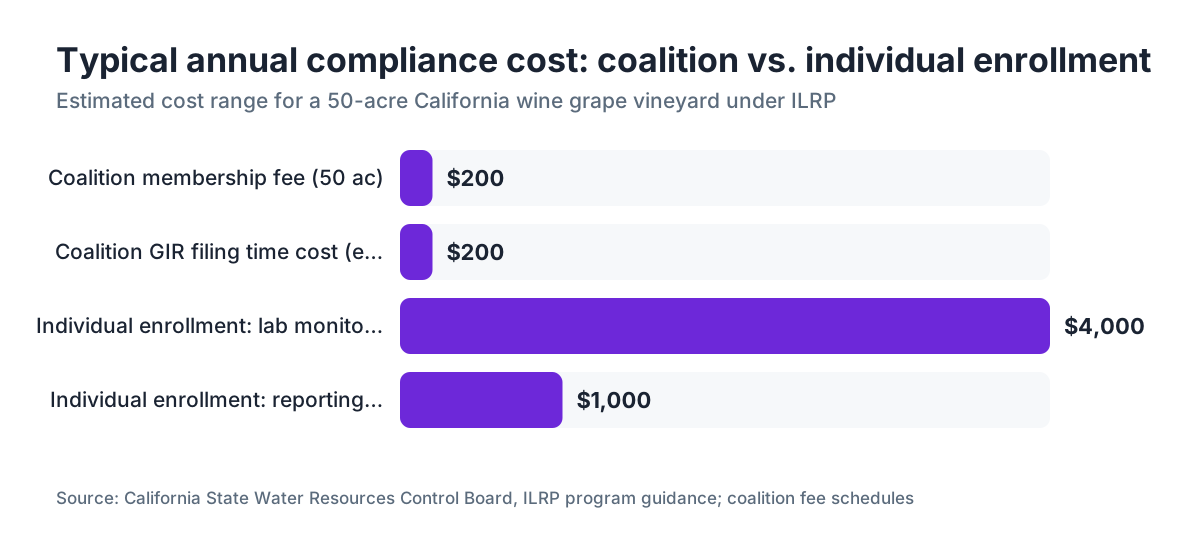
Missing the GIR deadline is not a minor slip. The General Order for the Irrigated Lands Regulatory Program (Order WQ 2014-0057-DWQ, as amended) lets regional boards require non-compliant growers to enroll individually and run their own water quality monitoring [5]. Individual enrollment means you hire a certified lab, run your own sampling program, and file your own reports straight to the regional board. That can run several thousand dollars a year depending on how many monitoring points you need. Staying in the coalition and filing on time is almost always cheaper.
Some coalitions offer a late window, usually 30 days past the deadline, with a notice and sometimes a fee. Once that window closes, they're required to report your name to the regional board as a non-filer. You don't want to be on that list.
How do you actually submit the GIR through the coalition portal?
Every major coalition now files through an online portal instead of paper forms. The steps below are representative of how most of them work, though the interface changes from one coalition to the next.
First, log into your coalition's member portal. New members get login credentials by email at enrollment. If you've lost yours, the coalition's member services contact can reset the account. Do this a week ahead of the deadline, not the morning of.
Once you're in, the portal usually shows a list of your enrolled parcels. Click into each parcel and work through the data screens in order. Most portals have a progress bar or checklist so you can see what's left. If your parcel count is high, don't try to finish in one sitting. Most portals save a draft.
Common sections you'll move through:
- Verify your contact and property information. Update acreage if fields changed.
- Confirm or update your crop type and irrigated acres.
- Enter your water source information.
- Enter your nitrogen inputs, either as product-level detail or as a total pounds-per-acre figure.
- Select the management practices you used from a checklist.
- Upload any supporting documents the coalition asks for, such as a nutrient management plan or soil test results.
- Review the summary screen and click Submit.
After you submit, you should get a confirmation email with a reference number. Save it. That's your proof of timely filing if anything goes sideways later.
If you keep records in a field operations platform like VitiScribe, the nitrogen application summaries and irrigation logs you've kept all season map almost directly to the GIR fields. That's the main practical reason vineyard managers run that kind of software.
Portal problems happen, especially near the deadline when everyone files at once. If the portal is down on the due date, document your attempt (a screenshot with a timestamp) and email the coalition right away. Most coalitions have a policy for technical failures, but you have to tell them while the deadline window is still open.
What nitrogen and fertilizer data does the GIR require from vineyards?
Nitrogen reporting is where vineyard managers most often underestimate the work, especially under the Nitrogen Management Plan requirements the Central Valley regional board has been expanding since the 2012 orders. Get your fertigation records straight before you start this section.
Most North Coast and Central Coast coalitions ask for total nitrogen applied per acre per year, sorted by source: synthetic fertilizer, organic amendments, compost, and irrigation water if you inject liquid fertilizer through your drip system (fertigation). You don't need a full nutrient management plan unless your regional board's order specifically requires one for your operation size or practice type.
In the Central Valley under the General Order, operations above certain thresholds must prepare or update a Nitrogen Management Plan and submit it to the coalition. The current trigger thresholds live in the Waste Discharge Requirements for the Central Valley [5], and they keep shifting. UC Agriculture and Natural Resources nutrient management guidance for wine grapes is a practical starting point if you're building a compliant plan from scratch [4].
For a typical wine grape vineyard on drip-fertigated urea or potassium nitrate, your PCA's fertilizer records plus your irrigation log are usually enough to fill the GIR nitrogen fields. Keep those records properly and the GIR is mostly data transfer. Skip them and this is the moment you discover the gap.
A useful rule of thumb: wine grapes at normal vine density in California typically take 20 to 60 pounds of nitrogen per acre per year, depending on variety, rootstock, and target yield. Numbers well outside that band tend to draw coalition follow-up questions, so make your figures reflect what actually went on, not a guess.
How do pesticide and worker protection standard records connect to the GIR?
The GIR does not replace your county pesticide use reporting. Those are separate legal requirements under the California Food and Agricultural Code [3]. The GIR uses your pesticide records to spot management practices and runoff risk, not to regulate the pesticides themselves.
Regulators and coalitions do cross-check, though. If your GIR says you applied one herbicide and your county PUR shows a different product or rate, that gap can trigger a compliance inquiry. Keep your records consistent across both systems.
The EPA Worker Protection Standard (WPS), revised in 2015 and administered in California by the Department of Pesticide Regulation, requires that application records be kept for two years and be accessible to employees [6]. The WPS also requires central posting of pesticide application information, handler training records, and emergency contact information. None of that goes into the GIR. But the same records you keep for WPS, application timing, products, rates, and restricted-entry intervals, are exactly what your PCA uses to generate the county PURs that feed your GIR summary.
One well-organized spray record binder or electronic spray log gives you what both programs need. WSU Extension has published guidance on vineyard spray record management that's worth reading even in California, because the record structure carries over cleanly [7].
Watch this if you're certified organic: the GIR still asks you to report pesticide applications, including OMRI-listed materials. The coalition tracks water quality risk from all products, not synthetic ones alone. Copper, used heavily in organic vineyards against powdery and downy mildew, is a regulated metal with documented runoff impacts in California coastal watersheds [8].
What are the most common GIR filing mistakes and how do you avoid them?
Wrong or missing APNs are the single most common error, and the hardest for a coalition to fix on your behalf, because they break the GIS mapping layer the board uses for watershed analysis. Check every parcel number against your property tax bill before you open the portal.
Reporting total farm acreage instead of irrigated acreage is a close second. Dry-farmed blocks may or may not be in scope depending on your regional board's current order. In most orders, any block that gets supplemental irrigation at any point in the year counts as irrigated for reporting, even a one-time establishment irrigation.
Forgetting leased parcels trips up a lot of people. If you lease land and farm it yourself, you're typically the responsible party for the GIR, not the landowner. Check your lease and the coalition's enrollment rules.
On nitrogen data, the mistake is usually reporting what you planned to apply instead of what you actually applied. Ordered 200 pounds of urea but used 150? Report 150. The GIR is a record of real practices, not intentions.
Not updating your contact info when management changes is a quieter problem that compounds. If the coalition sends a notice of deficiency to a former employee's email, you won't know there's an issue until the regional board flags you as non-responsive. By then the easy fix has passed.
Do small vineyards under a certain acreage have to file?
The ILRP has no general small-farm exemption. If your land discharges or could discharge to a water body of the state, you're covered regardless of size [1]. The practical threshold for enforcement attention varies by region, and some coalitions run tiered membership where very small operations pay lower dues and file simplified reports.
The Central Coast order and the North Coast order both cover operations as small as one irrigated acre if they're in scope. A few coalitions set minimum acreage thresholds for enrollment, but that's a coalition administrative call, not a regulatory exemption. A vineyard below a coalition's minimum may end up enrolling individually with the regional board instead, which is usually worse.
If you dry-farm your entire estate with no irrigation infrastructure at all, you may legitimately fall outside the ILRP. Call the regional board or your local farm bureau to confirm. Don't assume you're exempt and skip enrollment. The price of a wrong guess is individual monitoring and reporting.
For scale: the State Water Board's ILRP program tracks roughly 6 million enrolled irrigated acres statewide across all coalitions [1]. The average enrolled parcel is fairly small. This is not a program built only for large ag.
How does the coalition use your GIR data after you file?
After the filing window closes, the coalition aggregates every member GIR and builds a management practices inventory for the watershed. That feeds the coalition's annual monitoring report to the regional board, which maps practices against water quality samples from the ambient monitoring network.
If your GIR data plus nearby water samples suggest elevated nitrogen, sediment, or pesticide concentrations that line up with your management patterns, the coalition may contact you for a farm evaluation. This is usually framed as educational outreach, not enforcement. The coalition sends a farm advisor or consultant to walk the property, find runoff pathways, and recommend practice changes.
The regional board uses aggregate coalition data to judge whether the coalition's approach is cutting water quality impairments. If regional water quality isn't improving on schedule, the board can tighten requirements on the whole coalition, which flows down to every member as more reporting, more monitoring, or practice mandates.
Your individual GIR data isn't public-facing in most regions, but it is a public record under California law and can be obtained through a Public Records Act request. For most growers that's a non-issue. In a contentious watershed where environmental groups are active, it's worth knowing.
The GIR is the base layer under everything the ILRP does at the coalition level. Filing accurately and on time is how you stay out of individual oversight and how the coalition keeps its collective permit in good standing [5].
What resources are available to help you file correctly?
Your coalition is the first call. Every coalition has member services staff or a contract farm advisor who can walk you through the portal and answer data questions. Use them. That's part of what your dues pay for.
UC Cooperative Extension farm advisors in your county are the next resource, especially for the nitrogen and nutrient management sections. UC Agriculture and Natural Resources publishes vineyard nutrient management guidelines that show up throughout ILRP compliance guidance [4]. Cornell Cooperative Extension's viticulture publications are aimed at New York growers, but their nutrient management and integrated pest management frameworks are solid references anywhere [9].
WSU Extension in Washington has produced practical vineyard record-keeping guides that carry over to California compliance, especially for spray records and the pesticide-to-GIR data chain [7].
The State Water Board's ILRP program page holds current order language, coalition contact lists, and enrollment tools [1]. The Central Coast order, Central Valley orders, and North Coast order are all posted there as PDFs.
If you're running multiple parcels across hundreds of acres and the data entry burden is genuinely high, record-keeping software built for vineyards can automate the aggregation step. VitiScribe lets you log applications and irrigation events in the field, then export summaries in formats that mirror GIR data fields, which cuts the annual filing work a lot. Worth evaluating if you're spending more than a few hours pulling data together each year.
For vineyards in regions like Paso Robles or the South Coast area, your local winegrowers association often runs a pre-deadline GIR workshop in December or January. Go even if you've filed before. Order requirements change, and the coalition staff who run these sessions usually know about coming changes before they publish.
Frequently asked questions
Is the Grower Information Report the same as a pesticide use report?
No, they're separate requirements. Your Pesticide Use Report goes to your county agricultural commissioner by the 10th of the month after application, under California Food and Agricultural Code section 12981. The Grower Information Report goes to your regional water board coalition once a year and covers irrigated acreage, water sources, nitrogen use, and management practices. You do use your PUR data as a source when filling out the GIR pesticide summary.
What is the Irrigated Lands Regulatory Program (ILRP) and why does it matter for vineyards?
The ILRP is the State Water Resources Control Board program that regulates discharges from irrigated agriculture to surface and groundwater in California. Vineyards that irrigate, or that have runoff potential to a water body, must comply, either through a coalition or on their own. Coalition membership is almost always the lower-cost path. The program is authorized under the Porter-Cologne Water Quality Control Act and the federal Clean Water Act.
Can I file a GIR for multiple parcels at once or do I have to do them individually?
Most coalition portals let you file all your enrolled parcels under one account login in a single session, but you fill in data field by field for each parcel because acreage, crops, water sources, and nitrogen inputs differ by parcel. Some portals have a copy-from-previous-year function that pre-populates unchanged fields, which speeds things up if your operation stayed steady.
What happens if I made a mistake on a GIR I already submitted?
Contact your coalition's member services staff as soon as you notice. Most coalitions allow amendments within a set window, often 30 to 60 days after the deadline. After that, amendments usually need a written request and may get noted in your file. Fixing your own error looks far better than having the coalition or board find a discrepancy during review.
Do I need to file a GIR if my vineyard is certified organic?
Yes. Organic certification does not exempt you from the ILRP or GIR. The regional board cares about water quality impacts from all agricultural inputs, including OMRI-listed materials. Copper-based fungicides used in organic viticulture are specifically flagged as a water quality concern in Central Coast and North Coast watersheds, so organic operations may draw more scrutiny in that section, not less.
How far back do I need to keep GIR records?
The General Order for Irrigated Lands (Order WQ 2014-0057-DWQ) requires you to retain records supporting your GIR filings for at least five years and make them available for inspection. The underlying records (spray logs, fertilizer invoices, irrigation logs) should be kept at least that long. The EPA Worker Protection Standard separately requires that application records be maintained for two years.
What is a Tier 2 or Tier 3 designation and does it change my GIR requirements?
In several regional orders, particularly the Central Valley, growers are assigned to risk tiers based on proximity to water bodies, practice type, and compliance history. Higher tiers usually mean more detailed GIR reporting, more frequent monitoring, or submission of management plans. Your coalition tells you your tier at enrollment. Tiers can move up if ambient water quality near your operation shows persistent problems.
Can a farm manager or PCA file the GIR on behalf of the vineyard owner?
Yes, but the legal enrollee, usually the landowner or the operator named on the enrollment agreement, stays the responsible party. Many coalition portals let you designate an authorized representative who can log in and file. Set this up before the deadline opens, not on the day of. The enrollee should review and confirm the submission, since they sign off on its accuracy.
What water quality pollutants does the GIR focus on for wine grape vineyards?
Nitrogen, sediment, and pesticides are the primary concerns for wine grape operations in California. Copper from fungicide applications is a specific concern in North Coast and Central Coast watersheds where it has been detected above water quality objectives in receiving streams. Salinity is tracked in some Central Valley regions. The GIR collects management practice data that helps the coalition model risk for each of these.
Is there a fee to belong to a coalition and file a GIR?
Yes. Coalition membership fees vary by region and enrolled acreage. Typical ranges run from roughly $50 to $250 a year for small vineyard operations up to several hundred dollars for larger ones, though fee structures differ by coalition and change with budget cycles. Contact your coalition for current rates. Individual enrollment without a coalition carries no direct membership fee but requires self-funded monitoring that costs far more.
Do I still need to file if my vineyard produced no crop this year due to frost or smoke damage?
Generally yes, if your land stayed enrolled and had the potential for irrigation or runoff during the reporting year. Some coalitions run a fallow-year process where you notify them that no practices occurred, which simplifies your GIR but doesn't remove the filing requirement. Check with your coalition's member services staff about their fallow land protocol.
Where can I find the actual form or portal link for my regional coalition?
Start with the State Water Resources Control Board's ILRP page, which lists approved coalitions by region with contact information. Your county farm bureau and the UC Cooperative Extension farm advisor for your area are also reliable sources. Don't use a third-party link unless you can verify it's the current coalition portal. Some older URLs in search results point to outdated filing systems.
Sources
- California State Water Resources Control Board, Irrigated Lands Regulatory Program: ILRP requires irrigated agricultural operations to enroll through coalitions or individually; covers roughly 6 million acres statewide
- Central Coast Regional Water Quality Control Board (Region 3), Agricultural Order: Region 3 Central Coast growers from Monterey through Santa Barbara comply through approved agricultural water quality coalitions
- California Food and Agricultural Code, Section 12981: Pesticide use reports must be filed with the county agricultural commissioner by the 10th of the month following application
- UC Agriculture and Natural Resources, Nutrient Management in Vineyards: UC Agriculture and Natural Resources provides vineyard nutrient management guidelines frequently cited in ILRP compliance guidance
- State Water Resources Control Board, Order WQ 2014-0057-DWQ, General Order for Irrigated Lands: Order WQ 2014-0057-DWQ allows regional boards to require non-compliant growers to enroll individually and conduct their own monitoring; also defines Nitrogen Management Plan thresholds
- U.S. EPA, Agricultural Worker Protection Standard: EPA WPS revised in 2015 requires application records be maintained for two years and be accessible to employees
- Washington State University Extension, Vineyard Pest Management and Record Keeping: WSU Extension has published practical vineyard record-keeping guides applicable to spray records and the pesticide-to-GIR data chain
- North Coast Regional Water Quality Control Board (Region 1): Copper from fungicide applications has been detected above water quality objectives in North Coast and Central Coast receiving streams
- Cornell Cooperative Extension, Viticulture and Enology Program: Cornell Cooperative Extension publishes nutrient management and integrated pest management frameworks for viticulture
- California Department of Pesticide Regulation, Pesticide Use Reporting: California DPR administers the statewide Pesticide Use Reporting system; county agricultural commissioners receive monthly reports from PCAs and applicators
- Porter-Cologne Water Quality Control Act, California Water Code Section 13000 et seq.: ILRP regulatory authority derives from the Porter-Cologne Water Quality Control Act and the federal Clean Water Act
Last updated 2026-07-11