How to print and file a disease model forecast report with spray records

TL;DR
- Print your disease model forecast the same day you make a spray decision, attach it to the matching pesticide application record, and store both for at least two years (three in many states, five for organic).
- The forecast is your documented reason for the timing and rate.
- Skip it, and your spray record is just a list of chemicals with no defensible rationale behind them.
Why attach a disease model forecast to a spray record at all?
A pesticide application record tells an auditor what you sprayed and when. It does not tell them why. Regulators, crop insurance adjusters, and organic certifiers keep asking for that "why," and a printed disease model output is the cleanest answer you have.
Under the EPA Worker Protection Standard (40 CFR Part 170), employers must keep records of pesticide applications for at least two years [1]. States layer more rules on top. California requires pesticide use reports filed with the county ag commissioner within seven days of application, and the supporting documentation showing your decision basis can be pulled during an audit [2]. The forecast report is that documentation.
There is a farming reason too. Look back at a season where Botrytis got away from you, or one where you nailed it, and the forecast data shows which degree-day sums or humidity thresholds crossed before each spray. That makes next season's calendar smarter. The compliance obligation and the learning tool are the same piece of paper.
What disease models actually produce a printable forecast report?
Most commercial disease modeling platforms give you a graph of risk building over time plus a table of threshold crossings. In wine grape production, the common ones are the UC IPM Gubler-Thomas powdery mildew index, the NEWA (Network for Environment and Weather Applications) system run by Cornell, and WSU's Decision Aid System (DAS) [3][4][5].
Gubler-Thomas powdery mildew index: a daily numerical index. Low risk is 0 to 30, moderate is 31 to 60, high is above 60. Cornell's NEWA outputs grape disease risk for powdery mildew, downy mildew, and Botrytis as low, moderate, or high, with the underlying weather data shown. WSU DAS shows degree-day accumulations and spray windows for several pathogens.
Each one lets you export or print a date-stamped summary. That summary is what you attach to the spray record. No print or export button? A screenshot with the date and URL visible in the browser bar works for most audits, though check your state's specific rules first.
Some vineyard software pulls live weather and model data straight into the application record, so the forecast is attached the moment you enter the spray. If your tool does not do that, you are doing a manual two-step every single time you spray.
What information must a vineyard spray record legally contain?
The federal baseline under the Worker Protection Standard and FIFRA recordkeeping rules [1] sets the required fields for any pesticide application record.
| Field | Minimum federal requirement |
|---|---|
| Product name | Yes, including EPA registration number |
| Application date | Yes |
| Location of application | Yes (block, field ID) |
| Amount applied | Yes (volume per acre or total) |
| Applicator name | Yes |
| REI (Restricted Entry Interval) | Must be posted; commonly kept in record |
| Crop / target site | Yes |
States add fields. California wants the site ID matching the county parcel, the start and end time, and the pest or disease targeted [2]. Oregon wants the applicator's license number. Washington wants the water source if chemigation is involved [6].
The forecast report does not replace any of these fields. It supplements them by tying the application date and target disease to the risk index on that day. Think of it as the exhibit stapled to a legal brief. The brief still needs every element on its own. The exhibit is what makes it defensible.
How do you actually print a forecast report from the major platforms?
Every platform is a little different, but the workflow repeats: generate the current forecast view for your location and date range, export or print it so the date stamp is captured, and save the file before you move on to the next task.
For UC IPM Gubler-Thomas tools: go to your station's current index summary, select the date range covering the seven to fourteen days before your spray, and use the browser Print function (Ctrl+P or Cmd+P). Set the layout to landscape so the graph fits. Leave the header/footer option on and the URL and date print in the footer. Save as PDF [3].
For Cornell NEWA: log in, open your location's grape disease page, and use the print or export link near the table. NEWA gives you a clean table with dates, temperature and humidity averages, and risk ratings. PDF or paper both work [4].
For WSU DAS: the system shows a spray recommendation calendar with degree-day sums. Use Export CSV if you want a spreadsheet to store electronically, or print the current view. Always capture the run date shown at the top of the report [5].
Run a private weather station feeding a local model? Export the raw weather data alongside the model output. If someone challenges the forecast later, you have the temperature and humidity records to back it up.
How do you physically file the forecast with the spray record?
The two standard approaches are paper and electronic. Neither one wins on its own. The right choice depends on how you handle the rest of your compliance paperwork.
Paper: print both the spray record and the forecast, clip them together, and file chronologically by block in a binder. Label the binder by season and keep it dry. Two binders per season covers most operations under 50 acres. Color-code by disease if it speeds retrieval: green for powdery mildew, blue for downy mildew, and so on.
Electronic: create a PDF of the forecast (or download the platform's native PDF), name it something consistent like YYYY-MM-DD_BlockName_Disease_Forecast.pdf, and drop it in the same folder as the spray record. A plain shared-folder structure is fine. What matters is that the two documents surface together when someone audits a specific date and block.
Hybrid: many operations keep paper spray records in the field, then scan or photograph them at the end of the spray day and drop them in the same folder as the forecast PDF. This works well if your crew runs paper tally sheets during application.
VitiScribe links forecast data straight to application records in the field log, which kills the manual staple-or-attach step. That matters most during harvest crunch, when someone always forgets.
Whatever you pick, build the filing step into the same moment as the spray decision. Print the forecast Tuesday, spray Wednesday, file it Wednesday. Wait until Friday and the habit is gone by September.
How long do you need to keep spray records and attached forecasts?
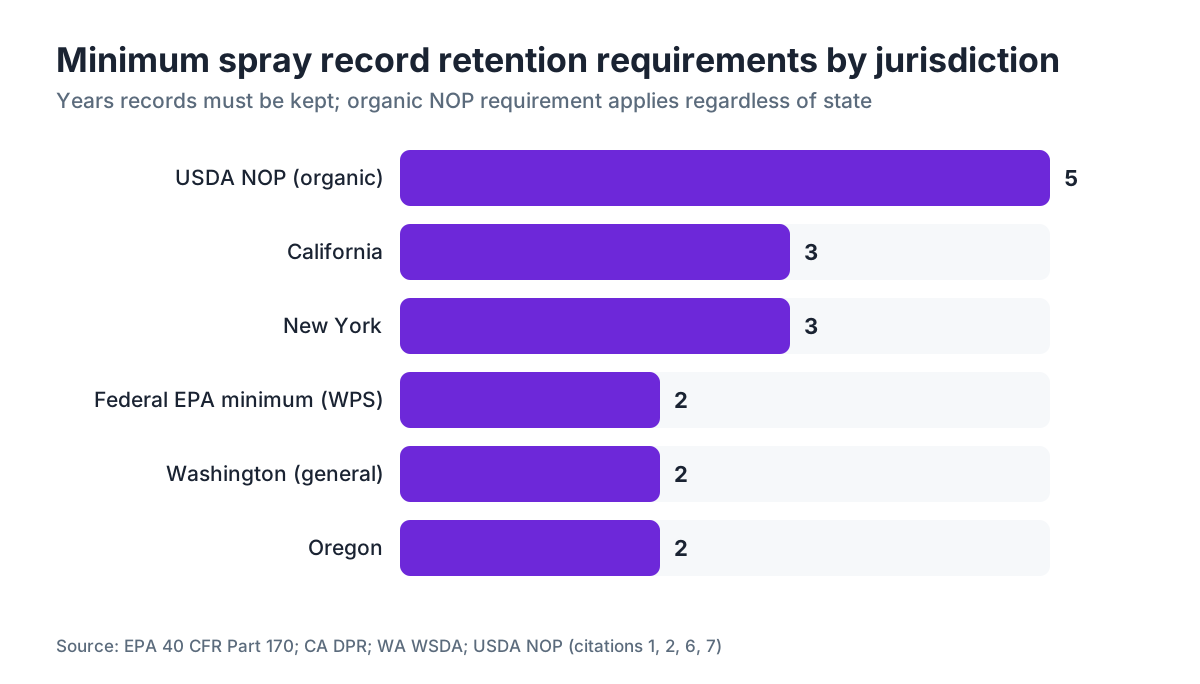
The federal minimum under 40 CFR Part 170 is two years from the date of application [1]. That is the floor, not the ceiling.
California requires pesticide use records for three years, and the county ag commissioner can request them any time in that window [2]. Oregon: two years. Washington: two years for most applications, three years for restricted-use pesticides [6]. New York: three years under the DEC's Part 325 rules.
For organic certification, the National Organic Program requires five years of records supporting your certification status, and that includes any input touching the vineyard [7]. Transitioning to organic and used a conventional fungicide during the transition? That record has to survive the full five years.
Here is the simple answer: keep everything five years. Hard drive space costs almost nothing. Paper takes a box. A missing record during an audit or a crop insurance dispute costs far more than an extra binder ever will.
One note on electronic records. The EPA accepts them as long as they are accessible and reproducible during an inspection. California allows electronic pesticide use reports filed through the county's approved system [2]. Forecast PDFs on a cloud drive count, as long as you can print them on demand.
What file naming and folder structure actually works in practice?
Most compliance failures during audits are not missing records. They are records that exist but cannot be found in time. A consistent naming convention prevents that.
Recommended folder structure:
/Vineyard Records
/2025
/Spray Records
/Block A
2025-05-14_BlockA_PowderyMildew_SprayRecord.pdf
2025-05-14_BlockA_PowderyMildew_Forecast.pdf
/Block B
...
/Equipment Calibration
/Worker Safety
Date-first naming (YYYY-MM-DD) sorts itself in any file browser. The block name and disease name make the content obvious without opening the file. Paired files share the date prefix so they sit next to each other.
If you use a shared drive (Google Drive, Dropbox, OneDrive), give the field manager and the owner access. Do not let one person's laptop be the only copy.
For paper, a tabbed binder with monthly dividers beats block dividers during heavy spray seasons. You more often need "everything we did in June" than "everything in Block C."
How do disease risk thresholds connect to spray timing decisions in the record?
The point of attaching the forecast is to show your spray timing came from real disease pressure, not calendar habit. That matters for a few reasons. It strengthens a liability defense if a crop damage claim gets filed. It supports a pesticide use justification under integrated pest management (IPM) principles. And it is required documentation if you take part in certain cost-share programs or certification schemes.
Here is how the connection should read. On the spray record, the pest or disease targeted field says something like "Powdery mildew, Erysiphe necator." The attached forecast for that same date shows the Gubler-Thomas index at or above 30 (moderate), or a NEWA rating of moderate or high, or a WSU DAS spray window flagged open. Together the two documents tell one coherent story.
UC IPM guidance describes the Gubler-Thomas index as a tool to guide spray timing and interval, and notes that programs run on a fixed calendar can over-apply or miss the risk windows [3]. Cornell's NEWA describes risk-based application timing as the whole intent of the system [4].
When the forecast shows low risk on your spray date, note why you sprayed anyway. Legitimate reasons come up all the time: the model lags your local microclimate, a specific block has a history of early pressure, or you were closing out an interval ahead of a wet stretch. Write that note on the spray record itself. An auditor who sees a low-risk forecast attached to a spray record with no explanation will ask questions.
What does the EPA Worker Protection Standard require for pesticide records specifically?
The WPS (40 CFR Part 170, revised 2015) requires agricultural employers to keep records of each pesticide application for a minimum of two years [1]. The required fields are product name, EPA registration number, active ingredient, application date, location and description of the treated area, amount applied, and applicator name.
The WPS also requires that pesticide safety information (the label and safety data sheet) stay accessible to workers and handlers during the application and for 30 days after. Keeping a label copy with the spray record satisfies this. Some operations clip the label copy to the same binder page as the spray record and forecast.
The 2015 revision added application exclusion zones and made records available to workers on request. Workers can now request application records for any application in an area where they worked [1]. That is one more practical reason to keep records organized: a legitimate worker request has to be answered within 15 days.
The WPS does not require disease model forecasts in the record. That requirement comes from state organic programs, IPM documentation standards, and cost-share rules. But the WPS is where the two-year retention minimum lives, and it is the federal backstop under everything else.
How do organic and IPM certification programs change the documentation requirements?
USDA National Organic Program (NOP) operations have to document that any input is on the approved materials list and was used according to the label and NOP rules [7]. For fungicides, that means documenting the pest or disease that justified the spray. A disease model forecast is the cleanest way to do it.
During the annual inspection, the certifier reviews your spray records. They want to see approved materials (copper, sulfur, bicarbonates, biologicals) tied to documented disease pressure. A Gubler-Thomas index print showing moderate to high risk on the spray date is the kind of documentation that satisfies an NOP certifier with no follow-up questions.
IPM certification programs, including USDA's voluntary guidelines and state-level efforts, require pesticide use to be justified by monitoring data [8]. The disease model forecast is monitoring data in printed form.
For USDA cost-share programs like EQIP (Environmental Quality Incentives Program), documentation requirements vary by practice standard [9]. If you are getting paid for IPM adoption, you may have to show spray decisions were model-driven. Keep the forecasts. Not having them during a program review can mean forfeiting a payment.
What can go wrong when you do not file the forecast with the spray record?
The most common problem is not a fine. It is a gap in your own records that costs you money or credibility at the worst possible moment.
Crop insurance: file a disease loss claim without spray records showing timely applications justified by documented pressure, and the adjuster has grounds to cut or deny it. There is no published federal rule requiring forecast documentation, but adjusters routinely ask for timing justification when a loss looks like a management issue instead of a weather event.
Organic certification suspension: a certifier who finds spray records with no documented justification for input use can issue a notice of noncompliance. A first offense usually means a corrective action plan. Repeat issues can end in certificate suspension [7].
State ag department audit: California county ag commissioners run random audits of pesticide use reports. Missing supporting documentation for restricted-use applications can bring fines. Under California Food and Agricultural Code Section 12999, penalties for pesticide use reporting violations run from $50 to $5,000 per violation [9].
The honest reality: most small vineyard operators never hit any of these. But the ones who do describe the same sequence. Busy season, skipped the filing, never caught up, and then something went wrong in the vineyard at exactly the moment the missing records mattered.
Is there a template or standard format for attaching forecasts to spray records?
There is no federally mandated template. The EPA and USDA publish sample record-keeping forms but do not specify a forecast attachment format [1][7].
California's Department of Pesticide Regulation provides a fillable PDF spray record form that meets state requirements [2]. Oregon and Washington have similar forms from their ag departments [6]. These forms leave room for a "pest observed" or justification note field, where you briefly summarize the forecast ("NEWA high risk for downy mildew, 6/12/2025") and attach the full forecast as a separate page.
Building your own template? A clean approach is a two-page set. Page one is the spray record with every required field. Page two is the forecast output with a header showing the vineyard name, block, date, and model used. Staple them or merge them into a single PDF before filing.
University extension programs at UC Davis [3], Cornell [4], and WSU [5] each publish spray record templates for wine grape operations. Download and adapt one rather than building from scratch. Cornell's template includes a column for disease pressure source, designed to reference exactly this kind of model output.
Frequently asked questions
Can I use a screenshot instead of a printed forecast report?
Yes, in most cases. A screenshot works as long as it clearly shows the date, location, risk level or index value, and the source platform. Make sure the browser date and URL are visible, or add a text annotation with that information. California and most other states allow electronic records. Check that your screenshot is stored in a format you can reproduce on demand for an auditor.
How far in advance can I print the forecast before I spray?
Print it the day you make the spray decision, not the day you spray if those differ. Most disease models update daily, so a forecast printed three days before your application may not match conditions at spray time. If weather shifted between the forecast and the application, note that on the spray record and attach both the earlier forecast and the updated one from the day you sprayed.
Do I need a forecast for every fungicide application, or just high-risk ones?
Attach one for every application. The documentation habit matters more than whether the risk was high or low. File forecasts only on high-risk days and an auditor notices the gap and wonders what drove the low-risk sprays. Consistency is the safest route and costs almost no extra time once the printing step is built into your spray day routine.
What disease models are recommended for Botrytis specifically?
Cornell's NEWA includes a Botrytis risk model for grapes based on the Broome model, which uses temperature and wetness duration around bloom. WSU DAS also models Botrytis risk. UC IPM recommends timing Botrytis sprays at early bloom, full bloom, and bunch closure regardless of model output, noting that the tight windows make a calendar-plus-model approach the practical choice for most growers.
How do I document a spray decision when I disagree with the model output?
Write a short note right on the spray record. Something like: "NEWA showed low risk but this block has a history of early Botrytis from canopy density; applied as a precaution before a forecast rain event." That note, paired with the low-risk forecast, shows good judgment rather than undermining the record. Auditors and certifiers want to see you considered the model, not that it controlled you blindly.
What happens to my spray records if I sell the vineyard?
Spray records stay with the property or the business entity more than with the owner. If you sell, include the spray record archive in the sale documentation or transfer it explicitly. The buyer needs the records for crop insurance, certification continuity, and any pending audits. Organic certification history transfers with the land for NOP purposes, and the certifier will ask for records going back to the start of the transition period.
Are disease model forecast reports required for restricted-use pesticide applications?
Not explicitly by federal law, but restricted-use pesticide (RUP) records carry stricter state requirements. In California, all RUP applications need a pesticide use permit and a completed use report filed with the county ag commissioner within seven days. The forecast is not part of the legal form, but it is the best documentation you have to show the application was justified during any later audit of that use report.
Can I keep all my spray records and forecasts in a cloud folder instead of paper?
Yes. The EPA accepts electronic records as long as they are accessible, legible, and reproducible during an inspection. California also accepts electronic records filed through approved county systems. Use a reliable cloud service with automatic backup, and make sure more than one person has access. A folder on a single employee's personal laptop is not a reliable electronic record system.
What is the Gubler-Thomas powdery mildew index and what threshold triggers a spray?
The Gubler-Thomas index is a numerical accumulator developed at UC Davis that tracks daily temperature conditions favorable to Erysiphe necator. It runs from 0 to roughly 100 or more. An index of 0 to 30 is low risk, 31 to 60 is moderate, above 60 is high. UC Cooperative Extension generally recommends starting a protective fungicide program once the index reaches the moderate range, around 30 to 40, especially in blocks with prior disease history.
How do I handle spray records for multiple blocks sprayed the same day?
Create a separate spray record for each block, but you can attach a single forecast if the blocks share the same weather station and risk level. Note on each spray record which forecast document applies and where it is filed. If the blocks sit in meaningfully different microclimates with separate weather stations, generate and attach a separate forecast for each one.
What if the disease model platform I use shuts down or changes its format?
This is a real risk with web-based tools. The fix is to save the forecast output as a PDF at print time rather than trusting the platform's history. Once you hold the PDF, the platform's future availability is irrelevant. If a tool announces it is closing, export your historical data immediately. WSU DAS, Cornell NEWA, and UC IPM tools are publicly funded and have been stable for over a decade, but no web service is permanent.
Do worker protection standard records and spray records have to be in the same place?
No, but it helps. The WPS requires application information to be accessible to workers for 30 days post-application, and records available for inspection for two years. Many operations keep a short-term binder at the shop with recent spray records and safety data sheets, then archive completed records annually in a separate spot. As long as both sets are accessible on request, the physical location does not matter.
Is there a standard way to number or track spray applications across a season?
No federal standard exists, but a simple sequential number (2025-001, 2025-002) added to every spray record and its forecast attachment makes retrieval fast. Put the application number in your file names. At season end, a one-page index listing each application number, date, block, product, and file location gives you and any auditor a map to the full archive without opening every document.
Sources
- US EPA, Worker Protection Standard 40 CFR Part 170: Agricultural employers must maintain pesticide application records for at least two years under the WPS, including product name, EPA registration number, application date, location, amount applied, and applicator name.
- California Department of Pesticide Regulation, Pesticide Use Reporting: California requires pesticide use reports filed with the county agricultural commissioner within seven days of application, with records retained for three years and subject to audit.
- UC Statewide IPM Program (UC IPM), Grape Pest Management: The Gubler-Thomas powdery mildew index guides spray timing and interval; calendar-only programs may over-apply or miss the risk windows.
- Cornell University NEWA (Network for Environment and Weather Applications): Cornell NEWA outputs grape disease risk for powdery mildew, downy mildew, and Botrytis as low, moderate, or high with underlying weather data, designed for risk-based application timing.
- Washington State University Decision Aid System (DAS): WSU DAS provides degree-day accumulations and spray recommendation windows for wine grape pathogens including powdery mildew and Botrytis.
- Washington State Department of Agriculture, Pesticide Program: Washington state requires pesticide application records retained for two years, three years for restricted-use pesticides, with the applicator's license number on the record.
- USDA Agricultural Marketing Service, National Organic Program: NOP requires certified organic operations to retain records supporting certification status for five years, including documentation that inputs were approved materials applied in response to documented pest or disease pressure.
- California Food and Agricultural Code Section 12999: Violations of pesticide use reporting requirements under California law carry fines ranging from $50 to $5,000 per violation.
Last updated 2026-07-10