How to get written approval from a winery before applying a new pesticide

TL;DR
- Before spraying any pesticide the winery hasn't already cleared, get written sign-off from the winery's designated representative.
- Send the product label, your intended rate, and the timing relative to harvest.
- The winery countersigns and you keep copies.
- This protects your contract, satisfies EPA Worker Protection Standard documentation rules, and gives the winery traceability if a residue question ever surfaces.
Why do wineries require written pesticide approval in the first place?
The short answer is liability and marketability. A winery putting its name on a bottle needs to know exactly what touched those grapes, and a verbal okay from a cellar hand three weeks before harvest falls apart the moment a foreign buyer's lab flags an unexpected residue.
Most winery-grower contracts now carry a pesticide approval clause for exactly this reason. The winery can be held responsible for residues above the tolerance limits set under the Federal Insecticide, Fungicide, and Rodenticide Act (FIFRA) and the Food, Drug, and Cosmetic Act, and no winery absorbs that risk on the strength of a text message. [1]
Organic certifiers add another layer. If any part of the vineyard or the winery holds USDA National Organic Program (NOP) certification, one unapproved synthetic application can cost that certification for up to three years. Written approval builds an auditable trail showing the certifier that every product got reviewed before it hit the vines. [2]
There's also the Worker Protection Standard angle. Under EPA's WPS (40 CFR Part 170), handlers must have access to pesticide application and safety information. A written approval record that travels with the product label fills part of that documentation chain and keeps your spray records coherent when an inspector pulls them. [3]
Written approval isn't bureaucratic noise. It's the thing that keeps a residue dispute from turning into a contract dispute.
What information does the winery actually need from you before they'll approve?
Most wineries that have formalized this want five things at minimum. Get all five into the first request and you rarely get a follow-up question.
First, the full product name and EPA registration number. The registration number shows up on the label as "EPA Reg. No." and ties the product to a specific formulation and tolerance filing. The trade name alone isn't enough, because reformulations happen and the number is the one identifier that doesn't drift.
Second, the active ingredient(s) and concentration. Some wineries work off an approved-active-ingredient list rather than an approved-product list, so the a.i. matters more to their winemaker than the brand name.
Third, the application rate you intend to use, in the label's own units (oz/acre, fl oz/100 gal, and so on). Never exceed what you put in the approval request. That creates a record inconsistency that's hard to explain later.
Fourth, the pre-harvest interval (PHI) for grapes and the last permissible application date given your anticipated harvest window. The PHI is printed on every federally registered label. [4] A systemic fungicide can run a PHI of 7 to 30 days; some insecticides list 0 days, though the winery may hold you to a stricter internal standard.
Fifth, the reason you want the product: what pest or disease, what scouting threshold triggered the call, and what you've already tried. This isn't about justifying yourself. It's context that lets their viticulture or compliance staff clear the request fast instead of sitting on it.
Here's what to include, and why each item earns its place:
| Item | Format to send | Why the winery needs it |
|---|---|---|
| Product name + EPA Reg. No. | Exact label text | Ties to tolerance database |
| Active ingredient(s) + % | From label or SDS | Matches their approved a.i. list |
| Application rate | Units from label | Confirms legal-use compliance |
| Pre-harvest interval | Days, from label | Calculates last-spray date |
| Target pest / disease | Common name | Agronomic context for reviewer |
| Proposed application date(s) | Calendar dates | Reviewer can check harvest ETA |
| Applicator name / license no. | Per WPS records | Completeness for their files |
Attach a copy of the full EPA-registered label. Not the abbreviated Safety Data Sheet. The label is the law under FIFRA, and sending it shows you're working from the legal document instead of a summary. [1]
What does a proper written approval request look like?
Keep it to one page. A short memo or a pre-built form beats a long email thread because it's easy to sign, easy to file, and easy to produce if someone asks for it two years out.
Header: your vineyard or management company name, the winery name, the request date, and the vineyard block(s) or AVA designation affected.
Body: the seven fields from the table above, laid out clean. No prose necessary. Bullet points or a simple grid work fine.
Signature block: two lines. One for you (the applicator or farm manager, with your date). One for the winery's authorized representative, with title and date. The title carries weight. "Vineyard manager," "director of viticulture," or "compliance officer" holds up in a dispute in a way a first name never does.
A note on email. An email chain can serve as written approval if it's clear, contains all the required information, and the winery's reply explicitly says "approved" or the equivalent. A countersigned form is cleaner, though, especially where the approving contact changes over time. The next vineyard manager, two seasons from now, understands a signed form on sight. They'll burn twenty minutes hunting through an inbox thread trying to reconstruct what got agreed.
If your winery hasn't handed you a form, draft one yourself. Cornell Cooperative Extension's IPM resources for vineyards include documentation guidance you can adapt. [5] UC Cooperative Extension has similar templates in its Integrated Pest Management materials for wine grapes. [6]
Who at the winery is actually authorized to give approval?
This trips people up more than the paperwork does. You can grab a quick "yeah, go ahead" from a winemaker who turns out to have no contractual authority, and then you're standing in a gray area.
Ask the winery directly, in writing, who the designated approving authority is for pesticide applications. Get that answer before you ever need an approval. It's usually one of: the winemaker (smaller operations), the director of viticulture (where that role exists), the compliance or sustainability manager, or a general manager who runs contract farming relationships.
For certified organic or Certified California Sustainable Winegrowing (CCSW) operations, the person signing off may also need to be the operation's Organic System Plan administrator or sustainability program contact, because the approval feeds their certification records. [7]
If the winery belongs to a larger company with multiple labels, the real authority often sits with a corporate viticulture or quality department, not local staff. Confirm the chain before you assume the person who answers your call can bind the company.
Get the authorizing title confirmed in your contract or in a brief side letter at the start of each growing season. Turnover in winery roles is constant, and a clear record of who can approve kills the ambiguity every time someone new walks in.
How far in advance should you submit the approval request?
Five to seven business days is a fair minimum for a routine product. Give yourself ten or more for anything involving a certified organic operation, an unfamiliar active ingredient, or a product the winery has never seen.
Disease and pest pressure doesn't check your paperwork calendar. That's exactly why you build a pre-approved product list with the winery at the start of the season. Operations that have the grower-winery relationship figured out do this routinely. The two parties agree in spring on a short list of products, rates, and PHIs that are cleared for the season, and anything off that list needs an individual request.
Emergencies need their own lane. Most contracts carry a provision for verbal approval followed by written confirmation within 24 to 48 hours. If yours doesn't, negotiate that language before you need it. A Botrytis break at 90% bloom won't wait a week for email.
WSU Extension's wine grape pest management guides note that contact fungicides often need application inside a narrow window (often 48 to 72 hours of infection conditions) to work. [8] That's incompatible with a slow approval loop unless you did the pre-approval work ahead of time.
Timestamp every request. If you send one and hear nothing within a reasonable window, follow up in writing and log the follow-up. You want a paper trail proving you did everything right even when the winery dragged its feet.
What happens to the approval record after the application is made?
The signed approval becomes part of your spray record for that block. Under California Department of Pesticide Regulation rules (and most other state pesticide use reporting systems), the pesticide use record has to carry the product name, EPA registration number, amount applied, application date, location, and applicator information. [9] The signed approval sits alongside that record. It doesn't replace it.
Keep copies in two places: your on-farm file and a digital backup. If the winery wants your completed spray records (many contracts require them quarterly or annually), the approval rides along with those records.
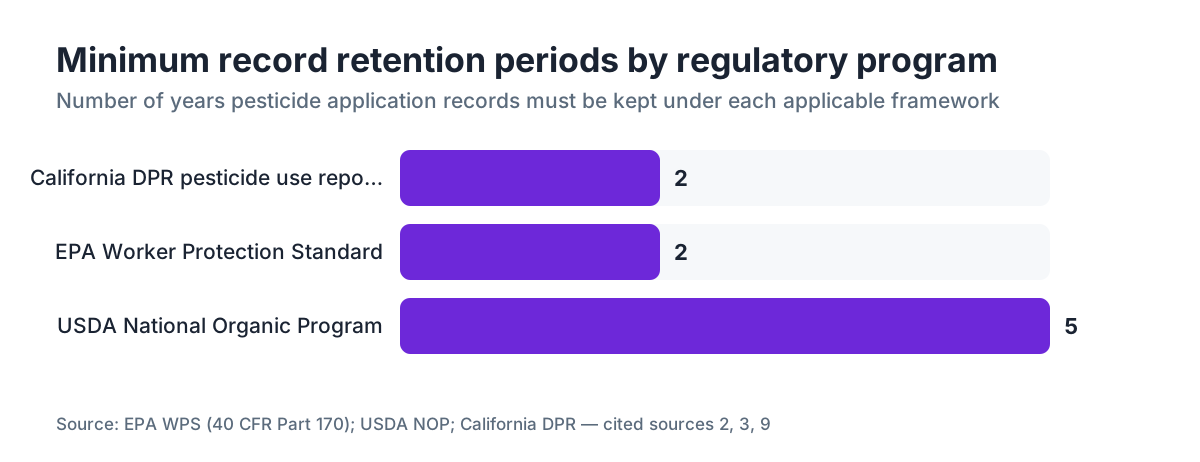
Retention rules vary by state, but a safe baseline is three years. California's DPR requires pesticide use records for two years. EPA WPS requires application information to be posted for 30 days after application, then retained for two years. USDA organic certification records must be kept at least five years. [2] [3] [9] When you're working several compliance contexts at once, default to the longest retention period that applies.
VitiScribe's spray record module is one place growers store these signed approvals alongside their pesticide use reports, so the whole chain from approval request to post-application record lives in one searchable file. That helps when you're pulling records for a DPR audit or answering a winery's annual sustainability questionnaire.
Don't alter a completed approval record. If a rate or product changed between approval and application, get a revised approval before you spray, or document plainly why the deviation happened and secure written acknowledgment from the winery after the fact.
How does EPA Worker Protection Standard overlap with the winery approval process?
The EPA WPS (40 CFR Part 170) governs how agricultural employers protect workers and handlers from pesticide exposure. [3] It doesn't specifically mandate a winery-approval step, but several of its requirements bump right up against how you structure your approval records.
WPS requires handlers to have access to the full pesticide label and a current Safety Data Sheet before handling any product. It also requires an Application Exclusion Zone and worker notification of application details. All of that documentation has to be in order before the spray rig moves.
The "agricultural employer" under WPS is whoever controls the agricultural establishment, which gets murky in a custom farming or management agreement. If you're a management company applying to a grower's vineyard that sells to a winery, the WPS employer-of-record question matters. Your grower contract should spell it out.
WPS training requirements have teeth. Handlers must be trained before working with pesticides, and that training must be refreshed every year. The 2015 WPS revisions (effective January 2017) tightened these requirements. [3] The winery's approval record won't satisfy WPS training on its own. That's a separate compliance track.
Still, a clean approval-and-spray-record system makes a WPS inspection far easier to get through. An inspector who can see at a glance that every application had a prior product review, a full label on file, and a contemporaneous spray record has a lot less to question.
What if the winery denies your pesticide request?
It happens. The winery may be chasing a new certification, may have caught buyer feedback about a specific active ingredient, or may just run a conservative internal policy. A denial isn't a personal judgment. It's a business or marketing call.
When you get a denial, ask for the reason in writing. This protects you too. If the winery is restricting your pest management options in ways that lead to crop loss, you may have a contract remedy depending on how your farming agreement reads.
Alternative chemistry is usually the way forward. Ask the winery what they'd accept for the same target pest. Many winery viticulture teams keep an approved or preferred substitute list, and they'd rather help you find a fit than watch a disease problem run through their grapes.
Sometimes an extension farm advisor helps. A UC Cooperative Extension farm advisor or a WSU Extension viticulture specialist can often name an equal or better alternative that lands inside the winery's restrictions. [6] [8] A third-party agronomic opinion in writing also strengthens your position if a dispute later turns on whether the denial caused a pest management failure.
Never apply a denied product and hope nobody notices. Residue testing is standard in wine grape sourcing contracts at any winery selling to export markets. European Union MRLs for some common active ingredients sit well below U.S. tolerances, and a winery selling to the EU knows it and tests for it.
Should you build a pre-approved product list at the start of each season?
Yes. This is the single biggest time-saver in the whole process. A pre-approved product list is an agreement made in winter or early spring that covers every product you're reasonably likely to need for the coming season. Both parties sign it, and then each individual approval inside that list is a documentation step rather than a negotiation.
The list usually covers fungicides for powdery mildew, Botrytis, and downy mildew where applicable; insecticides for leafhoppers, mealybug, and any region-specific pests; herbicides for the floor management program; and any nutritional or biocontrol products that need a label review.
For each product, the pre-approval sets the maximum rate, the minimum PHI, and any block restrictions (say, a product cleared for the Cabernet blocks but not the organically farmed Grenache block).
Update the list whenever a new product enters the picture mid-season. One addendum beats a from-scratch request for each new product.
This is also the moment to document your Integrated Pest Management thresholds. When the winery knows you scout on a calendar schedule and spray only when pest pressure crosses a defined threshold, they trust your in-season judgment. Cornell's IPM guidelines for wine grapes lay out scouting thresholds you can cite directly in your program documentation. [5]
Operations that run a vineyard compliance program with pre-approved lists and documented scouting almost never hit an emergency approval jam mid-season.
How does this process differ for organic or sustainable certification programs?
A lot. For USDA NOP-certified organic vineyards, the approved materials list under the National Organic Program is the floor, not the ceiling. The winery or the certifier may stack additional restrictions on top of what NOP allows. [2]
An OMRI (Organic Materials Review Institute) listing means a product is potentially allowed under NOP, but your certifier still has to approve its use in your Organic System Plan. OMRI-listed does not equal pre-approved by your certifying agency or your winery.
For programs like Certified California Sustainable Winegrowing (CCSW) or the California Department of Food and Agriculture's Sustainable Winegrowing workbook, the approval process is less prescriptive but the documentation expectation is identical. [7] Sustainability audits look for spray records that show IPM in practice: scouting, threshold-based decisions, and a preference for lower-risk options.
Lodi Rules, SIP (Sustainability in Practice), and similar regional programs each carry their own materials lists and documentation standards. If you farm for a winery enrolled in any of these, get the program's approved and restricted materials list before your first spray of the season, not after.
One nuance catches growers out. Some sustainability programs flatly prohibit certain active ingredients that are perfectly legal under FIFRA. A product with a valid EPA registration and a within-tolerance residue profile can still violate a program requirement. The written approval process catches this, because a winery sustainability manager reviewing your request flags a prohibited a.i. before it goes in the ground.
What records should you keep, and for how long?
Build one file per growing season with four things in it: the signed pre-approved product list (if you have one), each individual approval request with the winery's countersignature, your completed pesticide use records for every application, and your scouting or decision logs showing why each application happened.
Keep physical copies and digital backups. Digital-only works for most purposes, but some state inspections expect original signatures, so scan and store the originals somewhere fireproof or waterproof.
Retention: default to five years. That covers California DPR's two-year requirement, EPA WPS's two-year requirement, and USDA NOP's five-year requirement, so you're clear no matter which rulebook someone waves at you. [2] [3] [9]
When you hand off management of a block to a new operator, or when the grower-winery relationship ends, the spray history is an asset. It documents what the vines were exposed to, which matters for any new certification applications and for the incoming operator's first-season planning. Organize it before you pass it along.
VitiScribe keeps approval records, spray logs, and scouting notes in one place with timestamped entries, which makes retention and retrieval straightforward when an audit or contract review lands.
For operations farming blocks for multiple wineries at once, keep each winery's approvals completely separate. A product approved by Winery A for the Pinot block does not carry over to the Chardonnay block you farm under a contract with Winery B.
Frequently asked questions
Can a verbal approval from the winery substitute for written approval?
Rarely, and only if your contract explicitly allows it followed by written confirmation inside a defined window (usually 24 to 48 hours). Verbal approvals leave no audit trail and protect neither party in a residue dispute. Most formal grower-winery contracts and all organic certification programs require written documentation. If you get a verbal okay in an emergency, follow up immediately with an email confirmation and ask the winery to reply in writing.
What is the EPA registration number and where do I find it on a pesticide label?
The EPA registration number appears on the front panel of every federally registered pesticide label, formatted as "EPA Reg. No. XXXXX-XXXXX." The first set of digits identifies the registrant company; the second identifies the specific product. This number is the definitive identifier of a product and its approved uses. When you send an approval request to a winery, always include the full registration number, more than the trade name.
Does a winery-approved pesticide still have to comply with federal and state tolerances?
Yes, always. Winery approval is a contractual and agronomic step; it doesn't supersede legal requirements. The product must still be registered under FIFRA for use on wine grapes, applied at or below the label rate, and harvested no earlier than the PHI allows. The tolerance set by EPA under the Food, Drug, and Cosmetic Act is the legal maximum residue in the grape at harvest, regardless of what the winery signed off on.
What's the pre-harvest interval (PHI) and why does the winery care about it?
The pre-harvest interval is the minimum number of days between the last application of a pesticide and the legal harvest date, printed on the product label. Wineries care because applying inside the PHI can leave residues above the EPA-established tolerance at harvest, which creates both a legal violation and a rejection risk from domestic and export buyers. Always check the PHI against your anticipated harvest date before you submit an approval request.
Do I need a new written approval each time I apply the same product during the same season?
It depends on how your approval is written. A well-drafted pre-approval specifies the product, rate, and maximum number of applications per season, so you don't need a new form each time. If you got approval for a single application and conditions call for a second spray, you'll need a new request. Clarify in the original approval whether it covers one application or the full label-allowed program for the season.
What if my farming contract doesn't mention pesticide approval at all?
You're operating without a clear process, which creates risk for you and the winery. Raise it at the start of the next season and propose adding a pesticide approval clause. In the meantime, send written approval requests anyway and ask for written responses. Building a de facto approval record even without a contractual requirement protects you if a dispute arises. Many extension programs, including UC Cooperative Extension, offer sample grower-winery contract language.
Are pesticide approval requirements different for Paso Robles or other specific AVAs?
Not by regulation: FIFRA and state pesticide use reporting rules apply uniformly. But individual wineries in any region, including those in Paso Robles, may layer on restrictions through their sustainability programs or buyer requirements. Some regions with strong export markets hold stricter internal standards to meet EU MRLs. Always confirm the winery's specific requirements rather than assuming the legal baseline is enough.
Does the EPA Worker Protection Standard require the winery to approve pesticide applications?
No. WPS (40 CFR Part 170) governs protection of workers and handlers from pesticide exposure: training, notification, access to labels and safety data, and application exclusion zones. It does not mandate winery approval of products. The approval requirement comes from grower-winery contracts, certification programs, and good practice. Your WPS documentation and your winery approval records should still be organized together, since they'll often be reviewed in the same audit.
What role does OMRI listing play in winery approval for organic programs?
An OMRI (Organic Materials Review Institute) listing means a product has been reviewed and found compatible with NOP organic standards, but it doesn't guarantee approval by your certifying agency or your winery. You still need to confirm that the specific formulation is listed in your Organic System Plan and that the winery's own organic requirements don't impose additional restrictions. OMRI listing is a starting point, not a green light.
How do I handle a new product that has never been used on the winery's grapes before?
Submit a full approval request with extra supporting documentation: the complete label, the SDS, any university extension efficacy data you can find, and a clear explanation of why standard alternatives fall short. Give the winery more lead time than usual, at least ten business days. If the product carries a newer active ingredient, the winery's compliance team may need to consult their buyers or run it against export market MRL databases before they can sign off.
Can I use a digital signature on the approval form?
In most cases, yes. The USDA NOP and California DPR don't prohibit electronic records or digital signatures, and the federal E-SIGN Act gives electronic signatures legal weight equal to wet signatures for most commercial agreements. Confirm with your certifying agency if you're in an organic program, since some certifiers have specific record-format requirements. For straightforward grower-winery contracts, a countersigned PDF or a documented email approval is generally enough.
What should I do if the winery takes too long to respond to my approval request?
Follow up in writing within 24 hours of any missed deadline you agreed to, and document that follow-up. If your contract specifies a response window, hold the winery to it and note any delay. If no timeline is specified, a reasonable follow-up is three business days after submission. Do not apply the product without approval just because you didn't hear back. That won't protect you in a dispute and may void your contract or certification.
Do I need written approval for biocontrol or biological pesticide products?
Check your contract and any certification program requirements. Many biological products, including those based on Bacillus subtilis, Trichoderma, or beneficial nematodes, carry EPA registration numbers and fall under the same label-compliance rules as conventional chemistries. Even if the winery doesn't formally require approval for biocontrols, sending a notification builds a complete application record and heads off any later questions about what was applied.
How does the approval process work when a farm management company farms for multiple wineries at once?
Each winery needs its own approval on file for its own contracted blocks. Approvals are not transferable between winery contracts, even when the same product, rate, and applicator are involved. Keep a separate folder for each winery relationship. This matters most when the same block transitions between contracts or when a single spray day covers blocks under different winery agreements, which requires documentation showing separate approvals for each.
Sources
- EPA, Federal Insecticide, Fungicide, and Rodenticide Act (FIFRA) overview: Under FIFRA, the pesticide label is a legally binding document; use inconsistent with label directions is a federal violation.
- USDA Agricultural Marketing Service, National Organic Program regulations: NOP certification records must be retained for at least five years; a single prohibited-substance application can result in loss of certification.
- EPA, Worker Protection Standard (40 CFR Part 170): WPS requires handlers to have access to the full pesticide label and SDS before handling; application information must be retained for two years.
- EPA, Pesticide Labeling Questions and Answers: The pre-harvest interval and directions for use are printed on every federally registered pesticide label.
- Cornell Cooperative Extension, New York State Integrated Pest Management Program for vineyards: Cornell IPM guidelines provide scouting thresholds and documentation resources applicable to grower-winery compliance programs.
- UC Cooperative Extension, Integrated Pest Management for Wine Grapes: UC Cooperative Extension provides pest management recommendations and contract farming documentation templates for California wine grape growers.
- California Sustainable Winegrowing Alliance, Certified California Sustainable Winegrowing program: CCSW sustainability audits review spray records for documentation of IPM principles including scouting, threshold-based decisions, and materials review.
- Washington State University Extension, Wine Grape Pest Management Guidelines: WSU Extension notes that contact fungicides often require application within 48 to 72 hours of infection conditions to be effective, requiring rapid approval processes.
- California Department of Pesticide Regulation, Pesticide Use Reporting requirements: California DPR requires pesticide use records to include product name, EPA registration number, amount applied, application date, location, and applicator information, retained for two years.
- EPA, Pesticide Tolerances under the Federal Food, Drug, and Cosmetic Act: EPA sets maximum residue tolerances for pesticides in food commodities including wine grapes under the FFDCA; winery approval does not supersede these legal limits.
- USDA AMS, National List of Allowed and Prohibited Substances: OMRI listing indicates compatibility with NOP standards but does not replace certifying agency or winery approval for organic operations.
Last updated 2026-07-10