How to handle a missed spray record entry discovered during audit

TL;DR
- Found a missing pesticide application record during an audit?
- Document what happened before you touch the log.
- FIFRA requires records within two years of application, and late entries must be clearly marked as corrections, never backdated.
- Notify your certifying agent if you're certified organic.
- A written corrective action plan, filed before the auditor writes you up, usually reduces or erases civil penalties.
What does a missing spray record actually mean for compliance?
A missing spray record is a recordkeeping violation, full stop. It doesn't prove you applied something illegally or hurt a worker. But regulators don't sort out the difference until after they've written the notice of violation, and the gap in your log is the one thing they can act on right now.
Federal pesticide law under FIFRA Section 8 (7 U.S.C. § 136f) requires commercial applicators and agricultural producers who use restricted-use pesticides (RUPs) to keep records for two years from the date of application [1]. States can extend that to three years and impose their own formats on top of the federal minimum. If a state ag department inspector is running the audit, they're probably working a federal checklist and a state-specific one at the same time.
The EPA Worker Protection Standard (40 CFR Part 170) adds a parallel rule: pesticide application and hazard information has to be accessible to workers and handlers for 30 days after the restricted-entry interval (REI) expires [2]. A missing entry doesn't just dent your recordkeeping score. It can be framed as a failure to make that information available, which is a separate violation category.
None of this means panic. Inspectors see incomplete records constantly. What you do in the next few minutes and days decides whether this stays a minor correctable finding or turns into a civil penalty that follows you into next season.
What are the legal record-keeping requirements for pesticide applications?
For restricted-use pesticide applications, federal law sets the floor. Under FIFRA Section 8 and the EPA regulation at 40 CFR Part 171, the required data elements are the name and EPA registration number of the pesticide, the total amount applied, the location and size of the treated area, the date of application, and the name and certification number of the certified applicator [1].
States routinely add to that list. California requires county pesticide use reports (PURs) filed within one month of each calendar month of use, with a state-mandated format that includes the grower, the site, the pest treated, and the water applied [8]. Cornell's Pesticide Management Education Program notes that New York producers also have to record the target pest and the specific field or block treated [5].
Certified organic operations answer to a stricter rule. The USDA National Organic Program (NOP) requires that all materials applied be documented and that those records be kept for five years, not two [6]. A missing entry during an organic audit is a much bigger deal than during a state ag inspection, because it can trigger suspension of certification.
Here's the practical summary in table form:
| Regulatory body | Required retention | Key data elements beyond basics |
|---|---|---|
| EPA / FIFRA (federal floor) | 2 years from application | EPA reg. number, certified applicator ID |
| Most state ag departments | 2-3 years | Varies; often target pest and field ID |
| USDA NOP (organic) | 5 years | All inputs, lot numbers, supplier records |
| EPA Worker Protection Standard | 30 days post-REI expiry | Must be accessible to workers/handlers |
Know which bucket you're in before the auditor arrives. If all three apply to you at once, the organic five-year rule governs retention.
What should you do immediately when you spot the gap?
Do not alter the original log. This sounds obvious, but in the stress of an audit walk-through the instinct to fill in the blank is real. Backdating an entry, or slipping an undated line into a bound record without a note, is falsification. Under federal law, knowingly falsifying a FIFRA record is a criminal offense, not a civil one, and the penalties step up sharply [1].
Instead, do this in order.
First, pull every scrap of secondary documentation that can rebuild the application. Invoices from your chem supplier, tank-mix worksheets, tractor GPS logs, water meter readings, weather station printouts, texts to a crew foreman. Even a timestamped credit card receipt for the product helps. This corroborating evidence turns a missing entry from a credibility problem into a paperwork problem.
Second, write a short factual memo to yourself, dated today. Note what's missing, what you found, and what supporting documents you located. Don't editorialize about what probably happened. Just: "On [today's date], during audit preparation, I identified that the application on [approximate date] to [block name] was not entered in the field log. Supporting documentation includes invoice #XXXX and GPS tractor log file [filename]."
Third, flag the gap to the auditor yourself before they find it. This matters more than most people think. Extension programs that cover compliance, from UC Davis's IPM specialists to Cornell's PMEP, agree that voluntary disclosure of a recordkeeping gap almost always ends in a correctable finding rather than a penalty [5][7]. Inspectors have discretion. Surprises take it away.
Fourth, make the late entry in a way that holds up. Add a new line (or a clearly marked addendum page) with today's date, a note that this is a late entry, and every required data element you can reconstruct. Sign it. Never white-out or overwrite the original.
How do you make a legally defensible late entry in your spray log?
A late corrective entry is not a cover-up. It's what the system expects when records get reconstructed after the fact, as long as you do it in the open.
Here's the approach most state ag departments accept, and it lines up with federal guidance. On a new line or addendum sheet, write the original application date (to the best of your knowledge, and note the basis for that estimate, such as the supplier invoice date or a GPS log). Then add a second date showing today as the date recorded. Put a note in the comments column: "Late entry. Original application date estimated from [source]. Entered [today's date] upon discovery of omission."
No correction fluid, no tape, nowhere in the original record. If the log has a blank line where the entry should be, draw a single line through it (don't fill it), initial it, and point to the addendum page.
Paper logs get this treatment. Digital systems work differently. If you run software for vineyard recordkeeping, a good one timestamps every entry and flags late ones automatically. VitiScribe, for one, builds an audit trail that separates original entries from corrections by timestamp, so you have something to hand an inspector as evidence of transparency rather than evasion. The brand isn't the point. The audit-trail architecture is. Whatever you use, make sure it writes correction timestamps to the record instead of silently overwriting the original data.
Inspectors are trained to spot suspiciously consistent handwriting across entries that should span months, which is a classic sign of records rebuilt all at once. The corrected-entry approach, messy and dated as it looks, reads as more credible.
Should you notify your certifying agent or state agency proactively?
For conventional operations, telling your state department of agriculture before the audit closes is almost always the right move when the gap involves a restricted-use pesticide. It moves you from subject of enforcement to party cooperating with compliance. Most state pesticide programs run a compliance assistance track that ends in a notice of correction rather than a civil penalty, and that track usually requires voluntary disclosure [3].
For certified organic operations, notifying your certifying agent isn't optional. It's required. NOP regulations at 7 CFR Part 205.401 require you to tell your certifier of any application of a prohibited substance or any failure to keep required records [6]. The USDA Agricultural Marketing Service guidance says certifiers must learn of non-compliances as soon as they're discovered. Waiting for the certifier to find it on their own is a separate violation.
For operations under a food safety audit (USDA GAP, or a retailer's third-party protocol like SQF or Primus), the notification duty depends on your specific certificate. Read the corrective action section of your current certificate. Most require written notice within 24 to 72 hours of finding a non-conformance.
One practical wrinkle: if the missing entry covers a restricted-use pesticide applied by a licensed applicator-for-hire, that applicator has their own independent duty to keep records. Call them the same day you find the gap. They may hold a copy that fills it entirely.
What are the actual penalties for missing pesticide records?
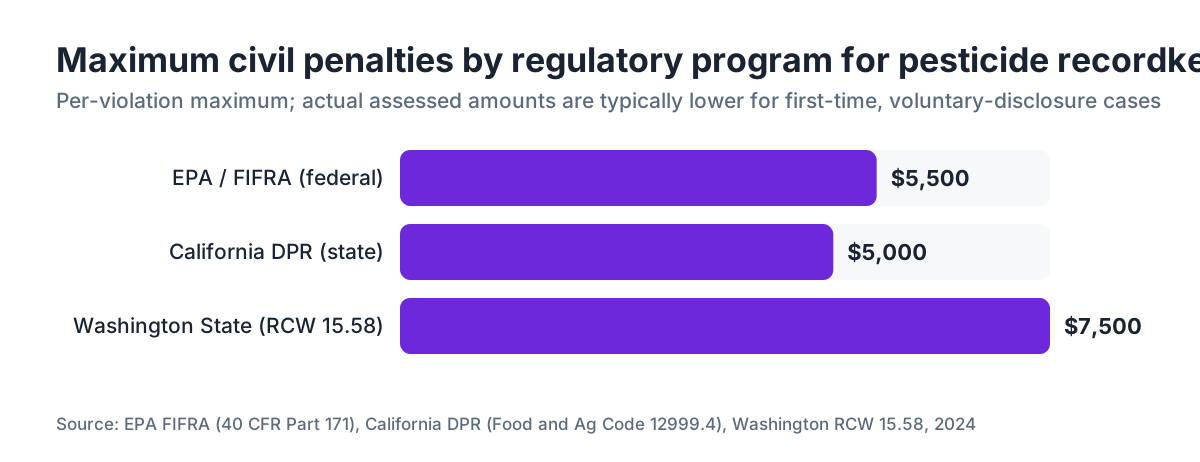
EPA's civil penalty policy for FIFRA violations sets a maximum of $5,500 per violation per day for commercial applicators [1]. In practice, first-time recordkeeping violations by farmers and growers where no actual harm occurred almost never land at the maximum. EPA's FIFRA Enforcement Response Policy uses a gravity-based matrix that weighs the severity of potential harm, the history of violations, and the good faith of the respondent [3].
EPA's own guidance says a first-time recordkeeping violation with no evidence of misapplication and with voluntary disclosure typically results in a compliance order, not a monetary penalty. Nobody has clean public data on average assessed penalties for this exact violation type. The closest source is EPA's ECHO database, where you can look up enforcement actions by region [9].
State penalties vary a lot. California's Department of Pesticide Regulation can assess up to $5,000 per violation for records violations under Food and Agricultural Code Section 12999.4 [8]. Washington's penalties under RCW 15.58 can reach $7,500 per violation. Some states use a graduated structure where the first violation in a rolling 12-month window draws a warning letter and the second triggers fines.
The practical risk for a vineyard with one missing entry, found and self-corrected proactively, is almost always a written notice of corrective action with a deadline, not a fine. The risk climbs if the missing entry involves a restricted-use pesticide, there's a pattern of gaps, the gap lines up with a period when worker illness or crop injury was reported, or the inspector finds it before you disclose.
What evidence can you use to reconstruct a missing application record?
Reconstruction is legitimate and expected. The goal is to pin down the facts of the application as precisely as you can from independent sources. The stronger evidence types:
Purchase invoices and delivery receipts from your ag chemical supplier establish the product, the EPA registration number, and the purchase date. If you applied it soon after buying it (most operators do), that brackets the likely application date.
GPS tractor logs or field computer records from sprayer controllers often store the date, field coordinates, and sometimes speed and boom pressure. John Deere's Operations Center, for example, keeps machine data that can rebuild application timing with reasonable precision.
Weather station records (on-site, or from a nearby CIMIS, AgWeatherNet, or Weather Underground station) can confirm whether conditions on a given date matched spray operations and your label's temperature and wind-speed limits.
Worker time records, including the pesticide handler sign-in logs you already keep under the WPS, can establish who was present and when [2].
Tank-mix worksheets, if you keep them apart from the spray log, count as contemporaneous records even if they were never filed as the official record.
Texts or email threads with a spray crew foreman or PCA are supporting evidence, not primary records, but they help.
The reconstruction memo should name each source, attach copies, and land on a specific date range (or a best single date) with your confidence level stated honestly. "Based on the invoice date of June 3 and the GPS log showing block 4 coverage on June 4, the application most likely occurred June 4" beats any vague assertion.
How should you write a corrective action plan after the audit?
Most auditing bodies, state ag departments, certifiers, and food safety auditors will ask for a written corrective action plan (CAP) when a recordkeeping gap turns up. Even if they don't ask, filing one shows you're treating this as a systems problem, not a one-off clerical slip. That framing shapes how the finding gets classified.
A CAP for a missed spray record has four parts. First, a root cause statement: why did the entry get missed? Honest common answers include "the spray applicator finished the application after office hours and the verbal note never made it to the log," or "the log book wasn't with the sprayer during the application." Vague answers like "human error" don't satisfy auditors and don't fix anything.
Second, an immediate corrective action: the late entry you already made, with the date and supporting documentation.
Third, a preventive action: the specific system change that stops it from happening again. Maybe a daily log review, a pre-application checklist zip-tied to the sprayer, a digital entry requirement before the tractor returns to the barn, or a second set of eyes before the week closes. Be specific. "We will be more careful" fails audits.
Fourth, a verification method: how will you confirm the fix is working? A monthly self-audit of spray records against purchase invoices is a common answer, and one extension programs recommend [5].
Cornell's Pesticide Management Education Program has public recordkeeping resources with sample corrective action frameworks worth reviewing before you write yours [5].
How can you prevent missed spray record entries in the future?
The structural cause of most missing entries is the same. The person doing the spraying isn't the person entering the data, or the data entry happens at a different time and place than the application. Close that gap and your exposure drops.
The simplest low-tech fix is a physical spray log that lives on the machine. Not in the office. Not on a clipboard in the barn. On the sprayer. The applicator fills it in before or right after the application. You transfer it to your master record at the end of the week and check off each transfer. That's a two-record system, and it builds redundancy where you used to have gaps.
Digital entry at the point of application is more reliable if your crew is comfortable with phones. Apps that let an applicator enter block, product, rate, and time in the field and sync to a central record back in Wi-Fi range delete the transfer step entirely. The catch: offline logging has to work, because spray decisions happen in corners of the vineyard where cell coverage is spotty.
A monthly self-audit is genuinely worth the time. Cross-reference your spray log against your pesticide purchase records and your GPS tractor data. Any purchase with no matching log entry is a flag. It takes about 20 minutes a month and is the single most cost-effective compliance habit a small vineyard can run. UC Davis's IPM program recommends exactly this kind of periodic cross-check as part of good documentation [7].
For operations with multiple blocks, a block-level log structure (one sheet per block, not one log for the whole property) makes it much harder for an entry to slip through unnoticed. The sheet for that block is visibly missing a date when the other blocks have entries around the same time.
Does a missing record create liability beyond the fine?
Sometimes, yes. The audit finding is one exposure. But a missing record can create liability in three other directions.
Worker safety claims. Under the Worker Protection Standard, workers and handlers have the right to access pesticide application information for 30 days after the REI expires [2]. The WPS central posting requirement means you're supposed to have that information posted at the establishment. A missing log entry is evidence the required information wasn't available. If a worker had a health event during that window, the missing record becomes relevant to any workers' compensation or enforcement action. EPA states in 40 CFR 170.311 that central posting must include the product name, EPA registration number, active ingredient, date of application, location, and REI [10].
Certification and marketing claims. If your wine carries a sustainable viticulture certification (Lodi Rules, LIVE, SIP Certified), a missing pesticide record is a non-conformance under those protocols too. Those programs run their own audits, and a missing-record finding can trigger extra requirements or put your certification at risk.
Food safety traceability. If a food safety recall ever touched your grapes, missing spray records would badly complicate your ability to show what was and wasn't applied. For wineries buying fruit from contract growers, that's why spray record review is now standard in grape purchase agreements.
What if the audit finds more than one missing entry?
One missing entry reads as an oversight. Three or more in a single season reads as a system failure. The regulatory and certifier response scales up to match.
If an inspection turns up a pattern, expect a more formal response: a notice of violation rather than a compliance order, possible referral for penalty assessment, and heightened scrutiny at your next inspection. Some state programs put operations with multiple violations on an annual inspection schedule for three years.
The strategy has the same shape but demands more. You still reconstruct each missing entry from independent sources, still produce a corrective action plan, and still benefit from proactive disclosure. But the CAP now has to address a systemic failure instead of a one-off gap, which means showing a genuine overhaul of your recordkeeping process rather than a small tweak to the current one.
For certified organic operations, multiple missing records in a single year can bring suspension of certification pending review. USDA NOP regulations at 7 CFR 205.662 spell out the conditions under which a certifying agent must suspend certification, and persistent recordkeeping failures are listed [6].
Get help from your county farm bureau or a licensed crop consultant who has been through compliance audits in your state. UC Cooperative Extension advisors and WSU Extension pesticide specialists can review your corrective action plan and catch weaknesses before you submit it [7]. Facing multiple violations is not the time to work alone.
Where does VitiScribe fit into ongoing spray record compliance?
Spray record gaps are almost always a workflow problem, not an intention problem. The applicator meant to record the entry and didn't, or the data lived in one place and never made it to the compliance record. The fix is a system that captures data where the work happens.
VitiScribe is built around exactly this: field operations and compliance records in one place, with block-level tracking, timestamped entries, and audit-trail logs that show corrections as corrections instead of silent edits. If you're running spray records on paper or in a spreadsheet and you just came out of an audit where a missing entry caused stress, a purpose-built tool is worth a look for the 2025 season. The trial is free.
That said, the process beats the platform every time. A paper log filled in rigorously at the point of application beats digital records entered sloppily two days later. Whatever system you run, the discipline of entry-at-application is what stops the gap from forming in the first place.
For vineyard operations of any size, keeping a vineyard compliance calendar that ties spray record reviews to monthly tasks, rather than to audit prep, is the most durable long-term approach.
Frequently asked questions
How long do I legally have to keep spray records for restricted-use pesticides?
Federal FIFRA requires you keep records for two years from the date of application. Many states extend this to three years, and the USDA National Organic Program requires five years for certified organic operations. Check your state department of agriculture's current rules, because a stricter state standard overrides the federal floor. California also requires monthly pesticide use reports filed with the county agricultural commissioner.
Can I get fined for a single missing spray record entry?
Technically yes. FIFRA civil penalties can reach $5,500 per violation per day for commercial applicators. In practice, a first-time recordkeeping gap with no evidence of actual misapplication, where you disclose it voluntarily and correct it, almost always ends in a corrective action notice rather than a fine. The fine risk rises sharply if the inspector finds the gap before you disclose it, or if there's a pattern of missing entries.
What's the difference between backdating a spray record and making a late corrective entry?
Backdating means writing the original date with no sign the entry was made late, presenting it as a contemporaneous record. That is falsification. A late corrective entry clearly states both the estimated original application date and the date the entry was actually made, with a note explaining it's a correction. The distinction is transparency. A late entry is a recognized, accepted practice. Backdating without disclosure is a federal records offense.
Does a missing spray record violate the EPA Worker Protection Standard?
It can. The WPS at 40 CFR Part 170 requires that pesticide application information be posted or accessible to workers and handlers for 30 days after the restricted-entry interval expires. If the missing record means that information was never posted, that's a separate WPS violation from the FIFRA recordkeeping violation. A single application gap can generate findings under two different regulatory frameworks at once.
What documents can I use to reconstruct a missing spray record?
Supplier invoices (product name, EPA registration number, purchase date), GPS tractor or field computer logs, weather station records, pesticide handler sign-in sheets required under WPS, tank-mix worksheets, and text or email threads with crew or a licensed PCA. List every source in your corrective memo, attach copies, and state your confidence level in the reconstructed date. Auditors expect reconstruction to be imperfect but honest.
Do I need to notify my certifying agent if I'm certified organic and find a missing record?
Yes, and promptly. USDA NOP regulations at 7 CFR Part 205.401 require you to notify your certifying agent of any failure to maintain required records as soon as it's discovered. Waiting for the certifier to find it themselves is itself a violation. Proactive disclosure typically results in a corrective action request. Discovery by the certifier without prior notice can lead to suspension of certification pending review.
What should a corrective action plan for a missing spray entry include?
Four things: a root cause statement explaining specifically why the entry was missed, the immediate corrective action you already took (the late entry itself with supporting documentation), a preventive action describing the specific system change that prevents recurrence, and a verification method showing how you'll confirm the fix is working. Vague answers like 'more careful in future' don't satisfy auditors and don't prevent the next gap.
How should I store spray records to make audits easier?
Keep spray records organized by season and block rather than only chronologically. Attach a copy of each product label and SDS to the matching season file. Cross-reference entries to purchase invoices so gaps show up during your own monthly self-audit. For paper systems, a bound log book beats loose sheets because missing pages are physically obvious. For digital systems, confirm your software creates timestamps and flags corrections without overwriting original data.
If a contract applicator made the application, who is responsible for the missing record?
Both of you, potentially. The certified commercial applicator has an independent FIFRA duty to keep records of every restricted-use pesticide application they make. You as the grower may also have state-level obligations depending on your state's agricultural code. Contact the contract applicator the same day you find the gap. They may hold a copy that resolves your issue entirely, or their record can serve as corroborating evidence for your reconstruction.
Will a missing spray record affect my sustainable viticulture certification like Lodi Rules or LIVE?
Yes. Sustainable viticulture programs including Lodi Rules, LIVE, and SIP Certified require complete pesticide application records as a foundational audit criterion. A missing entry is a non-conformance under those protocols. Depending on the program and whether it's a pattern, it can require a corrective action plan, a follow-up audit, or in serious cases suspension of certification. Notify your program's verifier the same way you'd notify a state inspector.
How often should I conduct internal spray record audits to catch gaps before an inspector does?
Monthly is the practical standard. Cross-reference your spray log against purchase invoices and, if available, GPS tractor data. Any purchase or machine activity without a matching log entry is a flag. A monthly review takes about 20 minutes for most small operations and costs far less than discovering a three-month gap during an official inspection. UC Davis and Cornell extension programs both recommend periodic internal cross-checks as part of routine documentation.
What's the best way to disclose a missing entry to an auditor who hasn't found it yet?
Be direct and early. At the start of the records review, say: 'Before we go through the log, I want to flag a missing entry for the application on approximately [date] to [block]. I've made a corrective entry with supporting documentation and I have a memo explaining how I reconstructed the record.' Hand them the memo. Inspectors have discretion. Voluntary disclosure before discovery nearly always beats letting them find it.
Can I use a mobile app entry made the day after the application as the original record?
The FIFRA regulations don't specify same-day entry. They require records be made and retained, not made instantaneously. Some state rules do set a timeframe. A next-morning entry made before the application details have blurred is generally fine and far better than a week-later reconstruction. The key is that the entry timestamp reflects when it was actually made, not when the application occurred.
Sources
- EPA, FIFRA Section 8 (7 U.S.C. § 136f) and 40 CFR Part 171, Pesticide Records Requirements: FIFRA requires records for restricted-use pesticide applications to be kept for two years and sets civil penalties up to $5,500 per violation per day for commercial applicators.
- EPA, Worker Protection Standard 40 CFR Part 170: WPS requires pesticide application information to be posted and accessible to workers and handlers for 30 days after the restricted-entry interval expires.
- EPA, FIFRA Civil Penalty Policy and Enforcement Response Policy: EPA's enforcement response policy uses a gravity-based matrix; first-time recordkeeping violations with voluntary disclosure and no harm typically result in compliance orders rather than monetary penalties.
- Cornell University, Pesticide Management Education Program: Cornell's PMEP provides recordkeeping guidance including required data elements for New York producers and recommends periodic internal cross-checks of spray records against purchase invoices.
- USDA Agricultural Marketing Service, National Organic Program regulations 7 CFR Part 205: NOP regulations at 7 CFR 205.401 require certified organic operators to notify certifying agents of record-keeping failures, and 7 CFR 205.662 describes conditions under which certifiers must suspend certification for persistent recordkeeping failures; organic records must be retained for five years.
- UC Davis Cooperative Extension, Integrated Pest Management Program: UC Davis's IPM program recommends periodic cross-checks of spray logs against purchase records as part of routine documentation best practice for farm operations.
- California Department of Pesticide Regulation, Pesticide Use Reporting: California requires growers to file county pesticide use reports within one month of each calendar month of use, and Food and Agricultural Code Section 12999.4 allows civil penalties up to $5,000 per violation for records violations.
- EPA, ECHO (Enforcement and Compliance History Online) database: EPA's ECHO database is the primary public source for actual assessed penalty data on FIFRA enforcement actions by region and violation type.
- EPA, 40 CFR 170.311, WPS Central Posting Requirements: 40 CFR 170.311 specifies that central posting must include product name, EPA registration number, active ingredient, date of application, location, and restricted-entry interval.
Last updated 2026-07-11