Vineyard spray record audit checklist for harvest season

TL;DR
- Before harvest, audit every spray record for correct pre-harvest intervals (PHIs) on all applied pesticides, complete applicator signatures, accurate water volumes and rates, REI documentation under EPA's Worker Protection Standard, and valid pesticide registrations.
- Missing any one can trigger a failed inspection, a quarantine hold, or a state fine.
- Plan for two full passes through your records, starting six weeks before your first pick date.
Why does a harvest-season spray record audit matter so much?
A spray record audit is not a formality. It's the paper trail that proves every pesticide you applied was legal, was applied correctly, and that grapes weren't picked before the label-required pre-harvest interval expired. When a winery, distributor, or state ag inspector finds a gap, the fallout runs from a corrective action notice to a crop hold to a misdemeanor charge, depending on your state.
California's County Agricultural Commissioner system conducts unannounced pesticide use inspections year-round, and harvest is peak activity. The Washington State Department of Agriculture audits records under RCW 17.21 [1]. Oregon's ODA has similar authority. If you supply a winery carrying GAP or SQF certification, your spray records can also end up in front of a USDA auditor.
There's a plainer reason too. Memory is terrible. The spray season runs April through September in most regions, and by the time you're pulling samples in late August, there's a real chance a product got applied, an REI never got logged, or a water volume fell off the record. Catching that in-house beats catching it on a regulator's clipboard.
The audit also hands you something the season rarely does: a clean picture of what you actually did versus what you planned. That gap tells you more than either document alone.
What records are you legally required to keep for vineyard pesticide applications?
Federal law under FIFRA Section 8 requires commercial applicators to keep records of restricted-use pesticide (RUP) applications for two years [2]. Most states pile more on top of that, and many extend recordkeeping to all pesticides, not only RUPs. California requires records for every agricultural pesticide application under the Food and Agricultural Code, kept for three years and filed with the County Agricultural Commissioner monthly [3].
At the federal baseline, each record has to include:
- The name and EPA registration number of the pesticide
- The crop or site treated
- The location (field ID or GPS-referenced block)
- The date and time of application
- The amount of product applied
- The applicator's name and certification number (for RUPs)
State requirements often add water volume per acre, equipment type, wind speed and direction, temperature at application start, target pest, and whether the applicator held a valid license that day.
The EPA Worker Protection Standard (WPS) adds a separate layer for any establishment with workers or handlers. Under 40 CFR Part 170, employers must keep WPS-required application information, including REI postings and Safety Data Sheet availability records, for two years [4]. That information isn't the same as the pesticide use record, and auditors check both.
Cornell Cooperative Extension's integrated pest management program notes that many New York growers fail audits for one reason: their WPS application information and their pesticide use records live in different places, and one set goes missing [5]. Keep them together.
What is a pre-harvest interval (PHI) and how do you verify compliance?
The pre-harvest interval is the minimum number of days between the last application of a pesticide and the harvest of the treated crop. The EPA sets it during registration, and it's printed on the product label. The label is a legal document. Harvesting before the PHI expires is a federal violation, full stop.
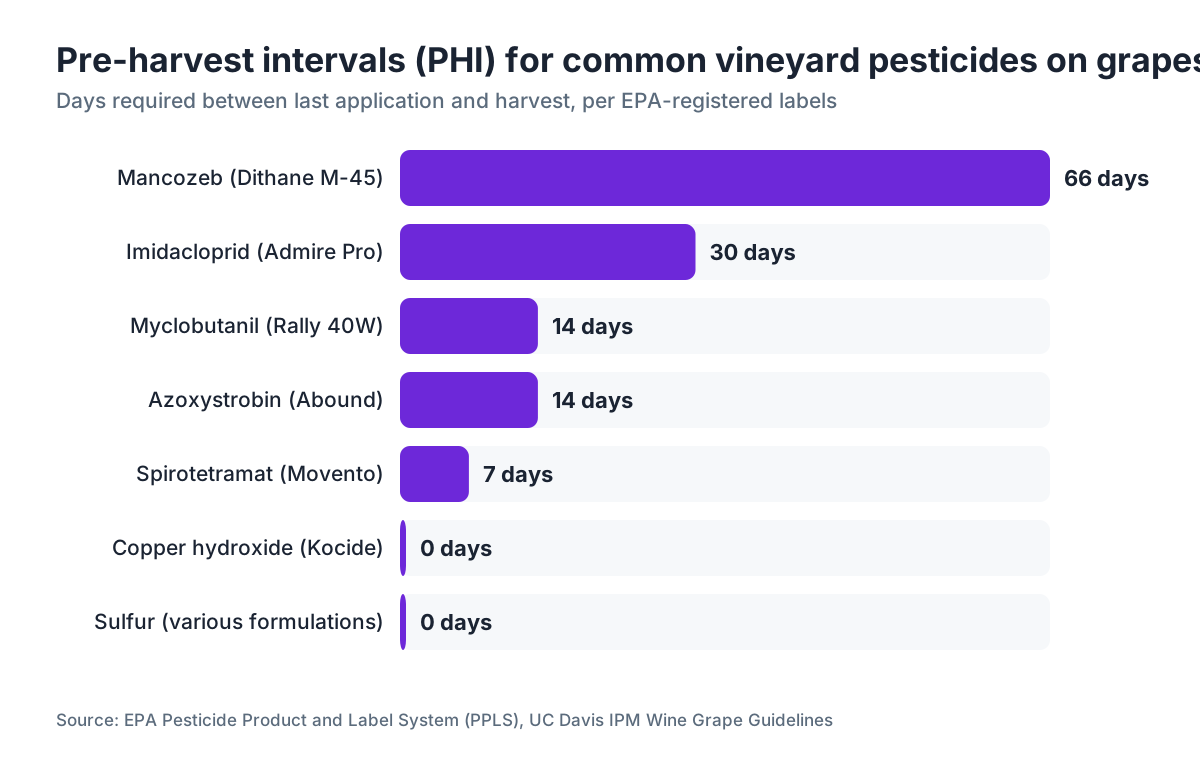
PHIs for vineyard pesticides swing wide. Sulfur usually carries a 0-day PHI. Systemic fungicides run anywhere from 7 to 66 days. Mancozeb (Dithane, Manzate) has a 66-day PHI on grapes [6], which means any block sprayed with Mancozeb after July 1 can't be legally harvested before September 5 in a typical calendar year. Imidacloprid (Admire Pro, plus many generics) on grapes carries a 30-day PHI. Insect growth regulators vary by product and formulation.
To verify PHI compliance in your audit:
- Pull your block-by-block spray records sorted by application date, most recent first.
- For each product applied after May 1, look up its PHI from the registered label (EPA's Pesticide Product and Label System, or the label PDF from EPA's site).
- Calculate the earliest legal harvest date: application date plus PHI in calendar days.
- Compare that date to your planned or actual harvest date for that block.
A spreadsheet with columns for Block, Product, Last App Date, PHI (days), Earliest Legal Harvest, and Planned Harvest Date catches most problems in under an hour. If any cell in the Earliest Legal Harvest column falls after your harvest date, you have a violation to fix before you pick.
Growers miss one thing often. The PHI runs from the last application, not the last application in a spray window. If you sprayed three times in a window and the third spray landed August 15, the clock starts August 15, not August 1.
What is the 12-point spray record audit checklist for harvest season?
Work through this checklist block by block, not field by field. Blocks have different variety timing, different spray programs, and different harvest windows. Treating the whole vineyard as one unit is where errors hide.
| # | Checkpoint | What to look for | Common failure |
|---|---|---|---|
| 1 | Product name and EPA reg number | Both on every record; no generic abbreviations | "Topsin" instead of full product name + reg # |
| 2 | Pre-harvest interval verified | Last app date + PHI is before harvest date | PHI miscalculated or PHI for wrong crop/use |
| 3 | Restricted-use status noted | RUP applications signed by certified applicator | No cert number or expired license |
| 4 | Application rate and water volume | Actual rate per acre; actual gallons per acre | "Per label" written in instead of real numbers |
| 5 | Block or field ID | GPS coordinates or named block, not "front field" | Ambiguous location creates audit dispute |
| 6 | Applicator name and signature | Legible, matches license on file | Initials only, or supervisor signed for worker |
| 7 | Application date and time | Full date; start time for REI calculation | Date only, no time; or month/day without year |
| 8 | Weather conditions | Temp, wind speed, wind direction at start | Missing or clearly copied from a weather app |
| 9 | Target pest | Specific pest or disease, not "fungal" | Vague target makes mode-of-action rotation impossible to verify |
| 10 | Valid product registration | Check label year; confirm state registration active | Label from wrong year; product cancelled or suspended |
| 11 | WPS REI posted and recorded | REI duration, posting location, time posted | REI logged in spray record but not in WPS central posting |
| 12 | Organic or conventional status | Products match your certification program | OMRI-listed product applied at rate exceeding NOP limits |
If you're certified organic, add a 13th point: verify that every product applied to every block has a current certificate of compliance from your certifier's approved materials list. Organic certifiers can and do decertify blocks mid-season when a prohibited substance shows up in records.
Print the checklist. Walk it against actual records, not your memory of what you think happened.
How do EPA Worker Protection Standard requirements connect to your spray records?
The revised WPS (effective January 2, 2017) requires agricultural employers to give workers and handlers pesticide application information: the product name, EPA registration number, active ingredients, location and description of the treated area, date and time of application, and the REI [4]. That information goes to the establishment's central location within 24 hours of application and stays posted for 30 days after the REI expires.
Here's where audits trip people. The WPS requirement is separate from your pesticide use records under state law. You can have a flawless pesticide use record on file with your county and still fail a WPS inspection because you can't show workers had access to the application information. The WPS also makes you keep records of that posting for two years.
WSU Extension's pesticide safety education program is blunt about this: the central posting is not optional, and failure to post can trigger EPA enforcement referrals with civil penalties up to $19,507 per violation per day for willful violations under 2023 penalty adjustments [7].
For your harvest audit, check that:
- Every application since May 1 has a matching WPS posting record
- REI end times are calculated correctly (the REI starts at application end, not start)
- Any early-entry exceptions (crop emergencies, for example) are documented with the required supervision records
- SDS sheets for all products applied this season are accessible at the central location
WPS also forbids sending workers into a treated area during an active REI. If any record shows harvest or other entry during a live REI, that's a priority correction before you're standing in front of an inspector.
How far back should your harvest-season audit go?
Work backward from your first anticipated harvest date, then count back the longest PHI in your program. For most wine grape varieties in California's coastal regions, harvest starts in late August. In the Finger Lakes or Willamette Valley, it might be October.
If you used Mancozeb (66-day PHI) at any point, you need clean records back to at least 66 days before harvest. If you used a systemic insecticide with a 30-day PHI, you need records back 30 days. The safer move is to audit every application from bud break forward, because label PHIs interact with replant decisions, second-crop potential, and neighboring block contamination questions.
For WPS records, audit everything from the start of the application season through your last anticipated entry during harvest. Harvest workers are covered under WPS. Any pesticide application near an active harvest crew requires documented awareness of REIs and exclusion zones.
Federal law requires two years of records and California requires three, so an inspector who shows up after harvest can ask for last year's records too. That's outside a harvest-season audit, but keep it in mind. Your archive has to be as clean as your current year.
What do state ag inspectors actually look for when they audit vineyard spray records?
County Agricultural Commissioners in California, and their counterparts in other wine states, focus on a handful of things above everything else [1][3].
First, they match product EPA registration numbers against the current registered label. Apply a product whose registration expired or got cancelled by application date, and that's an immediate violation, no matter how effective or safe the product actually was.
Second, they check applicator certification for RUPs. If your records show a restricted-use product applied by an uncertified worker, even under supervision, the record itself becomes the evidence of the violation.
Third, they look at rates. Applied rate above the label maximum is a violation. Applied rate below the label minimum for a pest control claim usually isn't a violation, but it can get flagged for efficacy questions under organic or resistance management programs.
Fourth, and this is where small operations get caught, they check that the crop site on the label matches your crop. A pesticide registered for "grapes for wine" may carry a different registration than "table grapes," and the use pattern can differ. Confirm the label crop use site includes wine grapes specifically.
UC Davis IPM's pest management guidelines for wine grapes carry registration status notes for most commonly used products and are updated annually [8]. That resource is genuinely useful as a cross-check before you finalize your audit.
How should you organize spray records for a faster, cleaner audit?
The biggest time cost in any harvest audit is hunting for records. Records kept in multiple places, recorded in different formats by different applicators, stored in a mix of paper and digital files, routinely turn a two-hour audit into an all-day slog.
Most experienced vineyard managers use a block-first file, not a date-first file. Within each block folder, records go chronologically. Every application is one record, with the date in the filename (YYYY-MM-DD format sorts correctly). Each record carries all 12 points from the checklist.
Still on paper? A three-ring binder per block, tabbed by month, with a cover sheet showing the block's variety, acreage, and spray program summary, gets you to any record in under two minutes. That matters when an inspector is standing next to you.
Digital platforms built for vineyard operations, including tools like VitiScribe, generate audit-ready reports sorted by block, by product, by date, or by PHI compliance status. The time savings are real once you're managing more than 20 acres with more than one applicator. The feature that earns its keep is automatic PHI conflict flagging: you enter the application date, the system knows the PHI, and it warns you if your planned harvest date is too early.
Whatever system you run, the audit should answer this in under five minutes: what was the last product applied to Block 12, what's its PHI, and what's the earliest legal harvest date for that block? If it takes longer, the system needs work.
What should you do if you find a PHI violation or missing record during your audit?
Don't pick the block. That's the clearest answer, and in most cases it's also the legal answer.
If your intended harvest date falls inside the PHI for a product applied to that block, you have three options. Delay harvest until the PHI expires. Or ask your state's pesticide enforcement division whether pre-harvest residue testing can support an exemption or variance (some states allow this, most don't, and nobody has a reliable universal answer). Or consult your pest control advisor and county ag commissioner proactively, in writing, before harvest.
Proactive disclosure beats inspector discovery, consistently. Most state enforcement programs have discretion to issue corrective action plans instead of fines for first-time violations with a documented good-faith correction. That discretion evaporates when the violation gets discovered rather than disclosed.
For a missing record (an application happened but never got documented), rebuild it from available evidence: purchase records, equipment calibration logs, weather station data for the application date, and applicator recollection. Mark the record clearly as reconstructed, with the date of reconstruction and the evidence you used. Falsifying records is a serious violation. Reconstructing records from evidence, labeled as such, is generally defensible.
For WPS gaps, check whether affected workers or handlers were actually present during an REI period. If they were, assess whether a worker was potentially exposed and whether WPS medical access requirements were triggered.
What's the timeline for a complete pre-harvest spray record audit?
Six weeks before first pick is when the audit should start, not finish. Here's a timeline that holds up for most operations.
| Week before harvest | Activity |
|---|---|
| 6 weeks out | Pull all spray records from bud break. Identify longest PHI in your program. |
| 5 weeks out | Run PHI check on every block. Flag any blocks at risk. |
| 4 weeks out | Audit WPS posting records and REI documentation. |
| 3 weeks out | Verify applicator certifications are current. Check product registrations. |
| 2 weeks out | Final check on any late-season applications. Confirm no REIs are active at harvest start. |
| 1 week out | Confirm records are organized and accessible. Brief harvest crew on any spray-related entry restrictions. |
| Harvest week | Keep records current as any post-harvest applications begin. |
Small operations with one or two blocks and a simple spray program can compress this to two or three weeks, but the sequence matters more than the duration. PHI checks come first, because a violation there forces a decision about harvest timing, and that decision ripples through everything else.
If you supply multiple wineries, check each purchase contract for extra recordkeeping or residue testing requirements. Premium winery contracts increasingly demand spray records as part of delivery documentation, and some name prohibited substances that go beyond federal or state law.
Are there common pesticide violations specific to harvest-season operations that you should watch for?
Yes. A handful of violation patterns show up over and over in vineyard inspections, and most of them are predictable.
The most common is what enforcement staff informally call the last-minute fungicide problem. A grower sees powdery mildew pressure in late July or early August, applies a systemic fungicide with a 30-day or longer PHI, then catches pressure from a winery to deliver on an earlier date. The PHI gets violated. That's the single biggest source of residue violations in wine grapes across the Western states.
Second is expired or incorrect product labels. Labels get updated. The product you bought in March might carry a different PHI or use restriction than the label version on your shelf. Always verify your on-file label matches the current EPA-registered label at the time of application. EPA's Pesticide Product and Label System is public and free [9].
Third is the generic substitution problem. A grower runs out of the usual product, buys a generic with the same active ingredient, and assumes the same PHI applies. Generics can carry different PHIs even for the same active ingredient, because they're registered separately. Check the specific product's label, not the active ingredient.
Fourth is REI overlap with harvest operations. Harvest often puts large crews across multiple blocks at once. If a spray application happens in an adjacent block with an active REI and workers cross into that zone, you have a WPS violation even though harvest itself is in a different block. Map REI boundaries before harvest starts.
In California, the Department of Pesticide Regulation's annual enforcement report documents which violations are most common and which draw penalties [10]. Reading last year's report before your audit is time well spent.
What resources and tools are most useful for auditing vineyard spray records?
Several free resources do most of the heavy lifting.
EPA's Pesticide Product and Label System (PPLS) lets you search any registered pesticide by product name, registration number, or active ingredient and download the current registered label [9]. Use it to confirm your on-file label is current and to read PHIs straight from the legal document.
The National Pesticide Information Center (NPIC) at Oregon State University maintains a product label database and a helpline staffed by toxicologists and pesticide specialists [11]. They can clarify ambiguous label language, which helps when you're trying to interpret a use restriction that was clearly written by a committee.
UC Davis IPM's wine grape pest management guidelines, updated annually, include pesticide tables with registration status, PHI, and REI for the most common vineyard products in California [8]. Cornell's guidelines cover Eastern varieties and Northeast-registered products [5]. WSU's resources cover the Pacific Northwest [12].
For WPS compliance, EPA's Worker Protection Standard resources include a training manual, posting templates, and a compliance guide that spells out exactly what records you need and in what format [4].
VitiScribe's spray record module was built around this audit workflow, with block-level PHI tracking and automatic compliance flags. Past 30 acres or multiple varieties with staggered harvest dates, the manual spreadsheet gets fragile fast, and software that keeps PHI checks current as you add records is worth a look.
Your state's land-grant extension program is underused. Most have pest management advisors who will review your spray records informally before harvest and flag concerns. It's free, and most growers never take it up.
Frequently asked questions
How long do I have to keep vineyard spray records after harvest?
Federal law under FIFRA requires two years for restricted-use pesticide records. California requires three years for all pesticide use records, filed monthly with the County Agricultural Commissioner. Most other wine states require two years minimum. Keep records retrievable quickly, because inspectors arrive unannounced and can ask for any season within the retention window.
What happens if I accidentally harvest before the PHI expires?
You've applied a pesticide in a manner inconsistent with its label, a federal FIFRA violation. Most states treat this as a misdemeanor for first offenses. Your grapes may also face a quarantine hold pending residue testing. Disclosing to your county agricultural commissioner before harvest, if you catch the error in time, typically results in far better outcomes than being found in violation after the fact.
Do organic vineyards still need to keep spray records?
Yes. Organic certification under the National Organic Program requires records of all substances applied to certified ground, and your certifying agent can audit those records at any time. Beyond NOP requirements, state pesticide use recordkeeping laws apply to organic operations the same as conventional ones. Some organic inputs still carry PHIs, and materials not on your certifier's approved list can trigger decertification.
Who can legally apply a restricted-use pesticide in a vineyard?
A certified private applicator (the grower, if certified) or a licensed commercial pesticide applicator. In most states, uncertified employees can apply RUPs only under the direct supervision of a certified applicator who is physically present and able to give immediate assistance. The certified applicator's name and license number must appear on the record. License expiration dates are one of the first things inspectors check.
Can I use a phone app to keep spray records for compliance purposes?
Yes, if the app captures all required fields and produces records you can export or print for an inspection. Format matters less than content. The legal requirement is that the information is accurate, complete, and retrievable. What you can't do is keep partial records in an app and fill in the rest from memory later. Courts and regulators find reconstructed records without contemporaneous documentation much less credible.
What is an REI and how does it relate to harvest timing?
REI stands for restricted entry interval, the period after a pesticide application when entry into the treated area is restricted to protect workers. REIs are set on the product label and range from four hours to several days. REI and PHI are independent: a product can have a short REI and a long PHI, or the reverse. Both must be respected. Harvest workers are covered by WPS REI restrictions the same as any other worker.
What records does the EPA Worker Protection Standard require me to keep?
Under 40 CFR Part 170, you must keep application information (product name, EPA reg number, active ingredients, treated area, application date and time, REI) at the central posting location for 30 days after the REI expires, and keep those records for two years. You also need WPS training records for all agricultural workers and handlers, plus records of medical access agreements. Failing to keep WPS records is a separate violation from missing pesticide use records.
How do I find the current PHI for a specific vineyard pesticide?
The PHI is printed on the registered product label. Download the current label from EPA's Pesticide Product and Label System using the product name or EPA registration number. Don't rely on a printed label from a previous season or from the container in your spray shed. Labels get revised, and PHIs can change between registration cycles. For common vineyard fungicides and insecticides, UC Davis IPM's grape guidelines also list current PHIs.
Do spray records need to include weather conditions at the time of application?
Federal RUP records don't mandate weather data, but many state requirements do, and most label use directions restrict applications above certain wind speeds or temperatures. California requires weather conditions in pesticide use reports. Even where it isn't legally required, recording temperature and wind speed at application start is good practice: it's the only way to demonstrate label compliance if a drift complaint or efficacy dispute arises.
Can a winery reject grapes because of my spray records?
Yes. Purchase contracts increasingly include spray record review as a condition of acceptance, and many wineries require delivery of spray records with the fruit. Some premium contracts name prohibited substances beyond federal or state requirements. If your records show an application a winery considers unacceptable, even one that was legally compliant, they may have contractual grounds to reject the load. Review your purchase contracts before your spray season starts, not during harvest.
How do I handle a spray record for an application made by a contract PCA or spray crew?
The contract applicator should give you their application record, including license number, product applied, rate, date, and all other required fields. You're responsible for keeping that record in your files. A verbal report from a contract crew is not a record. Establish in writing before the season that every application generates a written or digital record delivered to you within 24 hours. Put that requirement in your service contract.
What is the difference between a pesticide use report and a spray record?
In states like California, a pesticide use report (PUR) is a formal monthly submission to the County Agricultural Commissioner. A spray record is your internal documentation of each application. They cover much of the same information, but the PUR is a regulatory filing and the spray record is your operational record. You can fail an inspection even with correct PUR filings if your internal spray records are incomplete, because inspectors often check both.
Is there a federal inspection program that audits vineyard spray records?
EPA has authority under FIFRA to inspect pesticide use records, and it can delegate that authority to state lead agencies. In practice, most inspections come from state agricultural departments or county commissioners, not federal agents. If a complaint triggers federal involvement, or if a violation involves an endangered species, groundwater contamination, or worker injury, federal EPA enforcement can step in with penalties that far exceed typical state fines.
How do I audit spray records for multiple vineyard blocks with different harvest dates?
Work block by block, sorted by earliest harvest date first. For each block, identify the last application date and the longest PHI among all products applied. Calculate the earliest legal harvest date and compare it to your planned harvest. A spreadsheet with one row per block, showing last application, PHI, earliest harvest, and planned harvest, handles this clearly. Any block where planned harvest falls before earliest legal harvest needs either a delayed pick or a record correction.
Sources
- U.S. EPA, FIFRA Section 8 Recordkeeping Requirements: Federal law requires commercial applicators to keep restricted-use pesticide records for two years
- California Department of Pesticide Regulation, Pesticide Use Reporting: California requires records for all agricultural pesticide applications for three years, filed monthly with the County Agricultural Commissioner
- U.S. EPA, Worker Protection Standard (40 CFR Part 170): WPS requires agricultural employers to retain application information and posting records for two years and post REI information within 24 hours of application
- Cornell Cooperative Extension, New York State Integrated Pest Management Program: Many New York growers fail audits because WPS application information and pesticide use records are stored separately and one set goes missing
- EPA Registered Label, Dithane M-45 (Mancozeb) for Grapes: Mancozeb (Dithane, Manzate) carries a 66-day pre-harvest interval on grapes
- Washington State University, Pesticide Safety Education Program: WPS civil penalties reach up to $19,507 per violation per day for willful violations under 2023 penalty adjustments
- UC Davis Integrated Pest Management Program, Wine Grape Pest Management Guidelines: UC Davis IPM updates wine grape pesticide tables annually with registration status, PHI, and REI for common vineyard products in California
- U.S. EPA, Pesticide Product and Label System (PPLS): EPA's label database allows growers to search and download current registered labels by product name or EPA registration number
- California Department of Pesticide Regulation, Annual Enforcement Report: CDPR's annual enforcement reports document which pesticide violations are most common and which result in penalties in California agriculture
- National Pesticide Information Center, Oregon State University: NPIC maintains a pesticide label database and operates a helpline staffed by toxicologists who can clarify label language
- Washington State University Extension, Grape Pest Management: WSU Extension provides Pacific Northwest-specific pest management resources for wine grape producers including pesticide registration status
Last updated 2026-07-11