How to identify boron toxicity symptoms on grapevine leaves
TL;DR
- Boron toxicity in grapevines first appears as yellowing margins on older, lower-canopy leaves, which then turn brown and papery from the leaf edge inward.
- Petioles may show dark spotting.
- Above roughly 1 mg/kg soil boron or 0.5 mg/L in irrigation water, vines start accumulating damaging tissue levels.
- Visual diagnosis takes practice.
- Confirm it with petiole or leaf tissue analysis.
What does boron toxicity actually look like on a grapevine leaf?
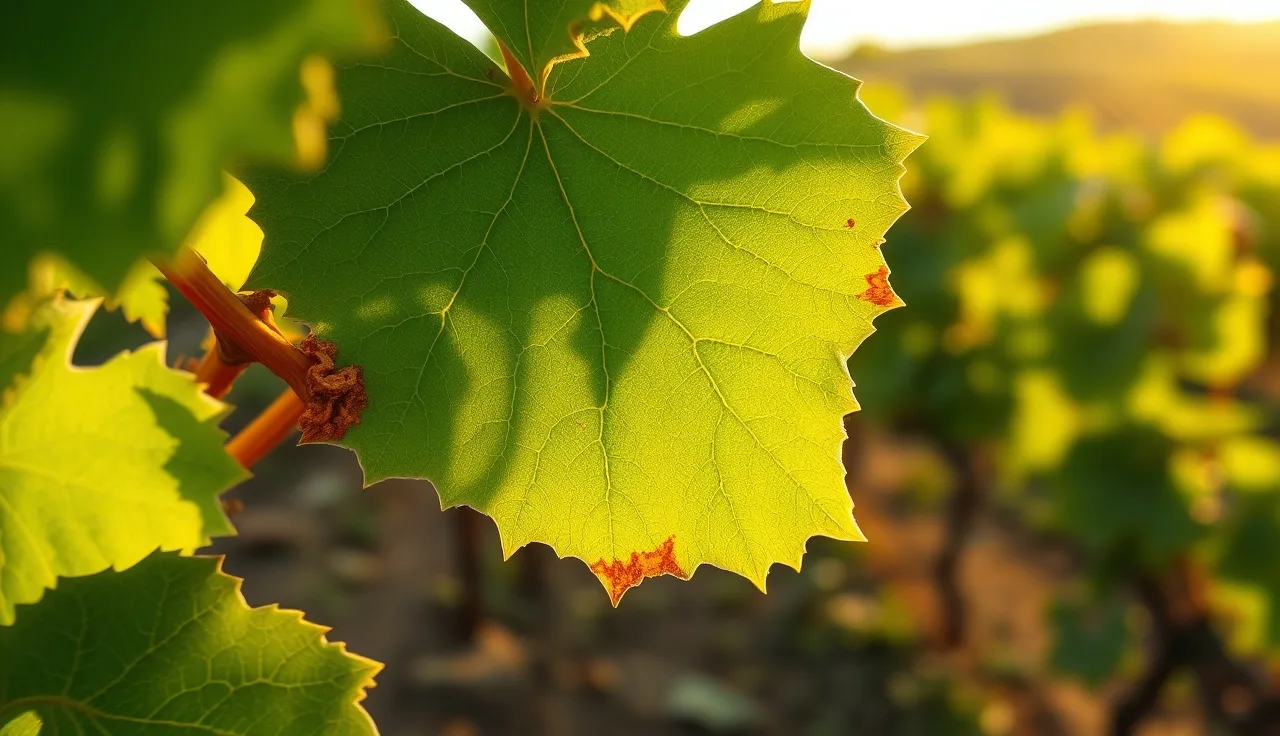
The first sign is a pale, washed-out yellowing along the outer margin of the blade, starting on the oldest leaves at the base of the shoot. That chlorotic band is narrow at first, maybe 3 to 5 mm, and it's easy to mistake for potassium deficiency or salt burn if you're not looking hard. Give it another week or two without correction. The pale margin turns tan, then dark brown, then papery and brittle. The necrosis crisps inward from the serrated edge but usually stops well before the midrib.
The pattern is almost always marginal and symmetrical. Both sides of the leaf show the same browning at the same time. That bilateral symmetry is one of the cleaner field clues. Potassium deficiency shows up in the same location, but K deficiency produces a more uniform, diffuse interveinal chlorosis across the whole blade first. Boron toxicity is edge-first, edge-dominant.
Petioles on affected leaves can show dark brown to black streaking or flecking, especially in varieties like Thompson Seedless and Flame Seedless that are documented to be more sensitive. In severe cases the shoot tips harden abnormally and internodes shorten noticeably toward the end of the season. The vine isn't dying dramatically. It's quietly getting less efficient, which is why growers sometimes miss it for a full season before tissue tests confirm what's happening [1].
Which leaves and shoots show symptoms first, and why?
Boron is phloem-immobile in most plants, so the vine can't easily move it from old tissue into new growth. Boron taken up from soil or irrigation water rides upward through the xylem and collects wherever transpiration runs highest. Older, more exposed leaves at the base of long shoots transpire the most over a season, so they receive and concentrate the most boron [2].
This is the mirror image of deficiency. Boron deficiency hits young shoot tips and flower clusters hardest. Toxicity hits the oldest leaves hardest. If you're scouting and you find marginal burn concentrated on the oldest leaves, on the longest shoots, lower in the canopy, and the shoot tips look fine, your differential should move toward toxicity rather than deficiency.
Timing within the season matters too. Symptoms are usually mild or absent in early spring because the vine dilutes whatever boron it took up across a large volume of new growth. By late June or July across most California and Pacific Northwest regions, older basal leaves have been stacking up boron for months, and that's when marginal necrosis becomes obvious. By harvest, the worst leaves may have dropped early. That early drop becomes its own problem for carbohydrate storage and vine health heading into dormancy [1][3].
How does boron toxicity in grapevines compare to other common leaf disorders?
This is where growers lose the most time, because several disorders look close enough to cause real confusion. Here's the practical comparison:
| Disorder | Which leaves first | Pattern | Color | Key difference |
|---|---|---|---|---|
| Boron toxicity | Oldest, basal | Marginal, bilateral | Yellow to brown, papery | Edge-first; petiole spotting |
| Potassium deficiency | Oldest, basal | Marginal then interveinal | Yellow, then necrotic | Starts more diffuse; no petiole spotting |
| Salt burn (sodium/chloride) | Oldest, basal | Marginal, bilateral | Brown, scorched | Soil EC elevated; no petiole spotting |
| Magnesium deficiency | Mid-canopy older | Interveinal | Bright yellow between veins | Veins stay green; not marginal |
| Powdery mildew | Any, younger preferred | Irregular white patches | White to gray, later brown | Fungal; distinct colony texture |
| Sunburn/heat scorch | Exposed, anywhere | Random exposed area | Bleached white to tan | Localized to sun exposure; not bilateral |
Salt burn and boron toxicity are the hardest pair to pull apart by eye, because both show bilateral marginal necrosis on old leaves. If your irrigation water has elevated EC, you may be dealing with both at once. In the San Joaquin Valley and Coachella Valley, that combination is common [3]. Water and tissue analysis is the only reliable way to separate them.
Potassium deficiency is the other frequent misread. Both hit old leaves first. Both cause marginal yellowing. The tell is that boron toxicity goes to the margin cleanly and early, while K deficiency yellows the whole blade before it localizes to the margin. In a deficiency you'll usually see some interveinal chlorosis mixed in [4].
What boron levels in soil, water, or tissue indicate toxicity?
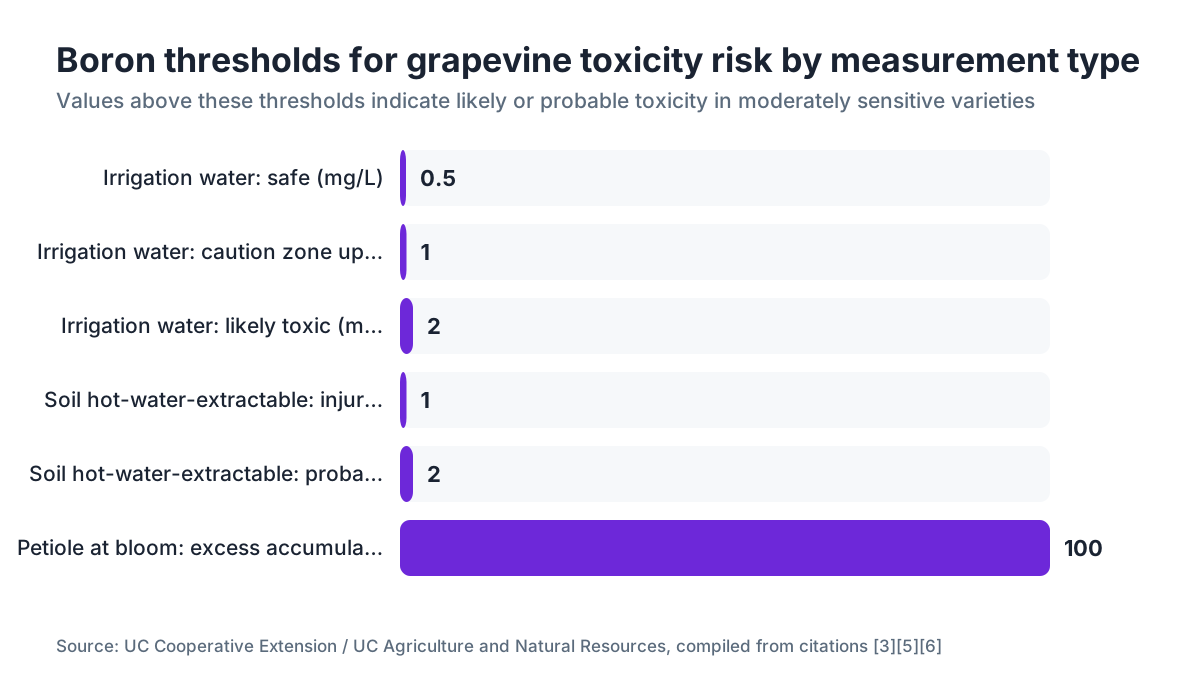
There's no single agreed threshold, and the honest answer is that published numbers move around depending on soil type, variety, and rootstock. The most widely cited UC Cooperative Extension guidance puts irrigation water boron above 0.5 mg/L as potentially problematic for sensitive crops, with toxicity increasingly likely above 1.0 to 2.0 mg/L [3].
For soil, UC guidance cites hot-water-extractable boron above about 1 mg/kg (ppm) in the root zone as the threshold where sensitive crops start to show injury. Grapevines are moderately sensitive, which puts the expected injury range somewhere between 1 and 2 mg/kg in soil [5].
Leaf and petiole testing at bloom is the most practical field tool you have. UC Cooperative Extension tissue guidelines for grapes flag petiole boron above 100 mg/kg dry weight at bloom as excess accumulation, and recommend collecting petioles opposite a flower cluster at full bloom for the most consistent results [1]. WSU Extension also recommends petiole sampling at bloom and flags levels above 100 ppm as potentially toxic, while noting that variety responses differ and some rootstocks (particularly the SO4 and 5BB families) may limit uptake somewhat [6].
Nobody has great varietal-threshold data for wine grapes at a commercially usable resolution. The closest work I've found comes from UC Cooperative Extension trials in the San Joaquin Valley comparing table grape varieties. Wine grape thresholds are mostly extrapolated from those studies and from the broader horticultural literature [3].
What causes boron toxicity in vineyards, and is irrigation water the main culprit?
Irrigation water is the most common cause, especially in arid regions where groundwater boron runs naturally high from geothermal activity, marine sediment deposits, or dissolving evaporite minerals. In California's Central Valley, parts of the Salinas Valley, and some areas of Arizona and New Mexico, groundwater boron regularly tops 1 mg/L with no human input at all [5].
Over-application of boron-containing foliar sprays or boron-fortified fertilizers is the second common cause. Growers apply boron to correct deficiency (genuinely common in sandy, low-organic-matter soils), and it's easy to overshoot. The gap between adequate and toxic is narrower for boron than almost any other micronutrient, often described as less than one order of magnitude [2].
Soil pH matters too. Above pH 7.5, borate ions are more mobile and more available to roots. Sodic soils and poorly drained soils that concentrate salts near the surface can build up boron from irrigation water faster than well-leached profiles. Clay soils with high organic matter bind boron more tightly and buffer it somewhat. Sandy soils in arid climates are the worst-case combination [5].
Reclaimed municipal water is a newer source of trouble. Several treated effluent sources in California and the Southwest carry boron in the 0.5 to 2 mg/L range, and managers who switched to recycled water for sustainability reasons have run into toxicity within two to three seasons because they never ran a baseline test [3].
How do you confirm boron toxicity rather than just guessing from leaf symptoms?
Visual symptoms should never be your final answer. The pattern narrows the list of suspects, but confirmation takes at least one of the following.
Petiole analysis at bloom is the standard for vineyards. Collect 60 to 100 petioles from a representative block, from the same shoot position (opposite a flower cluster), and send them to a certified agricultural lab. UC Davis Analytical Laboratory, A&L Western, and Waypoint Analytical all run standard grape petiole panels that include boron [1]. Expect a two-week turnaround from most labs.
Water testing is simpler, and it's often the first thing to do if you have any reason to suspect your source. A basic water quality panel from any agricultural water lab reports boron in mg/L alongside EC, sodium, chloride, and other relevant ions. It usually costs under $50, and it tells you immediately whether your source water is a likely culprit.
Soil testing for hot-water-extractable boron helps you understand the total profile load, especially after years of high-boron irrigation. Most soil labs offer the test. Request hot-water-extractable boron, not total boron, which overstates the plant-available fraction [5].
One practical note. If you're managing multiple blocks or you suspect spatial variability across a large vineyard, flag visually affected vines for targeted sampling before you submit composite samples. Otherwise a localized problem gets diluted in a block-wide composite and disappears [6]. If you already log field observations digitally, a tool like VitiScribe makes it easier to geo-tag symptomatic vines and attach photos, so your sampling matches the spatial pattern you're actually seeing.
Cornell's viticulture program also recommends comparing symptomatic and asymptomatic vines from the same block in the same submission, which gives the lab a clear contrast to interpret [4].
Can boron toxicity affect fruit quality and yield, more than leaves?
Yes, though the yield and quality effects are secondary to canopy damage in most cases. Severely defoliated vines from early leaf drop carry less photosynthate into dormancy, which can cut next year's fruitfulness at the affected nodes. One season of moderate toxicity rarely causes measurable yield loss on its own. Two or three consecutive seasons without correction starts to compound.
On berry quality, the direct effect of boron building up in fruit tissue is not well-documented for wine grapes specifically. In table grape studies, high boron in berry tissue has been linked to skin toughening and off-flavor development at very high accumulation levels, but the concentrations needed appear higher than what most field-symptomatic vines actually carry in their fruit. The bigger quality concern is indirect. A damaged, early-dropping canopy means less sugar accumulation, higher TA, and delayed ripening in the affected rows [3].
Flower and fruit set can suffer in acutely toxic situations. Boron at toxic levels in shoot tissue during flowering may interfere with pollen germination and tube growth, which leads to poor set and shot berries. Worth tracking if you're seeing poor set in blocks where the irrigation water has never been tested [2].
What are the practical options for managing or correcting boron toxicity?
There's no fast fix. Boron is persistent in soil, and vines store it in woody tissue over time. The management moves are mostly about cutting input and improving leaching.
Switch or blend the water source. If your well water is the problem, the most effective move is blending it with a low-boron surface source to bring total applied boron below 0.5 mg/L. Feasible in some regions. In others, you're stuck with one source.
Leaching. If your soil drainage allows it, deep irrigation without plant uptake (leaching fractions) can push boron below the root zone. Sandy soils leach boron fairly easily. Clay loams fight you. UC Cooperative Extension salt management guidance for vineyards includes leaching fraction calculations for different soil textures [5]. The catch is the water cost and the regulatory context, especially in California where irrigation efficiency rules keep tightening.
Cut every boron-containing input. Read every fertilizer label and foliar spray you're using. Some multi-element foliar products marketed to grape growers carry boron as a minor component, and applying them to vines already at the edge is enough to push symptoms forward.
Rootstock selection for new plantings. Some rootstocks limit boron transport to the scion better than others. Freedom and Harmony have shown some boron exclusion in table grape systems, though the data for wine grape combinations is thin. If you're replanting a block with known boron issues, discuss it with your farm advisor and pull whatever current UC or WSU trial data exists [6].
Soil organic matter and pH management can shift boron availability a little, but these are slow tools and won't solve an acute problem on their own.
Are there varietal differences in how sensitive grapevines are to boron toxicity?
Yes, and this matters for diagnosis, because you might see symptoms in one variety in a mixed block before another variety shows anything. That can scramble the scouting picture if you're not expecting it.
Thompson Seedless (Sultana) is among the most sensitive documented varieties and has been used as a reference plant in UC San Joaquin Valley research on boron in irrigation water. Flame Seedless is similarly sensitive. Among wine grapes, Chardonnay and Pinot Gris appear to take up boron more readily than thicker-skinned reds in informal extension observations, though controlled varietal comparison trials for wine grapes are limited.
Rootstock genotype affects uptake too, independent of scion variety. The mechanism is partly root boron transporter expression, partly root architecture and the depth from which vines draw water. Deeper-rooted rootstocks may pull from lower-boron layers where boron has accumulated near the surface [6].
The field takeaway: if you're looking at a mixed block and one variety shows marginal necrosis while adjacent vines of a different variety look clean, don't rule out boron just because the problem isn't uniform. Confirm with tissue analysis on both the affected and unaffected variety, then compare the results.
What records should you keep for boron toxicity incidents, and what do regulations require?
Boron is a naturally occurring element, not a pesticide, so EPA Worker Protection Standard requirements (40 CFR Part 170) don't apply to managing it the way they apply to pesticide applications [7]. That doesn't mean your records don't matter.
For compliance in California, corrective soil amendment applications (gypsum, sulfur, or other products used to manage soil chemistry) may need logging under your Fertilizer Materials Record depending on the product category. Check with your county ag commissioner.
For your own operational continuity, keep these: water test results with date and source, petiole and leaf tissue results with dates and block IDs, photos of visual symptoms with GPS coordinates and dates, and any corrective actions taken (water source changes, leaching events, rootstock decisions). These records earn their keep when a new farm advisor, buyer, or lender asks about vine health history in a specific block.
VitiScribe's field log is built for exactly this. The water test from April connects to the symptom photo from July and the tissue lab report from bloom, all tied to the same block ID instead of scattered across three email inboxes.
For organic certified operations, document that any soil amendments used in response were OMRI-listed or approved by your certifier before application. Calcium-based amendments and elemental sulfur are generally compliant, but confirm before you apply.
Where can you find reliable diagnostic support and laboratory resources?
University extension programs are your best free resource for diagnostic support. UC Cooperative Extension Farm Advisors in every California county will look at photos, discuss tissue results, and point you to the right diagnostic lab. UC Agriculture and Natural Resources maintains online nutrient disorder photo galleries that are genuinely useful for visual comparison [1].
WSU Extension Viticulture, based in Prosser, Washington, publishes grape nutrient management guides that cover boron toxicity and deficiency symptoms with photos, tuned to Pacific Northwest conditions [6]. Cornell Cooperative Extension covers boron management for Northeastern viticulture and has fact sheets on tissue testing protocols [4].
For laboratory analysis, UC Davis Analytical Laboratory runs petiole and soil tests calibrated to California grape standards. A&L Western, Waypoint Analytical, and Soiltest Farm Consultants are private labs with grape-specific interpretive guidelines. When you submit samples, specify that you want results compared to published grape petiole sufficiency ranges, and note the variety and rootstock on the form so the interpretation is accurate.
If you're in a region with known boron issues (Central Valley, Salinas Valley, parts of Arizona), your local irrigation district may have compiled water quality data by source and season. That data is often available on request, and it can tell you whether your boron problem is seasonal (tied to water table swings) or steady year-round.
Frequently asked questions
How quickly do boron toxicity symptoms appear after vines are exposed to high-boron water?
Symptoms rarely show in the same season you switch to a high-boron source. Boron accumulates in leaf tissue progressively through the season, so visible marginal necrosis on older leaves usually appears by midsummer of the first or second season of exposure. Acute toxicity from a dramatically elevated source can appear faster, within six to eight weeks of continuous high-boron irrigation during active growth.
Is boron toxicity the same as boron deficiency, just the opposite?
They're completely different problems with opposite symptoms. Deficiency hits young shoot tips and flower clusters, causing dieback and poor fruit set. Toxicity hits old basal leaves, causing marginal chlorosis and necrosis that works inward from the leaf edge. The tissue threshold reverses too: petiole boron below about 25 mg/kg at bloom may indicate deficiency, while above 100 mg/kg suggests toxicity.
Can boron toxicity be mistaken for herbicide drift damage?
Yes, though drift damage usually has a less uniform bilateral pattern and may show distorted or cupped leaf shape depending on the herbicide. Drift also tends to hit newer growth more often than old leaves, especially with growth-regulator herbicides like 2,4-D. Boron toxicity consistently targets the oldest leaves first. If you have any doubt, a tissue test is cheaper than guessing wrong.
What boron level in irrigation water is safe for grapevines?
UC Cooperative Extension guidelines classify irrigation water below 0.5 mg/L boron as generally safe for sensitive crops including grapevines. Between 0.5 and 1.0 mg/L is a caution zone where cumulative accumulation is possible over multiple seasons. Above 1.0 to 2.0 mg/L, injury to sensitive varieties is likely with continued use. Test your water before concluding there's no risk.
Do grapevine roots absorb boron more from some soil depths than others?
Boron from irrigation water tends to accumulate in the upper soil profile where evapotranspiration concentrates salts. Deeper-rooted vines on some rootstocks may draw from lower-boron layers, but this isn't a reliable exclusion mechanism. In poorly leached soils, boron can build up at multiple depths over time. Profile sampling at multiple depths (0-30 cm, 30-60 cm, 60-90 cm) gives a fuller picture than a single surface sample.
Can you apply anything to grapevine leaves to reverse boron toxicity symptoms?
No foliar treatment reverses boron toxicity in leaves that are already damaged. The necrotic tissue is dead and won't recover. Management is entirely about cutting further boron input and, where possible, promoting leaching below the root zone. New growth from the same season won't show toxicity symptoms if the source has been addressed, but the already-damaged leaves don't heal.
How do I sample petioles correctly to test for boron?
Collect petioles at bloom, from the leaf directly opposite a flower cluster, on multiple shoots per vine, from multiple representative vines per block. Target 60 to 100 petioles for a block sample. Remove the blade, leaving only the petiole. Place them in a clean paper bag, not plastic. Label with block ID, variety, rootstock, and date. Ship to the lab within 24 to 48 hours, or dry the sample at low heat before shipping.
Does high soil pH make boron toxicity worse in vineyards?
High pH alone doesn't increase total soil boron, but it does affect speciation and mobility. Above pH 7.5, borate ions are somewhat more mobile and plant-available in sandy soils. In calcareous soils the relationship is more complex. The bigger pH-related risk is that high-pH soils are often in arid regions where irrigation water boron is also elevated, so the two factors co-occur geographically rather than one causing the other.
Are there organic-approved treatments for reducing soil boron levels?
There's no organic-approved amendment that directly removes boron from soil. The only effective approach is leaching with low-boron water, which is compatible with organic certification. Increasing soil organic matter can improve boron adsorption and reduce plant-available concentrations marginally over time, but it's slow. Eliminate the boron source first, then lean on leaching if soil levels are elevated.
Do cover crops or compost applications affect boron availability in vineyards?
Organic matter from compost and cover crop residues can adsorb boron and reduce its immediate plant availability somewhat. The effect is real but modest and shouldn't be your primary correction strategy. Some composts made from municipal biosolids or certain industrial by-products may actually carry elevated boron, so test your compost source for boron before applying if you're already managing a high-boron situation.
How do I tell boron toxicity from salt burn if both look like marginal leaf scorch?
Visual separation is unreliable. Both cause bilateral marginal necrosis on old leaves, and both are common in arid irrigated regions. Test your irrigation water for boron, sodium, chloride, and EC at the same time. If EC is elevated but boron is below 0.5 mg/L, salt burn from sodium or chloride is more likely. If boron exceeds 0.5 to 1.0 mg/L, boron toxicity is the primary or contributing cause. Petiole testing confirms what the vine actually accumulated.
Can boron toxicity affect grapevine dormancy or cold hardiness?
There's no well-documented direct effect of boron toxicity on cold hardiness in grapevines. The indirect effect matters more. Early leaf drop from severe toxicity reduces carbohydrate storage going into dormancy, and vines entering winter with depleted reserves are generally less vigorous the following spring. Severely affected vines may also have compromised cane maturation, which can hurt bud survival in cold climates.
Sources
- University of California Agriculture and Natural Resources, Grape Nutrient Management and Tissue Sampling: Petiole boron above 100 mg/kg dry weight at bloom indicates excess accumulation; petioles collected opposite a flower cluster at full bloom give the most consistent results.
- University of California Agriculture and Natural Resources, Nutrient Management for Grapevines: Boron is phloem-immobile in most plants and accumulates in oldest leaves via xylem transport; the margin between deficiency and toxicity is less than one order of magnitude.
- UC Cooperative Extension, Irrigation Water Quality for Agriculture: Irrigation water boron above 0.5 mg/L is potentially problematic for sensitive crops; toxicity increasingly likely above 1.0 to 2.0 mg/L; co-occurrence with salinity common in San Joaquin and Coachella valleys.
- Cornell College of Agriculture and Life Sciences, Vineyard Nutrient Management: Comparing symptomatic and asymptomatic vines from the same block in the same tissue submission improves diagnostic accuracy; potassium deficiency causes more diffuse interveinal chlorosis before marginal necrosis.
- University of California Agriculture and Natural Resources, Soil Boron and Crop Toxicity: Hot-water-extractable soil boron above approximately 1 mg/kg (ppm) is the threshold where sensitive crops begin to show injury; grapevines are classified as moderately sensitive with injury range 1 to 2 mg/kg.
- Washington State University Extension, Viticulture Nutrient Management in the Pacific Northwest: WSU Extension flags petiole boron above 100 ppm at bloom as potentially toxic and notes that rootstocks in the SO4 and 5BB families may limit boron uptake somewhat; varietal responses differ.
- US EPA, Worker Protection Standard 40 CFR Part 170: EPA Worker Protection Standard requirements apply to pesticide applications; boron as a naturally occurring element in soil or water is not regulated under WPS.
- University of California Agriculture and Natural Resources, Analytical Laboratory Services: UC Davis Analytical Laboratory runs petiole and soil tests calibrated to California grape standards and provides interpretive guidelines specific to grapevines.
- Journal of Plant Nutrition, Boron Toxicity in Grapevines: Symptom Expression and Tissue Accumulation: Thompson Seedless has been used as a reference sensitive variety in boron irrigation water research; berry quality effects at high tissue accumulation include skin toughening and off-flavor in table grape systems.
Last updated 2026-07-11