Potassium deficiency symptoms on grape leaves versus magnesium deficiency
TL;DR
- Potassium deficiency shows up as brown leaf-margin scorch that starts on older leaves and moves inward.
- Magnesium deficiency yellows the tissue between green veins, also on older leaves first.
- Both look alike at a glance.
- The give-aways are the burn pattern, the timing, and your soil pH context.
- K burns the edges.
- Mg bleaches the middle.
- You can call it in the field before the lab confirms it.
Why do potassium and magnesium deficiencies look so similar on grapevines?
Both are mobile nutrients. That single fact explains most of the confusion.
When a mobile nutrient runs short, the vine pulls it out of older, mature leaves and ships it to young, growing tissue. So both K and Mg symptoms land on the same-aged leaves: the basal ones, closest to the cluster zone. A grower walking rows in mid-summer sees old leaves going bad and figures the vine is just aging. Sometimes it is. Sometimes it's a nutrient problem costing you sugar accumulation and crop quality.
The similarity fools experienced eyes. The fix for one is not the fix for the other, and the wrong amendment makes the competing deficiency worse. High K applications, for one, suppress Mg uptake through cation competition in the root zone. Getting the diagnosis right before you reach for the sprayer matters more than moving fast.[1]
The framework that works: burn pattern versus bleach pattern. K burns. Mg bleaches.
What do potassium deficiency symptoms look like on grape leaves?
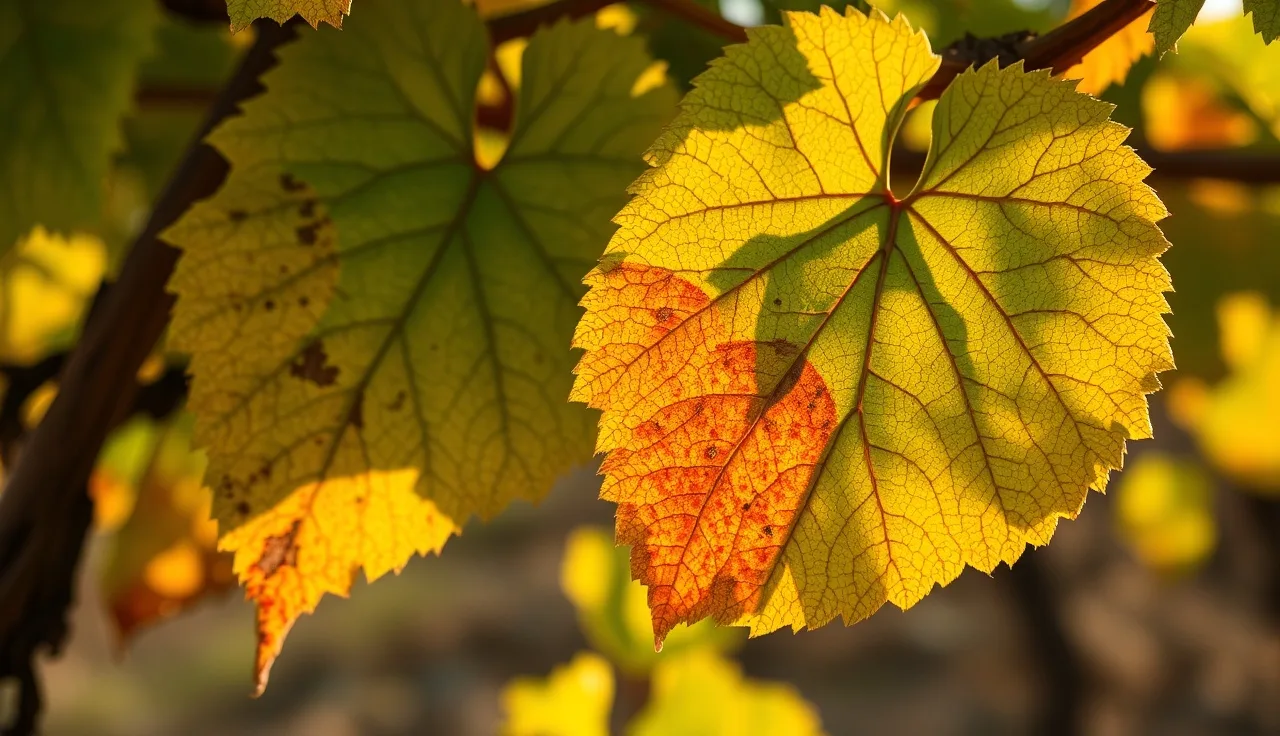
Potassium deficiency starts quiet. Early in the season you may catch a slight dullness or blue-green cast on the older leaves. By mid-season the margins of those basal leaves brown and curl upward, a dry scorch that looks like the vine baked from the outside in. The dead tissue has a sharp edge, not a soft fade, and it creeps from the leaf tip and margin toward the midrib as the deficiency deepens.[2]
On red-fruited varieties you'll often see a red or purple band just inside the brown dead zone before the tissue gives out. That anthocyanin build-up is a stress response. On white-fruited varieties the pre-necrotic zone tends to go pale yellow instead of red.
Timing is a reliable tell. K deficiency usually becomes visible around or just after veraison, because the ripening berries are K sinks. Berries pull roughly 70 percent of the shoot's potassium as they ripen [2], so the leaves lose the competition. Symptom severity tracks crop load. A heavily cropped vine scorches worse than a lightly cropped one in the same soil.
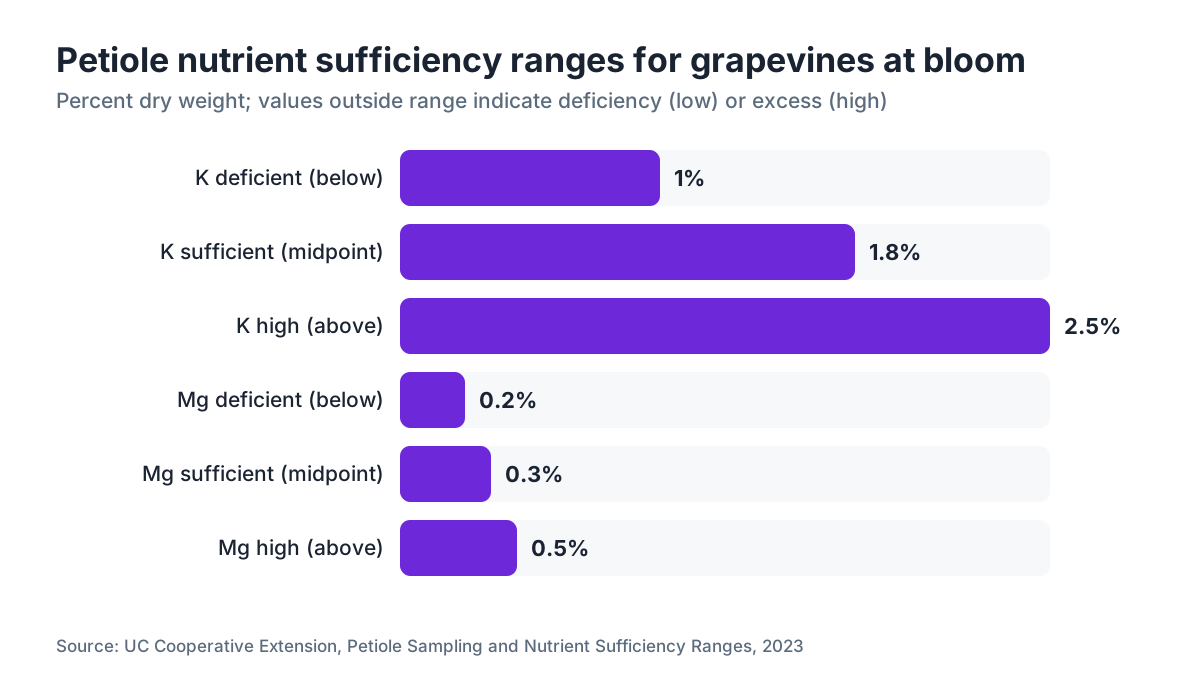
In bad cases, shoot growth slows, internodes shorten, and shoot tips die back. Petioles on affected leaves often carry less than 1.0 to 1.2 percent K on a dry-weight basis. UC Cooperative Extension treats anything below 1.0 percent at bloom as deficient.[3]
What do magnesium deficiency symptoms look like on grape leaves?
Magnesium deficiency looks like someone bleached between the veins and left the veins green. That interveinal chlorosis is the signature. The veins stay dark, the tissue between them goes yellow, sometimes fading to pale cream or white in severe cases. The pattern spreads out from the main veins, and once you've seen it you won't mistake it for K margin burn.[4]
Like K, Mg hits older and mid-canopy leaves first. It tends to show slightly earlier in the season than K, often at or shortly after fruit set, because Mg demand tracks both shoot growth and chlorophyll synthesis. Magnesium is the central atom of the chlorophyll molecule, so a shortfall cuts photosynthetic capacity directly.
Leaf margins on Mg-deficient vines stay relatively green next to the bleached interveinal tissue. That's the single clearest split from K deficiency, where the margin is ground zero for the damage.
Sandy soils, high-rainfall leaching sites, and soils with very high Ca or K (both suppress Mg uptake) are the usual suspects. WSU Extension notes that soils with magnesium saturation below 10 percent of the cation exchange capacity commonly produce deficiency symptoms in grapevines.[5] Petiole Mg below 0.25 percent at bloom flags a problem. Below 0.15 percent is severe.
One practical note: foliar Mg works well, better than foliar K, which is only a short-term patch. If you confirm Mg deficiency, a few well-timed foliar Epsom salt (magnesium sulfate) sprays at a 2 to 4 percent solution can clear leaf symptoms within weeks. You'll still want to fix the root cause in the soil.
How do you tell potassium from magnesium deficiency in the field without a lab test?
Here's a field key, roughly in order of reliability.
| Feature | Potassium deficiency | Magnesium deficiency |
|---|---|---|
| Symptom location on leaf | Margins and tips | Interveinal (between veins) |
| Vein color | Veins go with the rest | Veins stay noticeably green |
| Pre-necrotic color (red varieties) | Red-purple band inside necrosis | Yellow-green bleaching |
| Tissue death pattern | Sharp, dry brown necrosis | Less common; severe cases go tan-white |
| Timing peak | Near or after veraison | Fruit set onward |
| Soil context clues | Low-K soils, sandy, heavy cropping | High Ca or K soils, sandy, high rainfall |
| Response to foliar spray | Temporary improvement at best | Epsom salt spray gives visible response |
The margin-versus-interveinal split is the field workhorse. Walk to an affected leaf, turn it over in the light, and trace the veins. If the yellow or brown starts at the margin and moves in, think K. If it starts between the veins while they stay green, think Mg.
Crop load is a good second clue. High-yield vines with mid-to-late season margin scorch point hard at K competition between the crop and the leaves. Lightly cropped vines, or vines in very sandy, leached soils showing early-season bleaching, point at Mg.
No visual call is definitive. Cornell Cooperative Extension recommends pairing what you see with petiole analysis, sampled at bloom (opposite the basal cluster, 25 to 30 petioles per block) and again at veraison.[6] Those two data points, bloom and veraison, tell you whether the vine is draining a nutrient as the season runs or whether the problem was baked in from the start.
What soil and tissue tests confirm which deficiency you have?
Visual symptoms get you a working hypothesis. Lab work gives you the number.
Petiole analysis is the standard. For both K and Mg, the bloom-stage petiole is the most useful sample, because tissue nutrient concentrations at that point reflect what the vine is drawing from the soil at peak demand. The UC Davis Viticulture & Enology program publishes sufficiency ranges that most California labs use as reference: bloom petiole K runs 1.0 to 2.5 percent dry weight, Mg runs 0.25 to 0.45 percent.[3]
Soil tests matter too, but read them carefully. Soil K and Mg tell you what's in the bank, not what the vine can pull out. Soil pH, clay content, CEC, and the ratio of competing cations (Ca:Mg:K) all shift nutrient availability. A soil that looks fine for Mg on paper can still starve vines if the Ca:Mg ratio is very wide, which is common in limestone-derived soils.
If you're running several blocks with recurring symptoms, get a full base saturation analysis. The target ranges most extension specialists cite: Ca at 65 to 75 percent saturation, Mg at 10 to 15 percent, K at 2 to 5 percent. When K crowds out Mg or the reverse, this ratio shows it before the leaf does.
Whole-leaf analysis (blade instead of petiole) exists but sees little use for these two nutrients in viticulture. Stick with petioles for K and Mg. They're more sensitive and the reference ranges are better established.
For record-keeping across blocks and seasons, tools that log petiole results against block history save real time at amendment planning. VitiScribe is built for this kind of seasonal tracking, pairing petiole data with spray and soil records in one place.
Which grapevine varieties are most susceptible to each deficiency?
No variety is immune, but some are noticeably worse.
Potassium deficiency shows most on varieties with big crops or thin canopies that can't compensate by shedding fruit load. Chardonnay and Pinot Noir, both thin-skinned and usually cropped hard in commercial blocks, show K symptoms readily. The variety matters less than the rootstock, though. High-vigor rootstocks that push a lot of vegetative growth can actually mask K deficiency by dropping crop load. Lower-vigor rootstocks on K-poor soils surface symptoms faster.
Magnesium deficiency has a known rootstock pattern. SO4 (Selection Oppenheim 4), planted widely, is famous for it. SO4 has high Mg demand relative to most other rootstocks and does poorly on low-Mg soils.[4] 420A and 5BB Kober are also Mg-inefficient. If you're on SO4 and seeing interveinal chlorosis, Mg is your first guess, not your last.
Scuppernong and muscadine types grown in the southeastern U.S. show K deficiency in soils that would be plenty for Vitis vinifera, partly because those sandy coastal plain soils have inherently low CEC.
The takeaway: at planting or replanting, match rootstock to your soil's known cation profile. Putting SO4 on light sandy soil in a high-rainfall area is asking for Mg trouble no matter what you drop in the planting hole.[11]
How do you fix potassium deficiency in vineyards?
Soil application is the long-term fix. Foliar is triage.
For soil correction, potassium sulfate (K2SO4) is the preferred source for vineyards. It supplies K without the chloride load of muriate of potash (KCl), and grapevines are chloride-sensitive enough that most extension recommendations favor the sulfate form. Typical rates run 200 to 400 pounds of K2SO4 per acre on confirmed-deficient soils, incorporated or banded near the root zone.[7]
Timing counts. Fall applications after harvest let K move into position before spring growth. Spring pre-bloom applications work too, but give the nutrient less time to move through the soil.
Foliar potassium (potassium phosphite, potassium bicarbonate, or potassium silicate sprays) can knock back visible symptoms in-season but won't fix the soil. Going foliar as a stopgap while you plan soil amendments is reasonable. Making foliar your only move for years running means you're spending money and not solving the root cause.
Go careful amending K on soils already high on the Mg saturation range. Push K up without watching the Mg number and you can suppress Mg uptake and buy yourself a new problem.
Heavy cover crop biomass incorporation can build organic matter and indirectly improve K retention in sandy soils, but that's years, not months. If you've got a deficiency right now, soil amendments are the path.
How do you fix magnesium deficiency in vineyards?
Dolomitic limestone is the cheapest fix when soil pH also needs a bump. It supplies both Ca and Mg and raises pH in one pass. If your pH is already where you want it (roughly 6.0 to 6.5 for most wine grape production), use magnesium sulfate (Epsom salt) instead, which won't push pH higher.
Soil rates for Epsom salt typically run 100 to 400 pounds per acre depending on severity and soil type, applied in spring or fall.[5] On soils with very low CEC (sand, decomposed granite), split applications work better, because there's less capacity to hold Mg between rounds.
Foliar correction genuinely works for Mg, more than for K. Magnesium moves through leaf tissue readily. A 2 to 4 percent Epsom salt solution (about 20 to 40 pounds per 100 gallons) applied at 2-week intervals from fruit set onward can reverse visible chlorosis within a few weeks. WSU Extension describes foliar Mg as a reliable in-season correction for established deficiency in Washington vineyards.[5]
Don't apply foliar Mg during high heat. Spray in the early morning or evening to cut burn risk. Check your sulfate load too if you're already running sulfur fungicides. Very high total sulfur can occasionally cause trouble in sensitive varieties.
If your soil K is excessive relative to Mg (a K:Mg ratio above roughly 0.5:1 on a molar basis), cutting K inputs matters as much as adding Mg. You can't outrun cation competition by piling on Mg while K is overwhelming the uptake channels.
Can you have both potassium and magnesium deficiency at the same time?
Yes, and it's more common than you'd expect on leached sandy soils.
Both cations leach easily. Their peak demand periods overlap (fruit set through veraison). Both get suppressed by high Ca. Soils weak on Ca-holding capacity often end up low in K and Mg together.
When both hit at once, the symptoms overlap and the diagnosis gets muddy. You may see margin scorch and some interveinal bleaching on the same leaf. The only reliable way through is a petiole analysis, not more staring at leaves.
The treatment changes too. You can't just dump K sulfate and Epsom salt on the soil and call it done. Work from the cation balance: figure out what the Ca saturation is doing, then plan K and Mg additions in proportion so you don't overcorrect one and suppress the other. A certified crop advisor or viticulture extension specialist earns the call if you're in this spot. Cornell and WSU both keep extension viticulture specialists available for consult.[6][5]
One thing that won't help: guessing. Both nutrients are cheap enough that some growers apply both every year as insurance. That's not always harmful, but on clay soils with decent CEC you can oversupply K to the point of suppressing Mg uptake across seasons. Know your numbers before you amend.
What other grape leaf problems get confused with K or Mg deficiency?
A few are common enough to flag.
Boron deficiency can produce interveinal chlorosis, but it lands on young leaves near shoot tips, not old basal leaves. If the problem is at the growing tip, it's not K or Mg.
Sulfur toxicity from heavy elemental sulfur applications occasionally throws interveinal yellowing that mimics Mg deficiency. If you're on a heavy sulfur spray program and seeing Mg-like symptoms, check your spray records before you treat for Mg.
Leafroll virus produces red or yellow interveinal discoloration (color depends on variety) that looks strikingly like K deficiency, margin coloration and all in red varieties. Leafroll gives itself away: the leaf margins roll downward (the classic symptom), symptoms are worst in virus-infected vines regardless of soil K, and tissue testing shows normal K despite the leaf symptoms. If foliar K doesn't budge the symptoms and petiole K is adequate, get a virus screen.
Phylloxera root damage cuts nutrient uptake across the board. A vine with damaged roots can show K or Mg symptoms even in soil that tests adequate, because the roots can't move the nutrients in. Digging roots and checking for galling or knots belongs in any thorough diagnosis on a vine with multi-nutrient symptoms.
Hot, dry weather causes real leaf scorch that reads like K margin burn. Heat scorch tends to scatter across canopy position rather than concentrate on basal leaves, which is one way to separate it from K deficiency. Check the weather history.
If you're building a detailed record of symptom timing, spray history, and soil tests, that vineyard operations log becomes your best diagnostic tool over time.
What does the research actually say about K and Mg management in wine grape vineyards?
The research base is decent for K, thinner for Mg in wine grapes specifically.
UC Davis work on potassium in California vineyards has shown that K concentration in berry juice at harvest correlates strongly with must pH, and that high must K raises wine pH through tartrate buffering, cutting titratable acidity.[12] That's a wine quality concern separate from the plant nutrition question. Growers in warm climates chasing lower-pH wines may want to manage K conservatively even when the vine looks healthy, especially on heavy-bearing blocks of Chardonnay or Grenache.
Research summarized by Cornell Cooperative Extension found that petiole K at veraison below 0.8 percent was associated with visible leaf scorch in New York Riesling, and that yield losses became measurable when petiole K fell below 0.5 percent.[6]
For Mg, the rootstock-susceptibility finding is well documented. German viticultural research, summarized in widely cited extension materials, found that SO4 removes significantly more Mg from the soil per unit of vine growth than 5C Teleki or 3309 Couderc, making Mg deficiency a predictable outcome on SO4 in low-Mg soils.[4]
Here's the honest part. Nobody has strong large-scale replicated data on the best Ca:K:Mg ratios for grapevines across soil types. The ranges in extension publications come mostly from practitioner experience and small plot trials, not multi-site randomized experiments. So treat the petiole thresholds as guidelines, not gospel, and watch your own vines over several seasons to learn what the numbers mean in your specific soil.
How do spray record-keeping and compliance requirements apply to foliar nutrient applications?
Foliar nutrient sprays are generally exempt from pesticide application record-keeping under most state regulations, but the line blurs fast.
Products like copper sulfate or zinc sulfate carry EPA registration as pesticides and require a Pesticide Application Record in most states even when applied for nutrition. Epsom salt and potassium sulfate applied as foliar fertilizers usually don't require a pesticide record, but check your state, because California's CDPR, for one, has its own reporting rules that differ from federal baselines.[8]
Under the EPA Worker Protection Standard (WPS), restricted-entry intervals (REIs) apply to applications of EPA-registered pesticides, not to unregistered fertilizers. If you're applying a registered nutrient product (some phosphite formulations carry a pesticide registration), the REI and notification rules of the WPS apply.[9] The WPS requirement to establish Application Exclusion Zones and provide post-application safety information applies whether the product is a fertilizer or a pesticide, so long as it carries an EPA registration number.
Keeping clean records of what went out, when, at what rate, and on which blocks is good practice no matter the legal requirement. When a state agricultural inspector or a third-party auditor asks about a foliar program, a timestamped log beats memory every time.
VitiScribe handles both sides: nutrient application logs and the spray records that need WPS-compliant documentation, in the same workflow.
For organic operations, confirm your Mg and K fertilizer sources are OMRI-listed before applying. Potassium sulfate and magnesium sulfate are generally allowed under USDA National Organic Program rules, but the specific product formulation matters.[10]
Frequently asked questions
Does potassium deficiency cause yellow leaves on grapevines?
Potassium deficiency usually causes brown margin scorch rather than yellowing. On red varieties there's often a red-purple band inside the dead area. On white varieties the pre-necrotic zone may go pale yellow, but the defining symptom is dry marginal necrosis, not the broad interveinal yellowing you get with magnesium deficiency. If you're seeing yellow between green veins, magnesium is the more likely cause than potassium.
What is the petiole potassium threshold for grapevines at bloom?
UC Cooperative Extension treats bloom-stage petiole K below 1.0 percent (dry weight) as deficient, and 1.0 to 2.5 percent as sufficient. Levels above 3.0 percent can signal luxury consumption that may raise must pH and cut wine acidity. Sample opposite the basal cluster, 25 to 30 petioles per block, at full bloom for the most useful reading.
Can magnesium deficiency reduce grape yield?
Yes. Magnesium is the central atom in chlorophyll, so severe Mg deficiency cuts photosynthetic capacity and sugar accumulation. Berry size and cluster weight can drop in badly affected vines. The yield hit is usually less dramatic than the leaf symptoms suggest, but photosynthate supply to the fruit takes a hit, and Brix at harvest can come in lower than expected on Mg-deficient vines carrying heavy crops.
Is SO4 rootstock really that much worse for magnesium uptake?
Yes, substantially. SO4 has high Mg demand and ranks among the rootstocks most likely to show Mg deficiency on soils that would be fine for other varieties. German viticultural research, summarized in extension publications from WSU and Cornell, consistently names SO4 as Mg-inefficient. If you're on SO4 in a sandy, leached, or high-Ca soil, plan for Mg monitoring from the start rather than reacting after symptoms appear.
How quickly does foliar Epsom salt correct magnesium deficiency symptoms?
Visible greening of interveinal chlorosis typically starts within 2 to 3 weeks of the first application. Most extension recommendations suggest 2-week spray intervals with a 2 to 4 percent magnesium sulfate solution (20 to 40 lbs per 100 gallons of water). Severely bleached tissue won't turn green again, but new tissue emerging after applications comes in normal, and existing chlorotic tissue often improves noticeably.
Will applying potassium fertilizer make magnesium deficiency worse?
It can. K and Mg compete for the same root uptake channels. Adding high rates of potassium to a soil already tight on Mg suppresses Mg absorption further. If you suspect or confirm both deficiencies, work from a cation balance analysis and add both nutrients in proportion rather than addressing only one. A base saturation test showing the K:Mg ratio is a more useful guide than treating each nutrient alone.
How do I distinguish leafroll virus from potassium deficiency on red grape varieties?
Both produce red interveinal discoloration on older leaves in late summer. The clearest separators: leafroll-infected leaves roll their margins downward, while K-deficient leaves may curl upward at the margin; K-deficient vines improve with potassium while virus-infected vines don't; and petiole K reads normal in leafroll-infected vines. If symptoms don't respond to K correction and petioles test adequate, get a PCR-based leafroll virus test done.
When should I sample petioles for diagnosing K or Mg deficiency?
Bloom is the most important sampling point. Collect petioles opposite the basal cluster, 25 to 30 per block, when the block is at 50 to 80 percent bloom. A veraison sample gives a second reference point showing how nutrient status shifted through the season. Avoid sampling stressed vines (drought, disease), because stress itself alters nutrient concentrations and can produce false low readings.
Do organic-certified vineyards have different options for correcting K or Mg deficiency?
Most options work for organic operations. Potassium sulfate (sulfate of potash) and magnesium sulfate are generally permitted under USDA National Organic Program rules, but the specific commercial product must be OMRI-listed or reviewed by your certifier. Muriate of potash (potassium chloride) is prohibited under NOP. Dolomitic limestone for Mg correction is allowed. Always confirm with your certifier before applying, since formulations and allowed uses vary.
Can potassium deficiency affect wine quality even when yield looks normal?
Yes. Low vine K means lower berry K, which affects tartrate buffering in the must and tends to lower wine pH and raise titratable acidity. That can be a quality advantage in warm climates where high pH is the problem. Vines with very high K produce berries with elevated K content, higher must pH, and lower natural acidity. UC Davis research has documented this relationship between petiole K, berry K concentration, and must pH.
What potassium fertilizer source is best for vineyards?
Potassium sulfate (K2SO4) is the standard recommendation for vineyards. It supplies potassium without chloride, which grapevines accumulate and which can reduce wine quality. Muriate of potash (KCl) is cheaper but carries the chloride load. On alkaline soils, potassium sulfate also adds a small amount of sulfur. Rates of 200 to 400 lbs per acre for confirmed deficiency are typical, applied in fall or early spring.
Are there cover crops or organic matter practices that help prevent K or Mg deficiency?
Organic matter raises CEC, which helps soils hold both K and Mg against leaching. Cover crops like cereal rye or legume mixes add biomass that, when incorporated or mulched, can return meaningful K to the surface soil. But cover crops also compete with vines for K and Mg during growth, especially in water-limited sites. The net effect depends on management. Compost additions are a lower-risk way to build organic matter without in-season competition.
Do I need to keep records of foliar magnesium or potassium applications?
If the product carries an EPA registration number, yes, pesticide application records are required and Worker Protection Standard rules apply. Unregistered fertilizers like plain Epsom salt or potassium sulfate don't require a pesticide record in most states, though California CDPR rules add layers worth checking. Keeping your own application log regardless of legal requirement is smart for troubleshooting and audits. Log the product, rate, date, block, and who applied it.
How often should I do soil tests to monitor K and Mg levels in a vineyard?
Most extension programs recommend soil testing every 2 to 3 years in established vineyards, with petiole sampling every year. Soil tests change slowly; petioles give you annual in-season feedback. If you're actively amending for K or Mg deficiency, test the soil annually until you've stabilized the numbers, then move to the standard 2-to-3-year interval. New block establishment warrants a pre-plant soil and water test.
Sources
- UC Agriculture & Natural Resources, Nutrient Management in Vineyards: Cation competition between K and Mg in root uptake; high K applications suppress Mg absorption in grapevines
- UC Davis Viticulture & Enology, Grapevine Nutrition: Berries accumulate roughly 70 percent of shoot potassium as they ripen; K deficiency symptoms intensify near veraison due to fruit competition
- UC Cooperative Extension, Petiole Sampling and Nutrient Sufficiency Ranges for Grapevines: Bloom petiole K sufficiency range is 1.0 to 2.5 percent dry weight; below 1.0 percent is deficient; petiole K correlates with berry K and must pH
- Cornell Cooperative Extension, Grape Nutrition: Magnesium: SO4 rootstock is highly susceptible to Mg deficiency due to high Mg demand; interveinal chlorosis on basal leaves is the defining symptom; veins remain green
- Washington State University Extension, Nutrient Management for Grapes: Soils with Mg saturation below 10 percent of CEC commonly produce deficiency symptoms; foliar magnesium sulfate is a reliable in-season correction; soil Mg sulfate application rates 100 to 400 lbs per acre
- Cornell Cooperative Extension, Vineyard Petiole Sampling: Petiole K at veraison below 0.8 percent associated with visible leaf scorch in New York Riesling; yield losses measurable below 0.5 percent petiole K; bloom petiole sampling opposite basal cluster recommended
- UC Agriculture & Natural Resources, Fertilization of Winegrapes: Potassium sulfate (K2SO4) is the preferred K fertilizer for vineyards; typical application rates 200 to 400 lbs per acre for confirmed deficiency
- California Department of Pesticide Regulation, Pesticide Use Reporting: California CDPR pesticide use reporting requirements apply to registered pesticides including certain nutrient products with EPA registration numbers
- U.S. EPA, Worker Protection Standard for Agricultural Pesticides: WPS restricted-entry intervals and Application Exclusion Zone requirements apply to EPA-registered pesticide products; foliar nutrient products carrying an EPA registration are subject to WPS
- USDA Agricultural Marketing Service, National Organic Program: Potassium sulfate and magnesium sulfate are generally permitted under NOP; potassium chloride (muriate of potash) is prohibited for organic production
- WSU Extension, Rootstock Effects on Vine Nutrition: SO4 and 5BB Kober rootstocks identified as Mg-inefficient; 3309 Couderc performs better on low-Mg soils; rootstock choice at planting affects long-term Mg management
- UC Davis Viticulture & Enology, Effect of Potassium on Wine Must pH and Titratable Acidity: High vine K is correlated with elevated berry K concentration, higher must pH, and lower titratable acidity in harvested fruit
Last updated 2026-07-11