How to identify downy mildew on grape leaves versus nutrient deficiency
TL;DR
- Downy mildew (Plasmopara viticola) makes oil-spot lesions on the top of the leaf and white cottony sporulation on the underside, usually after a warm wet night.
- Nutrient deficiencies show interveinal chlorosis, edge scorch, or even yellowing, and never any sporulation.
- The fastest test is one motion: flip the leaf.
- White fuzz means downy mildew.
Why does this distinction matter so much in the field?
Get this wrong in either direction and you pay for it. A fungicide pass you didn't need runs $30 to $80 per acre in materials alone, before labor and equipment [1]. A nutrient problem you ignore because you thought it was disease bleeds brix and yield straight through veraison. And the fixes have nothing in common: one is a spray program call, the other is a tissue test and a feeding decision.
Both conditions start the same way. Yellow patches on the top of the leaf. That's the whole reason people confuse them, and it's enough to send a careful grower down the wrong road for a week.
What you need is a checklist you can run in the row without waiting on a lab. This article gives you that.
What does downy mildew actually look like on grape leaves?
Downy mildew comes from Plasmopara viticola, an oomycete (a water mold, not a true fungus, though everybody in the trade still calls it a fungal disease). The first thing you see on the top of the leaf is an oily, pale yellow to yellow-green patch. Growers call it an "oil spot" [2]. It looks angular or polygonal because the veins stop the pathogen's spread. Early spots run about 1 to 3 cm across.
Now flip the leaf. After a wet night between roughly 59°F and 72°F (15°C to 22°C), the underside of that patch carries a dense white cottony growth. Those are the sporangiophores and sporangia. This is the one character that settles it. Nothing else on a grape leaf looks like it, and the UC IPM Pest Management Guidelines for Grape treat that underside sporulation as the defining field diagnostic [2].
As lesions age they brown and die from the center out. On young leaves the infection can curl and warp the tissue before the oil spot is even obvious. Shoot tips and berries get hit too; infected berries turn grayish-white, then brown, then shrivel.
Here's the trap. On a dry sunny afternoon, hours after the dew burned off, the white sporulation may not show even when the pathogen is right there. So scout at dawn while the dew still sits on the leaves. Or bag a suspect leaf with a damp (not wet) paper towel overnight and check the underside in the morning. Active infections will fruit out [3].
What do the most common nutrient deficiencies look like, and how are they different?
One rule cuts through most of the confusion: nutrient deficiencies never sporulate on the underside, under any weather. Flip the leaf, and if the back is clean, you're looking at a nutrition or water problem until something proves otherwise.
After that, the pattern and color of the yellowing tells you which element. Here's how the common ones show up on grape leaves.
Nitrogen (N): Even, pale yellow to yellow-green color that starts on older basal leaves and climbs upward. The whole leaf goes pale, more than the tissue between veins. Shoots run short and thin.
Potassium (K): Marginal scorch, meaning brown dry leaf edges, on older leaves, often with a yellow band between the green center and the burned rim. K deficiency is one of the most common things mistaken for early downy mildew, because both can start as edge yellowing. But the scorched margin is crispy and dry, never oily or water-soaked [4].
Magnesium (Mg): Textbook interveinal chlorosis on older leaves. The tissue between the veins yellows while the veins stay green. Cornell's guidance describes the pattern as roughly the inverse of nitrogen, with veins the last tissue to fade [5].
Iron (Fe): Interveinal chlorosis on the young leaves at the shoot tips, not the old ones. Young leaves first is the opposite of nitrogen and magnesium. In bad cases the tissue goes nearly white.
Zinc (Zn): Small, mottled, lopsided leaves ("little leaf"), interveinal chlorosis, and short internodes. Once you've seen it, you never miss it.
Boron (B): Distorted, cupped, or asymmetrical new growth, sometimes with corky tissue. People confuse it with mite damage.
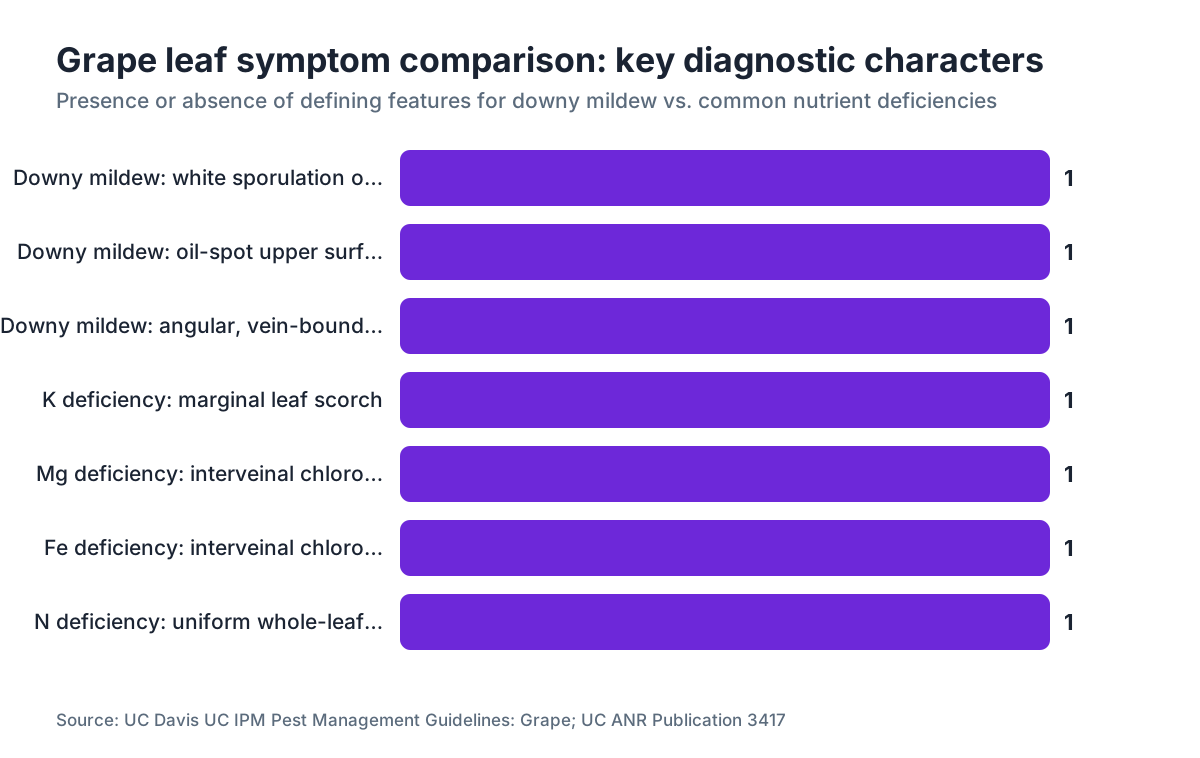
| Symptom | Downy mildew | N deficiency | K deficiency | Mg deficiency | Fe deficiency |
|---|---|---|---|---|---|
| White sporulation on leaf underside | Yes | No | No | No | No |
| Oily/water-soaked upper surface | Yes | No | No | No | No |
| Lesion bounded by veins | Yes | No | No | Sometimes | No |
| Older leaves affected first | Yes (usually) | Yes | Yes | Yes | No |
| Younger leaves affected first | No | No | No | No | Yes |
| Interveinal pattern | No | No | No | Yes | Yes |
| Marginal scorch | No | No | Yes | No | No |
| Uniform yellowing whole leaf | No | Yes | No | No | No |
What is the fastest 5-step field test to tell them apart?
You don't need a lab to make a working call. Run these in order.
- Flip the leaf. White cottony growth on the underside beneath a yellow patch means downy mildew. Stop there if you see it. No sporulation, keep going.
- Note where in the canopy it shows. Old basal leaves first points to a mobile nutrient (N, K, Mg, P). Young tip leaves first points to an immobile nutrient (Fe, Mn, Zn, B), or, if sporulation shows up later, a fresh downy mildew hit on young tissue.
- Read the lesion shape. Downy mildew lesions are angular and fenced in by veins. Nutrient patterns follow different logic: interveinal chlorosis makes a net with green veins, and marginal scorch tracks the leaf edge no matter where the veins run.
- Feel the texture of the yellow tissue. Downy mildew gives the top surface an oily, slightly see-through, water-soaked look. Nutrient chlorosis reads matte and dry. K-scorch feels papery and crisp.
- Walk multiple vines across the row and block. Downy mildew spreads from infection foci; early in an outbreak you'll find it clustered around a low wet spot or where inoculum overwintered. Nutrient deficiencies track soil variability. They go block-wide when the whole block has a pH problem, or run in strips across sandy ground that drains and leaches fast. Scattered symptoms with no soil logic point back toward disease.
The whole run takes under 10 minutes on a normal scouting walk.
What conditions favor downy mildew versus when should you suspect a deficiency?
Weather and timing tip the odds before you even reach the leaf. Downy mildew needs water. It wants leaf wetness for at least 1.5 hours above 52°F (11°C), then relative humidity over 95% to sporulate. The classic outbreak in the eastern US and Pacific Northwest is a warm rain followed by a humid night [3]. In California's inland valleys, irrigation management matters more than rain. WSU Extension describes primary infection this way: it happens in spring once temperatures rise past about 50°F and rain or heavy dew keeps leaves wet for several hours [3].
Nutrient deficiencies often sharpen after a dry stretch and then irrigation, because salts concentrate near the surface, pH shifts, and root activity changes. Potassium symptoms peak in late summer as the vine loads the crop and pulls K faster than the soil can resupply it. Iron chlorosis gets worse in high-pH soil (above 7.5) or waterlogged ground, where Fe availability drops.
So two quick reads. Just got an inch of rain and warm cloudy weather behind it? Think disease. Been dry and hot for three weeks and the leaf bottoms are clean? Think nutrition or water stress.
How do you confirm downy mildew if you're still not sure after the field test?
A hand lens usually closes the case. The sporangia of P. viticola are distinctive at 10x or under a basic compound scope: lemon-shaped sporangia sitting on branched sporangiophores. If you keep a 10x loupe in your vest (you should), that branching structure on a fresh sample is often all the confirmation you need.
For a lab answer, send a fresh leaf to your state plant disease diagnostic lab. UC Davis, Cornell, and WSU all run diagnostic services for their regions [5][6]. Turnaround is usually 3 to 7 business days, too slow for a spray timing decision but useful for confirming a new disease in a block that used to be clean.
Nutrition is a different sample. A petiole analysis pulled at bloom (the standard timing for California grapes) or at veraison beats a leaf-blade test for most elements. UC ANR's nutrient guidelines give sufficiency ranges by sampling timing [4]. Run a soil test alongside the petiole test and you can tell a supply problem (the soil is short) from an uptake problem (pH, compaction, waterlogging locking it up).
Dated symptom photos, filed by block and tied to your spray records and weather, are what let you see patterns across seasons. That linkage is what VitiScribe is built for: scouting notes, spray applications, and weather events in one place, so the pattern surfaces without digging through three spreadsheets.
What early-season scouting practices help you catch downy mildew before it's a problem?
The window that decides your season sits between bud break and about 12 to 15 inches of shoot growth. That's when primary infections establish from oospores that overwintered in the leaf litter. UC IPM guidance points growers toward weekly scouting once shoots hit 4 to 6 inches, and again after any rain of 0.1 inch or more [2].
Start at the bottom of the canopy. Young basal leaves and leaves near the ground catch the most splash inoculum off infected litter, and expanding shoot tips are the most susceptible tissue you've got. A solid scout checks the underside of at least one leaf per shoot on 10 to 15 shoots per block. Figure 15 to 20 minutes per block.
Go after dawn, dew still on. That's when sporulation shows even if the night wasn't ideal for heavy fruiting. Afternoon scouting on a dry sunny day misses infections you'd have caught at first light.
Record every walk by block and date, even the clean ones. A run of negatives is worth as much as a positive. It tells you whether to tighten the spray interval after a rain or hold another week.
How do you treat downy mildew versus how do you correct a nutrient deficiency?
The responses share nothing, which is the whole reason the diagnosis matters.
For downy mildew, the first question is protective or curative. Most registered materials for grape downy mildew are oomycete-specific: phosphonates (potassium phosphite, fosetyl-Al), mancozeb (a broad protectant), cymoxanil, and the newer CAA fungicides [1]. Protectants like mancozeb and copper have to go on before infection, meaning before the wet event or within about 24 hours of it. Curatives like cymoxanil can reach back roughly 48 hours after infection. Past that window, with sporulation already showing, you're mostly slowing further spread.
Copper works well on downy mildew and is allowed in organic programs, but it accumulates in vineyard soil and turns phytotoxic at high rates. Check your organic certifier's annual copper limits before you reach for it every time.
Nutrient fixes depend on the element and the cause. When soil pH is choking uptake (common with iron and zinc in alkaline soil), sulfur to lower pH or a chelated micronutrient spray is the faster route. For mobile macronutrients like N, K, and Mg, a foliar feed greens a vine up fast but doesn't repair the soil underneath it. A petiole result paired with a soil test gives you the roadmap. Set rates and timing with your farm advisor or certified crop adviser.
One thing to skip: spraying a fungicide "just in case" without a confirmed diagnosis. Beyond the money, you're adding worker exposure for nothing. Under the EPA Worker Protection Standard (WPS), every application means notifying workers, honoring the restricted-entry interval, and keeping records [7]. An unneeded pass isn't just waste. It's compliance work you created for yourself.
Are there other grape leaf problems that look like both downy mildew and nutrient deficiency?
Yes, and a handful of them fool experienced growers every year.
Powdery mildew puts white powdery growth on the top of the leaf, not the bottom. The white is on top, and it's superficial enough to wipe off. Downy mildew sits underneath and is dense and felt-like.
Bitter rot from Greeneria uvicola can throw brownish angular lesions, but no sporulation, and it lives mostly on berry tissue.
Botrytis (gray mold) fruits gray-brown, not white, usually in denser, more irregular patches, and it prefers damaged or aging tissue.
Phomopsis cane and leaf spot makes small dark-centered lesions with yellow halos early in the season, which people read as early nutrient spots. But Phomopsis lesions are smaller (1 to 5 mm) with a clear dark spot in the middle.
Spider mite stippling puts a fine, even bronzing across the leaf with no angular pattern and no sporulation. Flip the leaf and you may find mites, webbing, or both.
Herbicide drift (especially auxin materials like 2,4-D or dicamba) warps new growth hard, cupping and twisting leaves in a way that mimics boron deficiency or virus. The distribution usually points at an edge row next to a treated field.
Spider mites and powdery mildew get called nutrient problems most often. A leaf flip and a 10x loupe handle nearly all of these in the row.
What records should you keep after a downy mildew or deficiency diagnosis?
This isn't paperwork for its own sake. Good records are what let you make a better call next year and defend your applications if an inspector shows up.
A disease diagnosis means your spray record has to capture the product name, EPA registration number, rate per acre, water volume, date and time, applicator name, target pest, weather at application, and the REI [7]. California's Department of Pesticide Regulation requires pesticide use reports filed with the county agricultural commissioner within 7 days of each application [8]. Other states run similar rules. If the material needs a written recommendation from a licensed pest control adviser in California, that recommendation goes on file before you spray.
For a nutrient deficiency, file your tissue and soil test results dated and by block. Made a fertilizer pass? Record the product, rate, and method. These records help your PCA spot trends across seasons, and they're often required by sustainability programs like the California Sustainable Winegrowing Alliance's self-assessment [9].
The gap between field diagnosis and record-keeping is where a lot of small operations fall behind. Notes in your head or on a paper clipboard don't help you a year later. Records tied to block IDs and dates make the pattern visible. That's the core case for a field operations tool like VitiScribe, which links scouting observations straight to spray record entries so you don't do the work twice.
What do university extension programs recommend for confirming the diagnosis in the lab?
UC Davis, Cornell, and WSU all run plant disease diagnostic services and publish extension material specific to grape downy mildew.
UC Cooperative Extension's viticulture program wants a fresh, not frozen, leaf in a sealed bag with a damp paper towel, never soaking, so the tissue doesn't macerate in shipping [6]. UC IPM's Pest Management Guidelines for Grape carry a photo guide covering downy mildew and the major nutrient deficiency symptoms. That resource is free and public at ipm.ucanr.edu [2].
Cornell's viticulture extension, out of Geneva, NY, covers the P. viticola pressure more common in the eastern US and offers a grower-facing disease ID guide [5]. Cornell's NEWA (Network for Environment and Weather Applications) tool runs infection risk models off weather station data, which helps you decide whether the yellowing you're seeing lines up with recent weather [10].
WSU Extension covers the Pacific Northwest, where downy mildew pressure swings hard between eastern Washington (low, dry) and western Washington and Oregon (high, wet). Their fruit disease management guide is the standard reference for Washington growers [3].
For nutrition, UC ANR publishes petiole sufficiency ranges at bloom and veraison that get used well beyond California [4][11]. The full reference is "Nutrient Management for Winegrapes in California," UC ANR Publication 3417.
Frequently asked questions
Can downy mildew and a nutrient deficiency appear on the same leaf at the same time?
Yes. A potassium-short vine under disease pressure can carry both marginal K scorch and oil-spot downy mildew lesions on one leaf. The diagnostic key holds anyway: check the underside. Sporulation under any lesion means downy mildew is present, whatever else is going on. Treat the disease first, then handle the nutrition once a tissue test confirms the deficiency.
What temperature is too cold for downy mildew to sporulate?
Sporulation of Plasmopara viticola is minimal below about 52°F (11°C) and stops below 46°F (8°C). Primary infection can happen as low as 50°F given enough leaf wetness, but sporulation and fast spread need nights above 59°F. In cold spring weather, a yellow patch that never fruits out white over several days is more likely nutrient or frost than active downy mildew.
Does downy mildew ever appear on old leaves rather than young ones?
Downy mildew usually starts on young, expanding leaves because they're the most susceptible, but it can hit leaves at any stage given inoculum and the right weather. Older leaves develop oil spots during a heavy epidemic. Nitrogen and potassium deficiency also start on older leaves, so canopy position alone won't separate the two. You still need the leaf flip.
How do I tell magnesium deficiency from downy mildew? They both cause yellow patches.
Magnesium deficiency makes interveinal chlorosis: veins stay green, the tissue between them yellows, and you get a clean net pattern. Downy mildew makes oil-spot lesions fenced in by veins but not highlighted by them, with a slightly translucent, water-soaked look. Most important, Mg deficiency produces zero sporulation on the underside, ever. The leaf flip settles it.
Is the white growth from powdery mildew on the underside of grape leaves, or the top?
Powdery mildew (Erysiphe necator) grows white and powdery mostly on the top of the leaf. Downy mildew sporulation shows on the underside. That's the single fastest way to split the two in the field. Powdery mildew's top coating is also more diffuse and rubs off; downy mildew sporulation is dense and felt-like and stays put.
Can I just spray a fungicide preemptively instead of trying to diagnose it?
You can, but it wastes money and creates worker protection obligations for nothing. A mancozeb or copper pass costs $30 to $80 per acre in materials, triggers a required pesticide use report in California and most states, imposes a restricted-entry interval that limits crew access, and pushes fungicide resistance when used without cause. Ten minutes of field diagnosis saves the money and the risk.
How long after a rain event should I wait before scouting for downy mildew symptoms?
Incubation from infection to visible oil spots runs 4 to 13 days depending on temperature, faster in warm conditions around 64 to 72°F. If you got a real rain event (0.1 inch or more) with warm nights, start checking leaf undersides at dawn 4 to 5 days out. Weekly scouting through the growing season is the standard extension recommendation.
What is the EPA Worker Protection Standard requirement for grape fungicide applications?
Under the EPA Worker Protection Standard (40 CFR Part 170), agricultural employers must post application information (product, location, dates, REI) in a central spot, train workers on safety, supply decontamination materials, and keep everyone out during the REI. Most downy mildew fungicides carry a 4 to 48-hour REI. Applications must be recorded and records kept for two years after the application date.
Does downy mildew overwinter in the soil or on the vine?
Plasmopara viticola overwinters mainly as oospores in infected leaf litter on the vineyard floor, and those oospores can survive several years in the soil. In spring they germinate and release zoospores that splash onto young leaves to start primary infection. P. viticola doesn't overwinter significantly on dormant canes, unlike powdery mildew, which sits in cleistothecia on bark. That's why fall floor management matters.
What petiole test values indicate a potassium deficiency in wine grapes?
UC ANR guidelines (Publication 3417) put the potassium sufficiency range at 1.0 to 2.5 percent K in petioles sampled at bloom. Below 1.0 percent signals deficiency likely to cost yield and quality. At veraison the critical value drops a bit. Run a soil test with the petiole test to tell low-K soil from high-K soil with a pH-driven uptake problem.
How do I distinguish iron chlorosis from nitrogen deficiency on young vines?
Iron chlorosis hits the youngest leaves at the shoot tips first, with interveinal yellowing so strong the tissue can go nearly white while veins stay green. Nitrogen deficiency starts on the oldest basal leaves and yellows the whole leaf evenly, not between the veins. Canopy position and the vein-to-tissue contrast are the two characters that separate them without a lab.
Can downy mildew cause symptoms on grape berries, more than leaves?
Yes. Infected young berries develop grayish-white sporulation, then harden and shrivel, a symptom called gray rot of berries, which is distinct from Botrytis gray mold. The berry sporulation is the same white cottony growth you see on leaves. Older berries turn resistant once the skin toughens. Shoot tips can also get infected, causing the distorted "shepherd's crook" growth in heavy epidemics.
What is the best time of day to scout for downy mildew symptoms?
Scout early, at or just after dawn, while dew still sits on the leaves. Sporulation needs high overnight humidity to develop and shows best when leaves are still moist. By midday on a sunny day it dries out and gets harder to see. Miss the morning window and you can still use the bag trick: seal a suspect leaf with a damp paper towel and check the next morning.
Does boron deficiency on grape leaves look like downy mildew?
Boron deficiency distorts new growth. Young leaves come out asymmetrical, cupped, or malformed, with shortened internodes. There's no oil-spot lesion and no sporulation. It looks more like herbicide drift or virus than downy mildew. The tells are the physical distortion of the tissue rather than a flat color change, and nothing at all on the underside.
Sources
- UC ANR Statewide Integrated Pest Management Program, UC IPM Pest Management Guidelines: Grape, Downy Mildew: Fungicide application costs and registered materials for downy mildew in California grapes
- UC Davis UC IPM, Grape Downy Mildew disease identification and management: Oil-spot lesions as primary upper-surface symptom; sporulation on leaf underside as most reliable field identification character; scouting timing recommendations
- Washington State University Extension, Fruit Disease Management: Grape Downy Mildew: Primary infection conditions: temperatures exceeding 50°F with leaf wetness; sporulation humidity and temperature thresholds
- University of California Division of Agriculture and Natural Resources, Nutrient Management for Winegrapes in California (UC ANR Publication 3417): Potassium sufficiency range of 1.0 to 2.5 percent in petioles at bloom; nutrient deficiency symptom descriptions for K, Mg, Fe
- Cornell University New York State Integrated Pest Management Program, Grape Disease Identification: Magnesium deficiency interveinal chlorosis pattern described as inverse of nitrogen; Cornell diagnostic lab submission procedures
- University of California Agriculture and Natural Resources, Cooperative Extension Viticulture: Fresh (not frozen) leaf sample submission in a sealed bag with a damp paper towel for diagnostic labs
- U.S. Environmental Protection Agency, Worker Protection Standard for Agricultural Pesticides (40 CFR Part 170): WPS requirements for pesticide application notification, restricted-entry intervals, record-keeping for two years
- California Department of Pesticide Regulation, Pesticide Use Reporting requirements: California requirement to file pesticide use reports with county agricultural commissioner within 7 days of application
- California Sustainable Winegrowing Alliance, Sustainable Winegrowing Self-Assessment Program: Sustainability certification programs require record-keeping of nutrient applications and pest management decisions
- Cornell University Network for Environment and Weather Applications (NEWA), Grape Disease Forecast Models: NEWA infection risk models using weather station data for downy mildew decision support
- University of California Agriculture and Natural Resources, Petiole Sampling Guidelines for Wine Grapes: Standard petiole sampling timing at bloom and veraison for nutrient sufficiency evaluation
Last updated 2026-07-11