How to treat powdery mildew on grape leaves
TL;DR
- Powdery mildew on grape leaves is caused by the fungus Erysiphe necator.
- Treat it with well-timed fungicide sprays plus canopy management.
- Sulfur, potassium bicarbonate, and DMI or SDHI fungicides all work.
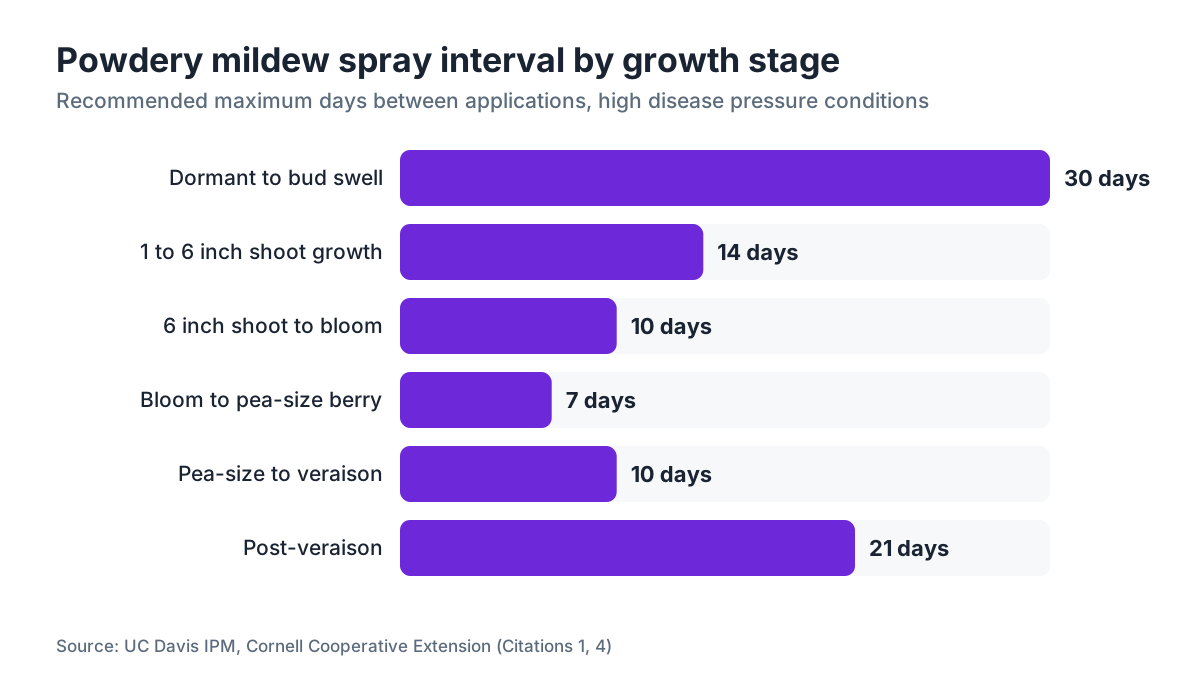
- Timing beats product choice: start at 1-inch shoot growth and hold a 7 to 14 day interval through veraison.
- Miss the bloom-to-pea-size window and you're playing catch-up all season.
What is powdery mildew and why does it hit grapes so hard?
Powdery mildew on grapevines comes from Erysiphe necator (older name: Uncinula necator), a fungus that lives only on living grape tissue. It evolved on wild North American Vitis species, which is why European Vitis vinifera varieties have almost no natural resistance. Your Cabernet has never met this pathogen in its evolutionary history. That's the problem. [1]
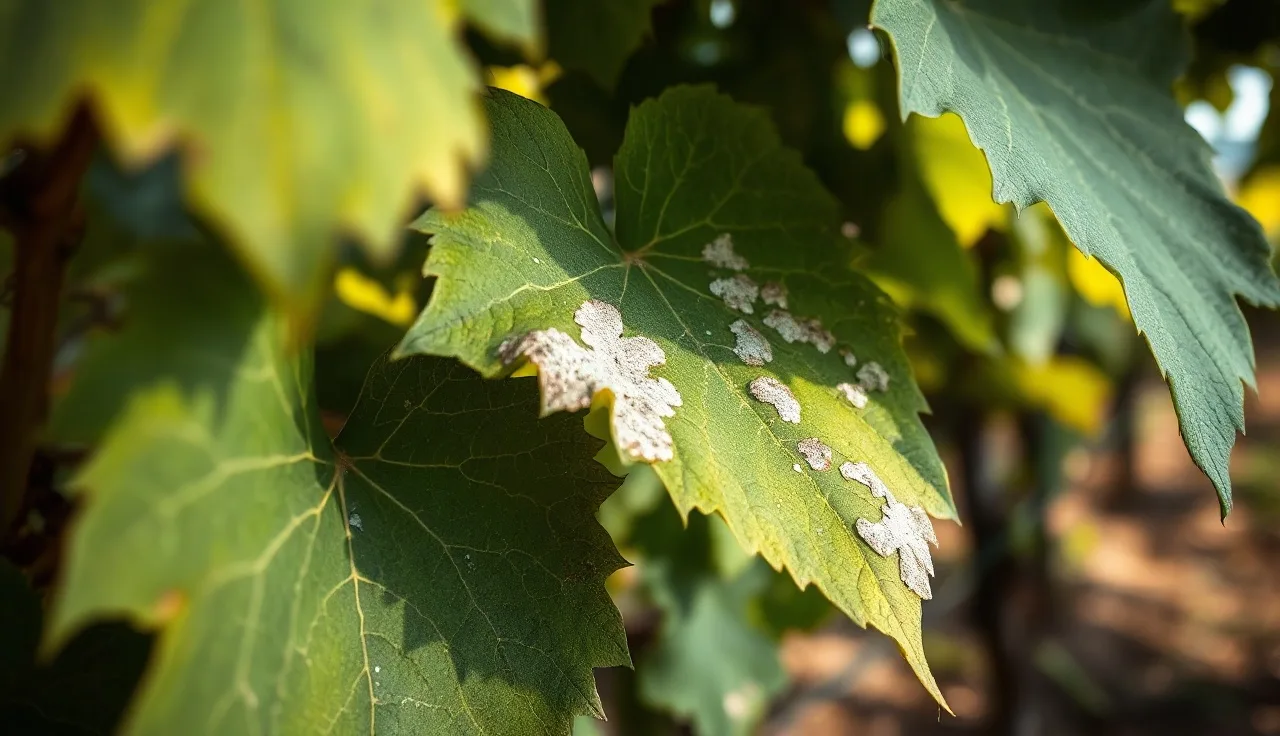
The disease shows up as white or grayish powdery colonies on the tops and bottoms of leaves, on young shoots, and worst of all, on the berries. Infected leaf tissue often yellows or browns under the colony. Early berry infection is the real money-loser: berries infected before they reach about 8 mm in diameter develop a corky, russeted skin that cracks during ripening and opens the door to Botrytis and other rots. [2]
Yield losses swing wide by variety and infection timing, but a severe unmanaged outbreak can cut a crop by 30 percent or more. Wine quality drops even when berries look clean, because the fungus interferes with sugar accumulation and raises the volatile acidity precursors in the juice. [2]
The pathogen overwinters two ways: as mycelium tucked inside dormant buds, and as chasmothecia (closed fruiting bodies) in bark crevices. Come spring, once temperatures hit around 50°F (10°C) and shoots reach an inch, those structures release spores. Here's the part that catches growers off guard. The fungus doesn't need free water to germinate. Relative humidity between 40 and 100 percent is enough, and 70 to 85°F is its sweet spot. A dry spring feels safe and isn't. [1]
When should you start treating powdery mildew on grapevines?
Start at or before 1-inch shoot growth, before you see a single colony. UC Davis and Cornell both draw the line there, and they're right. The most common mistake in mildew management is starting too late. [3]
Waiting until the white colonies appear means the fungus has already run several infection cycles and stacked up a heavy spore load. Now you're chasing it, and you usually won't catch up without spending a lot more on a tighter, more expensive program.
Here's how the timing windows stack up:
| Growth stage | Timing | Risk level | Action |
|---|---|---|---|
| Dormant / bud swell | Before 1" shoot | Low | Apply lime sulfur if heavy overwintering inoculum suspected |
| 1" to 6" shoot growth | April to early May (varies by region) | Moderate | Start regular 7 to 14 day spray schedule |
| 6" shoot to bloom | 4 to 6 weeks before bloom | High | Tighten to 7 to 10 days |
| Bloom to 3 weeks post-bloom | At capfall, through berry set | Very high | Do not skip any sprays |
| Berry pea-size to veraison | 6 to 10 weeks post-bloom | High | Continue program |
| Post-veraison | After color change | Low | Berries become resistant; reduce or stop sprays |
Once berries reach veraison (color change in reds, softening in whites), they build enough sugar and structural change to resist new infection. Taper off then. But the bloom-to-pea-size window is non-negotiable. That's when berries are most vulnerable and the damage is permanent. [3]
In high-pressure regions (Northern California coastal valleys, the Willamette Valley, humid East Coast appellations) there's a real case for a 7 day interval during the hot window instead of 14. The UC Davis Powdery Mildew Risk Assessment model and Cornell's NY Grape Powdery Mildew Risk Index both use temperature accumulation to tell you when to tighten up. [4]
Which fungicides actually work against powdery mildew on grapes?
Sulfur, potassium bicarbonate, DMIs, SDHIs, and strobilurins all control powdery mildew. Rotating among their FRAC (Fungicide Resistance Action Committee) groups isn't optional. E. necator develops resistance faster than almost any fungus you'll deal with, so leaning on one chemistry all season is how you break it. [5]
Here's an honest breakdown:
Sulfur (FRAC M2): The workhorse. Cheap, effective, and no documented resistance in E. necator after decades of use. Wettable or flowable sulfur at 3 to 6 lb per acre (or the liquid equivalent) on a 7 to 14 day interval is still the backbone of most programs. The catch: sulfur burns tissue when temperatures top 95°F (35°C) at application or in the 24 hours after, and Concord and Muscat are more sensitive than most. Never apply sulfur within 2 weeks of a captan spray. [3]
Potassium bicarbonate (Kaligreen, MilStop, others): OMRI-listed and genuinely effective as a contact material. It disrupts fungal cell walls and shifts the leaf surface pH. Most labels carry no pre-harvest interval, and it rotates well with sulfur in organic programs. [6]
DMI fungicides (FRAC 3, sterol biosynthesis inhibitors): Myclobutanil (Rally), tebuconazole, triadimefon, and others. Systemic, with 10 to 14 day residual. Excellent, but resistance is a real problem in some California populations. Rotate them. Don't ride DMIs alone all season. [5]
SDHI fungicides (FRAC 7): Boscalid (Endura), fluopyram (Luna), and combos. Newer and highly effective, but their single-site mode of action carries real resistance risk. Cap SDHI use at 2 applications per season, which is what most labels and resistance guidance recommend. [5]
Strobilurins (FRAC 11, QoI fungicides): Azoxystrobin, trifloxystrobin. They work, but resistance in E. necator is widespread. Use them early, never as a rescue spray. [5]
Quinoxyfen (FRAC 13): Selective for powdery mildews, systemic, good residual. Single-site, so rotate.
Oil products (jojoba oil, mineral oil): Lower efficacy than the rest. Useful in organic programs or as tank-mix partners at low-volume timings only.
A realistic rotation for a high-pressure vinifera block might run: sulfur at 1-inch shoot, DMI at 6-inch shoot, sulfur or potassium bicarbonate pre-bloom, SDHI at bloom, sulfur or DMI at berry set, then sulfur through pea-size, tapering to sulfur or potassium bicarbonate through veraison. That's a starting point, not gospel. Your local extension pathologist should pressure-test it against your region and your varieties.
How do you apply fungicides for powdery mildew correctly?
Coverage is everything. Powdery mildew colonies live on the leaf surface, not inside the tissue, so the fungicide has to physically land where the spores do. A great product applied badly loses to a cheap product applied well. [3]
Spray volume and nozzle choice are the two things most growers get wrong. You need enough water to push coverage deep into the canopy, especially onto leaf undersides. At 50 to 75 gallons per acre with the right nozzles, you'll penetrate a moderate canopy. In a dense, fast-growing July canopy, 75 to 100 gallons isn't unreasonable. A well-calibrated airblast sprayer run at 2 to 3 mph beats a hand gun for contact materials, every time.
Wind matters. Spray below 10 mph, ideally early morning or evening, to cut drift and dodge the heat-plus-sulfur burn risk. Most labels flat-out prohibit application above 15 mph.
Re-read the label every season for systemic materials. Pre-harvest intervals vary a lot. Tebuconazole products often carry a 7-day PHI. Myclobutanil (Rally) varies by formulation. Get this wrong and you've got a compliance mess at harvest. [7]
Wettable sulfur needs constant tank agitation. Sulfur settles fast. Run the agitator the whole time and spray the tank within 2 hours of mixing so the product stays in suspension.
Calibrate every spring. Going from 2.0 to 3.5 mph travel speed cuts your effective application rate by 43 percent at the same nozzle output. That single number explains a lot of "this product stopped working" complaints. The product was fine. The vine got half a dose.
What canopy management practices reduce powdery mildew pressure?
Fungicides won't carry a high-pressure season if your canopy is a jungle. Powdery mildew loves the shaded, humid air trapped inside a dense, unmanaged canopy, and no spray program fully makes up for that. [2]
Fruit-zone leaf removal is the highest-return cultural practice you have. Pull 2 to 4 leaves on the east or morning-sun side of the row at or just after bloom. It opens air movement, gets light to the clusters, and drops the humidity around the fruit. UC Davis research shows fruit-zone leaf removal can cut cluster powdery mildew severity by 40 to 80 percent versus an unmanaged canopy, depending on variety and season. [2]
Shoot positioning and tying keep shoots vertical and separated, which directly improves spray penetration and airflow. A flopped, tangled canopy turns your airblast into a wall of mist that dies before it reaches the interior.
Nitrogen gets overlooked here. Over-fertilized vines keep pushing soft, succulent shoots deep into summer, and that's a steady buffet of vulnerable new tissue for the fungus. Aim for a nitrogen level that lets shoot growth harden off by mid-July in most regions.
Row orientation matters more than people think. North-south rows get more even daily light than east-west rows across most Northern Hemisphere sites, which shrinks the shaded, humid interior E. necator wants. Planting a new block? Weigh this. [1]
On maritime and humid continental sites, aggressive canopy work often lets you stretch the late-season interval from 7 to 10 or 14 days. Over a full season that's real money saved.
How do you manage fungicide resistance in powdery mildew?
Rotate FRAC groups every one to two sprays and never make more than two consecutive applications of the same mode of action. E. necator develops resistance to single-site fungicides faster than most plant pathogens, thanks to its rapid reproduction and huge populations on a block. DMI (FRAC 3) resistance turned up in California in the 1980s. Strobilurin resistance followed in the 2000s. [5]
The FRAC guidelines, maintained by CropLife International, put it plainly: "To delay resistance development, it is recommended not to apply fungicides with the same mode of action for more than two consecutive applications." [5] Rotating two products back and forth isn't enough. You need real diversity in the program.
In practice, that means 3 or 4 FRAC groups across the season. Sulfur plus one DMI plus one SDHI works. Rally and Quintec all season selects hard for resistance, and you'll pay for it eventually.
When a DMI or strobilurin isn't holding the way it should, switch straight to a multi-site material (sulfur, potassium bicarbonate) and call your extension plant pathologist or certified crop advisor. Some labs test field isolates for resistance, but that takes 2 to 4 weeks and rarely helps you mid-season.
Accurate spray records (FRAC group, date, rate) are where a field records tool pays off. VitiScribe's spray log pulls FRAC group and PHI straight from the product database, so an end-of-season rotation audit takes under 10 minutes instead of a Saturday.
What are the EPA worker protection requirements for powdery mildew sprays?
The EPA Worker Protection Standard (WPS), 40 CFR Part 170, covers essentially every fungicide you'll spray in a commercial vineyard. It sets restricted-entry intervals, PPE, posting, training, and emergency-care rules. You have to know it. [7]
Here are the WPS pieces that touch a powdery mildew program directly:
Restricted-Entry Intervals (REI): Each label sets an REI, the window after application when nobody enters the treated area without PPE. Sulfur usually runs a 24-hour REI. Many DMIs run 24 hours. Some SDHIs are 12. Check the label. REIs change by formulation even for the same active ingredient.
Personal Protective Equipment (PPE): Applicators wear whatever the label lists. Most sulfur applications call for a long-sleeved shirt, long pants, chemical-resistant gloves, and protective eyewear. Some systemic fungicides require a dust/mist respirator. Luna Sensation and similar products typically specify a NIOSH-approved particulate respirator (N-95 or higher).
Central posting: The WPS requires application information posted at a central location within 24 hours and kept up for 30 days or until the REI expires, whichever is later.
Training: Under the 2015 revised WPS (effective January 2017), every agricultural worker and handler gets WPS safety training before working in treated areas, and training records are kept for 2 years. [7]
Emergency medical assistance: Handlers need access to emergency care, a decontamination site, and emergency contact information during applications.
Washington growers carry extra obligations under WAC 296-307, which in places goes beyond the federal WPS. California layers its own Department of Pesticide Regulation reporting to the County Agricultural Commissioner on top of the federal rules. [9]
What's the difference between organic and conventional powdery mildew programs?
A well-run organic program can match conventional control, but it demands tighter intervals and forgives almost nothing. Miss a spray in a warm week and you'll spend the rest of the season paying it back. That's the honest tradeoff. [6]
Certified organic materials for grape powdery mildew include:
- Sulfur (wettable, dust, or liquid, OMRI-listed)
- Potassium bicarbonate (Kaligreen, MilStop, others)
- Copper materials (copper hydroxide, copper sulfate), mainly for other diseases but with some powdery mildew activity
- Neem oil and neem-based products (variable efficacy, useful as rotational tools)
- Jojoba oil
- Bacillus subtilis biofungicides (Serenade, Double Nickel), low but real efficacy inside a layered program
The big limitation is the lack of systemic activity. Sulfur and potassium bicarbonate are contact materials with short residuals, often 7 days or less in warm, dry weather. So the interval has to be 7 days during the critical window, no exceptions. Slip 3 or 4 days in a warm late May and you can trigger an outbreak that dogs you until harvest.
WSU's organic grape production guide recommends sulfur at 3 to 4 lb per 100 gallons as the foundation, rotated with potassium bicarbonate, and intervals no longer than 10 days through bloom and pea-size. [10]
One trap: not every OMRI-listed sulfur product is cleared by every certifier. Check with yours before adding anything new. Some biofungicides carry inert ingredients that need review first.
How do you know if your treatment is working?
You scout. You can't manage what you don't measure, and powdery mildew hides early. Walk the block at least weekly from 1-inch shoot growth through veraison. [4]
A basic protocol: at each stop, examine 5 to 10 shoots at eye level, checking both leaf surfaces, the shoots, and all clusters. Record the percentage of leaves, shoots, and clusters showing symptoms. Cornell's IPM program uses a 5 to 10 percent leaf-infection threshold as the trigger to rethink your timing or product choice. [4]
Trap leaves are a sharper early-warning tool. Place freshly unfolded grape leaves in known hot spots, leave them 5 to 7 days, then check them under magnification for colonies. That buys you 7 to 10 days of warning before symptoms show up in the canopy.
If you're finding new infections on treated leaves within 5 to 7 days of a sulfur spray, on days that never topped 90°F, at the correct rate, work the checklist before blaming the product. Coverage is the usual culprit. Timing (sprayed too late) is second. Resistance is third, and only if the material was a DMI or strobilurin.
Photograph and log what you find: date, location in the block, which rows, a severity estimate. Those records earn their keep when you're comparing pressure year over year or figuring out why one block always runs hotter than the rest.
How do you treat a severe powdery mildew outbreak mid-season?
There's no silver bullet, and anyone selling one is lying. A severe outbreak (30 to 50 percent or more of clusters showing colonies at pea-size) is a serious problem with limited rescue options. Here's what actually helps. [2]
Switch to the most effective chemistry you haven't overused. If you've been running mostly sulfur, adding a DMI now can slow the outbreak, assuming resistance isn't already established. If you've been rotating well and it still blew up, this is almost always a coverage or timing failure, not the product's fault.
Tighten the interval to 5 to 7 days. Yes, it costs money. A severe mid-season outbreak costs more in lost fruit.
Pull fruit-zone leaves aggressively if you haven't already. It opens circulation and drops humidity around the clusters fast. Don't strip a heat-stressed vine all at once during a heat wave. Take the morning-sun side first.
Accept the loss on badly infected clusters. Infected fruit makes lower-quality wine and can drag Botrytis or volatile acidity into the tank. Talk to your winemaker before harvest and plan to sort harder.
After the season, take stock. Your block's disease history is your best planning tool. A block that blew up this year needs your most aggressive early program next year: tighter early intervals and possibly a dormant lime-sulfur application to knock down overwintering inoculum.
Across multiple blocks with different histories, a structured spray log (a spreadsheet, or something like VitiScribe) is what lets you compare block-by-block performance and adjust inputs on evidence instead of running the same program everywhere and hoping.
What do variety resistance ratings tell you about mildew risk?
They tell you how hard to push your program, not whether you can skip it. Vitis vinifera varieties run from moderately susceptible to extremely susceptible, and there are no commercially significant fully resistant vinifera varieties. Every wine grape needs a program. [1]
A general hierarchy, most susceptible to least:
Highly susceptible: Cabernet Sauvignon, Chardonnay, Zinfandel, Pinot Noir, Gewurztraminer, Riesling, Semillon. These need your most aggressive early-season program.
Moderately susceptible: Sauvignon Blanc, Merlot, Syrah, Sangiovese. Full program still required, but they tolerate slightly longer intervals in low-pressure years.
Lower susceptibility (vinifera): Grenache, Mourvedre. Still a full program.
Interspecific hybrids: Many USDA and Cornell-bred varieties (Marquette, Crimson Cabernet, Traminette) carry resistance from American Vitis species. Some can be managed with a reduced program. Cornell's variety resistance database has the specific ratings. [4]
Variety selection is your cheapest, longest-lasting disease tool. If you're in a high-pressure region and looking at a replant or a new block, put real weight on the resistance profile of the candidates. A 20 percent cut in fungicide applications across the life of a block is a genuine cost and compliance win.
Susceptibility also interacts with canopy density. A moderately susceptible variety in a dense, shaded canopy can run hotter than a highly susceptible variety in an open, well-managed one. The fungus reads the microclimate, not the rating sheet.
Frequently asked questions
Can powdery mildew on grapes be treated with baking soda?
Household baking soda (sodium bicarbonate) can briefly suppress powdery mildew by raising leaf-surface pH, but it isn't a registered pesticide for commercial use and burns tissue at higher concentrations. The commercial cousin, potassium bicarbonate, is OMRI-listed, works better, and carries a legal pesticide label with directions for use. That's what belongs in a real spray program, not the box from your kitchen.
How often should you spray for powdery mildew on grapevines?
During the critical window from bloom through berry pea-size, spray on a 7 to 10 day interval. Before bloom, 10 to 14 days usually covers moderate pressure. After veraison you can cut frequency sharply or stop, because berries resist new infection. Tighten any time infection develops faster than expected, temperatures hold in the 70 to 85°F optimal range for several days, or you miss a scheduled spray.
Does powdery mildew affect wine quality even if I can't see it on the berries?
Yes. Research has found that even subclinical infections, where berries show no obvious white colonies, can raise levels of 1-octen-3-ol, geraniol, and certain off-aroma compounds in the wine. A UC Davis study found detectable sensory differences in wines from fruit with as little as 3 percent cluster infection. Winemakers tend to note quality impacts consistently around the 5 to 10 percent cluster infection level.
What is the pre-harvest interval for sulfur on grapes?
Most wettable and flowable sulfur labels carry a 0-day pre-harvest interval on grapes, so you can legally apply up to harvest day. That's a practical advantage in late-season programs. But heavy sulfur residue can hurt fermentation by inhibiting yeast and producing hydrogen sulfide in the wine. Stop sulfur 30 to 45 days before harvest if you can, and settle the timing with your winemaker.
Is powdery mildew on grapes the same as downy mildew?
No. Powdery mildew is Erysiphe necator, a fungus that needs no free water to germinate and makes white powdery colonies on leaf and berry surfaces. Downy mildew is Plasmopara viticola, an oomycete that requires free water and makes yellow oily spots on the upper leaf with white sporulation underneath. They need different fungicide classes and different weather to spread, so identify which one you have before you spray.
What household remedy or spray can I use for powdery mildew on vines?
For a home gardener with a few vines, a 1 percent solution of potassium bicarbonate in water is practical and close to a commercial product. Neem oil at 1 to 2 percent with an emulsifier can help too. For any commercial planting, you must use a registered pesticide with a legal label and follow every application requirement. Using unregistered materials on a commercial block violates FIFRA no matter how well it works.
Can I spray copper fungicide for powdery mildew on grapes?
Copper mainly controls downy mildew and bacterial diseases, not powdery mildew. It has limited activity against Erysiphe necator, so don't count on it as a powdery mildew treatment. Organic growers sometimes keep copper in the rotation because it handles downy mildew at the same time, but for powdery mildew specifically, sulfur and potassium bicarbonate are your effective organic options.
What temperature kills powdery mildew spores on grapevines?
Erysiphe necator conidia die at roughly 95 to 100°F (35 to 38°C) when held there for several hours. Hot, dry summers with long stretches above 95°F suppress the disease on their own, which is one reason some interior California appellations run lower pressure than the coast. But the fungus survives in the cooler, shaded canopy interior, so don't let a hot forecast talk you out of a spray.
How do you treat powdery mildew on young grapevine leaves in a new planting?
Young vines are arguably more vulnerable. They have no crop to lose, but a severe outbreak can set back canopy development for the season. Start sulfur or potassium bicarbonate at 1-inch shoot growth and hold a 7 to 10 day interval through mid-summer. A small canopy makes good coverage easy, so don't skip sprays because the block looks clean. Good year-one habits set up a healthier block long-term.
Do I need to rotate fungicides if I'm only using sulfur?
No documented resistance to sulfur exists in Erysiphe necator populations, so a sulfur-only program doesn't build resistance pressure the way single-site fungicides do. That said, sulfur alone may fall short during very high pressure or on extremely susceptible varieties. Rotating in potassium bicarbonate or a systemic material during the bloom window gives you better control. The reason is efficacy, not resistance management, in a sulfur-only program.
How do I record powdery mildew spray applications to stay compliant?
Federal law (FIFRA and the EPA Worker Protection Standard) requires pesticide records that include the date, product name and EPA registration number, amount applied, target pest, and location. Most states require you keep them for 2 years, and some, including California, require reporting to the County Agricultural Commissioner. The records also have to support WPS central posting. Keep them in a format you can search and hand over fast when an inspector shows up.
What's the best fungicide for powdery mildew on grapes according to research?
UC Davis and Cornell trials consistently show DMI fungicides (myclobutanil, tebuconazole) and SDHI fungicides (boscalid, fluopyram) give the highest efficacy per application. Resistance risk means neither should run alone all season. Sulfur stays the most economical backbone of any program, and a well-timed sulfur plus DMI rotation often beats pricier programs in real vineyard trials when application timing is dialed in.
Can powdery mildew overwinter in grapevine buds and what does that mean for spring management?
Yes. Erysiphe necator overwinters as chasmothecia in bark crevices and as mycelium inside dormant buds. Flag shoots, the stunted, distorted shoots you see in early spring, are the visible sign of bud overwintering. If you spot flag shoots at 1 to 2 inch shoot growth, your inoculum is high and your program starts now. Some growers apply lime-sulfur at delayed dormant to knock down overwintering chasmothecia.
Sources
- UC Davis Division of Agriculture and Natural Resources, Grape Powdery Mildew Pest Management Guidelines: Erysiphe necator biology, overwintering in buds and bark, temperature thresholds for spore germination, and varietal susceptibility differences in Vitis vinifera
- UC Davis Department of Viticulture and Enology, Powdery Mildew Impact on Yield and Wine Quality: Yield losses up to 30% or more from severe outbreaks; sensory impacts on wine from subclinical cluster infections; leaf removal reducing cluster powdery mildew severity by 40-80%
- UC Cooperative Extension, Powdery Mildew Management in Winegrapes: Timing recommendation to begin spray program at 1-inch shoot growth; sulfur application rates 3-6 lb per acre; phytotoxicity risk above 95°F; 2-week interval restriction between sulfur and captan
- Cornell University New York State IPM Program, Grape Powdery Mildew Risk Index and IPM Guidelines: NY Grape Powdery Mildew Risk Index using temperature accumulation; 5-10% leaf infection scouting threshold; interspecific hybrid variety resistance ratings
- FRAC (Fungicide Resistance Action Committee), Code List and Resistance Management Recommendations: FRAC rotation guidelines: no more than two consecutive applications of the same mode of action; documented DMI resistance in California populations; strobilurin resistance in E. necator
- USDA Agricultural Marketing Service, National Organic Program: OMRI-listed status of sulfur, potassium bicarbonate, and neem oil for use in certified organic grape production
- EPA Worker Protection Standard, 40 CFR Part 170: REI requirements, PPE requirements for handlers, central posting requirements, training record retention for 2 years under the 2015 revised WPS
- Washington State Legislature, WAC 296-307 Safety Standards for Agriculture: Washington State agricultural worker protection requirements that in some respects exceed the federal WPS
- California Department of Pesticide Regulation, Pesticide Use Reporting: California CDPR requirement for pesticide use reporting to County Agricultural Commissioner for commercial agricultural operations
- UC Davis Department of Viticulture and Enology, Powdery Mildew Wine Quality research: Detectable sensory differences in wines made from fruit with as little as 3% cluster infection; consistent winemaker-detected impacts at 5-10% cluster infection level
- EPA, About Pesticide Registration (FIFRA): FIFRA requirement that all pesticide applications on commercial crops use a registered product with a legal label
Last updated 2026-07-09