How to kill powdery mildew on grapes: a complete field guide
TL;DR
- Powdery mildew (Erysiphe necator) dies fastest under sulfur, SDHI fungicides, or potassium bicarbonate applied at or just after the first sign of infection.
- Timing beats product choice.
- Spray at 7 to 10 day intervals during high-risk stretches (60 to 90°F, any humidity) and rotate modes of action so resistance never gets a foothold.
- Protect from budbreak through 6 to 8 weeks after.
- That window is non-negotiable.
What is powdery mildew on grapes and why does it spread so fast?
Powdery mildew on grapevines is caused by Erysiphe necator (formerly Uncinula necator), an obligate fungal parasite that lives only on living plant tissue. It doesn't need free water to germinate. That's what separates it from downy mildew, and it's why a dry, warm summer gives you no cover at all. Spores germinate and infect across roughly 50 to 95°F, with the sweet spot between 70 and 85°F. [1]
The fungus overwinters in dormant buds as chasmothecia (the sexual fruiting bodies) or as mycelium. Once spring temperatures climb past 50°F, spores release and the first infection cycle starts. A single infected cluster can throw off millions of conidia. Left alone, those conidia cycle every 5 to 7 days, so a light dusting on two shoots in week one turns into whole-vine contamination by week three.
Under ideal conditions, nights near 65°F and daytime highs around 80°F, UC Davis researchers found colonies can double in under a week. [1] That's the biology that makes the "I'll spray when I see it" plan so consistently painful.
Some varieties are far more susceptible than others. Chardonnay, Cabernet Sauvignon, Merlot, and Zinfandel all sit in the high-risk camp. Table grapes are often worse. Native American species like Vitis labrusca carry some natural resistance. Vitis vinifera has essentially none.
How do you identify powdery mildew vs. other grape diseases?
The classic sign is a white to gray powdery coating on the surface of leaves, shoots, and berries. It sits on top of the tissue instead of inside it, which is the fastest way to separate it from most other grape diseases. Infected leaves may curl upward. Infected berries early in the season develop a russeting or net-like scarring on the skin as they expand, because the mycelium colonizes the berry surface before fruit set and restricts skin elasticity. [2]
On young shoot tips, you'll often see a distorted or stunted look before any white powder shows. That's an easy early warning to miss when you're moving fast through rows.
Here's how to tell it apart from the common look-alikes:
| Symptom | Powdery mildew | Downy mildew | Spray residue |
|---|---|---|---|
| Powder location | Upper leaf surface | Lower leaf surface | Both surfaces |
| Color | White/gray | White (oily) | White/yellow/gray |
| Needs wet conditions | No | Yes | N/A |
| Berry symptoms | Russeting, cracking | Leathery rot | None typically |
| Rubs off easily | Partially | Yes | Usually yes |
A quick field test: rub the coating. Powdery mildew smears and leaves a faint green-gray residue with a mushroom smell. Spray residue crumbles or flakes off clean.
When should you spray to stop powdery mildew from getting established?
The window that works is before you see disease, not after. Cornell's IPM program is blunt about it: "Begin applications at or just before budbreak in high-risk situations, and no later than 1-inch shoot growth in moderate-risk blocks." [3] That call rests on decades of New York trial data showing early-season infections set the fungal baseline for the whole year.
The critical period for berry infection runs from just before bloom through four to six weeks after fruit set. Berries lose susceptibility once the skin lignifies, roughly at pea-size. Shoot tips and leaves stay open to infection all season, but berry infection is the economic killer. A heavily colonized cluster carries live spores into the winery and can destabilize fermentation. [1]
The spray calendar most managers run looks like this:
- Budbreak to 6-inch shoot: first protective application
- Pre-bloom (10% cap fall): second application, tighten interval to 7 to 10 days
- Bloom through fruit set: hold a 7-day interval if conditions favor disease
- Pea-size through veraison: 10 to 14 day interval, start rotating to save key modes of action for late season
- Post-veraison: extend intervals, consider sulfur only if pressure is high
WSU Extension adds a trigger that overrides the calendar. Once the Gubler-Thomas powdery mildew risk index accumulates enough degree-days (base 50°F) between the first and last events above 70°F in a season, treat regardless of what the calendar says. [4]
What products actually kill active powdery mildew infections?
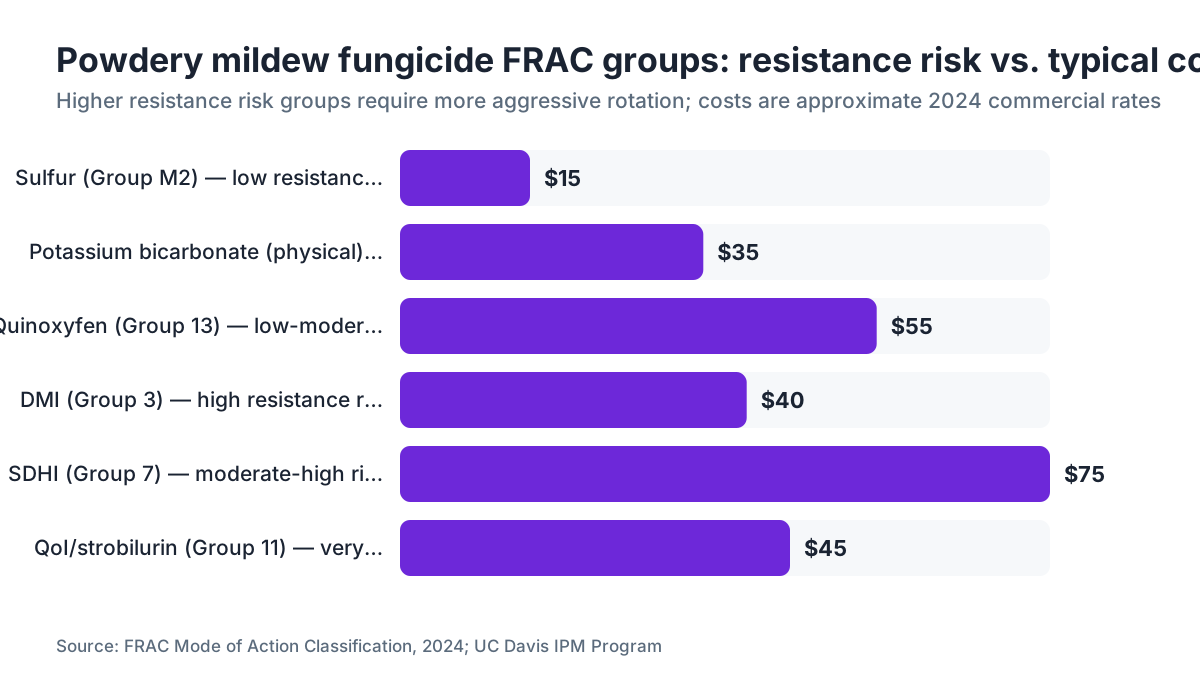
Sulfur is still the backbone. It's cheap (roughly $10 to 20 per acre per application for wettable sulfur), it works, and it has no known resistance issues because it kills through non-specific oxidative damage. [5] Elemental sulfur disrupts fungal respiration at the cellular level. It works both protectively and curatively within the first 24 to 48 hours after an infection event. The caveats matter: don't apply within 14 days of any oil spray (phytotoxicity), don't spray above 90°F (also phytotoxicity), and remember that some varieties (Concord, some Muscadines) are sulfur-sensitive even at moderate temperatures.
For active, visible infections you want curative (kickback) activity. The strongest curative fungicides growers can buy are these.
SDHI fungicides (Group 7, succinate dehydrogenase inhibitors): products like Aprovia (benzovindiflupyr) and Luna Sensation have protective plus strong curative activity up to 72 hours post-infection. Resistance risk is moderate-high. Rotate away after two consecutive applications.
DMI fungicides (Group 3, demethylation inhibitors): Rally (myclobutanil), Mettle (tetraconazole), Elite (tebuconazole). These are systemic and move upward in the canopy. Rally was the workhorse of the 1990s and 2000s, and resistance is now widespread across many California and Pacific Northwest populations. [6] Use at label rates, and don't lean on them as your primary tool if you've had failures.
Quinoxyfen (Group 13): Quintec. Strong protective and curative activity, no cross-resistance with DMIs. Most labels cap it at two applications per season.
FRAC Group 19 (polyoxin D): Fracture. Lower resistance risk, useful in organic programs.
Potassium bicarbonate: Kaligreen, MilStop. Raises surface pH and kills surface mycelium on contact. No systemic activity. Good knockdown when you catch infections early, essentially zero resistance risk, approved for organic use. Runs roughly $25 to 45 per acre per application.
A realistic rotation for a conventional operation under heavy pressure:
- Sulfur (Group M2), budbreak
- DMI (Group 3), pre-bloom
- SDHI + QoI premix (Groups 7+11), bloom
- Quinoxyfen (Group 13), 2 weeks post-fruit set
- Sulfur, mid-season
- SDHI (Group 7), if late-season pressure resumes
Always check the label for pre-harvest intervals (PHIs). Rally has a 7-day PHI, Quintec is 14 days, Luna Sensation is 3 days. Miss a PHI and you've got both a safety and a legal problem.
What are the best organic or low-residue options for killing powdery mildew?
Organic growers have a real toolkit. It just demands tighter intervals and better scouting. Sulfur is OMRI-listed and the most effective organic option by a wide margin. At 3 to 4 lb/acre of wettable sulfur every 7 to 10 days through high-risk windows, it holds its own against conventional programs in most trial data. [5]
Potassium bicarbonate (Kaligreen, MilStop) is the best knockdown tool for active infections in organic programs. It disrupts and desiccates surface mycelium. Pair it with a light oil where timing allows for better coverage.
Neem oil (azadirachtin, Group UN) has some activity, but the data is thin, especially on berries. Treat it as a tank-mix partner, not a solo treatment. Watch the emulsifiers. Wrong combinations cause phytotoxicity.
Microbial products built on Bacillus subtilis (Serenade) or Bacillus amyloliquefaciens (Sonata) are OMRI-listed and can fill a rotation slot, but Cornell's trials consistently put them below sulfur and potassium bicarbonate as standalone treatments. [3] They earn their keep as resistance management tools or late-season sprays when you're close to harvest and juggling intervals.
Jojoba oil (Prev-Am) is registered in some states with good contact activity. State registration varies, so check your state's pesticide database before you buy.
Organic record-keeping needs clean traceability of every input: product, rate, date, field block, and applicator. A log that satisfies your certifier is the same log that satisfies you. VitiScribe's spray record module formats to the USDA National Organic Program documentation standard, which saves time at audit.
How do you manage fungicide resistance to keep your sprays working?
Resistance to DMI fungicides is the best-documented failure mode in commercial vineyards. A 2013 study led by W.D. Gubler at UC Davis found strains of E. necator with reduced sensitivity to myclobutanil in nearly every California wine region tested. [6] If Rally quit working for you sometime in the last decade, that's almost certainly the reason.
The FRAC (Fungicide Resistance Action Committee) group system is the most practical tool you have. The rule is simple: never apply two consecutive sprays from the same FRAC group without an intervening spray from a different group (or a multi-site contact fungicide like sulfur). Most labels print the FRAC code somewhere in the Resistance Management section.
High-risk FRAC groups (rotate away after 1 to 2 sprays):
- Group 3 (DMIs): Rally, Mettle, Elite
- Group 7 (SDHIs): Aprovia, Luna products
- Group 11 (QoIs/strobilurins): Abound, Pristine. QoI resistance is also widespread in E. necator, and many resistance advisors recommend retiring strobilurins from your mildew program entirely unless they're in a premix with a different mode of action.
Low-resistance-risk anchors:
- Group M2 (sulfur): multi-site, essentially no resistance risk
- Group M (copper): multi-site
- Group 13 (quinoxyfen): single-site but distinct target, no cross-resistance
- Potassium bicarbonate: physical mode, no resistance
WSU Extension's powdery mildew guide treats sulfur as the backbone of every program and builds the rest of the rotation around it, rather than saving sulfur as a fallback. That's the practical read from 20-plus years of resistance surveillance. [4]
How do application method and canopy management affect powdery mildew control?
The best product applied poorly will let you down. Powdery mildew lives on the surface of plant tissue, so coverage is everything. Fungus on the underside of a leaf survives a droplet that lands on top of the adjacent shoot.
Air-blast sprayers deliver more volume and better penetration than handheld or backpack rigs. Calibrate for 50 to 100 gallons per acre in a conventional canopy. Dense or trellised VSP (vertical shoot positioning) canopies need higher volume or slower travel, and 4 to 6 mph is typical for solid coverage. Many growers push 60 to 80 GPA in high-pressure years.
Leaf removal in the fruit zone cuts powdery mildew pressure on clusters directly. Opening the canopy improves spray penetration, air movement, and light. UC Davis field work found leaf removal at fruit set dropped cluster infection rates by 30 to 60% compared to no removal, depending on variety and site. [2] You still spray, but now you're spraying a target you can actually reach.
Timing applications to early morning or evening lowers the risk of sulfur phytotoxicity and helps the deposit stay on tissue longer before temperature-driven volatilization. In the hottest weeks, night applications of sulfur are worth the logistical hassle.
A vineyard with multiple blocks and staggered maturities needs a spray log that shows which blocks got what, when, and with what equipment. That isn't paperwork for its own sake. It's how you find the block with a coverage failure, and why, when you're taking apart an August outbreak.
What does the EPA Worker Protection Standard require when spraying fungicides?
The EPA Worker Protection Standard (WPS), revised in 2015 and codified at 40 CFR Part 170, sets minimum requirements for pesticide handling, notification, and re-entry. [7] For vineyard managers, the parts that bite are these.
Restricted Entry Intervals (REIs): The label governs. Sulfur typically carries a 24-hour REI. DMIs like myclobutanil (Rally) run a 24-hour REI. Quintec is 12 hours. You cannot send workers into treated blocks until the REI expires.
Hazard communication: You must display application information (product name, EPA registration number, active ingredient, location treated, application date and time, REI) at a central location for at least 30 days after each application.
Personal protective equipment (PPE): The label sets required PPE for handlers. Chemical-resistant gloves, long-sleeved shirts, and eye protection are standard minimums for most fungicide applications.
Training: All agricultural workers and pesticide handlers must complete WPS safety training before working in treated areas. Keep the training records.
Access to medical information: Workers must have access to the Safety Data Sheet (SDS) for any product used on the operation.
The EPA's WPS guidance states that agricultural employers "must provide specific information about each pesticide application to workers and handlers." [7] Enforcement runs through your state department of agriculture, and penalties can reach thousands of dollars per violation.
For records, capture: product name, EPA registration number, active ingredient, crop treated, field or block ID, date applied, start and end time, application rate, total amount applied, applicator name, REI, and weather at time of application. Most states require pesticide records for at least 2 years. California requires 3 years for restricted-use pesticides under CDFA regulations. [8]
How do you track spray records and stay compliant with state requirements?
Spray record compliance is where good field work either pays off or turns into liability. Every state has its own pesticide recordkeeping law, and they don't match. California's is the most detailed. It requires records filed with the county agricultural commissioner within 7 days of a restricted-use application, with 18 specific data fields. [8]
Other major wine states set their own terms:
- Oregon: records within 6 days of application, retain for 2 years (OAR 603-057-0400)
- Washington: retain for 2 years, certain applications require state reporting under WAC 16-228
- New York: retain for 3 years under ECL Section 33-1205
The practical answer for most operations is a standardized digital spray log. Paper is legal, but it makes audit responses slow and error-prone. A system where you enter the product once and it auto-fills REI, PHI, and the required data fields pays for itself the first time it saves you from a penalty or a failed third-party audit.
VitiScribe is built for vineyard operations and generates spray records formatted to state requirements, which matters if you're running multiple blocks with different programs. The larger point holds no matter what tool you pick: you need one. Reconstructing records from memory after the fact will not hold up.
For paso robles wineries and other California operations in high-pressure regions, your PCA (Pest Control Adviser) must sign off on restricted-use pesticide applications. That's a legal requirement under the California Food and Agricultural Code, not a nicety.
What happens if you don't treat powdery mildew and how bad can losses get?
Untreated powdery mildew in a susceptible variety during a favorable year can destroy 30 to 50% of a crop. [9] That's not a worst case. The extension literature describes it as typical for severe outbreaks in Vitis vinifera. In exceptional years, total crop loss in unprotected blocks is documented.
The damage runs through several channels. Berry infection before fruit set causes the skin scarring and cracking already described. Cracked berries invite Botrytis cinerea, which finishes the job. Even berries that stay physically intact but colonized carry fungal spores into the winery, where they can interfere with yeast populations and produce off-flavors that are nearly impossible to fix in the cellar.
Heavily infected shoots and leaves early in the season come out weakened. Severely colonized shoots may fail to lignify properly, which leaves them open to winter cold damage. That's a two-season problem.
The economic math is not subtle. Growing premium wine grapes at $2,000 to 4,000 per ton, lose even 0.5 tons per acre across a 20-acre block and you're out $20,000 to 40,000 in revenue. A full-season powdery mildew program runs roughly $150 to 400 per acre in materials for a conventional program, or $200 to 500 for organic (sulfur is cheap, the extra application frequency is the cost). The return on a proper spray program is easy to see.
Are there grape varieties that resist powdery mildew naturally?
Yes, though "resist" is a relative word. No widely grown commercial wine grape is immune. Resistance breeding has run for decades, and several USDA and Cornell hybrids carry meaningful quantitative resistance to E. necator. Marquette, Frontenac, Traminette, and other University of Minnesota and Cornell releases show substantially lower susceptibility than standard Vitis vinifera. [10]
The mechanism usually traces to Rpv or Run (resistance to Uncinula necator) loci pulled from wild Vitis species. Cornell and USDA-ARS released these interspecific hybrids specifically for disease resistance in tough climates. They aren't zero-spray options, but many growers in humid eastern climates report dropping from 12 to 15 sprays per season to 3 to 5 on resistant varieties. [10]
For established vinifera blocks you can't swap out, rootstock won't help with powdery mildew (unlike phylloxera). Varietal conversion is a 5-year commitment. The realistic short-term move for susceptible blocks is tighter spray timing paired with canopy management.
Nobody has clean commercial data on exactly how much spray cost resistant varieties save in every climate. The closest systematic data comes from the USDA-ARS grape genetics research program and Cornell's breeding trials in Geneva, NY. [10]
What are the best scouting practices to catch powdery mildew early?
Scouting is the difference between a 7-day and a 14-day interval. Know where pressure is building and you tighten up. Know a block is clean and you can stretch.
The UC Davis IPM program recommends checking 10 shoots per block (from the middle of the canopy) from budbreak through pea-size, recording percent infected shoots and severity on those shoots. [1] That data drives the call on whether to tighten intervals or reach for a curative product.
Look for early symptoms on shoot tips first. They're the most susceptible tissue and show infection soonest. In dense plantings, check the undersides of leaves at the top of the canopy, where humidity holds longest.
Degree-day models predict infection periods without constant scouting. The Gubler-Thomas model, developed at UC Davis, uses temperature data to build a mildew index. High index values flag conditions favorable for infection. Weather station networks in wine regions (PestWatch in California, NEWA in the Northeast) run the model in real time and send alerts. [4] A model lets you time sprays to actual risk instead of the calendar.
Keep a written scouting log: date, block ID, number of shoots checked, percent infected, and notes on symptom type and severity. That log is the foundation of your spray decision record, and it's worth having in any third-party audit.
Frequently asked questions
Can powdery mildew kill a grapevine outright?
Rarely. Powdery mildew almost never kills a mature vine directly. What it does is weaken shoot growth, destroy the current year's crop, cut carbohydrate storage for winter, and in severe cases hurt the next year's bud fruitfulness. Young vines in their first or second leaf are more vulnerable, and heavy early-season infection can stunt them badly. But vines usually survive. Growers lose money, not the plant.
How long after spraying sulfur is it safe to reenter the vineyard?
Most wettable sulfur products carry a 24-hour restricted entry interval (REI) under the EPA Worker Protection Standard. Always read the specific product label, since some formulations differ. You also cannot apply sulfur within 14 days of an oil spray (and vice versa) because of phytotoxicity risk. If temperatures exceed 90°F, delay the sulfur application to avoid burning foliage, regardless of REI.
What temperature kills powdery mildew spores on grapes?
Temperatures above 95°F for extended periods inhibit spore germination and can kill surface mycelium. This is not a reliable control strategy. California's hot summer afternoons don't stop powdery mildew because nights and mornings stay in the optimal range. Temperatures below 50°F slow the disease significantly. There's no field-practical heat treatment for established infections. Fungicide application is the only dependable kill mechanism.
Is baking soda a real treatment for powdery mildew on grapes?
Sodium bicarbonate (baking soda) raises leaf surface pH and can kill surface mycelium on contact, similar to potassium bicarbonate. It works as a contact knockdown. The catch is sodium buildup in soil with repeated use, and it has no systemic or protective activity. Potassium bicarbonate products like MilStop are the commercial equivalent, better formulated and without the sodium issue. Baking soda is a garden trick, not a vineyard solution.
How do I know if my fungicide program stopped working due to resistance?
Signs of resistance: you're applying a product at the labeled rate, on time, with good coverage, and infection keeps advancing. A pattern where one FRAC group consistently underperforms while others still work is the clearest signal. UC Davis found widespread reduced sensitivity to DMI fungicides (Group 3) in California E. necator populations. If you suspect resistance, contact your local farm advisor or PCA and consider a rotation built around sulfur plus Group 13 (quinoxyfen).
Can I spray sulfur the same week I spray oil?
No. Applying sulfur within 14 days before or after an oil spray causes severe phytotoxicity. Sulfur and oil react to produce sulfur dioxide, which burns foliage and can defoliate vines. This is one of the most common timing errors in spray programs. Hold a strict 14-day separation. If you're using a neem oil or jojoba oil product, the same rule applies.
What spray interval do I need during bloom to stop powdery mildew?
During bloom and the two to three weeks after fruit set, the industry standard is a 7-day interval under moderate to high pressure. This is the single highest-risk period for berry infection, since berries are most susceptible before their skins harden. Cornell and UC Davis both recommend not stretching past 10 days during this window regardless of conditions. After pea-size, you can usually return to 10 to 14 day intervals.
Does rain wash off powdery mildew fungicides?
Sulfur and most contact fungicides partially wash off with significant rainfall (0.5 inches or more). Systemic fungicides like DMIs and SDHIs are absorbed into plant tissue and don't wash off once dried and absorbed, typically within a few hours of application. If you get rain within 2 to 4 hours of a sulfur application, plan to re-spray. Systemic products applied the day before rain are generally still effective.
How many powdery mildew sprays does a season typically require?
In the Pacific Northwest and Northern California, 8 to 12 applications per season is typical for susceptible varieties in moderate-pressure years. In wet or warm seasons, 15-plus applications is not unusual for high-pressure blocks. Organic programs using sulfur alone often need 12 to 18 applications because sulfur intervals must be tighter. Eastern wine regions like New York and Virginia, with humid summers, generally run higher spray counts than drier western regions.
What records do I legally need to keep for powdery mildew spray applications?
Federal WPS (40 CFR Part 170) requires product name, EPA registration number, active ingredient, crop and field location, date and time, application rate, and REI. State law adds more. California requires 18 fields and filing with the county ag commissioner within 7 days for restricted-use pesticides. Oregon requires records within 6 days. Washington requires 2-year retention. Retain all records for at least 2 years. Three years is safer given state variation.
Can powdery mildew spread from grapes to other plants in my vineyard?
Erysiphe necator is host-specific to Vitis species. It won't spread from your grapes to cover crops, trees, or vegetables. Other powdery mildew species affect other plants, but they don't cross-infect grapevines. A powdery mildew problem on your squash or roses is a different fungus and won't worsen your vineyard pressure. Your grape mildew won't jump to other crops either.
What pre-harvest interval (PHI) should I watch most carefully?
The most commonly missed PHI in commercial vineyards is Quintec (quinoxyfen) at 14 days. Rally (myclobutanil) has a 7-day PHI and gets pushed often too. Luna Sensation (fluopyram + trifloxystrobin) has a 3-day PHI, which gives you more flexibility late. Sulfur's PHI is label-specific but often 7 days or day-of-harvest on many formulations, so read your label. A PHI violation is a food safety issue and can trigger rejection at the winery.
How does powdery mildew affect wine quality even if berries look okay at harvest?
Even mildly infected berries that aren't visibly damaged carry live spores and fungal metabolites into the winery. E. necator infection is associated with elevated laccase (when Botrytis co-infection occurs), off-flavors described as mushroom or earthy, and in severe cases reduced fermentation efficiency as fungal biomass stresses yeast. Winemakers in affected regions consistently report fermentation anomalies traceable to high-mildew-pressure harvests.
Sources
- UC Davis IPM Program, Grapes: Powdery Mildew: E. necator infects across 50 to 95°F, optimal at 70 to 85°F; colonies can double in under a week under ideal conditions; berries are most susceptible before skin lignification.
- UC Davis Viticulture and Enology, Grape Disease Management: Leaf removal at fruit set reduced cluster powdery mildew infection rates by 30 to 60% compared to unmanaged canopies.
- Cornell Cooperative Extension IPM, Grape Powdery Mildew: Begin applications at or just before budbreak in high-risk situations; Bacillus-based biocontrols perform below sulfur and potassium bicarbonate as standalone treatments.
- WSU Tree Fruit and Grape Extension, Powdery Mildew Management: Gubler-Thomas risk index accumulation triggers treatment regardless of calendar; sulfur recommended as the backbone of the program; PestWatch and NEWA run the model in real time.
- OMRI (Organic Materials Review Institute), Listed Products: Elemental sulfur and potassium bicarbonate products are OMRI-listed for use in certified organic production.
- Gubler, W.D. et al., Plant Disease, Occurrence of DMI Fungicide Resistance in Erysiphe necator: 2013 UC Davis study found strains of E. necator with reduced sensitivity to myclobutanil in nearly every California wine region tested.
- EPA, Pesticide Worker Safety (Worker Protection Standard, 40 CFR Part 170): Agricultural employers must provide specific information about each pesticide application to workers and handlers; WPS revised 2015.
- California Department of Pesticide Regulation, Pesticide Use Reporting and Records: California requires specific data fields in pesticide application records; restricted-use pesticide records must be filed with the county ag commissioner; retention required.
- UC Davis IPM, Grape Powdery Mildew Economic Impact: Untreated powdery mildew in susceptible varieties can destroy 30 to 50% of a crop in favorable years.
- USDA-ARS Grape Genetics Research Unit / Cornell Grape Breeding, Geneva NY: USDA and Cornell interspecific hybrids (Marquette, Frontenac, Traminette) carry Rpv/Run resistance loci and can cut spray counts from 12 to 15 to 3 to 5 per season in humid climates.
- FRAC (Fungicide Resistance Action Committee), Mode of Action Classification: FRAC group system classifies fungicides by mode of action; QoI (Group 11) resistance is widespread in E. necator populations.
Last updated 2026-07-09