Late season powdery mildew in grapes: what actually matters
TL;DR
- Powdery mildew after veraison rarely scars berries, but it still raises volatile acidity, flattens wine quality, and builds next spring's inoculum.
- Whether you keep spraying past veraison comes down to pressure history, PHI windows, and harvest timing.
- Sulfur is often off the table by then.
- SDHI and DMI fungicides with the right pre-harvest intervals are your main tools.
Why does powdery mildew still matter after veraison?
Late season powdery mildew matters for three separate reasons: this season's wine quality, this season's vine health, and next season's inoculum. You're making calls that touch two harvests at once.
Most growers breathe easier once veraison hits. The berries are past the window when powdery mildew causes the classic scarring and cracking, so the thinking goes that you can drop your guard. That thinking is wrong, or at least half right.
After veraison, Erysiphe necator (the fungus behind grape powdery mildew) changes its game. Berries no longer take visible infection easily, but the disease keeps running on leaves, rachises, and any green tissue. Heavy late-season leaf infection speeds up defoliation, and that hits sugar accumulation and cold hardiness going into dormancy [1]. For wine quality, the bigger problem is subclinical berry infection, the kind you can't see clearly, which has been tied to higher volatile acidity and off-aromas in the finished wine [2].
The fungus is also finishing its sexual cycle right now. Cleistothecia, the overwintering structures that fire ascospores in spring, form on infected tissue in late summer and fall. A bad late-season outbreak turns directly into higher pressure the following year [3].
What's the actual infection risk window after veraison?
Berry susceptibility to visible powdery mildew drops sharply after about 8 degrees Brix [1]. UC Davis research puts the critical berry window at roughly 3 weeks before bloom through that 8 Brix threshold, which often lands 3 to 4 weeks past veraison depending on variety and site. Past that point, the skin resists colonization.
Green tissue is another matter. Petioles, tendrils, young canes, and any late-pushing shoot growth stay susceptible all the way to harvest and beyond. In a high-pressure year with late rain, you can find full colonies on leaves well into September across California, Oregon, and Washington.
The sweet spot for E. necator growth is 70 to 85 degrees Fahrenheit, with infection possible from about 50 to 95 degrees F [1]. Evening humidity, even without rain, gives spores enough moisture to germinate. That's why coastal sites and valley-floor blocks with morning fog stay risky longer than hot interior sites that shut the pathogen down in summer.
One thing works in your favor. Sporulation slows above 90 to 95 degrees F. Extended August and September heat in inland regions often breaks disease cycles on its own, which is a big reason late-season management looks nothing alike in Napa Valley and the Willamette Valley.
Which fungicides are still legal and practical this close to harvest?
Pre-harvest intervals (PHIs) are the constraint that runs everything. Once you're inside a product's PHI, you can't legally apply it and still harvest on schedule. That knocks out a surprising number of products growers lean on earlier.
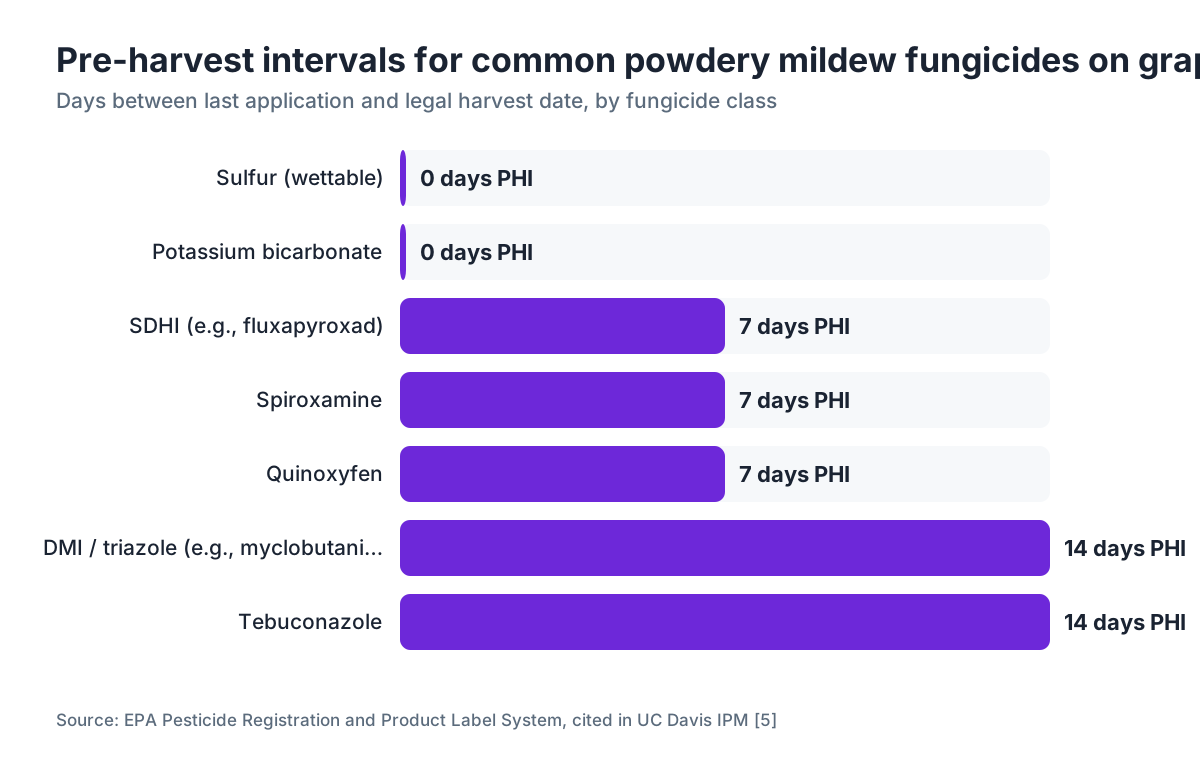
Sulfur, the workhorse of most powdery mildew programs, carries a PHI of 0 days on grapes for most label registrations [5]. On paper, you can spray it up to the day you pick. In the tank, sulfur past veraison brings real trouble: residue on fruit can interfere with fermentation, knock back native yeast, and at high levels feed hydrogen sulfide production in wine [2]. Plenty of winemakers flatly refuse fruit sprayed with sulfur in the 3 to 4 weeks before harvest. If you grow for a buyer, read that contract before you fill the tank.
SDHI fungicides (succinate dehydrogenase inhibitors) like fluxapyroxad (Merivon) and boscalid (Endura) have PHIs of 0 to 7 days on grapes, depending on the product and state registration [5]. They work well, they don't bring the sulfur-residue fermentation baggage, and they hit at lower use rates.
DMI fungicides (demethylation inhibitors, the sterol-inhibiting triazoles and related chemistry) include myclobutanil (Rally), tebuconazole, and quinoxyfen. PHIs in this class run 7 to 14 days for most grape registrations, so they need more lead time if harvest is close [5].
Spiroxamine and cyflufenamid show up on some labels with relatively short PHIs. Confirm against the specific EPA-registered label for your state, because labels shift by formulation and registrant.
Here's the practical read. If you have 10 to 14 days before harvest and see active disease, a well-timed SDHI or DMI is probably worth it. Inside 7 days, your choices shrink to sulfur (with winemaker buy-in) or nothing.
For organic programs, wettable sulfur and potassium bicarbonate (PHI 0 days) are the main late-season tools [6]. Copper is registered but weak against powdery mildew specifically.
How do you decide whether to spray or skip a late-season application?
There's no universal answer. There is a decision framework most experienced PCA advisors use, and it comes down to four checks.
First, read your disease history for the season. If you held clean fruit through July and your leaves show almost nothing going into August, the marginal payoff on a late spray is low. If July was rough, you missed a window, or you fought a resistant population, you're carrying more active inoculum and the math tilts toward spraying.
Second, know your PHI against your estimated harvest date. Sounds obvious. Harvest dates slide. If you target September 15 and a heat spike pulls it to September 8, a 14-day PHI product you planned for September 1 is suddenly illegal. Real application dates in your spray records protect you here. Field-operation software that logs applications with timestamps and flags upcoming PHI conflicts makes this math automatic instead of something you're doing in your head at 6 a.m.
Third, talk to your winemaker before you apply anything. That goes double for sulfur, but it's good practice for any late product. Get the conversation in writing, or at least in a text thread you can find later.
Fourth, weigh inoculum reduction for next year. Even if the wine-quality gain this season looks marginal, one application that knocks down cleistothecia on heavily infected leaves cuts next spring's ascospore load. That's a real agronomic win with no cost to this year's fruit.
WSU Extension frames it plainly: late-season management is about protecting next year's vines while holding this year's fruit quality and fermentation integrity [3].
What fungicide resistance patterns should you know about for late-season choices?
Resistance in E. necator is real, well-documented, and directly relevant late-season, because whatever you're spraying at now may be the survivors of your summer program.
QoI fungicides (strobilurins, the Group 11 chemistry: azoxystrobin, trifloxystrobin, pyraclostrobin) have widespread resistance documented in California, New York, and Oregon populations [7]. If you ran a strobilurin-heavy program earlier and you're still seeing disease, you're almost certainly looking at a resistant population. More of the same chemistry late is a bad move on both counts, control and resistance stewardship.
DMI resistance is messier. Reduced sensitivity shows up in some California populations, but it's nowhere near as universal as QoI resistance [7]. Rotating to a DMI late still makes sense, especially if you leaned on strobilurins mid-season.
SDHI resistance in E. necator hasn't been reported as widely as in some other pathogens, but FRAC (the Fungicide Resistance Action Committee) recommends limiting SDHI applications to two per season and never using them back-to-back without an alternate mode of action [8]. By late season you may have already burned your allotment.
The most resistance-friendly late-season move, when pressure is moderate and you're inside a tight PHI window, is often potassium bicarbonate. No resistance risk, no PHI, and it works by making the leaf surface alkaline enough that E. necator can't tolerate it. It won't rescue a serious outbreak. It's a reasonable last pass on sites that held mostly clean.
What are the PHI and re-entry intervals you legally have to follow?
Pre-harvest intervals and re-entry intervals (REIs) are two different legal requirements, and they're easy to mix up under pressure. The PHI protects the consumer. The REI protects your crew.
The PHI is the minimum number of days between your last application and harvest. EPA sets it in registration and prints it on the label. Break it and you can leave residues that exceed EPA tolerances, which opens you to market rejection, legal liability, or both. PHIs for common powdery mildew fungicides on grapes run from 0 days (sulfur, potassium bicarbonate, some SDHI formulations) to 14 days (some DMIs) [5].
The REI is the stretch after application when workers can't enter the treated area without specific protective equipment. For most powdery mildew fungicides on grapes, the REI is 4 to 24 hours under EPA Worker Protection Standard rules [9]. WPS requires you to post treated fields, tell workers about REIs, and give access to safety data sheets. If you've got a crew tying or suckering hours after a spray, that's exactly where violations happen. These requirements apply to all agricultural pesticides under 40 CFR Part 170 [9].
California adds a layer through the Department of Pesticide Regulation. A written Pesticide Use Report (PUR) goes to your County Agricultural Commissioner within 30 days of application, and restricted materials require a permit and monthly reporting [10]. The record has to name the specific product, EPA registration number, amount applied, treated acreage, and application date. This part is not optional.
If you keep spray records in a spreadsheet, late-season compression (multiple blocks, multiple products, multiple crew members) is when records get sloppy. A platform like VitiScribe logs applications in the field with GPS block data and flags PHI conflicts, which cuts the paperwork load at the end of a long harvest push.
New York growers answer to the DEC and keep pesticide records for at least three years under state pesticide regulations [11]. Washington growers work under WSDA rules that track federal WPS and add commodity-specific record requirements [12].
How does late-season powdery mildew affect wine quality specifically?
This is the question winemakers care about most, and the research is clearer than you'd guess. Even a light scatter of infected berries changes the wine.
A study published in the American Journal of Enology and Viticulture found that grapes with as little as 3 percent visually infected berries produced wines with measurably higher volatile acidity and lower sensory scores than clean controls [2]. Three percent sounds like nothing in the field. It's a scatter of berries you might not even flag on a walk-through.
The mechanism runs through fungal enzymes, mainly laccases, that oxidize phenolic compounds in must. E. necator laccase is more heat-tolerant than the laccase from Botrytis cinerea, which means SO2 additions and standard juice handling do less to neutralize it [2]. Wines from infected fruit can show premature browning, weaker color stability in reds, and flattened aromatics.
Beyond laccase, subclinical infection shifts berry chemistry before any symptom shows. Yeast assimilable nitrogen, sugar distribution, and pH can all move in heavily infected lots [1]. Those shifts change fermentation kinetics, yeast health, and final composition in ways that are hard to trace back to the vineyard if you never documented disease levels at harvest.
The practical takeaway: if you're selling to a winery under a quality contract, document late-season disease. Take photos. Record block-level severity. That protects you legally and helps the winemaker decide on lot separation, treatment, and fermentation protocols.
What does an effective late-season spray program actually look like?
A good late-season program isn't your mid-season program running on autopilot. Different goal, different constraints, different products.
From veraison to roughly 4 weeks out, the goal is holding colonization on vegetative tissue and slowing cleistothecia formation. Intervals can stretch to 14 to 21 days if it's dry and hot. In a wet, cool late summer, stay closer to 10 to 14 days [3].
Rotation matters more now than earlier because you're likely already carrying resistance pressure from summer. Use an SDHI or DMI if you haven't exhausted your seasonal allotment, rotate modes of action, and don't crawl back to a Group 11 strobilurin if disease broke through mid-season.
From 4 weeks to harvest, PHIs take over. Know exactly which products stay legal given your harvest window. A written spray schedule with PHI flags stops being a compliance formality here and becomes an operational tool.
In the last two weeks, your options are potassium bicarbonate and sulfur (with winemaker sign-off). Organic growers have lived this reality all season, so nothing new there.
Coverage matters more than growers expect this late. Powdery mildew is a contact target, so the fungicide has to land on the tissue to do anything. Late canopies are dense and often neglected. If you haven't hedged or pulled some leaves, you may be spraying into a wall and getting nothing on interior clusters. Sprayer calibration and timing (early morning, low wind) count as much as product choice [6].
Cornell's viticulture team recommends closing with a post-harvest sulfur application to suppress cleistothecia on dormant wood, especially after high-pressure years [1]. It doesn't touch fruit quality, carries no PHI concern once fruit is off, and can measurably cut the following spring's primary inoculum.
How do you document late-season applications to stay compliant?
Late-season records need everything the rest of the season needs, plus one added pressure: the gap between application and harvest is short, and audits sometimes land at harvest or right after. Reconstruct nothing from memory.
At minimum your spray record captures applicator name and license number, product name and EPA registration number, application date and time, rate per acre, total acres treated, and target pest [10]. In California that becomes a PUR that goes to the county. In most other states you keep records on file for 2 to 5 years and produce them on inspector request.
PHI compliance is simple math with unforgiving execution. Apply a 14-day PHI product on August 20 and you cannot legally harvest that block before September 3. If harvest gets pulled earlier, you have a violation. Log every application date in real time.
WPS posting means any treated area with an REI over 4 hours needs a WPS warning sign at the field entry during the REI [9]. The sign names the product, the REI end date and time, and any extra protection required. Contractor crews add a wrinkle: if you're using one, you're still the handler employer on the hook for WPS compliance.
For growers with several blocks and a long harvest window, a block-level table with application date, product, PHI, and earliest legal harvest date per application is the floor. Better systems timestamp entries and surface conflicts before they turn into violations.
Even a simple tool earns its keep here. The goal is to never be standing in a block on September 10 trying to remember when you last sprayed and with what, while the crew idles on the road.
Are there variety differences that change late-season risk?
Yes, and the spread is wide. Some varieties are just more susceptible to E. necator and stay risky longer into the season.
Vitis vinifera is broadly susceptible, but there's real variation inside it. Chardonnay, Cabernet Franc, and Pinot Noir rate highly susceptible. Cabernet Sauvignon and Syrah sit at moderate. Muscat varieties tend to run high [1]. Riesling can catch growers off guard with late rachis infection even when the berries look clean.
American varieties and hybrids carry partial resistance genes. Norton (Cynthiana), Marquette, Frontenac, and similar cold-hardy interspecific hybrids tolerate much higher inoculum loads without economic damage [3]. On these, late-season intervals can often stretch to 21 days or beyond without much cost.
Site interacts with variety. A susceptible variety on a warm, dry interior site with good airflow can finish cleaner than the same variety in a coastal canyon with fog and dead-still canopies. Your own site history over 3 to 5 seasons is the best predictor you've got.
Variety also moves the timing of that 8 Brix threshold. Early-ripening Pinot Noir hits 8 Brix and clears the berry-susceptibility window faster than late-ripening Cabernet Sauvignon. A Cabernet block still sitting at 5 Brix in late August in a cool year is more exposed than a Pinot Noir block in the same weather.
What's the cost-benefit of late-season powdery mildew sprays?
Worth working through honestly, because a late application costs money and time in the middle of harvest prep. Sometimes it's the best money you spend all year. Sometimes it's spraying cash onto healthy vines.
A single fungicide pass in a commercial vineyard usually runs $30 to $80 per acre in materials, depending on product, plus application labor and equipment of roughly $15 to $35 per acre for ground rigs [6]. Call it $50 to $115 per acre for one spray.
The cost of not spraying, in a moderate-to-high pressure year on a susceptible variety, is harder to pin down but real. Contract downgrades or rejections on infected lots can mean $200 to $500 per ton or more in lost revenue. Volatile acidity failures in premium markets are deal-killers. Heavier spring inoculum means heavier spray loads next year.
On the other side, in a clean year on a resistant variety at a dry site, the last one or two applications after veraison are often spraying money onto healthy vines. Nobody has clean regional data on this tradeoff; the closest published guidance comes from UC Davis IPM, which recommends basing late-season decisions on monitored disease levels rather than a calendar [1].
The UC Davis powdery mildew risk index, which builds on temperature-based infection risk, beats a calendar spray schedule as a decision tool [1]. If the index has stayed low for 3 weeks and your blocks show almost nothing, you can probably justify skipping. If it's been moderate to high and you've had some misses, spray.
For a vineyard trying to hold down input costs without giving up quality, the late-season spray call is one of the highest-leverage decisions of the year, precisely because it sits where agronomics, wine quality, and compliance meet at once.
Frequently asked questions
Can powdery mildew spread to berries after veraison?
Visible berry infection is uncommon after berries reach about 8 Brix, because the skin resists fungal penetration. The fungus keeps growing on green tissue like leaves, rachises, and young shoots, though, and subclinical berry infections below the visual threshold can still hurt wine quality through laccase enzyme activity and shifted berry chemistry. Green tissue stays at risk all the way to harvest.
What's the pre-harvest interval for sulfur on grapes?
Most EPA-registered sulfur products for grapes list a PHI of 0 days, so you can legally apply up to the day of harvest. The real concern isn't legality, it's fermentation. Sulfur residue on fruit can inhibit yeast, suppress native fermentation microbes, and feed hydrogen sulfide production. Most winemakers ask growers to stop sulfur 2 to 4 weeks before harvest regardless of the label PHI.
How does late-season powdery mildew affect volatile acidity in wine?
Research in the American Journal of Enology and Viticulture found that even 3 percent visually infected berries produced wines with measurably higher volatile acidity. The fungus makes laccase enzymes that oxidize phenolic compounds in must. E. necator laccase is more heat-tolerant than Botrytis laccase, so it's harder to neutralize with standard SO2 additions and winery treatment.
Which fungicide modes of action should I use late season to manage resistance?
Avoid Group 11 strobilurins (azoxystrobin, trifloxystrobin) if disease broke through mid-season, since QoI resistance is widespread in California, New York, and Oregon populations. SDHIs and DMIs are better late-season choices if you haven't used up your seasonal allotment. Potassium bicarbonate carries no resistance risk and has no PHI, which makes it a solid final application option.
Do I have to file a Pesticide Use Report for late-season fungicide applications in California?
Yes. California requires a Pesticide Use Report filed with your County Agricultural Commissioner for production agriculture applications, typically monthly for restricted materials by permit holders. The record must include product name, EPA registration number, application date, rate, and treated acreage. This applies throughout the season, including any applications in the weeks before harvest. Confirm exact timing with your county.
How long after a late-season spray do I have to keep workers out of the vineyard?
The re-entry interval varies by product. Most powdery mildew fungicides on grapes have REIs of 4 to 24 hours under EPA Worker Protection Standard rules. During the REI, workers can't enter the treated area without specific protective equipment. You must post WPS warning signs at field entries for any product with an REI over 4 hours. The rule applies no matter how close to harvest you spray.
Is a late-season spray worth it if berries look clean?
It depends on disease history, variety susceptibility, and harvest timing. Clean-looking fruit can still carry subclinical infection that affects wine quality. More to the point, heavily infected leaves are forming overwintering cleistothecia right now, and a late application that cuts that inoculum load pays off next season. In a high-pressure year on a susceptible variety, one late application almost always returns more than it costs.
What temperature stops powdery mildew infection late in the season?
Erysiphe necator sporulation slows sharply above 90 to 95 degrees Fahrenheit, and active infection needs temperatures between roughly 50 and 95 degrees F. Extended hot spells in inland regions can break late-season cycles on their own. Coastal sites with fog and mild temperatures stay at risk much longer and usually warrant continued management closer to harvest.
How should I document late-season spray applications for compliance?
At minimum: applicator name and license number, product name and EPA registration number, application date and time, application rate, and treated acreage. In California this becomes a Pesticide Use Report to the county. In New York, records must be kept at least three years. Document the PHI calculation for each block so you can show harvest timing met label requirements.
What's the best spray interval for powdery mildew between veraison and harvest?
In dry, hot conditions, intervals can stretch to 14 to 21 days without much risk on moderately susceptible varieties. In cool, humid conditions or on highly susceptible varieties like Chardonnay or Pinot Noir, 10 to 14 days fits better. UC Davis recommends basing interval decisions on monitored disease levels and temperature-based risk models rather than a fixed calendar.
Should I spray powdery mildew after harvest?
Yes, on high-pressure sites. A post-harvest sulfur application targets cleistothecia forming on dormant wood and senescing leaves. Cornell viticulture extension recommends it, and it carries no PHI concern since fruit is already off the vine. It won't rescue this season, but it can meaningfully cut the primary ascospore inoculum for the following spring.
How do hybrid or disease-resistant grape varieties change late-season powdery mildew management?
Interspecific hybrids like Marquette, Frontenac, and Norton carry partial genetic resistance to Erysiphe necator and run substantially less susceptible than vinifera. Late-season intervals can usually stretch to 21 days or more on these varieties without economic damage. Keep monitoring, especially in very wet seasons, but intensive late-season programs are rarely justified on resistant-variety blocks.
What spray coverage issues are specific to late-season canopies?
Late canopies are dense and often haven't been hedged since mid-summer. Spray penetration into the interior drops hard without airflow. Late leaf pulling around clusters and proper hedging improve coverage a lot. Ground rig speed, nozzle setup, and timing (early morning, low wind) matter as much as product choice for getting fungicide onto the target tissue.
Can I use copper as a late-season powdery mildew treatment in an organic program?
Copper is registered for organic viticulture but weak against powdery mildew specifically. Its main use is against downy mildew and bacterial diseases. For late-season organic powdery mildew management, wettable sulfur and potassium bicarbonate are the standard choices. Both carry a PHI of 0 days. The sulfur-fermentation concern still applies in organic programs, so check with your winemaker before applying sulfur near harvest.
Sources
- UC Davis Integrated Pest Management Program, Grape Powdery Mildew: Berry susceptibility drops sharply after about 8 Brix; temperature range for E. necator infection is 50 to 95 degrees F; UC Davis powdery mildew risk index integrates temperature-based infection risk; post-harvest management guidance
- American Journal of Enology and Viticulture (Gadoury et al. and related AJEV research on powdery mildew and wine quality): As little as 3 percent visually infected berries produced wines with measurably higher volatile acidity; E. necator laccase is more heat-tolerant than Botrytis laccase
- Washington State University Extension, Grape Powdery Mildew Management: Late-season management protects next year's vines while preserving fruit quality; cleistothecia formation drives following-year inoculum; hybrid varieties tolerate higher inoculum loads
- EPA Pesticide Registration and Product Label System: PHIs for powdery mildew fungicides on grapes: sulfur 0 days; SDHI formulations 0 to 7 days; DMI fungicides 7 to 14 days depending on product and state registration
- UC Davis IPM Program, Grape Pest Management Guidelines (fungicide costs and coverage): Organic late-season tools are wettable sulfur and potassium bicarbonate; coverage, calibration, and timing drive late-season control; typical per-acre application costs
- UC Davis Department of Plant Pathology, Fungicide Resistance in Erysiphe necator: QoI (Group 11 strobilurin) resistance is widespread in California, New York, and Oregon E. necator populations; reduced DMI sensitivity found in some California populations
- FRAC (Fungicide Resistance Action Committee), SDHI Resistance Management Guidelines: FRAC recommends limiting SDHI applications to two per season and avoiding back-to-back applications without an alternate mode of action
- EPA Agricultural Worker Protection Standard, 40 CFR Part 170: REIs for most powdery mildew fungicides on grapes are 4 to 24 hours; WPS requires posting treated fields and providing worker access to safety data sheets; handler employer responsible for compliance
- California Department of Pesticide Regulation, Pesticide Use Reporting: California requires a Pesticide Use Report to the County Agricultural Commissioner; record must include product name, EPA registration number, amount applied, treated acreage, and application date
- New York State Department of Environmental Conservation, Pesticide Recordkeeping: New York growers must keep pesticide application records for at least three years under state pesticide regulations
- Washington State Department of Agriculture, Pesticides and Fertilizers: Washington growers operate under WSDA regulations that parallel federal WPS with additional commodity-specific record requirements
Last updated 2026-07-10