How to maintain a cholinesterase monitoring log for organophosphate exposure

TL;DR
- California and several other states require cholinesterase monitoring for workers who handle organophosphate or carbamate pesticides above set thresholds.
- You need a baseline blood test before exposure starts, retests during the season, and a written log of every result.
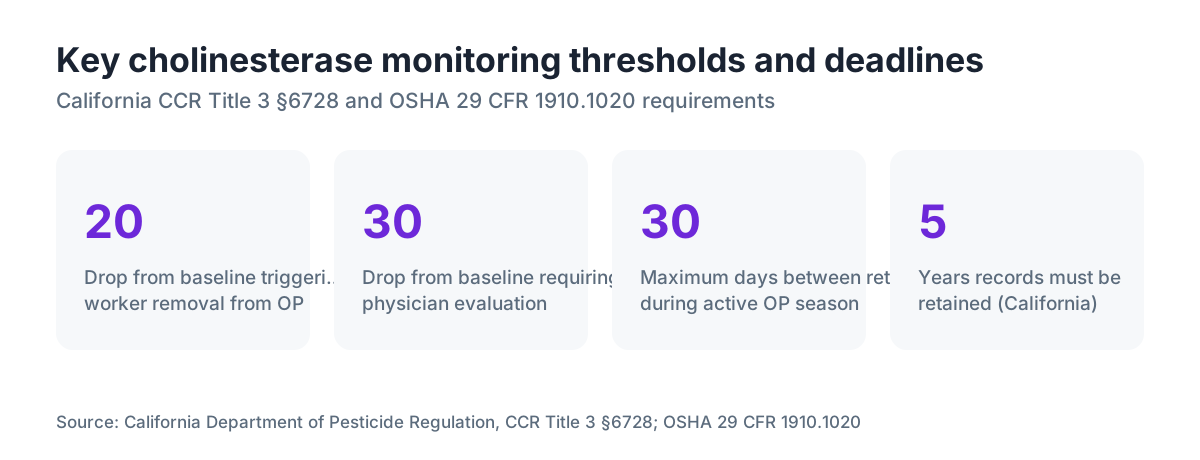
- A 20% drop from baseline pulls a worker off exposure; a 30% drop sends them to a physician.
- The federal EPA Worker Protection Standard sets the floor, and state ag departments usually go further.
What is a cholinesterase monitoring log and who has to keep one?
A cholinesterase monitoring log is a written record of every blood test that measures an agricultural worker's cholinesterase enzyme levels before, during, and after exposure to organophosphate (OP) or N-methyl carbamate pesticides. Cholinesterase is the enzyme OP compounds shut down. When that inhibition gets deep enough, the nervous system stops working right. That's what makes OP poisoning dangerous.
The log isn't optional paperwork. California's Department of Pesticide Regulation (CDPR) requires it under Title 3 of the California Code of Regulations, section 6728, for any handler who works with a pesticide whose label, tied to the Pesticide Safety Information Series (PSIS A-9), requires cholinesterase monitoring [1]. Washington and a handful of other states have parallel rules under their own worker safety codes.
The federal EPA Worker Protection Standard (WPS), 40 CFR Part 170, sets the baseline for agricultural employers, but the WPS itself does not mandate blood cholinesterase testing for every OP exposure. It requires that workers have access to emergency medical treatment and that records of any pesticide-related illness be kept. The rules that actually force you to run a monitoring program and log the results are state rules, especially California's [2].
Who needs a log? In California, any agricultural handler who uses a cholinesterase-inhibiting pesticide labeled as requiring monitoring must be tested and logged. That covers applicators, mixer-loaders, and flaggers. If you manage a vineyard in a state without a specific mandate, run voluntary monitoring and document it anyway. It's your best legal protection if a worker later claims OP-related illness.
Which organophosphates used in vineyards actually trigger monitoring requirements?
Not every OP triggers a mandatory program. The label is the law. Read the pesticide label's "Precautionary Statements" section. If it says handlers must be monitored for cholinesterase inhibition, or points you to PSIS A-9, you're in mandatory territory.
Common vineyard OP and carbamate products that have historically carried monitoring language include phosmet (used for leafhoppers and mites), chlorpyrifos, and azinphos-methyl. Chlorpyrifos is a moving target: EPA finalized cancellation of its food-use tolerances in 2021, California had already banned its agricultural use, and some state transitions ran on after that [7]. Azinphos-methyl is largely phased out but still shows up on older labels. Carbaryl, a carbamate, appears on vineyard labels too and can carry monitoring language.
CDPR keeps a list of pesticides that require cholinesterase monitoring as part of its pesticide use enforcement program [1]. Washington State University Extension documents which products Washington growers run into and what the trigger thresholds look like in practice [3].
Here's what trips up small operations: the requirement often applies even to handlers who use a monitoring-required product only a couple of times all season. "Only sprayed twice" doesn't exempt you if the label says monitoring is required. Check the label. Then check it again.
What does a baseline cholinesterase test involve and when do you get one?
The baseline is a blood draw, usually done by a licensed physician or clinic, that measures two kinds of cholinesterase: red blood cell (RBC) cholinesterase, also called acetylcholinesterase, and plasma cholinesterase, also called pseudocholinesterase or butyrylcholinesterase. Both get logged. They react differently to inhibition, and some OP compounds hit one harder than the other.
Timing is everything. California requires the baseline to be established before the employee starts work with the monitoring-required pesticide, during a stretch when the worker has had no exposure to cholinesterase-inhibiting pesticides for at least 30 days [1]. You can't baseline someone mid-season after they've already been spraying. If a worker comes to you from another farm where they used OPs, you need documentation of that history before you treat their first test as a clean baseline.
Labs report values in units per milliliter (U/mL) or international units per liter (IU/L), depending on the method. Reference ranges differ from lab to lab, which is exactly why you always compare a worker's result back to their own baseline, never to a population average. CDPR makes this explicit in its enforcement guidance.
A prior-season test can serve as a valid baseline under some state rules, provided the off-season period is documented and there was no intervening exposure. In California, a prior-season baseline works if it was taken more than 30 days after the last OP exposure and there's a written record linking it to the current season's log [1].
Most small vineyards use a local occupational health clinic or their county agricultural commissioner's office to coordinate testing. Costs vary by region, but a basic cholinesterase panel usually runs $40 to $120 per test, not counting the clinic visit fee. UC Davis's Western Institute for Food Safety and Security points out that test costs and lab turnaround times vary enough that you should line up your lab partner before the season starts, not the day you're about to spray [4].
How often do you retest workers during the spray season?
Retest frequency depends on your state's rules and the exposure pattern. In California, once monitoring is triggered, workers must be retested at intervals no longer than 30 days during any period when they're using a monitoring-required pesticide, and within 24 hours if a worker shows symptoms consistent with OP poisoning [1].
If a worker's first monitoring test comes back more than 10% below baseline, California requires you to shorten the interval to no more than 14 days [1]. The logic is plain. You want to catch a declining trend before it hits the removal threshold.
For growers in states without a specific interval rule, WSU Extension recommends monthly retesting as a practical baseline, and bi-weekly when workers are running high-volume OP programs [3]. That's a reasonable position.
End-of-season testing matters too. California requires a final cholinesterase test within five days of the last exposure to a monitoring-required pesticide. That result belongs in the log with everything else, and it's the marker that tells you whether next year's baseline is clean.
A few practical notes. Turnaround from a certified lab runs 24 to 72 hours for a standard cholinesterase panel. Some point-of-care tests exist, but state regulators don't universally accept them for compliance. Don't use them as your official record unless you've confirmed with your state ag department that they'll take them.
What are the removal thresholds and what happens when a worker hits one?
This is the part that needs a clear head. Two thresholds exist, and they trigger different responses.
A 20% drop from established baseline in either RBC cholinesterase or plasma cholinesterase is the first threshold. At this level, California requires you to pull the worker off any further exposure to cholinesterase-inhibiting pesticides immediately. They can't go back until a physician determines their levels have recovered to within 20% of baseline or gives written clearance [1].
A 30% drop from baseline is the serious level. It requires the worker to be seen by a physician, more than removed from exposure. The physician has to decide whether the worker can return to the monitoring-required pesticide at all, and any return has to be in writing.
The regulation text in California CCR Title 3, section 6728, directs employers to "remove the employee from all exposure to organophosphate and carbamate pesticides" once the 20% threshold hits. That's a hard stop, not a judgment call.
What counts as recovery? A return to within 20% of baseline on a retest done by the same lab using the same method. Switching labs mid-monitoring is a problem, because different analyzers can produce results that differ by 10 to 15%, enough to paint a false picture of recovery or decline. If you have to change labs, note the change in the log and have the physician acknowledge it in writing.
Documentation during a removal event has to be tight: the date of the triggering test, the specific values, the physician's name and license number, the date of any physician evaluation, and the date the worker was cleared to return. All of it goes into the monitoring log.
What exactly goes into the cholinesterase monitoring log?
The log is a written or electronic record kept for each monitored employee. California's rules say the record must include, at minimum [1]:
- Employee name, job title, and Social Security number or other unique ID
- Name and license number of the physician who authorized testing
- Name and address of the testing laboratory
- Date of each blood sample collection
- Date each test result was received
- Numerical results for both RBC and plasma cholinesterase
- The established baseline values for that individual
- The percentage deviation from baseline for each result
- Any physician determination about exposure restriction or removal
- Date the worker returned to work with the monitoring-required pesticide, if applicable
You also want to record the specific product and its pesticide registration number, the application dates the worker was involved in, and the PPE used. That's not legally required in every state, but it's exactly the detail that matters if a workers' comp claim or a CDPR inspection ever lands on you.
Keep the log for at least three years from the most recent entry, which is the federal OSHA retention floor for employee exposure records under 29 CFR 1910.1020 [5]. California requires five years under CCR Title 3. Because these records are also medical records, OSHA's 30-year medical retention rule can apply too. When in doubt, keep them longer.
Forms and templates: CDPR publishes a sample monitoring record form in PSIS A-9. Cornell Cooperative Extension and WSU Extension both have adapted versions for their states [3][6]. Start with one of those instead of building your own. A template built for compliance is less likely to drop a required field.
Running several workers on a monitoring program is a lot easier in a digital log than on paper. Tools like VitiScribe keep compliant worker records next to your pesticide application logs, so exposure dates, product names, and medical results all live in one place. That's genuinely useful when an inspector asks you to connect a worker's spray dates to their blood test timeline.
How do you store and secure employee medical records from monitoring?
Cholinesterase test results are medical records. That changes how you handle them.
Federal OSHA regulation 29 CFR 1910.1020 requires that employee exposure and medical records be kept separate from general personnel files, be accessible to the employee on request, and be kept confidential from unauthorized personnel [5]. Supervisors don't get automatic access to the medical results. Workers do. If you have an HR function, the monitoring records should live with your safety officer or the physician's office, not in the same file as performance reviews.
California's rules add that the monitoring log must be made available to employees, their authorized representatives, and CDPR enforcement personnel on request [1]. When a CDPR inspector shows up, you can't stonewall them on employee safety records.
Paper records go in a locked file with restricted access. Electronic records need password protection at a minimum, and on a shared system you want role-based access so payroll staff can't see medical results.
On employee access: OSHA requires you to provide copies of records to employees within 15 working days of a request, at no cost to the employee [5]. Train whoever manages your records on this. Denying a worker their own test results is an OSHA violation.
What are your obligations if a worker shows symptoms of OP poisoning?
Symptoms of OP poisoning include heavy salivation, miosis (pinpoint pupils), nausea, sweating, muscle twitching, and in severe cases seizures or loss of consciousness. If a worker shows any of these during or after exposure to an OP pesticide, your obligations go past the monitoring log.
First, remove the person from exposure immediately. Don't wait for a blood test result.
The WPS (40 CFR Part 170) requires agricultural employers to provide emergency medical care when a worker is injured or ill from pesticide exposure, and to provide the pesticide label and safety data sheet to the treating facility or emergency responders [2]. That information goes with the worker, right away.
You also do a same-day or within-24-hour blood cholinesterase test and document the result in the monitoring log. Even if the worker bounces back fast, the log entry is required. Note the symptoms, the time they appeared, the product the worker was using, the application method, and what PPE was in use.
California further requires that any pesticide-related illness be reported to the county agricultural commissioner within 24 hours of the employer learning of it [10]. That's separate from the monitoring log and from any workers' comp report.
Keep the physician's diagnosis and the case details in the monitoring log under a clearly labeled incident section. If the episode causes lost time, you have an OSHA 300 log obligation too.
How do California's cholinesterase rules compare to other major grape-growing states?
California has the most detailed cholinesterase monitoring statute in the country for agricultural workers. Other major grape-growing states range from moderately detailed to close to silent on this specific requirement.
| State | Mandatory OP Cholinesterase Monitoring Rule | Baseline Requirement | Removal Threshold | Records Retention |
|---|---|---|---|---|
| California | Yes, CCR Title 3 §6728 | 30-day pre-exposure window | 20% drop (removal); 30% drop (physician) | 5 years |
| Washington | Yes, WAC 296-307 | Required before exposure | 20% below baseline | 3 years |
| Oregon | Partial, by product label | Required by label | Label-specific | 3 years (OSHA) |
| New York | No state-specific mandate | Voluntary / label-driven | N/A | 3 years (OSHA) |
| Texas | No state-specific mandate | Voluntary / label-driven | N/A | 3 years (OSHA) |
Washington's rule under WAC 296-307-15005 requires monitoring for workers who handle pesticides that require it on the label, which mirrors California's label-driven approach [8]. Oregon leans harder on label language and OSHA's general industry standards.
For New York and Texas growers, the federal WPS and OSHA 29 CFR 1910.1020 still apply, so you have record-keeping obligations for any exposure records you do generate, even without a state testing mandate. Cornell Cooperative Extension recommends that New York growers who use monitoring-labeled OPs voluntarily follow California's intervals as a best practice [6].
One thing every state shares: if the pesticide label says monitoring is required, that label is a legally enforceable document under FIFRA, and ignoring it is a federal pesticide law violation no matter what your state's ag department does or doesn't mandate on its own [2].
What common mistakes get vineyards cited or create liability during inspections?
Inspectors see the same problems over and over, and they're almost never about not caring. They're about not knowing.
Missing or late baseline. This is the most common failure. A worker starts mixing product on April 10 and doesn't get a baseline draw until April 25, after two weeks of exposure. That baseline is worthless as a comparison point, and the employer is out of compliance the moment spraying started.
Using population reference ranges instead of individual baselines. A lab report often prints a range like "5.0 to 12.0 U/mL" next to the result. Some employers glance at that and say the worker's fine because the number falls inside the normal range. Wrong analysis. A worker who starts at 10.0 and drops to 7.5 has lost 25% of their personal baseline, which crosses the removal threshold, even though 7.5 looks normal on the population chart.
No log at all, just lab reports in a folder. Raw lab reports are not a monitoring log. The log has to include calculated percentage deviations from baseline, physician information, and exposure dates. A pile of printouts doesn't satisfy the regulation.
Failing to document return-to-work clearance. After a removal event, employers often bring the worker back once they feel better, with no written physician clearance and no logged return date or clearance basis.
Switching labs mid-season without noting it. Different analyzers produce results that aren't directly comparable. If you switch labs, document it in the log and note that a re-baseline or physician review is appropriate.
Keeping records in the wrong place. Medical monitoring records mixed into general job files, or reachable by supervisors who shouldn't see them, are a privacy violation stacked on top of a record-keeping violation.
VitiScribe's pesticide and worker records module keeps application dates and worker assignments in the same system as medical log entries, which makes the timeline reconstruction inspectors ask for much easier to produce. Any well-organized system works, though. The goal is connecting spray dates to worker assignments to blood test dates without digging through three separate filing cabinets.
Where can you get training and technical help setting up your monitoring program?
You don't have to figure this out alone. Several publicly funded resources exist to help agricultural employers.
CDPR's Pesticide Safety Information Series sheets, particularly PSIS A-9, walk through the cholinesterase monitoring requirements in plain language and include a sample log form [1]. Download A-9 from the CDPR website and make it your reference document.
UC Davis's Agricultural and Environmental Chemistry program and the Western Institute for Food Safety and Security publish guidance on OP safety for California growers [4]. Their farm advisor network can often point you to local occupational health clinics already set up for agricultural cholinesterase testing.
WSU Extension's Pesticide Education Program covers Washington's requirements and has published guides comparing state and federal standards across the western states [3]. Useful even outside Washington, because the biology and the procedures are the same everywhere.
Cornell Cooperative Extension runs the New York Agricultural Pesticide Safety program and has resources for small vineyard and farm operations, including sample record forms you can adapt to non-California rules [6].
Your county agricultural commissioner's office is a real resource too. Most counties with heavy pesticide use have enforcement staff who will, off the record, answer basic compliance questions before an inspection rather than wait to cite you for something you could have fixed. Use that.
For growers handling restricted-use pesticides for the first time: the Pesticide Applicator Competency training required for your license should cover monitoring requirements for any product you're certified to apply. If it didn't, that's a problem with your training provider.
Frequently asked questions
Do I need cholinesterase monitoring for every organophosphate pesticide I use in the vineyard?
No. The requirement is triggered by the pesticide label, not the chemical class. Read the 'Precautionary Statements' section of your specific product label. If it references cholinesterase monitoring or California's PSIS A-9, you're in mandatory territory. Many OP products on the market don't carry that language, which means no state-mandated program is required, though voluntary testing is still smart for high-exposure workers.
Can a seasonal worker use their test results from a prior employer as their baseline?
In California, a prior-season result can count as a baseline if it was taken more than 30 days after the worker's last OP exposure, is documented, and comes from a licensed lab. You need the actual lab report in writing. A worker saying 'I tested fine at my last job' is not a baseline. Get the paperwork, review the values, note the prior employer in your log, and confirm there was a clean off-season period.
What's the difference between RBC cholinesterase and plasma cholinesterase, and do I need both?
RBC (red blood cell) cholinesterase, also called acetylcholinesterase, reflects longer-term enzyme inhibition and is the more reliable indicator of chronic OP exposure. Plasma cholinesterase responds faster but fluctuates more with non-pesticide factors like liver function and genetic variation. California requires both values measured and logged. The removal threshold applies to either one independently: a 20% drop in either triggers removal, not a combined average.
What happens if a worker refuses to give a blood sample for the baseline or retest?
You cannot force a blood draw. Document the refusal in writing, have the worker sign or witness it, and keep it in the monitoring file. In California, you must still remove the worker from further exposure to the monitoring-required pesticide until they provide a valid baseline or retest result. The refusal doesn't erase your compliance obligation: keeping an unmonitored worker away from the product is your responsibility.
How long do I have to keep cholinesterase monitoring records?
California requires five years from the date of the last entry. OSHA's federal standard for employee medical and exposure records (29 CFR 1910.1020) requires 30 years for medical records and three years for exposure records. Because cholinesterase records are both exposure and medical records, default to the longest applicable period. In a non-California state without a specific state rule, keep records for at least 30 years to match OSHA's medical records standard.
Do I need to log cholinesterase monitoring results for the farm owner or family members who do the spraying?
In California, the rules apply to any 'handler,' which includes owners and family members who handle monitoring-required pesticides. The exemption for family members that applies to some agricultural labor laws does not apply to pesticide safety requirements. If the farm owner is mixing and applying a monitoring-required product, they need a baseline, periodic testing, and a log entry just like any paid worker.
Can I use a portable or fingerstick cholinesterase test device instead of a certified lab?
Some point-of-care devices exist (the EQM Test-mate ChE is the most common in agricultural settings), but CDPR has not generally accepted them as a substitute for certified laboratory analysis for compliance purposes. They can help with rapid field screening, but you still need lab confirmation for your official monitoring log. Check with your state ag department before relying on a point-of-care device for compliance records.
What do I tell a worker who's been removed from exposure and wants to know when they can return?
Be straight with them: they can't return to the monitoring-required pesticide until a physician clears them in writing and a retest confirms their levels have recovered to within 20% of their established baseline. There's no fixed timeline, because recovery speed varies by compound and individual. Plasma cholinesterase often recovers in days to weeks; RBC cholinesterase can take months after significant inhibition. Rushing the return creates both health and legal risk.
Does the EPA Worker Protection Standard require cholinesterase monitoring?
The federal WPS (40 CFR Part 170) does not independently mandate cholinesterase blood testing for all OP exposures. It requires access to emergency medical care and records of pesticide-related illness. The monitoring requirement at the federal level comes from pesticide labels, enforced under FIFRA. State rules, particularly California's CCR Title 3 and Washington's WAC 296-307, go further and impose specific testing, interval, and record-keeping requirements above the federal floor.
Are there free templates for a compliant cholinesterase monitoring log?
Yes. CDPR's PSIS A-9 includes a sample monitoring record. WSU Extension and Cornell Cooperative Extension both publish adaptable templates. Your county agricultural commissioner may have a local form too. Use an established template rather than building your own: the required fields are specific, and a template built for compliance is less likely to miss one. Any template should capture baseline values, all retest dates and results, percentage deviation, physician name, and return-to-work clearance dates.
What if the same worker uses both an OP and a carbamate product during the season?
Your monitoring log has to cover both, because both inhibit cholinesterase. Carbamate inhibition is generally more reversible and faster to recover than OP inhibition, but the removal and documentation thresholds are the same under California's rules. Log each product separately in the exposure section, note the application dates for each, and make clear which exposures were OP and which were carbamate. The physician reviewing a removal event needs that detail.
How do I handle a worker who shows a 25% drop from baseline but has no symptoms at all?
Remove them from exposure. The California rule is not symptom-based at the 20% threshold; it's purely numerical. A 25% drop triggers removal regardless of how the worker feels. Many workers with significant cholinesterase depression have no obvious symptoms until levels drop further, which is exactly why the numerical threshold exists. Document the result, the date, and the removal action, and begin the physician evaluation process if you're near the 30% mark.
Is there any connection between vineyard spray records and cholinesterase monitoring logs?
Yes, and inspectors look at both together. Your pesticide application records show which products were applied, on which dates, and which handlers were involved. Your cholinesterase monitoring log shows when those handlers were tested and what their results were. The two records need to line up: if a spray record shows a worker applied a monitoring-required product on June 5, the log should show a valid baseline before that date and a retest within 30 days after. Gaps between the two are a red flag.
Sources
- California Department of Pesticide Regulation, PSIS A-9 and CCR Title 3 §6728: California requires baseline testing before exposure, retesting at 30-day intervals, removal at 20% drop from baseline, physician evaluation at 30% drop, and 5-year record retention for cholinesterase monitoring
- EPA, Worker Protection Standard for Agricultural Pesticides, 40 CFR Part 170: The federal WPS requires employers to provide emergency medical care and the pesticide label/SDS to treating facilities; pesticide labels are enforceable under FIFRA
- Washington State University Extension, Pesticide Education Program: WSU Extension documents Washington's cholinesterase monitoring requirements, recommends monthly retesting as a practical baseline and bi-weekly for high-volume OP programs, and publishes adaptable log templates
- UC Davis, Western Institute for Food Safety and Security: UC Davis notes that cholinesterase test costs typically vary by region and that vineyard managers should identify their lab partner before the season begins
- OSHA, Access to Employee Exposure and Medical Records Standard, 29 CFR 1910.1020: OSHA requires employee medical records be kept for 30 years, exposure records for 3 years, kept separate from personnel files, and provided to employees within 15 working days of request at no cost
- Cornell Cooperative Extension, New York Agricultural Pesticide Safety Program: Cornell Cooperative Extension recommends that New York growers using monitoring-labeled OP products voluntarily follow California's testing intervals as a best practice and publishes adaptable sample log templates
- EPA, Chlorpyrifos Cancellation and Phase-Out: EPA finalized cancellation of chlorpyrifos food-use tolerances in 2021; California had separately banned its agricultural use; some state transitions were ongoing
- Washington State Department of Agriculture, Pesticide Registration and Safety, WAC 296-307-15005: Washington's WAC 296-307-15005 requires cholinesterase monitoring for workers handling pesticides with monitoring requirements on the label and mandates removal at 20% below established baseline
- National Institute for Occupational Safety and Health (NIOSH): NIOSH identifies RBC acetylcholinesterase as the more reliable indicator of chronic OP exposure, while plasma cholinesterase responds more rapidly but fluctuates with non-pesticide factors including genetic variation and liver function
- California Department of Pesticide Regulation, Pesticide Illness Surveillance Program: CDPR requires any pesticide-related illness be reported to the county agricultural commissioner within 24 hours of the employer becoming aware of it, separate from monitoring log requirements
Last updated 2026-07-10