How to manage high soil pH limiting nutrient uptake in vineyards
TL;DR
- When vineyard soil pH climbs above 7.5, grapevines can't absorb iron, manganese, zinc, and boron even when those nutrients sit right there in the soil.
- Elemental sulfur lowers pH over 1 to 3 seasons, EDDHA foliar sprays rescue the current vintage, and the right rootstock matters more than any amendment.
- Interveinal chlorosis on young leaves is usually the first warning.
What does high soil pH actually do to grapevine nutrient uptake?
High pH doesn't remove nutrients from the soil. It changes their chemical form so roots can't dissolve them. At pH 6.0 to 6.5, iron, manganese, zinc, copper, and boron all stay reasonably soluble. Push pH above 7.5 and iron shifts into ferric hydroxide, zinc into zinc carbonate, manganese into manganese dioxide. The roots sit in soil full of those nutrients on paper, but chemically they're locked out. [1]
Growers call this "lime-induced chlorosis" because calcareous soils (soils naturally high in calcium carbonate) cause most of it. Many limestone-derived soils in the Texas Hill Country, parts of California's Central Valley, southern France, and much of Spain run pH 7.8 to 8.4. The same problem shows up when a grower over-applies lime to fix an acidity problem that wasn't really there.
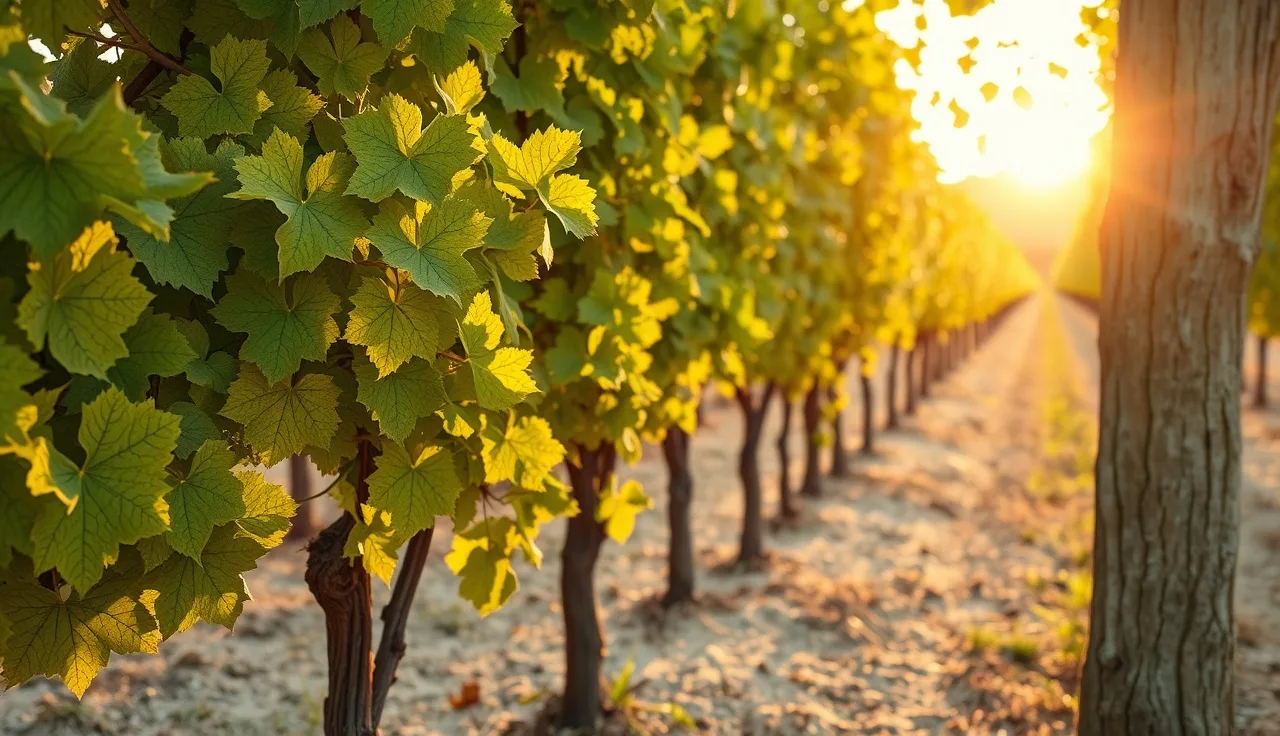
Iron deficiency is the symptom you'll spot first. Young leaves show interveinal chlorosis: green veins against a yellow or pale green background. It hits the newest growth first because iron won't move around inside the plant once it's fixed in older tissue. Zinc deficiency gives you small, distorted leaves and patchy berry set. Manganese deficiency looks a lot like iron but shows up on slightly older leaves.
None of this kills the vine overnight. But a vine stuck in pH 8.0 soil with moderate iron chlorosis can lose 20 to 30 percent of photosynthetic capacity in the affected leaves, and that loss ripples through shoot vigor, cluster development, and fruit quality. [2]
What soil pH is too high for grapevines?
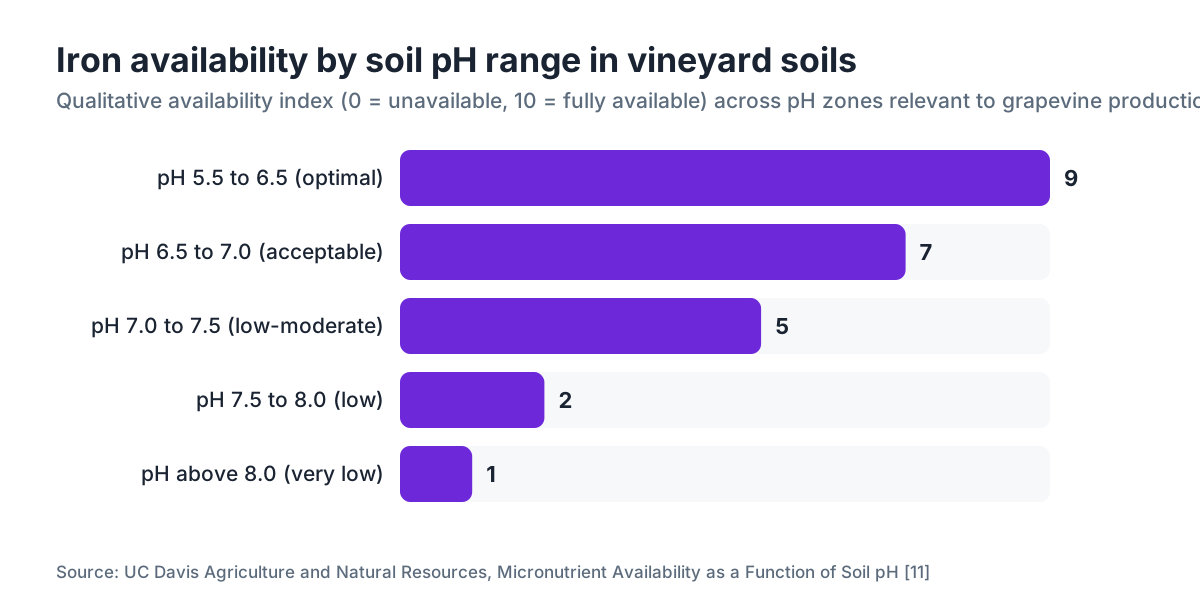
Above pH 7.5, most susceptible vines start showing visible deficiency. Above pH 8.0, you're managing a chronic condition rather than watching a risk. Extension guidance puts the sweet spot for Vitis vinifera at pH 6.0 to 6.5, with acceptable performance up to about 7.0 on adapted rootstocks. [3] UC Davis work shows iron availability drops off sharply once pH clears 7.5.
Here's the threshold table growers actually use:
| Soil pH range | Iron availability | Typical vine response |
|---|---|---|
| 5.5 to 6.5 | High | Optimal for most varieties |
| 6.5 to 7.0 | Moderate | Minor stress, watch sensitive varieties |
| 7.0 to 7.5 | Low-moderate | Early chlorosis risk on susceptible rootstocks |
| 7.5 to 8.0 | Low | Visible iron and zinc chlorosis likely |
| Above 8.0 | Very low | Severe multi-nutrient deficiency; rootstock and amendment both required |
Treat 7.5 as the line where passive monitoring becomes active management. Treat 8.0 as the line where a foliar spray alone won't save you and you need a real plan.
One soil sample at planting tells you almost nothing over the life of a block. Test annually at 0 to 12 inches and 12 to 24 inches, and pull petiole samples at bloom and veraison so you can see what the vine is actually taking up instead of what's theoretically sitting in the ground. [3]
How do you lower soil pH in a vineyard?
Elemental sulfur is the main tool. Soil bacteria (mostly Thiobacillus thiooxidans) oxidize it into sulfuric acid, which reacts with soil carbonates and pulls pH down. [4] It's slow: 6 to 18 months in warm, moist, well-aerated soil, longer when it's cold or dry. This won't rescue a vine in acute chlorosis. For long-term management, though, nothing else touches it on cost.
Rates depend on current pH, target pH, soil texture, and buffering capacity (carbonate content above all). WSU Extension guidance suggests roughly 500 to 1,500 pounds of elemental sulfur per acre for each one pH unit of drop, and calcareous soils with high CaCO3 often need much more because you burn through carbonate before the pH moves at all. [5] Get a lime requirement test before you calculate anything. A plain pH test isn't enough.
Incorporation changes everything. Sulfur left on the surface oxidizes slowly and unevenly. Till it into the top 6 to 12 inches and you get it into the root zone where the pH change counts. In established blocks where you can't till, apply to the undervine strip and work it in with light cultivation, or let irrigation water carry it down over time.
Acidifying nitrogen fertilizers help at the margins. Ammonium sulfate and urea both generate acidity as they break down, and ammonium sulfate acidifies harder per unit of nitrogen. These won't drag pH from 8.2 to 6.5, but they slow the creep and feed the vine at the same time. [4]
Sulfuric acid injection through drip (fertigation) works faster than elemental sulfur if you've got the infrastructure. A 35 percent sulfuric acid solution meters into the irrigation water toward a target pH. It takes training and real safety equipment because it's a hazardous material. Growers in California's San Joaquin Valley lean on this because the drip systems are already there, but setting it up from scratch is no small job.
One thing worth saying flat out: you cannot reliably acidify a heavily calcareous soil (5 to 15 percent CaCO3 by weight or more) down to pH 6.5. The carbonate buffering is too strong. On those soils, rootstock choice and foliar nutrition do more real work than fighting the geology ever will.
Which rootstocks tolerate high pH and calcareous soils?
Rootstock is the most durable fix for a high-pH site, and choosing wrong at planting locks you into decades of remediation. Some rootstocks pull iron and other micronutrients out of alkaline soil far better than others. This is a decision you make once and live with for the life of the vineyard.
420A and 41B are the classics for limestone. Both are Vitis berlandieri crosses selected in France for calcareous tolerance. 41B was developed for the chalk soils of Champagne and handles active lime (CaCO3) up to about 40 percent. [6]
Freedom and Harmony (both UC Davis releases) do fine in moderately alkaline soil but aren't the pick when pH regularly clears 7.8. 110R (Richter 110) handles dry calcareous ground well and is planted all over Spain and southern France.
Tolerance ratings run on a chlorosis index or iron chlorosis resistance scale. Ask your nursery for the numbers from UC Davis Foundation Plant Services, or the ENTAV-INRAE tables for French-origin rootstocks. These ratings exist. Use them. [6]
No rootstock is bulletproof. Even 41B will go chlorotic on a site that has both extreme pH and waterlogging, because wet soil goes anaerobic and iron uptake stalls out. Drainage and pH are the same fight.
What foliar sprays correct iron, zinc, and manganese deficiency fast?
Foliar nutrition rescues the vintage. It doesn't cure the soil. If your vine shows interveinal chlorosis in May, you will not fix the ground by harvest, but you can restore enough photosynthetic capacity to protect this year's crop while the sulfur program grinds through its slow chemistry underground.
For iron, chelates are the standard. EDDHA chelates (ethylenediamine-N,N'-bis(2-hydroxyphenylacetic acid)) stay stable at high pH and beat EDTA and DTPA above pH 7.5. [1] Apply iron chelate at 2 to 4 quarts per acre (check the label, formulations vary) at 10 to 14 day intervals during active shoot growth. Two to four sprays a season is a normal program.
For zinc, zinc sulfate sprays at budbreak or just after are cheap and effective. Cornell's viticulture extension notes that zinc sulfate at a 0.1 to 0.2 percent solution (about 1 to 2 pounds per 100 gallons) absorbs well when applied before full leaf expansion. [7] Zinc is a little easier to correct through the leaf than iron.
For manganese, manganese sulfate sprays work the same way. Manganese deficiency is less common than iron on most high-pH sites, but the foliar fix is simple when it turns up.
Boron is the tricky one. The gap between deficiency and toxicity is narrow, so foliar boron demands precision. Test petiole boron first to confirm you're actually short before you spray.
One note on timing and safety: spray early morning to avoid leaf burn from heat, and remember that any foliar pesticide or fertilizer application falls under the EPA Worker Protection Standard if you have agricultural workers. [8] Keep your application records. That's a compliance requirement, not a suggestion.
How do soil tests and petiole analysis help you diagnose the problem?
Visual symptoms tell you something's wrong. Soil and tissue tests tell you what, and how bad.
Start with soil. Pull composite samples separated by block, soil type, and management zone, at two depths (0 to 12 and 12 to 24 inches). Ask for pH, electrical conductivity, organic matter, CEC, and a full micronutrient panel with DTPA-extractable iron, zinc, manganese, copper, and boron. Most ag labs also run an active lime (calcium carbonate equivalent) test, which tells you how hard the pH will be to move. [3]
Then the petioles. Collect at bloom (opposite the basal cluster) and again at veraison. Bloom petioles give the cleanest read on micronutrient status. Compare against published sufficiency ranges. UC Davis and Cornell both publish these, and California labs treat the UC Davis numbers as the standard. [3][12]
High soil pH plus low petiole iron plus interveinal chlorosis on young leaves is a clean diagnosis. If pH is high but petioles read normal, the vine is coping, so watch it and don't panic. If petioles are low but pH is normal, look elsewhere: waterlogged soil, nematode damage, or misapplied herbicide.
Nobody has clean data on exactly how petiole iron deficiency maps to yield loss under California or Washington conditions. The closest work is UC Davis research suggesting moderate to severe chlorosis (a visual rating of 2 to 3 on a 4-point scale) cuts yield 15 to 35 percent in susceptible varieties. [2] Use that as a rough planning number, nothing more.
Does irrigation water pH contribute to the problem?
Yes, and most growers overlook it. Water high in bicarbonate raises soil pH over time, and drip makes it worse by concentrating salts in the root zone. Bicarbonate alkalinity above roughly 150 to 200 mg/L (ppm) is generally considered a problem for vineyards on moderately buffered soils. [4]
The fix is acid injection to neutralize the bicarbonate before it reaches the roots. Sulfuric acid is the common choice. Citric acid works and clears many organic certifications, but it costs more per unit of alkalinity neutralized. Phosphoric acid also works and adds phosphorus, though too much phosphorus interferes with zinc uptake, so that's a trade you make with your eyes open.
If you run drip and you're seeing pH creep in blocks that looked fine five years ago, test your water bicarbonate. It's a $20 to $50 water test at most ag labs, and it's the variable people forget.
Managing this across multiple blocks with different water sources and amendment histories gets messy by hand fast. Record-keeping software like VitiScribe logs soil results, amendment applications, and petiole data by block, so you're not digging through spreadsheets every spring trying to remember what you put where.
What organic matter inputs help buffer pH and improve micronutrient availability?
Organic matter won't lower pH the way sulfur does, but it helps in a few sideways ways. As it decomposes, it releases organic acids that grab iron and other metals into forms roots can absorb. Humic and fulvic acids are natural chelators. That's part of why cover crop residue and compost modestly improve micronutrient availability even on high-pH ground.
Compost also improves soil structure, water retention, and microbial activity, which speeds the biological oxidation of elemental sulfur. Dead soil with low organic matter and thin microbial populations oxidizes sulfur slowly.
Sulphate-based composts, lower-pH green waste composts (around 6.0 to 7.0), and well-aged manure all help a little. Don't expect any of them to solve a pH 8.2 soil on their own. Paired with sulfur and foliar correction, they earn their place in the program.
Undervine cover crops are worth a look too. Deep-rooted species like radish or cereal rye break up compaction and improve drainage, and their root exudates create small pockets of acidity in the rhizosphere. The effect is small and temporary, but it costs almost nothing if you're already managing undervine vegetation.
How long does it take to correct high soil pH in a vineyard?
Here's the frustrating truth: lowering pH in a buffered calcareous soil takes years, not weeks. Elemental sulfur at recommended rates in warm, moist, biologically active soil might move pH 0.5 to 1.0 units in the first 12 to 18 months. Going from 8.0 to 6.5 in a soil with 5 percent active lime is a multi-year project of repeated applications and repeated testing.
So you run two clocks at once. Manage the short term with foliar sprays (and possibly an EDDHA chelate soil drench) while the amendment program works the slower chemistry. Don't wait to see if the sulfur landed before you spray foliar iron. The vine needs to photosynthesize this season, not next.
Some growers find it saner to treat high-pH sites as a permanent condition rather than a problem to solve once. If the parent material is limestone and the water is high-bicarbonate, you'll manage micronutrient availability every single year. The goal isn't to hit pH 6.5 and walk away. It's to keep available iron, zinc, and manganese in a range where the vine functions well.
Tracking amendment dates, rates, pH readings, and petiole results by block across seasons is how you learn whether the program works. Without that running record, you're just guessing.
Are there any legal or compliance issues around soil amendment and foliar spray applications?
A few, and they matter.
Sulfuric acid for fertigation is a restricted material in California and can require a licensed pest control adviser (PCA) recommendation. Check your state's rules. In Washington, WSU Extension covers safe use of acid injection systems. [10]
Foliar products that also carry a pesticide label (some copper-based products, for example) fall under both fertilizer and pesticide regulation. Read the label. An EPA registration number means it's a registered pesticide and must be applied per label directions. [8]
The EPA Worker Protection Standard (WPS) applies whenever you have workers in the vineyard after a pesticide application. It covers restricted-entry intervals (REIs), personal protective equipment, and training. Iron chelate sprays that carry a pesticide label have REIs, so check the specific product. [8] The WPS is federal law under 40 CFR Part 170. The regulation states its purpose is "to reduce the risk of pesticide poisonings and injuries among agricultural workers and pesticide handlers."
On organic certification: elemental sulfur is approved under NOP standards, and iron sulfate is generally approved. Synthetic chelates like EDDHA are generally not approved. [9] If you're organic, your foliar iron options narrow to iron sulfate, which is weaker at high pH but still helps some. Confirm with your certifier before you spray anything.
Keep your spray records: date, product, rate, block, operator, REI. That's a WPS and state pesticide use reporting requirement in most states, and it's plain good farm management. VitiScribe's spray log module is built around these fields, which makes the recordkeeping faster than a paper logbook.
What are the most common mistakes growers make managing high-pH soils?
Applying sulfur once, skipping the follow-up test, and assuming it's handled. Calcareous soils buffer hard. One application rarely does it, and without testing at 6 and 12 months you have no idea whether the biology is even moving.
Using EDTA chelate where EDDHA is called for. EDTA iron chelate degrades fast above pH 7.0. Spend money on EDTA at pH 8.0 and you're mostly watering the vineyard. EDDHA costs more, stays stable at high pH, and actually works. [1]
Ignoring drainage. Waterlogged soil goes anaerobic, and anaerobic soil locks out iron even at moderate pH. If the trouble sits in a low spot or a poorly drained block, no amount of sulfur or foliar spray fully compensates until you fix the water.
Blaming the wrong nutrient. Interveinal chlorosis on young leaves reads as classic iron deficiency, but sulfur deficiency yellows young leaves uniformly and magnesium deficiency causes interveinal chlorosis on older leaves. If you spray iron chelate and nothing responds, ask whether you diagnosed it right. Petiole analysis before treatment is always worth the cost.
Skipping the lime requirement test. Knowing pH is 7.9 tells you there's a problem. Knowing active lime is 8 percent tells you how much sulfur it'll take to move the needle. Without that number, your application rate is a coin flip.
For how vineyard soils shape a whole region's practices, the Paso Robles wineries area is a useful study. Many blocks there sit on calcareous soils over limestone parent material, and lime-induced chlorosis management is just part of the job.
Frequently asked questions
Can I use garden lime to fix high pH in my vineyard?
No. Lime (calcium carbonate) raises pH. You'd be making the problem worse. To lower pH you need acidifying amendments: elemental sulfur, ammonium sulfate, or sulfuric acid injection. Lime only helps if your vineyard pH is too low, below about 5.5, which is a different and much less common problem in most wine regions.
How much elemental sulfur do I need per acre to lower pH by one unit?
WSU Extension estimates roughly 500 to 1,500 pounds of elemental sulfur per acre for each one pH unit of reduction, depending on soil texture and buffering capacity. Sandy soils need less. Heavy clay or calcareous soils need more. A lime requirement test from an ag lab gives you the specific buffering number you need to calculate an accurate rate. Don't guess.
Is iron chlorosis in grapevines always caused by high pH?
Not always, but it's the most common cause. Other triggers include waterlogged or compacted soil that limits root function, nematode damage to roots, or genuine iron shortage in the soil (rare in most vineyard soils). High pH is the main driver when soil iron tests adequate. Petiole testing plus soil pH and a drainage check together give you the real answer.
What is the best rootstock for high pH calcareous soils?
41B is widely regarded as the top pick for heavily calcareous soils, rated for active lime up to about 40 percent. 420A is also strong. Both are Vitis berlandieri crosses selected specifically for limestone tolerance. 110 Richter handles dry calcareous conditions well. Check UC Davis Foundation Plant Services or ENTAV-INRAE rootstock ratings for chlorosis index scores before you choose.
How long before elemental sulfur lowers my vineyard's soil pH?
In warm, moist, well-aerated soil with active microbial populations, elemental sulfur can start shifting pH within 6 months. Meaningful changes of 0.5 to 1.0 pH units usually take 12 to 18 months. Cold, dry, or heavily calcareous soils take longer. Test at 6 and 12 months after application to track progress and decide whether you need more sulfur.
Can I use foliar iron to replace soil acidification?
No. Foliar iron chelate is a rescue treatment that supports the current season's vine function. It doesn't change the soil chemistry. A vine that needs foliar iron every season for 10 years needs a real long-term plan: sulfur amendments, rootstock evaluation, drainage improvement, or all three. Foliar correction is a bridge, not a destination.
Does high pH affect all grapevine varieties equally?
No. Sensitivity is driven mostly by the rootstock, not the scion. Ungrafted vines and those on low-tolerance rootstocks like Riparia Gloire go chlorotic much sooner at pH 7.5 to 8.0 than vines on 41B or 420A. There's some variation among scions, but for high-pH sites the rootstock is the bigger variable by far.
Is EDDHA iron chelate approved for organic viticulture?
Generally no. EDDHA is a synthetic chelate, and most USDA National Organic Program certifiers don't allow it. Certified organic growers managing iron deficiency typically use iron sulfate foliar sprays, which are less stable at high pH but NOP-compliant. Always confirm with your specific certifier before applying any product to certified organic acres.
How often should I test soil pH in a high-pH vineyard block?
Annually at minimum, at two depths: 0 to 12 inches and 12 to 24 inches. If you're actively applying elemental sulfur or other acidifying amendments, test every 6 months for the first couple of years so you can see whether the program is working and adjust rates. Pair soil tests with petiole analysis at bloom to see what the vine is actually absorbing.
What does bicarbonate in irrigation water do to soil pH over time?
High-bicarbonate water (above about 150 to 200 mg/L) gradually raises soil pH in the root zone with each irrigation. Drip systems concentrate the effect near emitters. Over several seasons it can push soil pH up significantly even in blocks that started at reasonable pH. Test irrigation water bicarbonate annually and inject acid to neutralize it before it builds up.
Can I see high pH deficiency symptoms without a soil test?
You can see the symptoms, but you can't confirm the cause from symptoms alone. Interveinal chlorosis on young leaves strongly suggests iron deficiency from high pH, but a definitive diagnosis needs a soil pH measurement and ideally petiole analysis. Treating on symptoms alone risks applying the wrong correction or missing a drainage or root health issue.
What spray records do I need to keep for foliar nutrient applications?
At minimum: date, product name and EPA registration number (if applicable), rate per acre, block or location, and operator name. If the product carries a pesticide label, you likely have state pesticide use reporting obligations and must follow EPA Worker Protection Standard recordkeeping rules under 40 CFR Part 170. Keep records at least two years. Some states require longer retention.
Does composting or adding organic matter help with high soil pH?
Indirectly. Organic matter releases organic acids and natural chelating compounds as it decomposes, which modestly improve micronutrient availability. It also supports the microbial populations that oxidize elemental sulfur faster. But organic matter alone won't lower pH meaningfully in a calcareous soil. Think of it as supporting your sulfur program, not replacing it.
What's the difference between soil pH and active lime content, and why does it matter?
Soil pH measures the current hydrogen ion concentration. Active lime (calcium carbonate equivalent) measures buffering capacity: how much acid it takes to move the pH. A soil at pH 8.0 with 1 percent active lime is far easier to acidify than one at pH 8.0 with 10 percent active lime. Without the lime requirement or active lime test, your sulfur rate is a guess.
Sources
- UC Davis Agriculture and Natural Resources, Iron Deficiency Chlorosis in Grapevines: EDDHA chelates are the most stable form of iron chelate at pH above 7.5; EDTA degrades rapidly above pH 7.0, making EDDHA the correct choice for alkaline vineyard soils
- UC Davis Agriculture and Natural Resources, Grapevine Iron Chlorosis and Yield Effects: Moderate to severe iron chlorosis (visual rating 2 to 3 on a 4-point scale) reduces yield by 15 to 35 percent in susceptible varieties; affected leaves can lose 20 to 30 percent of photosynthetic capacity
- UC Davis Agriculture and Natural Resources, Grapevine Nutrition and Fertilization: Optimal soil pH for Vitis vinifera is 6.0 to 6.5; above 7.5, iron availability drops sharply enough to produce visible deficiency symptoms; bloom petiole sampling is the standard diagnostic timing
- UC Cooperative Extension, Soil Acidification for Vineyards: Thiobacillus bacteria oxidize elemental sulfur into sulfuric acid, lowering soil pH; bicarbonate alkalinity above 150 to 200 mg/L in irrigation water raises soil pH over time; ammonium sulfate has a higher acidifying effect per unit of nitrogen than urea
- Washington State University Extension, Soil pH Management in Pacific Northwest Vineyards: WSU Extension recommends roughly 500 to 1,500 pounds of elemental sulfur per acre per one pH unit reduction depending on soil buffering capacity; calcareous soils require significantly more
- UC Davis Foundation Plant Services, Rootstock Descriptions and Ratings: 41B rootstock is rated for active lime (CaCO3) up to approximately 40 percent and was developed for chalk soils; 420A is also rated for calcareous soils; chlorosis index ratings are available for standard rootstocks
- Cornell University College of Agriculture and Life Sciences, Viticulture Extension: Zinc sulfate foliar sprays at 0.1 to 0.2 percent solution applied before full leaf expansion are effective for correcting zinc deficiency in grapevines
- US EPA, Worker Protection Standard (WPS) for Agricultural Pesticides, 40 CFR Part 170: EPA Worker Protection Standard requires restricted-entry intervals, PPE requirements, training, and recordkeeping for pesticide applications in agricultural settings including vineyards; its stated purpose is to reduce the risk of pesticide poisonings and injuries among agricultural workers and handlers
- USDA National Organic Program, Allowed and Prohibited Substances: Elemental sulfur and iron sulfate are generally approved for use in certified organic production; synthetic chelates such as EDDHA are generally not approved under NOP standards
- WSU Extension, Irrigation Water Quality for Vineyards: Safe use of acid injection systems for bicarbonate neutralization in vineyard drip irrigation is covered by WSU Extension guidance
- UC Davis Agriculture and Natural Resources, Micronutrient Availability as a Function of Soil pH: Iron and other micronutrient availability declines as soil pH rises above 6.5, with sharp reductions above pH 7.5 in calcareous vineyard soils
- Cornell University Viticulture and Enology, Petiole Nutrient Sufficiency Ranges for Grapevines: Petiole samples collected at bloom opposite the basal cluster give the best diagnostic read on micronutrient status; sufficiency ranges are published for comparison
Last updated 2026-07-11