How to take a petiole sample for nutrient analysis in vineyards
TL;DR
- Pull petioles from 60-100 leaves per sample block at bloom (Eichhorn-Lorenz stage 23) or veraison, choosing the leaf opposite a basal cluster from non-symptomatic, representative vines.
- Keep samples cool, ship within 24-48 hours, and compare results to UC Davis or WSU sufficiency ranges to make fertility decisions before the next growing season.
What is a petiole sample and why does it matter for vine nutrition?
A petiole is the short stem that connects a grape leaf blade to the cane. That little stem is a better indicator of what the vine is actually absorbing than a soil test alone. Soil tests tell you what nutrients are present. Petiole analysis tells you what the vine is taking up and using right now.
The distinction matters because pH, compaction, rootstock, and water availability all filter what a vine gets from the soil. You can have plenty of potassium in your soil and still show deficient petiole potassium because high magnesium is competing for the same uptake sites. Petiole analysis catches that. Soil testing doesn't.
UC Davis Cooperative Extension has used petiole analysis as the standard vine nutrition diagnostic since at least the 1970s, and Washington State University's viticulture program recommends it as the primary tool for correcting mid-season nutrient problems [1][2]. Cornell's viticulture extension group also publishes sufficiency ranges calibrated specifically for cool-climate varieties like those grown in the Finger Lakes and Lake Erie regions [3].
For a manager running multiple blocks across a vineyard, petiole sampling gives you block-level resolution on nutrition. That means you can apply lime or foliar zinc to the blocks that actually need it instead of broadcasting inputs everywhere.
When is the right time to collect petiole samples?
Timing is not flexible. Labs report results against published sufficiency ranges built from samples collected at two phenological stages: bloom and veraison. Sample at a different stage and your numbers won't match any published standard. The report is nearly useless.
The two windows are:
- Bloom, defined as Eichhorn-Lorenz (EL) stage 23, when roughly 50% of the flower caps have dropped. This is the standard sampling point for almost every nutrient, and it's the one WSU and UC Davis both emphasize [1][2]. The window is short, usually about 5-7 days, so you need to be watching your vines daily in late spring.
- Veraison, when about 50% of berries have begun to soften and change color. This is a secondary sampling point, used most often when bloom samples were missed or when you suspect a mid-season potassium or boron problem you want to confirm before harvest.
A pre-bloom sample (EL stage 12-14) is sometimes used for boron specifically. Boron deficiency causes problems at pollination, and you want to catch it before damage happens. For a full nutrient panel, though, bloom is your primary window.
Set a calendar reminder tied to the 50% bloom date you estimated last year, then adjust forward or back by watching your earliest-maturing block. Missing bloom by even 10 days can shift nitrate-nitrogen readings enough to generate a false deficiency flag.
How many petioles do you need to collect per sample?
The standard recommendation is 60-100 petioles per sample, collected from a single, homogeneous block [1][2]. That number exists because nutrient concentrations vary vine to vine within a block, and 60-100 petioles average out that natural variation enough to give a stable, representative result.
A "block" for sampling purposes means an area that shares the same variety, rootstock, soil series, irrigation zone, and management history. If one corner of your Cabernet block sits on sandy loam and the rest is clay loam, that corner probably deserves its own sample. Lumping them together creates an average that doesn't represent either zone well.
For small vineyards with blocks under 5 acres, 60 petioles is defensible. For blocks over 10 acres, push toward 100, or split a large block into two sub-samples to catch spatial variability. The extra lab cost (most labs charge $20-$50 per sample for a standard petiole panel [4]) is trivial next to the cost of under-correcting a large deficit or over-applying potassium and crashing your titratable acidity at harvest.
Collect from a minimum of 15-20 vines per sample, taking 3-5 petioles per vine as you walk a zigzag pattern through the block. Don't cherry-pick vines that look healthy or dodge vines that look stressed. The sample should represent the block, not the best or worst vines in it.
Which leaf do you pick, and how exactly do you remove the petiole?
At bloom, you want the leaf directly opposite a basal cluster on the current-season shoot. That's typically the 5th, 6th, or 7th leaf from the base of the shoot, depending on variety and shoot vigor [1]. The "opposite a cluster" rule matters because metabolic activity around the cluster affects nutrient concentrations in the nearby tissue, and labs calibrated their sufficiency ranges using that specific leaf position.
At veraison, take the most recently mature leaf, usually near the growing tip of the shoot but fully expanded and green (not the newest unfurled leaf).
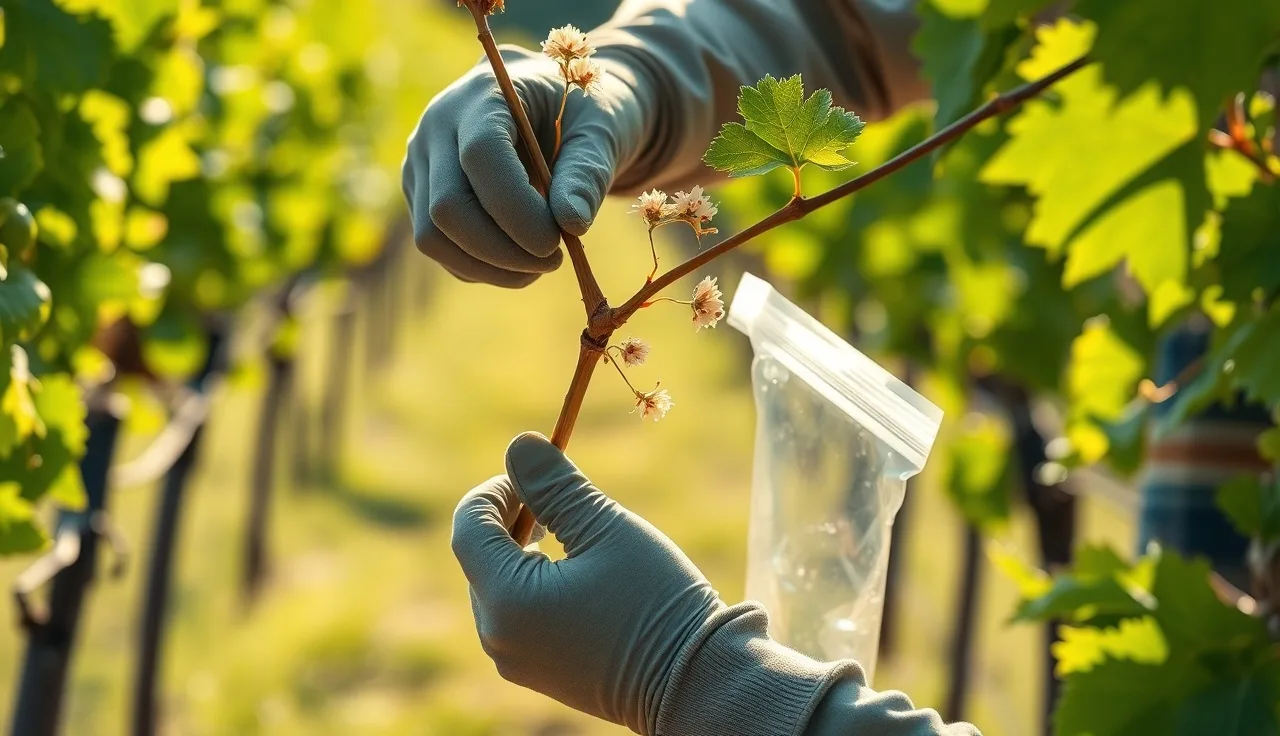
To remove the petiole: hold the leaf blade with one hand, grasp the petiole close to where it attaches to the cane, and snap it off cleanly with a twist. You want just the petiole, not the blade. Some labs want the blade included for certain analyses, but most standard petiole panels run on the petiole alone. Check your lab's submission instructions before you head out.
Use nitrile gloves. This isn't safety theater, it's a contamination issue. Skin contact deposits sodium, potassium, and zinc onto the tissue surface and skews your results. The EPA Worker Protection Standard (WPS) also applies to re-entry intervals in treated blocks, so confirm any applicable REIs have expired before you enter a block to sample [5]. That's non-negotiable from a compliance standpoint. Double-check your spray records before you pull your crew into a recently treated block.
If your block had a recent foliar application of a nutrient (zinc sulfate, for example), wait at least two weeks before sampling. Surface residue will contaminate tissue readings.
How do you prepare and handle petioles in the field?
Contamination and degradation are the two things that ruin otherwise well-collected samples. Here's how to avoid both.
Field preparation: bring zip-lock plastic bags or paper bags (labs differ on preference; check yours), a cooler with ice packs, a permanent marker, and your field map showing block IDs. Some labs send pre-labeled submission bags. Use those if available, because the barcoding prevents transcription errors.
Do not wash petioles before shipping unless your lab explicitly instructs it. Most labs prefer to do their own washing with distilled water to remove surface contamination in a controlled way. If you're sampling on a day when there's visible spray residue, dust, or irrigation water residue on the tissue, you can gently wipe the petiole with a clean damp cloth before bagging, but talk to your lab first.
Keep samples cool. Heat causes enzymatic breakdown that alters nitrate-nitrogen readings significantly. Put bagged samples in your cooler immediately. Never leave bags in a hot truck cab.
Label every bag clearly with block ID, variety, rootstock, date, sample collector name, and phenological stage. If you're using a record-keeping platform like VitiScribe to track your spray and fertility records, log the sampling event with GPS coordinates so you can tie the lab result back to the exact block when your report comes in.
Ship samples the same day if possible, or the next morning at the latest. Most labs want samples within 24-48 hours of collection. Use overnight mail if you're more than a day's drive from the lab.
Which nutrients does a standard petiole panel test for?
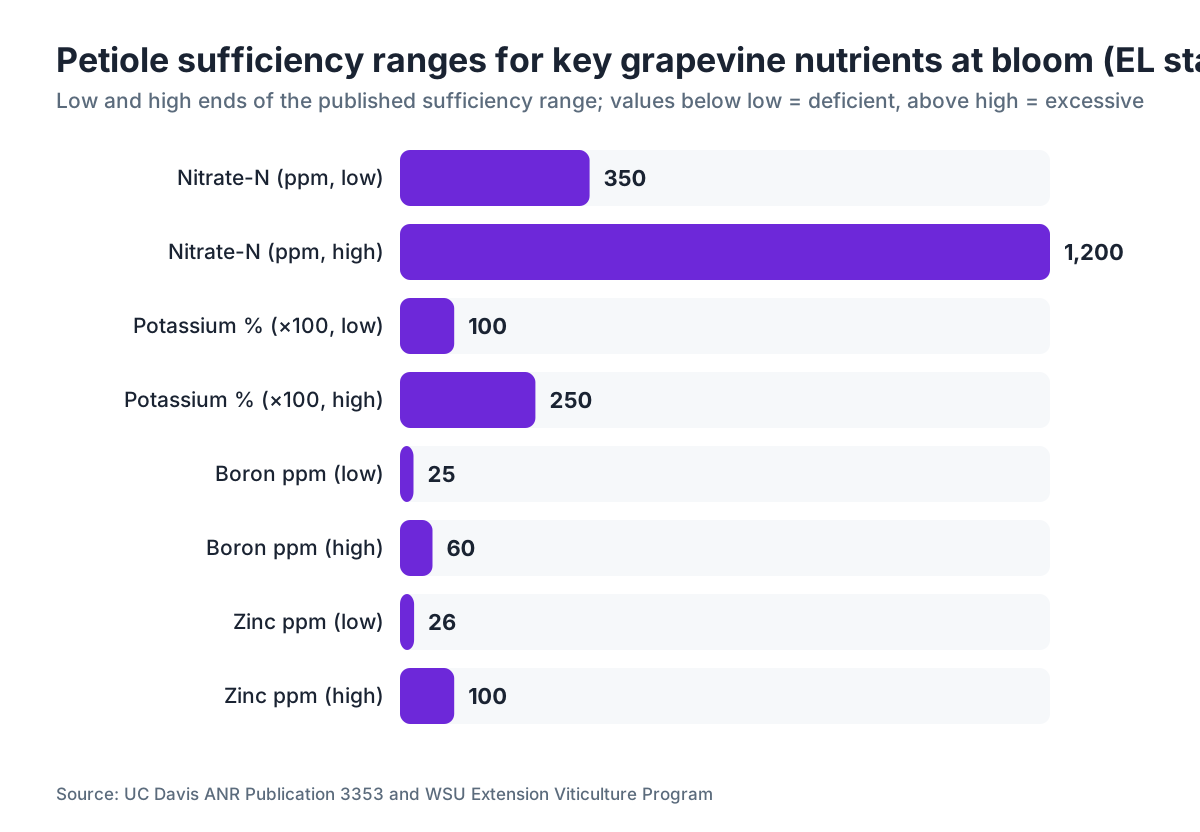
A standard panel from most university-affiliated or commercial ag labs covers 10-15 nutrients. The most commonly reported, and the ones with the strongest research-backed sufficiency ranges for grapevines, are:
| Nutrient | Typical bloom sufficiency range (% or ppm) | Source |
|---|---|---|
| Nitrate-N (NO3-N) | 350-1200 ppm | UC Davis [1] |
| Phosphorus (P) | 0.12-0.35% | UC Davis [1] |
| Potassium (K) | 1.0-2.5% | UC Davis [1] |
| Calcium (Ca) | 1.0-2.5% | UC Davis [1] |
| Magnesium (Mg) | 0.30-0.80% | UC Davis [1] |
| Boron (B) | 25-60 ppm | WSU [2] |
| Zinc (Zn) | 26-100 ppm | WSU [2] |
| Iron (Fe) | 30-100 ppm | UC Davis [1] |
| Manganese (Mn) | 30-300 ppm | UC Davis [1] |
| Copper (Cu) | 3-20 ppm | WSU [2] |
These ranges vary somewhat by variety, rootstock, and region. Warm-climate varieties like Zinfandel tend to run higher potassium than cool-climate Riesling, and rootstocks like 101-14 and 3309 have different uptake efficiencies than SO4 or 1103P. Compare your results to ranges published for your region and rootstock combination where you can.
Nitrate-nitrogen is the most time-sensitive measurement, because nitrate converts to ammonium in plant tissue after death. That's why the 24-48 hour shipping window matters most for nitrogen results. Some labs use total nitrogen (Kjeldahl N) instead of nitrate-N. The two are not directly comparable, so clarify with your lab which method they use [4].
How do you interpret petiole results and decide what to do?
Labs return results as a printed or digital report with your measured values alongside the sufficiency range for each nutrient. Anything below the low end is deficient. Anything above the high end is excessive. Both conditions can hurt yield and quality, though toxicity is less common than deficiency in most wine grape regions.
The most common deficiencies found in commercial vineyards, based on survey data from UC Cooperative Extension, are nitrogen, potassium, boron, and zinc [7]. Iron chlorosis shows up most often on high-pH calcareous soils.
For nitrogen deficiency flagged at bloom: a post-bloom fertigation or foliar application of urea can partially correct a shortfall within the same season. But significant nitrogen deficits are better addressed with a fall soil application of organic nitrogen sources or a spring application before budbreak the following year. The vine's ability to take up and store nitrogen in the permanent wood (reserve nitrogen) is set in fall, so one low bloom sample is really a flag to look at your prior-year fall management.
For potassium: high rates of potassium fertilizer raise juice pH, which reduces titratable acidity and can flatten your wine's structure. If your petiole K is deficient but your soil K is adequate, look at root distribution, compaction, and soil moisture before applying more. Many apparent K deficiencies in drip-irrigated blocks are really soil-distribution problems.
For boron: boron deficiency causes poor fruit set, often visible as "shot berry" or irregular cluster size. A pre-bloom foliar boron application at 0.1-0.2 lb actual boron per acre corrects most shortfalls for the current season [8]. Don't over-apply. Boron toxicity is real, and the margin between deficiency and toxicity is smaller than for most other nutrients.
Look at ratios, more than absolute numbers. A high potassium level combined with low calcium and magnesium suggests cation antagonism, more than a potassium surplus.
What equipment and supplies do you need before you go out?
You don't need much, but you do need all of it.
Nitrile gloves (not latex, not vinyl, both can leach compounds into tissue). Resealable bags or paper bags per your lab's instructions. A permanent marker. A field notebook or your phone to log block ID, variety, rootstock, date, and stage. A soft cooler with ice packs. A copy of your block map showing which blocks are scheduled to be sampled.
Optional but useful: a hand lens or loupe to confirm you're at the right phenological stage, especially for early bloom. A GPS device or app to log sample points. Pre-printed labels if your lab provides them.
You don't need scissors or a knife. Petioles snap off cleanly by hand, and a blade introduces a contamination risk from the metal surface.
Before heading out, pull your spray records and confirm that any recently treated blocks are past their re-entry interval under the EPA Worker Protection Standard [5]. If you're the one managing compliance paperwork, log that a sampling activity occurred in the field record so your pesticide application and sampling events don't get separated at audit.
How much does petiole analysis cost, and which lab should you use?
A standard 10-15 nutrient petiole panel runs $20-$50 per sample at most commercial and university extension labs in the US [4]. Rush turnaround (24-48 hours versus the standard 5-7 business days) typically adds $15-$30. If you're sampling 10 blocks at bloom, budget $200-$500 for the whole analysis. That's a small fraction of a single acre-foot of water or one pass with a spray rig.
University-affiliated labs often have strong research backing for their sufficiency ranges, because those ranges were developed from trials in their own growing regions. Good options depending on your geography:
UC Davis Plant and Environmental Sciences analytical lab serves California growers and has grapevine-specific reference ranges [1]. Washington State University's Viticulture and Enology program and the WSU extension system point to labs calibrated for Pacific Northwest conditions [2]. Cornell Cooperative Extension publishes ranges for Northeast varieties and can point growers to accredited labs in the region [3]. A&L Great Lakes, Waypoint Analytical, and Soiltest Farm Consultants are examples of commercial labs with established grapevine programs, though you should verify their reference ranges match your regional conditions.
Whatever lab you use, stay consistent year over year. Switching labs mid-run can shift your trend lines, because analytical methods and reference ranges aren't perfectly standardized across providers.
How does petiole sampling connect to your spray and compliance records?
Petiole sampling and spray records are more connected than most managers realize. If you apply a foliar micronutrient (zinc, boron, copper) and then pull petiole samples two weeks later without noting the application in your sampling log, your elevated petiole readings will look like adequate nutrition when they may actually be surface contamination. The reverse also bites: if your spray records show a late-season nitrogen application and your petiole nitrogen comes back high, you need to know whether that's genuinely good vine status or a recent application artifact.
Keeping your sampling records, spray records, and lab reports in the same system saves a lot of confusion at the end of the season. VitiScribe links block-level field events, so when you pull up a petiole result from a block, you can see the preceding spray history in the same view without digging through separate folders.
Your petiole sampling records also document your due diligence on nutrient stewardship, which matters for some certification programs (organic, sustainable wine certification, SIP Certified in California) that ask for evidence of nutrient monitoring [6]. Keep lab reports for at least three years. Some auditors want to see year-over-year trend data, more than a single-year snapshot.
What are the most common mistakes growers make when petiole sampling?
Sampling at the wrong growth stage is the single most common error. A petiole pulled two weeks after bloom generates numbers that don't match any published table, and labs will sometimes report them anyway without flagging the issue. Know your EL stages.
Sampling symptomatic vines only. If you only pull petioles from vines showing chlorosis or stunting, you'll confirm deficiency but lose the ability to know whether the rest of the block is adequate. You need the block average, not the worst-case reading.
Lumping heterogeneous blocks. If your block spans two soil types, two irrigation zones, or two rootstocks, one composite sample gives you an average that may mask a real problem in the weaker half.
Not accounting for recent foliar applications. Wait at least two weeks after any foliar nutrient application before sampling. This matters most for zinc, boron, and copper, which show up strongly in surface contamination.
Shipping slowly. Samples sitting in a warm mailbox over a weekend lose nitrate-nitrogen integrity fast. Ship Monday through Wednesday to avoid weekend delays at the lab or postal service.
Ignoring the trend. A single year's petiole result tells you something. Three years of results in the same block tells you whether a correction you made actually worked. File your reports and revisit them annually before you make the next season's fertility decisions.
Not logging the sampling event. If the sample isn't recorded in your field records with the date, block, and phenological stage, you can't reliably interpret the lab report six weeks later when it arrives.
How does petiole analysis compare to other vine tissue tests?
Petiole analysis is the most widely used vine tissue test, but it's not the only one. Whole-leaf blade analysis is sometimes used when you want a fuller picture of nutrient content, since the blade holds more total nutrient mass than the petiole. Blade analysis has more variability, though, because leaf size and age differ more than petiole composition, and fewer published sufficiency ranges exist for blades alone [10].
Sap analysis is a newer, faster approach that gives almost real-time data on plant-available nutrients in the xylem sap. It has generated interest in precision viticulture circles, but the published sufficiency ranges for sap analysis in grapevines are much thinner than those for petioles. Nobody has good data yet on how sap thresholds translate to yield or quality outcomes across many varieties and regions. Until those calibrations are published and peer-reviewed, sap analysis is best used as a complement to petiole analysis, not a replacement.
Soil tests stay necessary alongside petiole analysis, because they tell you about nutrient reserves and pH, which affect what happens over the long run. Petiole analysis tells you what the vine is experiencing right now. Good fertility management uses both.
Petiole analysis is also faster to turn around than most biological or physical soil tests, and it's cheaper than sap analysis equipment if you're outsourcing to a lab rather than buying on-farm instruments.
Frequently asked questions
Can I take petiole samples before bloom to get an early read on vine nutrition?
For most nutrients, pre-bloom samples can't be compared to published sufficiency ranges because those ranges were calibrated at bloom or veraison. The one exception is boron, where some extension programs recommend sampling at early shoot development (EL stage 12-14) to catch deficiency before pollination damage occurs. For a full nutrient panel, wait for 50% bloom.
How long can I store petioles before shipping to the lab?
Ship within 24-48 hours of collection, kept cool in an ice-packed cooler. Nitrate-nitrogen degrades fastest; samples left at room temperature for more than 24 hours can show falsely low nitrogen readings. Never freeze samples unless your lab specifically instructs you to. Ship Monday through Wednesday to avoid weekend transit delays.
Do I need different sufficiency ranges for different grape varieties?
Yes, to a degree. UC Davis and WSU both note that variety affects baseline petiole concentrations, particularly for potassium and nitrate-nitrogen. Varieties like Zinfandel tend to run higher petiole potassium than Riesling under similar conditions. Ask your lab whether their reference ranges are calibrated for your specific variety, or look at the variety-specific tables in UC Davis ANR Publication 3353.
What if my petiole potassium is very high but my fruit quality is suffering?
High petiole potassium raises juice pH and lowers titratable acidity, which can make wines taste flat or reduce natural microbial stability. If bloom petiole K exceeds 2.5%, reduce or eliminate potassium applications the following season and look at cover crop management to compete for uptake. Also check for cation imbalance: high K often suppresses calcium and magnesium uptake at the same time.
How many blocks should I sample across a whole vineyard?
Every distinct management unit deserves its own sample. At minimum, separate blocks by variety and rootstock combination. If soil types differ significantly within a block, split it. There's no scientific shortcut here: one composite sample across 20 acres of mixed soil types gives you almost no actionable information. Budget for one sample per 5-10 acres of distinct growing conditions.
Can I use the same petiole sufficiency ranges year after year, or do they change?
The core published ranges from UC Davis and WSU are updated infrequently, typically when a new survey or multi-year trial revises recommendations. The UC Davis ranges in ANR Publication 3353 have been stable for many years. Check with your lab or extension contact for any regional updates. More importantly, your own year-over-year trend data matters as much as the static sufficiency range.
Does the EPA Worker Protection Standard affect petiole sampling?
Yes. If the block was recently treated with a pesticide carrying a re-entry interval (REI), workers entering to sample must follow that REI unless they have personal protective equipment specified by the label. The EPA WPS requires that employers post treated field information and inform workers before they enter. Check your spray records against the WPS re-entry requirements before scheduling any sampling crew.
Should I wear gloves while collecting petioles?
Yes, always wear nitrile gloves. Skin oils and sweat contain sodium, potassium, and zinc that can contaminate the tissue surface and artificially inflate those readings on your lab report. Latex and vinyl gloves can also leach compounds into the sample. Nitrile is the standard recommendation from most lab submission protocols.
What should I do if my petiole nitrogen is deficient at bloom?
A post-bloom foliar urea application (typically 5-10 lb urea per acre in dilute solution) can partially address the current season's deficit. More importantly, investigate why: insufficient compost or cover crop incorporation the prior fall, excessive rainfall leaching nitrate, or competition from a dense cover crop. A long-term nitrogen deficit is corrected between seasons, not mid-summer.
How is petiole analysis different from leaf blade analysis?
The petiole is the stem connecting the leaf to the cane; blade analysis uses the flat leaf tissue itself. Petiole analysis has far more published sufficiency data for grapevines than blade analysis, making it the standard diagnostic tool. Blade analysis is sometimes used for specific nutrients like phosphorus where blade concentrations show less variability, but for most fertility programs, petiole is the more reliable choice.
What does it mean if my zinc is deficient on the petiole report?
Zinc deficiency (below roughly 26 ppm at bloom) often causes small, mottled leaves and poor shoot development. It's common on sandy soils, high-pH soils, and where phosphorus has been over-applied, because P can block zinc uptake. A pre-bloom or at-bloom foliar zinc sulfate application typically corrects deficiency within the current season. Confirm you haven't applied foliar zinc recently before reading a high result as adequate.
Can I use petiole data to adjust my drip fertigation program mid-season?
Yes, this is one of the strongest uses of bloom petiole data. If nitrogen or potassium is deficient at bloom and you have drip irrigation, a fertigation application of calcium nitrate or potassium nitrate can go on within 2-4 weeks of bloom, before it's too late to affect fruit set and early berry development. Veraison samples are better suited for diagnosing problems to correct the following year.
Sources
- UC Davis ANR, Grapevine Nutrition (UC ANR Publication 3353 / UC Cooperative Extension): Standard petiole sampling is at EL stage 23 (50% bloom); sufficiency ranges for nitrate-N, P, K, Ca, Mg, Fe, Mn, and other nutrients are published for California wine grapes
- Washington State University Extension, Viticulture and Enology Program: WSU recommends bloom petiole sampling as the primary vine nutrition diagnostic and publishes sufficiency ranges for boron (25-60 ppm), zinc (26-100 ppm), and copper (3-20 ppm)
- Cornell Cooperative Extension, Viticulture Program: Cornell publishes petiole sufficiency ranges calibrated for cool-climate varieties grown in the Northeast, including Finger Lakes and Lake Erie regions
- Waypoint Analytical (commercial ag lab), petiole panel pricing: Standard petiole panels run $20-$50 per sample at commercial ag labs; rush turnaround adds $15-$30
- U.S. EPA, Worker Protection Standard for Agricultural Pesticides: The EPA Worker Protection Standard requires employers to post treated field information and enforce re-entry intervals before workers, including sampling crews, enter treated fields
- SIP Certified (Sustainability in Practice), California wine grape certification program: SIP Certified requires documentation of nutrient monitoring practices, for which petiole sampling records serve as evidence
- UC Cooperative Extension, Nutrient Management Guidelines for Wine Grapes: The most common deficiencies in California wine grape vineyards are nitrogen, potassium, boron, and zinc, based on UC Cooperative Extension survey data
- WSU Extension, Boron Management in Pacific Northwest Vineyards: A pre-bloom foliar boron application of 0.1-0.2 lb actual boron per acre corrects most boron deficiencies for the current season without risk of toxicity at standard rates
- UC Davis, Grapevine Phenology: Eichhorn-Lorenz Scale: EL stage 23 is defined as approximately 50% flower cap fall (50% bloom), the standard reference point for petiole sampling
- Cornell University, Grapevine Nutrition Fact Sheet: Whole-blade tissue analysis has fewer published grapevine sufficiency ranges than petiole analysis, making petiole the preferred diagnostic method for most growers
Last updated 2026-07-11