How to manage trunk disease when replanting vineyard sections
TL;DR
- Trunk diseases like Botryosphaeria dieback, Eutypa lata, and Esca live in old wood and root debris, and they infect new vines within a season.
- Before you replant, pull and burn infected stumps, fumigate or biofumigate the soil, source vetted nursery stock, seal every pruning wound the same day, and log each treatment for Worker Protection Standard compliance.
What trunk diseases are you actually dealing with in a replant block?
Probably more than one at the same time. Trunk disease is not a single pathogen. It's a group of fungal species that colonize woody tissue, block vascular flow, and kill the vine from the inside out. Four show up in most U.S. wine regions: Eutypa lata (Eutypa dieback), Botryosphaeria species (Bot canker, also called dead arm), Esca-associated fungi (mainly Phaeoacremonium minimum and Phaeomoniella chlamydospora), and Cylindrocarpon/Ilyonectria species (Black foot disease).
Eutypa and Bot are the workhorses of the problem. UC Davis Cooperative Extension puts Eutypa lata as the dominant trunk pathogen in California coastal vineyards, with infection happening almost entirely through pruning wounds [1]. Botryosphaeria species are more opportunistic. They colonize vines already stressed by drought, heat, or mechanical damage. Esca scares growers most because it causes apoplexy, where a vine collapses and dies in a single summer with almost no warning.
Black foot is the one you can't overlook in a replant. Ilyonectria species live in soil and infected planting material, and they hit young vines hardest, often before the vine ever establishes. A 2019 survey in Phytobiomes Journal found Black foot fungi in over 60 percent of replanting sites examined across California wine regions [2]. Other surveys don't all land on that number, but every extension program I've seen says assume it's there.
Knowing which pathogen you're fighting changes your fumigation plan, your nursery stock specs, and what you protect against at pruning. Get a lab confirmation if the block had known trunk disease losses. UC Davis Cooperative Extension and Cornell's Plant Disease Diagnostic Clinic both run vine wood diagnostics [3].
Why does trunk disease keep coming back after replanting?
Because you left the inoculum in the ground. That's the blunt answer, and growers learn it the hard way.
Old vine stumps, buried wood fragments, and root debris are reservoirs. Eutypa lata produces airborne ascospores that travel long distances in rain events, so even if you clean up your own block perfectly, inoculum from neighboring vines or a brush pile at the vineyard edge reaches your fresh pruning wounds [1]. Botryosphaeria and Esca-associated fungi produce spores that spread locally from infected wood left on the ground or hanging on the trellis.
Soil persistence is the other half. Ilyonectria and Cylindrocarpon species live in old root fragments for years. WSU's Viticulture and Enology program has documented Black foot re-infecting new vines from old root debris four years after the original planting came out [4]. Waiting them out isn't a strategy.
A third route is the nursery. This one is uncomfortable to say plainly. Certified nursery stock in the U.S. is tested for phylloxera and a handful of viruses, not systematically for every trunk pathogen. UC Davis work has found Botryosphaeria and Phaeoacremonium in dormant nursery cuttings at rates from 5 to 30 percent depending on the lot [1]. That's not a knock on every nursery. It means you can't assume clean vines in the box.
What soil preparation and fumigation steps actually reduce replant risk?
The sequence matters more than any single treatment. Do these out of order and you pay for them twice.
First, rip and remove. Pull every stump, get as much root mass out as you can, and clear wood debris off the field. Don't chip infected wood on-site. Burn it or haul it off. Chipped wood left in the row becomes a spore factory.
Second, deep rip to at least 90 cm (about 36 inches). This breaks up any compaction layer and exposes root fragments so the next step can reach them. It's also the moment to pull soil samples for nematode and disease diagnostics.
Third, fumigate or biofumigate. Methyl bromide is gone for most uses. The registered options in most states are metam sodium, metam potassium (both applied through drip or shank), and 1,3-dichloropropene. Each carries a restricted-use permit requirement and a set replanting interval before you can put vines in. Check your state's label requirements, because California's intervals differ from Washington's [5]. If you want to skip synthetic fumigants, brassica cover crop biofumigation (incorporating high-glucosinolate mustard at high biomass) has shown modest suppression of Pythium and some Cylindrocarpon populations in trials. The efficacy data is weaker than for registered fumigants. WSU Extension recommends it as a complement, not a replacement [4].
Fourth, let the soil rest. Most fumigation labels require a wait of 4 to 12 weeks before planting, for phytotoxicity reasons and to allow off-gassing. Use that window to irrigate and watch for re-weed pressure.
Fifth, apply a biological soil amendment at planting if your extension program recommends it. Trichoderma-based products (several are registered for vineyard use) have shown some efficacy against Black foot pathogens in replant scenarios in UC trial work. Results are variable and often site-specific [1].
How do you choose nursery stock that won't reintroduce trunk pathogens?
Ask specific questions. Don't just order certified plants and figure you're covered.
Certified grapevine material in California runs under the California Department of Food and Agriculture's Grapevine Registration and Certification Program. Certification covers virus testing (leafroll, fanleaf, red blotch, and others) but does not require testing for Botryosphaeria, Eutypa, or Phaeoacremonium [6]. That's the gap you're working around.
Here's what to ask your nursery. What are their internal trunk pathogen testing protocols? Do they hot-water treat dormant cuttings before grafting? Hot-water treatment at 50 degrees Celsius for 30 minutes has cut internal latent infections of Esca-associated fungi and Botryosphaeria in multiple trials, without wrecking bud viability when done right [1]. Not every nursery does it. Some will on request with enough lead time.
Ask about the source vineyard for the mother vines too. If the mother block had documented trunk disease problems, the cutting material carries elevated risk no matter how clean the nursery operation is.
When vines arrive, spot-check a sample. Cut cross-sections on 5 to 10 percent of the arrival material and look for vascular staining or dark necrotic wood at the graft union or below. Find more than a couple of suspicious plants in a hundred, call the nursery and send samples to a diagnostic lab before the whole order goes in the ground.
For a replanted vineyard block, this is the highest-value thing you can do per dollar of time spent.
What pruning wound protection actually works and when do you apply it?
The infection window for Eutypa and Botryosphaeria opens within minutes of the cut. That's not an exaggeration. Rain event spore dispersal is the main vector, so pruning during or just before rain is the riskiest thing you can do [1].
Registered wound protection in the U.S. falls into three groups.
Paints and pastes with the fungicide thiophanate-methyl (Topsin-M) are the most widely used. Apply right after the cut, within 30 minutes if you can, and again if rain hits before the cut seals. UC Davis research has documented 70 to 90 percent reduction in Eutypa infection rates with timely application [1].
Biological protectants based on Trichoderma atroviride (Vinevax and similar products) are registered for this use. Efficacy runs lower than thiophanate-methyl in head-to-head trials, but they fit organic programs and give real protection when applied correctly.
Beeswax and latex sealants, with no fungicide active ingredient, give minimal protection against trunk pathogens. They're fine for cold protection at the graft union. Don't lean on them as a disease barrier.
In a replant block, protect every pruning cut for the first three to five years. Young vines are disproportionately vulnerable because they compartmentalize infection less well than mature vines. Prune in dry periods and cover cuts with protectant before any wet weather arrives. That one habit pays off more consistently than anything else on this list.
How do you train young vines to reduce future trunk disease risk?
Training system choice has real consequences here. A lot of growers pick a system on labor cost or existing trellis without thinking through the disease side.
Double Guyot and bilateral cordon systems need more large pruning cuts per vine per year than spur-pruned systems, which means more wound exposure. That's no reason to avoid them. It's a reason to be more disciplined about wound protection when you use them.
Leave longer stubs than you think you need, especially the first few years. It feels backward, but cutting flush to the cordon or trunk drives dieback straight into the main wood when infection sets in. WSU Extension's guidance on training young vines recommends leaving stubs of at least 2 to 3 nodes above the permanent spur position, then cutting back once the stub has died and sealed in a later year [4].
Avoid large cuts during establishment. Every big pruning cut in the first three years is an entry point. Build the vine structure gradually instead of making aggressive corrective cuts early. If a young vine has bad architecture, it's often smarter to take the loss and retrain from a low bud than to make several large cuts on a two-year-old.
The minimal pruning approach, sometimes called the Mildura system, has been studied as a trunk disease reduction strategy because it makes fewer wounds per season. It doesn't fit premium wine production for canopy management reasons, but some growers use modified versions in the first two or three years of establishment.
What are your options if some replanted vines already show trunk disease symptoms?
A few symptomatic vines in a young block is a warning, not a catastrophe. What you do next season decides whether it stays contained.
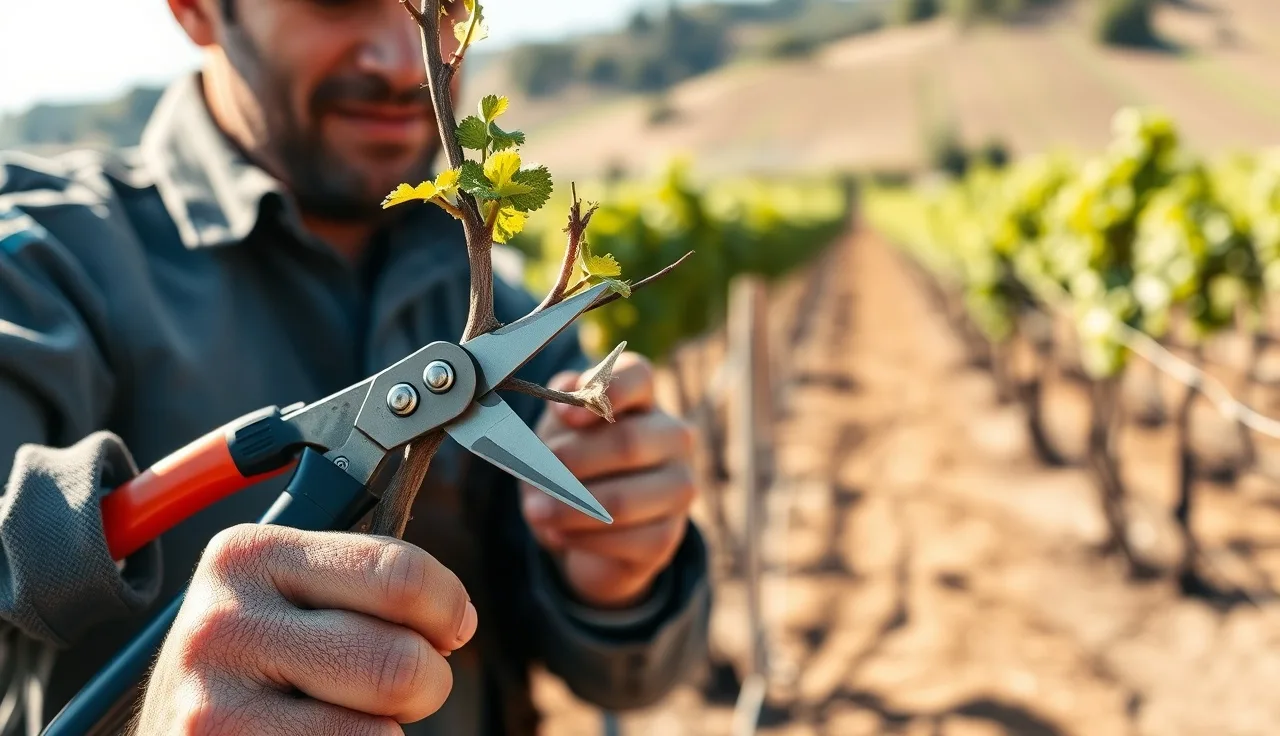
For young vines with early Botryosphaeria or Eutypa symptoms (wedge-shaped cankers, dead spurs, stunted shoots with chlorotic or 'fried egg' leaves), remedial surgery is the first tool. Cut back into clean, uncolored wood, well below the visible margin of any discolored tissue. Disinfect tools between cuts with a 10 percent bleach solution or 70 percent ethanol. Seal every cut surface with wound protectant.
Esca changes the math. Esca-associated fungi sit deep in the wood and often can't be pruned out. If a vine shows foliar symptoms but not apoplexy, some growers manage it for several seasons by cutting the whole vine back to a low stub and retraining a new shoot. Cornell's research on remediation has documented partial recovery from this cutback in early-stage Esca, though long-term survival data is mixed [3].
Black foot in young vines has no surgical fix. The pathogen is in the root system. If you see multiple young vines failing in a pattern with stunted growth, short internodes, and necrotic crowns at or below the soil line, pull them and send roots for lab confirmation. If it's Black foot, treat the surrounding soil before you replant that spot again.
Keep records of which rows and positions show symptoms. Spatial clustering tells you something about how the inoculum is distributed. This is exactly the kind of field data worth logging in a structured system like VitiScribe, so you can map disease spread across seasons instead of relying on memory or a paper map that gets wet.
What does the EPA Worker Protection Standard require for trunk disease treatments in replanted blocks?
Any restricted-use fumigant or registered fungicide you apply during replanting carries Worker Protection Standard obligations, and several of them trip growers up during audits.
The EPA's Worker Protection Standard (40 CFR Part 170) requires that all agricultural workers and pesticide handlers get WPS training every year. It requires a central posting location for pesticide application information and safety data sheets, and it sets specific Restricted Entry Intervals you must communicate and enforce [7]. EPA's own summary states the rule is meant to "reduce the risk of pesticide poisonings and injuries among agricultural workers and pesticide handlers."
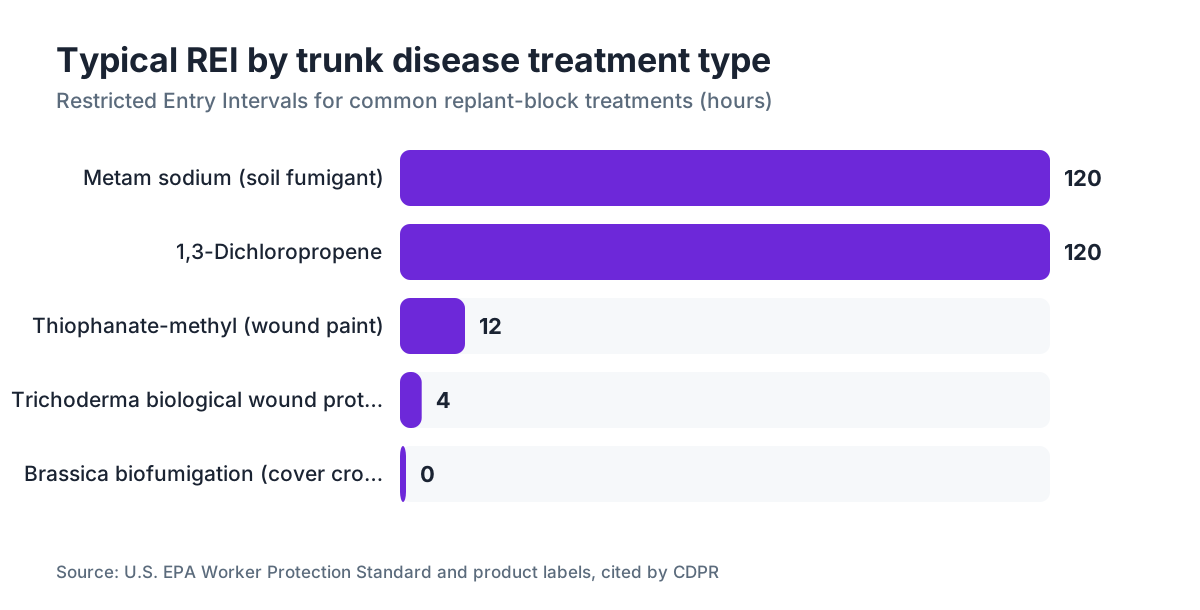
For soil fumigants like metam sodium, the REI is typically 5 days, and the product needs a Licensed Pest Control Adviser recommendation in California plus a Restricted Use Permit in most states [5]. Fumigation operations require specific handler PPE, emergency eyewash access, and in some cases an on-site monitoring protocol. The label is the law, and fumigant labels are among the most complex in agriculture.
For fungicide wound protectants, the REI is shorter, typically 12 to 24 hours depending on product. You still need each application logged with the field, application rate, and applicator information. California's Department of Pesticide Regulation requires pesticide use reports filed by the County Agricultural Commissioner deadline, which is the 10th of the month following application [5].
WSU Extension's viticulture program publishes a field record-keeping template that maps to WPS requirements [4]. Cornell's integrated pest management program has similar resources for the Northeast [3]. If you're running several replant blocks in a season, keeping these records in a digital format that auto-fills product info from registered labels saves hours and cuts the risk of a filing error.
| Treatment | REI (typical) | Restricted Use? | Permit Required |
|---|---|---|---|
| Metam sodium (soil fumigant) | 5 days | Yes | Yes (most states) |
| 1,3-Dichloropropene | 5 days | Yes | Yes |
| Thiophanate-methyl (wound paint) | 12 hours | No | No |
| Trichoderma biologicals | 4 hours | No | No |
| Brassica biofumigation | None (not a pesticide) | No | No |
How do you set up a multi-year monitoring plan for the replanted block?
Replanting is a five-year commitment, not a one-season fix. The blocks that come back clean are the ones where someone walks them on a schedule and keeps notes.
Year 1 (planting year): Flag and record the position of every vine, with variety, rootstock, and source nursery lot number. If a vine fails or shows symptoms in year one, that traceability tells you whether it's a nursery problem or a field problem. Walk the block after each significant spring rain and note any slow-leafing or weak vines.
Years 2 and 3: This is when Black foot becomes visible if it's present. Look for stunted growth next to healthy neighbors, short internodes, small leaves, and root systems that turn brown and corky when you dig. Watch for the first spur dieback too, which can be early Eutypa or Botryosphaeria.
Years 4 and 5: Esca symptoms tend to show up in this window in infected vines, usually after the vine reaches some vigor. The 'tiger stripe' interveinal chlorosis on leaves is the visual cue. Apoplexy can hit any time after year 3 in a stressed season.
A workable cadence: walk the block formally four times a season (bud break, three to four weeks post-set, veraison, post-harvest). Make a GPS-tagged note or a row-and-position record for any vine that looks off. After three seasons, map the distribution. Clustered failures point to soil-borne issues. Scattered random failures fit nursery stock or pruning wound infection.
For growers keeping spray records and block notes in one place, VitiScribe's field logging tools let you attach photos and GPS coordinates to individual vine positions, which makes longitudinal tracking far less painful than a paper system.
Does rootstock choice affect trunk disease susceptibility in replanted sections?
Yes, and the differences matter, though the data isn't as clean as you'd like.
For Black foot specifically, rootstock susceptibility varies. In trials published in Plant Disease, Richter 110 and 1103 Paulsen showed lower rates of Ilyonectria colonization than SO4 and Teleki 5C under equivalent soil inoculum pressure [8]. The differences were statistically significant but nowhere near full protection.
For above-ground trunk pathogens like Eutypa and Botryosphaeria, rootstock has less influence because infection happens through aerial pruning wounds above the graft union. Vigor level matters indirectly. Higher-vigor rootstocks produce more vegetative growth, which means more pruning cuts and more wound surfaces per year.
When you're choosing rootstock for a replant block with a trunk disease history, weigh soil type and drainage (poor drainage favors Black foot), phylloxera pressure, target vigor, and any nematode issues from soil sampling. UC Davis Viticulture and Enology publishes a rootstock comparison tool that covers most of these variables, and their farm advisors give region-specific guidance [9].
Don't make rootstock the thing you spend the most planning time on. It matters, but it won't save a block where inoculum was left in the soil and nursery stock never got checked.
What does a realistic replanting timeline and budget look like?
Nobody hands you a clean number, because it swings on region, labor market, fumigation choice, and whether you're reusing trellis. Here's an honest breakdown of the variables and rough ranges as of 2024.
Stump removal and deep ripping: $1,200 to $2,500 per acre depending on vine density and equipment availability. This isn't optional if you're managing trunk disease. Grinding in-row without pulling stumps leaves all the inoculum behind.
Soil fumigation (metam sodium drip application): $800 to $1,800 per acre for materials and application in California based on recent CDPR-reported use data [5]. Washington and Oregon run in a similar range but vary by county.
Nursery stock (certified grafted vines): $4.00 to $7.00 per vine as of 2024, depending on rootstock, variety, and order size. Per-acre costs run from about $1,600 to $3,500 at typical wine grape densities.
Planting labor and trellis repair: $1,500 to $3,000 per acre depending on whether existing infrastructure gets reused.
Pruning wound protection materials for years 1 to 5: low, roughly $100 to $300 per acre per year for product. Labor is the bigger variable.
Total investment to first commercial crop (typically years 3 to 5 depending on variety): most California wine grape consultants estimate $15,000 to $25,000 per acre all-in for a full replant with fumigation and new trellis, and $10,000 to $16,000 for a replant on existing trellis. These are ranges, not guarantees, and they don't count the revenue you lose during the out-of-production years.
The time you spend on pre-plant disease management is not wasted money. A replanted block that gets reinfected in year two or three doesn't just cost you the replant. It costs you another full round of this entire process.
Frequently asked questions
Can you replant grapevines in the same hole where a trunk-diseased vine was removed?
You can, but it's the riskiest approach. The old root system left in the soil carries Ilyonectria and other pathogens. At minimum, remove as much old root material as you can, treat the immediate soil zone with a registered fumigant or a Trichoderma-based biological, and wait the full label-required interval before planting. UC Davis extension advises against same-hole replanting without at least partial soil treatment.
How long should you wait between removing diseased vines and replanting?
Most extension programs recommend a minimum of one full growing season, ideally two, especially if Black foot or heavy Botryosphaeria pressure was present. That window lets fumigants off-gas fully, gives you time to monitor soil-borne pathogen levels, and lets you source and vet nursery stock properly. Rushing the timeline is the most common reason a replanted block fails again.
What is the difference between Eutypa dieback and Botryosphaeria dieback in grapevines?
Both cause wedge-shaped cankers and shoot stunting, but Eutypa produces small, chlorotic, distorted leaves with marginal scorch on affected shoots early in the season. Botryosphaeria cankers tend to spread faster and often follow drought stress and heat events. Lab confirmation from a cross-section sample is the only reliable way to tell them apart. UC Davis has published a visual ID guide for both.
Does hot-water treatment of nursery cuttings really work for trunk disease prevention?
The evidence says yes for Esca-associated pathogens and Botryosphaeria. UC Davis trials showed a significant drop in internal latent infections after treatment at 50 degrees Celsius for 30 minutes. The tradeoff is a slight bud viability reduction if temperature control is imprecise. It's a reasonable thing to negotiate with your nursery for high-value replanting blocks, and some nurseries now offer it as standard.
What fungicides are registered for pruning wound protection in organic vineyards?
Trichoderma atroviride-based products (Vinevax is the most widely used trade name) are OMRI-listed and registered for this use. Bacillus-based products are also labeled for some wound protection uses. Efficacy in trials runs lower than thiophanate-methyl, but it's meaningful, especially when applied right after cutting. Sulfur-based products do not give reliable trunk pathogen wound protection.
How do you know if trunk disease killed a vine versus other causes like phylloxera or crown gall?
Cross-section the wood at the trunk base and at multiple heights. Trunk disease typically shows vascular staining or a wedge of dark, necrotic tissue following the vascular tissue. Crown gall shows as a distinct tumor at the graft union or lower trunk. Phylloxera shows as root damage with secondary root proliferation and characteristic feeding scars. A diagnostic lab can confirm from wood or root samples when the picture is unclear.
Are there any cover crop options that reduce trunk disease inoculum in replant sites?
Brassica cover crops with high glucosinolate content (mustard varieties like Caliente 199) incorporated as a green manure at high biomass have shown some suppression of Pythium and Cylindrocarpon populations in WSU and UC trials. Efficacy against Eutypa and Botryosphaeria isn't well established, since those pathogens come mainly from aerial spores, not soil. Biofumigation is a useful complement to other strategies, not a standalone fix.
How do you disinfect pruning tools to prevent spreading trunk disease between vines?
Two standard options: a 10 percent sodium hypochlorite solution (household bleach diluted 1:9) or 70 percent isopropyl or ethyl alcohol. Bleach is corrosive to metal tools over time but cheap. Alcohol works well and is less corrosive. Dip or spray the blade between vines or between cuts in a high-risk block. Tools need to dry before touching the next vine when using alcohol. Most crews just carry two pairs of shears and rotate them.
Is Esca contagious from vine to vine, or does each vine get infected on its own?
Both. Each vine gets infected mainly through its own pruning wounds by airborne spores from local wood debris or neighboring vines. But infected vines produce more spores and raise local inoculum pressure over time, so clustered spread does happen. Removing symptomatic vines early, before they turn into major spore sources, eases pressure on adjacent plants. Apoplectic vines that die fast are less of a spore source than vines with chronic wood decay.
What records do you need to keep for trunk disease treatments under the Worker Protection Standard?
For any registered pesticide applied (fumigants, fungicides for wound protection), you need product name and EPA registration number, application date, target pest, rate and total amount applied, field and acreage, and applicator name. Restricted-use pesticides require the certified applicator's license number. In California, these go into the county pesticide use report by the 10th of the following month. WPS also requires posting application information where workers can see it.
How do you manage trunk disease in a mixed-age block where some vines are old and some are new?
Old vines are your primary spore source for infecting the new ones. Prioritize pruning wound protection on the new vines above everything else. Prune old vines first if you can, so cuts seal before weather changes, then move to the new vines. Where old vines show active trunk disease symptoms, consider removing them earlier than planned. One heavily infected old vine next to five new ones undercuts all the replant prep you did.
What's the best rootstock to use in a replant block with a history of Black foot disease?
Richter 110 and 1103 Paulsen showed lower Ilyonectria colonization rates in controlled trials published in Plant Disease, compared to SO4 and Teleki 5C. Neither gives immunity. In wet, poorly drained soils where Black foot is worst, improving drainage through deep ripping and possibly tiling matters as much as rootstock choice. Match rootstock to soil type and nematode profile first, then use Black foot susceptibility as a tiebreaker.
Can you use a soil health biological like mycorrhizal inoculants alongside fumigation at replanting?
Yes, but timing decides whether it works. Fumigation kills mycorrhizal fungi right along with the pathogens. Wait the full label-required interval after fumigation, then apply mycorrhizal inoculants at planting or as a root dip. UC Davis research shows native mycorrhizal populations recover partially within one to two seasons even without supplemental inoculation, but applied inoculants can speed establishment in fumigated soils.
Sources
- UC Davis Cooperative Extension, Trunk Diseases of Grapevines: Eutypa lata is the dominant trunk pathogen in California coastal vineyards; infection occurs through pruning wounds; hot-water treatment at 50C for 30 minutes reduces latent infections; thiophanate-methyl wound protection reduces Eutypa infection by 70-90 percent
- Phytobiomes Journal, Black foot disease survey in California vineyard replant sites: Ilyonectria species were found in over 60 percent of replanting sites examined across California wine regions
- Cornell University Plant Disease Diagnostic Clinic: Cornell runs vine wood diagnostics and has published research on Esca remediation by vine cutback
- Washington State University Extension, Viticulture and Enology: WSU documented Black foot re-infection from old root debris four years post-removal; recommends brassica biofumigation as complement; publishes WPS-compliant field record templates and young vine training guidance
- California Department of Pesticide Regulation, Pesticide Use Reporting: California requires pesticide use reports filed by the 10th of the month following application; soil fumigant REIs and restricted use permit requirements documented; use-reported fumigation cost ranges
- California Department of Food and Agriculture, Grapevine Registration and Certification Program: CDFA certification covers virus testing but does not require systematic testing for trunk pathogens like Botryosphaeria or Phaeoacremonium
- U.S. EPA, Worker Protection Standard, 40 CFR Part 170: WPS requires annual training for agricultural workers and handlers, central posting of application information, and enforcement of Restricted Entry Intervals; rule intended to reduce risk of pesticide poisonings and injuries
- Plant Disease Journal, Rootstock susceptibility to Ilyonectria species: Richter 110 and 1103 Paulsen showed lower Ilyonectria colonization rates than SO4 and Teleki 5C in controlled trials
- UC Davis Viticulture and Enology: UC Davis publishes a rootstock comparison tool covering soil type, phylloxera pressure, vigor, and nematode resistance for California wine regions
Last updated 2026-07-11