How to organize vineyard records by calendar year for tax and compliance

TL;DR
- Vineyard records fall into four buckets: financial (Schedule F, depreciation, receipts), pesticide application logs, labor and wage documentation, and water or site compliance permits.
- The IRS generally requires you to keep farm business records for at least three years, and the EPA Worker Protection Standard mandates pesticide application records for two years.
- A calendar-year folder structure, one folder per compliance category, makes audits and renewals manageable.
Why does calendar-year organization matter for vineyards specifically?
Vineyards sit at an odd intersection of farm tax rules, environmental regulations, and labor law. Most of those rules run on the calendar, not the grape season. Your spray season might run April through October, but the EPA's Worker Protection Standard (WPS) compliance window runs January 1 through December 31 [1]. The IRS looks at your Schedule F income and expenses by calendar year [2]. State agricultural commissioner pesticide-use reports are almost always due in January for the prior calendar year. File by growing season instead of calendar year and you'll spend hours hunting records at the worst possible times.
Small vineyards fall into this trap the most. A grower managing 20 acres might keep spray records in one folder, tax receipts in a shoebox, and labor paperwork in a drawer, with no year label on any of it. That works until it doesn't. One wage-and-hour audit, one pesticide misuse complaint, or one bank asking for three years of Schedule F records can turn a weekend into a month of reconstruction.
The fix isn't complicated. It's a decision: before December 31 of each year, you close out the current year's folders and open next year's. Everything filed after that date goes into the new year's structure. The discipline matters more than the software.
What records does the IRS require vineyard operators to keep?
Vineyard operations typically file as a farm under IRS Schedule F (Profit or Loss From Farming) [2]. The IRS wants every record that supports income and deductions kept until the statute of limitations runs out. That's generally three years from the date you file, six years if you underreported gross income by more than 25 percent, and forever if you file no return or file a fraudulent one [3].
In practice, keep everything for at least seven years. Here's the logic: buy a tractor in year one and depreciate it over seven years under MACRS (Modified Accelerated Cost Recovery System), and the IRS can question that deduction in any year it shows up on your return [4]. Seven years gives you clean coverage.
For a vineyard, the key Schedule F documents are:
- Gross receipts: fruit sale contracts, winery crush receipts, bulk wine invoices
- Operating expenses: fertilizer and chemical invoices, fuel receipts, custom farm work invoices, irrigation repair
- Labor costs: payroll records, 1099s for contractors, H-2A housing and transport costs
- Purchased inputs: vine nursery invoices, trellis materials, cover crop seed
- Capital improvements: new vineyard establishment costs (trellis, irrigation infrastructure, vine planting), replanting after disease or frost
- Depreciation schedules: Schedule F ties into Form 4562 for depreciation and amortization [4]
Vineyard establishment costs get special treatment. The IRS lets farmers currently deduct or capitalize new planting costs, and the rules changed with the 2017 Tax Cuts and Jobs Act. Newly planted vineyards may qualify for bonus depreciation, but the specific treatment depends on whether you qualify as a farming business under IRC Section 263A [5]. That's a question for your CPA. Your job is to keep the invoices that prove what you spent and when.
The single most commonly missing document in vineyard tax audits is the custom farm work invoice. Pay a spray contractor $12,000 to run your dormant oil program, and that deduction dies without a dated invoice tied to a check or bank transfer.
What pesticide records does the EPA Worker Protection Standard require?
The EPA's Worker Protection Standard (WPS) covers any agricultural establishment that uses pesticides and employs agricultural workers or pesticide handlers [1]. For commercial vineyards, that means all of them.
Under the WPS revised rule (effective January 2, 2017), employers must keep pesticide application and hazard information records for two years after the application date [1]. Each application record needs the product name, EPA registration number, active ingredients, location and description of the treated area, date and start/end times of application, the restricted-entry interval (REI), and the name and certification number of the person who applied the pesticide.
The EPA states: "agricultural employers must keep records of pesticide applications... and make them available to workers and handlers upon request within 15 days" [1]. That 15-day window matters. If a worker or their physician requests records after a possible exposure and you can't produce them on time, you've turned one problem into two.
Most states also require pesticide application records filed with the county agricultural commissioner. California's rules under the Department of Pesticide Regulation (CDPR) require growers to submit monthly Pesticide Use Reports (PURs) and retain supporting records [6]. Washington State requires licensed pesticide applicators to keep records for two years, matching the WPS [7].
For a calendar-year filing system, this means your pesticide log folder for 2024 stays open and accessible until at least December 31, 2026. Don't archive it to cold storage or a hard-to-reach spot.
| Record Type | Federal Retention Minimum | California Requirement | Washington Requirement |
|---|---|---|---|
| Pesticide application log (WPS) | 2 years | 2 years + monthly PUR filing | 2 years |
| REI postings / safety data sheets | 2 years | 2 years | 2 years |
| Worker training records (WPS) | 2 years | 2 years | 2 years |
| Tax and financial records (IRS) | 3-7 years | 3-7 years (federal rule applies) | 3-7 years (federal rule applies) |
How should you structure your physical or digital folder system by year?
The simplest system that actually works is a top-level year folder with five subfolders inside it. Call the top folder by the year number only: "2025". Inside, create these five subfolders:
- TAX (financial records, Schedule F support, depreciation, payroll tax filings)
- SPRAY (pesticide application logs, product labels, safety data sheets, handler certifications)
- LABOR (timesheets, I-9s, W-2s, 1099s, H-2A contract documents, training sign-in sheets)
- PERMITS (water rights, discharge permits, conditional use permits, TTB reports if you make wine)
- FIELD NOTES (scouting reports, variety maps, yield records, soil tests)
The year closes on December 31. On January 1 or the first working day after, you create the new year folder and move your active documents forward. Do not move the closed year's documents. They stay in place, dated and complete.
For physical paper systems, a simple accordion file or a 3-ring binder per subfolder works. Label the spine with year and category. Keep all five binders for the current year within arm's reach. Store the prior three years in a fire-resistant cabinet or a clearly labeled archive box in a dry location.
For digital systems, the folder structure above maps directly to any cloud storage (Google Drive, Dropbox, OneDrive). Add a naming convention for files: YYYY-MM-DD_description_vendor.pdf. So a spray record from April 15, 2025 becomes 2025-04-15_dormant-sulfur_block3.pdf. That convention lets you sort any folder chronologically without opening a single file.
University of California Cooperative Extension has published farm record-keeping guides that recommend organizing by enterprise and tax year, which matches this structure [8]. Cornell's agricultural business management program similarly ties record organization to tax year reporting periods [9].
What labor and wage records do vineyards need to retain?
Agricultural employers answer to a mix of federal and state wage-and-hour rules, and the record-keeping requirements differ from general business rules in ways that trip up small vineyards.
Under the Fair Labor Standards Act (FLSA), agricultural employers must keep payroll records for three years and basic employment records for two years [10]. Records must include employee name, address, date of birth (for workers under 19), sex, occupation, hours worked each workday and week, and wages paid.
H-2A workers need extra documentation, kept for three years after the worker's last day of employment [11]. That includes the job order, contracts, housing inspection records, and transportation documentation. H-2A audits have picked up in recent years, and missing documentation is the most common compliance failure.
I-9 forms (Employment Eligibility Verification) have their own retention rule: keep them for three years after the hire date or one year after employment ends, whichever is later [10].
WPS worker training records, as noted above, must be kept for two years under the revised WPS rule [1]. These belong in your SPRAY subfolder, not your LABOR subfolder, because they're pesticide compliance documents. Cross-reference them in your LABOR folder with a note pointing to SPRAY. That's good practice.
California vineyards carry extra requirements under the California Labor Code, including itemized wage statement rules and specific overtime rules for agricultural workers under AB 1066, which phased in full overtime parity for agricultural workers by 2022 [6]. Keep those payroll records accordingly.
What's the simplest way to handle spray records throughout the season?
The biggest failure point for spray records isn't year-end organization. It's the gap between the spray event and getting it into the system. Most vineyard managers apply a product, stuff the paper log in the tractor cab, and plan to file it later. Later never comes. By December, you have six months of logs in various states of completeness.
The fix is a same-day rule: the log entry is complete before the tractor is parked. Write the start time, end time, REI, EPA registration number, and block identifier while you're still in the field. A pre-printed carbonless log form in the cab makes this fast. Keep the original in the cab, put the copy in the SPRAY folder that night.
For digital entry, a tablet or phone-based field log that syncs to your year folder works well. Tools like VitiScribe are built for this workflow, capturing spray events in the field and storing them in a date-stamped record that satisfies WPS documentation requirements. The advantage isn't just convenience. It's that the record is timestamped at creation, which matters if you ever need to prove when an entry was made.
At a minimum, your spray log for each application needs:
- Date and time (start and end)
- Product name and EPA registration number
- Rate applied (per acre)
- Total acres treated
- Block or block identifier
- REI for that product
- Applicator name and license number
- Equipment used
- Wind speed and direction (best practice, required by some state laws)
WSU Extension's Integrated Pest Management program publishes spray record templates that cover these fields [7]. They're free and printable.
How do you close out a calendar year's records properly?
Year-end closeout is a two-hour job if you've been filing throughout the year. It's a two-week job if you haven't.
Run this checklist in the last two weeks of December:
TAX folder: Are all vendor invoices from October, November, and December filed? Do you have receipts for every significant cash purchase? Is your depreciation schedule updated to include any equipment bought or disposed of this year? Do you have the year-end payroll summary from your payroll processor?
SPRAY folder: Is every application logged with complete information? Are all SDS (Safety Data Sheets) current and filed for every product you used this year? Are handler certification documents current? Pull the log and count applications. If you applied your botryticide four times, there should be four entries. Match your product purchase invoices against your application log to catch any gaps.
LABOR folder: Are all I-9s filed for new hires? Are W-4s current? Do you have a complete set of timesheets or time records for every worker? If you used H-2A workers, is the complete file together in one place?
PERMITS folder: Have you filed any required annual reports with your state water board, county, or air quality district? Do any permits expire in the next 90 days and need renewal?
FIELD NOTES folder: Did you record any unusual weather events, frost dates, or disease pressure that might affect your cost basis for crop losses? Those notes can support a casualty loss deduction or an insurance claim.
Once those folders are complete, write a one-page index for the year. List what's in each folder and what's missing or pending. File that index on top. Two years from now, when you're pulling the 2025 file in response to an IRS notice, that index page saves an hour.
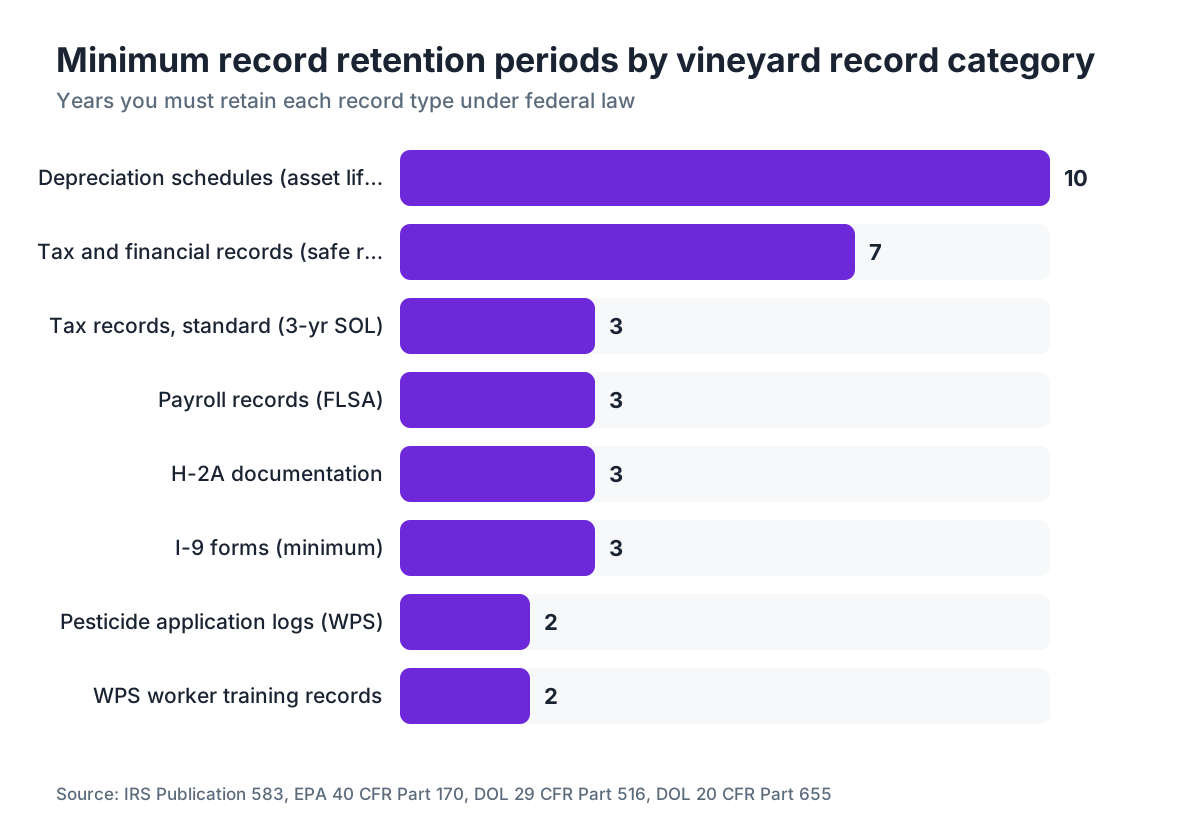
How long should you keep vineyard records, by category?
Retention periods vary by record type, and the longest applicable period governs. Here's the practical guide:
| Record Category | Keep For | Authority |
|---|---|---|
| Schedule F and supporting tax docs | 7 years minimum | IRS Publication 583 [3] |
| Depreciation schedules | Life of asset plus 7 years | IRC Section 168 / Form 4562 [4] |
| Pesticide application logs (WPS) | 2 years from application | 40 CFR Part 170 [1] |
| State pesticide use reports (CA) | 2 years | CDPR regulations [6] |
| Worker WPS training records | 2 years | 40 CFR Part 170 [1] |
| Payroll records (FLSA) | 3 years | 29 CFR Part 516 [10] |
| I-9 forms | 3 years or 1 year post-termination, whichever is later | 8 USC 1324a [10] |
| H-2A documentation | 3 years post-employment | 20 CFR Part 655 [11] |
| Water rights / permits | Indefinitely while active | Varies by state |
| Land leases | Duration plus 7 years | General contract law |
The practical answer for most small vineyards: keep everything for seven years in an accessible location, then move to long-term cold storage or scan to a low-cost cloud archive. Storage costs almost nothing next to the cost of reconstructing records for an audit.
What are common record-keeping mistakes vineyard managers make?
The most expensive mistake is confusing a receipt with a record. A receipt proves you bought something. A record proves what you did with it, when, where, and why. The IRS wants both. The EPA wants the application record whether or not you kept the invoice.
Mixing years is the second most common problem. Receive a December invoice in January and file it in the new year's folder, and your Schedule F understates last year's expenses. Track accruals. If you received a product in December but the invoice arrived in January, it's still a December expense for accrual-basis taxpayers. Your accountant handles the mechanics, but you have to flag it.
Not tracking small cash purchases kills deductions. A $47 bag of sulfur powder paid in cash at a farm supply store is a legitimate deduction. Without the receipt, it's gone. Keep an envelope in the tractor cab for cash receipts. Dump it into the TAX folder weekly.
Incomplete pesticide records are the most common WPS compliance failure. EPA inspections have found that vineyards frequently log the product name but omit the EPA registration number, or log the block but not the start and end time. Both are required fields under 40 CFR Part 170 [1].
Many vineyard operators also skip keeping records of pesticide product labels and SDS documents for the products they actually used that season. The label is the law. If EPA questions whether you applied a product according to its label, you need the label in effect at the time of application. Print or download and save the label PDF with each season's records.
What does a complete annual vineyard compliance file look like?
Imagine you're handing your 2025 file to an IRS agent or an EPA compliance officer tomorrow. Here's what a complete file holds:
For the IRS: A printed or digital copy of your 2025 Schedule F with every line item traceable to a document in your TAX folder. A depreciation schedule showing every depreciable asset, its purchase price, placed-in-service date, and method. Payroll summaries and 941 filings. All vendor invoices over $200 (and ideally everything). Bank statements showing deposits and withdrawals that match the income and expense totals. Year-end inventory count for unsold wine or bulk grape inventory if you carry it.
For EPA/WPS: A complete spray log with no gaps in the season. SDS sheets for every product applied. Handler certifications for anyone who mixed, loaded, or applied a restricted-use pesticide. Posted application information records (or documentation that central posting was used). Worker training records with signatures.
For labor compliance: Signed I-9s for all workers. Timesheets or time clock records. Payroll records showing hours and rates. H-2A job order and housing records if applicable.
For state compliance: Filed PURs (California) or equivalent reports. Any county-required permits or annual reports. Water board filings if your irrigation draws from a permitted source.
A complete file for a 50-acre vineyard with 10 seasonal workers and a full spray program runs 200 to 400 pages of documents per year. That's not a lot. Two binders. The discipline to close those binders by January 15 is what separates operations that sail through audits from operations that don't.
For operations managing multiple blocks across different properties or AVAs, a tool like VitiScribe keeps spray logs, block maps, and compliance calendars in one place, which cuts year-end reconciliation from a week to an afternoon.
How do small vineyards handle records without a dedicated office manager?
Most small vineyard operations run on one or two people doing everything: spraying, managing crews, selling fruit, filing taxes. The record-keeping system has to work for that reality or it won't get used.
The honest answer is that the system needs to be simpler than you think. UC Davis's Agricultural and Resource Economics extension materials consistently recommend that small farm operators choose a record-keeping method they'll actually use over a theoretically better system they'll abandon in March [8]. A paper log in the tractor cab, filled out every day, beats a sophisticated app that gets updated once a month.
For a one-person vineyard, here's the minimum viable system:
One accordion file per year, with labeled pockets: Spray, Tax-Income, Tax-Expenses, Labor, Permits. Every document goes in before Friday of the week it was created or received. Nothing stays on the tractor, the kitchen counter, or the truck for more than a week. At year end, that accordion file is your complete record.
For slightly larger operations (say, 30 or more acres with seasonal crews), shifting to digital makes sense. Scan receipts with your phone the day you get them. Google Drive or Dropbox with the folder structure described earlier gives you a searchable archive, off-site backup, and shareable access for your CPA. The scanning takes 30 seconds per document.
WSU's Center for Precision Agricultural Systems has published farm record-keeping guides for small operations that include templates for spray logs, labor records, and field activities [7]. All free, all printable, all built for people who don't have an office manager.
Frequently asked questions
How many years of vineyard records does the IRS require you to keep?
The IRS generally requires farm records to support a return for three years from the filing date, but six years if you underreported gross income by more than 25 percent. Because vineyards depreciate assets like trellises and equipment over multi-year schedules, keeping everything for seven years is the safe practical rule. IRS Publication 583 covers this.
What information has to be in a vineyard spray log to satisfy the EPA Worker Protection Standard?
Under 40 CFR Part 170, each entry needs: product name and EPA registration number, active ingredients, location of treated area, application date and start and end times, the restricted-entry interval, and the name and certification number of the applicator. Missing any of these fields makes the record non-compliant, regardless of how detailed the rest of the entry is.
How long do vineyard pesticide application records need to be kept?
The federal EPA Worker Protection Standard requires you to keep pesticide application records for two years after the application date. California's Department of Pesticide Regulation requires the same two-year minimum, with monthly Pesticide Use Reports filed with the county agricultural commissioner. Some state rules are stricter, so check your state's specific requirements.
Do vineyard operators need to keep pesticide labels and SDS sheets, or just the application log?
Both. The WPS requires that pesticide application information be accessible to workers and handlers, which means you need the label in effect at the time of application, more than the log entry. Safety Data Sheets must also be kept on file and made available to workers. Practically, save a PDF of the product label with each season's records so you can prove the label that governed your application.
What farm income and expense records go on Schedule F and need to be retained?
Schedule F covers all farm income (crop sales, custom work income, ag program payments) and expenses (fertilizers, chemicals, fuel, labor, repairs, depreciation). Every line item should trace to a dated document: a sale invoice, a vendor receipt, a payroll summary. Retain all of those for at least seven years. Depreciation schedules should be kept for the life of the asset plus seven years.
Do vineyard workers need to be in my record-keeping system differently than other farm employees?
Under the FLSA, all agricultural employees require payroll records kept for three years. H-2A foreign workers have additional requirements: the job order, housing inspection records, contract, and transport documentation must be kept for three years after the last day of employment. WPS training records for workers and pesticide handlers must be kept for two years, regardless of employment type.
What's the difference between a pesticide application record and a pesticide use report?
A pesticide application record is your internal field log, required by the EPA WPS, kept on-site for two years. A pesticide use report (PUR) is a formal filing submitted to your county agricultural commissioner in California (and equivalent agencies in other states) that summarizes all your applications. The PUR is typically due monthly. Your application records are the source data for the PUR.
Can I keep all my vineyard records digitally, or do regulators require paper?
Both the IRS and the EPA accept digital records. The IRS guidance is that electronic records must be accurate, complete, and retrievable during the full retention period, and the system must produce legible copies on request. The EPA has the same basic standard for WPS records. Make sure your digital files are backed up off-site. A cloud folder with automated backup satisfies both requirements.
What vineyard records do I need for a water or discharge permit compliance audit?
Water board compliance audits typically require your permit application, any annual fee payments, water use logs if you meter usage, and records of any discharge events or spill notifications. If you're in a nitrate management program area, you'll also need fertilizer application records. Keep these in a PERMITS folder separate from spray records, and retain them for the life of the permit plus seven years.
Do I need separate records if I farm under an LLC or S-corp versus as a sole proprietor?
Your tax entity structure changes how income and expenses flow through to your return, but the underlying record-keeping requirements are the same. The IRS still needs invoices and payroll records; the EPA still needs your spray log. An LLC or S-corp adds its own entity-level records: the operating agreement, annual state filing receipts, and any separate payroll tax filings for owners who draw a salary.
When during the year should I be updating vineyard compliance records, more than at year-end?
Spray records should be updated same-day, every application, no exceptions. Labor records should be updated weekly at payroll. Tax receipts should go into your folder within a week of receiving them. Monthly, file your California PUR or equivalent state report. Quarterly, review your depreciation schedule and reconcile bank statements. Year-end is just the final reconciliation; if you're doing weekly updates, it takes two hours instead of two weeks.
What's the penalty for a vineyard that can't produce WPS pesticide records during an inspection?
EPA can assess civil penalties for WPS violations. Under the Federal Insecticide, Fungicide, and Rodenticide Act (FIFRA), the maximum civil penalty for agricultural employers is $1,000 per violation per day under the simplified civil penalty schedule, though larger fines apply in egregious cases. Failing to produce application records within the required 15-day window is itself a separate recordable violation.
Is there a vineyard record-keeping template I can download for free?
Yes. WSU Extension and UC Cooperative Extension both publish free spray log and farm record templates. The EPA also provides WPS compliance guides and sample record forms on its website. UC Davis's Agricultural and Resource Economics extension materials include farm record-keeping worksheets designed for small operations. All are printable and cost nothing.
Sources
- EPA, Worker Protection Standard (40 CFR Part 170): WPS requires pesticide application records to be kept for two years and made available to workers within 15 days of request; records must include product name, EPA registration number, REI, location, and applicator certification.
- IRS, Schedule F (Profit or Loss from Farming), Form and Instructions: Vineyard and farm operations report income and expenses on Schedule F by calendar year.
- IRS Publication 583, Starting a Business and Keeping Records: IRS requires business records to support a return for 3 years from filing date, 6 years if income was underreported by more than 25 percent, and indefinitely for fraudulent or unfiled returns.
- IRS Form 4562, Depreciation and Amortization Instructions: Vineyard capital assets including trellises and irrigation are depreciated under MACRS via Form 4562; records must be retained for the life of the asset plus the applicable statute of limitations period.
- IRS, IRC Section 263A Uniform Capitalization Rules guidance: Vineyard establishment and planting costs may be subject to IRC Section 263A capitalization rules; the 2017 Tax Cuts and Jobs Act changed bonus depreciation eligibility for certain farming businesses.
- California Department of Pesticide Regulation, Pesticide Use Reporting: California requires growers to file monthly Pesticide Use Reports with county agricultural commissioners and retain supporting records for two years; California AB 1066 phased in full agricultural worker overtime parity by 2022.
- Washington State University Extension, Pesticide Safety and Integrated Pest Management: WSU Extension publishes free spray log templates and farm record-keeping guides consistent with EPA WPS two-year retention requirements; Washington State requires licensed applicators to keep records for two years.
- UC Davis Agricultural and Resource Economics Extension, Farm Record Keeping: UC Cooperative Extension recommends small farm operators choose a record-keeping method they will use consistently, organized by enterprise and tax year.
- Cornell University, Agricultural Finance and Business Management Extension: Cornell's agricultural business management extension ties farm record organization to tax year reporting periods and Schedule F requirements.
- U.S. Department of Labor, FLSA Records Retention for Agricultural Employers (29 CFR Part 516): FLSA requires agricultural employers to keep payroll records for three years; I-9 forms must be kept for three years after hire or one year after termination, whichever is later.
- U.S. Department of Labor, H-2A Temporary Agricultural Workers Program (20 CFR Part 655): H-2A employers must retain job orders, contracts, housing inspection records, and transport documentation for three years after the worker's last day of employment.
Last updated 2026-07-11