How to propagate grape vines: the complete grower's guide
TL;DR
- Grape vines root most reliably from hardwood cuttings taken during dormancy, roughly late November through February.
- A two-node cutting, treated with IBA rooting hormone and held in moist media at 65-75°F, typically roots in 3 to 6 weeks.
- Skilled growers hit 60-90% rooting with clean, disease-free wood.
- Green grafting and layering work too, but cuttings are the default for most varieties.
Can you propagate grape vines, and which method should you use?
Yes, and it's easier than most people expect. Grapes are one of the most forgiving woody perennials to propagate vegetatively, and growers have been doing it for thousands of years with nothing fancier than a knife and a patch of soil. The method you pick depends on what you're trying to do.
Hardwood cuttings are the workhorse. They're cheap, low-tech, and work for the vast majority of Vitis vinifera, American, and hybrid varieties. If you're building out a block with your own material, start here.
Softwood or green cuttings taken in late spring and early summer also work, but they need mist systems and constant attention against drying out. They root faster on the calendar, sure. The infrastructure cost rarely pays off for a small operation.
Layering (burying a cane while it stays attached to the mother vine, then severing it once it roots) is reliable but slow, and it ties up vine spacing. Most growers use it only to fill a gap in an established row.
Grafting is the right call when you need a specific rootstock for phylloxera resistance or a particular soil. It isn't propagation from scratch so much as marrying scion wood to established roots. UC Davis Cooperative Extension has a solid overview of rootstock selection and grafting for California conditions [1].
This guide spends most of its time on hardwood cuttings, because that's what most small vineyard operations actually do.
When should you take hardwood cuttings from grape vines?
Timing is the single biggest lever on rooting success. Hardwood cuttings have to come from fully dormant wood, meaning after leaf drop and before bud swell. In most North American wine regions that window runs from late November through late February, though in cold climates you may still be cutting in March.
The canes you want are healthy, pencil-diameter growth from last season. Brown, firm, with internodes that aren't stretched long. Skip anything off a diseased vine, skip thin wispy canes, and skip over-vigorous "bull canes" with very long internodes. They carry poor carbohydrate reserves for rooting.
Cut in December but won't stick until February? Store the canes. Bundle them in groups of 20 to 50, wrap lightly in moist burlap or newspaper, seal in a plastic bag, and hold at 32-36°F. A regular refrigerator handles small quantities fine. Cuttings stored this way stay viable for 60 to 90 days in most grower experience [2].
One practical note. Collect more cuttings than you think you need. Even with good technique, rooting isn't 100%. Cutting 30% extra gives you room to cull the failures and still hit your target plant count.
How do you prepare grape vine cuttings for rooting?
Cut each cane into sections of two to four nodes. Two-node cuttings are standard for greenhouse rooting programs. Four-node cuttings are common when you're callusing in an outdoor nursery trench. Aim for roughly 12 to 18 inches for outdoor trenching, or 6 to 8 inches for container propagation.
Make the basal cut (the bottom) just below a node at a slight angle, around 45 degrees. That maximizes callusing surface and gives you an instant reminder of which end goes down. Make the apical cut (the top) about a half-inch above the top node, straight across.
Before you stick them, think about a brief fungicide soak. Eutypa lata, the pathogen behind eutypa dieback, and Botrytis cinerea both colonize cut surfaces during propagation. A 30-minute soak in dilute thiram, or a fresh wax seal on the top cut, cuts infection risk. Washington State University's viticulture extension recommends treating all propagation wood as potentially contaminated until tissue testing says otherwise [3].
To speed rooting, apply IBA (indole-3-butyric acid) to the basal end. Most propagators use commercial talc formulations at 3,000-8,000 ppm IBA. Quick-dip liquid concentrates work too. Cornell's fruit extension program reports IBA treatment can push rooting rates up 15-25% over untreated controls in some trials, though the benefit varies by variety [4].
How do you root a grape vine cutting step by step?
This is the sequence that works in a basic greenhouse or heated propagation house.
Fill your rooting containers with a well-drained mix. A 50/50 blend of perlite and peat, or a commercial propagation mix, keeps oxygen at the basal end and resists compaction. Skip straight potting soil. It holds too much water and invites rot.
Stick each cutting basal-end down, about two nodes deep for a four-node cutting, one node deep for a two-node cutting. The bottom node sits in media. The top node sits at or just above the surface.
Bottom heat is your best friend. Grape cuttings want soil temperatures of 65-75°F at the rooting zone while air stays slightly cooler, maybe 55-65°F. That differential drives callus and roots at the base while it slows bud break at the top. If the top buds push hard before roots form, the cutting burns through its carbohydrate reserves and dies. Heated propagation benches or seedling heat mats handle small batches well [2].
Keep media consistently moist, never wet. A light overhead mist or hand watering once or twice a day is plenty. Direct sun isn't necessary at this stage. Bright indirect light is fine until roots establish.
Rooting runs 3 to 6 weeks for most vinifera varieties at 70°F. American varieties like Concord and Niagara often root faster, sometimes in 2 to 3 weeks. Check by gently tugging a cutting after week three. If it resists, you have roots.
Once rooted, transplant into a larger container with regular potting mix and harden off gradually over 1 to 2 weeks before moving outside. Cuttings rooted in February can usually go into the ground after last frost, which buys them a full season of establishment.
What rooting success rate should you expect, and what kills cuttings?
Honest answer: it depends heavily on variety, wood quality, and temperature control. A realistic range for hardwood cuttings under decent greenhouse conditions is 60-85% for most vinifera varieties. Some growers consistently hit 90% with clean wood and good bottom heat. Others struggle to crack 50% their first time.
The main killers are simple.
Poor wood quality. Canes from diseased, water-stressed, or overly vigorous vines don't store enough carbohydrate to fuel rooting. If the cross-section doesn't show clean white pith, don't use it.
Wrong orientation. People stick cuttings upside down more often than you'd think. The angled basal cut and the straight apical cut are there to stop that.
Too much heat at the top, not enough at the roots. Bud break before rooting is probably the most common failure in uncontrolled setups.
Desiccation. With no humidity management, cuttings dry out before they root. A simple humidity tent (clear plastic over wire hoops) over the propagation bench fixes most of it.
Root rot from oversaturation. The other side of the moisture coin. Perlite-heavy media and containers with drainage holes are non-negotiable.
Varietal differences are real. Pinot Noir and Grenache root more easily than Cabernet Sauvignon or Syrah, which can be finicky. Working with a difficult variety? Bump your IBA concentration and wound the basal end lightly with a knife before you apply hormone.
How does outdoor trench propagation work for larger quantities?
Producing hundreds or thousands of vines? The heated greenhouse route gets expensive fast. Outdoor callusing and rooting in nursery beds is how commercial nurseries scale.
You bundle cuttings basal-end up and warm-callus them at 75-80°F for 2 to 3 weeks in late winter. This pre-callusing before transplant is the step commercial nurseries lean on to equalize success across big batches [5]. After callusing, bundles go into cool storage (35-40°F) until soil temperatures are right for field planting, usually when the soil hits 55°F at six-inch depth.
The callused cuttings then go into prepared nursery beds, stuck deep enough to leave one or two nodes above ground. Drip irrigation keeps soil moist but not saturated through the season. By fall, you have rooted vines ready for their permanent home.
This method works best with four-node cuttings, 12 to 18 inches. Survival in a well-managed outdoor nursery runs 50-70%, lower than greenhouse propagation but fine at scale given the far lower labor cost per unit.
Can you propagate grape vines by layering?
Layering works, and it's dead simple. Pick a long, healthy cane from the vine you want to copy, bury a middle section in a prepared trench about 6 inches deep, and leave both the tip and the attachment to the parent above ground. The buried section roots over summer. You sever the connection in fall or the following spring and dig up the new plant.
The limitation is obvious. Each layer makes exactly one new vine, and it has to sit next to the parent. That's why it's ideal for filling a missing vine in an established row: the new plant grows precisely where you need it. It's impractical for building a whole new block.
Mound layering (and air layering, using a rooting medium wrapped in plastic around a cane that stays above ground) works with grapes too, but almost nobody uses it commercially. The results aren't better enough to justify the labor.
For how layering fits alongside other vegetative propagation methods in grapevines, the University of California's Agriculture and Natural Resources publications cover the tradeoffs well [6].
What are the disease and compliance considerations when propagating your own vines?
This is where small operations cut corners and regret it. Propagating from your own block means you can propagate your problems along with your vines.
Grapevine leafroll virus, grapevine red blotch virus, and fanleaf degeneration (caused by Grapevine fanleaf virus) all move through infected wood. A mother vine that looks productive can carry low-level leafroll that quietly drags down the quality of every vine you take from it. The only way to know is ELISA testing or PCR of your source material [11].
Start from certified clean foundation stock (UC Davis Foundation Plant Services maintains certified grapevine material, for example) and you begin with a known-clean baseline [7]. Propagating from your own vineyard instead? Test before you scale.
On the pesticide and worker protection side: if you treat cuttings or mother vines with any registered pesticide (fungicides for eutypa, dormant oils, and the like) while workers are present, the EPA Worker Protection Standard applies. The WPS, revised in 2015 with amendments effective in 2016 and after, requires that workers handling treated plant material get pesticide safety training and access to personal protective equipment [8]. It kicks in even at small scale once anyone beyond the owner is doing the work.
Keeping accurate records of what you applied to mother vines, when, and with what re-entry interval is the documentation that protects you during a USDA or state department of agriculture audit. That's the field record a tool like VitiScribe is built to track, tying spray events to specific blocks and dates.
Phytosanitary certificates matter if you're moving plant material across state lines. Most states require a certificate from your state department of agriculture before vines, rooted or unrooted, can move legally [10]. Check your state's specific rules. They vary a lot.
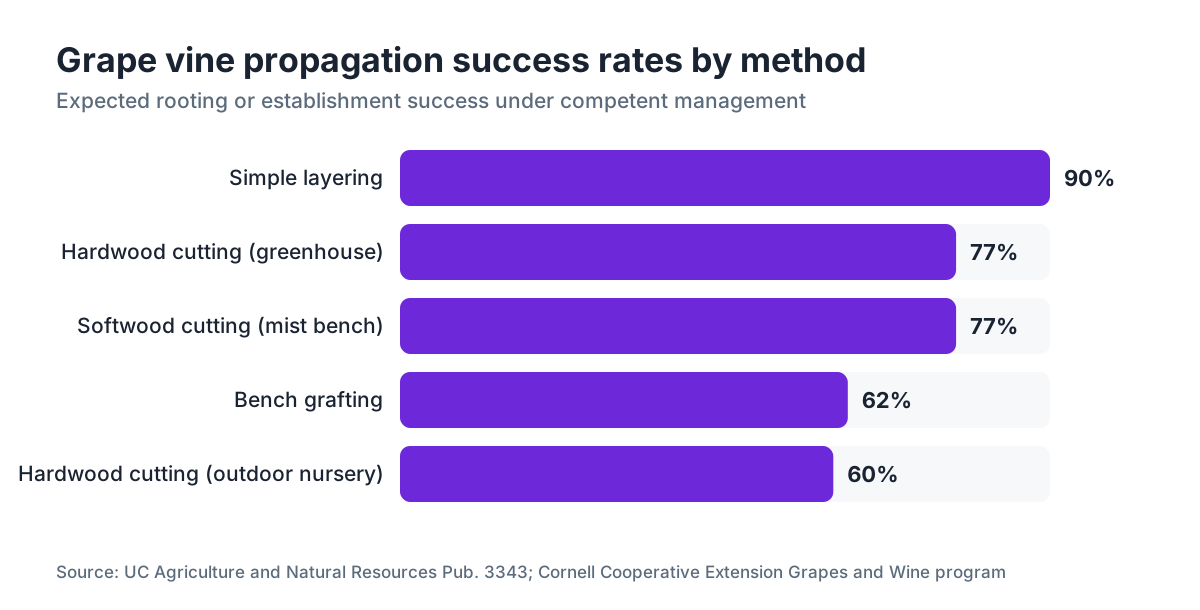
How do propagation success rates compare across methods?
Here's a realistic comparison built from published extension data and commercial nursery practice. The numbers assume competent execution, decent wood, and appropriate environmental controls.
| Method | Success Rate | Best Scale | Time to Plantable Vine | Main Risk |
|---|---|---|---|---|
| Hardwood cutting (greenhouse) | 65-90% | 10-500 | 3-5 months | Bottom heat failure; fungal rot |
| Hardwood cutting (outdoor nursery) | 50-70% | 500+ | 6-8 months | Weather variability; deer/rodents |
| Softwood cutting (mist bench) | 70-85% | 50-300 | 2-3 months | Desiccation; Botrytis |
| Simple layering | 85-95% | 1-20 per vine | 4-6 months | Space; cannot move parent |
| Bench grafting (with rootstock) | 50-75% | 100+ | 5-8 months | Graft union failure; callus issues |
Layering shows the highest success rate, but the per-vine cost in space and management makes no sense for new plantings. Hardwood cuttings in a greenhouse hit the best balance of success, speed, and scalability for most small operations [5].
How do you care for newly rooted grape vine cuttings before planting?
The week or two between "has roots" and "goes in the ground" is where a lot of otherwise successful cuttings get wrecked. Don't skip hardening off.
Move rooted cuttings from the propagation environment to a shaded outdoor spot for 4 to 5 days. Full sun right after greenhouse rooting causes fast drying before the root system can keep up with transpiration. After a few days of shade and outdoor air, move to dappled sun for another week.
Feed lightly at this stage. A half-strength balanced liquid fertilizer (something like 10-10-10 diluted 50%) once the cutting has spent two weeks in its grow-out container is plenty. Heavy feeding before roots establish pushes top growth the plant can't support.
Cuttings going straight from bench to their final vineyard spot need the right planting depth. The graft union, if present, stays above soil. The crown, where roots meet trunk, sits at or just below the soil surface for own-rooted vines.
First-year establishment is about root mass, not shoots. Don't let a new plant carry fruit in year one. Even if it flowers, pull the clusters. Every bit of carbohydrate spent on fruit in year one comes straight out of the root system you spent all that time building.
For managing vineyard operations year-round once your propagated material is in the ground, including pruning, trellis establishment, and first-year canopy work, we go deeper elsewhere.
What equipment and supplies do you actually need to get started?
You don't need a commercial nursery to propagate a few hundred cuttings. Here's what actually matters.
A sharp, clean pruning knife or hand pruners. Dull blades crush tissue. Keep rubbing alcohol or a 10% bleach solution nearby for sanitizing tools between mother vines. This is genuinely worth doing. Tool-borne pathogen transmission is well documented in vineyard disease literature.
Rooting hormone (IBA). Any horticultural supplier carries it. The 3,000-8,000 ppm talc formulation is the most forgiving for beginners. Figure $15-30 for enough to treat several hundred cuttings.
Propagation media. Perlite is cheap, roughly $10-15 for a 4-cubic-foot bag, and does most of the work. Mix it with peat or coir at 50/50.
Containers. Deep tree pots or root trainer cells, 6 to 8 inches deep, let roots run downward. Shallow containers give you kinked, circling roots.
Bottom heat. A seedling heat mat runs $20-50 and handles a small bench. For larger scale, bare-wire heating cables embedded in the bench are the standard commercial answer.
A humidity tent. Clear 4-6 mil poly over a simple wire frame. Costs almost nothing and makes a real difference in early-stage survival.
Total cost for propagating 50 to 100 cuttings at home is probably $50-150 in supplies, assuming you already own pruners. That's the whole appeal. This is an accessible skill.
Where can you get certified disease-free propagation material?
Establishing a new block and want to start clean? Foundation plant services are worth knowing about.
UC Davis Foundation Plant Services (FPS) maintains clean nuclear stock of hundreds of grape varieties, tested and certified free of known viruses and phytoplasmas [7]. Material from FPS goes to licensed nurseries, which produce the certified vines most commercial growers buy [12]. If you want to propagate from truly clean stock, source from a foundation-certified nursery and then do your own further propagation. That's the standard approach.
Cornell's vineyard disease extension work on leafroll and red blotch makes the point plainly: the economic hit from starting with infected planting stock compounds over the life of the vineyard [11]. A block set from infected material may show no obvious symptoms for years, but yield and quality losses pile up the whole time.
WSU Extension covers the same ground for Pacific Northwest growers, with specific guidance on wood-borne diseases common in Walla Walla and Columbia Valley conditions [3].
Once you're tracking propagation batches, source origins, and field performance over time, you want those records connected. VitiScribe was built for that kind of block-level tracking, linking propagation records to field performance years down the road.
What mistakes do beginners make most often when propagating grape vines?
Read enough extension literature and watch what commercial propagators fuss over, and the same failure modes come up again and again.
Propagating from unknown or unverified material is the most consequential mistake. One infected mother vine contaminates an entire batch, and you may not find out for three to five years.
Taking cuttings from stressed vines. A vine that was drought-stressed, heavily diseased, or poorly managed last season has depleted carbohydrate reserves in its canes. Those canes root poorly even with perfect technique.
Skipping sanitation between source vines. It takes 30 seconds, gets skipped constantly, and is exactly how Pierce's disease, crown gall, and a pile of fungal pathogens hitch a ride on your pruning tools.
Overwatering. Grape roots need oxygen. Sodden media doesn't give it to them. When in doubt, err dry once callus has formed.
Impatience with timing. Sticking cuttings in January in an unheated structure because you're eager to start, then watching them sit for eight weeks without rooting because the media temperature never reaches 65°F. A season or two of temperature logs on your bench will teach you plenty.
Expecting uniform variety performance. Some varieties root so easily it barely matters what you do. Others are genuinely difficult and reward reading the specific extension literature for that cultivar instead of treating all grapes as interchangeable.
Frequently asked questions
How to propagate grape vines from cuttings if I only have a few source vines?
You can propagate from a single vine. Take 8 to 10 cuttings per vine during dormancy (late November through February), treat with IBA rooting hormone, and stick them in a perlite-peat mix with bottom heat at 65-75°F. Expect 65-85% success. If your source is one prized vine, use gentle tug tests at week 3 or 4 to check for roots without disturbing the rest.
Can you propagate grape vines from a single node cutting?
Single-node cuttings (a bud piece with a short section of cane) root under mist propagation but are less reliable than two- or four-node cuttings. They carry smaller carbohydrate reserves, so small deviations in moisture or temperature tip them toward failure. Use single-node cuttings only when material is extremely limited, and bump your IBA concentration to the 6,000-8,000 ppm range.
How long does it take to propagate a grape vine from a cutting to a plantable vine?
Under greenhouse conditions with bottom heat, rooting takes 3 to 6 weeks. Grow-out to a plantable vine with a decent root system takes another 6 to 10 weeks. January propagation to a vine ready for the ground by late April or May is realistic. Outdoor nursery bed propagation takes longer, typically 6 to 8 months from cutting to field-ready vine.
Do I need to use rooting hormone to propagate grape vines?
No, but it helps. Grapes callus and root without hormone, especially American varieties like Concord and Niagara. For vinifera and difficult cultivars, IBA (indole-3-butyric acid) at 3,000-8,000 ppm talc formulation pushes rooting rates up 15-25% in Cornell extension trials. It costs almost nothing, so apply it as a standard step.
Can you propagate grape vines from green or softwood cuttings?
Yes. Softwood cuttings taken in late spring, when new shoots have 4 to 6 nodes, root under mist in 2 to 3 weeks, often faster than hardwood. The catch is infrastructure. You need a misting system to stop wilting, because leaves on green cuttings transpire hard. Without mist, desiccation and Botrytis cinerea kill most green cuttings within days. Hardwood is simpler for growers with no mist bench.
How do I know if my grape vine cuttings have rooted?
The gentle tug test is reliable. After 3 to 4 weeks, hold the cutting at the base and give a light upward pull. Resistance means roots have anchored in the medium. Watch for healthy new bud break that holds its green color too. Cuttings that push a bud, then collapse and brown, have used up carbohydrates without rooting. Pulling one to inspect roots directly is fine if you do it carefully.
Can you propagate grape vines in water?
It works as a demonstration, not as a practical method. Cuttings in water often produce callus and even some water roots, but they transplant poorly because the root system adapts to a low-oxygen aquatic environment and then struggles in soil. A perlite-peat mix gives the oxygen, moisture, and mechanical support that produces a functional, soil-adapted root system.
What is the best time of year to propagate grape vines?
Late winter is the practical sweet spot for hardwood cuttings, typically January through early March in most U.S. wine regions. The wood is fully dormant, carbohydrate reserves are at their peak, and you can time propagation so rooted vines harden off just as spring soil temperatures allow outdoor planting. Cuttings collected in late fall (November-December) can be cold-stored until February if needed.
How do you propagate grape vines to ensure they're disease-free?
Start with verified clean material: vines from a nursery carrying UC Davis Foundation Plant Services-certified stock, or your own vines that have tested clean by ELISA or PCR for leafroll, red blotch, and fanleaf viruses. Sanitize all cutting tools between mother vines with 70% isopropyl alcohol or 10% bleach. Propagating from untested blocks risks scaling up whatever infections already sit in your vineyard.
Do I need any permits or certifications to propagate and sell grape vine cuttings?
If you're selling or moving plant material across state lines, yes. Most states require a phytosanitary certificate from your state department of agriculture. Some also require a licensed nursery permit to sell rooted plants commercially. Propagating for your own vineyard only and staying within your state means lighter regulation, but still check with your state ag department first.
Can you propagate named wine grape varieties, or are they trademarked?
Many older, traditional varieties (Cabernet Sauvignon, Chardonnay, Merlot) are in the public domain and can be propagated freely. Some newer varieties, especially those from public university breeding programs, may be protected by plant patents or Plant Variety Protection certificates. Check the USDA PVP database and USPTO plant patent records before propagating any variety released after the 1970s, especially club varieties.
What's the difference between propagating own-rooted vines versus grafted vines?
Own-rooted vines, propagated directly from cuttings, are fine in phylloxera-free soils. In most of the U.S. West and much of Europe, phylloxera is present and own-rooted vinifera eventually declines. Grafted vines pair your desired scion variety with a phylloxera-resistant rootstock. Grafting is more complex, needs a rootstock source, and takes longer, but it isn't optional in affected soils. UC Davis and WSU extension cover rootstock selection well.
How many cuttings can you get from one grape vine?
A mature vine trained to a spur-pruned or cane-pruned system produces 4 to 8 canes per season, each potentially yielding 4 to 8 cuttings depending on length. A healthy vine gives you 20 to 50 propagatable cuttings per dormant season without stress. Use a vine as dedicated mother-vine stock (pulled from fruit production) and you can push higher shoot counts and gather much more cutting wood.
Sources
- UC Davis Cooperative Extension / UC Integrated Viticulture: Rootstock selection and grafting options for California grape-growing conditions
- Cornell Cooperative Extension, Grapes and Wine program (New York State Agricultural Experiment Station): Hardwood cutting propagation timing, cold storage of canes at 32-36°F, and bottom heat recommendations for rooting
- Washington State University Viticulture and Enology: Propagation wood treated as potentially contaminated pending tissue testing; wood-borne diseases in Pacific Northwest vineyards
- Cornell University, New York State Integrated Pest Management Program: IBA hormone treatment can increase rooting rates by 15-25% compared to untreated controls in grape cutting trials
- UC Agriculture and Natural Resources, Grape Pest Management (Publication 3343): Commercial nursery warm callusing at 75-80°F for 2-3 weeks before field planting; outdoor nursery rooting success rates of 50-70%
- University of California Agriculture and Natural Resources: Layering methods and their practical tradeoffs compared to cutting propagation in grapevines
- UC Davis Foundation Plant Services (FPS): Foundation Plant Services maintains certified clean nuclear stock of hundreds of grape varieties tested free of known viruses and phytoplasmas
- EPA, Agricultural Worker Protection Standard (40 CFR Part 170): The Worker Protection Standard, revised in 2015 with provisions effective 2016 onward, requires pesticide safety training and PPE access for workers handling treated plant material
- USDA Agricultural Research Service: Phytosanitary certificate requirements for interstate movement of grapevine propagation material
- WSU Extension, grapevine virus and vineyard management resources: Leafroll and red blotch viruses transmitted through infected propagation wood; PCR testing recommended for mother vine certification, and economic losses compound over vineyard life
- UC Davis Foundation Plant Services, grapevine certification program: Licensed nurseries sourcing from FPS certified foundation stock supply the commercial certified grapevine planting material chain
Last updated 2026-07-09