How to protect vineyards from frost: a practical field guide
TL;DR
- Grapevine buds start dying when air holds below 28°F (-2°C) for 30 minutes or more, and newly pushed shoots can burn at 32°F.
- Wind machines, overhead sprinklers, and heaters are the three methods that actually work, each with different cost and labor tradeoffs.
- Start your equipment before the air hits the kill threshold, never after.
What temperature should you start frost protecting your vineyard?
The number most growers treat as a hard trigger is 28°F (-2°C), held for 30 minutes or longer. At that point ice crystals form inside bud tissue fast enough to rupture cell walls and kill the primary shoot. But 28°F is the kill threshold, not the action threshold.
You start your equipment before the air reaches that point. Not after. Most experienced managers set the alarm temperature between 33°F and 35°F (0.5°C to 1.7°C) so the machines are running and stable before the danger zone arrives. Wait for your thermometer to read 28°F and you've already lost the window.
The real danger temperature moves with growth stage. Dormant buds shrug off temperatures down to about 10°F to 15°F (-12°C to -9°C). Once silver tip or bud swell begins, the kill temperature climbs to around 28°F. At half-inch green tip it rises again to about 29°F. And once shoots reach 2 to 3 inches, even 32°F can burn tender tissue [1]. UC Davis Cooperative Extension publishes a growth-stage temperature chart that's the most-used reference in California. Print it and pin it to the equipment shed door.
One more wrinkle: thermometer placement matters a lot. Official weather stations read at 4 to 5 feet above the ground. Cold air pools at the soil surface and in the canopy, so actual bud temperatures can run 2°F to 4°F colder than the nearest CIMIS or NOAA station reports. Put your sensors at bud height, not on a fence post at eye level.
What are the main types of frost that threaten vineyards?
There are two frost types, and they call for opposite responses.
Radiation frost happens on calm, clear nights when the ground and plant tissue radiate heat upward faster than the air replaces it. Wind speed usually sits below 3 mph. A temperature inversion forms, with cold air settling near the ground and warmer air stacked above it. This is the common vineyard scenario and the one wind machines were built to fight. Because warm air sits just 50 to 150 feet overhead, mixing it down can raise canopy temperatures by 3°F to 8°F [2].
Advection frost is the other kind. A cold air mass moves in on sustained wind. No inversion layer, no pool of warm air above you, just cold all the way up. Wind machines are useless here. If your region gets advection events, overhead sprinklers or portable heaters are your real defense. True advection frosts are less common in most wine grape regions, and they tend to show up in longer-range forecasts, so you usually get more lead time.
Knowing which type is coming changes everything about your response. Check the wind forecast next to the temperature. A forecasted low of 29°F with 8 mph winds overnight is an advection event. That same 29°F low on a calm, clear night is radiation frost, and your wind machine will handle it.
How do wind machines work for frost protection, and are they worth the cost?
A wind machine is a large fan, usually 50 to 65 feet tall on a diesel or electric motor, that pulls warm air down from the inversion layer and stirs it through the canopy. One machine covers roughly 10 to 20 acres depending on terrain, tower height, and blade pitch [2].
Installed capital cost runs $20,000 to $35,000 per unit, driven by motor type and site prep. That's a real number. Spread it over 10 to 15 acres and a 20-plus year service life, though, and the per-acre-per-season math usually pencils out against crop loss risk. Diesel machines cost less upfront but more to run and maintain. Electric units cost more to buy and need adequate service to the site, but they're quieter and far cheaper per hour.
Here's the honest limitation. Wind machines only work during radiation frost, because they need an inversion layer to exploit. If the air above you is already cold, the fan just shoves cold air around. Terrain matters too. Machines do better on flat or gently sloping ground than in steep canyons or tight valleys where cold air pools deeper than the fan can reach.
For a typical 15-acre block in a radiation-frost region, a wind machine is probably the best single investment you can make. For blocks with awkward terrain, an odd shape, or advection exposure, you need a backup plan.
How does overhead sprinkler frost protection work?
Overhead sprinklers protect buds by applying water continuously, which releases latent heat as it freezes on the vine surface. The water-to-ice phase change gives off about 80 calories per gram, enough to hold the ice-encased tissue at 32°F as long as the water keeps flowing [3]. The vine looks encased in ice, and it is. That's the protection.
This only works if the sprinklers run without stopping, from before the freeze begins until the air rises above freezing again. Stop mid-event and the ice starts pulling heat out of the tissue, doing more damage than no protection at all. That's the most common sprinkler mistake.
Application rates typically run 0.1 to 0.15 inches per hour, with higher rates needed at lower temperatures and higher wind. WSU Extension's frost protection publications include application rate tables keyed to temperature and wind combinations that are genuinely useful for system design [4].
Water supply is the constraint. You need enough pump capacity and volume to run continuously, sometimes 6 to 10 hours on a cold night. Plenty of small operations run out of water before the temperature recovers, which is exactly when you can't afford to stop. Size your storage and pump for your coldest plausible event, not your average one.
One more thing: ice loading can break your vineyard. On young vines or weak trellis, the weight of accumulated ice snaps canes and pulls wires. If your infrastructure is fragile, sprinklers carry a real structural risk right alongside the protection.
Do heaters and smudge pots still make sense for vineyard frost protection?
Propane heaters and the older smudge pots (fuel-oil burners) both work by warming the air around the vines directly. They're the most flexible option for small or oddly shaped blocks where sprinkler or wind machine infrastructure doesn't pencil out.
Propane heaters are what most growers use now. The old smudge pots burned number-two fuel oil and threw heavy black smoke. They're largely gone from commercial vineyards, partly because of air quality rules and partly because propane is cleaner and easier to manage. Check your county air district rules before you light any open flame. In California, many air districts restrict or require permits for smudge pots outright.
Heater density runs roughly 25 to 40 units per acre for effective protection, depending on the temperature differential you're chasing. That's a lot of gear to move, light, and monitor. Labor cost on a multi-acre block during an all-night event climbs fast. Heaters do their best work as a supplement to a primary system, covering the frost pockets a wind machine can't reach, like the low corner of a block.
I wouldn't build a primary strategy around heaters for anything over 3 to 5 acres. The labor demand on cold nights is brutal, and you'll have crew working around open flames in poor light, which raises worker safety concerns you have to settle before the season starts.
What role do helicopters play in vineyard frost protection?
Helicopters work on the same principle as wind machines: they push warmer air from the inversion layer down to the canopy. A helicopter flying at 50 to 150 feet can raise canopy temperature by 3°F to 10°F during a pass [2]. The coverage per pass is large, which makes them tempting for big ranches or cooperatives.
The economics are hard to justify for small operations. Frost patrol hire runs roughly $300 to $600 per hour or more, and an event can last 4 to 8 hours. For a 300-acre ranch where a single frost could mean $500,000 in lost crop, the math is obvious. For a 20-acre family vineyard, it isn't.
Cooperative helicopter programs exist in some regions, where several neighboring vineyards split the cost of a helicopter on frost nights. If your neighbors are interested, it's worth a conversation. The coordination overhead is real, but so is the savings.
How should you use frost prediction tools and weather monitoring?
Good frost protection starts 48 to 72 hours out, not the night of. Numerical weather models have gotten genuinely good at calling radiation frost nights, and the tools available to growers are better than they've ever been.
In California, CIMIS (the California Irrigation Management Information System) provides hourly weather data and frost forecasting from a network of more than 145 stations statewide [5]. In the Pacific Northwest, WSU's AgWeatherNet does the same work [11]. The National Weather Service's frost and freeze outlooks cover the whole country and cost nothing [10].
Your own on-site sensors are the data point that matters most. A wireless temperature system with sensors at bud height, set to text you when the reading drops below 35°F, is a modest investment that pays off the first time it wakes you at 2 AM before a radiation event. Most systems cost $500 to $2,000 for a small vineyard, and several vineyard-specific options come from suppliers like Onset HOBO and Campbell Scientific.
For tracking spray records, scouting notes, and equipment run times next to weather events, a field operations platform like VitiScribe puts your weather logs and your protection responses in one place, which makes end-of-season crop insurance documentation far less painful.
Dew point is an underused signal. As the air temperature approaches the dew point on a clear, calm evening, fog or dew forms and the cooling slows. A wide spread between air temperature and dew point at sunset (say, air at 45°F and dew point at 25°F) means conditions favor a hard radiation frost. Track that spread alongside the raw temperature forecast.
What cultural and site management practices reduce frost risk?
Equipment is only half the answer. How you manage the vineyard before frost season shifts your risk in real ways.
Delaying pruning is the most widely recommended practice. Grapevines break dormancy in the order they're pruned. Prune the whole vineyard in February and everything pushes together in March, so a late frost hits everything at once. Prune later and bud push comes later. Pruning your frost-prone low spots last is standard in high-risk regions. Some growers in marginal climates hold 100% of pruning until early April, trading shoot positioning flexibility for lower frost risk.
Double pruning (also called pre-pruning or spur leaving) refines this. You rough-prune to 2 to 4 buds per spur in February with a mechanical hedger, then hand-finish to your target bud count in late March or April. The extra buds that push early absorb any frost damage, and you're still holding enough buds on the cane to make your crop. It adds some labor, and it's increasingly used in Napa, Sonoma, and other regions with late frost risk [1].
Soil management moves the needle too. Bare, moist, dark soil soaks up more heat during the day and radiates more at night than soil buried under thick dry cover crop or mulch. Mow your cover crop short before frost season and keep a firm, moist surface in the vine row, and you can raise canopy temperatures by 1°F to 3°F on radiation frost nights. Not a substitute for active protection, but in a borderline event it can be the difference.
Skip heavy nitrogen in late summer and fall. Lush, poorly lignified shoot growth going into winter hardens off slower and burns easier in an early spring frost. This is basic vineyard nutrition, but the frost connection is easy to forget when you're chasing vigor.
What are the worker safety and compliance requirements during frost protection events?
Frost events put crew members in the dark, in near-freezing air, around running machinery, open flames, or water on the ground. The hazards are real and the legal obligations are clear.
Under the EPA Worker Protection Standard (WPS), any pesticide application restrictions on the treated area still apply, no matter what emergency you're dealing with. Applied a fungicide with a 24-hour restricted-entry interval the day before a frost event? Workers going in to check equipment or hand-light heaters may still be restricted [6]. WPS requirements don't pause for weather. Know your re-entry intervals before you plan the response.
For the cold work itself, OSHA's general industry standards on heat and cold stress apply. Cal/OSHA Title 8 in California includes provisions covering outdoor work in cold conditions, and you're expected to provide adequate clothing, warm rest areas, and supervision for workers in sustained cold [7]. Running a multi-hour event with crew? Keep a warm vehicle on site and set check-in protocols.
Propane heaters near workers also trigger OSHA standards around open flames, combustion air, and carbon monoxide. Brief your crew before the season on the hazard, not at 3 AM when they're cold and tired.
For small and medium vineyards, Cornell's Ag Workforce Development program publishes practical guides on cold-weather worker safety worth reviewing before spring [8].
How do you document frost events for crop insurance and compliance records?
If you carry crop insurance through USDA's Risk Management Agency, timely loss notices matter. USDA RMA requires you to notify your agent within 72 hours of discovering a loss and to preserve physical evidence, so don't mow or disk damaged vines before an adjuster visits [9]. Frost damage can hide in the first 24 to 48 hours, showing up as a blackened primary shoot inside what still looks like an intact bud. Scout carefully before you assume you're clean.
Your frost protection log should capture the date and time of the event, temperature readings from your vineyard sensors (not the nearest weather station), which blocks were affected, what equipment ran and for how long, fuel or water used, labor hours, and any observed damage. This does double duty. It supports insurance claims, and it's the data you need to sharpen next year's response plan.
State pesticide use reporting doesn't usually cover frost protection itself. But if you applied anything in connection with the event (dormant oils, mineral products), those go in your pesticide use report as normal.
For operations tracking frost responses alongside spray records and scouting data, VitiScribe holds all of it in one place with field-level GPS tagging, which turns pulling documentation for an adjuster into a quick export instead of a paper hunt.
For a vineyard in a frost-prone region, building documentation habits before you need them is the easiest risk management step you can take.
How do frost protection costs compare across different methods?
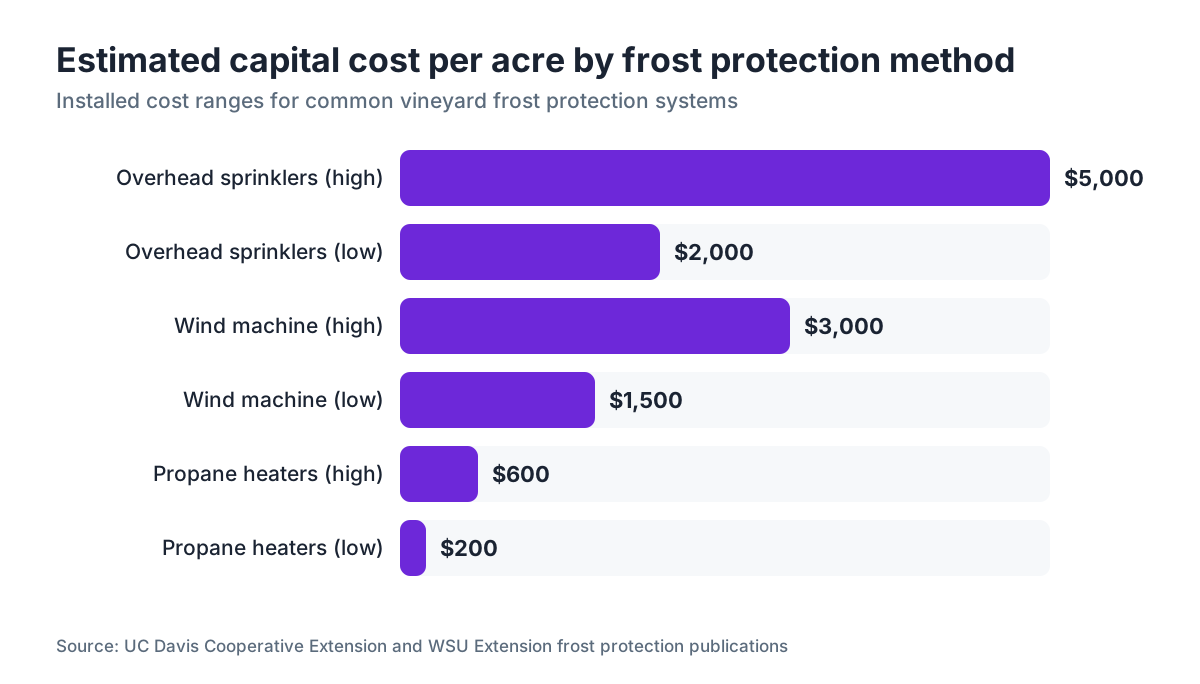
Cost comparisons are hard because they ride on block size, terrain, frost frequency, and local labor rates. That said, here are real ballpark figures drawn from UC Davis and WSU extension publications. Treat them as starting points for your own penciling [1][4].
| Method | Approximate capital cost (per acre) | Annual operating cost (per acre) | Effective range (°F protection) |
|---|---|---|---|
| Wind machine | $1,500-$3,000 | $50-$150 | 3-8°F above ambient (radiation only) |
| Overhead sprinklers | $2,000-$5,000 | $100-$300 | Holds tissue at 32°F as long as water runs |
| Propane heaters | $200-$600 (equipment) | $300-$800 | 2-5°F above ambient |
| Helicopter (shared) | $0 capital | $200-$500/event | 3-10°F above ambient (radiation only) |
| Double pruning (cultural) | $0 capital | $80-$200 (added labor) | Reduces exposed tissue, doesn't raise temp |
One real-world note: plenty of operations run two systems at once on critical nights, say a wind machine as the primary and targeted heaters in the frost pockets as backup. Don't plan your system around ideal conditions. Plan it around your worst plausible night.
Are there any passive or low-cost frost protection options that actually work?
Passive options are mostly useful at the margins, not as primary protection. But they're real and they're cheap or free, so use them.
Frost fabric (row covers) can protect young vines in the first season or two. Standard lightweight agribon-type fabric provides 2°F to 4°F of protection. It's labor-intensive to deploy and can cause humidity problems if left on too long, but for a few rows of expensive grafted material it's a sensible first-year practice.
Soil moisture is a passive tool, as covered above. A well-irrigated surface (moist, not saturated) releases more stored heat at night than dry soil. Running a short irrigation set the afternoon before a predicted frost is a standard low-cost move, especially for growers without mechanical protection. Cornell's viticulture program notes a 1°F to 3°F benefit in vineyard floor temperature from adequate soil moisture [8].
Site selection is the ultimate passive tool, and it's the one decision you can't revisit once you're planted. Hilltops and mid-slopes drain cold air down and away. Valley floors and low spots collect it. If you're planning a new block and you have any flexibility in siting, elevation and topographic position should weigh heavily.
Frequently asked questions
At what temperature does frost damage grapevine buds?
The standard kill threshold for grapevine buds is 28°F (-2°C) sustained for 30 minutes. But the safe temperature varies by growth stage. Dormant buds handle down to about 10-15°F. At bud swell, damage starts at 28°F. At half-inch green tip, damage can occur at 29°F. Emerged shoots 2-3 inches long can be damaged at 32°F. Always use growth-stage-adjusted thresholds, not a single number.
What temperature should I turn on my wind machine?
Set your wind machine to start at 34°F to 35°F, not at the damage threshold. Equipment needs several minutes to reach operating speed, and the goal is to be circulating warm air before the canopy reaches 29-28°F. Many automated controllers use a 34°F trigger with a 1°F hysteresis. Check your manufacturer's settings against your own sensor placement at bud height, not at the standard 4-5 foot weather station height.
How do I know if I'm dealing with radiation frost or advection frost?
Radiation frost happens on calm (under 3 mph), clear nights with a temperature inversion. Advection frost arrives with a cold air mass and sustained wind. Check the overnight wind forecast alongside temperature. If wind stays below 3 mph and skies are clear, plan for radiation frost and run your wind machine. If sustained winds of 5 mph or more are forecast, you're in advection territory and need sprinklers or heaters instead.
How much does a vineyard wind machine cost?
A single installed wind machine runs roughly $20,000 to $35,000 depending on motor type (diesel vs. electric), tower height, and site prep. One unit typically covers 10 to 20 acres. Electric units cost more upfront but less to operate per hour. The UC Davis cost of production studies and WSU extension frost protection publications both include equipment cost estimates you can use for budget planning.
Can I use overhead sprinklers in subfreezing wind?
You can, but it gets harder and riskier. Wind speeds up evaporative cooling, so ice forms faster and water must run at a higher rate (0.15 inches per hour or more) to keep pace. Ice loading on vines also increases with wind. In sustained winds above 10-15 mph, sprinkler systems often can't keep up and ice loading turns structurally dangerous. For windy advection events, portable heaters are usually a safer choice than sprinklers.
What is double pruning and does it actually prevent frost damage?
Double pruning means a rough mechanical prune to 2-4 buds per spur in late winter, then a final hand prune to target bud count 3-6 weeks later. The early buds that push first take the frost hit; the later buds you're counting on for crop stay protected inside the cane. It doesn't stop damage to the early buds, but it keeps your crop buds dormant longer, cutting the odds of a damaging event catching them.
Do I need a permit to run propane heaters or smudge pots in my vineyard?
It depends on your county and state air district. In California, many air quality management districts restrict or require advance notification for open-flame frost protection devices, especially the old fuel-oil smudge pots. Propane heaters face fewer restrictions but check with your local air district before the season starts. In other states, regulations vary; your county extension office is the right first call.
How do I document frost events for crop insurance purposes?
Log the event date and time, temperature readings from vineyard-level sensors, which blocks were affected, equipment run time, fuel and water used, labor hours, and any visible damage to buds or shoots. Notify your crop insurance agent within 72 hours of discovering a loss, as USDA RMA requires. Don't mow or disc damaged areas before an adjuster visits. Timestamped photos are invaluable supporting documentation.
How does soil moisture affect frost protection in a vineyard?
Moist, firm soil stores more heat during the day and releases it slowly at night, raising the vineyard floor temperature by roughly 1-3°F compared to dry or heavily mulched soil on radiation frost nights. Running a short irrigation set the afternoon before a predicted radiation frost is a simple, low-cost practice that gives you a small but real buffer. It's not a substitute for active protection but helps at the margins.
What worker safety rules apply during frost protection events?
EPA Worker Protection Standard restricted-entry intervals still apply even during emergencies, so check your most recent spray records before sending workers into treated blocks. OSHA and Cal/OSHA cold-stress provisions require appropriate clothing, warm rest areas, and supervision for sustained outdoor cold work. Propane heater operation requires briefing on carbon monoxide and open-flame hazards. Plan crew safety procedures before frost season, not during an event.
How accurate are frost forecasts for vineyard planning?
Modern numerical weather models are fairly reliable 24-48 hours out for radiation frost. Beyond 48-72 hours, treat forecasts as probability estimates, not certainties. Your on-site sensors at bud height beat the nearest weather station because cold air pools at canopy level and can run 2-4°F colder than station readings 4-5 feet above ground. Use CIMIS in California, AgWeatherNet in the Pacific Northwest, and the NOAA frost outlook nationally.
Is a helicopter effective for frost protection on a small vineyard?
Probably not economically, unless you join a cooperative program with neighboring properties. Helicopter frost patrol costs $300-$600 or more per hour, and an event can run 4-8 hours. For a small vineyard under 50 acres, a wind machine or sprinkler system almost always has better cost-per-acre math over a 10-year horizon. Helicopter programs make sense for large ranches or cooperative blocks where the cost spreads across hundreds of acres.
When should I start worrying about frost in spring relative to bud break?
Start monitoring temperature daily as soon as silver tip or bud swell begins, typically 2-4 weeks before full bud break depending on variety and location. The risk window runs from bud swell through about 2-inch shoot growth, often March through May in most North American wine regions. Pinot Noir and Chardonnay push early and carry higher frost risk than later-budding varieties like Cabernet Sauvignon. Your local frost date history beats calendar dates.
Sources
- UC Davis Cooperative Extension, Frost Protection for Vineyards: Growth-stage critical temperature thresholds for grapevine buds and double pruning as a frost avoidance practice
- University of California Agriculture and Natural Resources, Wind Machines for Frost Protection: Wind machines cover 10-20 acres per unit and can raise canopy temperature 3-8°F during radiation frost events by mixing down warm inversion air; helicopters can raise temperature 3-10°F per pass
- Cornell University Cooperative Extension, Frost and Freeze Protection for Horticultural Crops: Overhead sprinkler protection works by releasing latent heat (approximately 80 calories per gram) as water freezes on vine tissue, holding it at 32°F continuously
- Washington State University Extension, Frost Protection in Vineyards: Sprinkler application rate requirements by temperature and wind speed, and cost estimates for vineyard frost protection systems
- California Department of Water Resources, CIMIS Program: CIMIS operates over 145 weather stations across California providing frost forecasting and hourly weather data for agricultural use
- US EPA, Worker Protection Standard (WPS) for Agricultural Pesticides: EPA Worker Protection Standard restricted-entry intervals remain in effect regardless of weather emergencies and must be observed before workers enter treated areas
- Cornell University, Ag Workforce Development and Viticulture Program Resources: Adequate soil moisture raises vineyard floor temperature by 1-3°F on radiation frost nights; cold-weather worker safety guidance for agricultural operations
- USDA Risk Management Agency, Crop Insurance Loss Notice Requirements: USDA RMA requires crop insurance policyholders to notify their agent within 72 hours of discovering a loss and to preserve physical evidence before any field operations
- National Weather Service, Frost and Freeze Forecast Products: NOAA National Weather Service provides frost and freeze outlooks covering all US wine grape regions at no cost
- WSU AgWeatherNet: WSU AgWeatherNet provides agricultural weather data and frost forecasting for Pacific Northwest growers
Last updated 2026-07-10