How to read and calibrate a rain gauge for vineyard water balance
TL;DR
- A 4-inch manual rain gauge, read to the nearest 0.01 inch, placed 2 to 4 feet off the ground and clear of wind obstructions, is accurate enough for vineyard water balance if you calibrate it seasonally against a known water volume.
- Tipping-bucket electronic gauges need more frequent cleaning and calibration checks.
- Placement errors and dirty funnels cause most of the bad data.
Why does rain gauge accuracy matter for vine water balance?
A vine's water budget is only as good as its inputs. If you track soil moisture, schedule irrigation, or calculate evapotranspiration (ET) deficits using a reference ET source like CIMIS or AgriMet, the precipitation number you feed those calculations has to be right. A 0.1-inch error sounds trivial. Over a season it isn't.
Vines in the California coast ranges or the Finger Lakes take somewhere between 15 and 35 inches of rain a year, depending on the year, and a steady 5% gauge error becomes a real miss in your water balance. WSU's irrigation extension work notes that vine water stress decisions built on poor input data push growers into either under-irrigation, which can drive vines into severe stress before harvest, or over-irrigation, which feeds excessive vigor and disease pressure [1].
There's a compliance angle too. If you're enrolled in an NRCS cost-share conservation program, or documenting water use for a state permit, your precipitation records are part of the paper trail. Sloppy data there creates real problems later.
What type of rain gauge should a vineyard use?
You have three practical options: manual tube gauges, tipping-bucket electronic gauges, and wedge or cylindrical storage gauges. Each has a genuine trade-off.
The standard manual gauge, the kind with a 4-inch funnel feeding a 1.6-inch inner measuring tube, magnifies rainfall by about 6.25x so you can read small amounts accurately. These cost $10 to $40. Calibrated right, they're the most accurate tool on this list. The catch is that someone has to walk out and read them. Miss a reading after a multi-day event and you've lost the per-storm breakdown.
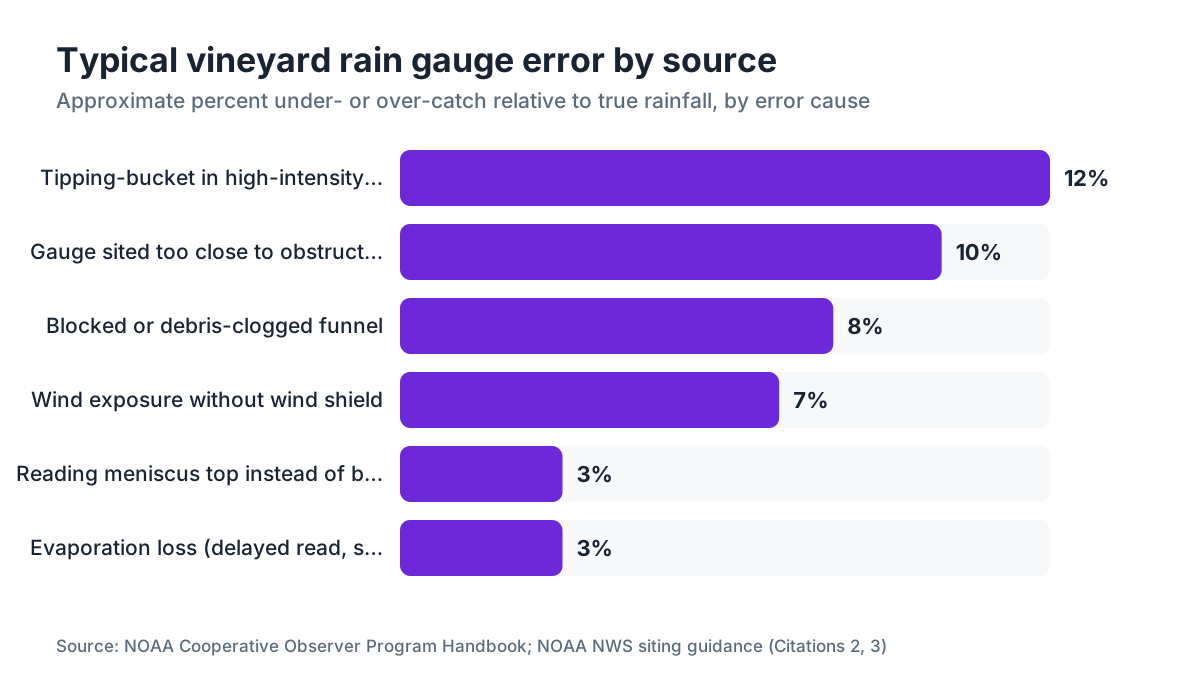
Tipping-bucket gauges feed a data logger and can sync with a weather station or farm software. A 0.01-inch tip is the common resolution. They're convenient and they're also the easiest to get wrong. Leaves, spider webs, dust, and dead insects lodge in the funnel and skew totals. During heavy convective storms the bucket can't tip fast enough, so they read low during the events that matter most. NOAA's cooperative observer program has documented catch deficiencies of 5 to 15% in high-intensity rain with some tipping-bucket models [2].
Wedge and storage gauges suit remote blocks where monthly check-ins are realistic. They hold enough volume to record a full season if you add a little mineral oil to stop evaporation.
Here's what I'd run: one manual gauge as a calibration reference and one data-logging tipping-bucket for operational convenience. It's not glamorous. It works.
Where exactly should you place a rain gauge in a vineyard?
Placement is where most vineyard rain data goes wrong. The National Weather Service recommends placing gauges at a distance from any obstruction (trees, trellis posts, buildings) equal to at least twice the height of that obstruction, and preferably four times [3]. A 10-foot trellis row means the gauge needs to sit at least 20 feet away, and 40 feet is better.
Height off the ground matters too. The standard is 2 to 4 feet above the soil for a manual gauge. Too low and splash from raindrops hitting the ground adds false reading. Too high and wind deflects drops away from the funnel opening, causing under-catch. NOAA's cooperative observer guidance puts the sweet spot near 2 feet for typical open sites [3].
In a working block, the only genuinely open spots are the headlands and equipment turnouts. Putting the gauge midrow between canopies is wrong. Canopy interception sharply cuts the catch during light rain, and light rain is exactly what decides whether you're running a deficit.
If your blocks vary in topography or aspect, one gauge for the whole ranch isn't enough. A north-facing hillside block in a fog belt can catch 20 to 40% more rainfall than the valley floor during the same storm, according to UC Davis Cooperative Extension work in coastal Sonoma [4]. Two gauges positioned across that gradient are worth the $30.
One note on wind shields. If your site stays windy, an Alter or Nipher style shield around the gauge can improve catch accuracy by 5 to 10% in exposed spots [2].
How do you read a manual tube rain gauge correctly?
Reading sounds simple. It's the step people get slightly wrong most often, and the errors compound.
After a rain event, lift the inner measuring tube out of the outer cylinder. Hold it at eye level on a flat surface or against a steady post. Read the bottom of the meniscus, the curved water surface, not the top of it. The meniscus in a plastic tube is subtle. In glass it's easier to see. Read the top instead of the bottom and you add roughly 0.02 to 0.04 inches on a typical tube. That's real error.
If the inner tube overflows (more than 1 inch of rain, usually), the excess collects in the outer cylinder. Empty and record the inner tube, then pour the outer cylinder water into the inner tube and read again. Add the two numbers.
Read within 24 hours of the event ending. Sitting water evaporates, especially in heat. In summer, leaving water in a gauge for three days inland in California can cost you 0.05 to 0.1 inches to evaporation, depending on conditions.
Record to the nearest 0.01 inch. If the level sits between graduations, read the lower mark rather than rounding up. Rounding up every time builds a systematic positive bias into your season record.
How do you calibrate a rain gauge to check its accuracy?
Calibration means confirming that what the gauge catches and what you read match the actual rainfall volume entering the funnel. It's straightforward and takes about 15 minutes.
For a manual tube gauge you need a graduated cylinder (or a precise kitchen measuring cup), water, and basic math. Measure the funnel diameter precisely with calipers or a ruler. Calculate the funnel area in square inches. Pour in a known volume of water and see if it reads what it should.
Example. A standard 4-inch funnel has an area of about 12.57 square inches. One inch of rain over 12.57 square inches is 12.57 cubic inches of water, roughly 205 mL. Pour 100 mL into the funnel slowly so none splashes out, and the inner tube should read 0.49 inches. If it reads 0.52 inches, the tube reads high by about 6%, which is a meaningful error for water balance.
For tipping-bucket gauges, run the manual fill test. Drip a known volume through the funnel at a slow, steady rate with a burette or syringe, count the tips, and compare to the expected count. A bucket calibrated at 0.01 inches per tip should give 100 tips for 205 mL. Getting 94 means you're reading 6% low. Most manufacturers allow adjustment with a set screw on the bucket arm [5].
Calibrate at the start of each season and again mid-season if the gauge sees heavy use or gets bumped. After any cleaning that involves pulling the funnel, check calibration before you trust the data again.
What causes common rain gauge errors and how do you fix them?
Most error in vineyard rain data doesn't come from the gauge itself. It comes from how the gauge gets maintained and read.
Funnel debris is the biggest culprit. A leaf or dead bee in the funnel shrinks the catch opening and holds moisture that evaporates between events, inflating the next reading. Check and clean the funnel before every significant rain. A small brush and a rinse with clean water takes two minutes.
Wind exposure causes under-catch. In windy storms, precipitation has a horizontal component that misses a vertical gauge opening. That's one reason official weather stations often read higher than exposed farm gauges nearby [2]. Relocating the gauge to a more sheltered position (while still meeting the obstruction clearance rule) usually helps more than bolting on a wind shield.
Cracked or warped tubes shift calibration. Sunlight degrades clear plastic inner tubes over time, warping them and changing the cross-section, which changes the volume per inch of apparent depth. Replace the inner tube every two to three years if it's a clear plastic type.
Spillage during reading loses data. Pull the inner tube out with water still in it and any jostling spills some. Lift it straight up and over the outer cylinder, slowly.
Forgetting to empty the gauge hurts on multi-day events. Leave it un-read and you can't assign rain to specific days, which matters when you're correlating soil moisture sensor readings with storms.
How do rain gauge readings connect to vineyard ET and water balance calculations?
Water balance for a block runs on a simple equation: soil water change equals rainfall plus irrigation minus evapotranspiration minus deep percolation minus runoff. Your rain gauge feeds the rainfall term directly.
Most western U.S. vineyard managers pull reference ET (ETo) from a network station, CIMIS in California [6] or AgriMet in the Pacific Northwest [7], and apply a crop coefficient (Kc) to get vine ET. UC Davis researchers have published Kc values for wine grapes ranging from about 0.15 at bud break to around 0.70 at peak summer canopy, adjusted for actual canopy size [4].
The balance works in inches or millimeters. Say your gauge reads 0.35 inches from a spring storm, ETo that week was 0.90 inches, and Kc was 0.55 (vine ET of about 0.50 inches). You gained 0.35 inches and lost 0.50 inches from the root zone, a net deficit of 0.15 inches. Over a month those numbers stack into an irrigation decision.
A steady gauge error of 0.05 inches per event shifts your cumulative water balance by an inch or more across a dry season. That's enough to change your schedule by a full irrigation set, which for a drip system delivering 0.10 inches per hour is a real operational difference.
Keep your spray and irrigation records in a field operations platform like VitiScribe, and connecting the rain gauge log straight to your water balance worksheet keeps your compliance records and your agronomic records synced without double entry.
Cornell Cooperative Extension's viticulture program in New York has documented vineyards running water balance with good precipitation data cutting irrigation applications by 15 to 25% in typical years compared to calendar-based scheduling [8].
How often should you record rain gauge data, and what records do you need to keep?
Daily readings after any precipitation are the professional standard. Take them at a consistent morning time, before sunrise evaporation touches the stored water. That gives the cleanest data.
For NRCS cost-share programs such as EQIP, your irrigation and water use documentation should line up with NRCS Conservation Practice Standard 449, Irrigation Water Management, which calls for records sufficient to show managed application against crop water needs [9]. Your precipitation log supports that demonstration.
For pesticide records under the EPA Worker Protection Standard (WPS) and FIFRA, rainfall data matters because many labels set re-entry restrictions or re-application intervals that depend on rain washing off product. The label line "reapply after 0.5 inches of rainfall" means nothing if you can't document actual rainfall. The WPS regulations at 40 CFR Part 170 don't mandate a gauge specifically, but your pesticide records need defensible rainfall data to back label-compliance decisions [10].
Keep at minimum: date, time of reading, rainfall total in inches, cumulative season total, and notes on gauge maintenance (cleaning, calibration check). A paper log works. A spreadsheet is better because you can sum seasons and compare to historical averages. Digital records that sync with your spray log and irrigation log keep everything auditable in one place.
Retain records at least two years for WPS compliance and three years if you hold a state pesticide applicator license, though some states require five. Check your state department of agriculture's rule specifically.
How do you compare your gauge reading to the nearest weather station?
Cross-check your gauge against a nearby reference station at least monthly, and after every significant rain event. The point is to catch gauge failures or drift before they corrupt a full season of data.
CIMIS (California only) runs over 145 stations with real-time precipitation data publicly available [6]. AgriMet covers Pacific Northwest states [7]. The CoCoRaHS network (Community Collaborative Rain, Hail and Snow Network) has over 20,000 volunteer observers across the U.S., and you can often find a station within a mile or two of your vineyard [11]. NOAA's Climate Data Online tool pulls historical daily precipitation for any airport or cooperative weather station [12].
A steady 10 to 15% gap between your gauge and a reference station a mile away, across multiple events, signals a real problem with placement, maintenance, or calibration. Event-to-event swings of that size are normal, because storms are spatially variable. A consistent systematic gap is not.
Joining CoCoRaHS is free and takes about an hour of training. Your readings become part of the public dataset and you get a mapped network of nearby observers that makes cross-checking easy. For a vineyard building a multi-year precipitation record without buying a full weather station, that's genuinely useful.
What's the difference between rain gauge data and CIMIS or AgriMet station precipitation?
This trips up a lot of vineyard managers, and the answer shapes how you build your water balance.
CIMIS and AgriMet station precipitation is the measured rainfall at that exact station location. It is not a spatial average for your region. If your vineyard sits on a hillside and the CIMIS station is on a valley floor five miles away, the two numbers can diverge by 30% or more during an orographic storm. Using the station's precipitation as a stand-in for your own gauge is convenient and can be badly wrong in terrain-varied country [4].
Here's the right split. Use CIMIS or AgriMet for your ETo, because those networks measure radiation, temperature, humidity, and wind properly and their ET models are validated. Use your own gauge for precipitation. Combine the two in your water balance. That's the approach that holds up agronomically.
For vineyards on flat ground within two miles of a station, using station precipitation as a backup when your gauge fails is reasonable. Note when you do it and why.
What's a simple seasonal rain gauge setup that actually works for a small vineyard operation?
Here's what I'd set up on a 30 to 50 acre operation. One 4-inch manual gauge at the spot you walk every day (near the shop or harvest scale), one tipping-bucket gauge at the far end of a representative block wired to a simple data logger, and a paper log on the shop wall for the manual gauge.
Budget. The manual gauge is $20 to $40. A decent tipping-bucket with a basic data logger runs $150 to $400 depending on brand [5]. That's it. You don't need a full weather station unless you're running a large operation or you're a farm advisor covering multiple sites.
Calibrate both at the start of the season (late February or early March in most of California). Clean the funnels before every forecast rain. Read the manual gauge every morning after a rain night.
At the end of each month, compare your tipping-bucket total to your manual gauge total. Within 5% means you're in good shape. If they diverge, the manual gauge is almost always the more accurate of the two, and the tipping-bucket needs attention.
Log this data properly in your field records, whether that's a spreadsheet or something like VitiScribe's field records module, and you'll have a clean seasonal record when you need it for irrigation reporting, NRCS documentation, or a label-compliance defense. A paper log works too. It's just harder to sum across years and easy to lose.
For operations in Paso Robles wine country or South Coast regions, where dry summers are the norm and irrigation is essential, a well-kept rain record is one of the most directly money-relevant data streams you have.
Frequently asked questions
How accurate does a rain gauge need to be for vineyard water balance?
For practical vineyard water balance, accuracy within 5% is the target most extension programs use. That's roughly plus or minus 0.01 inches on a 0.20-inch event. A properly placed and calibrated 4-inch manual tube gauge meets that reliably. A tipping-bucket gauge with a dirty funnel or bad siting can miss it by two to three times that margin without any obvious sign of failure.
Can I just use the nearest CIMIS or weather station precipitation data instead of my own gauge?
For flat ground within two miles of a validated station, it's a reasonable backup when your gauge is down. For hilly or coastal terrain, it can be badly wrong. CIMIS stations measure point precipitation at their exact location. CIMIS ETo transfers across short distances; precipitation does not. Use your own gauge for rainfall and CIMIS for ETo, then combine them in your water balance.
How do I calibrate a tipping-bucket rain gauge?
Drip a precisely measured volume of water through the funnel slowly using a syringe or burette. Count the tips and compare to the expected count based on the bucket's rated tip size (usually 0.01 inches). For a standard gauge, 205 mL should give about 100 tips. If you get consistently fewer, adjust the bucket arm set screw per the manufacturer's guide, or clean the funnel and re-test.
Where should I not place a rain gauge in a vineyard?
Don't put a gauge between vine rows where the canopy intercepts rainfall. Don't place it closer to a trellis, building, or tree than twice that object's height (four times is better). Don't mount it higher than four feet above ground. Avoid low spots where splash from puddles contaminates the reading. All of these are common mistakes that produce data that looks plausible but stays consistently wrong.
How does rain gauge data affect pesticide application records under WPS?
Many fungicide and insecticide labels set re-entry intervals or re-application triggers based on rainfall totals, such as 'reapply after 0.5 inches.' EPA's Worker Protection Standard regulations (40 CFR Part 170) require that label directions be followed, so you need documented rainfall data to show compliance. A dated rain log tied to your spray records is the defensible paper trail. A vague memory of 'it rained some' is not.
How often should I clean my rain gauge funnel?
Before every forecast rain event, at minimum. In practice, a monthly inspection catches most debris before it affects readings. In areas with heavy pollen fall, leaf drop, or high dust (common in late-summer harvest blocks), every two weeks is smarter. A blocked or partly blocked funnel produces falsely low readings during the very events you most need accurate.
What is the meniscus and why does it matter when reading a gauge?
The meniscus is the curved surface of the water in the inner tube, caused by surface tension. In a plastic or glass tube, water curves upward at the edges into a concave shape. Always read the bottom of that curve, not the top edge. Reading the top instead of the bottom adds roughly 0.02 to 0.04 inches per reading, which becomes a systematic positive bias across an entire season.
Do I need a separate rain gauge for each vineyard block?
Not necessarily, but it depends on your terrain. If blocks span different elevations or aspects, one gauge won't capture the variability. UC Davis extension work in coastal Sonoma found 20 to 40% precipitation differences between fog-belt hillside blocks and valley-floor sites during the same storms. Two gauges covering your elevation range is usually enough for most small to mid-size operations.
What's the difference between a manual tube gauge and a tipping-bucket gauge for vineyard use?
Manual tube gauges ($10 to $40) are more accurate per reading, need no power, and work as your calibration reference. Tipping-bucket gauges ($150 to $400 with data logger) record continuously and integrate with weather stations and farm software, but they read low in heavy rain and need more frequent cleaning. The best setup for most operations is one of each, using the manual gauge to check the tipping-bucket monthly.
How do vine crop coefficients (Kc) interact with my rain gauge readings?
In a vineyard water balance, vine ET equals ETo multiplied by Kc, where Kc runs from about 0.15 at bud break to 0.70 at peak canopy for wine grapes (UC Davis published values). Your gauge supplies the precipitation offset. Net water deficit in a given period is vine ET minus rainfall. A gauge error of 0.05 inches per event shifts your cumulative deficit enough to change irrigation scheduling over a season.
How long should I keep my vineyard rain gauge records?
At minimum two years for EPA WPS compliance and three years if you hold a pesticide applicator license in most states. If you're in an NRCS cost-share program like EQIP, check your specific agreement, but three to five years is common. Some states require five years of spray and water use records. A multi-year precipitation history is also agronomically valuable for identifying drought years and comparing vine response.
What is CoCoRaHS and should a vineyard join it?
CoCoRaHS is the Community Collaborative Rain, Hail and Snow Network, a free citizen-science program with over 20,000 U.S. observers who submit daily gauge readings. Joining takes about an hour of online training and costs nothing. As a member you get a mapped network of nearby readings that makes cross-checking your own gauge easy. For vineyards without a nearby CIMIS or AgriMet station, this is one of the most practical reference tools available.
What's a realistic budget for rain gauge equipment for a small vineyard?
A reliable manual 4-inch tube gauge costs $20 to $40. A tipping-bucket gauge with a basic data logger runs $150 to $400 depending on brand and connectivity. A full on-site weather station with wind, temperature, humidity, and solar radiation sensors runs $800 to $3,000 or more. For water balance alone, the $200 to $450 two-gauge setup covers most operations. A full station makes sense only if you're computing your own ETo instead of relying on a network station.
Sources
- WSU Extension, Irrigation Management for Pacific Northwest Vineyards: Vine water stress decisions based on poor input data frequently lead to under-irrigation or over-irrigation with measurable effects on vine performance and disease pressure.
- NOAA National Weather Service, Cooperative Observer Program Handbook: Tipping-bucket gauges can show catch deficiencies of 5-15% in high-intensity rainfall events; wind shields improve catch accuracy by 5-10% at exposed sites.
- NOAA National Weather Service, Rain Gauge Siting and Installation Guidance: Gauges should be placed at a distance from obstructions equal to at least twice, preferably four times, the height of the obstruction; standard mounting height is approximately 2 feet.
- UC Davis Cooperative Extension, Irrigation of Wine Grapes in California: Wine grape crop coefficients range from about 0.15 at bud break to 0.70 at peak canopy; hillside blocks in coastal Sonoma can receive 20-40% more rainfall than adjacent valley-floor sites.
- Oregon State University Extension, On-Farm Weather Stations for Agriculture: Tipping-bucket gauge accuracy can be adjusted via set screw on the bucket arm; typical data logger tipping-bucket setups cost $150-400 depending on connectivity.
- California Irrigation Management Information System (CIMIS), California DWR: CIMIS operates over 145 stations across California providing real-time precipitation and reference ET data for agricultural water management.
- USBR Pacific Northwest Region, AgriMet Agricultural Weather Network: AgriMet provides reference ET and precipitation data for agricultural water management across the Pacific Northwest.
- Cornell Cooperative Extension, Statewide Viticulture Program: Vineyards running water balance scheduling with good precipitation data have reduced irrigation applications by 15-25% in typical years compared to calendar-based scheduling.
- U.S. EPA, Agricultural Worker Protection Standard (40 CFR Part 170): The Worker Protection Standard requires that pesticide label directions be followed; documenting rainfall supports compliance with rainfall-dependent label instructions.
- CoCoRaHS, Community Collaborative Rain Hail and Snow Network: CoCoRaHS operates over 20,000 volunteer precipitation observers across the United States, providing publicly mapped daily gauge readings useful for cross-checking farm gauges.
- NOAA National Centers for Environmental Information, Climate Data Online: NOAA's Climate Data Online tool provides historical daily precipitation records for cooperative weather stations and airports across the United States.
Last updated 2026-07-11