How to record a bin cleaning and sanitizing procedure in harvest records
TL;DR
- Log every bin wash and sanitize event with the date, bin IDs, cleaning agent name and concentration, contact time, water temperature, the person doing the work, and a supervisor sign-off.
- That single record satisfies winery food safety audits, TTB traceability expectations, and most state agriculture inspections.
- No separate binders.
- No duplicate paperwork.
Why does bin sanitation need its own record at all?
Bin sanitation documentation protects you on three fronts, and auditors go looking for it first because it lives in a gap most growers don't cover well.
Most vineyard managers already track spray applications and chemical purchases down to the ounce. Bin cleaning gets treated differently. It happens on the crush pad instead of in the vineyard, so it falls into a gray zone between field records and winery production records. That gray zone is exactly where auditors look first.
Here's what the record buys you. If a fermentation goes wrong or a lot gets rejected for microbial contamination, a clean record chain lets you rule out your harvest bins as the source. Buyers running SQF, FSMA Preventive Controls, or GlobalGAP audits on your fruit can ask for sanitation logs at any point. And if you use a registered sanitizer like peracetic acid or sodium hypochlorite above the food-contact exemption threshold, you may have secondary paperwork obligations under the EPA FIFRA label, which is legally binding language. [1]
None of this is exotic. It's the same logic behind keeping a spray record: you did the work, now write it down so you can prove it later.
What information belongs in a bin sanitation log entry?
A good log entry answers seven questions without making the person filling it out hunt for anything. Date and time, bin IDs, cleaning agent and concentration, contact time, rinse confirmation, operator, and a sign-off. Everything below builds on those.
| Field | What to capture | Why it matters |
|---|---|---|
| Date and time | MM/DD/YYYY, start and finish | Proves coverage between harvests |
| Bin IDs or lot | Tag numbers, color codes, or count | Enables traceability to specific loads |
| Pre-rinse step | Yes/No, water temp if tracked | Shows gross debris was removed first |
| Cleaning agent | Product name, EPA reg. number | Required if a pesticide-classified sanitizer |
| Concentration | ppm or % as mixed | Label compliance; safety documentation |
| Contact time | Minutes sanitizer stayed on surface | Efficacy baseline |
| Rinse step | Yes/No, potable water confirmed | Critical for food-contact surfaces |
| Operator | Printed name or employee ID | Accountability, WPS training linkage [2] |
| Supervisor sign-off | Initials and date | Audit requirement for most third-party schemes |
Add a tenth field, "condition of bins at start," if your bins come back from the vineyard with heavy debris loads. Noting that a bin arrived with soil or wasp nests and needed an extended soak before the timed sanitizer step protects you if the contact time on the form looks short.
Water temperature matters more than most people realize. UC Davis extension guidance on winery sanitation points out that sodium hypochlorite efficacy drops above 86°F (30°C), and that cold water below 50°F slows peracetic acid reactions, both of which change how long your contact time needs to be. [3] Log the water temp and you have a built-in explanation if a microbiology swab comes back higher than expected.
Which sanitizers are used on harvest bins, and do any require extra documentation?
Four products cover almost every crush pad: sodium hypochlorite (bleach), peracetic acid (PAA), quaternary ammonium compounds (quats), and ozone. Each carries a different documentation tail, and PAA plus quats are the two most likely to pull you into pesticide record-keeping.
Sodium hypochlorite is cheap and fast, but it's used at such varying concentrations (100 ppm for a light rinse, 200 ppm for a harder surface clean) that logging the actual dilution is not optional. The EPA food-contact exemption under 40 CFR 180.940 covers hypochlorite on food-contact surfaces only when the concentration and rinse requirements on the label are met. [1] Exceed the label rate and you need a WPS-style record even for a crush pad application.
Peracetic acid, sold under trade names like Oxonia Active or VigorOx, is the current favorite at most commercial crush facilities because it rinses clean and leaves no chlorine residue. PAA products registered as pesticides require you to keep the product label and safety data sheet on file and to log applications with the same fields you'd use for a vineyard spray: date, rate, applicator, and site. [4]
Quats work, but they leave residues that can carry over into fermentation and suppress native yeasts. If your winemaker worries about residue, log the rinse steps and water volume, more than the sanitizer application itself. Some buyers now ask directly whether quats touched the harvest containers.
Ozone systems are self-contained, and people skip logging them because they feel automated. Mistake. Log the cycle time, the ozone concentration if your system reports it, and who ran the machine.
Cornell's Viticulture and Enology extension program recommends keeping the product label physically filed or digitally attached to the lot record, because labels can change between seasons and the current label governs legal use. [5]
What's the right format: paper log, spreadsheet, or field app?
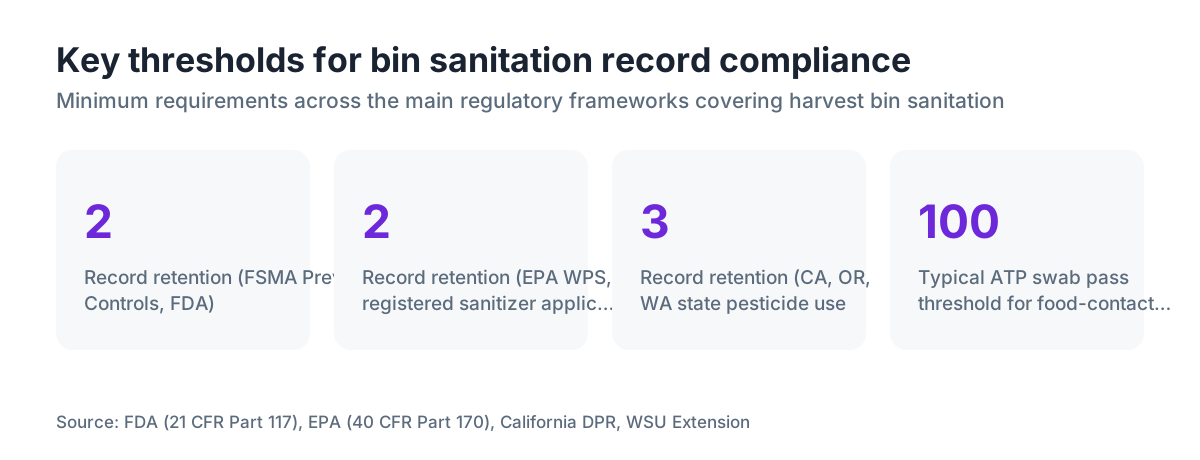
Paper works. A pre-printed form with check boxes gets filled out faster than a spreadsheet on a laptop when someone's holding a hose in August heat. The catch is storage and retrieval. FSMA requires records kept for a minimum of two years, and many state ag departments want three years for pesticide-classified sanitizer applications. [6] A box of damp log sheets is not a compliance strategy.
Spreadsheets on a shared drive beat paper for search, but they create version control problems and don't timestamp edits, which is a red flag for auditors hunting for retroactive entries.
Field record-keeping software, including tools like VitiScribe built around vineyard and harvest operations, lets you log bin sanitation from a phone at the wash station, attach the sanitizer label photo to the entry, and auto-fill the operator's name and date. The audit trail writes itself. That's genuinely useful during a four-week harvest push when paperwork is the last thing on anyone's mind.
Whatever format you pick, the records have to be retrievable by date, by bin lot, and by product name. If your auditor says "show me every entry where you used PAA in September," you need it in under five minutes. Plan for that search before harvest starts.
How do bin sanitation records connect to the EPA Worker Protection Standard?
If the sanitizer carries an EPA registration number, the Worker Protection Standard applies to whoever applies it, even on a concrete pad 200 yards from the nearest vine. That connection surprises a lot of managers.
The EPA Worker Protection Standard (WPS), 40 CFR Part 170, was revised in 2015 and covers agricultural pesticides, including sanitizers that carry a pesticide registration number on their label. [2] If the quat compound or PAA product you're using has an EPA registration number, WPS training and record-keeping requirements attach to the person doing the application.
The EPA's WPS guidance states that employers "must keep records of specific information about each pesticide application for two years." [2] For a sanitizer application at a crush pad, that record should include the product EPA registration number, the application date, the treated site ("harvest bin wash station, block 4 crush pad"), the applicator's name, and confirmation of any restricted-entry interval that applies. Most sanitizers used at food-contact rates have a zero REI, but confirm on the label.
WSU Extension's WPS compliance guides for Washington growers note that the person mixing and applying a registered pesticide, even in a sanitation context, must have completed WPS pesticide safety training and be listed as a trained handler in your records. [7] If a seasonal harvest worker runs the bin washer with a PAA solution, their training date needs to be on file. Cross-reference that training record with your sanitation log so everything ties together at audit time.
The easiest fix: add a "WPS handler training current Y/N" column to your bin sanitation log header page, filled out once per season per employee. Then each daily entry just references the employee ID.
What does a FSMA Produce Safety Rule audit look for in sanitation records?
FDA wants four things: a written procedure, proof it was followed, corrective actions when something went wrong, and a review by a qualified individual. Get those on the page and the audit goes fine.
If you grow grapes that go into juice sold fresh or as minimally processed juice (less common but not rare at farm wineries), FSMA's Produce Safety Rule under 21 CFR Part 112 applies. For most winery crush operations handling fermented product only, FSMA Preventive Controls for Human Food (21 CFR Part 117) governs instead, which requires written sanitation procedures and records confirming those procedures were followed. [8]
The qualified individual doesn't have to be a food scientist. It can be your harvest manager after completing a Preventive Controls Qualified Individual (PCQI) course, which runs two days and is available online through FSPCA. [8]
Here's the practical part: your bin sanitation SOP and your log entries are two separate documents that have to match. If your SOP says "sanitize at 200 ppm sodium hypochlorite for 5 minutes," your log had better not show 10 entries at "100 ppm, 2 minutes" without a documented deviation and sign-off. Auditors put the two side by side.
Should the sanitation log reference specific bin IDs, or is a general entry enough?
Specific bin IDs. Always. A general entry that reads "washed all harvest bins, September 3" is close to useless for traceability. If a lot develops a volatile acidity problem in October, you need to pull up exactly which bins carried that fruit and confirm they were cleaned before and after use.
Most vineyards already number their bins or use color-coded stacks. If yours don't have IDs, pre-harvest is the time to fix that. A paint pen and a two-digit number on the rim takes 30 seconds per bin and makes every future record ten times more useful.
Produce traceability guidance from FDA's FSMA implementation documents calls out lot-level traceability for containers in contact with covered produce. Wine grapes aren't always covered produce, but the same logic applies to any buyer running third-party food safety audits. [8]
If you're running 300 bins through a washer in one morning and they're cleaned identically, logging a range works ("Bins 001-300, sanitized per SOP 4.2") as long as you can prove every bin in that range went through the wash cycle. A tally sheet or conveyor count is your proof.
How do you handle corrective actions and re-cleans in the record?
Build corrective action space into the form from the start. A "Re-clean required? Y/N" checkbox and a two-line notes field handle 95% of situations. Skip this and the operator either leaves the failure blank or scribbles it on a scrap of paper that disappears by noon.
When a bin fails a visual or ATP swab check, the entry needs four things: what the failure was, what corrective action was taken (extended soak, repeat cycle, manual scrub), who authorized it, and the outcome.
Keep failed bins out of service until the corrective action is documented and a supervisor signs off. That's not bureaucracy. Auditors know bins fail. They're checking that you knew too, and that you did something about it.
ATP (adenosine triphosphate) bioluminescence testing is common on crush pads now. Threshold values vary by equipment manufacturer, but a reading below 100 RLU (relative light units) on a cleaned food-contact surface is a typical pass threshold in food processing environments. Some winery QA programs use 200 RLU for non-direct-contact surfaces. Log the reading, the meter model, and the threshold you're using. That context makes the number mean something.
How long do you need to keep bin sanitation records?
Three years for anything involving a registered sanitizer, two years for pure mechanical cleaning with no registered chemical. That single rule of thumb covers the overlapping frameworks below without you having to sort each record by hand.
FSMA Preventive Controls (21 CFR Part 117) requires records kept for at least two years. [8] EPA WPS records for registered pesticide applications must also be kept for two years from the application date. [2] California's Department of Pesticide Regulation requires pesticide use records kept for three years, and that includes sanitizers with EPA registration numbers used on agricultural operations. [9] Oregon and Washington have similar three-year state requirements for licensed applicators. [7]
Store them so you can retrieve by date and by product. A cloud folder organized by season then by month works fine. Paper in a labeled binder works too, as long as the binder doesn't live in a damp cellar.
TTB doesn't specify bin sanitation records directly, but if you're a licensed winery, TTB expects your production records to show the chain of custody for fruit from receipt through crush. A bin sanitation log that references the bin IDs used for each harvest lot ties into that production record chain cleanly.
What does a complete bin sanitation log entry look like in practice?
Here's a full entry written out in plain text. You'd format it as a table row or a field-by-field form, but the content stays the same.
Date: September 7, 2025
Time: 06:30 to 08:15
Bins cleaned: Bins 045-120 (76 bins, half-ton capacity)
Pre-rinse: Yes, high-pressure water at approximately 60°F
Cleaning agent: Oxonia Active (peracetic acid), EPA Reg. No. 1677-129
Concentration as mixed: 200 ppm (0.02% solution)
Contact time: 5 minutes
Rinse: Yes, potable water, two passes
Water temp at application: 65°F
Operator: J. Morales (Handler training confirmed 8/12/2025)
Visual inspection pass: Yes
ATP swab result: 87 RLU on bin 067 (spot check), pass threshold 100 RLU
Bins flagged for re-clean: None
Supervisor sign-off: K. Vasquez, 09/07/2025
Notes: Bin 098 arrived with visible soil on exterior wall, pre-rinsed separately before joining batch, no additional soak needed
That entry is audit-ready. It answers every question an SQF auditor, an FDA inspector, or a winery QA manager could ask about those 76 bins on that morning. It took about four minutes to fill out. That's the standard you're aiming for: complete, not complicated.
How do bin sanitation records fit into the broader harvest record system?
Bin sanitation records work best as a module of a larger harvest record, not a standalone binder. The chain runs like this: a vineyard block is scheduled for pick, a harvest block record opens with the block ID and pick date, the assigned bins are listed, the pre-pick sanitation entry is referenced by log number, the fruit goes into those bins and moves to crush, the post-dump cleaning entry closes it out, and the winery receives the record with the fruit.
That chain means your winery contact can pull the bin sanitation history for any lot without calling you. Buyers and co-op wineries increasingly expect that, especially in regions like Paso Robles or Sonoma where contract grower relationships run long-term and get audited every year. Growers who hand over a clean, organized record package tend to get better contract terms. Produce buyers and winery purchasing managers say so directly when they're asked.
If you want to see a connected vineyard record system in practice, VitiScribe's harvest module ties bin sanitation entries directly to block harvest records, so the log reference number shows up automatically in the lot history without manual linking. Testing it during your next harvest is a reasonable way to find out whether the format fits your operation.
For growers running multiple sites, like those managing blocks around Paso Robles wineries or leased blocks at south coast winery facilities, a shared digital log solves the access problem paper creates when the records live at one site and the auditor is at another.
What common mistakes make bin sanitation records fail an audit?
Missing entries top the list. A 30-day harvest with records for 22 days looks worse than no records at all, because the auditor sees you tried and stopped. Log every wash event, or document why a day had no wash activity (no harvest scheduled, bins in use).
Second most common: a mismatch between the SOP and the log. If your written procedure calls for 200 ppm PAA and your log shows 150 ppm entries for two weeks, you need a documented reason. "We ran out of product" or "supervisor approved lower rate due to product availability" is fine if it's written down. Unexplained deviations are not.
Third: missing chemical concentration. "Used Oxonia" is not a log entry. "Used Oxonia at 200 ppm per label direction" is. The number matters legally.
Fourth: no operator name. Anonymous entries are unverifiable. Some operations use initials only, which works if you keep a separate key matching initials to full names and training records.
Fifth: logs stored where nobody can reach them under harvest pressure. If your paper logs sit in a folder under six months of mail in the farm office, they don't exist for practical purposes. Pick a spot and stick to it.
WSU Extension's food safety resources for fruit growers list record accessibility among the top reasons audits fail at farms that actually performed the required procedures. [7] Doing the work and being unable to prove it is the same outcome as not doing the work.
Frequently asked questions
Do I need to record bin sanitation if I only use hot water and no chemicals?
Yes, though the required fields are fewer. Log the date, bin IDs, water temperature, contact time, and operator. No EPA registration number or WPS handler documentation is required for hot-water-only cleaning. Still log it, because it establishes a sanitation history for each bin, which matters if a lot develops quality problems and you need to rule out container contamination as the cause.
How do I know if the sanitizer I'm using requires a WPS record?
Look for an EPA Registration Number on the product label. If the label carries one, the product is registered as a pesticide under FIFRA and WPS record-keeping applies to its application. Common harvest bin sanitizers with EPA numbers include peracetic acid products like Oxonia Active and many quaternary ammonium compounds. Plain grocery-store bleach usually doesn't carry one, but commercial bleach concentrates used as sanitizers often do. When in doubt, call your county ag commissioner.
What concentration of sodium hypochlorite is standard for cleaning harvest bins?
Most extension guidance, including UC Davis winery sanitation resources, puts the working range at 100 to 200 ppm free chlorine for food-contact surface sanitation. At 200 ppm you need a potable water rinse after contact. Above 200 ppm you're outside the typical food-contact exemption and must follow label directions exactly. Always check the current product label, because label amendments can change approved rates between seasons.
How often should harvest bins be cleaned and logged during harvest season?
Before first use in the season, between every harvest lot (after dumping one load and before loading the next variety or block), and after any bin returns with visible contamination. Some operations also run a mid-season deep clean of the full inventory on a scheduled rest day. Each event gets its own log entry. There's no regulatory minimum frequency, but best practice from food safety audit frameworks is between every lot.
Can I use one log entry to cover an entire day's worth of bin washing?
Yes, if all bins washed that day got identical treatment: same chemical, same concentration, same contact time, same operator. List the full range of bin IDs or the total count. If anything varied, split the entry. An auditor reading a single entry for 150 bins needs to verify identical procedures applied to all 150. If you mixed a second batch and adjusted concentration partway through, that's two entries.
What's an ATP swab and do I need to use one for my bin sanitation records?
ATP bioluminescence testing measures organic residue on a surface using a swab and a handheld meter, giving a rapid pass/fail result in seconds. It's not legally required by FSMA or WPS, but many third-party audit schemes (SQF, GlobalGAP) expect environmental monitoring data. If you use ATP testing, log the reading, the meter model, and your pass threshold alongside the chemical sanitation entry. A reading under 100 RLU is a common food-contact pass criterion.
Does my winery need to keep bin sanitation records even if the vineyard keeps its own?
If your winery receives fruit in bins cleaned on your own crush pad, yes, keep your own records. If you receive fruit from a contract grower in their bins, request copies of their sanitation logs and file them with your lot records. Under FSMA Preventive Controls (21 CFR Part 117), you're responsible for sanitation of equipment in your facility. Bins on your property are your equipment.
How do I document a bin that failed inspection and needed a re-clean?
Write the original entry as normal, then add a corrective action note in the same record: the failure observation, what corrective action was taken, who authorized it, and when the bin was re-inspected and cleared. Mark the bin with a physical tag as "Hold" until cleared. Never clear a failed bin by just leaving the log blank. The written trail of failure, action, and clearance is exactly what auditors want to confirm your system works.
How long should I keep bin sanitation records?
Two years minimum under FSMA Preventive Controls (21 CFR Part 117) and EPA WPS. Three years if you're in California, Oregon, or Washington and used a registered pesticide sanitizer, because those states require three-year pesticide use records. When records fall under multiple rules, keep them for the longest required period. Storing everything for three years is simpler than sorting which records fall under which rule.
Do I need a PCQI to sign off on bin sanitation records?
Under FSMA Preventive Controls for Human Food (21 CFR Part 117), a Preventive Controls Qualified Individual must review corrective action records and any records documenting deviations from the food safety plan. Routine daily sanitation logs can be signed off by a trained supervisor. Your PCQI, typically your harvest manager or winery QA person after completing the two-day FSPCA course, handles the oversight layer, not necessarily each entry.
What should I do if I realize I missed logging several bin washes during a busy stretch?
Don't reconstruct the records as if they were written in real time. That's falsification. Instead, write a documented note for the missing dates explaining that cleaning was performed but not logged at the time, describe the procedure that would have been followed based on your SOP, and have a supervisor sign and date the note as a late entry. Then add a corrective action to your food safety plan to prevent the gap. An honest late entry is auditable. A fabricated one isn't.
Should vineyard bin cleaning logs and winery sanitation records be kept in the same file?
Keep them linked by lot number but stored in the system that owns that step. Vineyard sanitation records (field-side pre-harvest clean) stay in the vineyard harvest record. Crush pad post-dump cleaning records stay in winery production logs. Cross-reference the lot ID in both. This separation matters because two frameworks, FSMA and TTB winery records, may ask for each set independently, and you don't want to hand over winery production data when a field inspector only needs vineyard records.
Sources
- EPA, 40 CFR 180.940 Tolerance exemptions for active and inert ingredients for use in antimicrobial formulations: EPA food-contact exemption thresholds for hypochlorite and other sanitizers on food-contact surfaces
- EPA, Worker Protection Standard for Agricultural Pesticides (40 CFR Part 170): WPS requires employers to keep records of pesticide applications for two years; handler training documentation requirements
- UC Davis Department of Viticulture and Enology, Winery Sanitation Resources: Sodium hypochlorite efficacy drops at elevated water temperatures; peracetic acid reaction rates slow in cold water
- EPA, Pesticide Registration: Read the Label First: The pesticide label is the law; registered sanitizer labels carry EPA registration numbers and govern legal application rates
- Cornell Cooperative Extension, Viticulture and Enology Program: Recommendation to keep current pesticide/sanitizer product label on file with lot records because labels can change between seasons
- FDA, FSMA Preventive Controls for Human Food (21 CFR Part 117) recordkeeping requirements: FSMA records must be kept for a minimum of two years; state pesticide record requirements can extend to three years
- Washington State University Extension, Pesticide Record Keeping and WPS Compliance for Tree Fruit and Grape Growers: Washington three-year state record-keeping requirement for licensed pesticide applicators; record accessibility as a top audit failure reason
- FDA, FDA Food Safety Modernization Act (FSMA): FSMA Produce Safety Rule (21 CFR Part 112) and Preventive Controls for Human Food (21 CFR Part 117) written sanitation procedure and record requirements; PCQI review; lot-level traceability
- California Department of Pesticide Regulation, Pesticide Use Reporting (PUR) Program: California requires pesticide use records, including registered sanitizer applications on agricultural operations, to be kept for three years
- EPA, Summary of the Federal Insecticide, Fungicide, and Rodenticide Act (FIFRA): FIFRA label is legally binding; peracetic acid products with EPA registration numbers are classified as pesticides subject to WPS
Last updated 2026-07-10