How to record T-budding success rates for vineyard establishment records
TL;DR
- Record T-budding success rates by logging bud date, rootstock block, budder ID, and a take/fail check per vine at 3-4 weeks post-budding and again after dormancy break.
- Calculate take rate as live buds divided by total buds attempted.
- Most extension programs target 85-95% take as a benchmark.
- Keep records for at least 3 years to satisfy state nursery and pesticide compliance requirements.
Why does recording T-budding success matter beyond just knowing your numbers?
A take rate is a management tool first and a compliance document second. If 30% of your vines didn't take in block 7 and you never wrote the numbers down, you're replanting blind. You won't know whether the problem was budder skill, rootstock incompatibility, timing relative to bark slip, or a cold snap that hit three days after you wrapped.
There's a regulatory angle too. Many states require growers to keep vineyard establishment records as part of nursery stock compliance. California's Department of Food and Agriculture, for example, requires that certified grapevine material stay traceable from nursery to planting, and a T-budding record ties into that chain of custody [1]. File a crop insurance claim for failed establishment and the USDA Risk Management Agency will ask for written documentation of your planting method and success evaluation [2].
Hire labor for budding and another rule shows up. The EPA Worker Protection Standard requires you to keep records of pesticide applications near workers, which means your budding crews and your spray records have to be linkable by date and block [3]. A well-built T-budding log gives you that hook.
The point isn't paperwork for its own sake. Good records let you answer hard questions fast: which rootstock took best on your clay soils, which crew hit 90%-plus year after year, whether your timing in week 3 of August beat week 5.
What information should every T-budding record include?
Each entry needs seven things at minimum: the date of budding, the block or row identifier, the rootstock variety, the scion variety, the budder's name or crew ID, the total number of buds attempted, and the result of each evaluation check. That's the skeleton. Everything else is useful but optional, depending on how big your operation is.
Here's what a complete field entry looks like in plain terms:
| Field | Example entry |
|---|---|
| Date budded | 2025-08-14 |
| Block/row | Block 4, rows 12-18 |
| Rootstock variety | 110R |
| Scion variety | Cabernet Sauvignon clone 8 |
| Budder ID | Crew A / J. Morales |
| Total buds attempted | 147 |
| Evaluation date 1 (3-4 wk) | 2025-09-05 |
| Live buds at eval 1 | 128 |
| Take rate eval 1 | 87.1% |
| Evaluation date 2 (spring break) | 2026-03-20 |
| Live buds at eval 2 | 119 |
| Final take rate | 81.0% |
| Notes | 8 buds failed between eval 1 and 2, probable winter injury rows 16-17 |
That notes field matters. Numbers without context lie. An 81% take rate in a block that hit -12°C in January tells a different story than 81% on a mild site. Write the context down while you still remember it.
WSU Extension recommends recording bark slip condition at the time of budding, since buds inserted when the bark isn't slipping cleanly fail at much higher rates no matter how good the budder is [4]. A simple 3-point scale (good slip, marginal, poor) takes two seconds and hands you a strong explanatory variable later.
When should you evaluate T-bud take rates?
There are two standard evaluation windows and both matter. Skip either one and you lose diagnostic information you can't get back.
The first evaluation comes 3 to 4 weeks after budding. You're checking whether the bud union callused and the bud itself is still plump and green. A shriveled, brown bud that pushes easily off the wood has failed. This early check tells you whether immediate re-budding is possible while conditions still allow it. Cornell Cooperative Extension notes that in the northeastern U.S., this window usually closes by mid-September because bark slip ends [5].
The second evaluation happens at dormancy break the following spring, usually when soil temperatures at 4 inches reach about 50°F (10°C) and the buds are just starting to swell. This is your final take rate. Some buds that looked alive in fall will have been killed by winter cold or desiccation. This spring number goes into your permanent establishment record.
A third informal check is worth doing at full shoot emergence, maybe 2-3 weeks after the spring swell. By then you can see which buds pushed a healthy shoot and which forced a weak or one-leaf stub. Some operations count only vigorous pushes as true successes. That's a judgment call. Be consistent, though: whatever your definition is, write it in your record header so anyone reading it later knows what you counted.
Nobody has a universal standard for what counts as a "live" bud at the fall evaluation. The closest thing to consensus in published extension guidance is the green-cambium scratch test. Scratch the bud tissue lightly with a thumbnail. If the cambium is green and moist, it's alive.
How do you calculate T-budding take rate correctly?
The formula is simple. Take rate (%) = (number of live buds at evaluation / total buds attempted) x 100.
The ambiguity hides in the denominator. "Total buds attempted" should mean every bud you actually inserted and wrapped, no matter how much you doubted it at the time. Don't drop the ones you suspected were marginal when you placed them. Start excluding suspected failures before evaluation and your numbers inflate, and you lose the signal that tells you something went wrong that day.
If a vine had multiple buds placed (a double-budding strategy), decide in advance whether your unit of measurement is the vine or the individual bud, then hold to it. Most extension programs track by vine for establishment purposes and by bud for budder performance [4][5].
Round to one decimal place. "87.1%" is more useful than "87%" when you're comparing across blocks, crews, or years.
Keep the raw counts, not only the percentages. If block 4 had 147 attempts and block 9 had 23, an 85% rate in each block means very different things statistically. Small blocks with big percentage swings shouldn't get the same weight as large blocks in your operation-level summary.
What's a realistic target take rate for T-budding grapevines?
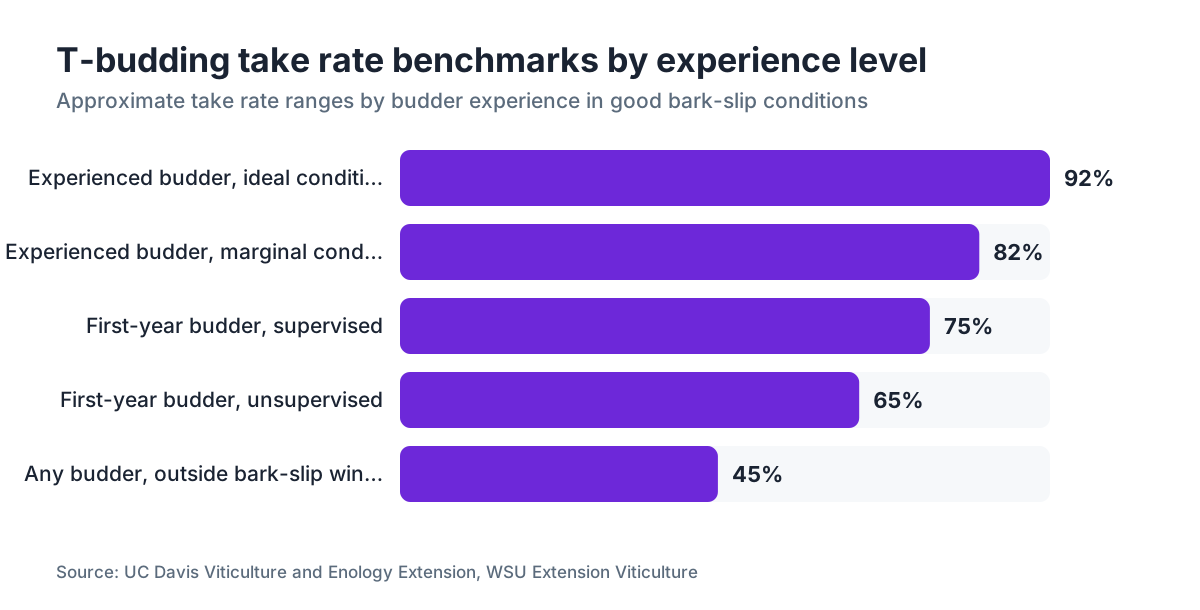
Published benchmarks vary by region and rootstock, and nobody should treat them as hard pass/fail cutoffs. UC Davis Viticulture and Enology extension materials reference 85-95% as a reasonable target for experienced budders working in good conditions [6]. WSU puts similar numbers in its Pacific Northwest guides [4].
Take rates below 75% usually signal a correctable problem: timing (outside the bark-slip window), poor budwood storage that let the wood dry out, or technique issues that training can fix. Take rates below 60% point to something more systematic, like rootstock-scion incompatibility, a disease issue in the budwood, or environmental stress that hit during the healing window.
First-year budders commonly land at 70-80% even with supervision. Experienced budders in ideal conditions hit 90%-plus. If you're tracking by individual budder, expect variance, and don't hang a performance verdict on a single season.
One honest caveat. Published success-rate benchmarks for T-budding specifically in vineyards are thin. Most studies look at chip budding or bench grafting. The UC Davis figures that circulate in extension programs come from practitioner surveys and trial plots, not large controlled studies. Use them as orientation, not gospel.
What form or system should you use to capture T-budding records in the field?
A paper tally sheet on a clipboard in the block is still the most reliable way to capture data at the moment of budding. One design rule beats all the others: the budder should be able to record one vine's data in under 5 seconds. That means pre-printed block and variety fields, a numbered row, and a single checkbox or tally mark per vine. Anything more than a tally mark per vine gets skipped when the crew is moving fast.
At the evaluation stage, a numbered vine map with two columns (eval 1 and eval 2) works well. Mark each vine live (L), dead (D), or questionable (Q). Transfer totals to your master record at the end of each day.
For operations running multiple blocks across a season, a spreadsheet organized by block and date keeps summaries accessible without manual recalculation. Google Sheets or Excel both do the job. The format matters less than the discipline of entering data within 24 hours of the evaluation.
If you want something purpose-built for vineyard compliance records, VitiScribe (vitiscribe.com) is designed around exactly this workflow, linking block-level field logs to compliance exports without manual re-entry. But a $0 spreadsheet template with consistent column names serves you fine if you keep it up.
One thing kills paper records: illegible handwriting in the notes column. Print, or use checkboxes. A record you can't read three years later is the same as no record.
How long do you need to keep T-budding records, and who might ask for them?
Three years is the minimum most growers should plan for, and five years is safer if your state runs an active nursery compliance program. Retention is cheap. Missing records during a claim or an audit is not.
The USDA's Noninsured Crop Disaster Assistance Program (NAP) and related crop insurance programs require documentation of production practices, including establishment records, going back to the year of planting [2]. If your new block takes two years to establish and you file a claim in year three, you need records from the budding date.
California's grapevine nursery certification program requires traceability documentation that links propagation material to the planting site [1]. Your T-budding records are part of that chain.
State department of agriculture inspectors can request establishment records during nursery audits or disease traceback investigations, especially for diseases like grapevine leafroll virus or the Xiphinema index-transmitted fanleaf that can move through propagation material.
The EPA Worker Protection Standard requires pesticide application records to be kept for 2 years [3]. If your budding operation overlaps with spray activities (fungicide applications near grafting wounds, say), your establishment records should cross-reference your spray records. "The WPS requires handlers to keep records of all pesticide applications" including the location, date, and product, per EPA's WPS guidance [3].
Keep digital backups. Paper records stored in a barn office have a poor 5-year survival rate.
How do you link T-budding records to your broader vineyard establishment file?
A vineyard establishment file for a new block should hold, at minimum: the site map with block delineations, rootstock and scion sourcing records (nursery invoices, phytosanitary certificates), planting or transplant dates, irrigation installation notes, and the T-budding records as a subset of propagation records.
The linkage is the block identifier. Every document in the file should carry the same block ID, whether it's Block 4, North Flat, or whatever naming convention you use. Consistent block naming is the one thing that makes a multi-year file searchable.
Index your T-budding sheets by block and year, not by budder or variety. When someone pulls the file five years out (maybe you, maybe a buyer doing due diligence, maybe an appraiser), they'll be looking by location.
Selling the property or the block? A clean establishment record adds real dollars. A buyer who can see rootstock provenance, take rates by block, and replant history has far better information than one inheriting a mystery vineyard. That holds whether you're talking about a Paso Robles vineyard or a small estate anywhere [see also: /vineyard].
How do you record T-budding data when you have multiple crews or budders?
Give each budder or crew a unique identifier that appears on every tally sheet they complete. It doesn't have to be a name if you have privacy concerns; a code works fine. The point is being able to break out take rates by individual when you're trying to understand variance.
Run tallies by budder within each block. A single block might have three people budding across different rows, and their individual results can swing 15 to 20 percentage points on the same day. Record only block-level totals and that signal disappears.
If you pay piecework tied to take rate, the record system matters even more, because now it's a payroll document. Be clear with crews about what gets measured and when. WSU Extension's labor management materials note that budder incentive structures need clear, agreed-upon measurement criteria to head off disputes [4].
After the season, summarize each budder's season-wide take rate. Three seasons of data per budder lets you separate skill from luck and gives you a real basis for training conversations.
What common recording mistakes reduce the value of your T-budding data?
The most common mistake is recording only the pass/fail count and skipping total attempts. Write "128 live" without "147 attempted" and you can't calculate a take rate or compare across blocks. The count is dead weight.
The second mistake is collapsing the two evaluation windows into one. Some growers record only the spring break evaluation, which throws away their ability to tell whether failures happened during fall callusing or over winter. That distinction drives your diagnosis.
Recording by variety instead of by block is a subtle one. Variety and block usually correlate, but plant the same scion on two different rootstocks in different blocks and variety-level aggregation hides the rootstock effect entirely.
Not dating the records is surprisingly common with paper forms. Pre-print forms for the season without a date field, the crew assumes someone else will fill it in, and you end up with undated documents. Print the date on the form at the start of each day, or make it the first field anyone fills.
Losing the budding notes before they reach the master file is a real hazard. A phone photo of the paper tally sheet at the end of each day costs you 10 seconds and gives you a backup. Do it.
How does T-budding record-keeping connect to long-term block performance tracking?
Your take rate records are the opening entry in a block's performance ledger. Vines that went through a rough establishment (low take rates, repeated replanting, dragging vigor) often show measurable differences in trunk diameter and yield uniformity in years 3 through 5 compared to vines from a clean first-year take.
Track yield by block, which you should be doing for any wine quality program, and you can correlate those yield records back to establishment take rate by sub-block or row. That tells you whether your current uneven-yielding rows trace to an establishment problem instead of a soil or irrigation issue. Different problem, different fix.
UC Davis viticulture research has documented that grafted vine establishment failures and the replanting delays that follow are among the leading contributors to non-uniform vine age within commercial blocks, which then affects harvest timing decisions and wine quality [6].
Keep T-budding records in a format you can query years later, whether on paper files organized by block or in a system like VitiScribe, and those early-season field observations stay useful for as long as the block produces fruit.
A vineyard is a decades-long investment. The record you write in August of year one still matters in year fifteen when you're trying to figure out why the northwest corner always underperforms.
Frequently asked questions
What is a good T-budding success rate for grapevines?
UC Davis extension materials reference 85-95% as a reasonable target for experienced budders in good conditions. First-year budders working under supervision typically achieve 70-80%. Rates below 75% usually indicate a correctable problem with timing, budwood quality, or technique. Rates below 60% suggest a more systematic issue worth investigating before the next budding season.
When do you check if a T-bud took?
There are two standard evaluation windows. The first is 3-4 weeks after budding, when you check whether the bud is plump and green versus shriveled and brown. The second is at dormancy break the following spring, typically when soil temps at 4 inches reach 50°F. The spring evaluation gives you the final take rate for your permanent establishment records.
How long should vineyard T-budding records be kept?
Keep records for at least 3 years, with 5 years being more prudent. USDA crop insurance programs require establishment documentation going back to the planting year. California's nursery certification program requires propagation traceability. State departments of agriculture can request establishment records during disease traceback investigations, so a longer retention period protects you.
Do EPA Worker Protection Standard rules apply to T-budding crews?
The WPS applies when pesticides are used in areas where budding crews work. If you're applying fungicides near grafting wounds or in adjacent rows, your spray records and your budding crew location records need to be cross-referenceable by date and block. The WPS requires pesticide application records to be kept for 2 years, per EPA guidance.
What's the difference between early-fall take rate and final spring take rate?
The fall evaluation (3-4 weeks post-budding) measures whether the bud callused and survived the initial healing period. The spring evaluation measures survival through winter. Some buds that look alive in fall are killed by cold or desiccation before spring. Both numbers matter: fall for diagnosing technique or timing problems, spring as the official establishment success figure.
Should I track T-budding success by vine or by bud?
Track by vine for establishment records and by individual bud for budder performance evaluation. If you use a double-budding strategy, decide which unit you're measuring before the season starts and stay consistent. Always record total attempts, not only successes; without the denominator, the success count is meaningless for calculating a take rate or comparing across blocks.
What rootstock information should be in T-budding records?
Record the rootstock variety name, the nursery source, and ideally the lot number or phytosanitary certificate number from the nursery invoice. This ties your budding record to your certified planting material documentation. California's CDFA nursery certification program requires this chain of custody. If a disease issue emerges later, rootstock source data is the first thing investigators ask for.
Can I use a simple spreadsheet for T-budding records, or do I need specialized software?
A spreadsheet with consistent column names works fine for most operations. The essential columns are: date budded, block ID, rootstock variety, scion variety, budder ID, total attempts, eval-1 date and count, eval-2 date and count, and notes. Software helps mainly when you're managing multiple blocks across multiple seasons and need summaries or compliance exports without manual recalculation.
How do I record T-budding data when a crew of multiple budders works the same block?
Assign each budder a unique code and include it on every tally sheet they complete. Record totals by budder within each block, not only block totals. Individual take rates within the same block on the same day can vary by 15-20 points, and that variance contains real diagnostic information about skill and technique that block-level aggregation hides.
What do Cornell or WSU say about recording grapevine budding success?
Cornell Cooperative Extension recommends evaluating bud take at 3-4 weeks post-budding and notes that the re-budding window typically closes by mid-September in the Northeast as bark slip ends. WSU Extension recommends recording bark slip condition at the time of budding as an explanatory variable, since marginal bark slip is a major predictor of failure regardless of budder skill.
How do I connect T-budding records to crop insurance documentation?
USDA's Noninsured Crop Disaster Assistance Program and related crop insurance policies require written documentation of establishment practices, including planting method and success evaluation, going back to the planting year. Your T-budding record, showing budding date, block, total attempts, and take rate at spring evaluation, is the core document. Keep it with your nursery invoices and site maps in one establishment file per block.
What is bark slip and why does it matter for recording T-budding results?
Bark slip is the condition when the cambium separates cleanly from the wood, letting the bud shield seat properly in the T-cut. It happens during active growth periods when the vine is well-hydrated. Buds placed outside the bark-slip window fail at much higher rates. Recording bark slip condition (good, marginal, poor) at the time of budding gives you a key variable for diagnosing low take rates.
How do I calculate take rate if some vines had two buds placed (double budding)?
Decide before the season whether your unit is the vine or the individual bud, and record total bud attempts accordingly. For establishment records, vine-level take rate (how many vines have at least one live bud) is usually more meaningful. For budder performance, bud-level take rate is more informative. Keep both counts in your raw data so you can calculate either metric.
Sources
- California Department of Food and Agriculture, nursery and grapevine registration and certification programs: California CDFA requires certified grapevine material to be traceable from nursery to planting site under its nursery certification programs
- USDA Risk Management Agency, Noninsured Crop Disaster Assistance Program: USDA crop insurance and NAP programs require documentation of production practices including establishment records going back to the year of planting
- US EPA, Agricultural Worker Protection Standard: The WPS requires handlers to keep records of all pesticide applications including location, date, and product for 2 years
- Washington State University Extension: WSU Extension recommends recording bark slip condition at time of budding and tracking take rates by individual budder within blocks
- Cornell College of Agriculture and Life Sciences (Cornell CALS): Cornell Cooperative Extension notes the re-budding window typically closes by mid-September in the northeastern US as bark slip ends, and recommends evaluating bud take at 3-4 weeks
- University of California, Division of Agriculture and Natural Resources (UC ANR): UC extension materials reference 85-95% as a reasonable T-budding take rate target for experienced budders, and note that establishment failures contribute to non-uniform vine age and yield variation within commercial blocks
- USDA National Agricultural Statistics Service, Grape acreage reports: USDA NASS tracks bearing and non-bearing grape acreage, providing context for commercial vineyard establishment scale in the US
- UC Agriculture and Natural Resources, UC IPM Pest Management Guidelines for grapes: UC ANR IPM guidelines cover fungicide applications during grafting and establishment periods relevant to WPS record cross-referencing
- Washington State University Extension: WSU Extension materials note that budder incentive structures tied to take rate need clear, agreed-upon measurement criteria established before the season
Last updated 2026-07-10