How to record a surgical removal of Esca-infected wood in vineyard logs

TL;DR
- When you cut out Esca-infected wood, your vineyard log needs at least six data points: the date, vine ID or GPS location, the infected tissue removed (cordons, spurs, trunk), the cut tool used, any wound sealant applied, and the worker doing the work.
- Keep these records at least two years to satisfy most state pesticide and crop audit rules.
- They also track disease progression year over year.
What is Esca, and why does surgical removal need its own log entry?
Esca is a wood disease complex caused by several fungal pathogens, most often Phaeomoniella chlamydospora, Phaeoacremonium minimum, and Fomitiporia mediterranea. It colonizes the permanent wood of grapevines and causes chronic foliar symptoms, wood necrosis, and the sudden collapse called apoplexy. No registered fungicide cures an infected vine once the wood is colonized [1]. Cutting out the infected tissue is one of the few management tools you actually have.
That's exactly why the work deserves its own log entry, not a scribble in the margin of your spray record. Surgical removal changes the vine's architecture for good. You need a record of what came off, from which vine, and at what growth stage, because that shapes every future pruning and training decision for that plant.
There's a compliance angle too. If you apply any wound sealant or biocontrol product after cutting, that application may trigger worker protection or pesticide record-keeping rules under the EPA Worker Protection Standard (WPS) or your state's pesticide use reporting program [2].
The practical reason is the one that pays off. Esca creeps through a block over years. A log with accurate per-vine records is the only way to know whether you're gaining ground or losing it.
What information should every Esca surgery log entry include?
No single federal form dictates what a vineyard wood surgery record must hold. You're building a template that serves two masters at once: your own agronomic memory and any audit that might look at your records. Here's what to capture for every entry.
Date and time. The day at minimum, ideally the time of day. Freshly cut wood exposed to afternoon heat or airborne spores can affect how well wound sealants bond and how fast callus tissue forms. Cornell's viticulture program notes that wound susceptibility to Eutypa and Esca pathogens is highest right after pruning cuts [3].
Vine identifier. Row number and vine number, or GPS coordinates if you map with precision viticulture tools. "Row 14, Vine 7" is fine. An approximate spot in a 5-acre block is not.
Block and variety. Obvious, but don't skip it. If you manage multiple varieties, Esca incidence data is only useful when you can sort by variety.
Tissue type removed. Be specific: entire cordon, section of cordon (note length in cm or inches), spur, trunk section, or full vine removal. Some operations also note the rough volume of discolored wood versus healthy wood left behind, which helps judge whether the cut hit a clean margin.
Severity rating at cut. A simple 1-3 or 1-5 scale works. WSU's viticulture resources recommend documenting symptom severity when surveying Esca, and the same logic applies at the cut [4]. What you saw in the cross-section, whether the discoloration was a narrow streak or most of the vascular system, tells next season's pruner a lot.
Worker name. Required under the EPA WPS if the work involves applying any registered pesticide product after surgery [2]. Good practice regardless.
Tool used and sanitation method. Loppers, pruning saw, reciprocating saw, or chainsaw for trunk work. And the part people forget: what did you dip or spray those tools with between vines? UC Davis Cooperative Extension recommends 70% ethanol or a 10% bleach solution, though bleach corrodes tools [1]. Note which one you used.
Wound treatment applied. Product name (active ingredient), EPA registration number if it's a registered pesticide, rate, and applicator. A latex-based paint or a Trichoderma-based biocontrol both go here. This is where your entry may cross into pesticide record territory depending on your state.
Vine disposition. Did you retrain from a sucker, install a new graft, leave the vine to push replacement growth, or flag it for removal? Write down the plan.
Photo reference. Not required by any law, but a photo file name tied to the vine ID earns its keep. When you revisit the vine two years later and see regrowth symptoms, that photo of the original cross-section tells you more than any written description.
How do Esca surgery records connect to pesticide compliance requirements?
The moment you apply any registered pesticide product to a wound or to the vine after surgery, federal and state record-keeping rules kick in. This is where small vineyard operations get tripped up. They treat Esca surgery as purely physical work, like pruning, so they skip the record discipline they'd use for a spray.
Under the EPA WPS, at 40 CFR Part 170, agricultural employers must keep pesticide application records for at least two years [2]. If you apply a wound protectant carrying an EPA registration number, that application has to be logged with the applicator's name, the location, the product name and EPA reg number, the rate applied, the date, and the crop. Many Trichoderma-based biocontrol products used on pruning wounds are EPA-registered, so read the label.
California requires pesticide use reporting (PUR) for all agricultural pesticide applications, including those tied to wood disease management, filed with the county agricultural commissioner [5]. Oregon and Washington run similar use-reporting programs. If you're in one of those states and applying anything to the wound after surgery, the record you keep for yourself and the record the law requires should be the same document, or at least cross-referenced.
Even if your wound treatment is not a registered pesticide, say you're brushing on plain latex paint, log it in the same entry for your own protection. An auditor who finds a gap in your records is harder to satisfy than one who reads thorough notes that go past the minimum.
What does a complete Esca surgery log entry look like in practice?
Here's a realistic entry, written plain the way you'd put it in a field notebook or a digital record.
Date: June 12, 2025
Block: Estate Block 3, Syrah, planted 2008
Vine ID: Row 06, Vine 19
GPS: 38.1234°N, 122.5678°W (optional)
Symptom observed: Apoplexy on left cordon, confirmed with cross-section showing brown necrosis through 80% of wood at point of cut
Tissue removed: Entire left cordon, approximately 60 cm, cut back to clean wood at cordon-spur junction
Severity at cut: 4/5 (extensive necrosis visible in cross-section)
Tool used: Pruning saw
Sanitation: 70% ethanol dip between vines
Wound treatment: Topsin-M (thiophanate-methyl, EPA Reg. No. 70051-27), applied by brush at labeled rate
Applicator: [Worker name]
Post-surgery disposition: Flagged for replacement cordon training from existing spur; will reassess at budbreak 2026
Removed material disposal: Tied and removed from block, burned on-site per county permit
Notes: Opposite cordon (right) shows early stripe symptoms in outer wood. Recommend monitoring at next scouting.
Photo file: B3_R06V19_06122025.jpg
That entry takes about three minutes once you're in the habit. It covers your agronomic needs, your pesticide record obligations, and your worker safety documentation in one place. It's also the kind of record that survives an audit without a follow-up phone call.
If you want a digital system that structures this for you, VitiScribe is built for vineyard operations and has fields for wood disease work alongside spray and scouting logs. That keeps your compliance records out of three separate notebooks.
How should removed Esca-infected wood be disposed of, and does that go in the log?
Yes, wood disposal goes in the log. Esca-infected wood holds viable fungal inoculum that can persist in dead wood and spread by splash or mechanical means [6]. Your record should note exactly how the removed tissue was handled.
The common options are burning (where permitted), burial, or chipping and hauling the chips out of the block. UC Davis Cooperative Extension recommends removing infected prunings from the vineyard entirely rather than leaving them in the row middles [1]. Chipping in place has not been shown to eliminate inoculum and may add to soil-level inoculum loads, though the research on chip dispersal for Esca specifically is thinner than for Eutypa.
If you burn, note the burn permit number or reference. In California, many counties require an agricultural burn permit even for small piles, and burn days are regulated by the local air quality district [5]. That's a real compliance exposure you don't want to discover during an inspection.
The entry should read something like this: "Removed material: cordon sections, approximately 2 kg. Disposal: removed from block, transported to farm burn pile, burned 06/13/2025 under County Burn Permit #XXXX."
How often should Esca surgery records be reviewed, and what patterns should you look for?
Run a block-level summary at least once a season, after harvest and before you plan winter pruning. You want the answers to three questions: How many vines got treated in each block? What's the year-over-year trend? Are certain rows or sections showing higher incidence than others?
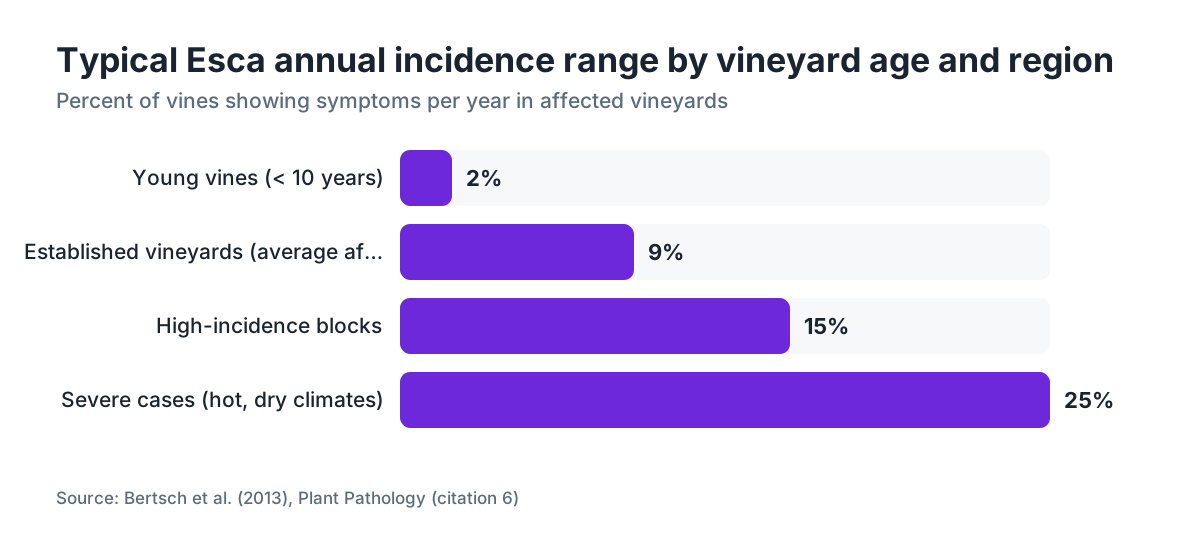
Esca incidence in established vineyards averages between 3% and 15% of vines a year in affected regions, though some blocks in hot, dry climates run much higher [6]. Once a block climbs past 10% annual incidence, replanting economics start to compete with the cost of managing vines one at a time.
WSU Extension's guidance on trunk disease management suggests mapping affected vines by GPS or row-vine grid to see spread patterns over time [4]. A cluster spreading outward from a focal point might mean a wound-infection event from shared contaminated tools. That's a different problem than a diffuse random scatter across a block.
Reviewing your logs also tells you whether your sanitation and wound treatment protocols are working. If vines treated with a particular product last season show recurrence at higher rates than untreated ones, that's worth investigating. You won't see that signal without records.
For managers running multiple blocks, a simple table updated seasonally is usually enough. Here's a structure you can adapt.
| Season | Block | Vines Scouted | Esca Surgeries | % Incidence | Full Removals |
|---|---|---|---|---|---|
| 2022 | Block 3 | 312 | 8 | 2.6% | 1 |
| 2023 | Block 3 | 312 | 14 | 4.5% | 2 |
| 2024 | Block 3 | 310 | 21 | 6.8% | 3 |
| 2025 | Block 3 | 307 | 28 | 9.1% | 5 |
That progression is telling you something. Four years of rising incidence in one block, with more full removals each year, is a replanting conversation, not a pruning conversation.
What are the worker safety requirements tied to Esca surgery work?
Even with no pesticides applied, Esca surgery carries real occupational hazards. Cutting into wood infected with Fomitiporia and related basidiomycetes can release fungal spores. Power saws throw wood dust from infected tissue. The specific inhalation risk from Esca-associated fungi in vineyard surgery hasn't been studied as thoroughly as occupational exposures in lumber settings, but general respiratory protection during wood dust-generating work is recommended by OSHA [7].
When pesticides go on as wound treatments, the EPA WPS requirements are clear. Employers must give application-specific information to workers who may be in treated areas, provide the personal protective equipment the product label specifies, and keep application records for two years [2]. The WPS was updated in 2015 with stronger protections. The EPA states: "Agricultural employers must provide early entry workers with a copy of the pesticide application information for each pesticide applied in the area where they will be working" [2].
If you own the vineyard and do the surgery yourself, you're still subject to WPS as both employer and handler once you apply a registered pesticide. Being a sole operator doesn't erase the record-keeping obligation.
For tool sanitation chemicals, 70% ethanol is an irritant and a flammable liquid. Bleach solutions can cause skin and eye irritation. Both belong in your hazard communication records if your operation has employees, per OSHA's Hazard Communication Standard [7].
How long do you need to keep vineyard Esca surgery records?
It depends on what the record holds. If the entry documents a pesticide application (any wound treatment carrying an EPA registration number), federal WPS requires you to keep it two years from the application date [2]. California's pesticide use reporting program sets the same two-year minimum for use reports filed with the county [5].
For purely agronomic records with no pesticide application, there's no federal minimum. The practical answer: keep them at least five years. Esca is a progressive disease. A record from three seasons back showing which vines had early symptoms but didn't need surgery yet is genuinely useful when those same vines start declining and you're deciding whether to cut or pull. Two years doesn't give you enough longitudinal data to read a disease progression curve.
If you're certified organic or in any certification program that audits field records, check your certifier's requirements. The USDA National Organic Program requires producers to keep records for at least five years, and your certifier may look for that full history as part of the farm's management trail [9].
Store records somewhere that survives a season in the field. A notebook riding around a pickup truck through August in Paso Robles will not survive to tell you anything in year three.
What's the best format for Esca surgery records, paper or digital?
The best format is the one your crew will actually use consistently. A paper field notebook filled out at the vine beats a digital system updated from memory two days later.
That said, digital records have real advantages for Esca tracking. The disease's multi-year progression and the block-level aggregation you need to spot trends are far easier to manage in a spreadsheet or purpose-built system than in stacked paper logs. GPS coordinates you can plot on a block map are also much more useful in digital form.
If you use paper in the field, the minimum is a pre-printed form with the required fields so nothing gets skipped at the vine. Typing those notes into a spreadsheet or database at the end of each day or week adds about ten minutes and sharply raises the value of the data over time.
For operations with multiple blocks and more than a few hundred vines, purpose-built vineyard record-keeping software makes this easier. VitiScribe lets you create custom activity templates, so you can set up an Esca Surgery entry with every required field and save it as a repeatable workflow. That cuts the odds of a skipped field during busy pruning season.
Whatever format you use, back it up. Vineyard records are not the place to trust a single notebook or a single hard drive.
How do records for Esca surgery differ from standard pruning logs?
Standard pruning logs usually capture date, block, worker hours, and sometimes cane or spur count. They're labor tracking documents as much as agronomic ones. Esca surgery records carry a lot more detail because they document a disease management intervention, not a routine cultural practice.
The key differences are these.
Vine-level specificity. Pruning logs often record by block or row. Esca surgery records have to be vine-by-vine, because each vine has its own disease history.
Tissue documentation. You're recording more than the fact that cuts were made. You're recording what was found, how far the necrosis ran, and what was left behind. This is pathology-adjacent information.
Treatment documentation. A standard pruning log doesn't need a wound treatment field. An Esca surgery log does, and that field may carry compliance weight.
Disposition tracking. What did you do with the vine after surgery? What's the plan for recovery or replacement? Standard pruning logs skip this entirely.
If you're shoehorning Esca surgery notes into a catch-all vineyard work log, you're probably missing fields. Build a separate template. It's worth the ten minutes.
Are there university extension resources for Esca record-keeping guidance?
Direct record-keeping templates for Esca surgery specifically are rare. Most university resources focus on disease identification, epidemiology, and management tactics rather than documentation protocols. Several extension programs still give guidance you can translate into record-keeping practice.
UC Davis Cooperative Extension's Integrated Pest Management program publishes material on trunk disease management, including Esca and Eutypa, with guidance on pruning practices that tells you what to document [1]. Their recommendation to sanitize tools between vines, for example, tells you tool sanitation needs to be a field in your log, not an afterthought.
Cornell's viticulture program has published on grapevine trunk diseases with attention to wound protection timing, which supports capturing wound treatment within hours of surgery [3].
WSU Extension covers trunk disease management in Pacific Northwest vineyards and recommends vineyard mapping of affected vines, which connects straight to the GPS and vine ID fields in a surgery log [4].
None of these programs publish a ready-made Esca surgery log template as of this writing. You're assembling your own from the compliance requirements (EPA WPS for wound treatments, state PUR for registered pesticides) and the agronomic best practices from extension publications. That's not a gap in the science. It's an area where practical operations knowledge hasn't been packaged yet.
Frequently asked questions
Do I need to record Esca wood surgery if I don't apply any pesticides afterward?
No federal mandate requires a log entry for purely physical wood removal with no pesticide application. Do it anyway. Esca is a progressive disease that spreads over years, and a vine-by-vine record of what was cut, when, and how severely the wood was affected is the only way to track whether your management is working or the disease is advancing through the block. The agronomic value outlasts any compliance argument.
Can I record Esca surgery in the same log as my spray records?
You can, but it gets messy fast. Spray records are built around product, rate, and reentry intervals. Esca surgery records need vine-level tissue detail that spray log formats don't have fields for. A separate surgery log, or a purpose-built activity type in a digital system, keeps things cleaner and makes block-level aggregation much easier at the end of the season.
What wound products are commonly used after Esca surgery, and do they all require pesticide records?
Common wound treatments include thiophanate-methyl formulations (like Topsin-M), copper-based products, Trichoderma-based biocontrols, and latex-based wound paints. Products with an EPA registration number require pesticide use records under WPS and, in states like California, use reporting to the county ag commissioner. Plain latex paint with no registered pesticide active ingredient does not trigger those requirements, though logging it for your own records is still smart.
How do I document a vine that needs to be fully removed due to Esca, rather than partially cut back?
Full removal gets its own log entry, distinct from surgery. Record the vine ID, date, degree of trunk and root system involvement if assessed, and the disposition of the removed material (burned, chipped and removed, and so on). Note whether a replacement vine went in immediately, got scheduled, or was deferred. Update your vine count and block map. Any pesticide applied to the site before or after replanting is a separate application record.
What does sanitation between vines look like in a log entry, and how specific do I need to be?
Note the sanitation agent (70% ethanol, 10% bleach solution, or a commercial tool sanitizer), whether you dipped or sprayed, and how often (between every vine, every five vines, and so on). Some operations also log whether tools air-dried before reuse. UC Davis Cooperative Extension recommends tool sanitation between vines to prevent pathogen spread, so your log should reflect the protocol you actually followed, not an assumed standard.
How do I record Esca surgery work done by a contractor, not my own crew?
The record-keeping obligation under EPA WPS stays with the agricultural employer of record, not the contractor. Get the contractor's application records for any pesticide products they applied, verify they match the product, rate, and EPA reg number, and file those with your records. For the surgical work itself, confirm who did it, collect the vine IDs and notes from their field records, and fold them into your block records. A contractor working in your vineyard doesn't shift your obligation.
How should I record Esca surgery on a vine that's already been treated in a prior season?
Cross-reference the prior entry explicitly. Note the vine ID, the date of prior surgery, and what was done then. Describe what you found on reentry: did the previous cut callus cleanly, is the disease pushing into tissue that looked clean before, or is this a new symptom in a different part of the vine? This longitudinal detail is the most valuable data you can collect for a multi-year trunk disease problem.
Is there a minimum incidence threshold for Esca that triggers a required management action or reporting?
No federal or state regulation sets a mandatory reporting threshold for Esca incidence in vineyards. It's not a notifiable plant disease in most U.S. states. The thresholds that matter are economic ones you set yourself. Most viticulture advisors suggest blocks above roughly 10% annual incidence warrant a serious replanting evaluation, though that depends heavily on vine age, variety, and land costs.
Does the EPA Worker Protection Standard apply to Esca surgery work even if workers aren't applying pesticides?
WPS applies when a registered pesticide is applied. If the surgery involves only physical cutting with no registered product applied afterward, WPS pesticide-application record-keeping doesn't technically apply. But WPS general duty provisions around working in agricultural settings still cover your workers. OSHA's general industry standards cover respiratory hazards from wood dust, which matter when you're running power saws on infected wood.
What's the difference between recording Esca surgery in summer versus during dormant pruning?
The timing changes some of the agronomic context you capture. Summer surgery on apoplectic vines happens at the shoot stage and often means removing a collapsing cordon while leaving viable growth. Dormant-season surgery follows the standard pruning calendar and is the more common time for preventive or curative cutting. In summer, also note ambient temperature and whether the vine was irrigated before or after surgery, since water stress interacts with Esca symptom expression.
How do I use Esca surgery records to decide when to replant a block?
Pull a cumulative incidence table by block for the past three to five seasons. If annual incidence climbs each year and full removals rise with it, the block is likely past the point where individual vine management pays. UC Davis and WSU viticulture resources both suggest that Esca losses above roughly 10 to 15 percent annually, combined with older vine age, usually make replanting more cost-effective than continued intervention. Your surgery log gives you the numbers to make that call instead of guessing.
Can I use photos as the primary record for Esca surgery, or do I need written entries too?
Photos alone don't satisfy WPS pesticide application record requirements, which specify written records with defined data fields. Photos are a supplement, not a substitute. A photo of the cross-section tied to a vine ID and a date is genuinely useful for retrospective review, but the application record with product name, EPA reg number, rate, applicator, and location has to exist in writing or in a compliant digital format.
What's the best way to map Esca surgery locations across a block over multiple years?
A simple row-and-vine grid, even in a spreadsheet, lets you shade or mark vines by year of surgery and track spatial spread. GPS coordinates entered at the time of surgery let you plot affected vines in any basic GIS tool or vineyard mapping software. WSU Extension recommends mapping affected vines to tell random distribution from cluster-spread patterns, which have different management implications. The mapping is only as good as the vine ID accuracy in your field records.
Sources
- UC Davis IPM, Grape Trunk Diseases (UC Statewide IPM Program): No registered fungicide cures Esca once wood is colonized; tool sanitation with 70% ethanol or bleach is recommended between vines; removing infected prunings from the vineyard is preferred over leaving them in rows.
- U.S. EPA, Worker Protection Standard (40 CFR Part 170): Agricultural employers must keep pesticide application records for two years under the WPS; employers must provide application-specific information to workers who may be in treated areas.
- Cornell University College of Agriculture and Life Sciences, Viticulture Extension: Wound susceptibility to Esca and Eutypa pathogens is highest immediately after pruning cuts; wound protection timing is critical.
- Washington State University Extension, Trunk Diseases of Grapevines: WSU recommends mapping affected vines by GPS or row-vine grid to distinguish cluster-spread patterns from random distribution; documenting symptom severity during surveys is standard practice.
- California Department of Pesticide Regulation, Pesticide Use Reporting: California requires pesticide use reporting for all agricultural pesticide applications, reported to the county agricultural commissioner; agricultural burn permits are required for burning in many California counties.
- Bertsch, C. et al. (2013), Grapevine trunk diseases: complex and still poorly understood, Plant Pathology (British Society for Plant Pathology): Esca incidence in established vineyards averages between 3% and 15% of vines annually in affected regions; viable fungal inoculum persists in dead wood.
- U.S. Occupational Safety and Health Administration, Hazard Communication Standard and Wood Dust Guidance: General respiratory protection during wood dust-generating work is recommended by OSHA; tool sanitation chemicals including ethanol and bleach must be included in hazard communication records for operations with employees.
- UC Agriculture and Natural Resources, Cooperative Extension viticulture resources: UC Cooperative Extension recommends removing infected prunings from the vineyard rather than leaving them in row middles.
- USDA Agricultural Marketing Service, National Organic Program: The USDA National Organic Program requires certified producers to keep records for at least five years as part of the farm's management history.
Last updated 2026-07-10