How to record beneficial insect release events in vineyard IPM logs

TL;DR
- Every beneficial insect release in a vineyard IPM log needs at minimum: date, location (block and row), species and life stage released, quantity, source supplier, lot number, target pest, and the person who did the release.
- Some certifications want a signed applicator entry.
- Good records support pesticide-reduction claims, third-party audits, and clean paperwork during an EPA Worker Protection Standard inspection.
Why do beneficial insect releases need to be in your IPM log at all?
Most vineyard managers keep spray records because the law demands it. Biocontrol releases feel different. You open a box of Anagrus epos wasps or Galendromus occidentalis predatory mites and let them go. No chemical, no tank, no rinse. So why write it down?
Three reasons, all practical.
Start with audits. SCS Global, CCOF, USDA organic, and most sustainability programs treat biocontrol release records the same way they treat pesticide records. An auditor asks whether you managed leafhopper pressure in Block 7. You say "yes, we released Anagrus." Now you'd better have the paperwork. Without it, the block fails on documentation, not on pest management, and that stings because your program actually worked.
Second, your own program gets smarter when you log releases. You can't tell whether 50,000 Trichogramma eggs per acre knocked down grape berry moth pressure if you never wrote down when you released them, where, what conditions were like, and what the pest count looked like before. UC Davis IPM Program guidance treats monitoring records, including biocontrol actions, as the raw material for judging whether an IPM program is doing anything [1].
Third, liability. If a neighbor complains that your released insects drifted onto their property, or a buyer questions a pesticide-reduction claim, a dated, detailed release log is the only evidence you have.
Biocontrol releases are IPM actions, full stop. Log them like any other intervention.
What fields does every beneficial insect release record need to include?
There's no single federal form for this. The EPA Worker Protection Standard requires records of pesticide applications, not biocontrol releases, so the format is yours to build [6]. But the mainstream IPM programs, UC Davis [1], Cornell Cooperative Extension [2], and Washington State University Extension [3], all land on the same core set of fields.
Here's what a complete record looks like:
| Field | Why it matters | Example |
|---|---|---|
| Date | Traceability, timing analysis | June 12, 2025 |
| Block / vineyard location | Spatial tracking, audit queries | Block 4B, North Slope |
| Row or zone | Finer mapping if releasing at row ends | Rows 1-40, east end |
| Species released | You may use multiple species | Anagrus epos (wasp) |
| Life stage | Eggs, larvae, adults behave differently | Adult female |
| Quantity and unit | Per-acre rate or total count | 10,000 adults / acre |
| Application method | Hang card, bottle release, hand broadcast | Tule card, 1 per vine |
| Target pest | Links the action to monitoring data | Western grape leafhopper |
| Supplier name | Needed for lot tracing and quality claims | Koppert Biological Systems |
| Lot or invoice number | If beneficial is dead or off-spec, trace back | Lot KBS-2025-3387 |
| Environmental conditions | Temp, wind, humidity at release | 68°F, wind <5 mph, 55% RH |
| Person performing release | Accountability, certification records | J. Torres |
| Supervisor or certified advisor sign-off | Required by some certifications | A. Reyes, CCA #12345 |
| Pre-release monitoring data | Pest pressure that triggered the decision | 2.1 leafhopper nymphs/leaf |
| Post-release monitoring plan | When and how you'll evaluate efficacy | Sweep net count in 14 days |
You don't have to fill every row every time. But if you're chasing organic certification, a sustainability audit, or an IPM plan that actually teaches you something, more complete beats less.
One field managers skip constantly: the supplier lot number. If a shipment of predatory mites shows up heat-stressed and dies, that number is how you file a complaint, get a replacement, or document why you pivoted to a spray.
How does this differ from a standard pesticide application record?
A pesticide record tracks a chemical. A biocontrol record tracks an organism. That's the short version, and it drives everything else.
California pesticide application records are legally mandated under California Food and Agricultural Code Section 12981 and must carry specific fields: operator name, site, pesticide product, EPA registration number, amount applied, and more [4]. Those records go to the county agricultural commissioner.
Beneficial insect release records aren't regulated that way. California doesn't make you file them with any agency. USDA doesn't either, in a general sense. The format is yours, but that freedom is a trap. Managers with no standard template log releases inconsistently, and inconsistent records are close to useless for judging whether a release did anything.
The deeper difference is what you're tracking. A pesticide record answers what chemical went into the environment and at what rate. A biocontrol record answers what organism you introduced, where, and what pest pressure prompted it. The monitoring context, the pest count or damage rating before release, matters more in a biocontrol record than in a spray record. It's the only way to know if the release changed anything.
Cornell's IPM record-keeping guidance calls for recording the pest problem that triggered the action alongside any biocontrol intervention [2]. WSU Extension makes the same point, tying release events to monitoring thresholds in its documentation templates [3].
One overlap worth planning for: if biocontrol is part of an organic certification, the certifier often wants records with the same rigor as a pesticide log, even though no pesticide touched the vine. Treat them the same and you'll never get caught short.
What format should your IPM log use: paper, spreadsheet, or software?
Paper works. Auditors accept it. The problem with paper is retrieval. When an auditor says "show me every Trichogramma release in Block 9 between 2022 and 2024," a binder means flipping pages for ten minutes. A spreadsheet with real columns means a ten-second filter.
Spreadsheets are the baseline most operations should meet. One Google Sheet or Excel file, one row per release event, the columns from the table above, and a consistent naming convention for blocks and species. That covers most small and mid-size vineyards. Keep it in a shared drive so it doesn't live only on one person's laptop.
Run multiple blocks, multiple biocontrol species, and multiple intervention types (spray, biocontrol, cultural) and a dedicated field operations platform starts earning its keep. VitiScribe is built for vineyard operations and logs biocontrol releases alongside spray events, with block-level mapping and audit exports. Whether it's worth it at your scale is a judgment call. The retrieval problem is real, and it gets worse as records pile up.
Whatever format you pick, timestamp your entries. "June" is not a date. "June 12, 2025, 7:30 AM" is a date. That gap matters when you're trying to line up a release with temperature records or a monitoring sweep done two weeks later.
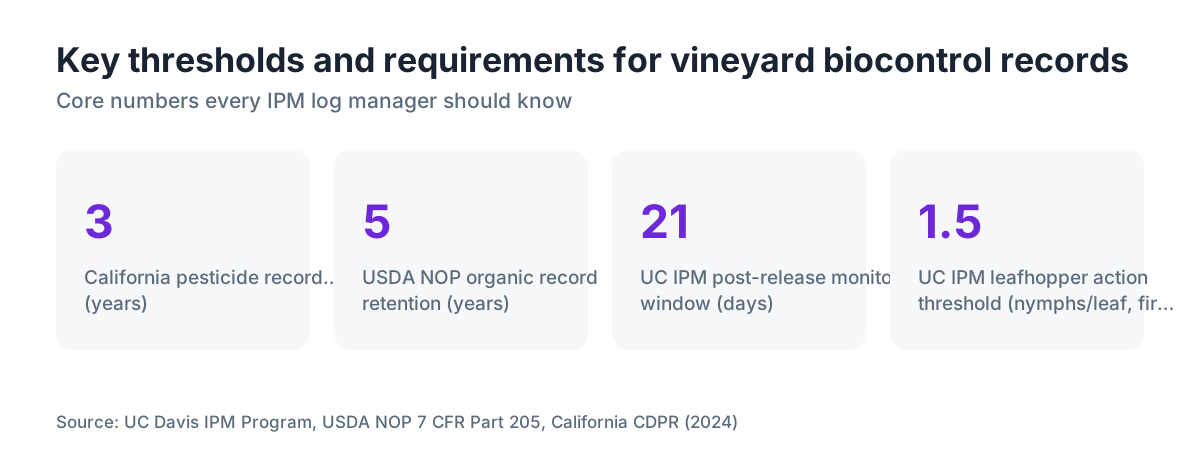
Keep records at least three years as a floor. California requires pesticide use records for three years [4]. Many sustainability certifications want IPM records across two audit cycles, which can push you toward five. When in doubt, keep them longer. Storage is cheap. A failed audit is not.
Which beneficial insect species are most commonly released in vineyards, and does species affect how you log the release?
The species doesn't change the record structure. It changes which fields carry the weight.
Anagrus epos is the main egg parasitoid used against western grape leafhopper (Erythroneura elegantula). Releases usually time to first-generation leafhopper egg hatch, roughly late April to mid-May in California's Central Valley. Log the life stage (you're releasing the adult wasp), the rate (often 1,000 to 2,000 adults per acre), and proximity to known leafhopper hot spots.
Galendromus occidentalis, the western predatory mite, targets Pacific spider mite. Growers often release it early as a preventive move before spider mite numbers climb. The release density and the per-leaf mite counts before release are the details that matter here.
Trichogramma species (T. platneri, T. brassicae) go after grape berry moth eggs, and timing tracks degree-day models closely. Log the degree-day accumulation at release, because that's the entire logic behind releasing when you did. UC Davis IPM Program publishes degree-day thresholds for grape berry moth management [1].
Lacewings (Chrysoperla spp.) and convergent lady beetles get used against aphids, mealybugs, and soft-bodied pests. Purchased adult lady beetles have a spotty track record. Nobody has strong, consistent field data showing store-bought adult lady beetles reliably establish in vineyards. They tend to fly off. Log them anyway, and watch your post-release monitoring hard to see if you're getting anything for the cost.
For any commercially purchased beneficial, file the supplier's certificate of quality (species identity, viability, life stage) with the release record, or reference it by lot number.
What do organic certification auditors actually look for in biocontrol records?
USDA National Organic Program regulations require certified operations to keep records that "fully disclose all activities and transactions of the certified operation" and that are "sufficient to demonstrate compliance" with the rules [5]. For biocontrol, auditors zero in on a few things.
The product must be on the National List of Allowed and Prohibited Substances (7 CFR Part 205, Subpart G) or otherwise compliant [11]. Most commercially produced beneficial insects are treated as biologicals and are generally allowed. But if the supplier uses synthetic carriers, preservatives, or growth media, you may need to confirm those are acceptable. Get your certifier to sign off before the first release, not during the audit.
Auditors want a visible link between a documented pest problem and the biocontrol action. "Released Anagrus, 2,000/acre, Block 4" with no monitoring attached leaves a hole. "Leafhopper nymph count 2.1/leaf (action threshold 1.5/leaf per UC IPM), released Anagrus epos, 2,000 adults/acre, Block 4" tells the whole story in one line.
Lot numbers and supplier documentation matter because auditors want proof the product is what you say it is. Keep invoices, shipping receipts, and any certificates of authenticity with your records.
Post-release efficacy data isn't required for NOP certification. But an auditor running an advanced review will notice if you release beneficials every single year and never check whether they worked. Showing that feedback loop marks the difference between a program you can defend and a checkbox you're hoping nobody reads.
Does the EPA Worker Protection Standard apply to beneficial insect releases?
Not directly. But the activity around the release can pull WPS in.
The EPA Worker Protection Standard (40 CFR Part 170) covers agricultural pesticide applications, and beneficial insects aren't pesticides [6]. Releasing Anagrus wasps creates no restricted-entry interval and no pesticide safety training obligation on its own.
Here's the catch. Release beneficials alongside a spray, even something soft like kaolin clay, and the spray triggers WPS. Log the two events separately so nobody has to guess which record covers which activity.
WPS also requires that workers can access safety data sheets and pesticide application records. During a WPS inspection, your biocontrol logs sit right next to your pesticide logs. Clean, organized records cut the confusion fast.
One place WPS does touch biocontrol: if a product contains inert ingredients classified as pesticides, or carries an EPA registration number, it falls under pesticide rules. Some microbial products (Bt, Beauveria bassiana) are registered pesticides even though they're biological [12]. Read the label. An EPA registration number on the product means it needs a full pesticide application record, more than an IPM note.
How should you connect monitoring data to release records?
This is the step most operations skip, and it's the one that makes the whole log worth keeping.
IPM is a decision-making framework. Releases should happen because monitoring triggered an action, not because the calendar said so. Every release record should answer three questions. What did you see? What did you decide to do? Did it work?
The "what did you see" piece means pre-release monitoring data lives in the same record or gets clearly cross-referenced. If your monitoring log is a separate document, note the entry date and block in the release record. "See monitoring log entry 2025-06-10, Block 4, leafhopper count" builds a traceable chain in one line.
The "did it work" piece means scheduling the post-release monitoring event at the time of release, not three weeks later when it crosses your mind. Write the follow-up date into the record before you close it.
UC Davis IPM Program guidelines for grapes recommend follow-up monitoring at 14 to 21 days for most beneficial insect releases, though the window shifts by species and pest [1]. Bake that into your standard operating procedure so it happens on autopilot.
A well-kept IPM log reads like a decision journal: problem observed, action taken, result measured. Records that hold only the action, with no problem and no result, are half a story. They satisfy a checkbox and teach you nothing.
What are the most common mistakes vineyard managers make when logging biocontrol releases?
Missing the supplier lot number. If a shipment arrives dead or mislabeled, that number is how you trace the problem. Lot numbers print on the shipping label. Photograph it before the box goes in the cooler.
Not logging failed or refused releases. You opened a shipment, found the wasps dead, and didn't release. Write it down anyway. "Shipment received 6/12/25, Lot KBS-3387, roughly 40% mortality on arrival, release canceled, supplier contacted" is a legitimate entry. It shows due diligence.
Vague location descriptions. "North block" means nothing when you have ten north-facing blocks across two properties. Use your standard block designations, and use them the same way across every record type.
Date without time. Temperature and humidity swing through the day, and many beneficials have narrow release windows. If you always release in the morning, fine, but note it.
Skipping environmental conditions. This feels like busywork until a release fails. Release predatory mites at 95°F on a bone-dry afternoon and they don't establish, and the conditions are the answer to why. Skip logging them and you'll never know.
Not training the person doing the release. The one opening boxes and walking rows is often a crew member, not the manager. No standard form, no clear expectation, and the records go patchy. Build the logging into the release protocol so it isn't optional.
How do you log biocontrol releases for third-party sustainability certifications like CSWA or SIP?
California Sustainable Winegrowing Alliance (CSWA) and Sustainability in Practice (SIP) certification both use the California Code of Sustainable Winegrowing Workbook as their assessment framework [7]. That workbook scores IPM practices, and biocontrol release records feed those scores directly.
For CSWA and SIP, the bar is a documented IPM program that weighs economic thresholds, uses biological controls when feasible, and monitors efficacy. Your release records need to show four things:
- You had a documented pest problem (monitoring data).
- You chose a biological intervention.
- You recorded it clearly.
- You followed up.
There's no required form. The workbook asks for documentation but doesn't dictate format. What auditors flag over and over is missing pre-release monitoring data and missing efficacy follow-up. Those two gaps signal a biocontrol program that's more marketing than management.
Lodi Rules certification, run through the Lodi Winegrape Commission's self-assessment, uses a similar framework, and biocontrol sits as its own category inside the pest management section. Lodi Rules auditors tend to read IPM documentation closely.
If your region has its own sustainability program, check whether it publishes a specific biocontrol record template. Some do. Using their template kills any argument about what was expected.
For vineyards juggling records across several programs at once, VitiScribe centralizes logs and exports to multiple certification formats, so you're not keeping a separate document for each one.
What should a sample biocontrol release log entry actually look like?
Here's a realistic entry. This is the kind of record that satisfies an organic auditor, a SIP assessor, and your own efficacy review at the same time.
Date: June 12, 2025
Time: 7:15 AM
Block: Block 4B (North Slope, Rows 1-40)
Operator: J. Torres
Supervisor / CCA: A. Reyes, CCA #12345
Pest target: Western grape leafhopper (Erythroneura elegantula)
Pre-release monitoring: June 10, 2025. Leaf samples, 10 leaves per site, 5 sites across Block 4B. Mean 2.1 leafhopper nymphs/leaf. UC IPM action threshold: about 1.5 nymphs/leaf for June, first generation [1].
Beneficial released: Anagrus epos (egg parasitoid wasp)
Life stage: Adult female
Source: Koppert Biological Systems, Sacramento CA
Lot / Invoice: Lot KBS-2025-3387, Invoice #KBS-44821
Supplier quality certificate: Filed with invoice, 94% viability at shipment
Quantity: 15,000 adults total / 375 per acre (40 acres)
Release method: Hand release at row ends, every 5th row
Environmental conditions: 68°F, 55% RH, wind 3 mph SW, overcast
Post-release follow-up scheduled: June 26, 2025 (14 days). Leaf sample, same protocol, same sites.
Notes: Shipment received June 11 PM. Held overnight in cooler at 50°F per supplier protocol. Viability check at 7:00 AM showed normal activity.
That's one record. It takes maybe five minutes if you have a template and the information in hand before you walk to the field. The lot number, the viability check, and the scheduled follow-up are the three details most logs leave out.
How long do you need to keep beneficial insect release records?
No single federal statute sets a retention period for biocontrol release records specifically. The practical answer depends on which standards you operate under, and it's smart to align them all to one rule.
California pesticide use records must be kept three years under California Food and Agricultural Code Section 12981 [4]. Biocontrol records aren't pesticide records, but matching that retention period keeps audits simple. One system, one retention rule.
USDA NOP requires records be retained for at least five years and be available for inspection [5]. Some organic operations keep even longer as a buffer against appeals or audits that span multiple certification cycles.
Lodi Rules and SIP re-certifications typically review a two-year window, but because those cycles land on different dates, three to five years of records is the safe range.
The practical reality: digital records in a cloud backup cost nothing to keep forever, so there's no reason to delete them. On paper, scan them once a year and archive the originals offsite. A single lost binder can cost you a certification cycle.
Frequently asked questions
Do I need a pesticide applicator license to release beneficial insects in a vineyard?
Generally no. Beneficial insects are living organisms, not pesticides, so releasing them doesn't require a pesticide applicator license in most states. Some states do regulate the importation of non-native beneficial species. Check with your state department of agriculture before releasing any species not already established in your region. California, for one, has import restrictions on certain biological control agents.
Can I count a beneficial insect release as part of my pest control record for organic certification?
Yes, if you log it correctly. USDA NOP requires organic operations to document all pest management actions. A biocontrol release counts and should appear in your IPM records with species, quantity, target pest, and supplier documentation. It won't replace a pesticide record if you also applied an approved pesticide, but it counts as a documented intervention in your organic system plan.
What's the difference between logging a biocontrol release and a spray application in an IPM log?
A spray record focuses on the chemical: product, EPA registration number, rate, REI, and PHI. A biocontrol release record focuses on the organism: species, life stage, quantity, source, and lot number. Both should include location, date, target pest, and operator. Biocontrol records also benefit from pre-release monitoring data and a scheduled follow-up, because unlike a spray there's no guaranteed kill event to evaluate.
How do I handle a biocontrol release where the shipment arrived in poor condition?
Log the arrival condition whether or not you release. Document the lot number, estimated mortality rate, and what you observed. Contact the supplier and keep that correspondence. If you chose not to release, note the decision and why. If you released anyway because viability looked acceptable, note your viability check method. This paper trail protects you if the release fails and you need to explain why pest pressure wasn't controlled.
Is there a standard form for vineyard biocontrol release records from UC Davis or Cornell?
Neither UC Davis nor Cornell publishes a single mandatory biocontrol release form. UC Davis IPM Program publishes IPM guidelines for grapes and monitoring protocols, and Cornell Cooperative Extension offers IPM record-keeping templates for growers. Both recommend including pest monitoring data alongside any biocontrol action. You can adapt their monitoring forms to include a release section, or build your own using the core fields above.
How do I log a biocontrol release that covers multiple blocks on the same day?
Create a separate entry for each block, or use one entry with a clear block list and per-block quantities. The key test: for any individual block, can you say exactly what was released, how much, and when? A single record reading "Blocks 4B, 5A, and 7C, 10,000/acre each" is acceptable if conditions matched, but a separate row per block is cleaner for filtering and audit queries.
Do beneficial insect release records need to be signed?
Federal law doesn't require a signature on biocontrol release records. USDA organic certification does require records that identify who performed the action, which in practice means a name in the record. Some California sustainability certifications expect a supervisor or CCA signature on IPM records as part of their audit requirements. Even when it isn't required, a name and sign-off adds accountability and exposes training gaps when records get inconsistent.
What monitoring data should I collect before a beneficial insect release?
At minimum, collect a pest density count using the method your IPM plan specifies (leaf samples, sticky traps, sweep net counts) from the block you're treating. Record the sample size, method, locations within the block, and the result. Compare it to your action threshold, which for leafhoppers in California is around 1.5 nymphs per leaf for the first generation per UC IPM guidelines. The release decision should trace straight back to that comparison.
How do I record the release rate when the supplier gives me a total count rather than a per-acre count?
Divide the total by your block acreage and record both numbers: total received and rate per acre. For example, "15,000 adults received, released across 40 acres, 375 per acre." This matters because efficacy research and reference rates are almost always expressed per acre. You need the per-acre figure to compare your program against published recommendations.
Can biocontrol release records help reduce my pesticide use documentation burden?
Indirectly, yes. A well-documented biocontrol program with monitoring data and efficacy follow-up supports the argument that biological controls reduced the need for chemical interventions. Certifiers and sustainability programs give credit for documented biocontrol use. But biocontrol records don't replace pesticide records when you spray. They sit alongside them, and together they tell the story of an integrated program.
What happens if I lose my biocontrol release records before an organic audit?
Losing records is a serious problem for certification. NOP regulations require records be retained for at least five years and be available for inspection. If you can't produce records for a period under review, the certifier may require additional documentation, restrict your certification, or in serious cases suspend it. Supplier invoices and lot records can partly reconstruct what you bought, but they don't prove you released the product or where.
Do I need to log biocontrol habitat work (like planting insectary borders) the same way as a release event?
Insectary border plantings are a habitat modification, not a release event, so they don't need the same record format. But they should appear in your IPM plan and annual records as a pest management action. Document the species planted, location, planting date, and intended pest targets. Some certification programs score habitat enhancement separately from active releases and want to see both documented.
How specific does the location description need to be in a biocontrol release record?
Specific enough that someone unfamiliar with your property could find the exact area. At minimum, use your standardized block names. Better records add the row range and cardinal position within the block. GPS coordinates are acceptable and increasingly common in digital systems. Vague descriptors like "west side" or "by the road" don't hold up for audit purposes or your own efficacy analysis.
Sources
- UC Davis IPM Program, Grape Pest Management Guidelines: UC Davis IPM recommends recording monitoring data alongside biocontrol actions and linking release timing to pest thresholds and degree-day models for grape berry moth and leafhopper management.
- Cornell Cooperative Extension, Integrated Pest Management Program: Cornell IPM guidelines call for recording the pest problem that triggered any biocontrol or pesticide intervention as part of IPM documentation.
- Washington State University Extension, IPM: WSU Extension emphasizes linking biocontrol release events to pre-release monitoring threshold data in IPM documentation templates.
- California Department of Pesticide Regulation, Pesticide Use Reporting: California Food and Agricultural Code Section 12981 requires pesticide use records to be kept for three years and mandates specific fields including operator name, site, pesticide product, and amount applied.
- USDA Agricultural Marketing Service, National Organic Program Regulations 7 CFR Part 205: NOP regulations require certified organic operations to maintain records that fully disclose all activities and transactions and are sufficient to demonstrate compliance, with a five-year retention requirement.
- EPA, Agricultural Worker Protection Standard (WPS) 40 CFR Part 170: The EPA Worker Protection Standard applies to agricultural pesticide applications; biological organisms released as beneficial insects are not classified as pesticides under WPS.
- California Sustainable Winegrowing Alliance, Code of Sustainable Winegrowing: CSWA and SIP certification use the California Code of Sustainable Winegrowing Workbook to assess IPM practices, including biocontrol use, requiring documented monitoring and efficacy follow-up.
- UC Davis IPM Program, Western Grape Leafhopper Management: UC IPM guidelines set an action threshold of approximately 1.5 leafhopper nymphs per leaf for first-generation western grape leafhopper as a trigger for management intervention.
- Koppert Biological Systems, Beneficial Insect Products: Commercial beneficial insect suppliers like Koppert provide lot numbers and certificates of quality with shipments, confirming species identity, life stage, and viability at time of shipment.
- USDA National Organic Program, National List of Allowed and Prohibited Substances, 7 CFR Part 205 Subpart G: The NOP National List governs which substances are permitted in certified organic production; commercially produced beneficial insects are generally allowed but inert carriers or growth media may require review.
- EPA, Biopesticides: Some biological pest control products, including microbial pesticides like Bt and Beauveria bassiana, carry EPA registration numbers and are regulated as pesticides, requiring pesticide application records rather than simple IPM notes.
Last updated 2026-07-10