How to record mechanical harvester settings and operation in vineyard logs
TL;DR
- A complete mechanical harvester log captures machine ID, operator, date, block, start and stop times, speed settings (reel RPM, shaker amplitude and frequency, fan speed, conveyor speed), fuel use, fruit temperature at pickup, and any mechanical issues.
- These records satisfy EPA Worker Protection Standard traceability requirements and support quality audits by your winery buyer.
Why do mechanical harvester logs matter beyond basic record-keeping?
A good harvest log does one thing an auditor never sees: it connects fruit quality on a specific night to the exact machine settings that produced it. That link is what you reach for when a receiving bin comes in with berry damage, oxidation, or too much MOG (material other than grapes). No log, no answer.
Wineries keep asking for more traceability documentation in grower contracts, especially in California, Oregon, and Washington. If a lot gets flagged for quality problems, your log is what turns a costly dispute into a short conversation. Cornell's grape and wine program notes that post-harvest quality variation is often traced back to harvest timing and handling conditions rather than vineyard inputs alone [1].
There's a worker protection angle too. The EPA Worker Protection Standard (WPS) requires employers to keep records of pesticide applications and re-entry conditions. WPS doesn't regulate how a harvester runs, but it sets the standard for the kind of operational paperwork regulators expect from a compliant operation [2]. If a worker gets hurt during mechanical harvest and OSHA investigates, your operational log becomes evidence.
Runtime records also make maintenance possible. Most manufacturers spec major service intervals in operating hours, not calendar time. A harvester logging 200 hours across three weeks in September hits those intervals fast, and calendar reminders will lie to you.
What are the required and recommended fields in a mechanical harvester log?
There's no single federal form for mechanical harvester records, so the real question is: what fields satisfy the most demanding audience you'll face? That audience is usually your winery buyer, a third-party auditor (SCS Global, CCOF, or similar), and sometimes OSHA or a county agricultural commissioner.
Required fields that essentially every auditing body expects:
- Date and block ID (APN or ranch map block reference)
- Operator name and any applicable pesticide applicator license number if the operator also sprays
- Machine make, model, and serial number (or a unique fleet ID you assign)
- Start time and end time, in actual clock time, rather than duration alone
- Estimated tons harvested per block (or the actual weigh-ticket number if the winery provides one)
- Any mechanical issues that stopped or slowed work
Recommended fields that serious operations add:
- Reel RPM at start and any adjusted settings mid-block
- Shaker frequency (Hz or strokes per minute) and amplitude setting
- Fan speed (for destemming/cleaning systems on the harvester) if equipped
- Conveyor belt speed setting
- Forward travel speed (km/h or mph)
- Fruit temperature at machine pickup (use a calibrated IR thermometer; log the reading, not "cool")
- Ambient temperature and relative humidity at start of harvest
- Fuel level at start and estimated fuel consumption
- Any field events: irrigation encountered, trellis wire down, bin exchange delays
WSU Extension's precision viticulture resources point out that documenting travel speed and machine settings by block lets growers match machine parameters to berry damage assessments at the crusher [3].
| Field | Required for compliance? | Required for quality traceability? |
|---|---|---|
| Date, block ID, operator | Yes | Yes |
| Machine ID / serial | Yes | Yes |
| Start and stop time | Yes | Yes |
| Reel RPM / shaker settings | No | Yes |
| Travel speed | No | Yes |
| Fruit temp at pickup | No | Strongly recommended |
| Tons harvested | Yes (for some programs) | Yes |
| Fuel consumption | No | Maintenance only |
| Mechanical issues | No | Yes |
How should you record reel speed, shaker amplitude, and other machine parameters?
The hard part of documenting machine settings is that operators adjust them on the fly, and those mid-block changes are exactly the ones that move fruit quality. A log that captures only the starting settings tells half the story.
Use an event-based approach. Record the initial settings when the machine enters the block, then log any change as an event with a timestamp and a reason. "21:14, reduced shaker amplitude from 38mm to 32mm, excessive berry shatter observed" tells you something. "Low setting" tells you nothing.
Most modern continuous-harvest machines run the reel (the beater bar or shaker rod assembly) at manufacturer-recommended RPM ranges that vary by variety and berry size. Typical ranges run from about 100 to 450 RPM depending on machine type and vine variety. Log the displayed RPM, not "normal" or "standard." If your control panel shows a percentage of maximum instead of RPM, log the percentage and note the machine's max RPM spec from the manual so someone can convert it later.
Shaker amplitude (how far the rods travel per stroke) and frequency (strokes per minute) are the two variables that most directly drive berry damage. Higher amplitude with lower frequency tends to work better for tight clusters; lower amplitude with higher frequency suits looser ones. UC Davis viticulture extension recommends logging both, because they interact, and logging only one produces ambiguous records [4].
Fan speed on machines with integrated cleaning systems affects MOG. Log it in whatever units the machine displays, whether that's a percentage, an RPM reading, or a dial position number. Dial numbers are annoying. They're also reproducible, which is the whole point.
What format works best for mechanical harvest logs: paper, spreadsheet, or software?
The best format is the one your crew will actually complete at 2 a.m. in a dusty cab. That constraint beats every theoretical argument about elegance.
Paper forms work fine if they're laminated, pre-printed with all fields, and physically attached to the harvester cab. A paper log on a clipboard with a grease pencil has survived conditions that would kill a tablet. The catch is transcription: someone enters the data later, and that's where errors sneak in.
Spreadsheets (Google Sheets synced offline, or Excel on a ruggedized tablet) are the middle ground most operations land on. Build a template with dropdown menus for block ID and operator name to cut typing errors, and lock the column headers so a tired operator can't overwrite your field names. Save a fresh copy each harvest season and archive the old ones.
Dedicated vineyard record-keeping software like VitiScribe can connect harvest logs directly to spray records, scouting notes, and block maps, so your documentation lives in one place instead of three separate spreadsheets. That pays off most when an auditor asks for the full history of one block across a season.
Whatever you choose, the record needs to be legible, dateable (ideally with a timestamp the operator can't quietly edit later), and stored somewhere that survives a hard drive failure. Cornell's extension guidance points to keeping farm records for at least three years to satisfy most third-party certification programs, and the EPA WPS requires pesticide application records to be kept for at least two years [2][1].
The biggest mistake I see is a single shared log passed between the harvester operator and the receiving winery crew, both parties scribbling in the same cells. Keep your vineyard copy separate from the winery's bin-receipt copy. They answer different questions.
How do you log mid-harvest mechanical issues and downtime?
Downtime records are the most neglected section of any harvest log. They're also the section most likely to matter later.
Log every stop longer than about five minutes with a timestamp, a reason (mechanical, bin swap, road crossing, operator break, trellis damage), and a restart time. This does two jobs. It lets you calculate real operating hours for maintenance scheduling. And if fruit sat in a bin for 45 minutes while you waited on a replacement part on a 90-degree night, that's information your winery needs for its SO2 addition decisions.
For mechanical issues, note what failed, what the operator did (field repair, called a service tech, limped to the end of the row), and whether the fix changed any machine settings. If you ran reduced shaker speed for the last six rows because a rod was loose, that goes in the log.
Many harvesters now carry onboard diagnostic systems that throw fault codes. Print or photograph those readouts and attach them to that date's log. They beat a hand-written description as evidence, and they're what your dealer will want to see anyway.
WSU Extension's equipment guidance notes that matching downtime events to later quality assessments is one of the most useful things a grower can do with harvest records, because it surfaces patterns that stay invisible in real time [3].
What operator information needs to be in a mechanical harvest log for WPS and OSHA compliance?
The EPA Worker Protection Standard covers agricultural workers and pesticide handlers. Mechanical harvest is not a pesticide application, but the WPS context still bites here. If the block had a pesticide application within the re-entry interval (REI) for any product used that season, no worker, including a harvester operator, can legally enter that block [2]. Your harvest log should confirm the block's last application date and that the applicable REI has cleared before harvest starts.
For direct WPS compliance, the fields that matter in a harvest log are:
- Operator name and any pesticide handler certification number if the operator has a dual role
- Block ID, so you can cross-reference against your spray records to verify REI clearance
- Date and start time of entry
For OSHA compliance under 29 CFR Part 1928 (agricultural operations), the concern is that if an injury happens, investigators look for evidence that the employer kept records of who operated what equipment, when, and under what conditions. Operator name, machine ID, and date/time are the floor. If you run harvesters at night (most operations do), note that 29 CFR 1928.57 covers machinery guarding requirements for harvesting equipment, and your training records for each operator are a companion document to the harvest log [5].
Some operations also log the operator's hours worked that day before the harvest shift, because fatigue is a documented risk factor in agricultural machinery accidents. Not legally required. Defensible practice.
How do you connect harvest logs to spray records and block maps?
A harvest log on its own is useful but limited. The value shows up when you can pull one block and see the whole picture: what was sprayed, when the REI cleared, what the canopy looked like at veraison, when the machine ran, and what the fruit temp was when it left the field.
The simplest way to connect these records is a shared block ID system. Every spray record, scouting note, irrigation log, and harvest log references the same block identifier. A farm map parcel number, a GPS polygon ID, or a consistent block name you've used for years all work, as long as it's the same string in every document.
For paper-based operations, a block summary folder does the job: one folder per block per season, with spray records, scouting sheets, and the harvest log filed together. When the auditor shows up asking about Block 7 Zinfandel, you pull one folder.
For digital operations, the block ID becomes a relational key that links tables. This is where vineyard management software earns its keep, because a well-built system lets you query "show me all activity in Block 7 from July 1 through harvest" and get a coherent answer. VitiScribe's block-level record structure is built around this kind of cross-document linkage, which helps most when your spray records and harvest records are kept by different people.
UC Davis extension materials on vineyard record-keeping stress that block-level traceability is now a contract requirement from premium winery buyers, not merely an auditing nicety [4]. Get the block ID system right at the start of the season and everything downstream gets easier.
How do fruit temperature and ambient condition records affect quality documentation?
Fruit temperature at harvest is one of the most underlogged numbers in mechanical harvest records, and one of the most useful.
Mechanical harvest usually runs at night precisely to capture cool fruit. But "harvested at night" is not the same as "harvested at 55 degrees F." A night that holds at 72 degrees F through 3 a.m. is common in California's Central Valley or warm inland Lodi blocks, and fruit picked in that heat arrives at the winery in a very different state than fruit picked at 52 degrees F in the Sta. Rita Hills.
Log fruit temperature with a calibrated IR thermometer aimed at the berry surface on the conveyor. Not the ambient air. Not a reading off the vine. The conveyor reading is what the winery actually receives. Take it at least once per block, ideally at the start of the run and again mid-block. Log ambient air temperature and relative humidity from a hand-held meter or your nearest weather station at the same time, for context.
This data matters because:
- Many winery receiving protocols set a maximum fruit temperature for premium lots
- High fruit temperatures speed up oxidation and volatile acidity development between harvest and crush
- If a lot comes back with elevated VA and the winery claims it arrived warm, your temperature log is your evidence
Nobody has clean published data on exactly how many degrees of fruit temperature translate to a measurable VA increase over a given transport window. The closest practical guidance comes from UC Davis enology extension materials, which generally recommend getting fruit below 60 degrees F before crush for white varieties and note that enzymatic browning accelerates meaningfully above 65 degrees F [4].
What's the best way to handle multi-operator or custom harvest contractor logs?
Plenty of smaller operations hire a custom harvest contractor rather than owning a machine. This opens a documentation gap that can hurt you in an audit: the contractor ran the machine, kept their own log, and you have no copy.
Close it with a contract requirement. Any contractor operating in your vineyard must provide a copy of their operational log for each block within 24 hours of harvest. Put it in writing in your harvest contract. Spell out exactly which fields you need (use the required and recommended list from the second section of this article) and make clear that failure to deliver records is a contract breach.
For multi-operator owned machines where different people run different shifts, the log needs an operator field at the event level, more than at the block level. If Operator A ran blocks 1 through 4 from 10 p.m. to 2 a.m. and Operator B ran blocks 5 through 8 from 2 a.m. to 6 a.m., the log should show both operators against the blocks they ran. A single "crew: night harvest team" entry fails an individual-level traceability requirement.
Training documentation matters here too. If you can show that every operator who ran the machine that season completed a site-specific equipment orientation covering the machine's settings and your target quality parameters, that's a real addition to your compliance file. Cornell's agricultural health and safety resources note that operator training records are a first point of inquiry in post-incident investigations [11].
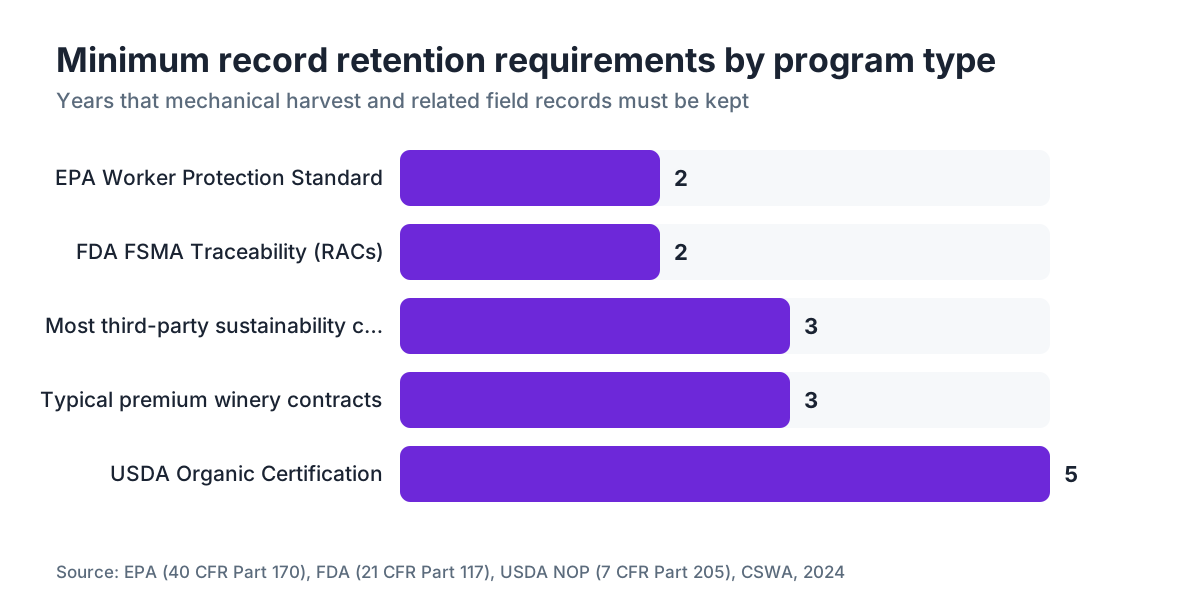
How long do you need to keep mechanical harvest logs, and in what form?
Retention depends on which program or rule you're satisfying. Here's the practical summary:
- EPA WPS pesticide records: minimum 2 years [2]
- Most third-party sustainability certifications (California Sustainable Winegrowing, LIVE, Salmon-Safe): 3 years of operational records [8]
- Food safety schemes audited against FSMA: records kept at least 2 years under 21 CFR Part 117, and FDA has held that traceability records for raw agricultural commodities should be retained for 2 years [6]
- USDA Organic certification: 5 years of records covering all inputs and field activities [7]
- Winery buyer contract requirements: varies, but 3 years is common in premium contracts; read your purchase agreement
For storage format, printed paper is legally acceptable everywhere. Scanned PDFs in a cloud backup meet the same requirement and are far easier to retrieve. Fully digital records (spreadsheets or software exports) are accepted by most programs as long as they're in a readable format (PDF exports beat proprietary .xlsx for long-term archiving) and can be produced within a reasonable time when requested.
The one trap to avoid is relying on the harvester's onboard computer as your primary record. Those systems get cleared, updated, or replaced, and you will not produce them five years later for an auditor.
What does a complete mechanical harvest log entry actually look like?
Here's a concrete single-block entry, the kind that satisfies a premium winery audit, a third-party sustainability certification, and works as an internal record.
Date: September 14, 2024
Block ID: Estate Block 3 (Cabernet Sauvignon, 12.4 acres)
Operator: M. Ramirez
Machine: Pellenc Optimum 2, SN 0219-4432, Fleet ID MH-01
Entry time: 22:05 | Exit time: 01:42
Total block time: 3 hrs 37 min
Initial settings:
- Forward speed: 3.2 km/h
- Reel RPM: 280
- Shaker amplitude: 34mm
- Shaker frequency: 7.2 Hz
- Cleaning fan: 65%
- Conveyor: 45%
Setting changes:
- 22:55: Reduced reel RPM to 255, excessive leaf MOG in first two rows
- 00:10: Increased forward speed to 3.6 km/h, fruit dropping cleanly
Fruit temp at conveyor:
- 22:10: 58 degrees F
- 00:15: 61 degrees F
Ambient temp: 63 degrees F, RH 72% at 22:05
Downtime events:
- 23:18 to 23:31: Bin exchange, no mechanical issue
Estimated tons: 22.4 (weigh ticket 4417 from Napa Valley Wine Company)
Last spray in block: August 28, 2024 (sulfur dust, 24-hr REI, confirmed cleared)
Mechanical issues: None
Operator notes: Row 14 has wire sag at post 22, flagged for trellis crew
That entry took about eight minutes to complete. It's worth a great deal more than eight minutes the day you need it.
Frequently asked questions
Does the EPA require mechanical harvest operational logs?
The EPA Worker Protection Standard doesn't directly mandate a mechanical harvest operations log. It does require pesticide application and re-entry records, and your harvest log should cross-reference those to confirm REI clearance before field entry. OSHA's agricultural machinery rules (29 CFR Part 1928) create an indirect documentation expectation by requiring workers to operate safe, maintained equipment, which means runtime and maintenance records support your compliance posture.
What harvester settings have the biggest impact on fruit quality?
Shaker amplitude and frequency have the most direct effect on berry damage and MOG levels, per UC Davis viticulture extension materials. Forward travel speed affects both throughput and how long each vine section sits under the shaker. Fruit temperature at pickup, while not a harvester setting, is arguably the single most consequential number for post-harvest quality and should be logged right alongside the machine parameters.
Can I use my harvester's onboard computer as my official log?
Technically possible, practically risky. Onboard systems get reset, updated, and replaced. They're also rarely set up for the non-machine fields an auditor needs (operator name, block ID, REI clearance confirmation). Use onboard data as a cross-check and export it to a permanent record format (PDF or spreadsheet) within 24 hours of each harvest session. Relying on the machine as primary storage has burned operations during audits.
How do I log harvest records when using a custom harvest contractor?
Put a documentation requirement in the harvest contract. Specify that the contractor must provide a block-level operational log including machine settings, operator name, start and stop times, and fruit temperature readings within 24 hours of completing each block. Accept no other arrangement. Your winery buyer and any third-party auditor will hold you responsible for the records, not the contractor, and "the contractor didn't give me the logs" is not an acceptable answer.
How many years do I need to keep mechanical harvest records?
The minimum is 2 years under EPA WPS pesticide cross-reference requirements and FDA FSMA traceability rules. Most third-party sustainability certifications require 3 years. USDA Organic certification requires 5 years of complete farm records. Many premium winery purchase agreements specify 3 years in the contract terms. When requirements vary, keep records for the longest applicable period, which usually lands at 3 to 5 years.
What's the best way to record mechanical harvest settings without slowing down the crew?
Pre-printed field forms, laminated and attached to the cab, cut most of the friction. Design the form so operators check boxes or fill in numbers rather than writing sentences. Dropdown menus in a tablet-based app work the same way digitally. The log should take under 10 minutes per block. If it's taking longer, you have too many fields or the wrong format for your crew's conditions.
Should I log fruit temperature in Fahrenheit or Celsius?
Log whatever unit your thermometer displays, but stay consistent within a season and label it clearly. Most US winery receiving protocols express temperature in Fahrenheit, so if your thermometer reads Celsius, add the converted Fahrenheit value in parentheses. What matters is that the number is a real IR reading taken at the conveyor surface, not an ambient air estimate or a guess.
Do mechanical harvest logs need to be signed or certified in any way?
No federal regulation requires a signature on a mechanical harvest operational log. Third-party auditors typically want logs that show they were created contemporaneously, which means a timestamp the auditor can trust. Signed and dated logs carry more weight than unsigned ones if records are ever disputed. Some organic and sustainability programs require the certified operator's name and date as a minimum; check your specific program's standards.
What block identification system works best for connecting harvest logs to spray records?
Any system works as long as it's consistent across every document type, all season, every year. A simple alphanumeric code tied to your farm map (Block 3A, Block 3B) is more stable than names that drift or GPS polygon IDs that need software to interpret. Create a master block list at the start of each season with the code, variety, acreage, and irrigation source, and make sure every person completing any field log uses the same code.
How do I document downtime and mechanical failures during harvest?
Log every stop over five minutes with a timestamp, a reason code (bin swap, mechanical, trellis damage, operator break, road crossing), and a restart time. For mechanical failures, note what failed, what was done about it, and whether it forced any settings change. Print or photograph onboard fault code readouts and attach them to the day's log. Downtime records also support maintenance scheduling, since most manufacturer service intervals run on operating hours.
What's the difference between what a winery buyer wants in harvest records versus what an organic certifier wants?
Winery buyers mostly want traceability (which block, what time, what fruit temp, how many tons) to support quality assessments and contract compliance. Organic certifiers mostly want evidence that no prohibited inputs were used and that REIs for any allowed materials were observed. In practice, a complete harvest log satisfies both if it includes block ID, operator, date and time, estimated tonnage, and a cross-reference to the last spray event with REI confirmation.
Are there any published templates for mechanical harvest logs from extension programs?
WSU Extension and UC Davis have published vineyard record-keeping templates that include harvest sections, though most aren't specific to mechanical harvesters. Cornell's agricultural extension program offers broader farm record-keeping frameworks. None are perfectly suited to mechanical harvest settings documentation out of the box, so most operations adapt a spreadsheet template from those starting points. The field list in this article reflects what those programs' guidance points toward.
Can harvest log data help me improve machine settings over multiple seasons?
Yes, and this is one of the strongest arguments for logging machine parameters consistently. After two or three seasons of records linking reel RPM and shaker amplitude to MOG percentages and crusher-side damage assessments by variety and block, you have real data to calibrate settings. Without that record, you reset to guesswork every September. WSU Extension viticulture resources note this feedback loop as a value of systematic harvest documentation.
Sources
- Cornell University, Grapes and Wine (Cornell AgriTech): Post-harvest quality variation is frequently traced to harvest timing and handling conditions; agricultural records should be kept at least 3 years for most certification programs
- US EPA, Worker Protection Standard (40 CFR Part 170): EPA WPS requires pesticide application and re-entry interval records to be kept for at least 2 years; field workers cannot enter a block within the applicable REI
- Washington State University Extension: Documenting travel speed and machine settings by block allows growers to correlate machine parameters with berry damage assessments; downtime events should be correlated with post-harvest quality assessments
- UC Davis Viticulture and Enology: Shaker amplitude and frequency should both be logged because they interact; block-level traceability is increasingly a contractual requirement from premium winery buyers; fruit above 65 degrees F accelerates enzymatic browning
- US Department of Labor OSHA, 29 CFR Part 1928 Agricultural Operations: 29 CFR 1928.57 covers machinery guarding requirements for harvesting machines; operator training records are a first point of inquiry in post-incident investigations
- US FDA, Food Safety Modernization Act (FSMA): Under FSMA and 21 CFR Part 117, traceability records for raw agricultural commodities should be retained for at least 2 years
- USDA Agricultural Marketing Service, Organic (7 CFR Part 205): USDA Organic certification requires 5 years of complete farm records covering all inputs and field activities
- California Sustainable Winegrowing Alliance, California Code of Sustainable Winegrowing: Third-party sustainability certifications typically require 3 years of operational records for auditing purposes
- WSU Extension, Viticulture and Precision Agriculture Resources: Systematic harvest documentation enables multi-season feedback loops linking machine settings to MOG percentages and damage outcomes by variety and block
- UC Davis Viticulture and Enology, Harvest and Post-Harvest Handling: Getting fruit below 60 degrees F before crush is recommended for white varieties; enzymatic activity accelerates meaningfully at fruit temperatures above 65 degrees F
- Cornell University, Agricultural Health and Safety (Cornell Cooperative Extension): Operator training records are a first point of inquiry in post-incident investigations involving agricultural machinery
- US FDA, Food Traceability Rule (21 CFR Part 1, Subpart S): FDA requires key data elements in traceability records including location, date, and quantity for raw agricultural commodities covered under the food traceability rule
Last updated 2026-07-10