How to record a conservation easement on vineyard property records
TL;DR
- Recording a conservation easement on vineyard land takes four pieces: a signed, notarized deed of easement filed with your county recorder, a qualified appraisal dated within 60 days of the grant, IRS Form 8283 attached to your return, and a baseline documentation report.
- The land trust holds a copy.
- You keep the originals in a permanent property file.
What exactly is a conservation easement on vineyard land?
A conservation easement is a voluntary legal agreement between a landowner and a qualified land trust or government agency. You keep ownership of the vineyard. You give up certain development rights, permanently, in exchange for a tax deduction based on the value of what you gave up. The IRS treats it as a charitable contribution of a partial interest in real property under IRC Section 170(h) [1].
For vineyards this usually means agreeing never to subdivide, put up commercial buildings, or convert the land to non-agricultural use. What you can still do, and this matters a lot in practice, includes farming every row, replanting varietals, building farm structures related to production, and selling the property. The easement runs with the land, so future owners are bound by it too.
The most common conservation purpose that qualifies vineyard land is preservation of open space under IRC 170(h)(4)(A)(iii), specifically where the preservation is for the scenic enjoyment of the general public or pursuant to a clearly delineated governmental conservation policy [1]. Agricultural land in wine-producing regions, especially in California's Central Coast, Oregon's Willamette Valley, and Washington's Columbia Valley, has qualified on both grounds. Paso Robles wineries have used county general plan language as the governmental policy hook, for example.
What documents do you need before you can record anything?
You need four things in hand before you file anything with the county recorder. Miss one and your deduction is disallowed. Not reduced. Gone entirely.
First, the deed of easement itself, drafted by an attorney familiar with conservation law. This is not a standard grant deed. It describes the property by legal description, names the land trust as grantee, lists exactly which rights are restricted and which are reserved, and must include a perpetuity clause stating the restrictions last forever [1].
Second, a baseline documentation report (BDR). This is a thorough record of the property's condition at the time of the donation: aerial photographs, soil maps, water features, existing structures, current land use, and a narrative description of the conservation values. The Land Trust Alliance Standards and Practices (Practice 11) require the land trust to complete this before or at closing [2]. Courts have upheld deduction disallowances when the BDR was incomplete or prepared after the fact.
Third, a qualified appraisal prepared by a qualified appraiser, as defined under Treasury Regulation 1.170A-17 [3]. The appraisal must be dated no earlier than 60 days before the contribution date and no later than the due date of your return (including extensions). For most vineyard owners filing a partnership or S-corp return, that window is real and tight.
Fourth, IRS Form 8283, Section B, signed by both the appraiser and an authorized official of the land trust [4]. The land trust official's signature confirms the organization received the contribution. Without it, the IRS rejects the form.
| Document | Who Prepares | Timing Requirement |
|---|---|---|
| Deed of Easement | Conservation attorney | Must be signed and notarized before recording |
| Baseline Documentation Report | Land trust (with landowner input) | Completed at or before closing |
| Qualified Appraisal | Qualified appraiser (IRS-defined) | No earlier than 60 days before donation, no later than tax return due date |
| IRS Form 8283 (Section B) | Landowner files; appraiser and land trust sign | Attached to return for year of donation |
How do you actually record the deed with the county?
Recording is simpler than people expect. Once the deed of easement is signed and notarized, you take it (or your attorney takes it) to the county recorder's office in the county where the vineyard sits. You pay a recording fee, which varies by county. In California counties, the fee runs roughly $15 for the first page and $3 per additional page as of 2024, though some counties charge differently under Government Code 27361 [5]. In Washington and Oregon, county recording fees are set by statute and typically fall in the $5 to $15 per page range.
The recorder stamps the document with the recording date, book and page number (or document number in counties using digital indexing), and returns a certified copy to you. That stamped copy is your proof of recording. Keep the original.
Some California counties require a Preliminary Change of Ownership Report (PCOR) filed alongside any recorded instrument. A conservation easement deed usually does not trigger a reassessment under Proposition 13 because it is not a transfer of ownership, but check with your county assessor. The California Board of Equalization has guidance on this [5]. File the PCOR anyway if required. Failure to file results in a penalty, not a reassessment, but it creates a paperwork mess you do not want.
After recording, the deed shows up in the chain of title for your parcel. Any future title search will surface the easement. That is the point. The land trust also typically records a separate notice of the easement, though the deed itself is sufficient legal notice once recorded.
How should you organize vineyard property records to show the easement?
Property records for a vineyard with a conservation easement have to do two jobs at once: satisfy IRS audit requirements and give you (or a future buyer or lender) a clear operational picture. Most vineyard managers underestimate how much documentation an examiner will request if a syndicated or high-value easement gets flagged.
Organize your permanent file like this:
- Recorded deed of easement with county stamp (original or certified copy)
- Title insurance policy showing the easement in Schedule B exceptions
- Full baseline documentation report with photographs (printed and digital backup)
- Qualified appraisal (full report, not a summary)
- Signed Form 8283 with all three signatures (yours, appraiser, land trust)
- Tax return excerpt showing the deduction claimed
- Land trust acknowledgment letter (the contemporaneous written acknowledgment required under IRC 170(f)(8)) [1]
- Any subsequent monitoring reports from the land trust (these come annually)
Keep this file separate from your operating records. The easement file is a permanent legal file. It should survive a farm sale, a generation transfer, and an IRS audit that could land years after the donation.
For ongoing monitoring records, which the land trust conducts typically once per year, keep those in a running subfolder by year. The land trust notes any changes to the property and confirms compliance with the deed terms. If you ever want to do something the deed might restrict, like add a structure or redirect an irrigation ditch, you need written approval from the land trust, and that approval letter goes in the file too.
Digital record-keeping tools built for vineyard operations, like VitiScribe, can store document attachments alongside field records, which keeps monitoring visits and deed-related notes in the same system as your spray logs and harvest data. That matters because an auditor or a land trust monitor may ask about farming activities tied to the easement terms.
What are the IRS requirements for the tax deduction, and where do people get tripped up?
The deduction equals the fair market value of the easement, defined as the difference between the property's value before the easement and its value after [3]. For a vineyard, that gap can be large because development potential, even theoretical subdivision potential, can represent a big fraction of raw land value in wine regions.
The IRS has audited conservation easements hard since 2016, designating syndicated conservation easement transactions as listed transactions in Notice 2017-10 [6]. Vineyard owners in syndicated deals, where investors buy into a partnership specifically to donate an easement and claim deductions, face heightened scrutiny and penalties. Owner-donated easements where you actually farm the land are not syndicated transactions, but they still get audited at elevated rates because of the enforcement climate.
Here are the disallowance reasons that show up again and again in Tax Court cases:
- Appraisal prepared outside the 60-day window [3]
- Deed fails to restrict all development rights sufficiently (courts have found deeds with carve-outs for future building too permissive)
- Baseline documentation report missing or completed after closing
- Form 8283 lacks the land trust signature or the appraiser's tax ID
- The conservation purpose is not protected in perpetuity (a clause letting the land trust release restrictions under certain conditions has sunk several cases)
The perpetuity requirement is the one that catches vineyard owners off guard. If your deed has any language allowing modification by mutual agreement, get an attorney to review it. The IRS and the Tax Court read perpetuity strictly.
The Consolidated Appropriations Act of 2023 added rules limiting deductions for syndicated easements to 2.5 times the investor's basis in the partnership [7]. This does not touch direct owner donations, but if a promoter approached you about a partnership structure for your vineyard land, that rule now caps hard what you can claim.
Does a conservation easement affect your property tax or estate planning?
Yes, on both counts, and the effects usually help working vineyard families.
On property tax: most states have statutes reducing assessed value for land under a conservation easement. California's Williamson Act (Land Conservation Act of 1965) already gives contracted agricultural land a reduced assessment, and a conservation easement can work alongside it or independently [8]. Talk to your county assessor before and after recording, because the interaction between Williamson Act contracts and easement deeds varies by county.
On estate planning: the easement lowers the property's taxable value for estate purposes, because heirs inherit land whose development rights are gone. That is the goal for many vineyard families who want to pass the property to the next generation without forcing a sale to cover estate taxes. IRC Section 2031(c) provides an additional estate tax exclusion of up to 40% of the value of land subject to a qualified conservation easement, up to $500,000 [1]. That exclusion sits on top of the reduced valuation from the easement itself.
One honest caution: an easement that dramatically lowers land value also lowers your collateral if you need to borrow against the property. Lenders understand agricultural easements reasonably well now, but a vineyard with a very restrictive easement may have lower loan-to-value capacity. Talk to your ag lender before you close the donation.
What role does the land trust play, and how do you choose one?
The land trust is your co-signatory on the deed and the entity legally responsible for monitoring and enforcing the easement forever. That is not a small job. If the land trust dissolves, the easement rights must transfer to another qualified organization under the deed's terms.
To qualify as a grantee under IRC 170(h)(3), the organization must be either a governmental unit or a publicly supported charitable organization with a commitment to protect the conservation purposes [1]. In practice that means a land trust accredited by the Land Trust Accreditation Commission or one with a demonstrated track record [2].
Choose a land trust with experience in agricultural and vineyard easements specifically. A trust that mostly does urban greenway easements will not understand vine training systems, cover crop management, or whether your proposed new equipment barn counts as agricultural use under the deed. The Land Trust Alliance runs a searchable member directory at landtrustalliance.org [2].
Fees vary. Some land trusts charge a stewardship fee at closing, typically 1 to 3% of the appraised easement value, to fund perpetual monitoring. Others ask for a separate donation to their stewardship fund. Budget for this. It is real money on a large vineyard easement.
How do conservation easements interact with your vineyard's operating permits and spray records?
The easement deed controls land use, not day-to-day farming practices. Your pesticide use permits, water rights, and worker protection standard compliance under 40 CFR Part 170 [9] run independently of the easement. An easement does not exempt you from any regulatory requirement, and it does not add new ones on pesticide application.
That said, some easement deeds include language about water quality, riparian buffers, or soil conservation practices. If yours does, your farming records (spray logs, fertilizer applications, irrigation schedules) become evidence of compliance with those deed terms, on top of regulatory compliance. The land trust's annual monitor will walk the property and may ask to see records.
WSU Extension's Viticulture Program has published guidance on record-keeping for compliance purposes, and Cornell's viticulture extension team covers integrated pest management documentation in agricultural contexts where conservation agreements are in play [10][11]. UC Davis Agricultural and Resource Economics has material on the economics of easements on California farmland [12]. Read these if you are trying to line up your operational records with your easement obligations.
Keep your spray records accessible and organized. If the easement deed names any pesticide-free buffer zones near water features, those records prove you honored the commitment.
What happens when you sell the vineyard? How does the easement transfer?
The easement stays. It runs with the land. The new owner takes title subject to every easement restriction, which appears in Schedule B of the title insurance commitment and in the recorded chain of title. You cannot sell the land free of the easement.
What you do need to do at sale is hand the buyer a complete copy of the easement file: the deed, the BDR, any monitoring reports, any written approvals for modifications the land trust has issued. Most buyers' attorneys request this in due diligence anyway, but sellers who deliver a complete, organized file close faster and with fewer headaches.
The sale price will reflect the encumbrance. Whether that is a discount (lower price because development rights are gone) or a wash depends on the buyer. A vineyard buyer who wants to farm the land and has no development ambitions may not discount much at all. An investor eyeing the land as a future residential subdivision will walk. That self-selection is partly the point.
Notify the land trust of the sale. Most deeds require it, and the land trust wants to introduce itself to the new owner before the first monitoring visit.
What are the biggest mistakes vineyard owners make when recording an easement?
The most expensive mistake is rushing the appraisal. Owners with a transaction closing on a fixed date sometimes push the appraiser to finish early or accept a summary appraisal instead of a complete qualified appraisal. A summary appraisal does not meet Treasury Regulation 1.170A-17 [3]. The deduction dies.
Second biggest: skipping the attorney on the deed. Some land trusts provide a template deed as a convenience. Use it as a starting point, not a final document. Your attorney needs to review the reserved rights language so your planned farming activities, future infrastructure, and estate planning goals all survive.
Third: losing the BDR. Baseline documentation reports are bulky. They hold hundreds of photographs, GIS files, and narrative text. Vineyard managers stick them in a drawer, renovate the office, and ten years later cannot find them. Store a digital copy with redundant backup (offsite or cloud) and note the storage location in the deed file.
Fourth: not telling the lender. If you have a mortgage on the vineyard, recording an easement without lender consent may technically trigger a default clause. Most agricultural lenders will consent to conservation easements without drama, especially when the USDA Natural Resources Conservation Service (NRCS) is involved through its Agricultural Conservation Easement Program, but you need written consent before you record [13].
Can USDA programs fund or support vineyard conservation easements?
Yes. The USDA Natural Resources Conservation Service administers the Agricultural Conservation Easement Program (ACEP), which has two components relevant to vineyard owners: Agricultural Land Easements (ALE) and Wetland Reserve Easements (WRE) [13].
Under ALE, NRCS pays a share of the easement value, up to 50% for privately held agricultural land easements, to eligible entities (land trusts and state agencies) to purchase conservation easements on farmland. If a land trust uses ACEP-ALE funds to pay you for a portion of the easement value, you give a bargain sale: they pay part, you donate the rest as a charitable contribution. This reduces your deduction but puts actual cash in your pocket.
The ACEP application process goes through your local NRCS field office. Funding is competitive and allocated by state. California applications go through the state conservationist's office; Washington runs through Spokane [13]. Funding cycles have historically run on annual appropriations, so timing matters.
Farm Service Agency (FSA) programs also allow conservation easements on enrolled CRP land, though most vineyard land is not CRP-enrolled. The main NRCS page for ACEP is the right starting point.
For vineyard operations software that keeps your NRCS paperwork, easement monitoring records, and spray logs in one place, VitiScribe is built for this compliance layer. But any organized file system, paper or digital, beats a disorganized one.
Frequently asked questions
How long does it take to record a conservation easement on vineyard property?
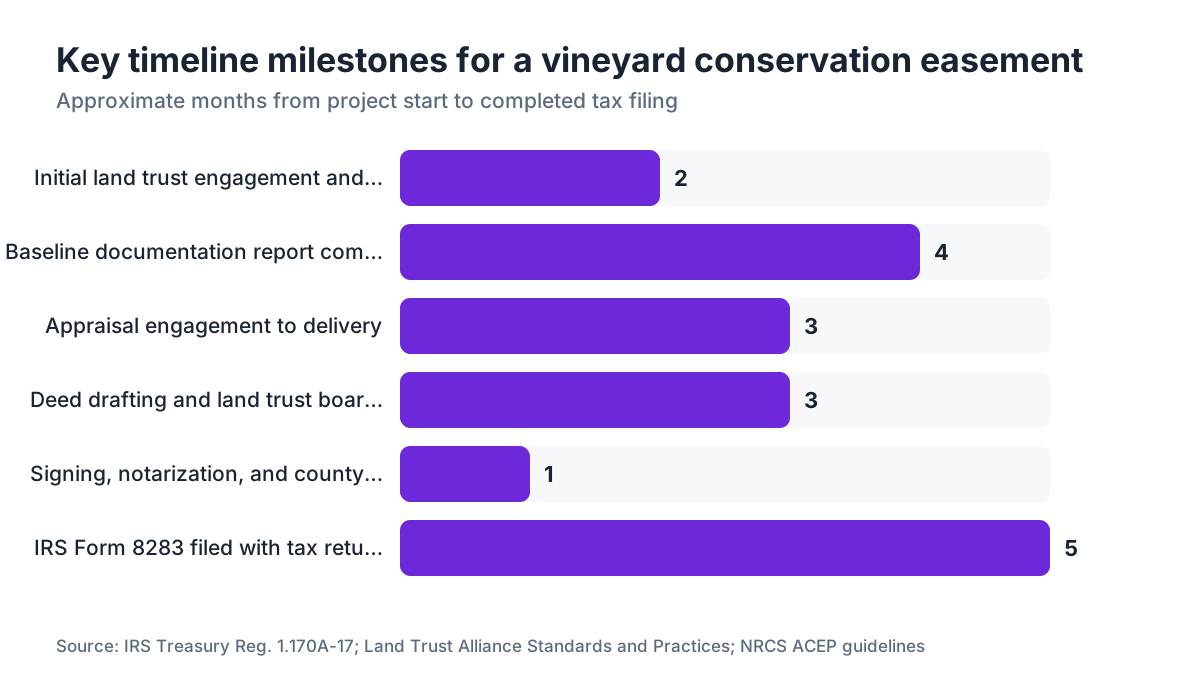
From first conversation with a land trust to recorded deed, budget 6 to 18 months for a straightforward vineyard easement. The appraisal alone takes 60 to 90 days from engagement to delivery. The land trust's due diligence, baseline documentation, and board approval add more time. Recording at the county recorder, once everything is signed, takes one day or less.
How much does a conservation easement appraisal cost for a vineyard?
Qualified appraisals for vineyard conservation easements typically run $8,000 to $25,000 depending on property size, complexity, and the appraiser's market. Do not accept a flat-fee appraisal contingent on the easement closing or tied to the appraised value. That arrangement disqualifies the appraisal under Treasury Regulation 1.170A-17 and is an IRS red flag.
Does a conservation easement have to be permanent?
Yes. To qualify for a federal income tax deduction under IRC 170(h), the easement must be perpetual. The deed must restrict the land forever, with no buyout or release clause that lets restrictions lapse. Some state programs allow term easements for state tax benefits, but federal deductibility requires perpetuity. Check your state's rules separately.
What is a baseline documentation report and who prepares it?
A baseline documentation report (BDR) records the property's condition at the time of the easement donation: photographs, maps, soil descriptions, existing structures, current land use, and a narrative of conservation values. The land trust prepares it, usually with your participation, before or at closing. It is the benchmark for all future monitoring visits. Without a complete BDR, your easement and deduction are at risk.
Can I still plant new grape varieties or replant after a conservation easement?
Almost always yes, but check your specific deed language. Standard agricultural conservation easement deeds preserve farming activities including replanting, cover cropping, irrigation, and normal viticultural practices. What they restrict is subdivision, residential development, and major commercial structures unrelated to farming. Read the reserved rights section of your deed carefully before signing.
How does IRS Form 8283 work for a conservation easement donation?
File Form 8283, Section B for non-cash charitable contributions over $500. For conservation easements, you need three signatures: yours as the taxpayer, the qualified appraiser's (with their tax identification number), and an authorized official of the land trust. The land trust signature is mandatory and confirms receipt of the contribution. Attach the completed form to your income tax return for the year of the donation.
What happens to the conservation easement if the land trust goes out of business?
The easement does not disappear. The deed must specify that if the land trust ceases to exist or can no longer carry out its conservation purposes, the easement rights transfer to another qualified organization with similar purposes. This is a required element under IRC 170(h). Most well-drafted deeds name a backup grantee or spell out the transfer process.
Does a conservation easement affect my vineyard's water rights?
Generally no. Water rights are a separate legal instrument from real property easements. Your existing water rights, whether riparian or appropriative, are not transferred by the easement deed. However, if the deed includes language about riparian buffers, irrigation diversion structures, or water quality practices, those specific provisions do create operational commitments. Have your water attorney review the deed before signing.
Can I claim a conservation easement deduction if my vineyard is held in an LLC or partnership?
Yes. Conservation easements donated by pass-through entities (LLCs, partnerships, S-corps) pass through to the individual partners or shareholders on Schedule K-1. Each partner claims their proportionate share on Form 8283. The entity must still complete the full documentation process. Note that enhanced deduction limits (up to 50% of AGI, or 100% for qualified farmers) apply at the individual level.
How often does the land trust monitor the property after the easement is recorded?
Most land trusts conduct an annual monitoring visit. The monitor walks the property, compares current conditions to the baseline documentation report, and writes a report noting any changes and confirming compliance. You should receive a copy. Some trusts visit more often in the first few years or if they see a potential violation. Budget a couple of hours per year for the visit.
What is the difference between a conservation easement and a Williamson Act contract in California?
A Williamson Act contract (Land Conservation Act) is a 10-year renewable agreement with the county that reduces property tax assessment on agricultural land in exchange for keeping it in agricultural use. A conservation easement is permanent and grants development rights to a land trust in exchange for a federal tax deduction. They serve different purposes and can coexist on the same parcel, but the easement is perpetual while the Williamson Act contract can be non-renewed.
How do I update my property records with the title company after recording an easement?
After the deed records, notify your title insurance company and request an endorsement to your owner's policy noting the easement. Future title commitments will show the easement in Schedule B exceptions. Also update your property file with the recorded deed (including document or book-and-page number), notify your lender, and send a copy to your estate planning attorney so your will or trust documents reflect the encumbrance.
Sources
- IRS, Internal Revenue Code Section 170(h) and Publication 561: IRC 170(h) defines qualified conservation contributions, perpetuity requirement, conservation purposes, and the IRC 2031(c) estate tax exclusion of up to 40% of easement value up to $500,000
- Land Trust Alliance, Standards and Practices: Land Trust Alliance Standards and Practices (Practice 11) requires baseline documentation to be completed before or at the time of closing; searchable land trust directory available
- IRS, Treasury Regulation 1.170A-17 (Qualified Appraisal and Qualified Appraiser): Appraisal must be dated no earlier than 60 days before the contribution and no later than the due date of the return; contingent-fee appraisals are disqualified
- IRS, Form 8283 Instructions: Form 8283 Section B requires signatures from the taxpayer, qualified appraiser (with TIN), and an authorized official of the donee organization for conservation easement donations
- California Board of Equalization, Property Tax Rules: Conservation easement recording does not trigger Proposition 13 reassessment; county recording fees in California governed by Government Code 27361
- IRS, Notice 2017-10 (Syndicated Conservation Easements Listed Transaction): IRS designated syndicated conservation easement transactions as listed transactions in 2017, subjecting participants to heightened penalties and disclosure requirements
- Congress.gov, Consolidated Appropriations Act 2023 (Public Law 117-328): Consolidated Appropriations Act of 2023 limits deductions for syndicated conservation easements to 2.5 times the investor's basis in the partnership
- California Department of Conservation, Williamson Act Program: California Williamson Act (Land Conservation Act of 1965) reduces property tax assessment on contracted agricultural land and can coexist with a conservation easement
- EPA, Worker Protection Standard 40 CFR Part 170: Pesticide use on vineyard land subject to a conservation easement remains governed by EPA Worker Protection Standard 40 CFR Part 170; the easement does not alter these obligations
- WSU Extension, Viticulture and Enology Program: WSU Extension Viticulture Program publishes guidance on vineyard record-keeping for compliance purposes relevant to conservation commitments
- Cornell Cooperative Extension, Viticulture and Enology: Cornell Extension covers integrated pest management documentation in agricultural contexts including conservation agreement compliance
- UC Davis, Agricultural and Resource Economics: UC Davis ARE has published research on the economics of conservation easements on California farmland including vineyards
Last updated 2026-07-11