Owl box installation and monitoring documentation for vineyard IPM records
TL;DR
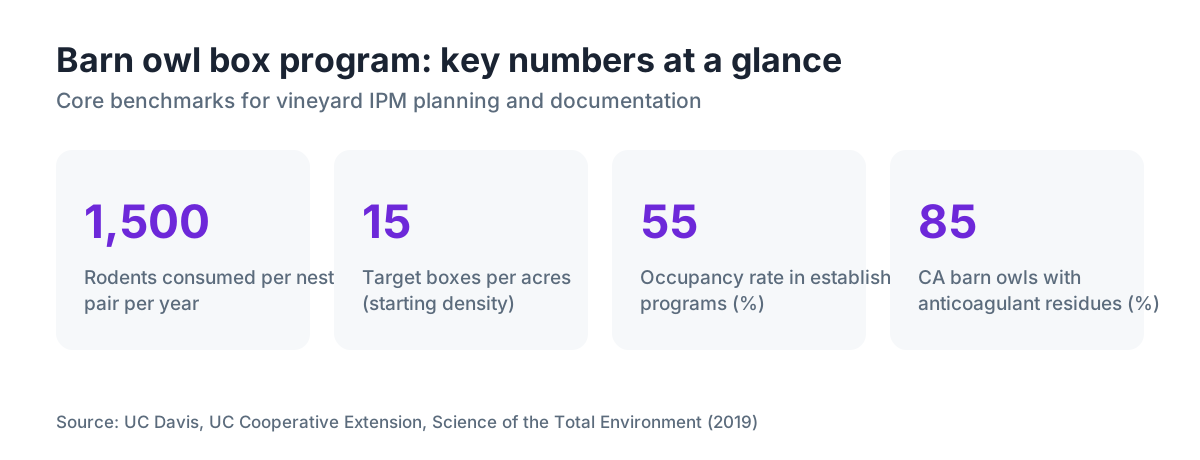
- A barn owl pair eats 1,000 to 2,000 rodents a year, which makes owl boxes one of the cheapest rodent tools a vineyard has.
- But an undocumented box is just wood on a post.
- To count as an IPM practice, you need three things: installation records, seasonal monitoring logs, and outcome notes.
- This article covers exactly what to record, when, and where to file it.
Why do owl boxes belong in your vineyard IPM records at all?
Integrated pest management runs on one habit: you document every tactic, more than the ones that come out of a spray tank. Biological controls like barn owls are real pest management actions, and certifiers, auditors, and county agricultural commissioners expect to see them treated that way. If you're chasing USDA organic certification, California Certified Organic Farmers (CCOF) accreditation, or SIP (Sustainability in Practice) certification, documented biological control counts in your favor. An undocumented owl box is a wooden box on a post.
The UC Cooperative Extension publication "Barn Owls in the Vineyard" (Sonoma County) says the same thing plainly: systematic monitoring records are what separate a passive habitat feature from an active IPM strategy [1]. That distinction matters most when you're defending a pesticide reduction claim to a buyer, a certifier, or a regulator.
Good records also tell you whether the program actually works. Occupancy rates, prey pellet counts, and rodent pressure trends across several seasons give you data to decide whether to add boxes, relocate the dead ones, or shift the timing on other controls. That's the whole idea behind IPM: decisions driven by monitoring, not by habit.
Where should you install owl boxes in a vineyard, and what affects placement?
Barn owls (Tyto alba) want a clear flight path to the entrance, a perch nearby, and open ground to hunt. Vineyards fit almost perfectly. The rows form flight corridors, and gopher and vole pressure runs high. Most extension programs agree on the same siting rules.
Height: Mount boxes 10 to 20 feet off the ground. Lower boxes get bumped by equipment and crews. Higher boxes are hard to monitor safely. 12 to 15 feet is the sweet spot for most operations [2].
Orientation: Face the entrance away from the prevailing wind, and in hot inland zones, away from direct afternoon sun. In California's Central Valley that usually means a northeast-facing entrance. On the cooler coast, west-facing is fine.
Spacing: One pair hunts roughly 25 to 100 acres of territory depending on prey density and terrain [3]. UC Davis recommends one box per 10 to 20 acres of vineyard as a starting density, knowing not every box fills at once [2].
Substrate: Wooden posts are fine. Metal poles cook in summer. Don't bolt boxes to vine end-posts, because tractor passes vibrate them and rattle nesting birds. A dedicated 4x4 or 6x6 wooden post works well and costs almost nothing.
Buffer from spray zones: This is the part vineyard managers miss. Barn owls are sensitive to certain pesticides. The EPA Worker Protection Standard covers workers, not wildlife, but state and federal wildlife rules and the pesticide label itself may limit what you apply near an active nest [4]. Keep boxes at least 150 feet from any area getting rodenticide bait. Write that buffer into your installation record. That note protects you.
Record the GPS coordinates of every box the day you install it. You'll thank yourself in year three when you're trying to line up box locations against rodent damage zones in your vineyard map.
What materials and hardware do you need, and what does it cost?
A working barn owl box has a few features you can't skip: an entrance hole 4 to 6 inches across (owls need at least 4), interior dimensions around 10 inches wide by 18 inches deep by 10 inches tall, ventilation holes near the top, and a hinged inspection door for monitoring [2].
Pre-built boxes from suppliers like the Hungry Owl Project or a local Audubon chapter run $75 to $150 each. A DIY box from exterior-grade plywood costs $20 to $40 in materials and takes about two hours to build [1]. At scale, say 20 boxes on a 200-acre property, building saves real money.
The post and hardware for one box (a galvanized carriage bolt, lag screws, and post-setting concrete) adds another $15 to $30. Total installed cost per box lands around $35 to $180, depending on whether you build or buy.
That's a one-time spend. Compare it to a single application of zinc phosphide or anticoagulant bait across 200 acres, which can run $500 to $2,000 depending on product and method, and the math on owl boxes gets obvious over a 5 to 10 year horizon. It gets better still if you're trimming rodenticide use for certification.
One detail people skip: paint or stain the box a light color in hot country. Bare wood in a California summer can push interior temperatures past 105 degrees F, which kills eggs and nestlings [2]. Light gray or tan latex. Nothing dark.
What exactly should you record at installation?
Your installation record is the foundation for everything that follows. Keep it simple enough that whoever does the work actually fills it out. These are the minimum fields.
| Field | Example entry |
|---|---|
| Box ID | OWL-07 |
| Installation date | 2024-02-15 |
| GPS coordinates | 38.5123° N, 122.8041° W |
| Block or parcel | Block 4-East, Cabernet Sauvignon |
| Mount height (ft) | 14 ft |
| Entrance orientation | Northeast |
| Structure type | 4x4 wood post, concrete-set |
| Box source / dimensions | DIY, 10"W x 18"D x 10"T, 4" entrance |
| Installer name | J. Morales |
| Notes | 30 ft from windbreak, clear flight path to row 12 |
Also note the distance to the nearest rodenticide application zone, any standing water, existing barn owl sign, and known raptor activity in the area. That context helps you read the occupancy data later.
If your vineyard runs a field operations platform like VitiScribe, log each box as a permanent fixture with its own location record and attach monitoring entries to it over time. That keeps everything searchable by block, season, or pest pressure event. On paper, a three-ring binder with one sheet per box works fine, as long as it stays consistent year over year.
File the installation records with your IPM plan. Your county agricultural commissioner or your certifier may ask to see them.
How often should you monitor owl boxes, and what should you look for?
Five visits per box per year is the honest answer. Most programs check once a year and call it monitoring. That's not monitoring. That's a barn tour.
Here's the schedule UC Cooperative Extension and the Cornell Lab of Ornithology's NestWatch program both back.
- Pre-season setup check (January to February in most wine regions): Is the box sound? Is the entrance clear? Any debris or wasp nests inside? Clean and reset.
- Early nesting check (March to April): Look for eggs or a brooding female. If she's sitting, keep it under two minutes and don't shine a light at her.
- Mid-season nestling check (May to June): Count nestlings if you can see them. Note prey pellets on the box floor. Dissecting a few tells you what the pair is hunting.
- Post-fledge check (July to August): Are fledglings using the box as a roost? Any second clutch?
- Annual condition check (October to November): Clean the box, check the hardware, note structural issues, file the year's summary.
For a 20-box vineyard, that's maybe 8 to 12 hours of field time per season, spread across the year. Not a burden.
Every visit gets a written entry. The fields you want:
- Date and time of visit
- Observer name
- Box ID
- Occupancy status (empty, eggs present, female brooding, nestlings, adult pair roosting)
- Number of eggs or nestlings if you can count them
- Prey pellet count (a rough estimate is fine)
- Box condition (intact, damage, entrance obstruction)
- Weather at time of visit
- Wildlife notes (adults hunting nearby, kestrel using the box, and so on)
The pellet count is the field nobody uses and everybody should. A dissected barn owl pellet from a vineyard box shows you the rough split of gopher, vole, mouse, and other prey. UC Davis researchers have used pellet analysis to confirm that vineyard barn owls take pocket gophers (Thomomys spp.) and voles (Microtus spp.) at high rates, which are the exact species chewing on your vines [3]. That's the outcome data that turns a compliant record into a useful one.
How do you document nest check visits without disturbing the birds?
The Migratory Bird Treaty Act protects barn owls and their active nests [5]. You can monitor boxes on your own property, but disturbing an active nest enough to cause abandonment creates real legal exposure. Follow a tight standard and log what you saw.
Never check an active nest more than once every 7 to 10 days during incubation. Cornell's NestWatch protocol, the most widely used citizen-science monitoring standard in North America, sets a minimum of 4 days between checks during the egg stage and recommends keeping visits under 5 minutes [6].
Wear the same clothes each visit if you can. Barn owls settle faster around a regular visitor than a rotating cast of strangers. It sounds trivial. It cuts flush behavior.
Use a small inspection mirror or a phone camera on a selfie stick instead of leaning your face into the entrance. Better view, calmer bird.
Document your disturbance level in the log. Note whether the female flushed, stayed, or called. A female who flushed and didn't come back within 10 minutes of watching is telling you to stretch the interval between checks. That note shows a certifier or auditor that you're running the monitoring program responsibly.
If you're near a county with a raptor monitoring program (Sonoma, Napa, and Monterey counties in California all run them), think about registering your boxes. More eyes on the data, and it can help with grant applications.
What records do you need to satisfy IPM certification requirements?
It depends on the standard you're working toward, but there's a core set of records that satisfies most of them.
USDA National Organic Program regulations at 7 CFR Part 205 require an organic system plan that documents all pest management practices, with records that support the plan [7]. A documented biological control program using native predators sits under preventative pest management and backs the argument that you've minimized synthetic pesticide use.
SIP Certified (Sustainability in Practice) and California Sustainable Winegrowing Alliance (CSWA) standards both score biodiversity and biological pest control. Installation records, occupancy logs, and outcome summaries feed those scores directly.
CCOF requires records to be kept for 5 years after certification [8]. Your owl box logs from year one need to be retrievable in year six. Paper is fine if it's organized and stored where it won't flood. Digital is safer.
The minimum documentation package for most certifiers:
- A map or GPS list of all box locations tied to vineyard blocks
- Installation records with dates and hardware notes
- Seasonal monitoring logs with occupancy data
- An annual summary of boxes occupied, estimated pairs, and any prey analysis
- A line in your IPM plan naming owl boxes as a standing biological control measure
None of this is hard. The failure mode isn't complexity, it's inconsistency. A monitoring log with 2022 and 2024 entries and nothing from 2023 looks worse than no log at all, because it says the program exists only on paper.
How do you link owl box monitoring to rodent pressure data in your IPM records?
This is where most vineyard programs leave value on the table. Owl box data is half the picture. The other half is rodent monitoring: pocket gopher mounds per acre, vole runway activity scored by block, or bait station records.
The question you want your records to answer is simple. In blocks with active owl pairs, is rodent pressure lower or falling over the season compared to blocks without a nearby active box? You don't need a controlled experiment. You need consistent before-and-after scouting notes.
A format that works: every time you check a box, do a 10-minute rodent pressure walk in the two nearest rows. Count fresh gopher mounds. Score vole runways on a 1 to 3 scale. Write it down next to the box entry.
After two or three seasons you'll have enough to see whether active boxes track with lower pressure. WSU Extension's IPM resources for tree fruit and vineyards treat this kind of paired observation as the working backbone of biological control documentation [9].
No correlation after three seasons is useful too. Maybe the boxes sit too far from the worst gopher zones. Maybe the local prey base is already thin and the owls hunt elsewhere. Move the underperformers and document the decision. That's adaptive management, and it's exactly what an IPM plan is supposed to show.
For vineyards running field operations across many blocks, a platform that links point locations (box GPS coordinates) to block-level scouting records makes this analysis far easier. That's the problem VitiScribe's field records layer solves.
What are the pesticide application restrictions near active owl nest sites?
This is a real compliance issue, and the owl box literature barely mentions it. Barn owls aren't federally listed as threatened or endangered, but they're protected under the MBTA, and several western states pile on more protection. The bigger practical risk is secondary poisoning. Anticoagulant rodenticides are a documented cause of barn owl death.
A 2019 study in Science of the Total Environment found anticoagulant rodenticide residues in 85% of California barn owls sampled [10]. That's not a hypothetical.
The EPA's Worker Protection Standard at 40 CFR Part 170 governs pesticide application to protect farm workers, not wildlife [4]. It won't tell you to buffer rodenticide away from owl boxes. The pesticide label might, and the label is law.
Products with brodifacoum, bromadiolone, and other second-generation anticoagulant rodenticides (SGARs) carry label language restricting use where non-target wildlife could be exposed. Read the label. First-generation anticoagulants like diphacinone in a bait station carry lower secondary risk, but not zero.
The working rule: document a buffer around active boxes in your IPM records, and name the rodenticide products you've agreed not to apply inside it. 150 feet is a reasonable minimum. 300 feet is better in California, where the Department of Pesticide Regulation (CDPR) is watching SGAR use near foraging raptors more closely every year [11].
That buffer note also signals to an auditor that you've thought about how your biological control and chemical control programs interact. Good IPM.
How should you store and organize owl box records long-term?
Organic certification wants 5 years of records. SIP and CSWA audits can reach back 3 years. Plan for five and you cover all of it.
The simplest filing structure that holds up:
- One master installation log (spreadsheet or binder), one row per box, all the static information
- One seasonal monitoring file per year, organized by box ID and date
- One annual summary per season noting overall occupancy rate, boxes added or moved, and rodent pressure tied to box activity
Back up digital files to at least two places. A spreadsheet that lives only on a laptop that gets stolen isn't a record. It's a memory.
Scan paper records at the end of each season. Paper fades, tears, and gets wet. The scan is the backup.
Date every entry. Sign every entry. This matters if a regulatory question surfaces years later and you need to prove who observed what and when.
Tag each physical box with a weatherproof ID (engraved aluminum or UV-stable plastic) that matches your master log. Box IDs painted on with a spray can fade in two seasons. A screwed-on aluminum tag lasts 20 years.
For vineyards that want one system for spray records, scouting logs, and biological control documentation, keeping it all in a single platform avoids the version-control mess of six separate spreadsheets. Whatever you use, consistency beats sophistication.
What's a realistic occupancy rate to expect, and how do you interpret low occupancy?
Don't expect a full house in year one. Barn owls need time to find new boxes, and the local population isn't always dense enough to fill every one fast.
The Hungry Owl Project, which has placed thousands of boxes across California wine country since 1994, reports occupancy in established programs reaching 40% to 70% within 3 to 5 years [1]. First-season occupancy of 10% to 20% is normal and no sign of failure.
What suppresses occupancy:
- Boxes in low-prey zones (the owls just hunt elsewhere)
- Entrances facing heavy prevailing wind
- Boxes too close to human traffic or noisy equipment storage
- Great horned owls in the area (they prey on barn owls and take the nest sites)
- Rodenticide use that has thinned the prey base past the point where owls can feed a nest
A box that's been up two full seasons with zero occupancy needs to move. Document why, and where it went. That's good adaptive management, and it makes your records stronger, not weaker. A program that never changes is a program nobody's monitoring.
Track occupancy as a percentage in your annual summary: boxes occupied at peak nesting divided by total boxes in service. That one number, trended across 5 years, tells you more about the health of your biological control program than any single season can.
Frequently asked questions
Do owl boxes count as a documented IPM practice for organic certification?
Yes. Under the USDA National Organic Program (7 CFR Part 205), documented biological controls like predatory birds count as preventative pest management. You need installation records, seasonal monitoring logs, and an annual summary to support the claim in your organic system plan. A box with no documentation is infrastructure, not a certifiable practice.
How many owl boxes do I need per acre of vineyard?
UC Davis recommends starting at one box per 10 to 20 acres. A nesting pair hunts roughly 25 to 100 acres depending on prey and terrain. Don't over-install in year one. Start at one box per 15 acres, monitor occupancy and rodent pressure for two seasons, then add or reposition based on what the data shows.
What's the best time of year to install barn owl boxes in a vineyard?
Install between October and January in most Western wine regions. Barn owls start scouting nest sites in late winter, so boxes need to be up and weathered before February. Early fall gives the wood time to off-gas any treatment chemicals and the structure time to blend into the landscape before prospecting birds come looking.
Can rodenticide applications harm barn owls nesting in my vineyard?
Yes, especially second-generation anticoagulant rodenticides (SGARs) like brodifacoum and bromadiolone. A 2019 study found anticoagulant residues in 85% of California barn owls sampled. Document a pesticide-free buffer of at least 150 to 300 feet around active boxes and record that commitment in your IPM plan. SGAR labels may carry additional requirements.
What data fields are required in a barn owl monitoring log for IPM records?
At minimum: date, observer name, box ID, occupancy status (empty, eggs, nestlings, adult roosting), egg or nestling count if visible, pellet count estimate, box condition, and brief weather notes. Add a rodent pressure observation from nearby rows to connect biological control data to pest trends. Keep entries dated and signed.
How long do I need to keep owl box monitoring records?
CCOF requires 5 years of records after certification. SIP Certified and CSWA audits typically look back 3 years. Plan on 5 years as your minimum retention. Store paper in a dry place and scan it annually. Digital records need backup in at least two physical locations, or one cloud service with version history enabled.
Is it legal to check active barn owl nests in California?
Barn owls are protected under the federal Migratory Bird Treaty Act. Monitoring your own boxes is legal, but intentionally disturbing an active nest enough to cause abandonment creates legal exposure. Follow the Cornell NestWatch protocol: no more than one check every 4 to 7 days during egg incubation, visits under 5 minutes, and log whether the female flushed each visit.
What should I do if a box has had zero occupancy for two seasons?
Move it. Two full seasons of zero occupancy usually signals a siting problem: too much human traffic, poor prey density, wrong entrance orientation, or nearby great horned owl territory. Document why you're relocating the box and where it's going. That adaptive management note strengthens your IPM records rather than weakening them.
How do I analyze barn owl pellets to confirm rodent predation in my vineyard?
Collect pellets from the box floor during the annual clean-out. Soak them in warm water for 30 minutes, then tease them apart with forceps. You'll find skull fragments, teeth, and bones. Pocket gophers have distinctive orange incisors; voles have smaller, shorter molars. UC Davis extension resources on barn owl biology include basic prey ID guides. Even rough proportions give you useful IPM data.
How do I attach owl box monitoring records to my pesticide application records in an IPM file?
Keep both record types in the same seasonal file, organized by date. When you apply a rodenticide or insecticide near a box, cross-reference the box ID and note any buffer decisions. When you check a box, note any recent nearby applications. That cross-referencing turns two separate logs into an IPM record that tells a coherent pest management story.
Do I need to register my owl boxes with any government agency?
No federal and, in most states, no state registration is required to install barn owl boxes on private agricultural land. Some counties, including Sonoma and Napa in California, run voluntary raptor box registration programs through agricultural commissions or Audubon chapters. Voluntary registration can help you access monitoring support and may strengthen grant applications for biological control programs.
What's a realistic payback period for an owl box program compared to rodenticide costs?
At $35 to $180 installed per box versus $500 to $2,000 per rodenticide application across a mid-size vineyard, boxes typically recover their cost within 2 to 3 seasons if they hit 40% or better occupancy. Payback improves if reduced rodenticide use contributes to organic or sustainability certification, which can add a per-ton buyer premium depending on the market.
Sources
- UC Cooperative Extension Sonoma County, Barn Owls in the Vineyard: Systematic monitoring records distinguish active IPM strategy from passive habitat feature; Hungry Owl Project reports 40-70% occupancy in established programs within 3-5 years
- UC Agriculture and Natural Resources, barn owl box siting and construction guidance: Recommended mount height 10-20 feet, one box per 10-20 acres starting density, entrance and interior dimensions, and heat risk above 105F for unpainted boxes
- UC Agriculture and Natural Resources, Barn Owls as Biological Control Agents: A nesting pair hunts roughly 25 to 100 acres; pellet analysis confirms high rates of pocket gopher and vole predation in vineyard-installed barn owl pairs
- US EPA, Worker Protection Standard, 40 CFR Part 170: EPA WPS governs pesticide application to protect agricultural workers; wildlife protections are governed by separate statutes and pesticide product labels
- US Fish and Wildlife Service, Migratory Bird Treaty Act Overview: Barn owls and their active nests are protected under the Migratory Bird Treaty Act; intentional disturbance causing nest abandonment creates legal exposure
- Cornell Lab of Ornithology, NestWatch Monitoring Protocol: Minimum 4-day interval between nest checks during egg stage; visits should be kept under 5 minutes; observers should minimize disturbance to incubating females
- USDA National Organic Program, 7 CFR Part 205: Organic system plan must document all pest management practices including biological controls; records must support the plan
- California Certified Organic Farmers (CCOF), Certification Recordkeeping Requirements: CCOF requires records to be kept for 5 years post-certification
- Washington State University Extension, Integrated Pest Management for Vineyards: Paired observation of biological control agent presence and pest pressure is the practical backbone of biological control documentation in WSU IPM guidance
- Science of the Total Environment, 2019, Anticoagulant rodenticide exposure in barn owls: Anticoagulant rodenticide residues were found in 85% of barn owls sampled in California in a 2019 study
- California Department of Pesticide Regulation, Rodenticide Risk Mitigation: CDPR increasingly scrutinizes SGAR use near foraging raptors; buffer documentation around active raptor nest sites is recommended practice
Last updated 2026-07-11