How to record a no-spray decision with supporting monitoring data

TL;DR
- A no-spray decision needs a written record that captures the date, the pest or disease in question, what you scouted, the action threshold you compared it against, weather conditions, and your reasoning.
- Without that paper trail, regulators and certifiers see a gap, not a decision.
- The record takes under five minutes to write and can save hours of audit headaches.
Why does a no-spray decision need to be recorded at all?
A decision not to spray is still a pest management decision, and it's just as auditable as any application you make. Most managers log every spray (product, rate, REI, applicator license) and stop there. The empty spray column doesn't tell anyone why you held off. It tells them nothing.
Under the EPA Worker Protection Standard, your pesticide safety information has to be kept current and your application records maintained for two years [1]. But if a certifier, a buyer, or a state ag auditor asks how you managed powdery mildew pressure in a given block during a given week, and your only answer is "we didn't spray," you have a problem. The absence of a spray record documents nothing. A written no-spray record documents a decision.
For certified organic operations, USDA National Organic Program rules require records that show your practices match your organic system plan [2]. A no-spray decision backed by scouting data is direct evidence you're running an IPM-based system. A no-spray decision with no documentation is a gap an inspector can flag.
Even if you're not certified, documented no-spray calls earn their keep. They show buyers you manage inputs with a plan. They show your own crew what a real threshold looks like in the field. And they protect you if a spray contractor, a neighbor, or a regulator ever questions your pesticide use history.
What information should a no-spray record actually contain?
The record doesn't need to be long. It needs to be complete. Think of it as answering six questions for someone who wasn't in the field with you.
Date and block. Obvious, but get specific. "Block 3, Cabernet Sauvignon, rows 1-48, north slope" is a record. "The cab block" is not.
The pest or disease being evaluated. Name it. Powdery mildew. Western grape leafhopper. Grape mealybug. Botrytis risk. If you scouted for several things in one walk, list them separately. A reader six months from now shouldn't have to guess what you were looking at.
Your scouting method and sample size. UC IPM guidelines for many grape pests specify minimum sample sizes, usually 25 to 50 shoot tips, clusters, or leaves per block depending on the pest [3]. Write down how many plants you examined, where in the block you walked (random, diagonal transect, perimeter-plus-interior), and what signs or symptoms you were after.
What you found. Actual counts or incidence percentages, not adjectives. "3 of 30 shoot tips showed powdery mildew colonies" is a record. "Low pressure" is an opinion. If you use a 0-to-4 rating scale for disease severity, write the scale into your record once and refer to it the same way every time.
The threshold you compared it against. This is the piece most managers skip, and it matters most. Write down the action threshold you're using and where it comes from. Cornell's NEWA disease models link powdery mildew infection risk to temperature and leaf wetness hours [4]. WSU's Pacific Northwest handbook lists economic thresholds for several key grape insects [5]. A published threshold shows your decision had a basis outside your own gut.
Weather data or forecasted risk. Temperature, relative humidity, precipitation, and any disease model output you consulted (NEWA, UC IPM risk index, iMETOS). These numbers give context to your findings. High counts in hot, dry weather carry different weight than the same counts heading into a humid stretch.
Your conclusion and reasoning. One or two sentences. "Mildew incidence at 10% of shoot tips; intervention threshold is 20% at this growth stage per UC IPM. No spray warranted. Will re-scout in 5 days." That's it. That's a defensible record, agronomically and legally.
What monitoring data is good enough to justify skipping a spray?
It depends on the pest, the growth stage, your risk tolerance, and whether you're certified. There are solid benchmarks from extension research, though, and they beat guessing.
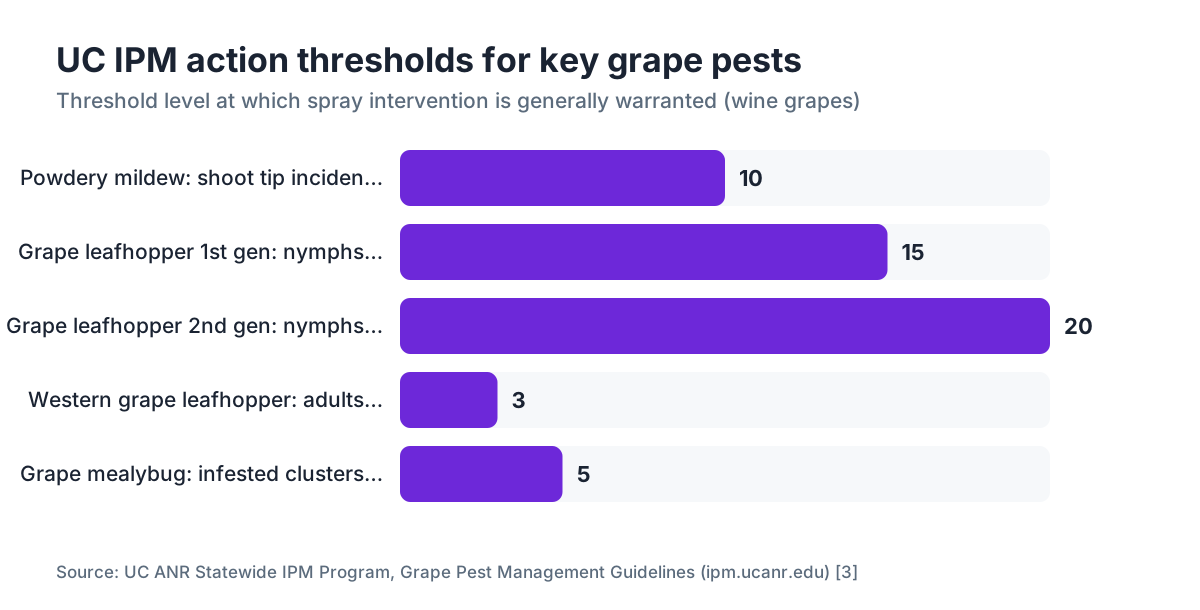
For powdery mildew (Erysiphe necator), UC Cooperative Extension recommends tracking infection periods using temperature and leaf wetness data [9]. When cumulative infection risk is low and visual incidence on shoot tips sits below your internal threshold (many California growers use 5 to 10% shoot tip incidence as a pre-bloom trigger, higher after fruit set), a no-spray decision holds up if you document it.
For grape leafhopper (Erythroneura spp.), UC IPM gives economic thresholds around 15 to 20 nymphs per leaf in the first generation for wine grapes, with intervention generally warranted only when natural enemy populations aren't keeping pace [3]. A record showing 6 nymphs per leaf and active parasitism by Anagrus wasps is strong justification for holding off.
For botrytis bunch rot, Cornell's NEWA system and the UC IPM botrytis risk index produce quantitative risk scores from weather data [4]. A low score on both, paired with open-canopy notes from your latest shoot-thinning records, is a reasonable basis for a no-spray call. Say plainly that you leaned on a model.
What's not good enough: "I walked the vineyard and it looked fine." That's observation, not scouting. Scouting has a protocol, a sample size, and a specific thing you're counting or rating. If you can't write down how many plants you looked at and what you looked for, you didn't generate data. You generated an impression.
WSU Extension's Pacific Northwest handbook gives region-specific thresholds that differ from California standards in some cases, so use the threshold that matches your region [5].
Is there a standard form or template for recording no-spray decisions?
There's no federally mandated form for this record type. The EPA Worker Protection Standard requires application records but doesn't prescribe a format for a decision not to apply [1]. The NOP requires records that demonstrate compliance with your organic system plan but leaves format to the operator [2].
So you get to build something that fits your operation. The table below shows what a minimal but complete record looks like.
| Field | Example entry |
|---|---|
| Date | 2025-06-12 |
| Block / Variety | Block 7 / Grenache |
| Growth stage | Shoot tip (10-15 cm) |
| Target pest/disease | Powdery mildew |
| Scouting method | 30 shoot tips, diagonal transect |
| Incidence / count | 2 of 30 tips with mildew (6.7%) |
| Action threshold | 10% shoot tip incidence (UC IPM) |
| Weather / disease model | Avg temp 72°F, RH 45%; NEWA risk = low |
| Decision | No spray |
| Reasoning | Below threshold; dry forecast 7 days |
| Next scouting date | 2025-06-17 |
| Recorded by | J. Martinez |
Paper logbooks work. Spreadsheets work. Purpose-built vineyard record software (like VitiScribe) can attach scouting data straight to a block and generate a dated, signed record on its own. Whatever you use, the record needs to be retrievable by block, by date, and by pest for the full two-year lookback window [1].
Build one field into any template no matter what: a "next action" or follow-up date. No-spray decisions aren't permanent. A record that ends with a decision but no follow-up plan reads like you forgot to come back.
How do action thresholds work and where do you find them for vineyards?
An action threshold is the pest population or disease risk level at which control measures pay for themselves. Below it, the cost of spraying (money, labor, resistance risk, ecological disruption) beats the expected benefit. Above it, you spray.
Thresholds are pest-specific, crop-stage-specific, and often region-specific. The same leafhopper count that's fine at veraison in a warm interior region might justify a spray in a cool coastal site where populations keep building into harvest. Check your regional extension source, not a generic national one.
Key sources for U.S. vineyard thresholds:
- UC IPM (University of California): Pest management guidelines for wine, table, and raisin grapes, with thresholds, natural enemy notes, and timing. Available at ipm.ucanr.edu [3].
- Cornell University / NEWA: Powdery mildew and botrytis risk models and disease forecasting tools for Northeast and Great Lakes grape production [4].
- WSU Extension: Pacific Northwest Pest Management Handbooks, with grape sections and economic thresholds for key pests [5].
- CDFA and state ag departments: Some publish their own guidance or adopt published extension thresholds by reference.
Using a threshold not published by one of these? Say where it came from in your record. A threshold you built from your own historical data is legitimate, but write that down too: "Internal threshold based on five years of block-level yield loss correlation; see 2019-2023 harvest records."
The most common audit finding in organic vineyard inspections is a mismatch between the thresholds stated in the organic system plan and the ones actually used in field decisions. Keep them consistent, or update the plan when you change your approach.
How often do you need to scout to support a no-spray decision?
Often enough that your records show a pattern, not a one-off walk. Most extension programs tie scouting frequency to growth stage and pest pressure. During high-risk windows (bloom through fruit set for mildew, first and second leafhopper generations for insects), weekly scouting is the practical minimum [3].
A single scouting record on June 1 doesn't justify a no-spray call on June 20. Certifiers and regulators look for a series of records showing you monitored consistently and that the decision rode on a trend, not a guess. If you scouted June 1, June 8, and June 15 and all three showed incidence below threshold, your June 15 no-spray call is well-supported. One record from early June and then nothing until late July is a monitoring gap.
Frequency matters because pest populations and disease risk move fast. A block that's clean on a Thursday morning after three days of 95°F heat can look very different after a weekend of fog and 60°F nights. Your cadence should track how quickly conditions shift in your microclimate.
Across multiple blocks and varieties, a scouting schedule tied to a calendar (not to "whenever I have time") is the only thing that produces consistent records. Build it into your weekly ops plan the same way you schedule irrigation checks.
What weather data should you log alongside your scouting notes?
Log the data that actually informed your decision: what you had in front of you when you made the call, not numbers pulled afterward to justify something you'd already done.
At minimum, record temperature (high and low for the preceding 24 to 48 hours), relative humidity, and any precipitation. If you ran a disease model, note the model name, the date you checked it, and the output (risk index value, infection period designation, whatever it produces).
On-site weather stations give you the most defensible data. A station in or next to the affected block, logging hourly temperature and RH, produces a trail that matches what the canopy actually experienced. Regional airport data beats nothing but adds uncertainty, especially in coastal or valley-floor sites where morning fog is hyperlocal.
Free or low-cost weather sources used in U.S. viticulture include the NEWA network (managed by Cornell) [4], Weather Underground's personal weather station network, and CIMIS (California Irrigation Management Information System) for California growers. CIMIS stations are run by the California Department of Water Resources and cover most major production regions [6].
Name the model explicitly if it's part of your justification. NEWA's grape powdery mildew tool uses a cumulative infection risk index; UC IPM's model uses temperature-based infection period calculations. A record that says "disease model showed low risk" is vague. A record that says "NEWA powdery mildew risk index = 12 (low) on 6/12/2025, checked 8:00 a.m." is specific and retrievable.
How do no-spray records fit into IPM documentation for organic or GAP certification?
IPM documentation for organic certification under the USDA NOP has to show a defined decision process: monitor, compare to threshold, choose the least-disruptive intervention, document [2]. A no-spray decision with below-threshold counts recorded is the cleanest IPM record you can produce. It shows the system working exactly as intended.
For Global GAP or Primus GFS food safety certification (common for wineries selling to retail chains), pest monitoring records with documented decision points are a standard audit requirement. You should be able to produce records for any block and any scouting event on demand.
California's Department of Pesticide Regulation requires licensed pest control advisers to keep written recommendations, and a no-spray recommendation counts [7]. If your vineyard works with a PCA, ask for written no-spray recommendations when they apply. Those carry real weight in an audit because they come from a licensed professional.
For managing records digitally, VitiScribe is built around block-level scouting and decision documentation, letting you attach weather data, threshold references, and scouting photos to a timestamped record. That's the format a certifier expects. Software or paper binder, the structure matters more than the medium.
The vineyard operations context matters too: your no-spray records should line up with your broader block history (canopy management notes, irrigation logs, harvest data) so an auditor can see a coherent picture of how you ran each block through the season.
What are the most common mistakes in no-spray record-keeping?
These patterns show up over and over when vineyard records get audited or reviewed at harvest.
Vague language instead of numbers. "Low pressure," "minimal activity," "not a problem yet." These mean nothing to anyone who wasn't in the field with you. Replace every adjective with a count or percentage.
No threshold cited. The record shows what you found but not what you measured it against. Without a threshold, there's no decision, just an observation.
Missing scouting method. How many plants? Which rows? Random or systematic? Without method, your counts aren't reproducible and the record doesn't demonstrate a protocol.
Gaps in the scouting calendar. Three records in June, nothing in July, two in August. Gaps suggest either monitoring didn't happen (a problem) or records weren't kept (also a problem).
Retroactive record creation. Writing up your notes at month's end instead of in the field breeds wrong dates, inconsistencies, and entries that don't match weather from the actual scouting day. Same-day field notes, even on paper, beat a polished spreadsheet filled in a week later.
No follow-up date. A no-spray decision without a committed re-scouting date reads like a closed file. Pest management is continuous. Your record should show you knew that.
Threshold source not identified. "Our threshold is 15%" is weaker than "Our threshold is 15% per UC IPM guidelines for shoot tip incidence at pre-bloom." Source your thresholds every time.
Can a no-spray record protect you legally or in a dispute?
Yes, and it's underappreciated. Consider three scenarios.
First: a neighbor claims your vineyard was the source of a pest outbreak on their property. Scouting records showing below-threshold populations during the relevant period refute the claim, or at least shift the burden of proof.
Second: a buyer's inspector questions whether your "sustainable" or "IPM-certified" designation reflects real practice. Records showing documented thresholds, consistent monitoring, and multiple data-backed no-spray decisions are exactly what those programs require. A spray-only record set tells a very different story.
Third: a worker alleges pesticide exposure during a period when you believe no spray happened. A dated, signed no-spray record for that block on that date is documentation. Without it, you're asking someone to take your word.
The EPA Worker Protection Standard at 40 CFR Part 170 requires application records to be kept for two years and made available to employees on request [1]. The flip side: absence of application records for a date and block is ambiguous, not exculpatory. A positive no-spray record removes the ambiguity.
None of this replaces legal counsel in an actual dispute. But records are evidence, and evidence matters.
What's a practical system for keeping no-spray records across multiple blocks?
Start with a scouting schedule that lists every block, the target pests for each, and the recommended frequency by growth stage. Print it or drop it in a shared document. The schedule is the commitment; the records are proof you kept it.
For the records, pick one format and stick to it. Mixed formats (some on paper, some in email, some in a Google Sheet) create retrieval problems. If a paper field notebook is your starting point, build in a weekly transfer to a digital log. If you run vineyard management software, make sure scouting events are date-stamped and block-tagged automatically.
Assign responsibility out loud. In a two-person operation, both people should know who scouts which blocks and who enters the records. In a bigger operation, the vineyard manager should sign off on scouting records weekly, the same way they'd sign a spray record.
For season-end review, pull every no-spray record and every spray record for each block and read the pattern. Do your no-spray decisions line up with low-risk weather periods? Do your sprays line up with above-threshold scouting events? If they do, your records tell a coherent story. If they don't, you have either a recording problem or a decision-making problem, and finding that out internally beats finding it during a certification audit.
Even small operations gain from a shared folder or binder organized by block and month, with a cover page per block listing the thresholds used that season. If you can't find the relevant record in two minutes, it's not a functional record system.
Frequently asked questions
Do I legally have to record no-spray decisions in my vineyard?
No federal law specifically requires a no-spray record for conventional vineyards. But USDA National Organic Program rules require records showing your practices match your organic system plan, which makes no-spray documentation mandatory for certified organic operations. Beyond the law, no-spray records are routinely expected during USDA NOP, Global GAP, and state certification audits. Two years of application records are required under the EPA Worker Protection Standard, and no-spray records fill in the rest of the picture.
What's the minimum scouting data needed to justify not spraying for powdery mildew?
At minimum: a specific date, the block, the growth stage, how many shoot tips or clusters you examined (30 to 50 is the common UC IPM recommendation), the incidence percentage you found, the action threshold you compared against, and any disease model risk output you checked. For powdery mildew, temperature and leaf wetness data from the preceding 48 to 72 hours add real weight, because mildew infection risk is temperature-dependent.
Can I use a PCA's written recommendation as my no-spray record?
Yes, a licensed pest control adviser's written no-spray recommendation is a strong record. In California, PCAs are required to keep written recommendations under Food and Agriculture Code Section 12002, and those can be no-spray recommendations [7]. Ask your PCA to put them in writing when they advise against a spray. Keep copies with your block records. A PCA recommendation tied to scouting data and a threshold citation is more defensible than a self-generated record.
How long do I need to keep no-spray records?
The EPA Worker Protection Standard requires pesticide application records for two years [1]. For consistency and to stay safe for organic audits, keep no-spray records for the same two-year window. USDA NOP inspectors can request records back to your last inspection, which could be over a year. Some state programs set their own retention rules, so check with your state ag department if you're in a certification program.
What's an action threshold and how is it different from an economic threshold?
The terms sometimes get used interchangeably in extension literature, but technically an economic threshold is the pest density where control costs equal economic damage, while an action threshold sits somewhat below that to leave time for an intervention to work before the economic threshold is crossed. For practical record-keeping, use whichever term your extension source uses, define it in your record, and cite the source. The distinction matters more in academic discussion than in the field.
Which disease models are accepted by organic certifiers as valid monitoring data?
No single disease model is universally mandated or excluded. NEWA (Cornell) and UC IPM's powdery mildew risk tools are widely cited in extension literature and accepted in practice by most certifiers who see them in records. The key is to name the model, the date you checked it, and the output value. Certifiers are judging whether you had a rational basis for your decision, not whether you used a specific proprietary tool.
How do I record a no-spray decision when scouting shows mixed results across a block?
Split the record. Log the high-pressure area and the low-pressure area separately, even in the same block. Note the precise rows or sub-areas where counts ran high. If any sub-area exceeds your action threshold, your no-spray decision applies only to the parts below threshold; the elevated area gets a follow-up treatment plan or a spot treatment record. A block-wide no-spray call based on averages that hide above-threshold sub-areas is a documentation weakness.
Is photographic evidence useful in a no-spray record?
Photos help but don't replace counts. A time-stamped photo of a shoot tip with or without visible mildew colonies supports your written count but isn't a substitute for it. Where photos add real value is documenting canopy conditions (open versus dense), fruit stage, and natural enemy activity (parasitized leafhopper eggs, beneficial insect presence). Label every photo with block, date, and what it shows. An unlabeled photo folder is not a record.
What if scouting shows borderline conditions, close to threshold but not over it?
Document it as borderline and note your reasoning plainly. Something like: "Incidence at 9% against a 10% threshold. Held off based on a dry 7-day forecast and open canopy. Will re-scout in 3 days rather than 7." That record shows you understood the risk, weighed added context, and answered with a faster monitoring cadence. A borderline call with good documentation is far more defensible than a clear call with poor documentation.
Can I use my vineyard's historical spray records to set internal action thresholds?
Yes, and it's a legitimate IPM approach. With five or more years of block-level scouting and yield data, you can calculate the pest densities that have historically correlated with economic damage in your specific blocks. Document the analysis: which years, what the correlation showed, and who reviewed it. Reference that analysis in each season's no-spray records. An internally developed threshold backed by your own data holds up; an unexplained internal threshold does not.
Do I need to record no-spray decisions for every pest at every scouting event?
Only for the pests you actually evaluated. If you scouted for powdery mildew and leafhopper on a walk and neither warranted a spray, record both decisions. You don't need to mention pests you didn't scout for and weren't monitoring. But don't skip logging a decision just because it's a non-event. That's exactly the gap that creates audit problems. Consistent monitoring records for the pests in your organic system plan or IPM program are what auditors want.
How do I handle a no-spray decision when my consultant and I disagree?
Write it down exactly as it happened. Note that you consulted your adviser, note their recommendation, and note your decision and reasoning if you chose differently. Disagreement between a grower and a consultant is normal and legal; what matters is that the record reflects the actual decision and who made it. If your PCA recommended a spray and you chose not to, document and justify that. If conditions changed between the recommendation and your scouting, note that too.
What's the difference between a scouting log and a no-spray record?
A scouting log records what you found in the field: counts, incidence, pest stages, natural enemy presence. A no-spray record is a decision record that uses scouting data as its input. The best systems combine them in one form: you record the scouting data, the threshold comparison, and the decision in a single entry on the same date. Keeping them separate risks a scouting log that never connects to a decision, which is incomplete from a compliance standpoint.
Sources
- U.S. EPA, Worker Protection Standard for Agricultural Pesticides (40 CFR Part 170): EPA WPS requires pesticide application records to be kept for two years and available to employees upon request
- USDA Agricultural Marketing Service, National Organic Program regulations (7 CFR Part 205): NOP requires certified operations to keep records demonstrating practices comply with their organic system plan
- UC ANR Statewide IPM Program, Grape Pest Management Guidelines: UC IPM guidelines specify scouting methods, sample sizes, and action thresholds for key grape pests including powdery mildew and leafhoppers
- Cornell University Network for Environment and Weather Applications (NEWA), Grape Disease Models: NEWA provides grape powdery mildew and botrytis risk indices based on temperature and leaf wetness data; Cornell extension developed infection period thresholds for Northeast grape production
- Pacific Northwest Pest Management Handbooks (Oregon State, Washington State, University of Idaho Extension): The PNW Pest Management Handbooks publish economic thresholds for grape pests specific to Pacific Northwest growing conditions
- California Department of Water Resources, CIMIS (California Irrigation Management Information System): CIMIS operates weather stations across California production regions providing temperature, humidity, and ET data for agricultural use
- California Department of Pesticide Regulation, Pest Control Adviser licensing and recommendation requirements: California Food and Agriculture Code Section 12002 requires licensed PCAs to provide written pesticide use recommendations, which can include no-spray recommendations
- UC ANR, Powdery Mildew of Grape (UC IPM Pest Management Guidelines): Powdery mildew infection risk is temperature-dependent; UC extension recommends tracking cumulative infection periods based on temperature and wetness data to time spray decisions
- U.S. EPA, Pesticide Worker Safety and record-keeping requirements: Federal and state pesticide record-keeping requirements for certified applicators; records must be retrievable for inspection by regulatory agencies
Last updated 2026-07-10