Vine mealybug monitoring log and spray decision documentation

TL;DR
- A vine mealybug monitoring log records scouting dates, crawler counts per vine, life stages seen, and natural enemy presence.
- Spray decision records should document the threshold that triggered treatment, why you picked the product, and the restricted-entry interval.
- UC IPM suggests treating when crawlers pass about 100 per sticky trap per week during shoot growth.
- Good records satisfy EPA Worker Protection Standard rules and back up pesticide use reporting.
What is a vine mealybug monitoring log and why do you need one?
A vine mealybug monitoring log is a written or digital field record that captures every scouting event: who walked which blocks, on what date, how many mealybugs (and which life stages) they found per vine or per sticky trap, and what parasitoids or predators showed up alongside them. That's the core of it.
Why keep one? Three reasons that actually matter to a vineyard manager. It lets you catch population trends early enough to act before crawlers colonize new growth or fruit. It gives you the paper trail regulators and certifiers want when they ask why you sprayed what you sprayed on the day you sprayed it. And it forces scouting onto a schedule instead of whenever someone has a spare hour.
California requires pesticide use reports for all restricted-use and many general-use materials [1]. Those reports mean nothing without the monitoring context that justified the application. In an organic program, your certifier needs to see you tried cultural and biological controls first. The monitoring log is that evidence.
Vine mealybug (Planococcus ficus) is one of the most damaging pests in California wine grape production. UC Davis researchers have tracked its spread to most major California grape-growing regions since it was first detected in the Coachella Valley in 1994 [2]. It's also established in parts of Washington, Oregon, and some eastern wine regions. Once it's in a block, eradication is off the table. Management is the game.
What should a vine mealybug scouting log actually include?
Keep it simple enough that a scout fills it out in the field, not back at the office from memory. That single design choice decides whether your records are worth anything.
Every log entry needs at minimum:
- Block ID and GPS block boundaries (or a block map reference)
- Date and time of scouting
- Scout name (required for EPA Worker Protection Standard training verification) [3]
- Phenological stage (bud swell, 2-inch shoot, bloom, veraison, post-harvest)
- Sample size: number of vines examined and sample method used
- Count data per vine: eggs, crawlers, nymphs, adult females, adult males if visible
- Sticky trap data if traps are deployed: trap ID, location, crawler count per trap per day or per week
- Natural enemy observations: Anagyrus pseudococci (parasitic wasp), Leptomastidea abnormis, Cryptolaemus montrouzieri adults, or lacewing eggs
- Honeydew and sooty mold rating (0 = none, 1 = light, 2 = moderate, 3 = heavy)
- Remarks: new infested vines, spread pattern, ant activity
Ants protect mealybugs from parasitoids. If you're seeing heavy ant activity, note it. It changes the biological control picture completely [4].
For sticky traps, UC IPM recommends yellow or white sticky cards set at graft union height or on cordons in mid-spring to catch the first-generation crawler flush [5]. Record the trap exposure period (install date, pull date) so your per-day or per-week rate is accurate. A trap left out 10 days versus 7 days gives you a very different number if you don't normalize it.
How do you set an economic threshold for vine mealybug spray decisions?
This is where the science gets genuinely fuzzy, and I'd rather tell you that than pretend there's a clean number that works everywhere.
UC IPM publishes a threshold of roughly 100 crawlers per sticky trap per week as a guideline for treatment during the spring crawler flight [5]. Washington State University Extension uses a similar concept but notes that threshold research is still thin for Pacific Northwest conditions [6]. Cornell's grape IPM resources frame thresholds more around infestation prevalence (percentage of vines infested) than crawler trap counts alone.
In practice, the threshold that makes sense for your operation depends on four things:
- Your market: Table grape and fresh-pack operations have near-zero tolerance because mealybugs in clusters fail USDA visual inspection. Wine grape growers have more room.
- Block history: A block with a two-year infestation at high density needs a lower action threshold than a clean block where you're watching a new introduction.
- Biological control presence: If you have strong Anagyrus pseudococci parasitism (UC researchers have observed rates above 70% under good conditions) [2], you can let populations ride longer before spraying.
- Proximity to harvest: Spraying systemic materials within 30 days of harvest raises residue and re-entry questions. Your threshold shifts.
Write your threshold decision out in plain language in the spray decision record. Something like: "Block 7 exceeded 100 crawlers/trap/week on May 14; no parasitoid mummies observed; ant baiting completed April 28; decision to spray made May 15." That one sentence is worth more than any form template.
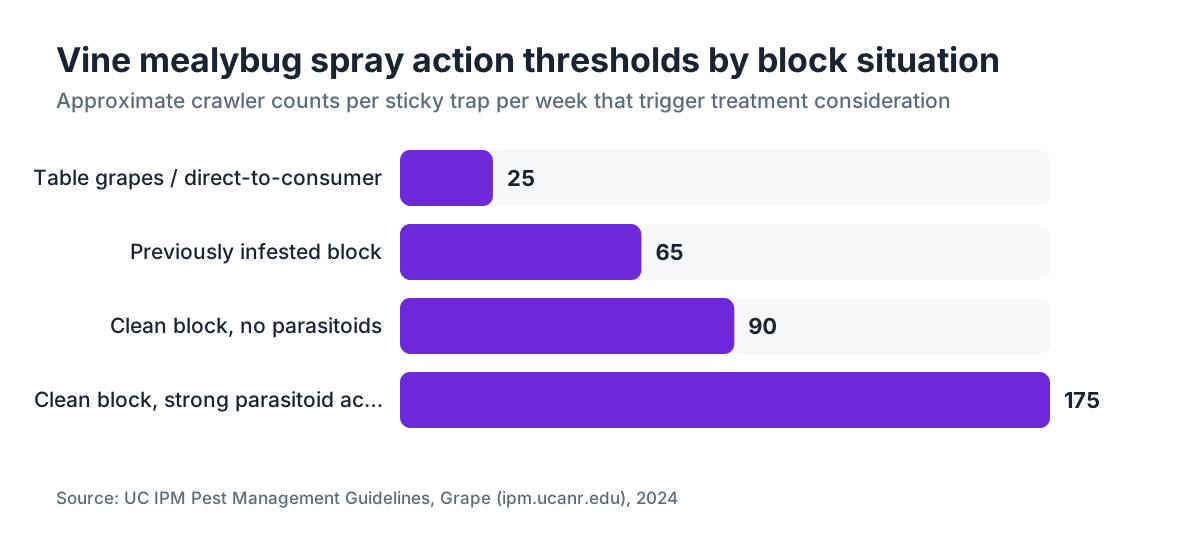
Here's a rough threshold framework used in California programs:
| Situation | Action threshold (crawlers/trap/week) |
|---|---|
| Clean block, strong parasitoid activity | 150-200+ |
| Clean block, no parasitoids observed | 80-100 |
| Previously infested block | 50-80 |
| Table grapes or direct-to-consumer | 20-30 |
| Within 30 days of harvest | Evaluate non-residual options only |
What do spray decision records need to document for compliance?
A spray decision record is separate from your pesticide application record, though the two reference each other. The application record captures what got mixed and applied. The decision record captures why.
For EPA Worker Protection Standard compliance, you have to keep records of pesticide applications, REI postings, and worker training [3]. The WPS (40 CFR Part 170) doesn't explicitly require a spray decision record, but it does require that pesticide safety information be posted before any application. If an inspector asks why a field was posted, your monitoring log is how you show the decision was legitimate.
In California, Pesticide Use Reports submitted to your County Agricultural Commissioner must include the specific pest targeted and the pest management rationale [1]. A monitoring log showing threshold exceedance backs up that report.
For certified organic operations, the National Organic Program requires your Organic System Plan to describe your pest management decision-making process, and your certifier may audit field records to check that you followed it [7].
Your spray decision record should include:
- Date of decision and decision-maker name
- Block(s) affected
- Monitoring data that triggered the decision (cite specific log entries by date)
- Threshold used and why (e.g., "UC IPM 100 crawlers/trap/week guideline; no biological control observed")
- Products considered and ruled out (especially important for organics)
- Product selected, rate, timing, and rationale
- REI and any re-entry posting requirements
- PHI (pre-harvest interval) and projected harvest date check
- Expected efficacy window and follow-up scouting date
That follow-up scouting date matters. One of the most common documentation gaps is a spray record with no post-treatment monitoring entry. If you sprayed and it worked, show it. If populations rebounded in 10 days, you want that documented before you make a second application decision.
Which pesticide options are registered for vine mealybug and how does product choice affect your records?
Product choice is both an agronomic and a recordkeeping decision. Different materials carry different REIs, PHIs, and mode-of-action considerations, and all of that feeds your spray decision documentation.
The main categories used in California and other western states:
Organophosphates and carbamates: Chlorpyrifos lost its California registration in 2020 [8]. Diazinon stays registered for dormant applications in some states. These are broadly toxic to beneficial insects and disruptive to your biological control program. If you use them, your decision record needs to account for parasitoid suppression.
Neonicotinoids: Imidacloprid (soil-applied) and spirotetramat (a ketoenol, often grouped with the systemic options) are common. Soil-applied imidacloprid can take 60-90 days to move into above-ground tissue, so timing against vine phenology matters a lot. UC IPM guidance is to apply at or after budbreak so uptake happens before peak crawler activity [10]. PHIs run around 30 days for most neonicotinoids in wine grapes.
Insect growth regulators: Buprofezin disrupts crawler development and has shown good efficacy in UC trials. It's a targeted option with relatively low impact on beneficials.
Softer options for organic programs: Kaolin clay, insecticidal soaps, and narrow-range oils have limited efficacy against protected populations under bark but can knock down exposed crawlers. Beauveria bassiana-based products (BotaniGard, for example) give variable field results. OMRI-listed materials need documentation in your organic system plan.
Record the mode of action group (IRAC group number) in your spray decision notes. That's standard resistance management practice and increasingly expected by certifiers and sustainability auditors.
For documentation, field record systems like VitiScribe can link spray decision records straight to the monitoring log entries that triggered them, which makes audit prep a lot less painful. That link between scouting data and application records is exactly what inspectors look for.
How often should you scout for vine mealybug throughout the season?
Vine mealybug runs two to four generations a year in California, depending on heat accumulation. In the Coachella Valley, four generations are possible. In cooler coastal areas, two is more typical [2]. Your scouting frequency has to match that biology.
Here's a basic seasonal scouting calendar:
| Phenological stage | Scouting priority | What to look for |
|---|---|---|
| Dormant / bud swell | Medium | Egg masses under bark, overwintering nymphs |
| 2-6 inch shoot | High | First-generation crawlers, sticky trap catch |
| Bloom | High | Second flush, crawler counts, parasitoid activity |
| Berry set through veraison | High | Cluster infestation, honeydew on berries |
| Post-harvest | Medium | Third generation (in warm climates), bark colonization |
For a block with known infestation history, weekly scouting during shoot growth and again around veraison isn't excessive. Bi-weekly may be enough for low-history blocks. The absolute floor is four scouting events, one for each major phenological window.
Sample at least 2% of vines per block or 10 vines minimum, whichever is larger [5]. In blocks bigger than 10 acres, proportional sampling gets you better data. Hit the hot spots: vines near ant nests, vines next to previously infested blocks, anything on the block perimeter near a known source.
Always record how long the scout took. If someone is supposed to examine 20 vines in 45 minutes and the log shows 20 vines in 8 minutes, that's a question waiting to be asked. Real scouting takes real time.
How do you document biological control observations alongside spray decisions?
This part gets skipped, and it shouldn't. Biological control documentation does two jobs: it helps you make better spray decisions (you won't spray into an active parasitoid population for no reason), and it gives you a record of conservation practices that organic certifiers and sustainability auditors want to see.
When scouting, check about 10% of the mummies (hardened, parasitized mealybug bodies) you find. Cut them open or collect them in a vial. If the mummy holds an intact Anagyrus pseudococci pupa or an emerged adult, that's an active parasitoid population. Record the number of mummies per vine and your parasitism rate estimate.
UC biological control researchers identify Anagyrus pseudococci as the primary parasitoid of vine mealybug in California [4]. Leptomastidea abnormis and Leptomastix dactylopii show up too. Cryptolaemus montrouzieri (the mealybug destroyer) is a predatory beetle whose adults are easy to spot and worth recording.
In the spray decision record, write a line like: "Parasitism rate estimated at 40% in Block 7 based on 12 mummies examined; decision to hold spray one additional week."
That sentence documents restraint. It's the kind of note that shows an integrated pest management approach instead of a calendar spray program, which matters for Sustainability in Practice (SIP) certification, CCOF audits, and similar programs.
What are the EPA Worker Protection Standard recordkeeping requirements that apply to mealybug sprays?
The EPA Worker Protection Standard (40 CFR Part 170) applies to any agricultural pesticide application where agricultural workers or handlers may be exposed [3]. For vine mealybug applications, the main compliance points are:
Application-specific posting: The safety data sheet (SDS) and pesticide label information must be posted at a central location before handlers enter the treated area. Keep a copy of the label on file for each product used.
REI compliance: Workers can't enter a treated area during the restricted-entry interval. Your log should record the REI start and end time, who posted the field, and when posting came down. REIs for common vine mealybug products range from 4 hours (some biopesticides) to 24 hours (some organophosphates) to 48 hours (some carbamates). Check the specific product label, not a general rule.
Handler training records: Anyone mixing, loading, or applying pesticides needs WPS handler training within the last year [3]. Store training certificates. Record handler names in your application record so there's a link.
Decontamination sites: Soap, water, and clean towels must be within 0.25 miles of handlers during application. Record where your decontamination setup sat in your application log.
Emergency assistance information: The name and address of the nearest emergency medical facility must be posted at the central location during any application.
The 2015 revised WPS rule tightened these requirements and added provisions for agricultural workers in the field during the application exclusion zone [3]. If you haven't reviewed your WPS compliance since 2015, do it. Your County Agricultural Commissioner's office can usually point you to a local WPS training resource.
How do you build a spray record that holds up to a pesticide use audit?
California's County Agricultural Commissioners run random pesticide use audits. So do organic certifiers. A record that looks like it got filled out in the truck on the drive home won't survive either one.
A complete spray record for a vine mealybug application needs:
- Date of application (exact date, not "week of")
- Block and acreage treated
- Product name, EPA registration number, and formulation
- Application rate (oz or lb/acre as the label specifies)
- Total product used
- Dilution and total water volume applied
- Application equipment (airblast sprayer, backpack, soil injector)
- Applicator name and license number if applicable
- Weather conditions at time of application: temperature, wind speed and direction, relative humidity
- Growth stage at application
- Pest targeted (Planococcus ficus, vine mealybug)
- REI and posted start time
- PHI and projected harvest date
- Reference to the monitoring log entries that supported the decision
That last item is the one most records skip. Write it in. Something like: "Application triggered by scouting records dated 5/10 and 5/17/2025, Block 4, exceeding UC IPM threshold." Seven seconds to write. Huge difference in an audit.
Keep records for a minimum of two years (California's requirement for pesticide use reports) [1]. Plenty of managers keep three to five years because it's useful for your own block trend analysis anyway. Digital records backed up off-site beat a binder that can burn or flood. Tools built for vineyard record-keeping, including VitiScribe, structure these fields so nothing gets left out at application time.
What do WSU and Cornell say about vine mealybug monitoring approaches outside California?
Vine mealybug is documented in Washington State, and WSU Extension has been working on Pacific Northwest-specific management guidance. WSU's regional approach leans on monitoring through visual inspection and sticky traps during bloom and shoot growth, with the understanding that the cooler Northwest climate builds populations slower than the San Joaquin Valley does [6].
WSU researchers note that biological control by Anagyrus pseudococci does happen in Washington vineyards but can be less consistent than in California, because cooler temperatures shorten the parasitoid's active windows. Their guidance recommends pairing monitoring with degree-day models to predict crawler emergence, since heat accumulation above a base temperature drives first-generation timing [6].
Cornell's integrated pest management program covers mealybug species relevant to eastern viticulture, mostly grape mealybug (Pseudococcus maritimus) rather than vine mealybug. Cornell's grape IPM resources recommend percent-infestation thresholds (treating when more than 10-15% of sampled vines show active colonies) as a complement to count-based thresholds [9]. For vine mealybug specifically in eastern vineyards, Cornell recommends contacting your regional extension specialist because distribution and baseline parasitoid populations vary a lot by region.
The practical takeaway: UC IPM's thresholds and monitoring protocols are the most developed in North America and make a reasonable starting point even outside California, but calibrate them to your local pest pressure history and check with your state's extension service for regional guidance updates.
How should your monitoring log handle blocks with both conventional and organic sections?
Mixed programs are common, especially during organic transition periods. Your monitoring log needs to clearly flag which blocks sit under which program, because the spray decision records and product choices split apart completely.
Simplest approach: put a block-level program designation at the top of every log sheet or in a digital record field. Something like "Block 12, Organic Transition Year 2" versus "Block 15, Conventional." When you make a spray decision, that designation drives product selection and documentation.
For transition blocks, the National Organic Program's three-year transition requirement means your pre-transition spray records may matter to your certifier [7]. If you applied a synthetic systemic in Year 0 and your certifier has questions, your monitoring logs from that period show the pest pressure context behind the decision.
For side-by-side organic and conventional blocks, document the buffer management. Drift of a restricted synthetic material into a certified organic block is a certification problem. Your spray records should note wind conditions, equipment settings, and any buffer distances you kept. This isn't only good practice. It's the record that resolves a dispute with your certifier fast instead of slow.
Keep your biological control release records tied to block designations too. If you're releasing Cryptolaemus or ordering Anagyrus pseudococci, log the release date, release point, quantity, and source. Those records support the case that you made real biological control efforts before reaching for organic-approved sprays, which strengthens your organic system plan documentation.
What's the fastest way to set up a monitoring log system your whole team will actually use?
The best monitoring log is the one scouts finish in the field. A form with 30 fields that gets skipped or filled from memory back at the office is worse than a short form that gets completed accurately every time.
Start with five non-negotiable fields: date, block, scout name, vine count examined, and mealybug count. Add sticky trap data if you're running traps. Everything else builds from there.
Paper works fine. A single laminated quick-reference card with your threshold numbers, plus the log form on a clipboard, is hard to beat for field usability. Waterproof paper (Rite in the Rain pads, roughly $5-8 per pad) survives a foggy morning in coastal vineyards.
Digital options on a phone or tablet work well if your blocks have reliable cellular service and your scouts are comfortable with the tools. The payoff is automatic timestamping, GPS tagging, and trend charts pulled from accumulated data without manual entry later.
Whatever you pick, run a five-minute training session at the start of the season. Walk through a sample entry. Show scouts what a complete record looks like next to an incomplete one. Explain why it matters: compliance, better spray decisions, money saved on sprays you didn't need. Scouts who understand the purpose fill out forms more completely than scouts who think they're doing paperwork for someone else's benefit.
Schedule a mid-season records review. Pull the logs, find the gaps, close them before they turn into a compliance problem. Two hours in July costs a lot less than a scramble in October when an audit request lands.
Frequently asked questions
How long do I need to keep vine mealybug spray records?
California requires pesticide use reports to be kept for a minimum of two years, under the California Food and Agricultural Code sections governing pesticide use reporting [1]. Federal EPA WPS records also carry a two-year retention requirement for application information. Most advisors keep five years of records because block trend analysis across multiple seasons helps calibrate your thresholds and document resistance management.
Can I use a phone app for my vine mealybug monitoring log?
Yes, and it has real advantages: automatic timestamps, GPS coordinates, and easy transfer to a computer for trend analysis. The main risk is data loss if the app or phone fails without backup. Any digital system needs cloud backup or regular export to a second location. Make sure the app can produce a printable or PDF record for certifiers and auditors who may not accept digital-only documentation.
What's the difference between a monitoring log and a pesticide use report?
A monitoring log records scouting observations and the spray decision rationale. A pesticide use report records the actual application: product, rate, acreage, date, and applicator. They're related but separate documents. In California, the pesticide use report goes to your County Agricultural Commissioner [1]. The monitoring log stays in your own records and provides the context that backs up the reported application.
Do I need to log blocks where I found zero mealybugs?
Yes. A zero count is data. It shows the block was scouted and clean on that date. Without zero-count records, you can't prove you monitored clean blocks, which matters if mealybug turns up there later and a neighbor or certifier asks when the infestation started. Record the date, block, sample size, and zero count. Five seconds of writing, real documentation value.
What threshold does UC IPM recommend for vine mealybug treatment?
UC IPM recommends roughly 100 crawlers per sticky trap per week as a general treatment guideline during the spring crawler flight [5]. That's a guideline, not a fixed rule. Organic operations, table grape blocks, and previously heavily infested blocks typically use a lower threshold. Blocks with documented high parasitoid activity can tolerate higher counts. Always document which threshold you used and why in your spray decision record.
How do I document biological control as part of my spray decision?
Record parasitoid mummy counts and estimated parasitism rates when you scout. If you examine mummies and find active Anagyrus pseudococci pupae or adults, note it. A standard field approach is to record mummies per vine and check a sample to estimate parasitism percentage. Include that estimate in your spray decision record with a note on how it changed the decision, such as delaying treatment or cutting the rate.
Does the EPA Worker Protection Standard require a spray decision record specifically?
The WPS (40 CFR Part 170) does not explicitly require a spray decision rationale document [3]. It requires application records, REI postings, handler training records, and decontamination provisions. But California pesticide use reporting asks for the pest targeted and management rationale [1], and organic certification requires documented decision-making in your system plan [7]. In practice, one spray decision record satisfies all three at once.
What vine growth stages are most important to scout for vine mealybug?
The two highest-priority windows are 2-inch to 6-inch shoot growth (first-generation crawler emergence) and the period around veraison, when second or third generation crawlers can colonize fruit clusters [2]. Post-harvest scouting matters in warm climates where a third or fourth generation builds up under bark before dormancy. Miss the early-season scout and you're already behind the population curve when you find the problem.
How many vines should I sample per block when scouting for vine mealybug?
UC IPM recommends sampling at least 2% of vines per block or a minimum of 10 vines, whichever is larger [5]. In blocks with known infestation history, proportional sampling from hot spots (near ant activity, block perimeters, previously infested rows) gives better population data than purely random sampling. Record your sampling method in the log so future scouts stay consistent and your counts compare across seasons.
What should I do if my spray decision and scouting log conflict with each other?
Correct both records right away, in ink with a single strikethrough (never white-out or deletion on paper), initialed and dated. Digital systems should keep an edit log. Regulators and certifiers understand field records get corrections. What raises flags is records that look written after the fact with no corrections, or spray applications on dates with no matching scouting entry. Accuracy and honesty beat clean-looking records.
How does ant management factor into my vine mealybug spray decision documentation?
Ant activity is worth documenting in your scouting log because ants tend mealybugs and exclude parasitoids, which directly affects your biological control picture [4]. If you applied ant bait or sticky barriers before making a spray decision, record it: date of the ant management action, product or method, and treated area. This shows your spray decision accounted for removing a biological control suppressor before you concluded chemical intervention was needed.
Can I use the same monitoring log format for organic and conventional blocks?
Yes, with one required addition: mark the program designation (organic, transition year, conventional) on every log entry at the block level. The scouting data fields stay identical. The split happens in the spray decision record, where product selection and rationale differ completely between programs. Keeping one log format but flagging block status lets your certifier review organic blocks without confusion from conventional entries.
What's the best sticky trap color and placement for catching vine mealybug crawlers?
UC IPM recommends yellow or white sticky cards placed at graft union height or on the cordon where crawlers move actively [5]. There's no consensus that one color clearly beats the other for mealybug crawlers. Placement at the graft union catches the upward movement from overwintering sites under bark. Record trap install date, removal date, and location in your log so you can calculate a per-day or per-week rate accurately.
How does degree-day modeling help with vine mealybug monitoring timing?
Degree-day models use accumulated heat above a base temperature (about 10 degrees C for Planococcus ficus) to predict crawler emergence [6]. WSU Extension has applied this approach to Pacific Northwest conditions. In practice, pairing degree-day data from a local weather station with your sticky trap timing means you monitor when crawlers are actually mobile instead of starting traps arbitrarily. Record the degree-day figure in your log for any scout date where you're making a threshold call.
Sources
- California Department of Pesticide Regulation, Pesticide Use Reporting: California requires pesticide use reports for restricted-use and many general-use materials, submitted to the County Agricultural Commissioner, with records retained for a minimum of two years.
- UC Statewide IPM Program, Pest Management Guidelines: Grape: Vine mealybug (Planococcus ficus) was first detected in California's Coachella Valley and has since spread to most major California grape-growing regions; it produces two to four generations per year depending on heat accumulation.
- U.S. EPA, Agricultural Worker Protection Standard (40 CFR Part 170): The EPA Worker Protection Standard requires application-specific posting, REI compliance, handler training records, and decontamination site provisions for all agricultural pesticide applications where workers or handlers may be exposed.
- University of California Agriculture and Natural Resources: Anagyrus pseudococci is the primary parasitoid of vine mealybug in California; ants tend mealybugs and actively exclude parasitoids, reducing biological control effectiveness when ant populations are unmanaged.
- UC IPM, UC Pest Management Guidelines: Grape, Vine Mealybug: UC IPM recommends deploying yellow or white sticky cards at graft union height in mid-spring, sampling at least 2% of vines or 10 vines minimum, and using approximately 100 crawlers per sticky trap per week as a general treatment threshold during spring crawler flight.
- Washington State University Extension: WSU Extension recommends integrating degree-day models with sticky trap monitoring to predict vine mealybug crawler emergence timing in Pacific Northwest vineyards, where biological control by Anagyrus pseudococci may be less consistent than in California due to cooler temperatures.
- USDA Agricultural Marketing Service, National Organic Program Regulations (7 CFR Part 205): The National Organic Program requires that certified operations maintain an Organic System Plan describing pest management decision-making, and certifiers may audit field records to verify compliance with that plan.
- California Department of Pesticide Regulation, Chlorpyrifos: California cancelled chlorpyrifos registrations effective February 6, 2020, removing it as a registered option for vine mealybug management in the state.
- Cornell University College of Agriculture and Life Sciences: Cornell's grape IPM resources recommend percent-infestation thresholds (treating when more than 10-15% of sampled vines show active mealybug colonies) as a complement to count-based thresholds.
- UC IPM, UC Pest Management Guidelines: Grape, Vine Mealybug: Soil-applied imidacloprid can take 60-90 days to move into above-ground vine tissue; UC IPM guidance recommends application at or after budbreak for adequate uptake before peak crawler activity.
Last updated 2026-07-10