How to record a rejected load decision based on harvest quality data
TL;DR
- When you reject a load at harvest, write down the lot ID, date and time, field block, measured Brix/pH/TA, the pass/fail thresholds your winery contract specifies, who made the call, and the final disposition of the fruit.
- Keep that record at least three years.
- A signed, timestamped entry protects you in contract disputes and satisfies TTB audit expectations.
Why does documenting a rejected load matter beyond just turning the truck away?
Rejecting a load is the easy part. Proving you rejected it correctly, for documented reasons, against written thresholds, is where growers and winery receiving staff get into trouble later.
Contract disputes over rejected loads are one of the most common sources of litigation in the wine grape business. When a grower contests a rejection, the winery's only defense is a contemporaneous record: objective data, the contractual standard that data was measured against, the name of the person who made the call, and what happened to the fruit afterward. Without that paper trail, you are arguing from memory against someone who remembers the same event differently.
There is a regulatory side too. The Alcohol and Tobacco Tax and Trade Bureau (TTB) requires bonded wineries to keep records that account for all grapes received and processed [1]. A rejected load that simply disappears from your intake log without explanation creates a gap that an auditor will flag. The record you keep on the rejection is the documentation that closes that gap.
Pesticide residue rejections add a separate compliance layer. Under the EPA Worker Protection Standard and the Federal Insecticide, Fungicide, and Rodenticide Act (FIFRA), pesticide application records must be kept for two years, and anything touching a rejection based on residue concerns should cross-reference those spray records [2]. If your vineyard or a contracted grower's vineyard had a pre-harvest interval violation, that belongs in writing before the fruit even leaves the block.
The record protects the grower, too. A well-documented rejection that shows exactly what the data said, measured on a calibrated refractometer with a recorded lot ID and timestamp, is harder to dispute than a vague note that says "fruit was bad." Both parties benefit from precision.
What quality metrics are typically used to accept or reject a load?
Most grape purchase contracts specify a handful of measurable parameters. Knowing which ones your contract uses, and what the threshold values are, is the prerequisite to filling out any rejection record.
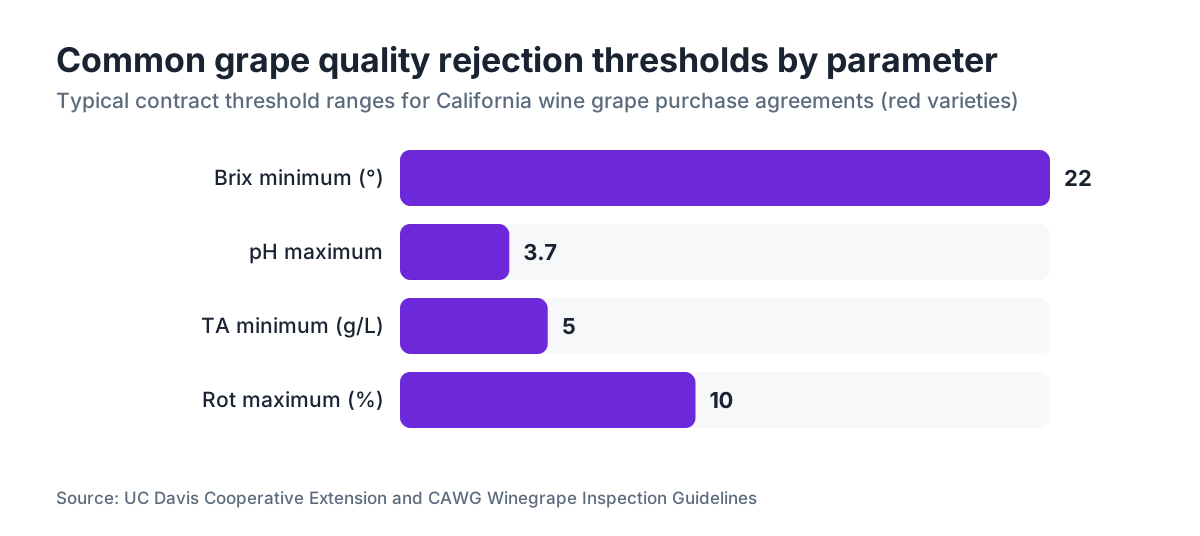
Brix (soluble solids measured as percent sugar) is the most common single metric. Contracts usually express a minimum Brix for acceptance, a target range for full price, and sometimes a maximum above which heat damage or overripe character is assumed. For wine grapes in California, contract minimums typically run from roughly 21 to 25 Brix depending on variety and style, but your contract governs, not any industry average [3].
pH matters because high pH fruit has lower microbial stability and can demand heavy acid additions. Many contracts set a maximum pH, often between 3.5 and 3.8 for red varieties, with rejection or price adjustment above that ceiling.
Titratable acidity (TA), expressed in grams per liter as tartaric acid equivalent, is sometimes specified alongside pH. Low TA combined with high pH is a double flag for overripe, potentially compromised fruit.
Here is how the common contractual parameters typically function in a rejection decision:
| Parameter | Typical contract threshold (wine grapes) | Direction of rejection concern |
|---|---|---|
| Brix | Minimum 21-25° (variety dependent) | Below minimum OR above maximum |
| pH | Maximum 3.5-3.8 | Above maximum |
| TA (g/L tartaric) | Minimum 4.5-6.0 | Below minimum |
| Visual rot (%) | Maximum 5-15% by weight | Above maximum |
| Tons per acre (for MOG) | Varies | Excess material other than grapes |
| Pesticide pre-harvest interval | Must be met per label | Any violation |
Some contracts add sensory triggers: visible mold coverage above a threshold, off-odors suggesting acetic spoilage, or excessive material other than grapes (MOG). Those are harder to record cleanly because they are subjective, which is exactly why your record needs to name the evaluator and describe the observation in specific terms rather than write "bad quality."
Washington State University Extension's wine grape production resources describe field-sampling protocols for Brix measurement, including the minimum sample size (typically at least 100 to 200 berries per block, drawn across the canopy) that produces a statistically meaningful reading [4]. If your sample was smaller than that, note it. Transparency in your methodology protects you.
What information belongs in a rejected load record?
Think of the record as answering six questions: who, what, when, where, why, and what next. Every field below answers one of them.
Lot and load identification. Assign a unique lot number or load ID the moment the load arrives. This connects every subsequent document to the same fruit. Include the grower name or ID, the block designation, and the vineyard address or APN if you have multiple source properties.
Date and time. Use a 24-hour clock or note AM/PM explicitly. "Rejected 7/28, morning" is not a record. "Rejected 2024-08-14 at 06:42" is.
Weight at intake. Weigh even rejected loads. You need the tonnage to reconcile your intake log and to calculate any partial rejection or price adjustment. Most receiving scales print a ticket. Attach or scan it.
Measured quality data. For every parameter your contract specifies, record the measured value, the method used (say, a temperature-corrected digital refractometer for Brix, or a pH meter with two-point calibration for pH), and the instrument ID or last calibration date. If you measured multiple samples and averaged them, record the range and the average.
Contractual threshold. This is the field most people skip and most attorneys care about. Write down the specific threshold from the contract that the measured value failed to meet, with the contract section number if you have it. "Measured pH: 3.91. Contract maximum pH: 3.70 per Section 4.2(b)." That one sentence is the entire legal basis for your rejection.
Decision maker. Full name and title of the person who made the rejection call. If the decision required a supervisor sign-off, include both names.
Disposition of the rejected load. This is what happened to the fruit after you turned it away. Returned to the grower? Sent to a juice processor? Dumped? Each outcome carries different record-keeping implications. If it went back to the grower, note that they received it and get a signature if you can.
Grower notification. Record when, how, and by whom the grower learned of the rejection. A timestamped email or text is ideal backup.
Instrument calibration reference. Your pH meter calibration log, refractometer check against a known standard, and scale certification should all be referenced. You do not have to reproduce them in the rejection record, but you need to be able to produce them.
A well-kept rejection record is usually one page. It does not need to be complicated. It needs to be complete.
How do you sample a load to get defensible quality data before you reject it?
The sampling protocol matters as much as the measurement. A rejection based on a single grab sample from the top of one bin is legally weak and scientifically weak. Use a protocol you can describe and defend.
For bulk bins or gondolas, sample from at least four locations per gondola: two from different quadrants near the top and two from depth using a sampling tube or probe. UC Davis viticulture and enology guidance recommends a minimum of 200 to 300 berries per sample, drawn systematically across the load, to get a Brix reading within about 0.5 degrees of the true mean [3]. Record the number of sample points and the total berry count.
For pH and TA, you need a juice sample, not whole berries. Crush your berry sample by hand or with a small press, let it settle briefly, and measure pH with a calibrated meter. Note the juice temperature, because pH is temperature-sensitive. Most laboratory-grade pH meters apply an automatic temperature correction. Note whether yours does.
If the load is borderline, run a second independent sample and average the results. Document both readings. A load that tests at 3.71 pH on the first sample and 3.69 on the second sits right at the edge of a 3.70 maximum. Documenting both readings and noting that the average is 3.70 is a more defensible position than quietly choosing the number you prefer.
For rot or MOG assessment, a visual percentage estimate is standard practice. Cornell Cooperative Extension's viticulture materials describe a bucket-sort method: take a representative 5-kg sample, hand-sort it, weigh the compromised berries separately, and calculate the percentage by weight [5]. Record the sample weight and the compromised fraction weight, more than the final percentage.
Calibration documentation is your backstop. If you cannot show that your pH meter was calibrated that morning against pH 4.0 and pH 7.0 buffer solutions, and that your refractometer was zeroed with distilled water, the grower's attorney will argue your instrument was drifting.
What does a completed rejection log entry actually look like?
Guidelines are less useful than seeing a real example. Here is a sample record structure with illustrative values. These values are not real data. They show correct formatting only.
HARVEST QUALITY REJECTION RECORD
Load ID: 2024-HRV-0083
Date: 2024-09-06
Time of arrival: 05:18
Time of rejection decision: 05:47
Grower: [Grower name / ID]
Block: East Block 7B, Cabernet Sauvignon, planted 2009
Vineyard address: [Street, City, County]
Estimated tonnage on truck: 11.4 tons (scale ticket #SC-4491 attached)
Sampling protocol: Four-point gondola sample, 240 berries total, sampled by receiving tech J. Morales.
| Parameter | Measured value | Contract threshold | Pass/Fail |
|---|---|---|---|
| Brix | 22.4° | Min 22.0° | Pass |
| pH | 3.86 | Max 3.70 (§4.2b) | FAIL |
| TA | 5.1 g/L | Min 4.5 g/L | Pass |
| Rot | 8% by weight | Max 10% | Pass |
Instrument: pH meter Model [X], Calibrated 05:05 this date against pH 4.0 and 7.0 buffers. Calibration log ref: CL-2024-0906-01.
Refractometer: [Model], zeroed 05:00 with distilled water.
Basis for rejection: pH of 3.86 exceeds contract maximum of 3.70 per Section 4.2(b) of Grape Purchase Agreement dated 2024-01-15.
Decision maker: J. Reyes, Winery Receiving Manager
Supervisor notified: K. Park, Winemaker, 05:49 by phone.
Grower notification: Grower called at 05:52. Email sent 06:14 (copy filed under Load ID 2024-HRV-0083).
Disposition: Load returned to grower. Grower representative [Name] acknowledged receipt and signed field copy at 07:10.
Additional notes: Grower stated irrigation was cut late due to equipment failure. No pesticide application within 30 days per grower spray record on file.
This format is plain text and can live in a paper logbook, a spreadsheet, or a field operations platform. The point is that every field is filled before the truck leaves the property.
How long do you need to keep rejected load records?
The answer depends on which rules apply to your operation, and usually more than one set applies at once.
TTB bonded winery regulations under 27 CFR Part 24 require that records of wine operations, including grape intake and processing, be retained for at least three years from the date of creation [1]. A rejected load record is part of your intake documentation because it explains a gap in your received-fruit tally. Keep it for at least three years.
California's grape crush report requirements, run by the California Department of Food and Agriculture (CDFA), also mean your intake records have to support your crush report data. Discrepancies between what your scale tickets show arriving and what your crush report shows processed need an explanation, and a rejection record is that explanation [6].
If the rejection was based even partly on pesticide concerns, EPA's FIFRA regulations require pesticide application records to be kept for two years, but the smart move is to retain any related documents, including the rejection record that references those spray logs, for the same three-year window as your TTB records [2].
Contract law is the wildcard. Statutes of limitations for contract disputes vary by state: four years in California for written contracts under Code of Civil Procedure Section 337 [7], six years in New York. If you think a rejection might get contested, the practical answer is keep the record until the applicable limitations period has passed, which usually means four to six years depending on your state.
The simplest policy is a uniform seven-year retention period for all harvest records. It clears every regulatory floor with margin to spare, and it is easy to explain to staff.
What do you do when a rejection is contested by the grower?
Start with the record. If your rejection record is complete, calibrated, and signed, that is your opening position. Walk the grower through each data point, the sample methodology, and the contract section you cited. Most disputes cool down once the grower sees that the process was consistent and documented.
If the grower wants an independent test, that is a fair request. Many contracts include a provision for a referee sample: a retained portion of the original load that an independent lab can retest. If your contract has this clause, you should have retained a sample at the time of rejection. A 100 to 200 ml sealed juice sample, labeled with the load ID and stored at 4 degrees C, holds up for pH and TA retesting for up to 48 hours without significant drift.
If your contract has no referee clause and the grower is threatening legal action, your first call is to your attorney, not the grower. The best thing you can do in that conversation is hand your attorney a clean, contemporaneous rejection record that matches every fact you remember about the event.
One thing to avoid: never alter the original record after the fact, even to add a detail you forgot. If you need to add information later, create a supplemental note with a new date and your signature, and attach it to the original. Backdated or altered records are worse than incomplete ones in litigation.
Some California grape purchase agreements require the winery to provide written notice of rejection, with the quality data, inside a specific window, sometimes 24 hours. Check your contract. Missing that window does not automatically void your rejection, but it weakens your position.
How does a rejected load affect your TTB crush report and tax records?
TTB requires bonded wineries to file operational reports that account for all grapes received. In practice, your winery report on TTB Form 5120.17 should reconcile with your scale tickets and intake logs [8].
A rejected load that was weighed on arrival but never processed creates an apparent discrepancy: the scale ticket shows fruit arriving, but your crush report shows nothing processed from that lot. The rejection record bridges that gap. File it with your supporting records for the relevant reporting period.
If you operate in California, the CDFA grape crush report (due February 10 for the prior harvest year) asks for total tons received by variety and county of origin [6]. Rejected loads that were never processed should not appear as received tonnage. But if you weighed them and hold scale tickets, you need to be able to show those tons were rejected and returned, not quietly processed.
Keep your rejection records physically or digitally tied to the scale tickets from the same load. When your accountant or a TTB auditor reconciles records, having both documents linked by the same load ID saves hours.
For tax purposes, rejected loads generate no excise tax liability because no wine was produced. They are still part of the evidence trail that supports your reported figures.
Can digital or app-based records satisfy regulatory requirements?
Yes, with a few caveats. TTB regulations do not mandate paper. Under 27 CFR Part 24, records may be kept in any format that produces a legible, complete, and retrievable record [1]. Electronic records are acceptable provided they can be made available for inspection during an audit.
The practical requirements for electronic records: the record must be complete (all required fields), timestamped at the time of entry, non-editable after finalization (or carry an edit history), and exportable in a format the auditor can read without proprietary software.
A shared spreadsheet with no edit tracking fails that last requirement, because you cannot demonstrate it was not altered. A purpose-built field operations platform with audit log functionality is better. Something like VitiScribe is built for this workflow: timestamped entries, instrument calibration linkage, and exportable PDF reports you can hand an auditor or attach to a dispute letter without reformatting.
For spray record cross-references, EPA's Worker Protection Standard does not specify a format, but records must be retrievable and must reach employees or their representatives within 15 days of a request [9]. Keep spray records and the rejection records that reference them in the same system or with a clear cross-reference.
One honest caution: whatever system you use, test the export function before harvest. Discovering that your app will not produce a clean PDF until you pay for an upgraded tier, at 5 AM on crush day, is not the moment you want to find out.
What role does your grape purchase contract play in structuring the record?
The contract is the measurement standard. Your rejection record has to cite it directly.
Before harvest, pull your grape purchase agreement and find every quality clause. Write down the exact threshold values and the section numbers. Build a reference sheet for your receiving staff that lists parameter, minimum or maximum value, unit, and contract section. That reference sheet becomes the header of your rejection log template.
Contracts often carry provisions you might not expect. Some specify the sampling protocol, the type of instrument (say, "temperature-corrected digital refractometer"), or the minimum sample size. If your contract specifies a protocol and you used a different one, your rejection can be technically non-compliant even when the data is accurate.
Some California wine grape contracts run through the California Association of Winegrape Growers (CAWG) standard form or incorporate CDFA winegrape inspection guidelines by reference [11]. If your contract pulls in those guidelines, you need a copy on file too.
UC Davis viticulture and enology farm management resources include guidance on grape purchase agreement terms and what growers should negotiate, which is useful reading for winery staff who need to understand what a grower expects from the inspection process [10]. Understanding both sides of the contract makes your rejection records more defensible.
If your operation handles fruit from many growers with different terms, put a table in your intake log that maps each grower to their specific thresholds. It saves a lot of confusion during the compressed harvest window. You want your receiving staff looking up numbers in a prepared table, not scrolling through contract PDFs at 4 AM.
What records should you keep from the vineyard side before the fruit even arrives?
A rejected load rarely comes as a complete surprise. Quality problems usually have upstream causes: a late-season heat event, a delayed harvest decision, irrigation cutoff timing, or disease pressure that went unmanaged. The records you keep in the vineyard through the season become context for the rejection record at receiving.
Pre-harvest sampling data is especially useful. If you or the grower ran weekly Brix checks on the block for the three weeks before harvest, and each one showed pH trending upward, that data shows the rejection was not a random event but the expected end of a documented trajectory. Attach that pre-harvest data to the rejection record.
For vineyards you manage directly, your spray records under FIFRA must show that every pre-harvest interval (PHI) was met for every product applied [2]. WSU Extension's integrated pest management resources publish PHI tables for common wine grape pesticides and fungicides [4]. If a PHI violation is even a contributing factor in a rejection, the spray record belongs in the file.
Weather station data, irrigation logs, and crop load records from the block can all become relevant if a rejection is contested. You do not need to attach them all to every rejection record, but knowing where they live and that they are retained for the same period as your rejection records is good practice.
For growers delivering to your winery, ask them to hand over a summary spray record at delivery, or at minimum a signed declaration that all PHIs have been met. Some purchase agreements require this as a condition of acceptance. Even if yours does not, the practice protects both parties. You can read more about vineyard field record workflows that fold this pre-harvest documentation into a single harvest-day audit trail.
How do you handle partial rejections and price adjustments versus full rejection?
Not every quality problem is a binary reject-or-accept call. Many contracts include tiered pricing: a target range for full contract price, a discounted tier for fruit that meets minimum standards but misses the target, and an outright rejection threshold below which no payment is made. Your record structure has to handle all three.
For a partial rejection (accepting part of the load at a reduced price after sorting out visibly compromised clusters, for example), the record should document the pre-sort weight, the reject fraction weight and reason, the accepted fraction weight, the quality data on the accepted fraction measured after sorting, and the price tier applied under the contract.
For a price adjustment without rejection, record the measured value, the contract tier it falls into, and the adjusted price calculation. Keep this in your intake log as a separate column or note so it does not read like a full rejection.
The danger in partial rejections is that your intake log ends up showing less tonnage received than the scale ticket for the original load. Document the split explicitly: "Load 2024-HRV-0083: 11.4 tons arrived, 2.1 tons rejected for rot excess (ROT-FRAC-083 sent to composting, waste manifest #WM-448), 9.3 tons accepted at Tier 2 price per §5.1(a)." Every number accounts for every ton.
Waste disposal of rejected fruit in California may need documentation under state solid waste rules if the volume is significant. Check with your county agricultural commissioner if you are dumping or composting more than small quantities of rejected fruit.
Frequently asked questions
Does a rejected load still need to appear on a TTB winery operations report?
Rejected loads that were never processed into wine should not appear as received tonnage in your TTB Form 5120.17 winery report. But if you have scale tickets showing the load arrived, you need to retain the rejection record to explain the discrepancy. The rejection record is the supporting documentation that reconciles your scale records against your crush report figures. Keep it with your TTB records for a minimum of three years.
What is the minimum sample size needed to make a Brix rejection defensible?
UC Davis viticulture and enology guidance recommends a minimum of 200 to 300 berries, drawn from multiple locations across the load, to produce a Brix reading within about 0.5 degrees of the true mean for a standard gondola. A single grab sample from the top of one bin is not adequate for a rejection decision. Record the number of sample points, the total berry count, and who did the sampling.
How quickly does pH drift in a juice sample after sampling?
A freshly crushed juice sample can drift measurably in pH within 30 to 60 minutes at ambient temperatures, from CO2 outgassing and oxidation. For a defensible measurement, test within 15 to 20 minutes of crushing, note the juice temperature, use a calibrated pH meter with automatic temperature correction, and record the time of measurement relative to the time of sampling. For referee samples, seal and refrigerate at 4 degrees C immediately.
Can a grower dispute a rejection if the winery did not provide written notice within 24 hours?
Possibly, depending on your contract language. Many California grape purchase agreements require written notice of rejection within a set window, often 24 hours. Missing that window does not automatically invalidate the rejection, but it weakens your legal position. Review your contract for notice requirements and build a notification step into your receiving workflow. A timestamped email sent the same day is usually sufficient written notice.
Do pesticide pre-harvest interval violations require a separate record from the rejection record?
Yes. Spray application records under FIFRA Section 8 must be kept separately for at least two years, and those records must show the application date, product, rate, and treated block. Your rejection record should cross-reference the relevant spray record by date and lot number, but the spray record itself has to exist as a standalone document. EPA's Worker Protection Standard requires that spray records reach employees within 15 days of a request.
What format should a rejected load record be in to satisfy a TTB auditor?
TTB does not mandate paper or any specific software. Under 27 CFR Part 24, records must be legible, complete, and retrievable. Electronic records are acceptable if they produce a printable, readable output and carry an audit trail showing when entries were made. A locked PDF export from a timestamped system is clean. An unlocked spreadsheet with no version history is not ideal, because you cannot prove it was not altered.
How do you document a rejection based on visual rot when you cannot easily quantify the percentage?
Use a bucket-sort method: draw a representative 5-kilogram sample from the load, hand-sort it, weigh the compromised fraction, and calculate the percentage by weight. Cornell Cooperative Extension describes this approach in its viticulture materials. Record the total sample weight, the compromised fraction weight, the calculated percentage, and the name of the person who did the sort. Photographs taken at the time are useful supporting evidence.
If a rejected load is returned to the grower and they sell it elsewhere, does the winery have any ongoing record-keeping obligation?
Once the load is returned, your main obligation is to record the return clearly in your intake log so your tonnage accounting reconciles. Get a signed acknowledgment from the grower or their representative noting the date and time they received the fruit back. You have no obligation to track what the grower does with the fruit afterward, but the disposition note in your rejection record should state it was returned rather than processed or destroyed.
Can the same rejection record template work for both estate fruit and purchased grapes?
Yes, with minor adaptation. For estate fruit, the grower fields become internal block identifiers and the contract threshold fields become your internal quality standards or house protocol thresholds. The calibration documentation, measured values, decision maker, and disposition fields are identical. Using one template for all incoming fruit simplifies training and keeps record quality consistent across the board.
How long should you retain rejected load records to be safe from contract litigation?
The TTB minimum is three years. California's statute of limitations for written contract disputes is four years under Code of Civil Procedure Section 337. A practical uniform retention policy is seven years for all harvest records, which clears every regulatory floor and most litigation windows. Store records in a format you can actually retrieve years later: a locked PDF archive or a platform with long-term data retention guarantees.
Should the winemaker or the receiving technician make the final rejection call?
Your SOPs should settle this clearly before harvest starts. For straightforward threshold failures, a trained receiving technician can make the call and document it, with the winemaker or receiving manager named as the responsible supervisor. For borderline cases or unusual circumstances like a suspected PHI violation, escalate to the winemaker before turning the truck away. Whoever makes the final call must be named in the rejection record.
Does California's grape crush report require rejected loads to be reported?
Rejected loads that were never processed should not appear as received tonnage in the CDFA grape crush report. Your internal scale records will still show the fruit arriving. Your rejection record is what explains to an auditor why those scale ticket tons are absent from the crush report. Keep it on file with your crush report supporting documentation.
What is the best way to link spray records to a rejection record when the rejection involves a PHI concern?
Create a cross-reference field in your rejection record: note the spray application date, product name, and the spray record document ID or file location. Retain both documents together or in linked folders in your records system. Under the EPA Worker Protection Standard, spray records must be producible within 15 days of request, so both documents need to sit in a retrievable system, not a filing cabinet nobody has the key to.
Sources
- Alcohol and Tobacco Tax and Trade Bureau (TTB), 27 CFR Part 24 Wine (winery recordkeeping and retention obligations): TTB requires bonded wineries to maintain records of grape receipts and wine operations, retained for at least three years.
- EPA, Federal Insecticide, Fungicide, and Rodenticide Act (FIFRA) Section 8 and Worker Protection Standard 40 CFR Part 170: Pesticide application records must be retained for two years; WPS requires records be available to employees within 15 days of request.
- UC Davis Department of Viticulture and Enology, grape quality and harvest sampling guidance: UC Davis recommends a 200-300 berry minimum sample size for representative Brix measurement from a gondola load.
- Washington State University Extension, wine grape production and integrated pest management resources: WSU Extension provides pre-harvest interval tables for common wine grape pesticides and fungicides, and describes field Brix sampling protocols.
- Cornell Cooperative Extension, viticulture and enology program, fruit quality assessment: Cornell describes bucket-sort methodology for estimating rot percentage by weight in harvested grape samples.
- California Department of Food and Agriculture (CDFA), Grape Crush Report Program: CDFA grape crush report (due February 10) requires reporting of total tons received by variety and county; rejected unprocessed loads should not appear as received tonnage.
- California Code of Civil Procedure Section 337, statute of limitations for written contracts: California's statute of limitations for written contract disputes is four years from the date of breach.
- TTB, Report of Wine Premises Operations, Form 5120.17: TTB Form 5120.17 requires wineries to reconcile grapes received against wine produced; rejected loads require supporting documentation explaining the discrepancy.
- EPA, Worker Protection Standard, 40 CFR Part 170, pesticide safety and recordkeeping: Under WPS, pesticide application records must be provided to employees or their designated representatives within 15 days of a written request.
- UC Davis Department of Viticulture and Enology, farm management and grape purchase agreement considerations: UC Davis farm management resources include guidance on quality threshold terms in grape purchase agreements and grower-winery contract negotiation.
- California Association of Winegrape Growers (CAWG), winegrape inspection and pricing guidelines: CAWG standard form contracts and CDFA inspection guidelines are commonly incorporated by reference into California wine grape purchase agreements.
Last updated 2026-07-11