How to record a soil biological assay result and link it to management decisions

TL;DR
- Record the assay type, sample date, lab, block ID, depth, and numeric result in a permanent log the day the report arrives.
- Then write a triggered action next to every value that falls outside your target range.
- Labs report active carbon (POXC), respiration (CO2-C), and biological activity index scores.
- Skip the decision link and the data sits idle, with nothing for a compliance reviewer to audit.
What is a soil biological assay and why do vineyard managers record it?
A soil biological assay measures the living fraction of your soil: the bacteria, fungi, nematodes, and the metabolic activity they produce together. The metrics you'll see most on a lab report are permanganate-oxidizable carbon (POXC, also called active carbon), short-term carbon mineralization (CO2 flush or respiration), total bacteria and fungi counts, and mycorrhizal colonization percentage. Some labs also run a biological activity index that rolls several measures into a single score for trend-watching.
Vineyard managers record these results for three reasons that overlap. First, they're building a baseline. Soil biology changes slowly enough that a single number means almost nothing. Two or three years of data from the same block at the same time of year start to mean a lot. Second, grant programs, third-party sustainability certifications like California Sustainable Winegrowing, and increasingly buyers want documented evidence that you're tracking soil health rather than assuming it. Third, if you ever apply a biological product like a compost tea, a mycorrhizal inoculant, or a cover crop termination, you need a before-and-after record to know whether it did anything.
The obligation here is self-imposed rather than federally mandated the way pesticide application records are. That doesn't make it optional if you're running a serious operation. Think of it the way you'd think about irrigation records: nobody audits them every year, but the day you need to defend a water use claim or a frost event loss, you want the log.
For how biological records fit alongside broader field tracking, the vineyard overview explains how different record types connect inside a single farm management system.
What information belongs in a soil biological assay record?
Every entry needs seven fields minimum. No exceptions.
- Date sampled (not the date the report arrived, the date the cores were pulled)
- Date reported (when the lab issued results)
- Block or block group ID, tied to your vineyard map
- Sampling depth, usually 0-6 inches and 6-12 inches separately
- Number of cores composited per sample
- Lab name and sample accession number
- Each analyte, its value, and the unit
Beyond those seven, add the person who pulled the cores and how the samples were handled (refrigerated, shipped overnight, or hand-delivered). Soil respiration degrades fast if samples sit warm, so handling is no minor detail. If your results look low, you want to rule out handling as the cause.
The action column is where most growers fall short. Right next to each analyte, or in a separate "decision" column in the same row, write what you're going to do because of that number. If active carbon came in at 320 mg POXC per kg on a block where your target is 450 mg/kg, the decision column should say something like: "apply 2 tons/acre compost before winter cover crop seeding, resample spring." That one sentence turns a data point into a management record.
Some managers use the Haney Soil Health Test, which bundles biological and chemical parameters into a single index. The USDA Natural Resources Conservation Service publishes the Haney test methodology and interpretation guidance, and it's free to reference [1]. If you use it, log the composite score AND the component numbers. The composite alone hides which parameter is driving a low result.
Which soil biological tests matter most for a vineyard?
Here's the honest answer. Active carbon (POXC) and short-term CO2 respiration are the two with the strongest peer-reviewed support for linking to management outcomes in perennial cropping systems. The rest are useful contextually, but the research base in wine grapes specifically is thin.
POXC measures the pool of carbon that soil microbes can access quickly. It responds to management changes faster than total organic matter, sometimes within one growing season after a compost application. Cornell University's Soil Health program put POXC at the center of its assessment framework partly because of that sensitivity [2]. A common vineyard goal in a Mediterranean climate sits somewhere above 400-500 mg/kg, though your local baseline may run lower and that's fine as a starting point. Washington State University's regional recommendations differ from Cornell's because Pacific Northwest soils and California coastal soils are genuinely different systems [3].
CO2 respiration (the 24-hour or 3-day flush) tells you how metabolically active the microbial community is right now. High respiration means living organisms are doing work. Very low respiration can mean the biology is dormant, stressed, or simply not there. UC Cooperative Extension has documented respiration differences of 3-5x between biologically managed and conventionally managed vineyard floor systems in some trial blocks, though results vary by site and vintage [4].
Mycorrhizal colonization percentage matters for grapevines because VAM fungi help roots reach phosphorus. If you're buying mycorrhizal inoculants and never checking colonization, you're flying blind. But this test is the most expensive and most variable, so sample it every two or three years rather than annually unless you have a specific hypothesis to test.
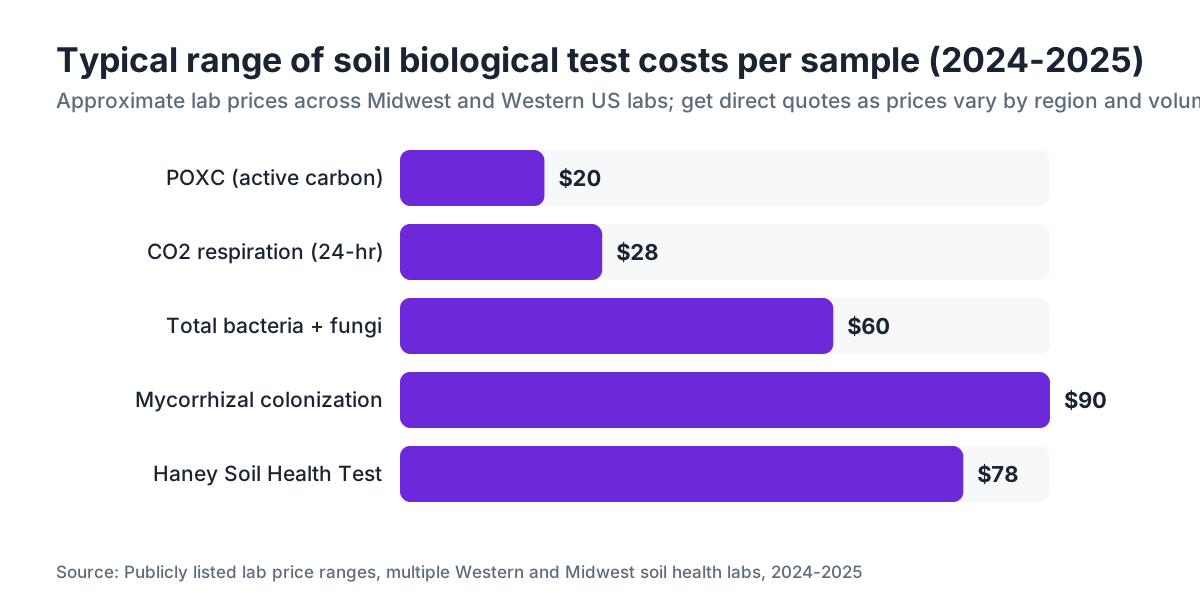
| Test | What it measures | Response time to management | Typical cost per sample |
|---|---|---|---|
| POXC (active carbon) | Labile carbon pool | 1-2 seasons | $15-25 |
| CO2 respiration (24-hr) | Microbial metabolic rate | Weeks to 1 season | $20-35 |
| Total bacteria + fungi | Community size | 1-3 seasons | $40-80 |
| Mycorrhizal colonization | VAM root infection rate | 1-2 seasons | $60-120 |
| Haney Soil Health Test | Multi-parameter index | 1-2 seasons | $55-100 |
Prices are approximate ranges based on publicly listed rates from Midwest and Western labs as of 2024-2025. Always get a quote directly from your lab; prices shift.
When should you sample for a soil biological assay in a vineyard?
Timing matters more for biological tests than for a standard Mehlich-3 chemistry panel. Microbial activity peaks in spring and early fall when soil moisture and temperature sit in a comfortable range, typically 50-75 degrees F and above 40% water-holding capacity. Sample in August when the vineyard is baking and dry and you'll get suppressed respiration numbers that look alarming but are mostly an artifact of conditions.
The standard recommendation from both Cornell's Soil Health program and UC Cooperative Extension is to sample in spring before bud break or in fall after harvest, at the same time each year so comparisons hold [2][4]. If you apply compost or a biological amendment, sample before you apply and again 60-90 days after, at the same time of day if you can manage it. Diurnal variation in microbial activity is real, though it's not large enough to blow up a trend analysis.
Ship samples to the lab within 24-48 hours of collection in a cooled container. Some labs, particularly those running the Solvita CO2 respiration method, send you pre-measured jars so the incubation starts under controlled conditions the moment you add the soil. That protocol cuts handling variability a lot, and it's worth asking about when you're choosing a lab.
How do you link a soil biological assay result to a management decision?
The linkage step is simple in concept and skipped constantly in practice. Here's the workflow that holds up to scrutiny.
First, define your targets before the samples go out. Write down what POXC value or respiration rate you consider healthy for each block, based on lab interpretation guides, extension benchmarks, or your own three-year trend. Cornell publishes scoring functions for POXC where scores above 7 (on a 1-10 scale) indicate good biological function in temperate soils [2]. Use those as a starting point if you don't have local data.
Second, when results come back, compare each value to your stated target and sort it: within range, marginally below, significantly below. Don't read the number in isolation.
Third, write the triggered action. In the "significantly below" category, the action might be compost application, cutting or dropping a contact fungicide with known biocide effects, a change in tillage timing, or a cover crop species shift. If you're within range, the action is "no change, resample same date next year." That's still a documented decision.
Fourth, assign a person and a deadline. "Apply compost" with no name and no date is not a management decision. It's a wish.
If you keep these records in a spreadsheet, build the target column, the result column, and the action column into the same sheet so the connection is visible at a glance. If you're using field operations software like VitiScribe, you can attach the lab report PDF to the block record and tag the triggered task to the same season's work orders, which keeps everything in one place instead of spread across email threads and notebooks.
WSU Extension frames this as a test, interpret, decide, record loop, and the record step explicitly includes recording the decision, not only the test result [3].
What are the record-keeping requirements for soil biological testing in vineyard compliance programs?
No federal law mandates soil biological assay records the way FIFRA mandates pesticide application records [5]. But several programs create an effective requirement by making documentation a condition of certification or benefit eligibility.
The USDA Environmental Quality Incentives Program (EQIP) and California's Healthy Soils Program both require documented soil health baselines and follow-up sampling as conditions of payment [6][7]. If you're drawing EQIP cost-share for a compost application or cover cropping practice, your NRCS field office will ask for the sampling records. "I did it but didn't write it down" will cost you the payment.
California's Healthy Soils Program, run by CDFA, requires participants to collect baseline soil samples (which can include biological parameters) before practice implementation and follow-up samples after, with results reported to the program [7]. The exact analytes required vary by practice but tend to include organic matter, POXC, and sometimes respiration.
Third-party sustainability schemes like SIP Certified and the California Sustainable Winegrowing Alliance (CSWA) scorecard don't mandate specific lab tests, but they award points for documented soil health monitoring paired with a management response. The CSWA's Code of Sustainable Winegrowing includes soil biology tracking in its self-assessment [8].
EPA's Worker Protection Standard doesn't address soil biological assays directly. But if you're collecting soil samples in a treated area, the restricted-entry interval for the pesticide applied must have elapsed before workers enter [9]. Document that compliance separately in your pesticide application log.
How do you store and organize soil biological assay records for audit readiness?
Paper works. A binder organized by block, then by year, then by test type is legible to any auditor and survives a software company going out of business. That's not a knock on digital systems. It's a point about redundancy.
Digital records work better for trend analysis. A spreadsheet with one row per sample, columns for every field listed in section two above, and a "decision" column is enough for most operations under 100 acres. Filter by block, sort by date, and a three-year trend shows up in thirty seconds.
Retention: California requires pesticide records to be kept for three years by statute. For soil health records there's no statutory minimum, but NRCS program requirements generally expect records to be available for the life of the practice plus three years [6]. Keep them at least five years. Hard drives fail, so back them up to cloud storage or print an annual summary.
One thing kills audit readiness fast: sampling records that can't be tied to a specific location. If your block IDs shift because you replanted or redesigned a block, maintain a mapping table showing old ID to new ID with effective dates. An auditor looking at a record from 2019 needs to find that block on your current map.
What management decisions can a soil biological assay actually justify?
This is where it gets honest. A single assay result can suggest a direction. It can't tell you exactly what to do. Interpreting vineyard soil biology is genuinely less settled than nutrient management. Nobody has a clean randomized trial showing that raising POXC from 320 to 450 mg/kg in a Napa Valley Cabernet vineyard produces a specific yield or quality outcome. The closest evidence is correlational, from programs like Cornell's long-running soil health work in the Northeast and USDA-ARS trial data.
That said, here's what the peer-reviewed and extension literature supports as a response to low biological activity.
Compost application at 1-2 tons per acre per year consistently raises POXC over 2-3 seasons in trials across many systems, including orchards and vineyards [4][2]. It's the most evidence-backed intervention.
Cover cropping with diverse species (especially legume-grass mixes) raises soil respiration relative to bare midrows. WSU trials show 20-40% higher CO2 flux in covered midrows versus clean cultivation [3].
Reducing tillage intensity, specifically switching from complete undervine discing to targeted strip tillage or herbicide use, preserves fungal hyphal networks that support mycorrhizal colonization. The tradeoff with herbicide is a separate decision.
Cutting fungicide rate or switching from a broad-spectrum contact material to a more targeted chemistry can reduce the incidental suppression of beneficial soil organisms. Some SDHI and DMI fungicides have documented effects on soil fungal communities when they reach soil via runoff or leaf litter decomposition. UC IPM guidelines address this in the context of resistance management and note the soil biology dimension [4].
These decisions belong in your assay record. "Result: POXC 320 mg/kg, 30% below target. Decision: add annual compost application to block 4B starting October, switch undervine management to no-till roller-crimp from 2025, reassess fungicide program with PCA." That's a usable record.
How do you set a baseline when you've never run a soil biological assay before?
Start with a single spring sampling across all your major block types. You don't need one sample per block in year one. You need enough to see whether meaningful variation exists across the farm. Group blocks by management history: blocks that have had cover crops and compost for five years, blocks under conventional clean culture, blocks that were recently replanted. Sample one representative area from each group.
In year one, your baseline IS whatever numbers come back. They're not good or bad yet. They're a starting point. Write them down with a note on the management history for each block. That context is as important as the number.
By year two you have a comparison. By year three you have a trend. Trend is what you're actually building, because soil biology doesn't move fast enough to mean much in a single measurement.
If you're starting mid-season or after a dry summer, note that explicitly in the record. A respiration value from August soil during a drought year is not comparable to a May value from the same block. Context annotations in your log aren't bureaucratic overhead. They're the difference between a useful record and a misleading one.
What labs run soil biological assays for vineyard samples and how do you choose one?
Several labs offer the main biological suite. Ward Laboratories in Nebraska (the standard source for the Haney test), Earthfort in Oregon, and Cornell's Soil Health Laboratory in New York run some of the most referenced methods. UC Davis's Analytical Lab handles standard soil chemistry and can route samples for biological tests; check their current menu directly [4].
Choosing a lab comes down to three factors: method consistency, turnaround time, and whether the report uses units you can compare to published benchmarks.
Method consistency is the big one. POXC by the Weil et al. (2003) method and POXC by a modified protocol from a different lab may not produce comparable numbers [11]. Switch labs mid-study and your trend line breaks. Pick a lab and stay with it unless it shuts down or fundamentally changes its protocol, in which case run a side-by-side split sample to establish a conversion factor.
Turnaround of 5-10 business days is typical for biological tests. Some rush to 3 days for an upcharge. For seasonal management decisions, 10 days is usually fine.
Make sure the lab reports interpretation ranges, or you get nothing useful from the number alone. Some labs include their own scoring (Earthfort uses a biological activity index; Cornell uses a 1-10 Soil Health Score). Those frameworks are lab-specific and shouldn't be compared across labs, but they're useful internally.
VitiScribe's record format lets you attach the raw lab PDF and log the parsed values separately, so you're never dependent on just one of those formats being readable five years from now.
How does a soil biological assay record integrate with your pesticide and spray records?
Your pesticide application records and your soil biology records should cross-reference each other, and almost nobody does this.
Here's the practical reason it matters. If you apply a broad-spectrum fungicide in June and your September soil biology sample shows depressed respiration relative to an untreated block, you want to look back at the spray log and ask whether the timing and rate could explain the difference. That analysis needs both records to use the same block ID system and the same date format.
Under FIFRA and most state pesticide regulations, commercial pesticide applicators must retain application records for two years minimum; California requires three [5][10]. Those records typically include the product, EPA registration number, rate, location, and applicator credentials. None of that is going away. What you're adding is a column or a note in the biological assay record: "See spray log entries for block 4B, May 15 through June 30, for fungicide applications that preceded this sample."
This cross-reference matters for organic certification too. If you're transitioning to or maintaining organic status, your certifier looks at what went into the ground. A biological assay showing healthy fungal communities alongside a clean spray record tells a coherent story. One showing suppressed biology with a heavy mancozeb history tells a different one, and you'd rather know that than have a certifier find it first.
EPA's Worker Protection Standard requires training and record-keeping for pesticide exposure, and it requires sampling activities in treated areas to comply with restricted-entry intervals [9]. Log the REI clearance date in your soil sampling record if samples came from recently treated blocks.
Frequently asked questions
How long do I need to keep soil biological assay records?
There's no federal statute setting a minimum for soil biology records specifically. USDA NRCS program agreements typically require records to be available for the life of the practice plus three years, so five to seven years is a safe rule of thumb. California's Healthy Soils Program stores reported results, but keep your own copies too. Five years is the minimum I'd recommend for any serious operation.
Can I use a soil biological assay result to qualify for USDA EQIP payments?
Yes. EQIP practices like compost application (Practice 808) and cover cropping (Practice 340) often require documented soil health baselines as a condition of payment. Your NRCS field office sets the specific sampling requirements for your conservation plan. Collect baseline samples before practice implementation and retain lab reports with your EQIP paperwork. Providing results to your NRCS office on request satisfies most documentation requirements.
What is POXC and what range should a vineyard aim for?
POXC stands for permanganate-oxidizable carbon, a measure of the labile (readily available) carbon pool that soil microbes use for energy. Cornell's Soil Health program considers values above roughly 400-500 mg/kg favorable in temperate agricultural soils, though Mediterranean and arid western soils often run lower. Your best target is the upper quartile of your own multi-year baseline, compared to extension benchmarks for your region rather than national averages.
Does the time of year I collect a soil biological sample affect the result?
Yes, significantly. Microbial activity peaks in spring and fall when soil temperature is 50-75 degrees F and moisture is adequate. Summer samples from hot, dry vineyard soils show suppressed respiration that doesn't reflect the system's actual biological capacity. Sample at the same calendar window each year, note soil temperature and moisture at the time of collection, and compare only within the same seasonal window across years.
Which fungicides are most harmful to soil biology in vineyards?
The research isn't fully settled, but SDHI fungicides (like boscalid and fluopyram) and some DMI fungicides have documented effects on soil fungal communities when they reach soil via runoff or leaf litter breakdown. Broad-spectrum contact materials like mancozeb also affect non-target organisms. UC IPM guidelines note this in the context of resistance management. The safest approach is to flag fungicide timing in your spray records and watch for correlated drops in mycorrhizal colonization in blocks that receive heavy programs.
What's the difference between a Haney test and a standard biological assay?
The Haney Soil Health Test bundles chemistry and biology into a single composite score by combining water-extractable carbon and nitrogen, CO2 respiration, and an organic nitrogen estimate. A standard biological assay reports individual metrics like POXC, respiration, and microbial counts without the composite index. Both are valid. The Haney score is easier to explain to a certifier or grant reviewer, while individual metrics are easier to track as targeted responses to specific management inputs.
Do I need separate records for each vineyard block or can I pool samples?
Record-keeping should tie to the management unit you can actually act on. If you'd apply compost to block 4B but not block 4A because they have different soil types or histories, sample and record them separately. Pooling two blocks into one sample works for a general farm baseline in year one, but by year two you want block-level data so management decisions can be targeted and documented at the same resolution.
How do I record a soil biological assay result if my block IDs changed after a replant?
Maintain a mapping table with old block ID, new block ID, and the date the change took effect. Reference this table in your lab records and note which ID system was active at the time of sampling. Auditors and grant reviewers deal with this regularly; a clean mapping table is all they need. Keep the old records under the old IDs and add a cross-reference note rather than retroactively relabeling them.
Can I use cover crop data as a substitute for a soil biological assay?
No. Cover crop species and biomass data tells you what's growing above the soil, not what's living in it. They're complementary records. A field with vigorous cover crop growth often shows improved soil biology over time, but the assay is the only way to confirm it. Grant programs like CDFA's Healthy Soils Program require actual soil sample results, not proxy observations from above-ground vegetation.
What's the best way to store physical soil samples before shipping to the lab?
Refrigerate at 35-40 degrees F within an hour of collection and ship in an insulated cooler with ice packs. Ship overnight or two-day at most. Biological samples, especially those used for respiration tests, degrade quickly at ambient summer temperatures. Some labs supply pre-measured Solvita jars or similar vessels that start the incubation at collection; ask your lab what it recommends before pulling samples. Note handling conditions in your sampling record.
Are soil biological assay records required for organic certification in a vineyard?
They're not explicitly required by the USDA National Organic Program regulations, but organic certifiers increasingly ask for soil health documentation to show that your management system is building rather than degrading biological function. More practically, if you're choosing inputs based on soil biology, those records help defend your management plan. Many Certified Naturally Grown and Demeter programs actively request them.
How do I compare my vineyard's soil biology results to regional benchmarks?
Use extension-published interpretation guides from your closest regional program: Cornell's Soil Health lab for Northeast vineyards, WSU Extension for the Pacific Northwest, and UC Cooperative Extension publications for California. Each region's benchmarks reflect local soil types and climate. National averages from USDA NRCS soil health data are a rough starting point but can mislead you if your soils fall outside the range used to build those benchmarks.
What happens if my soil biological assay shows no improvement after two years of cover cropping?
First, check whether you sampled at the same time of year and under comparable moisture. Timing artifacts can mask real change. If conditions were comparable and biology hasn't moved, look at whether other factors are limiting: high soil pH suppresses some bacterial communities, compaction limits fungal networks, and residual herbicides can depress microbial populations longer than label claims suggest. The record you kept is exactly what you need to diagnose this. Document the investigation and its outcome.
Sources
- Cornell University College of Agriculture and Life Sciences, Soil Health Laboratory: Cornell's Soil Health program places POXC at the center of its assessment framework and publishes scoring functions where values above a threshold indicate good biological function in temperate soils.
- Washington State University Extension: WSU Extension provides region-specific soil health benchmarks for Pacific Northwest vineyards and documents 20-40% higher CO2 flux in covered midrows versus clean cultivation.
- University of California Agriculture and Natural Resources (UC Cooperative Extension and UC IPM): UC Cooperative Extension has documented respiration differences of 3-5x between biologically managed and conventionally managed vineyard floor systems in some trial blocks, and UC IPM guidelines address SDHI and DMI fungicide effects on soil organisms.
- US EPA, Pesticide Registration and FIFRA record-keeping requirements: FIFRA requires commercial pesticide applicators to retain application records for a minimum of two years; there is no parallel federal mandate for soil biological assay records.
- California Department of Food and Agriculture, Office of Environmental Farming and Innovation (Healthy Soils Program): CDFA's Healthy Soils Program requires participants to collect baseline soil samples before practice implementation and report follow-up results.
- California Sustainable Winegrowing Alliance, Code of Sustainable Winegrowing: The CSWA's Code of Sustainable Winegrowing includes soil biology tracking in its self-assessment and awards points for documented monitoring paired with a management response.
- US EPA, Agricultural Worker Protection Standard: EPA's Worker Protection Standard requires that workers entering treated areas for sampling comply with restricted-entry intervals for the pesticides applied; this applies to soil sampling activities.
- California Department of Pesticide Regulation, Pesticide Use Reporting: California requires pesticide application records to be retained for three years, longer than the two-year federal FIFRA minimum.
- Weil et al. (2003), American Journal of Alternative Agriculture, permanganate-oxidizable carbon method: The Weil et al. (2003) permanganate-oxidizable carbon method is the peer-reviewed standard for POXC measurement; labs using this specific protocol produce results comparable to published benchmarks.
Last updated 2026-07-11