How to record spray drift incidents in vineyard compliance documents

TL;DR
- When spray drift happens, write an incident record the same day: date, product and EPA registration number, application method, measured wind speed and direction, drift direction, affected area, and anyone exposed.
- If a person was exposed or a neighbor's crop was damaged, California and Washington require you to notify the county or state within 24 hours.
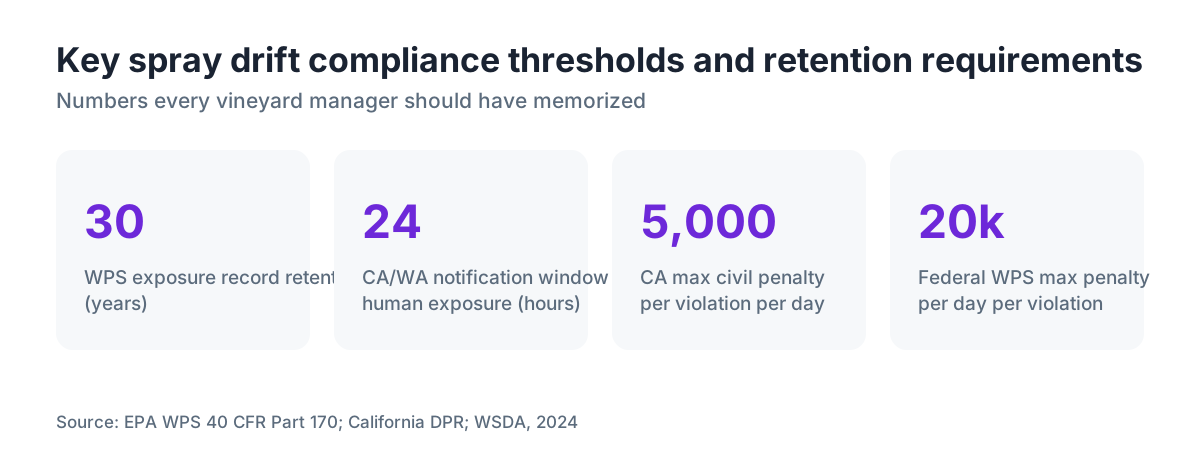
- WPS exposure records must be kept 30 years.
What counts as a spray drift incident that needs to be recorded?
Spray drift is any movement of pesticide droplets, vapor, or particles outside the target area during or after application. Under EPA regulations, a recordable pesticide incident includes off-target deposition that reaches a neighboring property, a water body, a non-target crop, or any person who wasn't authorized to be in the application area. [1]
Not every wisp of fog-like spray needs a formal report. A few droplets on the dirt road between rows probably don't. But if drift crosses a property line, reaches a residence, contacts a worker who wasn't told about the application, or damages a neighbor's crop, you have a recordable incident. The test most county agricultural commissioners use is simple: would a reasonable observer say the pesticide ended up somewhere it wasn't supposed to go?
Vapor drift is trickier. Some products, especially soil fumigants and herbicides like dicamba, volatilize after application and move as gas rather than droplets. Those incidents carry the same documentation requirements even though no liquid left the sprayer at the wrong moment. [2]
Then there's the restricted-entry interval. If drift enters a treated block where workers are present before the REI has expired, that's a drift incident and a WPS violation at once, and you'll document both aspects separately.
What information is legally required in a drift incident record?
The minimum fields come from two overlapping sources: your state's pesticide use reporting rules and the EPA Worker Protection Standard (40 CFR Part 170). [3] California, Washington, and Oregon have the most detailed state-level requirements. Other states largely track the federal minimums.
At the federal level, the WPS requires employers to keep records of any pesticide exposure incident for at least 30 years. California's county agricultural commissioner system requires routine pesticide use reports within a month of application, but a drift complaint or exposure incident triggers a separate, faster obligation: notify the county agricultural commissioner within 24 hours of discovering an incident involving human exposure or property damage. [4]
Here are the fields every incident record should include, no matter which state you're in:
| Field | What to capture |
|---|---|
| Date and time of application | Exact start and end time |
| Product name(s) | EPA registration number, more than the trade name |
| Application rate | Per acre, as applied |
| Equipment used | Sprayer type, nozzle type, pressure setting |
| Operator name | Licensed PCA or applicator if applicable |
| Wind speed and direction | Measured at the time, not forecast |
| Temperature and humidity | Affects volatility and droplet evaporation |
| Direction of drift | Compass bearing toward affected area |
| Estimated distance drifted | In feet or meters, with basis for estimate |
| Affected area description | Neighboring block, property, water body |
| Persons potentially exposed | Names, contact info, exposure type |
| Symptoms reported (if any) | Don't diagnose; record what was reported |
| Corrective action taken | What you did immediately |
| Notification made | To whom, what time, by what method |
The WPS language is explicit. Records of pesticide exposure incidents must include "the name, address, and social security number of each agricultural worker or handler who may have been exposed." [3] That last part, the social security number, surprises a lot of growers. It's required whenever there's potential human exposure.
How should you document wind conditions at the time of the incident?
Wind data is where drift records fall apart in an enforcement review. Writing "calm" or "light wind" is useless. You need actual measurements.
Keep a handheld anemometer on the spray rig or in the cab. Record wind speed in mph at the start of the application, at the end, and at the moment you noticed off-target movement if that time is different. Record direction as the compass bearing the wind is coming from, not where it's blowing toward. That's the meteorological convention, and it's what auditors expect.
If you didn't measure wind at the time, NOAA's nearest ASOS weather station can give you historical hourly readings, but your own on-site number beats any station miles away. [5] A county ag commissioner investigating a drift complaint will almost always pull independent weather data. If your record says 2 mph and the nearest station logged 12 mph, you have a problem.
Temperature inversions are a documented mechanism for long-distance drift, especially at dawn and dusk. UC Davis extension notes that inversions can carry droplets hundreds of meters even when wind at ground level seems calm. [6] If you sprayed during a period when an inversion was likely, say so in the record. It shows you were thinking about it, and it helps explain what happened.
One shortcut. Most precision viticulture weather stations log wind at 15-minute intervals. If you have one in the block, export that log and attach it to every spray record, not only incident records. It takes 30 seconds and it's exactly what you'll want later.
When do you have to notify the county agricultural commissioner or state agency?
Timing varies by state and by how serious the incident is. The short version: if a person was exposed or a neighbor's property was damaged, California and Washington both give you 24 hours.
In California, Department of Pesticide Regulation (DPR) guidance requires the operator or employer to notify the county agricultural commissioner (CAC) within 24 hours if the incident involves human illness, injury, or exposure, or if it causes economic damage to a neighboring crop or property. [4] The CAC then has its own investigation and reporting timeline to DPR.
The Washington State Department of Agriculture (WSDA) has a similar 24-hour phone notification requirement for incidents involving human exposure, with a written follow-up report within five days. [7]
For incidents that don't involve human exposure or clear crop damage, the routine pesticide use report filed with the CAC (California) or through state reporting systems often covers it. Document everything before you decide it's minor, though. The classification can change if a neighbor notices damage a week later.
If drift reaches a waterway and might violate a discharge permit or the Clean Water Act, you have a separate obligation to the regional water quality control board or state environmental agency. That's a different clock, often 24 hours for visible impacts. [1]
Experienced growers say the same thing over and over: call the CAC voluntarily even when you're not sure you've hit the threshold. An agency that hears from you first is far less likely to treat the situation as willful non-compliance. That posture matters.
What does the EPA Worker Protection Standard require for drift exposure records?
The WPS (40 CFR Part 170) was rewritten in 2015, with most provisions taking effect in January 2017. [3] The revised standard goes well beyond logging a spray event.
When a handler or agricultural worker is exposed through drift, the agricultural employer has to provide immediate decontamination (soap, water, clean clothing), make sure the person gets medical attention if needed, and document the incident in writing. Records of pesticide exposure incidents must be kept for a minimum of 30 years. The record has to include the product's EPA registration number, the active ingredient, and the circumstances of exposure.
That 30-year retention period catches growers off guard. Most spray records get kept three to five years, which satisfies general pesticide use reporting. A WPS exposure record has to survive property transfers, ownership changes, and business sales. The reason is long-latency occupational disease: symptoms can appear decades after exposure, and workers have legal rights to that historical record. [3]
The WPS also requires that workers who may have been exposed get information about the product within 72 hours, including where to get emergency medical treatment and what the treating physician should know. That's not a courtesy. It's a compliance obligation with its own paper trail.
How do you structure a drift incident log alongside your regular spray records?
Most vineyard spray record systems weren't built with drift in mind. The standard spray log captures what you applied, where, and when. A drift incident record captures what happened unexpectedly and what you did about it. Related documents, different jobs.
Keep a spray record and a separate incident report that cross-reference each other. Your spray log entry for the application that caused the drift gets a notation: "see Drift Incident Report #[number], [date]." Your incident report points back to the spray record entry by date and block number.
Some growers keep a physical binder or folder labeled "Incident Reports" next to their spray binders. Others run a rolling incident log at the back of each year's spray book. Either works, as long as both documents are findable and cross-referenced.
Digital systems make the cross-reference easier. VitiScribe and similar platforms let you attach an incident note to a specific spray record entry, timestamp it automatically, and flag the record for follow-up. That's genuinely useful during an audit, because the inspector sees the application record and the incident documentation in one place instead of hunting through binders.
Use the same template every time for the incident report itself. Inconsistent formats suggest the records were created after the fact. A pre-structured form with date fields, checkboxes for notification type, and signature lines builds an audit trail that holds up. Cornell's extension program offers a sample pesticide incident report template that several northeastern states accept. [8]
What evidence should you photograph or collect at the scene?
Documentation isn't only paper. Physical and photographic evidence is often more convincing than written notes, both for your own protection and for pinning down what actually happened.
Photograph the affected area as soon as it's safe to do so. Most smartphones timestamp automatically. Capture the direction from your application point toward the drift area, any visible damage on plant tissue, and physical markers like flagging or stakes that show the boundaries of the affected zone. Visible residue on vegetation gets its own shot.
Collect physical samples if you can do it safely and if the drift is bad enough to warrant a possible damage claim. A few leaves with suspected residue in a clean ziplock bag can go to a lab for residue analysis. Without samples, you can't confirm or rule out what reached the neighboring property. Labs affiliated with UC Davis or WSU, plus private commercial residue labs, can run these analyses. [6]
Write a scene description on paper or into a notes app within an hour of finding the incident. Memory degrades fast. Note the color of the vegetation damage, the pattern (one side of the plant or all over?), the distance from the application block, and whether anyone was present.
If a neighbor is involved, note whether they were on the property, what they said, and when you spoke. Don't admit liability in that conversation. Do listen and record what they observed. Their account may actually help you characterize how far the incident reached.
How long do you need to keep spray drift incident records?
It depends on which regulation applies to the specific incident. Here's the floor.
General pesticide use records, required under most state use reporting laws, must be kept three years in most states, including California and Washington. [4][7]
WPS exposure incident records must be kept 30 years under federal law. [3] That's the federal floor. Some states go longer.
Records tied to environmental damage, especially where a discharge complaint or violation was filed, should be kept indefinitely or for the length of any statute of limitations, which can run five years or more depending on the cause of action.
A working rule. Any incident involving human exposure gets kept 30 years. Any incident involving property damage gets kept at least 10 years. Standard spray records with no incident notation get kept three years. Keep everything digital with a backup if you can. Paper records are hard to hold onto through three decades of personnel changes, business sales, and storage disasters.
WSU's extension program on pesticide recordkeeping recommends scanning all paper spray records annually and storing them in at least two physical locations. [9] Follow that advice for incident records especially.
What are the penalties for incomplete or missing drift incident records?
Penalties vary by state and by whether the violation is procedural (bad paperwork) or substantive (actual harm). The numbers are big enough to pay attention to.
In California, violations of pesticide recordkeeping requirements under the Food and Agriculture Code can bring civil penalties up to $5,000 per violation per day. [4] A DPR enforcement action for failure to keep required records typically starts around $500 to $2,500 per violation for a first offense, then escalates sharply if there's a pattern or if human exposure was involved.
At the federal level, EPA can assess civil penalties up to $19,816 per day per violation for WPS violations, a figure adjusted periodically for inflation and current as of EPA's 2024 penalty adjustment. [10] WPS violations that cause actual worker harm get treated most seriously.
Washington's WSDA can suspend or revoke applicator licenses for repeated recordkeeping failures, which hurts a commercial operation more than a fine.
The hidden cost of poor records is often worse than the regulatory penalty. If a neighbor sues over crop damage and you can't produce contemporaneous records of your wind conditions, application timing, and corrective actions, your defense is basically "trust me." That's a losing position in civil litigation.
What corrective actions should you document after a drift incident?
Corrective action is the piece growers skip most, and it's exactly what separates a one-time error from a compliance pattern in a regulator's eyes.
Document what you did the moment you recognized the drift. Stopped the application? Shut down the sprayer? Moved workers out of the affected area? Called the neighbor? Each action goes in the incident record with a timestamp.
Then document the root cause and what you're changing. "Wind shifted unexpectedly" is an explanation. "We will require the applicator to measure wind speed every 30 minutes during applications adjacent to neighboring properties, and halt if wind exceeds 7 mph" is a corrective action. Regulators want the second one.
WSU extension guidelines on drift reduction point to buffer zones, application timing, and nozzle selection as the most effective mitigation measures. [9] Document which of those you reviewed and what you decided.
Add a notation to the affected blocks in your spray record system so future applicators see the history. A block with a documented drift incident should carry that flag in the operational notes, so the next person planning a spray there applies extra caution at the boundaries.
If you're using a digital system for your vineyard records, corrective action notes attached to an incident report become searchable history. That's useful when you're planning next year's applications and want to know which blocks have had boundary issues.
How do you handle a neighbor's complaint about spray drift after the fact?
A neighbor complaint, especially one that lands days after the application, is a different animal from a drift event you watched happen. Your documentation has to cover both.
Start by taking the complaint seriously and creating a record of the complaint itself: who called, when, what they reported, and when you got the information. Do this even if you doubt the drift reached them. The complaint is a fact regardless of whether it's accurate.
Then pull your spray records for the relevant window. What did you apply in the days before the call? What were the wind conditions? Did anything you applied leave residual symptoms that could show up on plants three to five days later? Some herbicides do. Some fungicides cause visible phytotoxicity on non-target species that wouldn't appear right away.
Notify your CAC proactively if the complaint alleges crop damage or human symptoms. Don't wait for the neighbor to call the county first. A commissioner who hears about an incident from the complainant before hearing from the grower starts the investigation from a colder position.
Keep a log of every communication with the complaining neighbor: date, time, what was discussed, any agreements or disputes. If this escalates to a formal investigation or a civil claim, that log matters.
Check whether a neighboring grower sprayed during the same window, too. Drift identification gets complicated when several nearby operations are applying at once. The county investigation will look at all possible sources, and your records should be complete enough to confirm or rule out your operation.
Frequently asked questions
Is a spray drift incident the same as a pesticide use report?
No. A pesticide use report is a routine monthly or annual record of every application you make. A drift incident report is a separate, event-triggered document you create when pesticide moves off-target. Both may reference the same application, but they go into different filing systems with different retention rules. In California the routine use report goes to the CAC monthly; a drift incident notification goes to the CAC within 24 hours if human exposure or property damage is involved.
What if the drift was caused by a contract spray crew, not my own equipment?
You still have a documentation obligation. Under the WPS, the agricultural employer, which in most vineyard contexts means the farm operator or property owner, is responsible for worker protection and incident recordkeeping regardless of whether the applicator was an employee or a contractor. Document that the contracted crew was responsible and record their license numbers. The contractor carries their own liability, but that doesn't relieve your recordkeeping obligation.
Do I need to record drift incidents that only affected my own vineyard blocks?
If drift moves between your own contiguous blocks with no workers present and no damage, formal incident reporting is generally not required. But if workers were in the receiving block during or after the drift, WPS exposure provisions apply and you need a full incident record including potential exposure documentation. When in doubt, document it. A record you don't need costs far less than a missing record you do need.
How do I document wind speed if I didn't measure it at the time of the application?
Note in your record that no on-site measurement was taken, then pull the nearest available weather station data from NOAA or a local ag weather network (Mesowest, CIMIS, and similar). Reference the station name and its distance from your vineyard. Be transparent about the gap. A reconstructed record that admits its limits beats a blank field or an unsupported estimate. Going forward, a handheld anemometer costs around $30 to $80 and pays for itself the first time you need the data.
What is the WPS requirement for keeping drift exposure records?
Under 40 CFR Part 170, the revised EPA Worker Protection Standard effective 2017, agricultural employers must keep records of pesticide exposure incidents, including handler or worker exposure from drift, for 30 years. The record must include the EPA registration number of the product, the active ingredient, the circumstances of exposure, and identifying information for exposed individuals, including social security numbers.
Can a spray drift incident result in pesticide license suspension?
Yes. In Washington and California, repeated or severe drift incidents can lead to suspension or revocation of an applicator's license. A single serious incident involving human harm or substantial crop damage can also trigger license action, especially if the investigation shows the applicator ignored label requirements on wind speed limits or buffer zones. Complete drift incident records actually support your defense in a license action.
Does the EPA have a specific form for reporting spray drift incidents?
The EPA has no single universal form for vineyard spray drift incidents. The WPS specifies what information must be kept but not the exact format. Your state may have its own form: California's DPR and county agricultural commissioners use standard incident report forms. For federal WPS compliance, a consistent internal template that captures all required data fields is acceptable. Cornell Cooperative Extension offers a sample template that meets multi-state requirements.
How soon after a drift event should I complete the incident record?
Complete it the same day, as close to the event as you can. A record written within hours captures details memory discards quickly, like exact wind direction, where workers were standing, and what you saw the droplets do. If human exposure is involved, California and Washington require CAC or WSDA notification within 24 hours. Most regulatory guidance treats a same-day record as contemporaneous; records finished days later get more skepticism during investigations.
What label language governs when you're legally allowed to spray in windy conditions?
Most pesticide labels set specific wind speed limits, often 10 to 15 mph as an upper threshold, though some products, particularly herbicides and fumigants, set lower limits. The label is a legal document under FIFRA, and spraying in conditions that exceed label limits is a violation on its own, whether or not drift actually occurs. [11] Always check the current product label, because wind speed language changes between registration cycles. The active label in EPA's label database overrides older printed copies.
Should I notify my crop insurance carrier after a spray drift incident?
Yes, if the drift damaged your own crop or created potential liability for a neighbor's loss. Timely notice to your insurer is usually a policy condition, and failing to report within the required window can jeopardize coverage. Keep a copy of any communication to your insurer in the incident file. Your incident documentation, including photos and weather data, is exactly what an adjuster needs to process a claim.
How do I record a suspected vapor drift incident when I didn't observe any obvious droplets?
Vapor drift records use the same format as droplet drift records, but documenting the conditions matters more. Note the product's volatility classification, the temperature at application time, and whether atmospheric conditions (low wind and temperature inversions at dawn or dusk especially) fit vapor movement. Record the symptoms observed on affected plants or the complaint received, noting that vapor drift was suspected rather than confirmed. A laboratory residue analysis is the only way to confirm it.
What's the difference between how California and Washington handle drift incident reporting?
Both states require 24-hour notification to the relevant state or county authority when human exposure or property damage occurs. California routes it through county agricultural commissioners who report to DPR; Washington goes directly to WSDA. California's pesticide use reporting system is among the most detailed in the country, requiring monthly electronic submission. Washington's system is less granular at the reporting stage but just as serious in enforcement. Both states' rules stack on top of federal WPS requirements.
Does a spray drift incident need to be recorded if no one complained and no damage was visible?
If you saw drift leave your property or potentially expose workers, document it whether or not anyone complained or damage is visible. Some pesticide damage isn't immediately apparent, and some regulations trigger on potential exposure rather than confirmed harm. A voluntary internal record protects you if a complaint or claim surfaces later, and it demonstrates good-faith compliance during any inspection.
Sources
- EPA, Pesticides program: Off-target pesticide deposition that reaches neighboring property, water bodies, or non-target persons constitutes a pesticide incident under EPA definitions.
- EPA, Pesticide registration program (dicamba and volatile products): Some products such as soil fumigants and certain herbicides volatilize after application and move as vapor rather than droplets, carrying the same documentation requirements.
- EPA, Agricultural Worker Protection Standard 40 CFR Part 170: WPS requires records of pesticide exposure incidents to be kept for 30 years and to include the EPA registration number, active ingredient, and social security numbers of exposed individuals.
- California Department of Pesticide Regulation: California requires notification to the county agricultural commissioner within 24 hours of a pesticide incident involving human exposure or property damage; civil penalties for recordkeeping violations can reach $5,000 per violation per day.
- NOAA, National Weather Service: NOAA ASOS stations provide historical hourly wind speed and direction data usable for reconstructing conditions during a pesticide application.
- University of California Agriculture and Natural Resources: Temperature inversions at dawn and dusk can carry pesticide droplets hundreds of meters even when ground-level wind speeds appear calm.
- Washington State Department of Agriculture: WSDA requires 24-hour phone notification for pesticide incidents involving human exposure, with a written follow-up report within five days; repeated recordkeeping failures can result in license suspension.
- Cornell University College of Agriculture and Life Sciences: Cornell extension provides a pesticide incident report template accepted by several northeastern states for WPS compliance.
- Washington State University Extension: WSU extension recommends modifying buffer zones, application timing, and nozzle selection as the most effective pesticide drift mitigation measures, and advises scanning paper spray records annually with storage in two physical locations.
- EPA, Enforcement (civil penalty inflation adjustments): As of EPA's 2024 inflation adjustment, WPS violations can result in civil penalties up to $19,816 per day per violation.
- EPA, Pesticide registration and FIFRA labels: Under FIFRA, pesticide labels are legal documents and spraying in conditions that exceed label wind speed limits is a violation independent of whether drift occurs.
Last updated 2026-07-11