How to record aerial spray applications in vineyard logs

TL;DR
- Federal EPA Worker Protection Standard (40 CFR Part 170) and most state ag departments require at least 14 data points for every pesticide application, aerial included.
- Aerial jobs add a few fields: aircraft registration, pilot license number, GPS flight path or block description, and buffer zone notes.
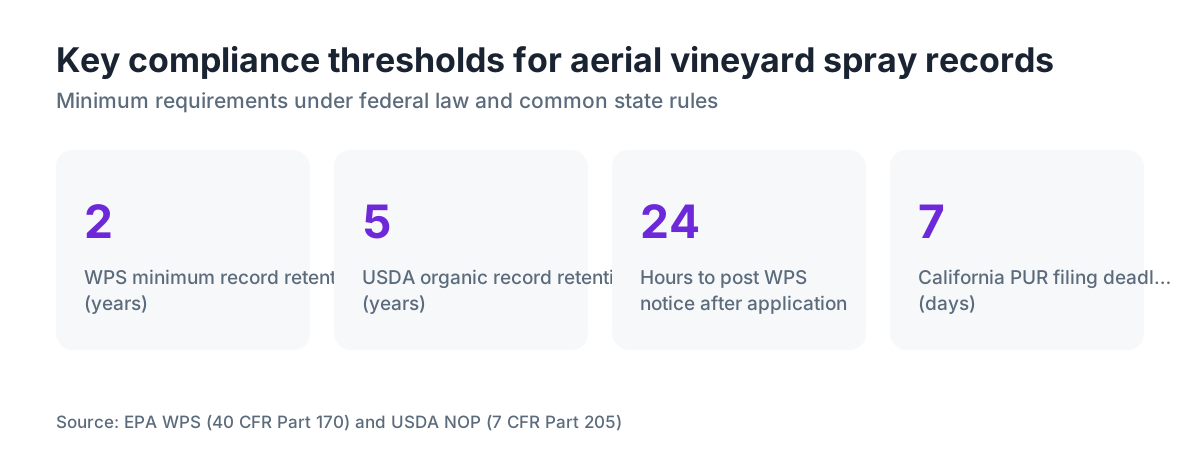
- Keep records two years minimum.
- WPS posting kicks in within 24 hours of application.
What federal law actually requires you to record for pesticide applications
The EPA Worker Protection Standard, at 40 CFR Part 170, sets the floor for what every agricultural employer keeps in a pesticide application record. The rule does not treat ground and aerial equipment differently in its data requirements. That surprises a lot of vineyard managers. The WPS final rule (revised 2015, effective January 2017) says records must be "maintained for a period of 2 years from the date of application" and available for inspection by EPA, state lead agencies, and authorized employees or their designated representatives [1].
The required fields under 40 CFR 170.309(k) cover product identity (EPA registration number, brand name, active ingredient), location (field name, legal description, or GPS coordinates), date and time, application rate, total amount applied, and the restricted-entry interval. Those are non-negotiable for any application, no matter the method.
The FAA has a stake in aerial work too. Any commercial aerial applicator has to hold an FAA commercial pilot certificate plus an agricultural aircraft operator certificate under 14 CFR Part 137 [2]. Log that certificate number. State ag inspectors ask for it more and more during audits, and having it on the record is the only way to prove you hired a legally authorized operator.
What extra fields does an aerial application add to the log?
Beyond the WPS baseline, an aerial job creates record-keeping needs a typical ground-application form never touches.
Aircraft registration number. The FAA N-number on the plane or helicopter. This ties your spray record to a specific aircraft and, through it, to the operator's insurance and certification.
Pilot certificate number. Your applicator's FAA and state ag department credentials. Some states, California among them, require a separate state license through the Department of Food and Agriculture on top of the FAA certificate [3].
Timing relative to wind and temperature. Drift potential runs much higher from the air than from the ground. California's Department of Pesticide Regulation recommends logging the actual wind speed and direction at application time, not the forecast. Most product labels cap wind speed (commonly 10 mph, though it varies).
Buffer zones and nearby sensitive sites. If a school, residence, water body, or organic operation sits within the drift setback on the label or in a state order, note it, along with what you did about it (flight path direction, nozzle type, altitude flown).
GPS flight path or block map reference. Not a federal WPS requirement, but state inspectors and crop insurance adjusters increasingly expect it. Many operators export a GPS track log straight from the aircraft's guidance system. Attach it, or at least record the block names and acreage covered.
Application altitude and equipment settings. Some state programs want nozzle type, boom configuration, and altitude above canopy. These feed drift modeling if a complaint ever lands.
Here is what a ground log and an aerial log look like side by side:
| Field | Ground application | Aerial application |
|---|---|---|
| Applicator name | Yes | Yes |
| Applicator license number | Yes (Pest. Applicator Cert.) | Yes (Pest. Applicator Cert. + FAA cert.) |
| Aircraft N-number | No | Yes |
| Pilot FAA cert. number | No | Yes |
| State aerial applicator license | No | Yes (CA, WA, OR, NY, others) |
| Wind speed and direction at time of app | Recommended | Required in most states |
| Buffer zone documentation | Sometimes | Almost always |
| GPS flight track | No | Strongly recommended |
| Application altitude | No | Yes (some states) |
| Crop canopy height | No | Recommended |
If you manage blocks across a region like Paso Robles or the South Coast AVA, an aerial contractor may hit several properties in one pass. Make sure your log covers only your property and your contracted treatment, never the contractor's combined flight log.
What state-specific rules should California vineyard managers follow?
California runs well past the federal WPS minimums. The California Department of Pesticide Regulation (CDPR) requires a Pesticide Use Report (PUR) filed with your county agricultural commissioner for every pesticide application, aerial included [3]. That filing is due within seven days of application. Monthly aggregate reporting is allowed for some operations, but aerial applications often require individual reporting.
California also makes the aerial applicator hold a California Pest Control Aircraft Pilot License from CDPR on top of the FAA cert [3]. Put that state license number in your log.
County agricultural commissioners often add site-specific conditions, especially near organic operations or school buffers. Farm in Napa, Sonoma, or the Sierra Foothills and your county may have an Ag Commissioner order that limits aerial timing (say, no aerial applications during school hours within a set distance). Record whether any such order applied and what you did to comply.
Washington State takes a similar path. Washington State University Extension notes the WA Department of Agriculture requires aerial applicators to file separate notification before treatment in certain sensitive areas, and that records must be available to WSDA inspectors within 48 hours of a request [4].
Cornell Cooperative Extension guidance for New York says any application within 100 feet of a water body triggers DEC notification requirements that have to show up in your records, aerial or otherwise [5].
How do you log the required Worker Protection Standard posting after an aerial spray?
The WPS makes you post a notice at the central display area (usually the field office or worker check-in point) within 24 hours of any application carrying an REI. Aerial applications get no pass here [1].
The posting has to include the product name, EPA registration number, active ingredient, location of the treated area, date and time of application, and the REI. For aerial work, the treated-area description needs to be precise enough that a worker can tell which blocks are off limits. "The back 40" will not satisfy an inspector. Use block names, parcel numbers, or a map.
Keep a copy of each posting in your spray records, or at minimum note in the log that a posting went up, by whom, and when. Some managers photograph the posted notice with a phone time-stamp as backup.
Spray over a weekend or when nobody is scheduled and you still have to post before any worker enters a treated area, even if that is three days out. The 24-hour clock starts at application completion, not at the next workday.
UC Davis Cooperative Extension recommends a standardized log template with a checkbox and timestamp for posting completion, so the step does not slip during a fast-moving harvest [6].
When exactly does a spray record have to be completed after an aerial application?
Federal WPS requires records completed "as soon as practicable" after application. Most state lead agencies read that as within 24 hours. California's PUR system wants the county filing within seven days, but the field log itself should be done the same day.
Aerial contractors usually work at dawn to catch calm wind, which means the log often needs completing before your crew is even in the vineyard. Build the habit of calling or texting your contractor the morning of the job to confirm actual application time, product amounts, and any changes from the original work order. That confirmation becomes part of your record.
If the applicator hands you a printout or digital summary (GPS track, application rate confirmation, product lot numbers), attach it to your spray log. It does not replace your own record, but it fills technical details more accurately than anything you reconstruct from memory a week later.
The two-year retention rule under WPS [1] means your 2023 aerial spray records need to stay reachable through at least the end of 2025. Paper binders work, but they carry real risk. A fire, a flood, or one misfiled folder can wipe out the records you would lean on to defend a complaint or an insurance claim.
What information do you need from the aerial contractor before the application?
Good record-keeping starts before the plane takes off. Get all of this in writing from your contractor beforehand:
- Product name, EPA registration number, formulation, and lot number
- Planned application rate (volume per acre, concentration)
- Their FAA certificate number and any state license numbers
- Aircraft N-number and type
- Proposed application window (time range, wind speed limit they plan to work within)
- Buffer zone plan if any sensitive sites are nearby
- What documentation they will hand you after the job
Most reputable aerial applicators expect this and send a pre-application work order covering most of it. Keep that work order. After the job, ask for a completion report or job ticket confirming actual product used, actual time, and any deviations from plan. Your spray log should reconcile against that ticket.
A contractor who drags their feet on documentation is a red flag. You, as the agricultural employer and property manager, own the accuracy of your pesticide records no matter who physically applied the product.
How do you handle records when the aerial application covers multiple vineyard blocks or owners?
This is one of the messier real-world situations. A contractor may cover 500 acres in a single morning that spans several parcels or even different ownership groups. Your log only needs to cover your property and your contracted application.
Get a block-by-block breakdown from the contractor showing the acreage applied on your parcels specifically. That number drives your PUR filing in California and your pesticide use total for crop insurance and organic transition records if either applies.
Custom-farm for several owners and each ownership entity may need its own separate record set. Do not assume one combined log serves everyone. Check with your county ag commissioner or ag attorney if you are unsure.
On large, mixed estates the paperwork stacks up fast. Software built for vineyard operations helps. VitiScribe, for one, lets you attach contractor documentation to a spray event and flag which blocks got treated, keeping ownership-level records separate inside a single application event. Whatever system you run, the test is simple: if a state inspector walked in tomorrow, could you pull a complete aerial spray record for any block, any date, within five minutes?
The vineyard management workflow you built for ground applications needs a few extra fields to handle aerial jobs. Design the form once now rather than patch it under pressure during an audit.
What are the drift and buffer zone documentation requirements for aerial vineyard applications?
Aerial drift is one of the leading sources of neighbor complaints and enforcement actions in grape country. Your records should document what you did to hold drift down, more than that the application happened.
At minimum, log the wind speed and direction at application time. Many pesticide labels set wind speed maximums for aerial use, often in the 3 to 10 mph range. If conditions sat at the edge of that limit, say so.
Sit within a setback of a sensitive site (organic operation, school, surface water, residence) and you log the setback distance, the label requirement, and any extra measures taken (direction of spray passes relative to the site, or a coarser nozzle to cut drift).
California's DPR has published drift mitigation guidelines for aerial applications that go past label requirements in some counties [3]. Washington State enforces its own ground and aerial application requirements through the Department of Agriculture [4].
Get a drift complaint and your documented wind conditions, buffer measures, and contractor qualifications become your primary defense. A log that reads "sprayed Block 7 with product X" hands you almost nothing to work with.
What do organic vineyards need to record differently for aerial spray applications?
Organic certification stacks a layer on top of state and federal rules. For a certified organic vineyard, any pesticide application gets documented, including a neighbor's aerial spray that might drift onto your ground.
Contract an aerial application on an organic vineyard and the product has to be OMRI-listed or otherwise cleared by your certifier, with a record showing that approval next to the spray log. Your certifier will want that at the next annual inspection.
The more common problem runs the other way: a neighboring conventional grower arranges aerial spray that drifts onto your blocks. Document the date, time, suspected products (ask the neighbor or file a complaint with the county ag commissioner to pull the PUR records), and any sampling or crop testing you run in response.
USDA National Organic Program rules under 7 CFR Part 205 require organic operators to keep records for five years, longer than the two-year WPS minimum [7]. Build your whole system around the longer window.
What does a complete aerial spray log entry look like?
Here is a template for one complete entry. Every field below belongs in your log for each aerial application.
Date and time of application: Actual start and end time, not the scheduled window.
Property and block identification: Legal description or APN, plus your internal block names and acreage.
Crop and growth stage: Grape variety if relevant, BBCH or general stage (pre-bloom, post-set).
Pesticide product: Full brand name, EPA registration number (format: XXXXX-XXXXX), active ingredient(s), formulation type.
Application rate: Product amount per acre (oz/acre, fl oz/acre, lbs/acre), carrier volume (gallons per acre if applicable).
Total product used: Calculated total for the block(s) treated.
Applicator name and contact: The aerial contractor's business name.
Applicator license number(s): State pesticide applicator license, state aerial pilot license (where required), FAA certificate.
Aircraft: N-number and type (Air Tractor AT-502B, helicopter type if applicable).
Wind speed and direction: At application time, measured on site or from the closest reliable station.
Temperature and relative humidity: Useful for drift modeling and some label requirements.
REI (Restricted Entry Interval): As stated on the label.
WPS posting: Date, time, and location of posting; who posted it.
Buffer zone notes: Any sensitive sites within drift range, measures taken.
Contractor documentation attached: Yes/No, with document reference.
Signature: Person completing the record.
A paper form covering all of this fits on one page. A digital record in a field management platform prompts for each field and auto-fills date and block data. Both pass compliance. What matters is completeness and retention.
How long do you have to keep aerial spray records and who can inspect them?
The federal WPS floor is two years from the date of application [1]. California's DPR enforces the same window through PUR records, though some county commissioners hold their own files longer. USDA organic certification requires five years [7].
Keep everything for five years. Digital storage costs almost nothing, and it ends any argument about which standard covers which record.
Who can inspect: EPA and state lead agencies have inspection authority under WPS [1]. County agricultural commissioners in California can inspect PUR records. Your crop insurance adjuster can request records to process a claim. Workers or their designated representatives can request their own exposure records under WPS within 15 days. And if a neighbor drift complaint ever names you, plaintiff counsel will subpoena your spray records.
For digital records, keep a backup that does not hang on a single device or software subscription. Export to PDF and store in a cloud account or external drive at least once a year. VitiScribe exports spray records to standard formats you can store on your own, but whatever platform you run, do not let your records live only inside a vendor's system without a local copy.
WSU Extension guidance on pesticide record retention runs through their agricultural safety program and covers both the federal minimums and Washington-specific rules [4].
Frequently asked questions
Does an aerial spray application require a different form than a ground application?
Not federally. The EPA WPS mandates the same core data fields regardless of application method. In practice you add several aerial-specific fields (aircraft N-number, FAA and state pilot certificate numbers, altitude, GPS track) that a standard ground form skips. Most state ag department spray record templates carry a section for these, or you add them to your own form.
Can I use the aerial contractor's own job ticket as my spray record?
No, not as a standalone record. The job ticket is useful supporting documentation and you should keep it, but you need your own spray log covering all WPS-required fields. The contractor's record satisfies their compliance obligation; yours satisfies your obligation as the agricultural employer or property manager. Reconcile any differences between the two before filing.
What happens if I miss a field on an aerial spray record?
An incomplete record during a state or EPA inspection can bring a warning, a notice of violation, or a civil penalty, depending on jurisdiction and how material the gap is. California DPR penalties for inaccurate or incomplete PUR records can run from a few hundred dollars to several thousand per violation per day. You can fix a missing field after the fact if you can document the source, but corrections must be transparent, never erasures.
Do I have to notify workers before an aerial application in addition to posting after?
The WPS requires a pre-application hazard communication covering workers who might be in or near the treated area. Aerial work requires you to clear workers from the field before the aircraft starts its runs. Document the time workers were cleared and who confirmed it. Some state rules require written pre-notification for aerial applications specifically, so check your state lead agency guidance.
What wind speed is too high to spray aerially, and do I record the actual speed?
The limit varies by product label, but many labels cap aerial application at 10 mph, with some as low as 3 mph for high-drift products. Record the actual wind speed and direction at application time, not a note that conditions were fine. If wind topped the label limit and the application went ahead anyway, that is a label violation regardless of what your record says.
How do I get the EPA registration number if the contractor supplies the product?
Ask for it before the application, not after. The EPA registration number sits on every product label and is required on your PUR filing and spray log. Without it you cannot complete a compliant record. A reputable contractor hands it over on the pre-application work order without hesitation. The format is always two groups of digits separated by a hyphen, like 62719-556.
What records do I need if an aerial application drifts onto my organic vineyard from a neighbor's field?
Document the date and time you noticed or were notified of the drift, the suspected source, any visible crop damage or residue, and any sampling you ran. File a complaint with your county agricultural commissioner, which creates an official record and triggers a PUR lookup to identify the product. Notify your organic certifier promptly. Under USDA NOP rules, unintentional contamination does not automatically decertify a field, but you need documentation to support that.
Are there special rules for aerial applications near water in California wine regions?
Yes. The State Water Resources Control Board and regional water quality boards set surface water protection requirements that layer on top of label and DPR rules. Many California counties impose riparian buffers for aerial applications. Document the nearest water body, the distance, and any label or county buffer you observed. The North Coast and Central Coast regions have seen specific enforcement actions over pesticide drift into waterways.
How long does the restricted entry interval apply after an aerial application compared to ground?
The REI comes from the product label, not the application method. Aerial and ground applications of the same product carry the same REI. Some products carry a longer REI at higher concentration, which aerial applications sometimes use, so check the label for rate-dependent REI provisions. The 24-hour posting requirement after application completion is the same regardless of equipment type.
Can GPS data from the aircraft replace a written block description in my spray log?
GPS track data is excellent supplementary documentation and you should attach it whenever your contractor can provide it. But most state spray record rules want a field location a human can read (legal description, APN, or named block), not raw coordinate data. Keep both. The GPS track helps in a drift complaint; the written block description helps an inspector confirm you covered the right acreage.
Do I need to record aerial applications differently for crop insurance purposes?
USDA crop insurance programs, particularly under the Risk Management Agency, may ask for spray records during a loss claim adjustment to verify you followed good farming practices. The adjuster wants to see applications made at the right timing and rate. An aerial application that is fully documented, matches the label, and covers all the fields above gives you a strong position during a claim review.
What is the best way to organize aerial spray records so they are easy to find during an inspection?
Organize by season, then chronologically within the season. Flag aerial applications separately or in a tabbed section, since inspectors often pull them specifically. Each record should show the block name, date, and product without opening the full document. Paper or digital, the test is whether someone unfamiliar with your filing can find a specific aerial record for a specific block within five minutes.
Sources
- EPA, Worker Protection Standard for Agricultural Pesticides (40 CFR Part 170): WPS requires pesticide application records to be maintained for two years from the date of application and made available for inspection; 40 CFR 170.309(k) specifies required data fields.
- FAA, 14 CFR Part 137 Agricultural Aircraft Operations: Commercial aerial pesticide applicators must hold an FAA commercial pilot certificate and an agricultural aircraft operator certificate under 14 CFR Part 137.
- California Department of Pesticide Regulation, Pesticide Use Reporting: California DPR requires a Pesticide Use Report filed with the county agricultural commissioner for every application including aerial, and requires aerial applicators to hold a California Pest Control Aircraft Pilot License in addition to the FAA certificate.
- Washington State University Extension, agricultural safety and pesticide education program: WSU Extension notes the WA Department of Agriculture requires aerial applicators to file notification before treatment in certain sensitive areas and to make records available to WSDA inspectors within 48 hours of a request.
- Cornell Cooperative Extension, New York State Integrated Pest Management Program: Applications within 100 feet of a water body in New York trigger DEC notification requirements that must be reflected in pesticide application records.
- UC Agriculture and Natural Resources (UC Davis Cooperative Extension), pesticide record keeping guidance: UC Cooperative Extension recommends standardized log templates with checkboxes and timestamps for WPS posting completion to prevent compliance gaps during busy operational periods.
- USDA Agricultural Marketing Service, National Organic Program (7 CFR Part 205): USDA National Organic Program rules under 7 CFR Part 205 require certified organic operators to maintain records for five years, exceeding the WPS two-year minimum.
- EPA, Pesticide Registration and Label Requirements: Pesticide EPA registration numbers appear on every product label in a two-group hyphen-separated format and must be recorded in application logs and state pesticide use reports.
- USDA Risk Management Agency: USDA RMA crop insurance loss claims may require spray records demonstrating that applications met label requirements and good farming practice standards.
- EPA, Pesticide Registration and the Federal Insecticide, Fungicide, and Rodenticide Act (FIFRA): Under FIFRA, using a pesticide in a manner inconsistent with its label, including exceeding wind speed limits for aerial application, constitutes a federal violation.
Last updated 2026-07-11