How to record a systemic insecticide soil application for mealybug
TL;DR
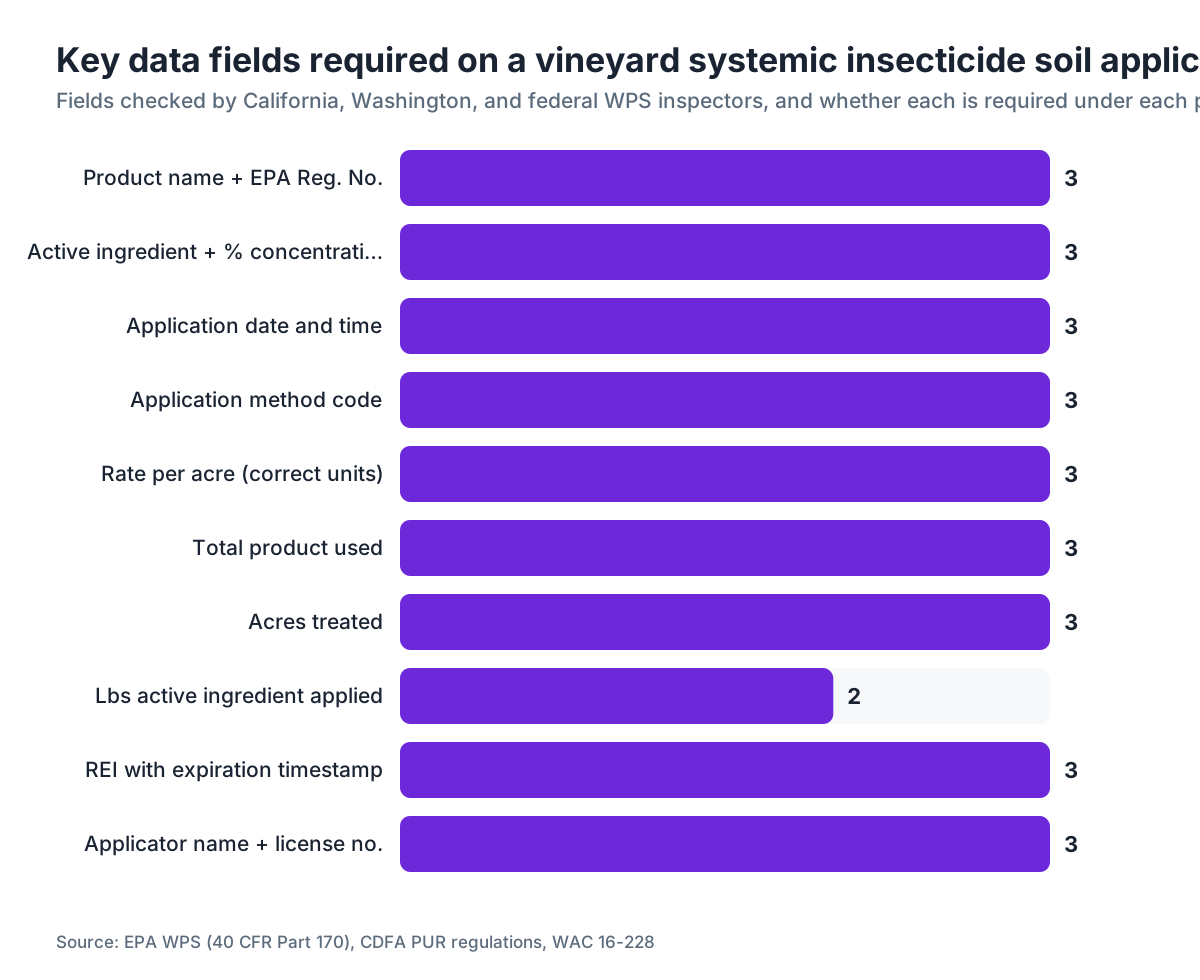
- A compliant record for a systemic insecticide soil drench or drip injection targeting mealybug needs, at minimum: product name and EPA Reg.
- No., date and location, target pest, application method, rate per acre, total product used, water volume, applicator name and certificate number, and the posted restricted-entry interval.
- Miss one field and you can trigger a violation under your state's pesticide use reporting rules.
What information is legally required on a pesticide application record?
Every pesticide record in the United States has to carry the same core fields, whether you farm in Napa, Walla Walla, or the Finger Lakes. The EPA's Worker Protection Standard (40 CFR Part 170) requires specific application details to be recorded and kept for two years [1]. Most states pile more on top of that federal floor.
Here are the fields a soil application record cannot skip:
- Product name (exactly as printed on the label)
- EPA Registration Number (on the label, formatted XXXXXX-XXXXX)
- Application date, plus start and end time if your state asks for it
- Location (block name, APN, or legal description depending on state)
- Target pest (grape mealybug, Pseudococcus maritimus, or obscure mealybug, Pseudococcus viburni, whichever you're after)
- Application method (soil drench, drip system injection, trunk drench, or subsurface injection)
- Rate per acre (fl oz/A for liquids, lbs a.i./A for the active ingredient)
- Total amount of product used (the actual quantity, more than the rate)
- Total acres treated
- Water volume per acre or total gallons of mix
- Applicator name and their license or certificate number
- Any restricted-entry interval (REI) posted, and the time it expires
California goes furthest. Under California Food and Agriculture Code Section 12981 and the regulations at 3 CCR Section 6624, growers file pesticide use reports (PURs) with their county agricultural commissioner, and the records themselves have to carry extra fields like the CDFA method-of-application code [2]. Farm in California and you treat the CDFA requirements as your baseline. The federal minimum is beside the point.
Washington requires records under WAC 16-228-1250, with a two-year retention period and a rule that records be available for inspection within 24 hours of a request [3]. Oregon's requirements under OAR 603-057-0300 look much the same.
Most vineyard managers keep records that cover the obvious fields but miss the application method code or forget to log when the REI expires. Those two gaps are the first thing a county ag inspector goes looking for.
Which systemic insecticides are registered for mealybug soil applications in vineyards?
Two active ingredients do most of the work here: imidacloprid and flupyradifurone. A third, thiamethoxam, is registered in some states but carries hard label restrictions around bloom timing because of pollinator toxicity, and several states have tightened those limits since 2020.
Imidacloprid sells as Admire Pro, Nuprid, and a stack of generics. Admire Pro (EPA Reg. No. 264-827) is the label most California and Pacific Northwest extension guidance points to [4]. It allows both soil drench and drip system chemigation. For grape mealybug, the Admire Pro rate runs 7 to 10.5 fl oz per acre as a soil drench, applied in enough water for good soil penetration, usually 100 to 200 gallons per acre depending on your soil type and organic matter [11].
Flupyradifurone (Sivanto Prime, EPA Reg. No. 264-1121) has a soil application section on its label and is registered for mealybug in grapes across most western states. It's a butenolide, not a classical neonicotinoid, so it sometimes draws different regulatory treatment. Check your county's status before you buy.
On the record, the active ingredient matters as much as the brand. Log the trade name AND the active ingredient AND the EPA Reg. No. Writing "imidacloprid" alone, with no product name and no registration number, is not a compliant record in California or Washington.
| Active Ingredient | Common Trade Name | EPA Reg. No. | Typical Soil Rate for Grapes |
|---|---|---|---|
| Imidacloprid | Admire Pro | 264-827 | 7-10.5 fl oz/A |
| Flupyradifurone | Sivanto Prime | 264-1121 | 10.5-14 fl oz/A |
| Thiamethoxam | Platinum | 100-1169 | 5-11 fl oz/A (check state bloom restrictions) |
Those rates come off the current product labels. Verify against the label in your hand, because registrations change. The EPA is blunt about this: the label is the law, and soil rates for several systemics have been amended in recent years [5].
How do you record the application method for a soil drench vs. drip injection?
This is where records get sloppy, and it matters more than people think. The application method tells an inspector, or a buyer running a supplier audit, exactly how the product entered the soil, and therefore what drift, runoff, and groundwater exposure look like.
For a soil drench (also called a bucket drench at the base of the vine), record:
- Application method: Soil drench
- Equipment type: backpack sprayer, handgun, or tractor-mounted drench rig (be specific)
- Volume delivered per vine or per acre
- Whether the application went to the root zone or the trunk base
Drip system injection (chemigation) needs more. EPA chemigation requirements and most state laws require that chemigated applications log the injection rate (amount injected per unit time), system run time, total flow through the drip, and confirmation that a working anti-backflow device was in place [12]. California requires the applicator to be present or immediately available during the entire chemigation run.
For CDFA's PUR system, the method-of-application code for soil injection via drip is "11" and for a soil drench it is "4" [2]. Submit a California PUR with the wrong code and the report still accepts it electronically, but it creates a mismatch that surfaces in an audit.
WSU Extension recommends recording soil drench applications at the vine level (gallons per vine) and then converting to gallons per acre for the official record, because that's how you prove the label rate wasn't exceeded [6]. That's good practice everywhere, not only in Washington.
What does a complete sample record entry look like for a mealybug soil application?
Here's a fully compliant entry for a soil drench. Treat it as the floor. Your state may want more.
Date: [Month/Day/Year]
Start time: [HH:MM AM/PM]
End time: [HH:MM AM/PM]
Location: Block 7, North section, APN 123-456-789, GPS coordinates [if required by state]
Crop: Wine grape, Vitis vinifera cv. Chardonnay
Growth stage at application: Pre-bloom (or bud swell, or whatever phenological stage applies)
Acres treated: 4.2 acres
Target pest: Grape mealybug (Pseudococcus maritimus)
Product name: Admire Pro Systemic Protectant
EPA Registration Number: 264-827
Active ingredient: Imidacloprid 42.8%
Application method: Soil drench, directed at root zone, 18-inch band
Rate: 10.5 fl oz / acre
Total product used: 44.1 fl oz
Concentration in mix: 10.5 fl oz product per 150 gallons water
Total water volume: 630 gallons
Equipment: John Deere 5075E with 100-gallon saddle tank and drench hose
Applicator: [Full name], CA Qualified Applicator Certificate No. [XXXXXX]
REI: 12 hours. REI expires: [Date, Time]
Wind speed at application: 4 mph from SW
Temperature: 72°F
Weather notes: Overcast, no rain forecast 48 hours
Pre-harvest interval: 7 days (per Admire Pro label)
Purchase documentation: Invoice No. [XXXX] from [Supplier], dated [Date]
A few things to notice. The applicator's certificate number sits right there next to the name. The REI is logged as a specific clock time, more than "12 hours," because workers need to know when they can walk back in, not do arithmetic. And the PHI is on the record even though this went in the soil, because systemics move into the fruit and the PHI still applies.
Running compliance across a dozen blocks gets old fast. A tool built for it, like VitiScribe (https://vitiscribe.com), can pull the product fields from a library and spit out state-formatted PURs, which cuts the odds of a blank field on a hectic spray day.
Attach the purchase receipt to the record, or cross-reference it. California requires purchase records to reconcile with use reports. Stapling the invoice at the time of application beats reconstructing it six months later from a shoebox.
How does the EPA Worker Protection Standard affect what you record for a soil application?
The Worker Protection Standard, revised in 2015 and codified at 40 CFR Part 170, covers any pesticide application on an agricultural establishment where workers or handlers might be present [1]. A soil application of a systemic insecticide gets no pass.
Under the WPS, you have to:
- Post the application information at a central location (or hand it to workers in writing) before re-entry. That means product name, EPA Reg. No., active ingredient, location treated, REI, and the date and time the REI expires.
- Keep a pesticide application record with all of the above, retained for two years.
- Provide emergency medical information (the product's Safety Data Sheet and label) to treating medical staff if a worker is exposed.
EPA guidance states that records "must be kept for 2 years" and be "immediately accessible during normal business hours" [1]. Inspectors cite that line word for word when they find records locked in a filing cabinet with no one who can open it.
Soil drenches trip people up on one point. The REI for soil-applied imidacloprid products is usually 12 hours, but the WPS central-location posting requirement kicks in the moment the application starts. If your crew is hand-harvesting an adjacent block during or right after your drench next door, you need a physical or written notice posted before they clock in that day.
Cornell's Pesticide Management Education Program lays out WPS posting rules and what "central location" means on a farm with several entry points [7]. Print their factsheets and keep them in the spray binder.
How long do you need to keep pesticide application records for soil-applied insecticides?
The federal minimum is two years from the date of application, per the WPS [1]. States vary, and wine grape production drags in extra timelines tied to organic certification, third-party audits, and winery supplier contracts.
California: county ag commissioner records on file for two years minimum, but many sustainable-program contracts (like California Sustainable Winegrowing Alliance certification) want three years for audit purposes [8].
Washington: two years, with records available within 24 hours of an inspection request [3].
Oregon: two years.
New York: five years for commercial applicators applying for hire; two years for private applicators on their own land.
Lodi Rules and CCOF organic programs often want five years, because auditors want an unbroken chain of input history. Transition a block to organic and the three-year pre-certification window means your old conventional spray records are exactly what proves what did (and didn't) go on the ground.
Keep everything five years no matter what your state's minimum says. Storage is cheap. Losing an organic certification because you can't produce a record from 30 months back is not.
Do you need to report a soil systemic application to California's county ag commissioner?
Yes, if you farm in California. The Pesticide Use Reporting (PUR) system requires growers to report every application to their county agricultural commissioner by the 10th of the month following the application [2]. Soil-applied systemics count the same as foliar sprays. There's no exemption for application method.
The report has to carry the CDPR commodity code for grapes, the site code, the county and township-range-section or GPS coordinates, the pounds of active ingredient applied (not the product volume), and the method-of-application code. CDFA makes all PUR data public, which growers sometimes forget: neighbors, environmental groups, and reporters can pull your application history.
Work the math for a 4.2-acre soil drench at 10.5 fl oz Admire Pro per acre:
- Total product: 44.1 fl oz
- Imidacloprid is 42.8% a.i. by weight
- Admire Pro density is roughly 9.2 lbs/gallon (confirm on the current SDS)
- 44.1 fl oz = 2.756 lbs product
- Pounds a.i. = 2.756 lbs x 0.428 = about 1.18 lbs a.i.
That pounds-of-active-ingredient number is required on the California PUR, and skipping the conversion is one of the most common errors. Report volume alone and your report gets rejected or flagged [2].
Small growers ask whether a partial acre needs reporting. It does. California sets no minimum acreage threshold. One vine counts.
What are the common record-keeping mistakes that lead to violations?
Pull the extension guidance from UC Davis, WSU, and Cornell, add CDFA's enforcement summaries, and the same mistakes keep showing up.
Missing EPA Registration Number. People write "Admire Pro" and quit. The Reg. No. is what pins down the exact formulation and label version. Without it you can't prove which label governed the application.
Rate in the wrong units. If the label rate is fl oz per acre and you logged ounces per 100 gallons of water, those are different things, and an inspector can't verify compliance without a conversion that may not even work out.
Logging block size instead of acres treated. Your Block 7 might be 6 acres, but if you drenched 4.2 of them, record 4.2. Logging the full block overstates use and mismatches your purchase records.
Writing "REI: 12 hours" and stopping. That's incomplete. "REI expires 5:30 PM on [date]" is what workers and inspectors actually use.
No purchase receipt. California's reconciliation audits compare what you reported applying against what your invoices show you bought. Can't show the purchase, and it looks like you're applying product you didn't legally acquire.
Filling out the log a week later from memory. Dates and rates drift. The audit trail gives it away when the ink color changes mid-page, or a digital record's "created" timestamp doesn't match the application date.
UC Davis IPM has published record-keeping guidance for California vineyards that walks through each of these with examples [4].
How do timing and phenological stage affect what you record for mealybug soil applications?
Timing matters agronomically and legally. A soil-applied systemic needs time to move through the root system, into the xylem, and out to the shoot tips and leaf tissue. UC Davis IPM data suggests imidacloprid soil drenches go on at or just before bud swell, so the concentration peaks in new shoot tissue right when mealybug crawlers emerge in late spring [4]. That timing also keeps systemic levels lower at bloom, which matters for pollinators.
On the record, document the phenological growth stage at application. Use a standard scale. The modified E-L (Eichhorn-Lorenz) scale is the wine grape standard and shows up on most state spray forms. Bud swell is E-L stage 1-3, the usual target window for pre-bloom soil systemics against mealybug.
Why log the stage beyond agronomy? Two reasons. First, some county variance programs and Endangered Species Act protections (in certain California counties) restrict neonicotinoid applications to specific phenological windows, or ban them outright during bloom in designated areas. Recording the stage proves you stayed inside the permitted window. Second, if a residue violation ever surfaces at harvest, the stage record helps rebuild the timeline for PHI compliance.
Treating near a flowering cover crop? Log that too. Several California counties now require cover crops to be mowed, or drift controls to be in place, before systemic applications, and the record of how you handled that is part of your compliance file.
How should you store and organize spray records for easy audit access?
The WPS says records must be "immediately accessible during normal business hours" [1]. In practice, an inspector who shows up unannounced should see any record in a few minutes, not after you drive back to the house, hunt down the binder, and flip through unlabeled pages.
Paper works if it's organized. A three-ring binder per calendar year, records filed by date and tabbed by block, is the minimum setup that functions. Keep a running index up front: application date, block, product, page number. Clip purchase receipts to the matching application record. Store the binder somewhere locked but reachable in the winery or shop, not in your truck or the kitchen.
Digital is faster to search and won't burn up in a shop fire. If you use a spreadsheet, hold a consistent column structure and never delete a row, even to fix a mistake. Correct an error with a new annotated row, not an overwrite. Keep a PDF export of each month's records on a separate backup drive, because a cloud outage on inspection day is a real headache.
For multi-block operations running several applications a week, software built for vineyard compliance, like VitiScribe (https://vitiscribe.com), tracks records by block and generates the formatted reports California, Washington, and Oregon commissioners accept. That earns its keep when you have six blocks, two crews, and need to confirm the REI on Block 7 before the pruning crew goes in tomorrow morning.
For how vineyard operations tie into wider field management, see our coverage of vineyard management systems and practices.
Do organic or sustainable certification programs have additional record-keeping rules for past pesticide use?
Yes, and this is where growers get burned during the transition to organic. USDA National Organic Program regulations require a three-year period free of prohibited substances before a field can be certified organic [9]. Proving that three-year history means producing spray records from the conventional years. Apply imidacloprid soil drenches now and think about organic certification in five years, and today's records have to survive.
The California Sustainable Winegrowing Alliance self-assessment and third-party programs like SIP Certified ask applicants for pesticide use records covering the prior three years [8]. They look at active ingredients, application frequency, and whether you considered reduced-risk alternatives for the high-risk chemistries.
Lodi Rules certification runs on the Lodi Winegrape Commission's IPM scorecards, which penalize certain neonics at certain growth stages, and your spray records are what the third-party verifier checks [10]. Incomplete records mean no credit for the compliant applications you actually made.
Here's the takeaway for any grower who thinks certification might ever be on the table: keep records now as if you'll defend every application five years out. Because you might have to.
What equipment calibration records do you need to keep alongside the application record?
The application record proves what you meant to apply. Calibration records prove what you actually applied. This matters most for soil drenches and drip injection, where a delivery-rate error means either a phytotoxic overdose or a useless underdose.
For a drench rig, keep a calibration log showing:
- Date of calibration
- Nozzle type and orifice size
- Operating pressure at the nozzle (psi)
- Output volume per minute (measured, not assumed)
- Ground speed if tractor-mounted
- Gallons delivered per vine or per 100 feet of row at working speed
For drip injection (chemigation), the injection pump calibration record should show:
- Pump make, model, and serial number
- Calibrated injection rate (ml/min or fl oz/min)
- System flow rate at the time of injection
- Injector ratio (ppm active ingredient in the drip water, if relevant)
- Confirmation of a backflow preventer function test
WSU Extension recommends calibrating soil application equipment at the start of each season and after any repair, and keeping calibration records with the spray log rather than in a separate equipment file [6]. That way anyone reviewing the spray record can cross-check the calibration on the spot.
You don't have to paste the full calibration log into every entry. Reference the calibration date instead: "Equipment calibrated [Date], calibration log on file."
Frequently asked questions
What EPA registration number format should I record for a systemic insecticide?
EPA Registration Numbers appear on the label as XXXXXX-XXXXX, where the first set is the registrant company number and the second is the product number. For Admire Pro, that's 264-827. Record it exactly as printed on the label you used, because versions with different Reg. Nos. can carry different use requirements. Never guess or abbreviate it.
Can I record a soil systemic application on the same form I use for foliar sprays?
Yes, as long as your form has an application method field where you can enter 'soil drench' or 'drip injection.' The required data fields are largely the same. Soil applications add water volume per acre for penetration, and chemigation adds injection rate and anti-backflow device confirmation. A single multi-purpose form works fine as long as it's complete.
How do I calculate pounds of active ingredient for the California PUR system?
Divide total fluid ounces of product by 128 to get gallons, multiply by the product density in pounds per gallon, then multiply by the active ingredient percentage as a decimal. For Admire Pro at 42.8% a.i. and density around 9.2 lbs/gallon: (fl oz / 128) x 9.2 x 0.428 = lbs a.i. applied. Confirm density from the current SDS, since it can vary slightly between lots.
Does the pre-harvest interval apply to soil-applied systemic insecticides?
Yes. Systemic insecticides move from the soil through the vascular system into fruit tissue. The label PHI applies from the date of application regardless of method. For Admire Pro soil applications in grapes, the PHI is 7 days. Record the PHI and the earliest legal harvest date on your spray record at the time of application so there's no ambiguity later.
What's the restricted-entry interval for imidacloprid soil applications in vineyards?
The REI for Admire Pro (imidacloprid) is 12 hours for most scenarios, including soil drench. Workers cannot enter the treated block for 12 hours after the application ends unless they wear the PPE the label specifies. Post the REI start time and expiration time at the central location before workers begin any activity that day, per the EPA Worker Protection Standard at 40 CFR Part 170.
Do I need to report a soil systemic application if I treated less than one acre?
In California, yes. There is no minimum acreage threshold for pesticide use reporting. Any application of a registered pesticide on agricultural land must be reported to the county agricultural commissioner by the 10th of the following month. Other states differ, so check your local rules. Washington and Oregon do not require grower-level PUR submission the way California does, but records still have to be kept.
How should I record a mealybug soil treatment that used the drip irrigation system?
Record it as a chemigation application and include the method code (code 11 in California's system). Beyond the standard fields, log the injection pump model and calibrated injection rate, total drip run time, estimated gallons delivered per acre, and written confirmation that your anti-backflow device was functional before injection. Federal and state chemigation rules require the applicator on-site during the entire injection run.
What records do I need to keep if I hire a pest control adviser to recommend the application?
In California, licensed pest control advisers must provide a written recommendation for any restricted-use pesticide application, and you keep a copy with your spray records. Imidacloprid products like Admire Pro are restricted-use in California, so a PCA written recommendation is required before purchase or application. The PCA's license number must appear on the recommendation document.
How do I handle a record if I had to stop a soil application mid-block due to equipment failure?
Record what was actually applied, not what you planned. Note the specific rows or portion treated, the time the application stopped, total product dispensed to that point, and why you stopped. Create a separate record for the completion application on the later date. Do not merge the two dates into one entry. Partial-application records are common and completely legitimate as long as they reflect what happened.
Are there specific record-keeping differences for soil systemic applications near waterways?
Yes. If your block sits inside a buffer zone set by the label or a local ordinance, record that you identified the buffer, measured the distance to the nearest water body, and confirmed the application stayed within allowed areas. Some imidacloprid labels have specific buffers from water bodies for aquatic toxicity. California's Department of Fish and Wildlife and CDFA both offer guidance for applications near waterways, and commissioners in sensitive watersheds may want extra documentation.
How long after a soil systemic application should I keep the product label on file?
Keep a physical or digital copy of the label as it existed at the time of application for at least as long as you keep the spray record. That's two years federally, but five years is safer for organic transition and third-party audits. Label language changes between registration cycles, and if a compliance question comes up, you want the label from the day you applied, not a later version with different rules.
Can a vineyard worker fill out the spray record, or does it have to be the licensed applicator?
Any knowledgeable person with access to the correct information can complete the record, but it must accurately reflect the application. In California, the licensed pest control operator or qualified applicator is responsible for the record's accuracy and must be named with their license number on the record. If someone else fills it out, the applicator should review and sign it. Unsigned or unattributed records are a common deficiency.
Do I need a separate record for the cover crop mowing I did before the soil application?
No separate pesticide record is needed for mowing, since it's a cultural practice, not a pesticide application. Some county requirements and sustainable certification programs do ask you to document pre-application site prep. A short note in the spray record, such as 'cover crop mowed to soil level prior to application, date X,' covers it in 30 seconds and protects you if pollinator exposure questions come up later.
What's the difference between private and commercial applicator record-keeping for vineyard soil treatments?
Private applicators, meaning growers applying on land they own, operate, or work on, have a two-year federal retention requirement. Commercial applicators applying for hire face stricter rules in most states: longer retention (up to five years in some), more detailed equipment records, and in California, records available within 24 hours of any inspector request. Know which category fits your operation and whoever does the applying.
Sources
- EPA, Worker Protection Standard (40 CFR Part 170): WPS requires pesticide application records to be kept for two years and be immediately accessible during normal business hours; records must include product name, EPA Reg. No., active ingredient, location, REI, and applicator information.
- California Department of Food and Agriculture, Pesticide Use Reporting: California requires pesticide use reports to be submitted to the county agricultural commissioner by the 10th of the month following each application month, with no minimum acreage threshold and with pounds of active ingredient as a required field.
- Washington State Legislature, WAC 16-228-1250, Pesticide Record Keeping: Washington requires pesticide application records to be kept for two years and available for inspection within 24 hours of a request.
- UC Davis Integrated Pest Management Program, Grape Mealybug: UC Davis IPM recommends soil application of imidacloprid at or just before bud swell for maximum systemic concentration in new shoot tissue coinciding with mealybug crawler emergence; guidance covers record-keeping for compliant California applications.
- EPA, Pesticide Labels (Office of Pesticide Programs): The EPA states that the pesticide label is a legally binding document and applicators must follow all label directions; soil application rates for systemic insecticides must be recorded as specified on the label in use at time of application.
- Washington State University Extension, Pesticide Record Keeping for Agricultural Producers: WSU Extension recommends recording soil drench applications at the vine level and converting to gallons per acre for official records to verify label rates were not exceeded; equipment calibration records should be kept with spray logs.
- Cornell University, Pesticide Management Education Program: Cornell PMEP provides detailed guidance on WPS posting requirements for agricultural establishments, including what constitutes a 'central location' for farms with multiple entry points.
- California Sustainable Winegrowing Alliance, SIP Certified Standards: California Sustainable Winegrowing Alliance and SIP Certified third-party verification programs require applicants to provide pesticide use records covering the prior three years, reviewing active ingredients and application frequency.
- USDA National Organic Program (7 CFR Part 205): USDA NOP regulations require a three-year transition period free of prohibited substances before a field can be certified organic, necessitating the retention of conventional spray records covering the pre-certification period.
- Lodi Winegrape Commission, Lodi Rules Certification Program: Lodi Rules IPM scorecards penalize use of certain neonicotinoids at specific growth stages, and third-party verifiers use spray records to confirm compliant applications during certification review.
- EPA, Pesticide Registration (Admire Pro, EPA Reg. No. 264-827, Bayer CropScience): Admire Pro (imidacloprid 42.8%) is registered for soil drench and drip system chemigation in grapes at 7 to 10.5 fl oz per acre for mealybug control, with a 12-hour REI and 7-day PHI.
- EPA, Pesticides (chemigation application requirements): EPA chemigation regulations require that drip-injected pesticide applications be logged with injection rate, system run time, total flow, and confirmation of a functional anti-backflow device.
Last updated 2026-07-10