How to record a veraison assessment and timing in block management records
TL;DR
- A veraison assessment record needs four things: the date you walked the block, the percentage of berries showing color change (sampled from at least 100 berries per block), vine row and position notes so you can track within-block variability, and a projected days-to-harvest estimate.
- Record it the same day you scout.
- Most blocks reach full veraison 45 to 65 days before target harvest.
What is veraison and why does recording it matter for block management?
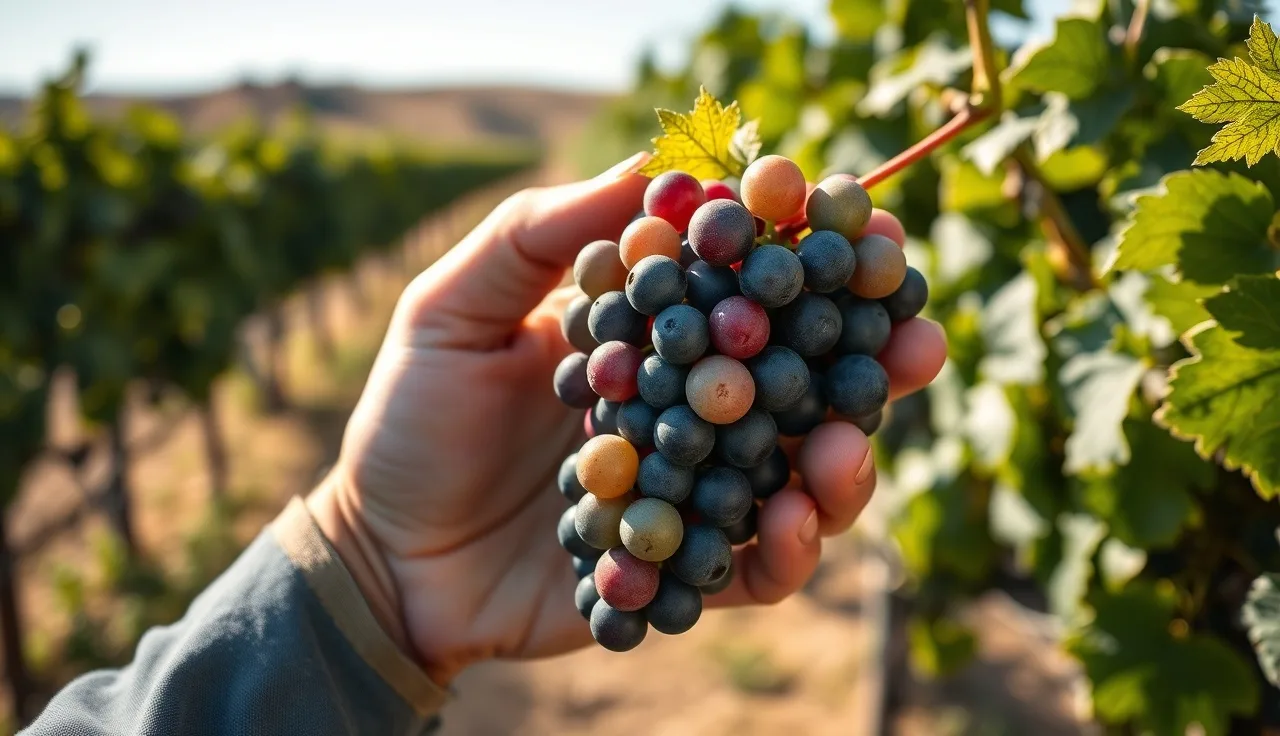
Veraison is the shift from hard, green, acidic berries to soft, colored (in reds), sugar-loading fruit. It's not one moment. It's a window, and that window can stretch 10 to 21 days across a single block depending on vine age, rootstock, and canopy density. [1]
The entry you make at veraison carries more signal than almost anything else you log all season. It anchors your harvest date projection. It tells you whether a block is running early or late against prior years. And it gives you documented proof of crop condition if you ever have to justify a thin crop to a wine buyer or a crop insurance adjuster.
Skip the formal record, or scrawl something vague like 'veraison starting,' and you're left with nothing you can act on. A structured assessment gives you a percent-complete number you can graph over time, compare block to block, and use to schedule your next scout.
When should you walk a block to assess veraison?
Walk the first formal count when you spot the first berry anywhere in the block showing color (reds) or softening and translucence (whites). That's 0% veraison. From there, count every 3 to 5 days until you hit 100%.
Two or three assessments usually build a useful progression curve. Washington State University Extension recommends scouting red varieties when 5 to 10% of clusters show visible color change, then again at roughly 50%, and again at full veraison. [2] Walk once and call it done, and you have a snapshot with no trend.
Timing drives more than harvest math. It sets your window for leaf removal, green thinning, and pre-harvest spray cutoffs. The EPA Worker Protection Standard requires pesticide application records to carry the product's restricted-entry interval (REI), and a solid veraison record is how you turn a guessed harvest date into a defensible one on late-season sprays. [3] Blow the REI calculation because you eyeballed veraison timing, and that's exactly the kind of miss that surfaces on an inspection.
How do you count percent veraison accurately?
The standard field method is a 200-berry count, though plenty of operations run 100 berries when time is tight. Cornell's viticulture extension recommends a minimum of 100 berries pulled at random from multiple positions in the block, from different cluster zones (shoulder, mid-cluster, tip) to keep selection bias out. [4]
Here's the protocol that holds up:
- Pick your sample vines before you start walking. Choose at least 10 vines spread across the block, covering the ends, the middle rows, and any known problem areas like low spots or heavier canopy.
- At each vine, detach 10 to 20 berries at random from different clusters and different positions on those clusters.
- Count colored or softened berries against total berries handled.
- Divide colored count by total count, multiply by 100. That's your percent veraison.
One shortcut that actually holds water: skip the picking and count external appearance on the cluster. Walk 10 vines, look at 10 clusters per vine, estimate the fraction by eye. It's faster and it drifts. Two people walking the same block the same day with the visual method can land 10 to 15 percentage points apart. The berry-detach count repeats better.
White varieties are trickier. Color change is subtle, so you're hunting for translucence and softness. Press a berry lightly. If it yields, it's in veraison. White assessments are hard to standardize, and nobody has strong published data on inter-rater reliability for white veraison counts specifically. UC Davis Cooperative Extension points to physical softening as the primary reliable indicator. [5]
What fields belong in a veraison assessment record?
A complete record carries more fields than most people bother with. Here's what you actually need:
| Field | What to record | Example |
|---|---|---|
| Block ID | Your internal block name or number | Block 7-Cab |
| Variety | Grape variety | Cabernet Sauvignon |
| Assessment date | Calendar date, not 'mid-August' | 2024-08-14 |
| Evaluator name | Who walked the block | J. Morales |
| Percent veraison | Berry count result | 42% |
| Sample size | How many berries counted | 150 berries |
| Sample vine count | How many vines sampled | 12 vines |
| Within-block variability | Any zones running ahead or behind | NW corner ~60%, SE corner ~25% |
| Temperature conditions | Heat or cold spell context | 104°F spike prior 3 days |
| Canopy notes | Dense, open, flag any problems | Dense on rows 4-7, shading berries |
| Previous veraison date | From last season's record | 2023-08-09 |
| Projected full-veraison date | Your estimate | ~2024-08-21 |
| Projected harvest window | Based on heat accumulation | Sept 18-25 (est.) |
The within-block variability field is the one people skip and later regret. A block reading 45% average can hide a northwest corner at 70% and a southeast corner at 20%. Miss that, and you'll either pick too early for the lagging section or too late for the leading one. Some managers split those zones into separate records, which is even better.
If you keep records digitally, VitiScribe has block-level templates with the variability fields built in, plus auto-logged assessor and timestamp, which kills a few common transcription errors.
How do you project harvest timing from a veraison record?
Two tools do most of the work: growing degree days (GDD) and the historical days-from-veraison average for your site and variety.
GDD-based projection: Track cumulative degree days from the date of 50% veraison using a base temperature of 50°F (10°C), the standard base in California viticulture research. [5] Most red varieties in warm climates pile up roughly 700 to 1,000 GDD between 50% veraison and their harvest brix target (typically 23 to 26°Brix for reds). Your own historical records calibrate this best because they reflect your dirt, not somebody else's.
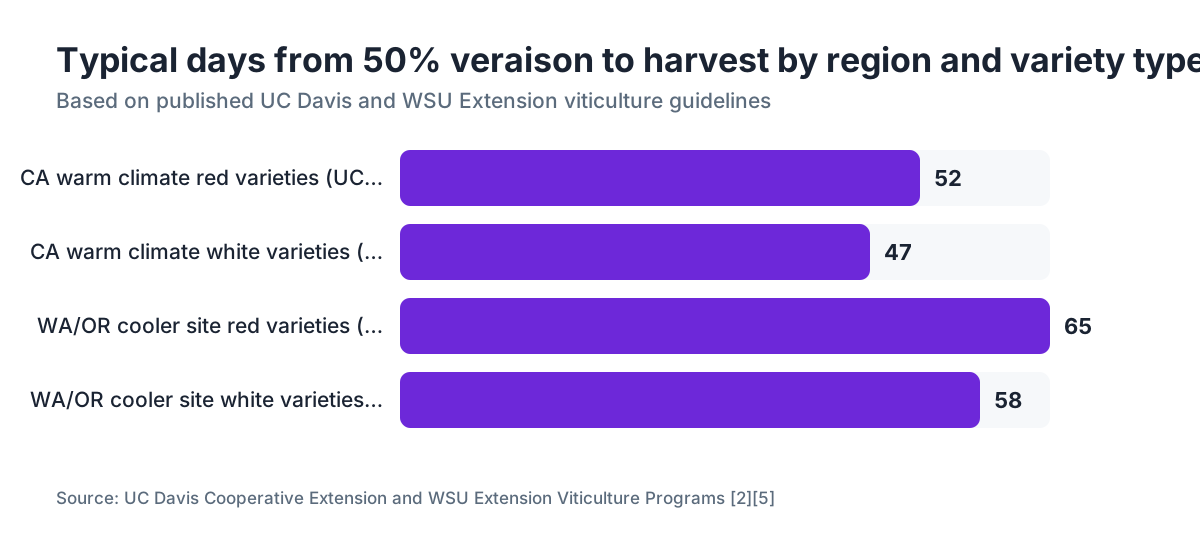
Days-from-veraison averages: UC Davis research puts the typical range at 45 to 60 days from full veraison to harvest for most wine grape varieties in California. [5] Cooler Washington sites can push that to 60 to 70 days. Treat these as order-of-magnitude guides, not precision.
Here's the honest part. Neither method beats 5-plus years of your own records showing veraison date against actual harvest date. That trend line, site-specific and variety-specific, is worth more than any published table. Start building it now even if this is your first season of formal tracking.
Log your GDD checkpoints right alongside the veraison record. On the same document, note: 'GDD from 50% veraison as of [date]: 340.' Update it weekly. That running count is your real prediction engine.
How does within-block veraison variability affect your harvest decision?
This is where the record earns its keep. If your assessment shows rows 1 to 5 hitting 100% veraison a full week ahead of rows 12 to 18, you know going in that those sections will carry different brix and acid profiles at any given harvest date.
Your options: harvest in two passes, delay for the lagging section and give up some quality in the leading one, or accept the blend and manage it in the cellar. None of those is the obvious right answer for every block. But you can only choose on purpose if you have the variability data.
WSU Extension notes that within-block variability in veraison timing often tracks soil texture differences, vine age gaps from replanting, and irrigation zone boundaries. [2] Logging the zone gives you the starting point for diagnosing why the variability exists, more than that it does.
Run the records across a few seasons. If the same northwest corner keeps lagging, that's a management problem worth solving, through targeted irrigation, canopy work, or row-end flags in your harvest plan.
What format should veraison records be kept in for compliance purposes?
For compliance, completeness and accessibility beat format every time. California's Pesticide Use Reporting (PUR) system and the EPA Worker Protection Standard both require you to tie pesticide applications to crop context, and auditors want harvest date estimates traceable to real field observations, not guesses. [3][6]
Paper is legal everywhere. Handwritten field notes in a bound log with dated entries satisfy the record-keeping rules of the WPS and the state ag departments in California, Washington, and Oregon. The catch is querying it. Finding last season's veraison record for Block 12 in a box of field notebooks takes 20 minutes. A spreadsheet with a basic table takes 30 seconds to filter.
At minimum, keep a spreadsheet with one row per assessment event and the columns from the table above. Back it up somewhere off the farm office. If you run more than a handful of blocks, a dedicated field record system makes the cross-block comparisons and year-over-year trending far easier.
Oregon's Department of Agriculture and Washington's Department of Agriculture both require pesticide application records kept for at least 3 years and available for inspection. [6][7] Veraison records aren't independently mandated, but they're part of the paper trail behind compliant spray decisions, so holding them for the same 3-year window is a reasonable floor.
How do heat spikes and cool periods affect veraison timing records?
Temperature context belongs in the record because it explains the anomalies. A block that hits 50% veraison two weeks ahead of its historical average didn't turn into a different vineyard overnight. Something happened. Write down what.
Record the highs and lows for the 7 to 10 days before the assessment. If a heat event landed, note it. If an unusually cool stretch may have stalled progression, note that too. UC Davis research shows that extreme heat (over 95°F/35°C) during early veraison can cause uneven berry development and delay full color change even while sugar accumulation continues, which means your percent-veraison count and your brix curve can split apart in a heat year. [5]
This is the detail that makes a record genuinely useful in hindsight. Pull the record five years later, see a block ran two weeks early, and you want to know instantly whether that was a structural pattern or a one-off weather response.
Link your veraison records to the season's weather data. Even a bare reference like 'see 2024 weather log, week 33' beats nothing.
How do you record veraison for organic and certified vineyards?
Certified organic operations under USDA National Organic Program standards must keep records that show compliance with their organic system plan, including records documenting crop development and any interventions. [8] Veraison records feed that requirement because they document the timing behind any allowed inputs applied after veraison.
There's no organic-specific format for veraison assessment records. The same fields above work fine. What matters is a coherent chain: you observed veraison on this date, you applied (or didn't) X product on this later date inside the pre-harvest interval, and your crop timing supports that call.
Biodynamic operations sometimes ask for phenological records (flowering, fruit set, veraison, harvest dates) as part of the farm diary. The same structured record covers it. You may just need to export it in a format your certifier's file wants.
Keep organic and conventional block records separated and clearly labeled if you run both. Cross-contamination questions are far easier to answer when your records show distinct block-by-block histories.
What's a realistic veraison recording schedule for a 50-acre mixed-variety vineyard?
The common miss is treating veraison as a single event and walking the whole vineyard once. On 50 acres with five or six varieties, your earliest blocks (often Chardonnay or Pinot Noir) sit at 70% while you're still waiting on Cabernet to start.
A realistic schedule for a mid-sized operation:
- Set calendar alerts for each variety off your historical records, offset 2 weeks before expected veraison start.
- Start scouting each variety block on its own when the first visual change shows.
- Run formal counts at roughly 0 to 10%, 40 to 60%, and 90 to 100% for each block.
- Log each assessment the day it happens, not at week's end.
For a 50-acre operation with 6 blocks, that's roughly 18 field assessment events across a 4 to 6 week veraison window. Budget 30 to 45 minutes per block for a proper 150-berry count with notes. Call it 9 to 13 hours of scouting labor for the season, before record entry.
If that's over your labor budget, prioritize the 50% assessment above everything. That single, well-documented data point gives you the GDD anchor for harvest projection and a clean comparison against prior years.
How do historical veraison records help you plan future seasons?
Year-over-year veraison records are the raw material for characterizing your site. Five years of consistent records gets you something genuinely useful: a normal distribution of veraison dates per block, variability ranges, and correlation with weather patterns.
Concretely, you can answer questions like these. Does Block 4 Syrah run 8 to 10 days ahead of Block 7 Syrah every year? Is that gap stable across hot and cool years, or does it collapse in a warm one? Which blocks show the most within-block variability, flagging them as candidates for canopy work or irrigation zone changes?
Cornell's viticulture program has documented that veraison date is one of the most reliable phenological indicators for predicting harvest timing, with higher predictive power than many other mid-season metrics. [4] That value only shows up if you have the history.
Practical tip: keep a simple summary table apart from your detailed assessment records. One row per variety per year, columns for first-color date, 50%-veraison date, full-veraison date, and actual harvest date. Update it each fall. That one table becomes a management asset that outlives staff turnover and speeds up onboarding.
For managing multiple blocks across a larger vineyard operation, consistent record structure matters more than the tool. A system like VitiScribe can generate that summary table from block-level entries, which saves the manual compilation at season end.
Frequently asked questions
What percentage of veraison do I record if berries are at different stages on the same cluster?
Count each berry individually, not each cluster. A cluster with 6 of 10 berries showing color contributes 6 colored berries and 4 uncolored to your total. Cluster-level averaging inflates your percentage because the most visible clusters tend to be the most advanced. Stick to the berry-by-berry count across your full 100 to 200 berry sample.
Do veraison assessment records count as legally required records under the EPA Worker Protection Standard?
Veraison records themselves aren't mandated by the WPS. But the WPS requires pesticide application records that include the crop and the product's restricted-entry interval, and those records need to connect to a harvest date estimate. A documented veraison assessment is the defensible basis for that estimate, which makes it an important supporting record even when it isn't required on its own. [3]
How many vines should I sample per block for a veraison count?
Cornell Extension recommends at least 10 vines spread across different positions in the block, chosen before you start walking so you don't drift toward the most advanced or most colorful vines. [4] For blocks with known variability zones, add 2 to 3 extra vines in each distinct zone. More vines are always better. The floor is 10.
Can I use drone or remote sensing imagery instead of a berry count for veraison records?
Multispectral drone data can show canopy-level NDVI changes around veraison and helps map within-block variability. It doesn't substitute for a berry-count percentage in your records because it measures canopy reflectance, not berry color change directly. Use imagery to guide where you focus your ground-truth berry counts, not to replace them.
How far in advance of harvest does veraison typically occur?
For most wine grape varieties, full veraison lands 45 to 65 days before target harvest under normal conditions. UC Davis Cooperative Extension puts the California average at 45 to 60 days for red varieties in warm climates. [5] Cooler regions in Washington and Oregon often see 60 to 70 days. Your own multi-year records will calibrate this range for your specific site and varieties better than any published average.
What's the difference between veraison start and full veraison, and which date should I record?
Veraison start is when you first spot any color change, typically 0 to 5% of berries. Full veraison is 100% of berries showing color change or softening. Record both if you can. The 50% veraison date is the most common reference point in viticulture research and harvest-timing models because it pegs more consistently than the ambiguous endpoints. When in doubt, record the 50% date as your primary anchor.
Should veraison records be kept separately from spray records?
Keep them in the same block management file but as distinct record types. Spray records have their own required format and retention rules (3 years minimum in California, Washington, and Oregon). Veraison assessments are crop-observation logs. Filing them together by block makes it easy to show the timeline from veraison observation to any later spray decision, which helps in an audit.
How do I record veraison for a block that has been replanted in patches with younger vines?
Record the replanted sections separately, even within the same block boundary. Young vines often hit veraison earlier or later than mature vines on the same rootstock, and the pattern can surprise you. Flag the vine age in your record and note which rows are replanted. This data helps you decide whether to treat them as a separate pick zone at harvest.
Is there a standard form or template for veraison assessment records from a university extension program?
WSU Extension and UC Cooperative Extension both publish general vineyard scouting forms you can adapt for veraison assessment. [2][5] Neither publishes a veraison-specific mandated template because the format isn't legally required. Most managers build their own from the fields they track. The fields that matter: date, block, evaluator, percent veraison, sample size, and variability notes.
How does veraison timing relate to pest and disease management record-keeping?
Veraison marks the shift from shoot and canopy focus to fruit-quality and disease-pressure focus. Botrytis risk climbs sharply after veraison as berries soften. Your veraison date should trigger a review of your fungicide program and pre-harvest interval math. Documenting the link between 'veraison observed August 14' and 'last Botrytis application August 18, 14-day REI, projected clear September 1' creates a traceable compliance chain.
What growing degree day base temperature should I use when projecting harvest from my veraison record?
Base 50°F (10°C) is the standard for wine grape GDD calculations in North American viticulture research, used by UC Davis, Cornell, and WSU extension programs. [2][4][5] Some researchers use base 41°F (5°C) for full-season modeling, but for the veraison-to-harvest window, the 50°F base is more widely validated and lets you compare your projections against published varietal benchmarks.
Can veraison assessment records affect crop insurance claims?
Yes, potentially. USDA Risk Management Agency crop insurance policies for wine grapes may ask for documented evidence of crop stage and condition at various points in the season, especially when a weather event causes damage near harvest. A dated, signed veraison assessment showing crop status before a damaging frost or heat event strengthens a claim. Verbal recollections are much harder to support. Keep your records at least 5 years for this reason.
How should I handle veraison records when a new vineyard manager takes over mid-season?
Require a documented handoff that includes every block assessment record completed to date, along with the spray logs. The incoming manager needs the veraison data to project harvest timing correctly. If records live in a paper log, photocopy or scan everything. If they're digital, transfer access before the previous manager's credentials get revoked. A veraison record with no identified evaluator is hard to validate later.
Sources
- UC Cooperative Extension, Grape Pest Management Guidelines: Veraison can extend 10-21 days across a single block depending on vine age, rootstock, and canopy density
- Washington State University Extension, Viticulture and Enology: WSU Extension recommends scouting red varieties when 5-10% of clusters show visible color change, then at 50% and at full veraison; GDD base 50°F standard for Pacific Northwest
- EPA Worker Protection Standard for Agricultural Pesticides: WPS requires pesticide application records to include the product's restricted-entry interval and supports legally compliant pre-harvest spray scheduling
- Cornell Cooperative Extension, Viticulture Program: Cornell recommends a minimum of 100 berries sampled randomly from multiple positions; veraison date is one of the most reliable phenological predictors of harvest timing
- UC Davis Cooperative Extension, Viticulture and Enology: UC Davis puts the California average at 45-60 days from full veraison to harvest for red varieties; physical softening is the primary reliable indicator for white variety veraison; extreme heat over 95°F can delay full color change while sugar accumulation continues; GDD base 50°F used in California viticulture research
- California Department of Pesticide Regulation, Pesticide Use Reporting: California Pesticide Use Reporting requires pesticide application records connected to crop context; records must be retained and available for inspection
- Washington State Department of Agriculture, Pesticide Management Division: Washington pesticide application records must be kept for a minimum of 3 years and be available for inspection
- USDA National Organic Program, Organic Regulations: Certified organic operations must maintain records demonstrating compliance with their organic system plan, including records showing crop development and any interventions
- USDA Risk Management Agency, Crop Insurance for Grapes: USDA RMA crop insurance policies for wine grapes may require documented evidence of crop stage and condition, supporting veraison records as part of claim documentation
Last updated 2026-07-11