How to record a vineyard drainage improvement project for tax deductions
TL;DR
- Most vineyard drainage work is a capital improvement depreciated over 15 years as a land improvement under MACRS.
- Some costs qualify for Section 179 expensing or bonus depreciation, and Schedule F farmers may deduct up to 25% of farm income under Section 175.
- Keep project invoices, a site map, dated photos, and a written business-purpose note.
- Recording each cost component separately is what protects you in an audit.
Are vineyard drainage costs tax-deductible or do they have to be capitalized?
Most vineyard drainage work is a capital improvement, not a same-year write-off. You depreciate the cost over time rather than expensing the whole thing in year one. The full answer has enough nuance that getting it wrong costs real money, either by depreciating something you could have expensed, or by expensing something the IRS expects you to capitalize.
The IRS draws the line at whether an expenditure "improves" property (capitalize it) or merely "repairs" it (deduct it now). Treasury Regulation 1.263(a)-3, finalized in 2014, lays out the framework: a cost must be capitalized if it results in a betterment, a restoration, or an adaptation to a new or different use. A brand-new subsurface tile drainage system in a block that used to stay wet almost always clears the betterment bar. Cleaning a clogged existing drain line probably does not. [1]
Agricultural drainage gets its own lane in the tax code. IRC Section 175 lets farmers deduct soil and water conservation expenditures in the year paid, up to 25% of gross income from farming, with a five-year carry-forward for any excess. Drainage ditches, earthen berms, and grading done "primarily for the purpose of soil or water conservation" can qualify. The catch is that Section 175 is for farmers filing Schedule F, and many vineyard owners are classified differently depending on how they operate. [2]
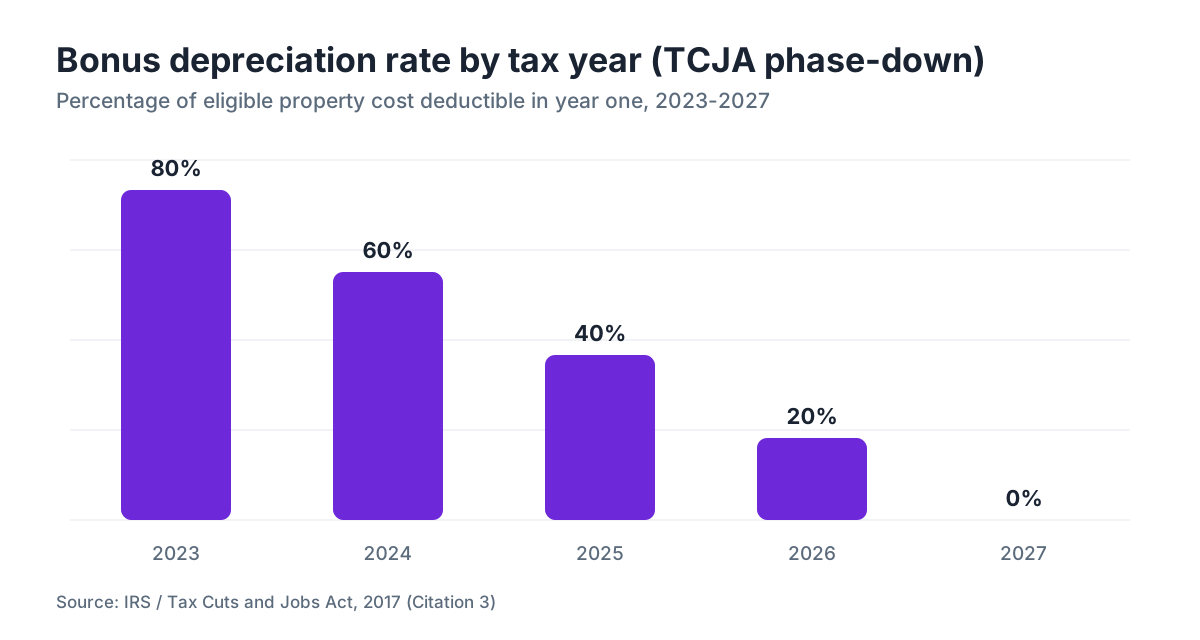
No Section 175? Your next option is a 15-year land improvement under MACRS (Asset Class 00.3), then layering Section 179 expensing or bonus depreciation on the eligible pieces to pull the deduction forward. The Tax Cuts and Jobs Act of 2017 set bonus depreciation at 100%, but the rate has been phasing down: 80% in 2023, 60% in 2024, 40% in 2025, 20% in 2026, then zero in 2027 unless Congress extends it. [3]
Talk to a CPA who knows agricultural taxation before you file. Start documenting everything the day you break ground.
What drainage project costs can you deduct versus depreciate?
Not every line on a drainage contractor's invoice is treated the same way. Separating them in your records before your accountant sees them can change your tax bill by real dollars.
| Cost type | Common tax treatment | Authority |
|---|---|---|
| Engineering and design fees | Capitalize with the project (part of asset basis) | Reg. 1.263(a)-1 |
| Excavation and grading | 15-yr land improvement (MACRS 00.3) or Sec. 175 | IRC 175, Rev. Proc. 87-56 |
| Drainage tile or pipe materials | 15-yr land improvement | Rev. Proc. 87-56 |
| Pump stations and mechanical equipment | 7-yr equipment (MACRS 00.12) or Sec. 179 | Rev. Proc. 87-56 |
| Cover crop seed after grading | May be currently deductible farm supply | Reg. 1.162-12 |
| Permits and inspection fees | Capitalize with project | Reg. 1.263(a)-1 |
| Repair of existing drain line | Currently deductible if no betterment | Reg. 1.263(a)-3 |
The mechanical equipment distinction matters. A pump station with an electric motor is personal property, not a land improvement, and qualifies for Section 179 expensing up to the 2024 limit of $1,220,000 (adjusted annually for inflation). [3] Drain tile buried in the ground is a land improvement and does not. Asking the contractor for an itemized bid, or splitting those items on the contract, is the single most practical thing you can do before the project starts.
Permits and engineering fees often get folded into one lump-sum invoice by the contractor. Ask for the breakdown in writing. The IRS expects capitalized amounts to include all costs necessary to bring the asset to its intended use, which means those fees belong in the asset's basis whether they show up on one invoice or five. [1]
What records do you actually need to support a drainage deduction?
Records for a drainage project have two jobs: prove the expenditure happened, and explain why it was a legitimate business expense for your vineyard. The IRS does not mandate a format. Publication 225, the Farmer's Tax Guide, tells you to keep "documentary evidence such as receipts, canceled checks, or bills" for all expenses. [4]
Here is what actually belongs in the file.
First, the project contract or proposal. Keep the signed version, not a quote. It should identify the property by legal description or APN, describe the scope of work, and list the contract price. Save any change orders from during construction too.
Second, itemized invoices. If you got a lump-sum invoice, ask the contractor for a cost breakdown by category: materials, labor, equipment rental, subcontractors. You need this to support different depreciation treatments for different components.
Third, proof of payment. Canceled checks, bank statements, or credit card statements tied to invoice numbers. Cash payments with no paper trail are red flags in an audit.
Fourth, a site map or drainage plan. A hand-drawn sketch with dimensions works if it clearly shows where the drainage went in. An engineer's stamped drawing is better. This proves the improvement is permanently attached to a specific parcel.
Fifth, dated photographs. Before-and-after shots with metadata (phone camera timestamps are fine) showing the drainage problem and the finished installation. If your vineyard has chronic wet spots or disease pressure tied to poor drainage, photos from earlier seasons strengthen the business-purpose argument.
Sixth, a short written business-purpose statement. Two or three sentences on why the drainage was necessary: blocked vine row access, Phytophthora root rot pressure, poor fruit quality in wet years, a lease requirement, whatever applies. Write it the day the project is approved, not after an audit notice lands.
Seventh, the asset record. Once the project wraps, add it to your depreciation schedule with the placed-in-service date, cost basis, asset class, and recovery period. This is the document your accountant files and the IRS expects to see. [4]
How do you set up an asset record for a drainage improvement in your farm books?
The asset record is simpler than it sounds. You need six fields, and any accounting software with a fixed asset register or depreciation schedule module will capture them.
The fields are: asset description, placed-in-service date, total cost basis, MACRS asset class, recovery period, and depreciation method. For a tile drainage system, typical entries look like: "Block 4 subsurface tile drainage system," the date the contractor signed off as complete, the total capitalized cost, MACRS Asset Class 00.3, a 15-year recovery period, and 150% declining balance (the default for land improvements) or straight-line if you elect it. [5]
If you are claiming bonus depreciation on eligible property, that gets recorded as a first-year bonus depreciation deduction separate from the regular MACRS schedule. Your tax software or CPA handles the math. Your job is to have the right placed-in-service date and cost basis ready.
One detail catches people. "Placed in service" for a drainage system is the date the system is complete and functional, not the date you signed the contract or paid the deposit. If a project runs across two calendar years and does not finish until January, the depreciation clock starts in the new year. Document the completion date in writing: a contractor sign-off, a final inspection certificate, or your own dated field note.
For managers keeping records digitally, a tool like VitiScribe can hold the running log of photos, project notes, and placed-in-service dates tied to specific blocks, which beats hunting through email threads when your CPA asks for the file.
Got multiple drainage projects on different blocks in the same year? Set up a separate asset record for each. Lumping them together hides the cost-per-block data you will want later and complicates partial disposals if you ever sell or replant a block.
Does IRC Section 175 apply to vineyard drainage, and how do you qualify?
Section 175 is one of the most useful and least-used provisions in agricultural taxation. It lets a farmer deduct soil and water conservation expenditures currently, skipping the capitalization rules that would otherwise apply. The deduction caps at 25% of your gross income from farming in the year the expense is paid, and anything over the cap carries forward up to five years. [2]
The statute defines qualifying expenditures as those for "the treatment or moving of earth" that are "primarily for the purpose of soil or water conservation" or the prevention of erosion. A subsurface drainage system in a vineyard fits that definition in most readings. A concrete retention pond that doubles as an irrigation reservoir gets murkier, because part of its purpose is water supply rather than conservation.
The requirement that trips people up is the "engaged in the business of farming" test. The IRS reads this to mean farming as your trade or business, reported on Schedule F. Lease your vineyard land to a tenant farmer and report the income on Schedule E, and you generally cannot use Section 175 for improvements you make. Grow grapes yourself and report on Schedule F, and you almost certainly can. [4]
One more catch. If you claim a Section 175 deduction and later sell the property, the deducted amounts may face recapture under Section 1252. The recapture percentage phases down over time: 100% if sold within five years, then dropping 20 percentage points per year, reaching zero after ten years. Your basis in the land does not go up by the amount expensed under Section 175, which also changes your gain calculation on sale. [2]
Given all that, the Section 175 election versus MACRS capitalization call is worth running numbers on with a CPA in the year you do the work, not later.
What is the correct depreciation period and method for drainage tile and french drain systems?
Land improvements permanently installed in or on the ground, including drainage systems, fall into MACRS Asset Class 00.3 with a 15-year recovery period using the 150% declining balance method (or straight-line over 15 years if you elect it). That comes from IRS Revenue Procedure 87-56, Table B-1, and it covers most subsurface tile drainage, french drain gravel trenches, concrete swales, and earthen channels. [5]
The 150% declining balance rate in year one on a 15-year asset, using the half-year convention, works out to roughly 5.0% of cost. Straight-line gives you 3.33% a year. Neither is exciting, which is why most practitioners layer on bonus depreciation or Section 179 where eligible.
For tax years 2023 through 2026, bonus depreciation phases down as follows under the TCJA and the absence of a congressional extension (rates as of this writing): [3]
| Tax year | Bonus depreciation rate |
|---|---|
| 2023 | 80% |
| 2024 | 60% |
| 2025 | 40% |
| 2026 | 20% |
| 2027+ | 0% (unless extended) |
So on a $150,000 tile drainage project placed in service in 2025, you could take a $60,000 bonus depreciation deduction in year one (40%), then depreciate the remaining $90,000 on the 15-year MACRS schedule. That is a very different cash position than 15 years of straight-line.
Pump stations and mechanical components with their own asset class (typically 7-year property under Class 00.12) are eligible for Section 179 expensing without the phase-down issue, up to the annual limit. [5]
One thing to flag: the alternative minimum tax (AMT) used to limit bonus depreciation for some taxpayers, but the TCJA eliminated corporate AMT for most small operations and reformed individual AMT. Check with your CPA if AMT could bite in your situation.
How should you document the business purpose for a drainage project?
The IRS's "ordinary and necessary" standard for business deductions (IRC Section 162) means you have to explain why the expense was normal for your type of business and helpful for making income. For a vineyard, drainage improvements pass that test easily, but you still have to put it in writing. [13]
A solid business-purpose statement covers three things. The agronomic problem: standing water in Block 3 after 1 inch of rain, limiting spray equipment access for 48 to 72 hours after each event. The consequence: delayed dormant spray timing, Botrytis pressure in prior vintages, spray records showing skipped applications. The expected remedy: tile drainage routed to the perimeter ditch will drain the block within 12 hours of a rain event, per the contractor's site assessment.
Your spray records corroborate all of this. If you have records showing you missed a critical spray application because the block was inaccessible, they back the business-necessity argument for the drainage fix. WSU Extension and UC Davis both publish guidance on spray timing windows for common vineyard diseases, and citing those windows ties the agronomic need to recognized science. [6][7]
Photos of ponding are especially convincing. A smartphone shot with GPS coordinates and a timestamp, exported to a PDF and dropped in the project file, beats any written description. Repeat photos from different rain events show a chronic problem rather than a single bad day.
Managing multiple blocks with different drainage profiles? Block-level records in a digital platform make this easy to pull. VitiScribe's block record system lets you attach photos and notes to GPS-referenced block boundaries, which gives you a ready-made exhibit if you ever have to prove the project scope.
Can you deduct drainage project costs if your vineyard is not yet producing grapes?
Pre-production vineyard costs have their own tax treatment, and drainage improvements made before the vines bear a commercial crop are part of that picture.
Under IRC Section 263A and the uniform capitalization rules (UNICAP), a vineyard that has not had its first commercial harvest generally must capitalize all production costs, including drainage improvements made during the pre-production period, into the basis of the plants. Those costs are then recovered through depreciation of the vines once they reach bearing age, which for wine grapes is typically a 10-year MACRS recovery period. [8]
There is an exception worth knowing. Farmers with average annual gross receipts of $30 million or less (the 2024 threshold, indexed annually) are generally exempt from UNICAP under IRC Section 263A(d). If your vineyard falls below that threshold, the general capitalization rules under Section 263(a) apply instead of UNICAP, and Section 175 may still be available for soil and water conservation expenditures even during pre-production, as long as you are engaged in the business of farming.
The practical advice: if you are installing drainage in a newly planted block, flag it for your CPA before filing. The right treatment depends on your gross receipts, your entity structure, and whether the block was previously farmed. Getting this wrong creates a basis error that compounds over the life of the vineyard.
What records should you keep after project completion, and for how long?
The IRS's general rule is to keep records for as long as they are "material in the administration of any internal revenue law," which in practice means at least three years from the return due date for most deductions. For depreciable property, the clock does not start until you dispose of the asset. A drainage system you installed in 2025 and never sell means you should keep those project records indefinitely, or at least until three years after the year you sell or demolish it. [4]
What to keep after completion: the full project file (contract, invoices, proof of payment, site map, photos, business-purpose statement), the depreciation schedule entries for the first year and every year after, and any permit documentation from your county or water district.
For the drain system specifically, also keep the as-built drawing from the contractor. Drainage systems are underground and invisible. When you replant a block in 15 years, or when a new manager takes over, that as-built drawing is the only record of where the pipes run. It also backs any future insurance claim if equipment damages a drain line.
Storage format does not matter to the IRS as long as documents are legible and retrievable. Digital scans in cloud backup are fine. Some county agricultural commissioners or state water boards have separate record-keeping requirements for drainage work that affects water discharge, so check with your local agency.
One approach that works: create a single folder per project (physical or digital) named with the year and block number, and put everything in it the day the project closes. File it later and you will lose pieces.
Are there state tax incentives or cost-share programs that affect how you record drainage projects?
Federal taxes are not the only variable. Several states offer added deductions or credits for conservation-related agricultural improvements, and federal cost-share programs can change the taxable amount of your project costs.
The USDA's Environmental Quality Incentives Program (EQIP) and the Agricultural Conservation Easement Program (ACEP) both provide cost-share payments that can offset drainage project costs. Under the tax code, cost-share payments from qualifying government programs may be excluded from income under IRC Section 126, which means you do not pay tax on the payment, but you also reduce your depreciable basis by the excluded amount. [9] The exclusion covers payments under a federal or state cost-share program that the Secretary of Agriculture has designated as a conservation program. EQIP qualifies. Keep the EQIP contract and payment documentation in your project file.
At the state level, California's Williamson Act (Land Conservation Act) creates property tax reductions for land under agricultural contracts but does not change income tax treatment of improvements. Some states, including Oregon and Washington, have additional agricultural income tax deductions or credits that may interact with drainage improvements. Cornell Cooperative Extension covers New York-specific agricultural tax provisions in its farm business management publications. [10]
Water district assessments for drainage infrastructure are a related issue. If your county or water district levies a special assessment to fund area-wide drainage work, that assessment is usually deductible as a real property tax if it benefits the general public, but must be capitalized (added to your land basis) if it specifically benefits your property. The IRS discusses this split in Publication 225. [4]
The interaction between federal exclusions, state credits, and the basis adjustments they trigger is genuinely complicated. Receive any government cost-share payment for drainage work and that is a specific item to walk through with your CPA in the year of receipt.
How does drainage documentation fit into your overall vineyard compliance record system?
Tax records for drainage projects do not live in isolation. They connect to your spray records (which establish the agronomic need), your block maps (which locate the improvement), your labor records (if you used in-house crew), and your water board or county permits (which show legal compliance).
Here is the common failure. Spray records sit in a binder in the tractor shed, photos live on someone's phone, invoices hide in an email folder, permits stay in a county-issued paper file. When you need the complete picture, for a tax audit or a lender doing due diligence on a sale, you are searching across four systems at once.
Whatever system you run, the point is that each block has a complete history: what was installed, when, at what cost, with what documentation. That serves tax purposes, agronomic decisions, and property valuation all at once.
The EPA Worker Protection Standard (WPS) also requires that certain records tied to pesticide applications be kept for two years and be available for inspection. [11] Drainage improvements that change the timing or method of pesticide applications, for instance by changing which blocks are accessible during a rain event, should be noted in your WPS recordkeeping too. It is a small connection, but it shows why block-level records that span agronomic, compliance, and financial data are worth keeping in one organized place.
For operators running multiple vineyards or blocks across parcels, a spreadsheet tax summary by block and year is a useful companion to the raw project files. It shows at a glance what was capitalized when, what the current undepreciated basis is, and which projects might face Section 1252 recapture if a block sells.
Frequently asked questions
Can I deduct the full cost of a drainage project in the year I pay for it?
Sometimes. If you qualify for IRC Section 175 (Schedule F farmer, primarily soil or water conservation purpose), you can deduct up to 25% of gross farming income in the year paid and carry the rest forward. Otherwise the cost is capitalized and depreciated over 15 years, though bonus depreciation (40% in 2025) or Section 179 can pull a large portion into year one for eligible components.
What asset class does a subsurface tile drainage system fall under for MACRS depreciation?
IRS Revenue Procedure 87-56 puts permanently installed land improvements, including subsurface drainage tile, in Asset Class 00.3 with a 15-year recovery period and 150% declining balance depreciation (or straight-line if elected). Pump stations and electric motors attached to the system are generally 7-year property under Class 00.12 and can be Section 179 expensed.
Does a government EQIP cost-share payment for drainage work count as taxable income?
EQIP payments may be excluded from income under IRC Section 126 if the Secretary of Agriculture has designated the program as a qualifying conservation program, which EQIP is. But the amount excluded reduces your depreciable basis in the drainage system, so you get a smaller depreciation deduction going forward. Document both the payment and the basis adjustment in your project file.
What photos and documents should I gather before starting a drainage project?
Before construction starts, take timestamped photos of the drainage problem (ponding, wet vine rows, access blockages), note dates of prior rain events that caused the issue, pull spray records showing missed applications due to access problems, and get the contractor to provide an itemized bid rather than a lump-sum price. These documents establish the business need and cost breakdown before there is any tax motivation to create them.
Is drainage work deductible if I rent my vineyard land and the landlord owns the improvements?
If your lease requires you to make drainage improvements and you bear the cost, you generally capitalize those costs as a leasehold improvement and amortize them over the shorter of the lease term or 15 years. If the landlord reimburses you or makes the improvement, the landlord takes the deduction. The lease language controls, so get it reviewed by a CPA before you spend the money.
When does the depreciation clock start for a drainage project that spans two calendar years?
Depreciation begins when the asset is placed in service, meaning it is complete and functional. If construction starts in October 2025 but the system is not operational until February 2026, depreciation begins in 2026. Document the completion date with a contractor sign-off letter or a dated field inspection note, because the placed-in-service date affects both the depreciation start and eligibility for the applicable bonus depreciation percentage.
Can in-house crew labor costs for drainage work be deducted or capitalized?
Labor costs for in-house crew directly attributable to the drainage project should be capitalized as part of the asset's cost basis rather than expensed as wages. This requires allocating actual hours worked on the project from payroll records. Keep time sheets or a labor log showing crew names, dates, hours, and task descriptions. Expensing the payroll and ignoring the construction work creates a basis understatement.
What happens to my drainage improvement deduction if I sell the vineyard?
The undepreciated basis in the drainage system reduces your taxable gain on sale. If you claimed Section 175 deductions for the drainage work, Section 1252 recapture may apply: 100% of the Section 175 amounts are recaptured as ordinary income if sold within five years, declining 20 points per year. MACRS depreciation on land improvements does not trigger Section 1250 depreciation recapture (which applies only to buildings), so that is one less complexity.
Do I need a licensed engineer's drawing to support a drainage deduction, or will my own site map work?
The IRS does not require a licensed engineer's drawing. Your own site map with block boundaries, drainage layout, dimensions, and a north arrow is enough documentation of what was installed and where. That said, an engineer's stamped as-built drawing is stronger evidence in an audit and has practical value when you later need to locate underground pipe. On a project over $50,000, a real drawing is worth the few hundred dollars.
Can I use Section 179 to expense a french drain or tile drainage system?
Section 179 cannot be used for land improvements like tile drainage or french drains; those are 15-year MACRS property ineligible for Section 179 under current law. But any mechanical components (pump stations, electric controls) that qualify as personal property under MACRS can be Section 179 expensed up to the annual limit ($1,220,000 in 2024). This is why separating components on the contractor invoice matters.
How long do I need to keep tax records for a vineyard drainage improvement?
Keep records for at least three years after the tax return due date for any year the asset generates a deduction, but for depreciable property the practical rule is to keep records until three years after you dispose of the asset, because the statute of limitations does not run until then. Since drainage systems can last 30-plus years, this often means keeping project records indefinitely. Digital scans in a backed-up system are enough.
Does UC Davis or WSU publish guidance on vineyard drainage that I can cite in my business-purpose statement?
Yes. UC Davis Viticulture and Enology publishes research on soil management, root health, and the agronomic effects of drainage on grapevine performance. WSU Extension covers Pacific Northwest vineyard soil and water management. Citing a specific extension publication when you explain why drainage was necessary (for example, Phytophthora pressure or delayed spray access) gives your business-purpose statement credibility rooted in recognized agronomic science rather than just your own assertion.
What is the difference between a repair to an existing drain and a new drainage improvement for tax purposes?
Under Treasury Regulation 1.263(a)-3, a repair that merely maintains property without improving it is currently deductible. Cleaning a blocked drain outlet, replacing a short section of broken pipe, or rodding out a clogged line is almost certainly a repair. Installing a new tile drainage system, extending an existing system to a new block, or rebuilding a system that was not functioning is an improvement requiring capitalization. The test is whether you created a betterment, restoration, or adaptation to a new use.
Should I set up a separate asset record for each block's drainage project?
Yes. A separate depreciation record per block lets you track the undepreciated basis of each installation on its own, which matters if you sell or replant individual blocks. It also makes it easier to calculate any Section 1252 recapture by project date, and it gives you clean data for future cost-per-block analysis. Lumping all drainage work into one asset record saves time upfront but creates accounting confusion later.
Sources
- IRS, Treasury Regulation 1.263(a)-3 (Tangible Property Regulations): Capitalization is required when an expenditure results in a betterment, restoration, or adaptation to a new or different use of the unit of property
- Cornell Legal Information Institute, IRC Section 175 (Soil and Water Conservation Expenditures): Section 175 allows farmers to deduct soil and water conservation expenditures up to 25% of gross farming income, with Section 1252 recapture on early sale
- IRS, Tax Cuts and Jobs Act: A Comparison for Businesses (bonus depreciation phase-down): Bonus depreciation under TCJA phases from 80% in 2023 to 60% in 2024, 40% in 2025, and 20% in 2026 before expiring; Section 179 limit was $1,220,000 in 2024
- IRS, Publication 225: Farmer's Tax Guide: Documentary evidence including receipts, canceled checks, and bills must be kept for farm business expenses; records for depreciable property should be kept until three years after disposal
- IRS, Revenue Procedure 87-56 (MACRS Asset Class Lives and Recovery Periods): Land improvements including drainage systems fall in Asset Class 00.3 with a 15-year recovery period and 150% declining balance method; mechanical equipment falls in shorter-lived classes
- WSU Viticulture and Enology, Washington State University: WSU Extension publishes Pacific Northwest guidance on vineyard soil and water management and disease spray timing windows
- UC Davis Department of Viticulture and Enology: UC Davis publishes research on vineyard soil management, root health, and the agronomic effects of drainage on grapevine performance
- IRS, Publication 225: Farmer's Tax Guide (Uniform Capitalization Rules / UNICAP): Under UNICAP (IRC Section 263A), pre-production vineyard costs including drainage improvements generally must be capitalized into the basis of the plants for taxpayers above the gross receipts threshold
- Cornell Legal Information Institute, IRC Section 126 (Certain Cost-Sharing Payments): Payments received under qualifying federal or state cost-share conservation programs such as EQIP may be excluded from gross income, reducing the depreciable basis of the improvement
- Cornell Cooperative Extension, Farm Business Management: Cornell Cooperative Extension publishes state-specific agricultural tax and business management guidance for New York farm operators
- EPA, Agricultural Worker Protection Standard (WPS): The EPA Worker Protection Standard requires certain pesticide application records be kept for two years and made available for inspection
- Cornell Legal Information Institute, IRC Section 162 (Ordinary and Necessary Business Expenses): Business deductions must be for expenses that are ordinary and necessary to the trade or business; taxpayers must be able to demonstrate business purpose
Last updated 2026-07-11