How to record chlorine injection for drip emitter maintenance

TL;DR
- Record every chlorine injection with the date, target concentration (1 to 50 ppm free chlorine at the emitter), contact time, system pH, water source, product name and EPA registration number, application rate, acres or zones treated, and who did the flush.
- Keep the record at least two years under federal FIFRA rules, three years in California and New York.
Why do you need a formal record for chlorine injection at all?
Chlorine used to flush a drip system is a pesticide the moment you apply it to kill something. Algae, bacteria, biofilm: control any of those biological deposits and the EPA classifies sodium hypochlorite, calcium hypochlorite, and chlorine gas as biocides under FIFRA. Applying any registered pesticide triggers federal recordkeeping for certified applicators under 40 CFR Part 171. [1] State pesticide-use reporting laws sit on top of that, and in most grape-growing states the records have to survive two to three years.
Compliance is only half the reason. A written record is your best diagnostic tool. Emitters clogging again six weeks after a flush? The log tells you whether the last treatment hit the right concentration, held long enough, and reached every zone. Skip the log and you're guessing.
There's a worker-safety angle too. The EPA Worker Protection Standard requires that workers and handlers get informed about pesticide applications, and your records are how you prove the notification happened. [2] Plenty of operations wave off chlorine injection as "just water treatment." That framing is where the liability starts.
What concentration of chlorine is actually effective for emitter maintenance?
Aim for 1 to 10 ppm free chlorine measured at the distal (farthest) end of the drip tape for routine maintenance, and up to 50 ppm when you're fighting heavy biofilm or iron-bacteria deposits. That's the range university extension literature repeats most consistently. [3] The University of California Cooperative Extension recommends holding under 1 ppm free chlorine during normal operation to protect emitters, but notes that shock treatments at 10 to 50 ppm for 30 to 60 minutes clear serious biofouling. [4]
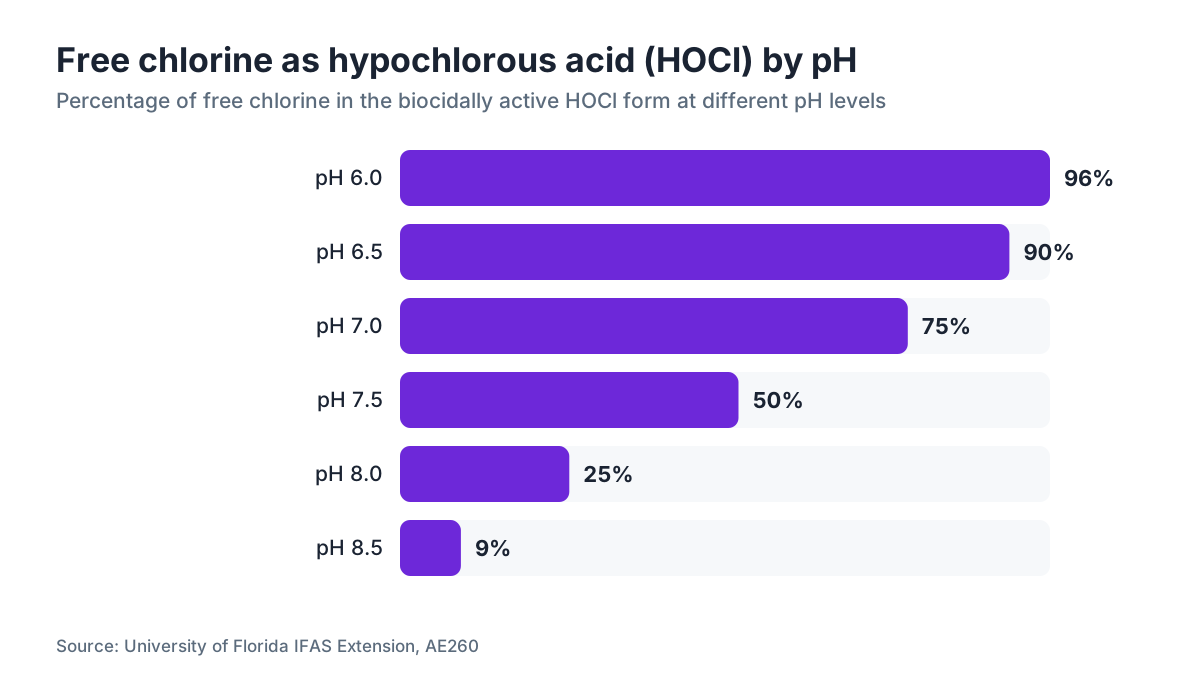
Here's why those two numbers both belong in your log: what you inject at the mainline and what you measure at the end of the lateral are different, sometimes by a lot. pH is the other variable that decides whether the treatment worked at all. Free chlorine is far more biocidally active below pH 7.5. Hypochlorous acid (HOCl), the form that actually kills, makes up roughly 75% of free chlorine at pH 7.0 and drops to about 25% at pH 8.0. [5] Logging pH at injection isn't busywork. It's the difference between a flush that worked and one that just moved water around.
| Goal | Free Cl at emitter | Contact time | pH target |
|---|---|---|---|
| Routine maintenance flush | 1 to 5 ppm | 30 to 60 min | <7.5 |
| Moderate biofilm removal | 5 to 10 ppm | 30 to 60 min | <7.5 |
| Shock treatment (heavy deposit) | 10 to 50 ppm | 30 to 60 min hold then flush | <7.5 |
| End-of-season purge | 5 to 10 ppm | 20 to 30 min | <7.5 |
What fields are required on a chlorine injection log entry?
No single federal form exists for chlorine drip-injection records, but FIFRA and state pesticide-use reporting rules tell you what the record has to contain. [1] Put those requirements next to the field practices from WSU Extension and UC Davis, and a complete entry has these fields:
Date and time of application. When injection started, not when you noticed the problem.
Location. Block name, vineyard ID, field number, or GPS coordinates. The record has to trace back to a real piece of ground.
Crop or commodity. "Wine grapes" or the specific variety works fine.
Product name and EPA registration number. Sodium hypochlorite sold as a pesticide carries a registration number on the label. Buying pool-grade calcium hypochlorite? Confirm it's labeled for irrigation system use. Some formulations aren't registered for that, and using them is its own compliance problem.
Active ingredient and percentage. Sodium hypochlorite solutions run from 3% (household) to 12.5% (commercial). Log what you used.
Application rate. Record the injection rate (ounces per minute or liters per hour off the chlorinator) and the resulting concentration at both the mainline and the end of the lateral.
Total volume of product used. Fluid ounces, liters, or gallons. This feeds pesticide-use reporting in states like California, where tools like VitiScribe can auto-calculate it from your injection settings.
Water pH before and during injection. One reading before you start, one midway through. That's the practical minimum.
Contact time. How long the treated water held in the laterals before you flushed it out.
Method of injection. Venturi injector, electric pump, batch tank. This affects how reproducible your concentration is.
Name and certification number of the applicator. In states that require certified applicator supervision for regulated applications, the certified person's license number belongs in the log.
Field observations. Pressure drop during injection, emitters that looked plugged before treatment, zones that didn't flush clean. This is the free-text field most people skip and most people regret skipping at audit time.
How do you measure free chlorine in the field, and what do you record?
Two practical options for the vineyard: pool test strips rated to 50 ppm, or a digital colorimeter with DPD reagent tablets. Strips are fast and cheap, but they read within 1 to 2 ppm at best, which is fine for routine maintenance checks. A colorimeter like a Hach DR900 reads to 0.02 ppm and earns its price if you're doing remediation and need to prove you held 30 to 50 ppm. [5]
Record two measurement points: the injection header (what goes in) and the furthest emitter in the last zone treated (what comes out). Some operations sample mid-zone too. Write down the location, the time, and the reading. If your venturi injector hasn't been calibrated lately, the header concentration reads optimistic. A direct measurement beats any calculated estimate.
For pH, use a waterproof pocket meter calibrated that morning. Log the header reading before injection. If you're acidifying to pull pH down before chlorinating (common when source water runs above 7.5), log the acid product and rate too. That's a separate pesticide application entry when the acidifier is a registered product.
Record the instrument type, and for colorimeters, the last calibration date. This feels like over-documentation right up until an auditor asks how you know your readings were accurate.
Does chlorine injection count as a pesticide application under state law?
In most states, yes, if the product is EPA-registered and you're applying it to control biological organisms rather than as a plain sanitation rinse. California's Department of Pesticide Regulation requires a Pesticide Use Report for any agricultural pesticide application, and sodium hypochlorite used for drip maintenance qualifies. [6] California growers file monthly PURs by the 10th of the following month.
Washington requires licensed commercial pesticide applicators to keep records of all applications for two years under WAC 16-228. [7] Oregon runs a similar structure under ORS Chapter 634. The takeaway: your chlorine injection log is a legal document, not a maintenance diary.
Cornell Cooperative Extension notes that New York growers must keep pesticide application records for three years and produce them for DEC inspectors on request. [8] Confirm your state's specific retention rule with your county farm advisor or the state lead agency. Two years is a safe minimum everywhere.
One thing that trips people up. Hire a custom applicator or a pest control adviser to supervise the injection, and the recordkeeping responsibility may shift to them. Keep your own copy anyway. Relying on a third party's records you've never actually laid eyes on is a gap waiting to open.
What does the EPA Worker Protection Standard require you to document?
The EPA Worker Protection Standard (40 CFR Part 170) requires that workers entering treated areas after an application are informed about it and any restricted-entry interval (REI). [2] Chlorine products registered for drip irrigation usually carry a short REI, often 4 hours, or in some cases until the treated water has been flushed from the system. The label governs. Check it.
Your records need to show that central posting or direct notification happened before workers re-entered. For drip injection that usually means posting the treated block at the field entrance, or logging that the irrigation crew got notified before anyone went in to check emitters after a flush.
The WPS also requires application-specific records with the product name, EPA registration number, active ingredient, location treated, date and time, and REI. [2] That overlaps almost entirely with the FIFRA records above, so one good log entry covers both. The mistake people make is keeping two separate logs that are each half-finished. One thorough record beats two thin ones.
How should you format and store these records?
Paper or digital both hold up legally. The real question is which one you'll actually keep current under field conditions. A paper logbook in a weatherproof binder near the pump station gets filled out in real time, which is its whole advantage. A spreadsheet or vineyard records platform (tools like VitiScribe let you build application records tied to specific blocks) is searchable and rolls up into the monthly PUR filings many states require.
Whatever you pick, the record has to be legible, permanent, and retrievable. Pencil on a torn scrap that lives in your truck for six months fails all three.
For digital records, a weekly backup and an offsite copy (cloud sync is fine) saves you if the device dies during an audit. California's DPR has accepted digital pesticide-use records since the 2010s, and most state lead agencies followed. Just be sure you can print a legible copy when an inspector asks.
Keep the supporting documents with the log: the product label and SDS for the lot you used, calibration records for your injection gear, and any lab results from water samples. An auditor tracing a chlorine application wants the whole chain, more than the one entry.
How often should you flush drip emitters with chlorine, and how do you decide?
WSU Extension recommends inspecting drip emitters at least monthly during the irrigation season and flushing with chlorine preventively every 4 to 8 weeks if the water supply carries any biological load. [9] Pulling from a surface source (canal, pond, river)? Monthly treatments are more defensible than quarterly. Groundwater low in iron and microbial counts can stretch longer, but you still want a start-of-season and end-of-season chlorination on the record.
The trigger for an unscheduled treatment is a pressure or flow discrepancy. When zone-by-zone flow rates drop more than 10 to 15% below the emitter's rated output, that's a clogging signal worth treating. Log the pre-treatment flow readings alongside the chlorine application. They're the evidence of why you treated and the baseline for judging whether it worked.
Emitter manufacturers often specify a maximum chlorine concentration to protect diaphragms and outlets. Netafim, for one, has published guidance that sustained concentrations above 50 ppm can degrade certain emitter types. [10] That ceiling belongs in your log for any treatment, with a note that you checked the emitter spec sheet.
A season-long log of treatment frequency, concentrations, and post-treatment flow checks gives you a real performance record for the drip system. Run it for a few seasons and a pattern shows up: specific zones that need more attention, usually the ends of long laterals or blocks fed by water with heavier native biomass.
What does a completed chlorine injection log entry actually look like?
Here's a realistic entry. It's not a prescribed form, just an illustration of the data that needs to be there.
Date: June 14, 2025
Time start/end: 7:10 AM, 8:45 AM
Block(s): North Estate, Blocks 3 and 4 (Cabernet Sauvignon)
Irrigation zone(s): Zones 3A, 3B, 4A, 4B
Acres treated: 12.4 ac
Purpose: Routine biofilm maintenance flush
Product: Clorox Pool & Spa Shock (sodium hypochlorite 12.5%), EPA Reg. No. 5813-50
Active ingredient: Sodium hypochlorite
Product volume used: 2.4 gallons
Application method: Venturi injector, 3/4-inch, on 2-inch mainline
Injection rate: Approx. 0.8 gal/hr at 30 psi differential
Target concentration: 5 ppm free Cl at emitter
Measured free Cl at mainline header: 8.2 ppm (DPD colorimeter, Hach DR900, cal. 6/10/25)
Measured free Cl at end of Zone 3B lateral: 4.9 ppm
Water pH before injection: 7.2 (pocket pH meter, calibrated 6/14/25)
Water pH during injection: 7.1
Contact time: 45 minutes hold before flush
Post-flush observations: All emitters visually active, no obvious plugging. Zone 3B pressure slightly low pre-treatment (22 psi vs 24 psi nominal), normal post-flush.
REI: 4 hours per label. Block posted at gate 7:05 AM.
Worker notification: Irrigation crew (J. Hernandez, F. Ruiz) verbally notified 7:00 AM.
Certified applicator: Maria Gutierrez, CA QAL #12345
That's a lot of fields. Filling them in takes about five minutes at the pump station when the information is fresh. Reconstructing any of it three weeks later takes thirty minutes and half of it is guesswork.
What are the most common recordkeeping mistakes for chlorine injection?
Missing the EPA registration number. People write "bleach" or "pool chlorine" and call it done. The registration number is what ties your record to the label, and it's the first thing a state auditor checks. Look it up once per product and put it on a laminated card at the pump station.
No measurement at the emitter. Logging what you injected at the header without checking what arrived at the end of the lateral is both an incomplete record and an incomplete treatment. The whole point of the flush is what reaches the emitter.
Skipping pH. Inject to hit 5 ppm free chlorine at pH 8.2 and you're getting almost no biocidal activity, because most of the chlorine sits as the hypochlorite ion (OCl-), not HOCl. [5] A log that omits pH hides a treatment that probably didn't work.
Logging by block instead of zone. For a clogging diagnosis or a re-treatment call, block-level records aren't specific enough. Log by irrigation zone.
Vague location data. "Back 40" or "the old Merlot block" means nothing to a state inspector, or to whoever runs this vineyard in five years. Use the block names on your permanent vineyard map.
No record of the flush-out. The entry has to show when you opened the end caps or flush valves to clear treated water, more than when injection started. Contact time begins when the treated slug reaches the laterals and ends when you flush it.
Forgetting the REI posting documentation. This is the WPS piece most operations treat as optional. It isn't.
How does chlorine injection recordkeeping fit into a broader vineyard compliance system?
Chlorine injection logs live in the same stack as your other pesticide-use records, your irrigation management records, and your chemical inventory. In California they feed monthly PUR filings. In other states they're auditable at applicator license renewal or during a DEC or state ag department inspection.
Manage multiple blocks across vineyards at different sites, and keeping every record in one searchable system (instead of a binder per block per season) is what lets you actually find a three-year-old chlorine injection record when you need it. A platform that ties application records to GPS-referenced blocks and auto-populates the state PUR format earns its keep here. That's what VitiScribe is built to do, and it's worth a trial if you're currently juggling this across disconnected spreadsheets.
The bigger payoff of thorough records is a written maintenance history for your drip infrastructure. Troubleshooting chronic emitter clogging, pitching a capital replacement to your ownership group, or handing a vineyard off to a new manager, that history is a real asset. Records that only exist in someone's memory don't transfer.
Frequently asked questions
Is sodium hypochlorite (bleach) always considered a pesticide when used for drip irrigation?
Yes, when it's used to control biological organisms like bacteria, algae, or biofilm in an irrigation system, it falls under FIFRA as a biocide pesticide. Not all bleach products carry an EPA registration for agricultural irrigation use, so check the label before you buy. Using a non-registered product for that purpose is itself a FIFRA violation.
How long do I have to keep chlorine injection records?
Federal FIFRA requires two years for certified applicators. California requires three years for pesticide-use reports under DPR rules. Washington requires two years under WAC 16-228. Two years is a safe baseline everywhere, but confirm your state's requirement with your county farm advisor or state lead agency. Keep the product label copy for the same period.
Does chlorine injection require a certified pesticide applicator license?
It depends on the product's use classification and your state. If the product is a general-use pesticide (most sodium hypochlorite solutions are), a certified applicator must supervise but a trained handler can perform the application under supervision in many states. Restricted-use pesticides require direct certified applicator involvement. Check your state's rules because this is one area where requirements vary significantly.
What is the EPA registration number for common sodium hypochlorite products used in irrigation?
Registration numbers vary by brand and formulation. Clorox-brand sodium hypochlorite products have used EPA Reg. No. 5813-series numbers, but the specific number is on the product label and should be confirmed there. Never copy a registration number from another grower's log; always transcribe it directly from the label of the product you actually used.
What is the restricted-entry interval (REI) for chlorine injection into a drip system?
REIs for sodium hypochlorite registered for drip use are typically 4 hours, but the product label governs. Some products specify that workers may re-enter once the chlorinated water has been fully flushed from the system. Check the specific product label and log which REI you applied. Posting the treated area at field entrances before the application starts is the WPS requirement.
Can I use pool-grade calcium hypochlorite (HTH, granular shock) for drip emitter maintenance?
Only if the specific product is registered by EPA for use in agricultural irrigation systems. Many pool-grade chlorine products are not labeled for irrigation use. Applying a pesticide in a manner inconsistent with its label is a federal violation. Look for a product explicitly labeled for drip irrigation or chemigation use, and record that label's EPA registration number in your log.
What pH should the irrigation water be before I inject chlorine for emitter maintenance?
Below 7.5 if possible. At pH 7.0, roughly 75% of free chlorine exists as biocidally active hypochlorous acid (HOCl). At pH 8.0 that drops to about 25%. If your source water runs above 7.5, acidifying with sulfuric or phosphoric acid before or during injection significantly improves treatment effectiveness. Log the acid product and dose as a separate application entry.
How do I calculate how much bleach to add to reach a target ppm concentration?
The formula is: volume of product (gallons) = target ppm x flow rate (gpm) x contact time (minutes) / (product concentration % x 75,000). For example, to reach 5 ppm in a 20 gpm system with 12.5% sodium hypochlorite running for 45 minutes: 5 x 20 x 45 / (12.5 x 75,000) = 0.048 gallons, or about 6 fluid ounces. Verify with a field measurement; injection rates vary. UC Cooperative Extension irrigation guides include worked examples.
Do I need to report chlorine injection on a Pesticide Use Report in California?
Yes. Any agricultural pesticide application in California, including sodium hypochlorite used for drip irrigation biofilm control, must be reported monthly to the county agricultural commissioner via a Pesticide Use Report. Reports are due by the 10th of the following month. Growers below 50 acres may have modified reporting thresholds; confirm with your county ag commissioner.
What happens if I get audited and my chlorine injection records are incomplete?
Consequences range from a written notice to civil penalties under state pesticide law or FIFRA. California DPR civil penalties for pesticide-use reporting violations can reach $5,000 per violation per day. Beyond fines, incomplete records weaken your position if a worker exposure claim or environmental complaint arises. The paperwork burden up front is far smaller than the audit response burden after the fact.
Should I keep records of the emitter flow tests I do after a chlorine flush?
Absolutely. Pre- and post-treatment flow or pressure readings are your best evidence that the treatment worked. They also protect you: if an emitter zone continues to underperform after a documented treatment, the record supports a warranty or manufacturer support conversation. Log the readings, the measurement method (catch-can, pressure gauge), and which zones showed improvement.
Is there a standard form or template for drip irrigation chlorine injection records?
No single federal form exists. Some states publish suggested formats (California's DPR and UC Cooperative Extension have examples), and the National Association of State Departments of Agriculture has guidance documents. The key is including all FIFRA-required fields plus the irrigation-specific data points (pH, measured concentration at emitter, contact time) discussed above. A consistent internal template you actually use beats a perfect form you ignore.
How do chlorine injection records relate to food safety audits like PrimusGFS or GLOBALG.A.P.?
Both PrimusGFS and GLOBALG.A.P. require documented water treatment records and evidence that water quality is managed to minimize food safety risk. Chlorine injection logs that include water source, treatment rates, and pH measurements directly satisfy those requirements. Auditors will ask to see them, and gaps create non-conformances. Treating these records as dual-purpose (regulatory compliance and food safety) is the efficient approach.
Sources
- U.S. EPA, FIFRA Pesticide Registration and Recordkeeping Requirements (40 CFR Part 171): Chlorine biocides used to control biological deposits are registered pesticides under FIFRA; certified applicators must keep application records for two years.
- U.S. EPA, Worker Protection Standard (40 CFR Part 170): WPS requires posting or direct notification of workers before pesticide applications and documentation of REI compliance; records must include product name, EPA registration number, active ingredient, location, date, time, and REI.
- Washington State University Extension, Irrigation Management for Vineyards (EM067E): WSU Extension recommends 1 to 10 ppm free chlorine at the emitter for routine maintenance and 10 to 50 ppm for remediation of heavy biofilm; monthly inspection during irrigation season is advised.
- UC Cooperative Extension, Drip Irrigation Management for Wine Grapes: UC Cooperative Extension recommends a maximum of 1 ppm free chlorine during normal drip operation and shock treatments at 10 to 50 ppm for 30 to 60 minutes to clear significant biofouling.
- University of Florida IFAS Extension, Chlorination of Micro-Irrigation Systems (AE260): Hypochlorous acid (HOCl) represents approximately 75% of free chlorine at pH 7.0 and drops to roughly 25% at pH 8.0; DPD colorimetry with a Hach DR900 provides accurate field measurement of free chlorine.
- California Department of Pesticide Regulation, Pesticide Use Reporting: California requires a monthly Pesticide Use Report for all agricultural pesticide applications including sodium hypochlorite used for drip irrigation; reports are due by the 10th of the following month.
- Washington State Department of Agriculture, Pesticide Recordkeeping Requirements (WAC 16-228): Washington state requires licensed commercial pesticide applicators to maintain pesticide application records for two years under WAC 16-228.
- Cornell Cooperative Extension, Pesticide Recordkeeping Requirements for New York Agricultural Producers: New York growers must maintain pesticide application records for three years and make them available to DEC inspectors on request.
- Washington State University Extension, Drip Irrigation Maintenance and Clog Prevention: WSU Extension recommends preventive chlorine flushing every 4 to 8 weeks during the irrigation season when the water supply has any biological load.
- Netafim, Drip Irrigation System Maintenance Guidelines: Netafim guidance indicates concentrations above 50 ppm sustained for extended periods can degrade certain emitter types.
- California DPR, Civil Penalty Schedule for Pesticide Violations: California DPR civil penalties for pesticide-use reporting violations can reach $5,000 per violation per day.
Last updated 2026-07-10