How to record cultivation passes as an alternative to herbicide use
TL;DR
- When you cultivate instead of spraying herbicide, you still log the operation: date, equipment, tractor operator, field block, and purpose.
- These records satisfy USDA organic certification, state IPM audit trails, and your own weed control file.
- A single standardized cultivation entry takes about two minutes and protects you during any compliance review.
Why do you need a record for cultivation if you're not spraying anything?
Because organic certifiers and cost-share auditors treat the cultivation pass as a documented practice, even though no chemical touched the vineyard. No spray means no pesticide application record. It doesn't mean no record at all.
Here's the trap a lot of vineyard managers fall into. If you're pursuing organic certification under the USDA National Organic Program, you have to document all inputs and practices that substitute for prohibited substances, and mechanical weed control is one of those practices [1]. Skip the entry and you have a hole in your organic system plan that an accredited certifier can flag.
There are two more reasons to keep the record. Some states require growers in county or state IPM programs to log every weed management action, mechanical or chemical, to show that chemical use is justified when it does happen. California's Department of Pesticide Regulation doesn't mandate cultivation logs by name, but county Agricultural Commissioners auditing sustainable pest management grants expect to see them [2]. Then there's your own liability. If a worker gets hurt by equipment in the vine row, your OSHA incident file and your EPA Worker Protection Standard training records both benefit from a written record showing what equipment ran in which block on which date [3].
The short version: cultivation records aren't legally required at the federal level the way pesticide records are. Organic certification and most state cost-share programs treat them as mandatory anyway. And they cost you almost no time.
What information belongs in a cultivation pass record?
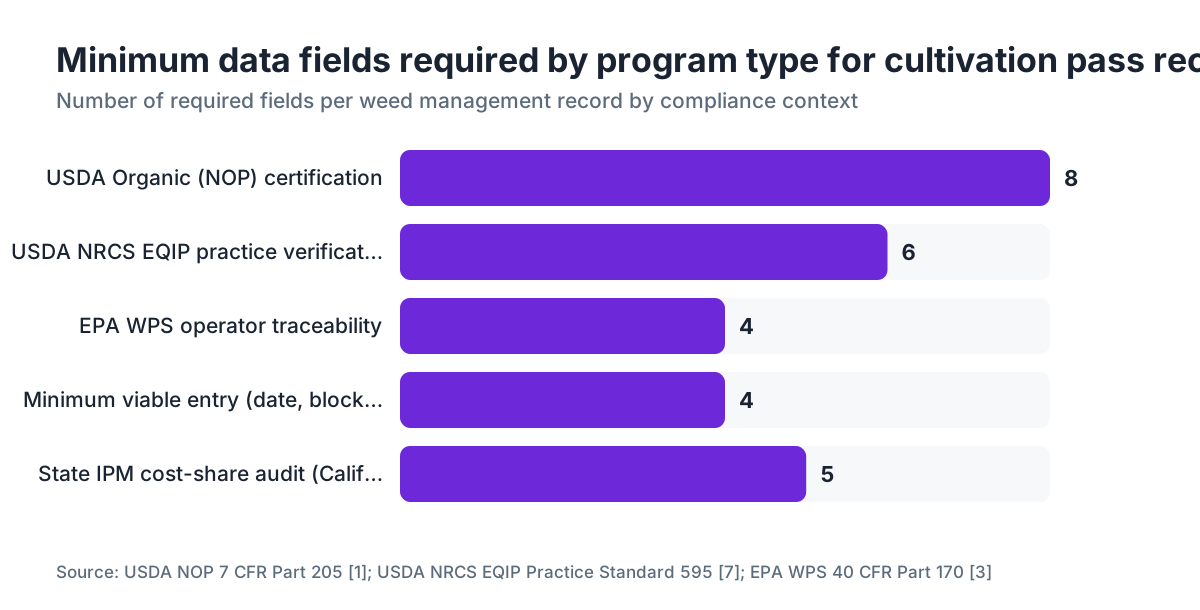
About eight fields, if you reverse-engineer what an organic certifier or an IPM auditor actually checks. There's no single federal form. The list below is what shows up consistently across every audit context.
| Field | What to enter | Why it matters |
|---|---|---|
| Date | Exact calendar date | Ties operation to growth stage |
| Block/block ID | Your internal block name or APN | Locates the work geographically |
| Acres treated | Measured or calculated | Used in cost tracking and carbon programs |
| Equipment description | Implement type, brand/model if available | Shows appropriate tool selection |
| Cultivation depth | Inches or cm | Proves you didn't disturb vine roots |
| Pass direction | Under-vine, between-row, or both | Helps assess weed control efficacy |
| Tractor operator | Full name | Required for WPS training cross-reference [3] |
| Growth stage at time of pass | BBCH code or plain description | Connects operation to a weed management decision |
| Purpose or target weed | E.g., "pre-emergence competitive suppression" or "bindweed knockdown" | Documents decision-making logic |
| Notes | Equipment downtime, missed areas, soil conditions | Useful for future seasons |
For organic certification, the USDA NOP also wants to see why you cultivated instead of using a permitted substance. A one-line rationale in the notes field covers it. Something like "cultivation preferred over approved oil spray to reduce input cost and soil compaction" is enough [1].
Keep cultivation depth in there even though it feels granular. UC Davis Cooperative Extension recommends holding under-vine cultivation to 2 inches or less to avoid feeder root damage in established vines, and your depth record shows you're following that guidance [4]. It's the kind of detail that makes a certifier's visit much shorter.
How is a cultivation record different from a pesticide application record?
A pesticide record is a legal document with penalties attached. A cultivation record is operational documentation. Same binder, different rules.
A pesticide application record under California Food and Agricultural Code Section 12979 or the equivalent EPA WPS requirements has a fixed set of mandatory fields: product name, EPA registration number, target pest, rate, REI, applicator license number, and so on [3][5]. Falsify or omit and you face real fines.
A cultivation record has no equivalent federal statute with penalties attached. Think of it as operational documentation, not regulatory documentation. That distinction shapes how you format the form, but it doesn't license sloppiness. An organic certifier has contract authority to deny or revoke certification over incomplete records, and for many small wineries that economic hit runs larger than a DPR fine.
The two records live in different binders or different tabs in whatever software you use, and they feed different audit trails. Your pesticide records go to the county Ag Commissioner annually in states that require it [5]. Your cultivation records stay in your organic system plan and your own field operations file. They rarely leave your farm. When they do, during an NOP inspection or a USDA EQIP audit, they need to be complete.
One overlap matters. Both records should reference the same block ID system. If your pesticide records use names like "North Hillside Merlot" and your cultivation records use a separate numbering scheme, you're creating reconciliation work every time someone asks for a full weed management history of a block.
What equipment details should you log for under-vine cultivators specifically?
Log the implement type, working width, and configuration, because that's exactly where compliance scrutiny lands. Under-vine cultivation is the clearest mechanical substitute for a herbicide strip application, so certifiers look at it hardest. UC Davis and UC Cooperative Extension have published guidance on under-vine cultivation as a weed management tool in wine grape vineyards, and they're explicit that records should capture implement type, because different implements carry different efficacy and root damage profiles [4].
For a finger weeder or a Weed Badger-style tool, note the number of rows of fingers and the working width. For a disc hiller-dehiller, note the disc angle and whether you're hilling or dehilling. For a mowing pass combined with cultivation, log them as separate operations or clearly note both in one entry.
WSU Extension's viticulture resources recommend logging cultivation timing relative to vine phenology rather than calendar date, because the same calendar week in a warm year versus a cool year can mean very different vine root activity [6]. Logging BBCH codes (BBCH 07 for early bud swell, BBCH 57 for pre-bloom) takes ten seconds and makes your record genuinely useful when you review decisions the following winter.
Renting equipment or running a contract crew? Log the equipment owner and the operator separately from the operation itself. Under WPS, the farm operator is responsible for making sure anyone working in the vineyard has the required training, so your cultivation record needs to trace back to a named operator whose training records you hold [3].
How do cultivation records satisfy organic certification requirements?
They're your proof that you did what your organic system plan says you'd do. The USDA NOP regulation at 7 CFR Part 205 requires certified organic operations to keep records for at least five years, sufficient to demonstrate compliance [1]. The National Organic Program's guidance on record-keeping says records must "fully disclose all activities and transactions of the certified operation in sufficient detail as to be readily understood and audited." That's what pulls cultivation into scope.
Your Organic System Plan (OSP) has a weed management section where you describe your approach. Every cultivation pass is evidence you're running the plan you wrote. If your OSP says "primary weed control in vine row will be mechanical cultivation with disc hiller and finger weeders, two to four passes per season," then your cultivation log is the proof you actually did it.
Certifiers like Oregon Tilth, CCOF, or MOSA sample your field records during inspection. They're matching entries to the timing described in your OSP and checking that they cover the blocks on your certificate. A block with no cultivation records and no herbicide records during weed-pressure season raises a question. The answer is usually innocent (maybe you mowed and it was enough), but you need the record that shows what you did.
Five years of records. That's a real retention requirement with a real enforcement mechanism, not a suggestion [1].
Do cultivation records matter for IPM documentation and state cost-share programs?
Yes, and it's the angle most growers underestimate. USDA NRCS's Environmental Quality Incentives Program (EQIP) pays for implementing IPM practices in vineyards, and practice standard 595 (Pest Management) requires documentation of all pest management decisions, including mechanical weed control [7]. Draw EQIP payments, then fail to produce cultivation records at a practice verification, and you risk a repayment demand.
California's DPR sustainable pest management grants and similar programs in Washington and Oregon use cultivation records as evidence that growers are reducing pesticide use. The argument to the auditor is simple: here's what I used to spray, here's what I cultivate now, here's the record proving I did it. No record, no argument.
A note on format: most state programs don't care whether your records are paper or digital as long as they're legible, dated, and retained. Cornell Cooperative Extension's integrated pest management program points out that digital records give you cleaner time-stamped audit trails, but a paper field notebook stored dry and photographed periodically is entirely acceptable [8].
For vineyard operations also pursuing quality programs like Sustainability in Practice (SIP) or LIVE certification, cultivation records feed the sustainability metrics those programs require every year.
How often should you record cultivation passes, and what's the minimum viable entry?
Every pass gets an entry. Not every week. Every time a cultivator goes through a block, that's a record. In a typical Northern California wine grape season you might run four to six under-vine passes between bud break and canopy closure, plus one or two between-row passes if you're managing mid-row vegetation mechanically. Call it six to eight entries per block per season.
The minimum viable entry that survives an NOP audit or an EQIP verification is date, block, implement type, operator name. That's it. Everything else in the table above is best practice that makes the record more useful to you, but those four fields get you through most compliance checks.
Four fields. You can enter that on a phone in under a minute while the tractor refuels.
Growers don't lose time making the entries. They lose it hunting for the records later. A cultivation log scrawled on a scrap of paper in the cab is technically a record, but it creates work at certification time. Keep cultivation records in the same filing system as your other field records: a binder with tabbed block sections, a shared spreadsheet, or a purpose-built field operations platform. VitiScribe was built to capture this kind of field operation alongside spray records in one place, so your weed management history is searchable by block and date without reorganizing a filing cabinet every inspection season.
The real cost of poor record-keeping isn't the fine. It's the three hours before an organic inspection spent rebuilding records from memory and old text messages.
Can cultivation records replace herbicide application records in your weed management file?
No. They supplement, they don't replace. If you ran a cultivation pass and a spot herbicide treatment in the same block in the same month, you need both records. The cultivation record doesn't cancel the pesticide application requirement, and the pesticide record doesn't make the cultivation record unnecessary.
What cultivation records do is fill the logical gap in your weed management story. An auditor looking at a block with no herbicide applications might wonder what you did all season. The cultivation log answers that. Together, a cultivation log and a pesticide log (even one with very few entries) tell a coherent story.
For blocks you've fully transitioned off herbicides, the cultivation record is the only document you have. Make it count. Include phenology notes, weed species observed, an efficacy rating after each pass (1 = poor, 5 = excellent is a simple scale), and any follow-up needed. That detail sharpens your timing in future years and shows, in writing, that you're actively managing weed pressure rather than skipping a spray and hoping.
Cornell's IPM program notes that under-vine cultivation against perennial weeds like bindweed often needs four to six passes per season to deplete root carbohydrate reserves [8]. Logging efficacy ratings lets you see whether you're hitting that threshold or falling short, which is useful independent of any compliance obligation.
What format should a cultivation log take, paper or digital?
Both work. Pick the one you'll actually keep up. Digital gives you time-stamp integrity (harder to backfill than paper), searchability, and summary reports by block or season without manual counting. Paper works when there's no cell signal in the back blocks of a mountain vineyard, which describes most of the interesting places to grow grapes.
If you're using paper, a pre-printed field sheet with the eight fields listed earlier, one row per pass, stored in a three-ring binder organized by block, is the standard approach. Date your entries in ink. Don't use pencil for official records.
Going digital, any spreadsheet works, but a shared sheet with one tab per block and columns matching your required fields is a ten-minute setup your whole team can reach from a tablet in the field. The downside is that it doesn't talk to your spray records or your fertilizer log, so you're still juggling multiple files.
A purpose-built platform handles that integration, which is why compliance-focused operations tend to migrate toward one as record complexity grows. Whatever format you choose, make sure it supports the five-year retention requirement under NOP rules [1] and can produce a printable summary a certifier or NRCS agent can review without a software tutorial.
WSU Extension's viticulture guidance notes that digital records should be backed up off-site regularly, because a hard drive failure right before an organic audit is a real scenario that has happened to real growers [6].
How do you document the decision to cultivate rather than spray?
Write a one-line scouting note before each pass. That's the part most growers skip, and it's the part that makes the record worth more than a checkbox. Certifiers and auditors don't just want to know what you did. They want evidence you thought about it.
Before each pass, note what you saw: weed species present, approximate coverage percentage, growth stage of the weeds, and any economic or ecological threshold you applied. Then note your decision: cultivate, spot spray, do nothing, or some mix.
For organic operations, NOP guidance points to prevention-first decision-making, meaning cultural and mechanical practices come before permitted materials. Recording why you chose the cultivator maps directly onto that principle [1].
For IPM programs, the decision record is the core of the whole system. USDA NRCS practice standard 595 frames IPM around monitoring pests and beneficials, identifying them, and evaluating management strategies [7]. A one-line field note before each pass covers all of that in thirty seconds.
You don't need a separate scouting form. Add a "decision rationale" column to your existing log sheet. Something as brief as "bindweed emerging, pre-emergence timing, cultivation preferred to avoid repeat herbicide use in this block" is enough.
VitiScribe's field operations module includes a decision rationale field alongside each cultivation entry precisely because certifiers ask for it, and it's the field most often missing from paper logs brought in at audit time.
What are the most common mistakes in cultivation record-keeping?
Missing blocks, vague equipment entries, backdating, and no operator name. Those four cause most of the noncompliance notices I've seen come out of an inspection. Here's each one and the fix.
Missing blocks. A grower does a pass, forgets to log one of the six blocks covered that day, and the gap surfaces during certification. The fix is a block checklist on the log sheet, checked off as each block is finished.
Vague equipment entries. "Disk" or "cultivator" isn't enough. An entry like "3-row hydraulic finger weeder, 24-inch working width, Clemens model" takes five seconds and answers every follow-up a certifier might have about whether the tool suited the conditions.
Backdating. Fill in missed entries later from memory and you've got a problem. Backdated records are often obvious (all the same ink, written in one sitting), and a certifier who spots a pattern of it scrutinizes everything else harder. The honest fix: make the entry as soon as you remember, mark it as a reconstructed record based on field notes or equipment logs, and date it with the actual entry date next to the operation date. That transparency does far less damage than records that look fabricated.
No operator name. Seems trivial, but it creates a compliance problem under EPA WPS requirements [3]. Every person operating equipment in the vineyard has to be identifiable in your records so you can cross-reference their safety training if an incident occurs.
Confusing cultivation logs with tillage practice records for NRCS. Some EQIP contracts include conservation tillage practices with their own documentation requirements. A cultivation log for weed management is not the same document as a tillage practice record for soil health, and mixing them leaves gaps in both.
Where can you find templates and training for vineyard cultivation record-keeping?
Start with your extension service and your certifying agency. Both publish sample forms already calibrated to what inspectors look for. UC Davis Cooperative Extension has published weed management resources for wine grapes that include sample record-keeping forms [4]. Their integrated viticulture publications are free online and worth keeping in your files as cited guidance for your organic system plan.
WSU Extension's viticulture resources include record-keeping templates built for Washington's agricultural reporting requirements, and many translate directly to other western states [6].
Cornell Cooperative Extension's integrated pest management program publishes resources for New York vineyard operations, including weed management decision tools and field record formats [8]. On the East Coast, Cornell's materials are the most directly applicable.
For organic certification, your certifying agency is the best source of its own preferred record formats. CCOF, Oregon Tilth, and MOSA all publish sample forms already matched to what their inspectors want.
NRCS state offices can give you the documentation checklists for EQIP practice standard 595, since verification requirements vary slightly by state office [7]. Call your local NRCS office before you design your record system if you're drawing EQIP payments. Adding columns to a form is much easier than reconstructing information an auditor needs after the season is over.
The EPA's Agricultural Worker Protection Standard training materials are on epa.gov and cover the operator identification and equipment safety documentation that informs who needs to be named in your cultivation records [3].
Frequently asked questions
Is there a federal law that requires me to keep cultivation records?
No single federal statute mandates cultivation logs the way 40 CFR Part 170 mandates pesticide application records under the Worker Protection Standard. But USDA NOP regulations at 7 CFR Part 205 require organic operations to document all management practices, and USDA NRCS EQIP practice standard 595 requires documentation of all IPM actions including mechanical weed control. If you're organic-certified or drawing EQIP payments, you're effectively required to keep them.
How long do I need to keep cultivation records?
USDA National Organic Program regulations require a minimum of five years of records for certified organic operations. USDA NRCS EQIP contracts generally require records for the duration of the contract plus three years. If you're subject to neither program, three years is a defensible standard that covers most state audit cycles and typical contract dispute windows.
Do I need to record cultivation passes during dormancy?
Yes, if you're making passes. Some growers run a shallow disc pass in late winter to terminate cover crops or knock back weed pressure before bud break. That's a weed management action and belongs in your log. Dormancy passes are often lighter on detail because weed pressure is lower, but the date, block, equipment, and operator fields should still be filled in.
Can I use a simple paper notebook instead of a formal form?
Yes. A paper notebook with consistent entries is a valid record. Write in ink, record each pass as a separate entry, include date, block, equipment, and operator at minimum, and keep the notebook for at least five years if you're organic-certified. The downside is that notebooks are harder to summarize at audit time and easier to lose. Pre-printed forms or a digital system reduce both risks without adding much work.
Do cultivation records count toward reducing my pesticide use baseline for state programs?
In many California DPR sustainable pest management grant contexts and similar state programs, yes. The mechanism is that you present cultivation records as evidence that weed management goals were met without a pesticide application. Without the record, you can't claim the reduction. The specific calculation method varies by program, so check with your local county Ag Commissioner or state extension office for the formula used in yours.
What's the best way to track cultivation records across multiple blocks efficiently?
A block-based log sheet works well for paper: one row per block per pass, all blocks listed down the left column, dates across the top. For digital, a shared spreadsheet or field operations software with a block dropdown lets you filter by block instantly. The key efficiency gain is entering data in the field right after the pass rather than reconstructing it later. Phone-based entry with a simple form takes under two minutes per block.
Should I photograph weed pressure before each cultivation pass?
It's good practice, not a strict requirement. Photos with GPS coordinates and timestamps create a strong visual record that supports your scouting notes and decision rationale. They're useful when a certifier questions whether your cultivation timing suited the weed pressure present. Most phones automatically embed date and GPS data in image files, making them easy to attach to digital records. Even one photo per block per season beats none.
How does cultivation record-keeping tie into my OSHA and EPA WPS obligations?
EPA Worker Protection Standard regulations at 40 CFR Part 170 require farm operators to keep records of agricultural worker and handler training. A cultivation record naming the tractor operator lets you cross-reference that person's WPS training record. If an equipment-related incident happens, investigators ask who was operating the equipment and whether they were trained. A dated cultivation log entry with the operator's name is your documentation that you know who was where and when.
What weed species information should I record?
At minimum, note the dominant weed species or weed group present at each pass. Common categories: annual grasses, annual broadleaves, perennial grasses, perennial broadleaves, sedges. If you can identify to species (yellow nutsedge, bindweed, little mallow), that's more useful for reviewing efficacy over multiple seasons. You don't need a formal botanical ID, but knowing whether you're dealing with annuals or perennials tells you how many passes you'll need and whether the approach is working.
Can I count mowing passes as cultivation for record-keeping purposes?
Mowing and cultivation are separate operations and should be logged separately. Mowing manages vegetation height and competition but doesn't disturb soil or weed root systems the way cultivation does. For organic certification and IPM documentation, certifiers and auditors treat them differently because they have different modes of action against weed pressure. Log both, but in separate fields or with clear notation distinguishing the operation type.
What happens if my organic certifier finds gaps in my cultivation records during an inspection?
A gap doesn't automatically mean decertification. Certifiers typically issue a noncompliance notice giving you a chance to respond. If you can provide corroborating evidence (fuel receipts dated to the day, equipment maintenance logs, worker pay stubs), some certifiers accept that as supporting documentation. Repeated gaps, or gaps suggesting prohibited substances may have been used instead, are treated more seriously. The practical lesson: maintaining contemporaneous records is far easier than reconstructing them.
Does cultivation record-keeping apply to between-row passes or just under-vine passes?
Both. Between-row cultivation is often heavier mechanical work, and it's still a weed management decision your organic system plan and IPM documentation should reflect. In practice, between-row cultivation is sometimes easier to skip logging because it feels like routine farm maintenance rather than a targeted treatment. That's the wrong instinct. Every pass goes in the log, whether it's under-vine or between-row.
How do I record a cultivation pass that was only partially completed due to equipment breakdown or time?
Log what you actually completed. Note the specific rows or sub-blocks covered, where you stopped, and why. An honest partial record beats either no record or one that overstates the work. On your next pass, note that it covered the areas missed on the previous date. Certifiers rarely scrutinize this level of detail, but it's accurate and it protects you if someone later questions whether a particular area was managed.
Sources
- USDA Agricultural Marketing Service, National Organic Program, 7 CFR Part 205: NOP regulations require certified organic operations to maintain records for at least five years that demonstrate compliance, including documentation of all management practices substituting for prohibited substances
- California Department of Pesticide Regulation: California DPR and county Agricultural Commissioners auditing sustainable pest management grants expect documentation of all weed management actions, mechanical or chemical
- U.S. EPA, Agricultural Worker Protection Standard, 40 CFR Part 170: EPA WPS requires farm operators to maintain records of agricultural worker and handler training; cultivation records naming operators support cross-referencing those training records
- University of California Agriculture and Natural Resources, Statewide Integrated Pest Management Program, Weed Management in Vineyards: UC recommends keeping under-vine cultivation to 2 inches or less to avoid feeder root damage in established vines, and advises documenting cultivation depth and implement type
- California Department of Pesticide Regulation, Pesticide Use Reporting, Food and Agricultural Code Section 12979: California FAC Section 12979 requires pesticide application records with specific mandatory fields including EPA registration number, applicator license, and REI; these differ from cultivation records
- Washington State University Viticulture and Enology: WSU viticulture resources recommend logging cultivation timing relative to vine phenology using BBCH codes, and advise backing up digital records off-site regularly
- Cornell Cooperative Extension, New York State Integrated Pest Management Program: Cornell IPM notes that digital records give cleaner time-stamped audit trails, and that under-vine cultivation against perennial weeds often requires four to six passes per season to deplete root carbohydrate reserves
- USDA Agricultural Marketing Service, National Organic Program Handbook: NOP guidance states records must fully disclose all activities and transactions of the certified operation in sufficient detail as to be readily understood and audited, pulling mechanical weed control into scope
Last updated 2026-07-09